CAMUS (Albert).Livre Rare Book

3517 risultati
1958rif. 74045Paris Gallimard 1958 1 vol. Broché in-12, broché, sous double emboîtage, 69 pp. Édition originale de ces deux discours que Camus dédie à Louis Germain, son instituteur à Alger : le premier prononcé le 10 décembre 1957 à l'Hôtel de ville de Stockholm, selon la tradition, à la fin du banquet qui clôturait la cérémonie d'attribution du Prix Nobel de Littérature ; le second, "L'artiste et son temps", donné le 14 décembre 1957 dans le grand amphithéâtre de l'Université d'Upsal. Un des 56 premiers exemplaires numérotés sur vélin Hollande van Gelder. En parfait état.
1958rif. 74045Paris Gallimard 1958 1 vol. Broché in-12, broché, sous double emboîtage, 69 pp. Édition originale de ces deux discours que Camus dédie à Louis Germain, son instituteur à Alger : le premier prononcé le 10 décembre 1957 à l'Hôtel de ville de Stockholm, selon la tradition, à la fin du banquet qui clôturait la cérémonie d'attribution du Prix Nobel de Littérature ; le second, "L'artiste et son temps", donné le 14 décembre 1957 dans le grand amphithéâtre de l'Université d'Upsal. Un des 56 premiers exemplaires numérotés sur vélin Hollande van Gelder. En parfait état.
1948rif. 46405413Paris, Gallimard, 1948 ; in-12, demi-chagrin grenat, dos lisse, non rogné, couv. et dos. (Lobstein). Tirage de janvier 1948. cet exemplaire a appartenu à Paul Celan (1920 - 1970). La page de garde porte sa signature autographe suivie de la mention : Insbrück, 28 juin 1948. Paul Célan avait quitté la Roumanie en 1947 pour l’Autriche. C’est à Vienne qu’il publiera son premier livre Der Sand aus den Urnen. En Autriche, il fit la connaissance de Erica Lilleg, romancière née à Graz en 1907 (morte en 1988), une liaison amoureuse de plusieurs années. Il se lia aussi, à cette époque, avec le peintre Edgar Jéné (Saarbrücken 1904 - La-Chapelle-Saint-André (Nièvre) 1984). Ce dernier avait quitté l’Allemagne pour des raisons politiques en 1935 pour se fixer à Vienne où il épousera Erica Lilleg. Edgar Jéné a illustré de deux planches le livre de Paul Célan. En 1948 Celan publie à Vienne une monographie sur E. Jéné : Edgar Jené. Der Traum vom Traume. Le volume provient de la bibliothèque de Edgar Jené et Erica Lilleg. Il a été relié postérieurement.
rif. 51-4757Paris: Gallimard 1956. 8vo. 10.5 x 17.5 cm. Contemporary blue cloth with leather titled label on spine. The first edition and the 9th printing from May 1956 the same month as the first printing.Likely a Presentation copy to Adolf Herckenrath. Accompanied by a publicity photo of Albert Camus by Lennart Green 27 x 21 cm. . See provenance below.First published in 1956 it is his last complete work of fiction.Provenance:From the archives of the celebrated bookstore and literary salon Herckenrath on Veldstraat in Ghent Gand Belgium. Founded by the writer Adolf Herckenrath 1879-1958 in 1909; continued by his son Walter Herckenrath 1907- 1989 and by Walter’s children Guy and Helga Herckenrath until around 2000….Poète dramaturge libraire et éditeur. Adolf Herckenrath est entré dans l' histoire en tant qu'ami d'enfance pour lequel Karel van de Woestijne a écrit son Laethemsche Brieven sur Lente 1901… À partir de novembre 1909 Herckenrath résida dans la Veldstraat où il conserva la librairie Adolf Hoste et une fois l'université devenue bilingue principalement consacré à la littérature francophone. Entre les deux guerres mondiales Herckenrath était toujours actif en tant que professeur et membre du conseil d'administration de l'académie de théâtre de Gand pour laquelle un magazine De Tooneelschool 1937-1940 avait également été fondé. Il aida à fonder Pan le cercle de la littérature flamande orientale en 1938… En 1935 Herckenrath s'installa dans la villa 't Kersouwken sur l'Eikeldreef à Sint-Martens-Latem. Pendant la Seconde Guerre mondiale il y résidera officiellement pendant quelques mois de mai à novembre 1944. Il est ensuite retourné dans sa librairie de la Veldstraat où il vivrait au moins officiellement jusqu'à sa mort. Après la guerre sa librairie a été reconstruite par le célèbre architecte Geo Henderick. Grâce à la continuation de son fils Walter et de ses petits-enfants Guy et Helga le nom Herckenrath a également survécu jusqu'à la fermeture de l'entreprise à la mi-2000. 175 x 105 cm 171 pp mention de 'neuvième édition' sur la page de titre. achevé d'imprimer en mai 1956. Imprimé très peu de temps après l'édition originale. Exemplaire SIGNÉ envoi AUTOGRAPHE de l'auteur. Reliure privée en toile bleue. Paris: Gallimard, 1956 hardcover
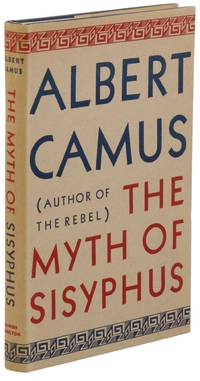
1955rif. 140945412London: Hamish Hamilton 1955. First British Edition. Near Fine/Near Fine. First British edition and the first English language edition. Bound in publisher's original blue cloth with spine lettered in silver. Near Fine with very slight lean to spine slight fading and wear to spine ends offsetting to endsheets and contents lightly tanned. In a Near Fine unclipped dust jacket with light tanning and a small indentation to the spine panel light wear. A beautiful copy of a book that does not normally turn up in such nice condition. Hamish Hamilton unknown books
1958rif. 1022151958 Paris, Gallimard, 1958, 200x130mm, broché sous couverture imprimée.Un des 25 exemplaires sur Hollande, premier papier.Neuf et non coupé, étui et chemise (Devauchelle).(102215)
1951rif. 58821(Paris), Gallimard, (1951). 8vo. Bound uncut and with the original printed wrappers, also the spine, in a wonderful grey full morocco binding with splendid line-gilding and gilt lettering to spine and onlays of coloured morocco (eight different colours) in a weve-like pattern with gilt outline to boards. top-edge gilt. Binding by Henning Jensen, gilding by Leif Hagel Olsen and design by Jens Bork. Gilt super ex-libris to inside of front board. A very nice and clean copy. 382, (2) pp.
1954rif. 58192Paris, Gallimard, 1954. Uncut in the original printed wrappers. Excellent copy.
1951rif. 58821Paris Gallimard 1951. 8vo. Bound uncut and with the original printed wrappers also the spine in a wonderful grey full morocco binding with splendid line-gilding and gilt lettering to spine and onlays of coloured morocco eight different colours in a weve-like pattern with gilt outline to boards. top-edge gilt. Binding by Henning Jensen gilding by Leif Hagel Olsen and design by Jens Bork. Gilt super ex-libris to inside of front board. A very nice and clean copy. 382 2 pp. First edition review-copy Service de Presse-copy - "S. P." to bottom of title-page and on back wrapper of "The Rebel" one of Camus' greatest works with signed presentation-inscription to front free end-paper to the famous critic of literature and drama the writer Guy Dumur 1921-1991.The younger Guy Dumur was a close friend of Camus who hired him to work on "Combat" with him. It is reported that he had a great talent for discovering new talent. Since childhood he was extremely passionate about the theatre and came to work with all the great dramatic figures in Paris at the time. He is also famous for a number of well respected novels.Famous for it's opening lines "What is a rebel A man who says no: but whose refusal does not imply a renunciation. He is also a man who says yes as soon as he begins to think for himself. A slave who has taken orders all his life suddenly decides that he cannot obey some new command. What does he mean by saying 'no'" the novel addresses themes that have never lost their relevance like terrorism rebellion art etc. and counts as one of the great literary productions of the 20th century. hardcover
1954rif. 58192Paris Gallimard 1954. Uncut in the original printed wrappers. Excellent copy. First edition Service de presse-copy i.e. review-copy "S.P" to bottom of title-page and to verso of back wrapper with an excellent presentation-inscription of Camus' magnificent and highly influential collection of essays entitled "Summer". The copy is inscribed to Camus' close friend and ally in numerous respects Jean Paulhan: "a Jean Paulhan/ en affectueuse pensée/ Albert Camus" on half-title. The famous French writer literary critic and publisher Jean Paulhan 1884-1964 shared many things with Camus with whom he grew very close. Not only did he participate actively in the publication of Camus' first books by Gallimard was one of the first to see the true value of Camus' "The Stranger" he was also a confidante of Camus who considered Paulhan one of the main reasons that he became a proper author. In a letter to Paulhan dated September 17 1952 at the moment of break with Sartre Camus writes: "Ever since I thanks to you became what is called an author I have not ceased to be astonished by my brethren. Sometimes it is true in the sense of admiration. Today it is in another sense." Depuis que je suis devenu en peu grâce à vous ce qu'on apelle écrivain je n'ai pas cessé d'être étonné par mes confrères. Parfois dans le sens de l'admiration il est vrai. Aujourd'hui c'est dans un autre sens.Paulhan was an early and active member of the French Resistance director of the literary magazine Nouvelle Revue Française NRF from 1925 to 1940 and again from 1946 to 1968 and a great translator of Malagasy poetry which attracted the interest of the likes of Guillaume Apollinaire and Paul Éluard. He also wrote numerous works of literary criticism "The Flowers of Tarbes or Terror in Literature" 1941 probably being the most famous and he wrote several autobiographical short stories. After the war Paulhan he founded "Cahiers de la Pléiade" and in 1953 he re-launched NRF.Interestingly especially in connection with Camus' famous essays in "L'été" which are devoted entirely to his beloved Algiers Paulhan was loudly against independence for Algeria. He caused great controversy by opposing independence and supporting the French military during the Algerian War. This not only caused public problems for him it also cost him on the personal front as for instance Maurice Blanchot denounced him. The essays in "L'été" are devoted to Algiers and represent a very personal side of Camus who provides a marvelous poetic and humorous picture of the provincial simplicities of Oran and Algiers. For many Camus-devotees "L'Été" constitutes one of the most beloved works as it gives the feel of a certain intimacy with the author that few of his other works does. "In "Return to Tipasa" perhaps the most confessional essay in "Summer" which dates from a long trip to Algeria in December 1952 Camus issues his now famous testimony of survival - "In the depths of winter I finally learned that within me lay an invincible summer" Hawes: Camus A Romance 2009 pp. 181-82. unknown
1958rif. 52286Paris: Gallimard 1958. Fine. Gallimard Paris 1958 13 x 20 cm relié First edition one of 25 numbered copies on Hollande this one of 5 lettered hors commerce the tirage de tête. Half red morocco over marbled paper boards by Goy & Vilaine spine in six compartments endpapers and pastedowns of red paper covers and spine preserved top edge gil . A very good coop well-margined in a nice binding. Gallimard hardcover
1950rif. 48392Gallimard | Paris 1950 | 12 x 19 cm | broché sous chemise et étui
1950rif. 51282Gallimard | Paris 1950 | 12 x 19 cm | broché
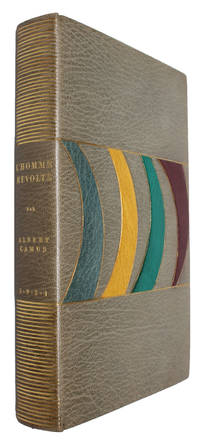
1951rif. 114503Paris Gallimard 1951 1 vol. relié in-12, demi-maroquin rouge à bandes, dos lisse titré en long, plats de papier rouge sérigraphié à créneaux irréguliers sur les deux côtés, filets dorés horizontaux se prolongeant sur les bandes et le dos, doublures et gardes de papier rouge légèrement marbré, tête dorée, couvertures et dos conservés, étui bordé (D. Grégoire), 382 pp. Édition originale de cet essai philosophique et politique, objet d'une virulente critique dans Les Temps Modernes, revue fondée par Sartre, qui reprochait à l'auteur de faire le jeu de la droite. Ce qui fit dire à Camus dans une lettre-réponse adressée en juin 1952 : "On ne décide pas de la vérité d'une pensée selon qu'elle est à droite ou à gauche, et moins encore selon ce que la droite et la gauche décident d'en faire. (... ) Si enfin la vérité me paraissait à droite, j'y serais". Un des 260 exemplaires numérotés sur vélin pur fil Lafuma-Navarre. Dos très légèrement éclairci pour cette belle reliure contemporaine de Denis Grégoire.
1951rif. 114503Paris Gallimard 1951 1 vol. relié in-12, demi-maroquin rouge à bandes, dos lisse titré en long, plats de papier rouge sérigraphié à créneaux irréguliers sur les deux côtés, filets dorés horizontaux se prolongeant sur les bandes et le dos, doublures et gardes de papier rouge légèrement marbré, tête dorée, couvertures et dos conservés, étui bordé (D. Grégoire), 382 pp. Édition originale de cet essai philosophique et politique, objet d'une virulente critique dans Les Temps Modernes, revue fondée par Sartre, qui reprochait à l'auteur de faire le jeu de la droite. Ce qui fit dire à Camus dans une lettre-réponse adressée en juin 1952 : "On ne décide pas de la vérité d'une pensée selon qu'elle est à droite ou à gauche, et moins encore selon ce que la droite et la gauche décident d'en faire. (... ) Si enfin la vérité me paraissait à droite, j'y serais". Un des 260 exemplaires numérotés sur vélin pur fil Lafuma-Navarre. Dos très légèrement éclairci pour cette belle reliure contemporaine de Denis Grégoire.
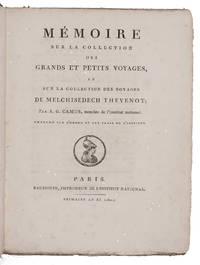
1802rif. K2SBMCLI5XNFParis 1802. 4to. Baudouin Contemporary boards rebacked with cloth. 8 "401"=405 3 pp. First edition of an important bibliographical study of De Bry's Grand and Petit voyages and Thévenot's Relations des divers voyages curieux. Two of the most famous collections of voyages ever published. Sabin calls it "an excellent specimen of bibliographical analysis" and it remains the standard bibliographical reference for both works. It notes the sources for all travels included and gives historical commentary.Armand Gaston Camus 1740-1804 a French Revolutionary was restored to his function as archivist to the Commission des archives of the Assembly in 1796.Some foxing and with restored wormholes throughout a good copy wholly untrimmed.l Sabin 10328. BOOK HISTORY & PRINTING EXPLORATION & TRAVEL TRAVEL & VOYAGES Bibliography & Biography hardcover
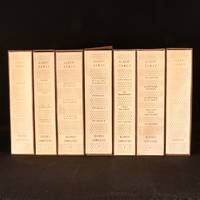
1962rif. 1009H36DParis: Imprimerie Nationale André Sauret Editeur 1962-1965. Hardback. Near Fine. 11" by 8.5". Alexandre Garbell; . A finely produced limited edition de luxe of Camus" collected works number 97 of 200 richly illustrated with original signed lithographs and suites on Japon housed in the original slipcases. In the publisher"s original vellum-backed chemises loose as issued in folded gatherings each volume in the original wrappers and housed in matching red paper slipcases.Complete in seven volumes. Limited edition being number 97 of 200 copies on vélin d"Arches each volume issued with an additional suite of the illustrations on Japon nacre and a further original lithograph numbered and signed by the artist. Illustrated with a total of 216 original colour lithographs after Garbell Borès Carzou Pelayo Masson Guiramand and Cavailles. Each volume includes its signed lithograph and separate suite. Five of these additional suites have been inserted into Volume IV causing strain to the slipcase with splitting to the head.Volume I: Récits et Romans l'Étranger. La Peste La Chute. With sixteen original color lithographs by Alexandre Garbell.Volume II: Essais littéraires Noces l'Été l'Exil et le Royaume l'Envers et l'Endroit. With sixteen original color lithographs by Orlando Pelayo in the text.Volume III: Essais Philosophiques. Le Mythe de Sisyphe l'Homme Révolté Discours de Suède. With twelve original color lithographs by André Masson in the text two of which are double-page.Volume IV: Essais Politiques. Actuelles suivies de Lettres à un Ami Allemand. With sixteen original color lithographs by Paul Guiramand in the text.Volume V: Théatre. Caligula le Malentendu l'État de Siège les Justes. With sixteen original color lithographs by Cavaillès in the text.Volume VI: Adaptations et Traductions. Les Esprits la Dévotion a la Croix le Chevalier d'Olmedo Requiem pour une Nonne les Possédés. With sixteen original color lithographs by Francisco Borès in the text.Volume VII: Carnets Mai 1935 - Mars 1951. With sixteen original color lithographs by Jean Carzou in the text.Collated complete.Albert Camus 1913-1960 was a French-Algerian writer and philosopher associated with existentialism and best known for his exploration of the absurd in works such as L"Étranger and Le Mythe de Sisyphe. He was awarded the Nobel Prize in Literature in 1957. In the publisher's original vellum-backed chemise loose as issued in folded gatherings in the original wrappers. Externally very smart. The odd very minor handling mark and very slight rubbing to boards of chemise. The slightest trace of shelf wear to extremities. Slipcases generally very smart with the exception of the slipcase of volume IV to which the top edge defective. This is likely due to the additional suit of plates on Japanese paper of Bores Pelayo Masson Guiramand and Cavailles have been inserted to this slipcase. The odd light scratch and scuff mark. Internally pages bright and clean. Near Fine Imprimerie Nationale, André Sauret Editeur hardcover
1958rif. 82402Gallimard | Paris 1958 | 12 x 19 cm | broché
1950rif. 86112Gallimard | Paris 1950 | 12 x 19 cm | broché
1947rif. 52557Paris Gallimard 1947 In-12, broch, couverture imprime.Edition originale. Un des 215 exemplaires numrots sur vlin pur fil. Neuf, non coup.
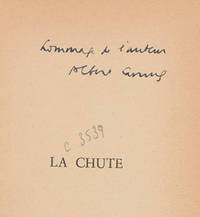
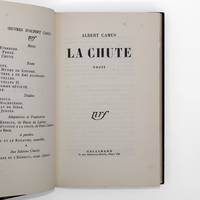
1956rif. 374898Paris: Gallimard 1956. First edition one of 235 numbered copies on vélin pur fil Lafuma-Navarre after 35 on Hollande. 169 pp. 1 vols. 12mo. Full chestnut morocco spine titled in gilt suede doublures preserving the original wrappers edges gilt on the rough by Alix. Book label. Fine binding in perfect condition in matching slipcase. First edition one of 235 numbered copies on vélin pur fil Lafuma-Navarre after 35 on Hollande. 169 pp. 1 vols. 12mo. La Chute is the masterful final novel by Albert Camus 1913-1960 whose other works include L'Etranger 1942 and Le mythe de Sisyphe. Camus was awarded the Nobel prize in literature the year after publication of La Chute which Sartre called his most beautiful and least understood. In his eulogy Sartre recalled how Camus provisionally chosen silence after receiving the honor but his autobiography in progress Le premier homme was published posthumously. This copy on fine paper has been bound in a sober dazzling binding from the French designer bindery Alix. Gallimard unknown
1956rif. 374898Paris: Gallimard 1956. First edition one of 235 numbered copies on vélin pur fil Lafuma-Navarre after 35 on Hollande. 169 pp. 1 vols. 12mo. Full chestnut morocco spine titled in gilt suede doublures preserving the original wrappers edges gilt on the rough by Alix. Book label. Fine binding in perfect condition in matching slipcase. First edition one of 235 numbered copies on vélin pur fil Lafuma-Navarre after 35 on Hollande. 169 pp. 1 vols. 12mo. La Chute is the masterful final novel by Albert Camus 1913-1960 whose other works include L'Etranger 1942 and Le mythe de Sisyphe. Camus was awarded the Nobel prize in literature the year after publication of La Chute which Sartre called his most beautiful and least understood. In his eulogy Sartre recalled how Camus provisionally chosen silence after receiving the honor but his autobiography in progress Le premier homme was published posthumously. This copy on fine paper has been bound in a sober dazzling binding from the French designer bindery Alix. Gallimard unknown books
1950rif. 48392Paris: Gallimard 1950. Fine. Gallimard Paris 1950 12 x 19 cm broché sous chemise et étui First edition one of 23 numbered copies on Hollande paper the tirage de tête A fine unsophisticated copy. Gallimard unknown
1950rif. 51282Paris: Gallimard 1950. Fine. Gallimard Paris 1950 12 x 19 cm broché First edition one of 23 numbered copies on Hollande paper the tirage de tête A fine copy. Gallimard unknown
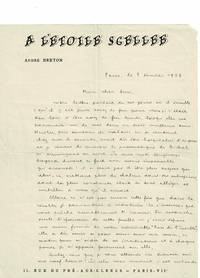
1953rif. 75729Paris 1953. Fine. Paris 8 janvier 1953 21 x 27 cm 1 pages et quelques lignes sur un feuillet Unpublished handwritten signed letter from André Breton addressed to critic Charles Estienne; one page and a few lines in black ink on a paper from the à l'étoile scellée gallery. Two transverse folds from having been sent a small corner missing in the upper right margin. Very beautiful letter giving an account of the death of one of André Breton's dearest friends and of his quarrel with Albert Camus. Breton tells his friend about the death of the Surrealist Czech artist Jindich Heisler: Your letter spoke of those days where it seemed that there was only just enough fire to live: on Monday there was far from enough fire when it reached me: one of my two or three best friends Heisler taken suddenly unwell on his way to mine on Saturday had to be hospitalised urgently and I had just received the pneumatic from Bichat telling me of his death. The event no less inconceivable than accomplished left me distraught for a long time: there was no-one more exquisite than he putting more warmth into everything he did the most constant of which was to lighten and embellish those whom he loved. The two poets were indeed very close: Heisler participated alongside Breton in the launch of Néon in 1948 and supported him during a period of depression accompanying him with other friends to the Île de Sein. The beginning of 1953 was overshadowed by the death of Jindich Heisler 4 January. Loyal among the faithful he lived entirely for Surrealism according to Breton who pays tribute to his activity as a leader: This is how he was between 1948 and 1950 the soul of Néon and until his last moments the greatest bearer of projects that as if by magic his talent gave him the means to achieve. Henri Béhar André Breton In this letter laden with pain Breton suddenly makes reference to L'Homme révolté by Albert Camus published two years earlier: Come on it is not yet the time in the rebellion that I will succeed in introducing the measure that M. Camus kindly preaches to us. The two writers met in New York at the end of March 1946 when Camus was invited to the United States for a conference tour as a representative of Combat. The two agree on the best way to preserve the testimony of certain men free from ideological distortions. They dream of a kind of pact by which people of their calibre would commit to not join any political party to fight against the death penalty to never claim any credit whatsoever. ibid. With other intellectuals they founded the Rassemblement démocratique révolutionnaire RDR in 1948; but the idyll ended a couple of years later in the autumn of 1951 when Camus published Lautréamont et la banalité an extract from his Homme révolté which was published later. Breton was extremely hurt and responded to him in an article entitled Sucre jaune in Arts: This article . testifies to the part of Camus for the first time for an indefensible moral and intellectual position. . He only wants to see a guilty adolescent in Lautréamont whom he - in his capacity as an adult - must discipline. He goes as far as to find him in the second part of his work: Poésies a deserved punishment. According to Camus Poésies would be but a mass of laborious banalities . It could still be worse if the destitution of these views did not intend to promote the most suspect thesis in the world which is that absolute revolt can generate only the taste for intellectual enslavement. This is a completely gratuitous ultra-defeatist statement which must incur even more contempt than its false demonstration. Thus two years later Breton still holds out against Camus' crime of lese-majesty towards that which Breton constructed as the father of surrealism but even more this allusion to Camus' pacifist philosophy bearing witness to the incompatibility between a thought of moderation and a poetry of revol unknown