3853 risultati
2013rif. 60182013 Paris, Gallimard - NRF, 2013. Broché: 14.5 x 21.5 cm, 157-[18] p., non coupé. Édition originale. Un des 50 exemplaires sur vélin pur fil Malmenayde (no. 22), seul grand papier. Exemplaire à l'état de neuf.
1953rif. feb811611953: First hebrew Persian Edition of The Plague La Peste הדֶּבר Used. For more details please contact me Am Oved
1951rif. feb589831951: First Japanese Edition of The Stranger 異邦人 Used. For more details please contact me Shinchosha hardcover
1948rif. feb1116541948: First German Edition of The Stranger Der Fremde Used. For more details please contact me Karl Rauch hardcover
rif. 51377Charlot.1950.In-8 br.E.O.Ex.47 sur Hollande sur 50.Très bon état intérieur.Couverture usagée avec léger manque de papier en queue.
1951rif. 32245Editions Gallimard 2009. In-4 broché de 79 pages au format 32,5 x 25 cm. Couverture spéciale imprimée sur Freelife Merida graphite avec titre imprimé en jaune et blanc. Dos carré. Plats et intérieur parfaits. Texte de Albert Camus avec photographies en noir de Henriette Grindat et itinéraire par René Char. Un des 120 exemplaires numérotés du tirage de tête ( n°64 ), sous couverture imprimée sur Freelife Merida graphite et enrichis d'une photographie inédite en noir, sous serpente, d'Henriette Grindat tirée spécialement sur papier Baryté. Etat de neuf. Rarissime édition originale.
rif. 42529Paris : Les Editions de Minuit (jusqu'au n°9) puis Editions Julliard - Directeur : Jacques Brenner - 49 fascicules 14,5x22,8 cm, pour les 15 premiers numéros, 14,1x19,3 cm et 12x20 cm pour les suivants - Le premier numéro s'intitule "Cahiers des quatre saisons" - Ensemble en bon état, la plupart des exemplaires sous papier cristal -Textes de François Augiéras, Dominique Aury, André Breton, Michel Butor, Albert Camus, Jean Cocteau, René Crevel, Jean-Paul de Dadelsen, André Dhôtel, Jean Follain, André Frédérique, Jean-Pierre George, André Gide, Pierre Herbart, Ionesco, Philippe Jaccottet, Max Jacob, Marcel Jouhandeau, Ernst Jünger, Jack Kerouac, Georges Limbour, Armen Lubin, Ossip Mandelstam, Joyce Mansour, Roger Martin du Gard, Roger Nimier, Bernard Noël, Ricardo Paseyro, Boris Pasternak, Jean Paulhan, Cesare Pavese, André Pieyre de Mandiargues, Robert Pinget, Marcel Proust, Raymond Queneau, Alexeï Remizov, Jean Reverzy, André de Richaud, Armand Robin, Maurice Sachs, Françoise Sagan, Jean-Philippe Salabreuil, Jules Supervielle, Henri Thomas, Alexandre Vialatte, Boris Vian, Orson Welles, etc. Des numéros en partie consacré à Jacques Chardonne, Jean Cocteau, Jean-Louis Curtis, Jean-Paul de Dadelsen, Eugène Ionesco, Armen Lubin, Jean Paulhan, Armand Robin, Jean Schlumberger, Marcel Schneider, Marguerite Yourcenar, etc.
rif. 102324London Hamish Hamilton 1946 1st UK Edition. Hardback 7.5 x 5 inches. Grey cloth with gilt lettering to spine. In dustwrapper. In very good condition with very good dustwrap DW tanned with some minor foxing spots to front minor water stain to spine. Small nicks to corners chips to ends of spine and top front edge Not price clipped in protective sleeve. Cloth faded on front and spine. Inside all very clean and tight no inscriptions handling marks or foxing spots. Else a very clean and tight copy. Rare with Dustwrapper. 104pp. First English Translated Edition. London, Hamish Hamilton, 1946 1st UK Edition hardcover
1963rif. 329898np: New Labratory Press 1963. One of 30 copies hand set in 14 point Hunt Roman a type designed by Hermann Zapf printed at the New Labratory Press. 4pp. Small folio. Gray wrappers. Fine. One of 30 copies hand set in 14 point Hunt Roman a type designed by Hermann Zapf printed at the New Labratory Press. 4pp. Small folio. New Labratory Press unknown books
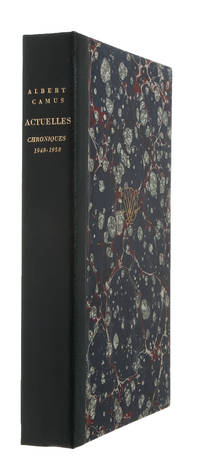
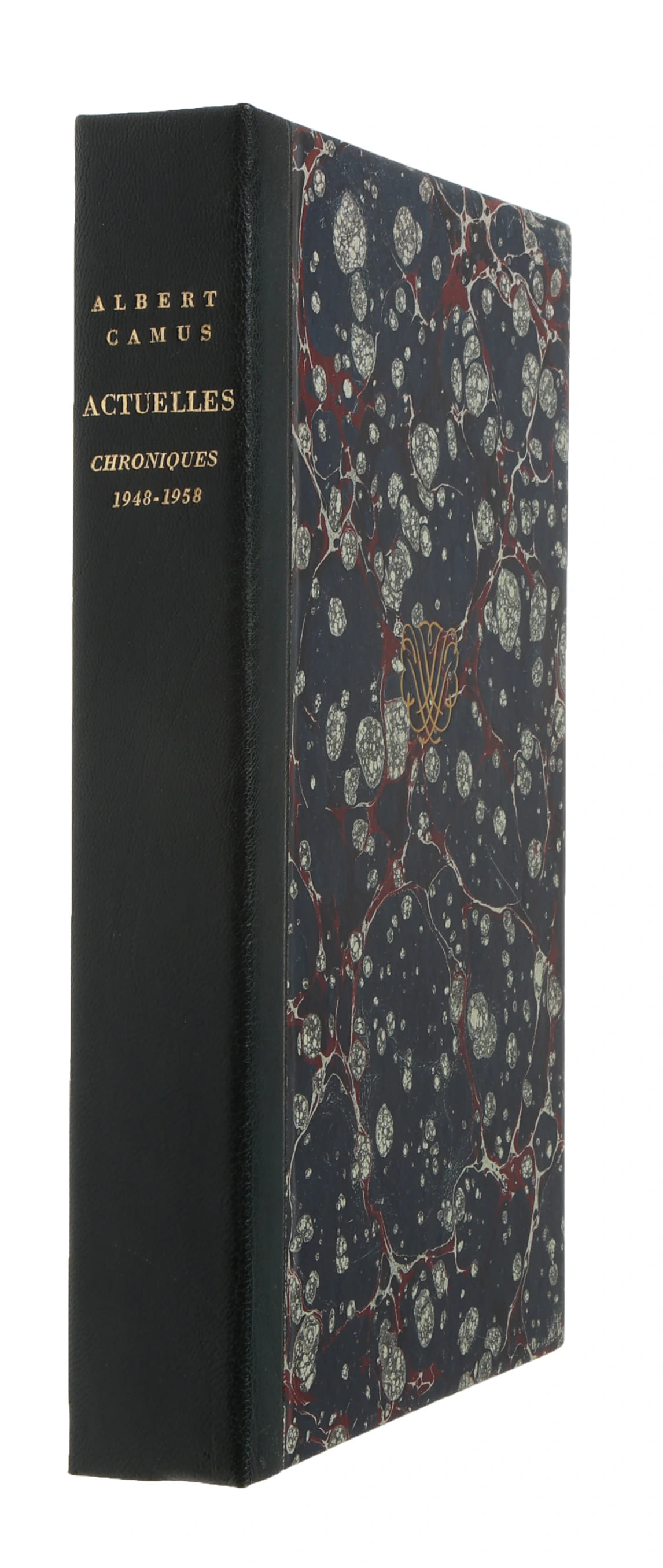
1953rif. 63533Paris Gallimard 1953. 8vo. Uncut in the original printed wrappers. An excellent fresh copy evenly browned througfhout as always due to the quality of the paper. 186 1. Housed in an exquisite dark blue half morocco box with blue marbled paper and gilt lettering to spine Henning Jensen. Gilt super ex libris to front board. Some browning to pages otherwise neat and clean. In half calf box with marbled boards gilt title to spine and gilt ex libris on the top. Some wear to edges. Signed copy dedicated to Jean Ballard 1893-1973. First edition presentation-copy inscribed to Jean Ballard of Camus' second collection of three published betweeen 1950 and 1958 of chronicles. Camus started preparing this second volume in 1953 which brings togther articles interviews polemical letters etc. dealing with world affairs since 1948 the cut-off point of the first volume. Actuelles II covers the troubling moments of the Cold War from the Prague coup 1948 to Stalin's death 1953 see Vanney. In this volume he summed his hopes in a brief preface: "The new world true liberation was not yet just around the corner but nihilism was a thing of the past and creation always possible now became more than ever necessary. A long section of Actuelles II looked backward . But a final section entitled 'Création et Liberté' was an attempt to demonstrate the continuing need for art. 'It's not enough to criticize one's times one must also try to give them a form and a future.'" Lottman: 521 Camus completed the reading of the proofs in Thonon-les-Bains "at the last moment adding the speech he had recently delivered at Saint Etienne". This speech was delivered in May 1953 at the Labor Exchange where a group of labor organizations had called a meeting. Camus "denounced threats to freedom in Western societies as well as Eastern ones pleaded for freedom as the one good the one heritage of the great revolutionary conquests of two centuries." Lottman: 522 Actuelles II is also strongly tied to his book-long essay L'homme révolté EN: The Rebel published in 1951. According to Vanney "The book's significance can be gauged if necessary by the sheer volume of commentary and criticism it generated from both the right and the left." own translation. In 1952 Camus had written a defense of his work but decided not to publish it and instead prepared the current volume of which seven out of sixteen texts revisit his controversial book. "Since Camus had decided against publishing Défense de L’Homme révolt written in the wake of these polemics reading them becomes essential to understanding the nuances and interpretations he brings to his essay. Apart from an interview with Pierre Berger they are presented in epistolary form and therefore should be read alongside the criticisms that prompted them." own translation see Vanney After WWII Albert Camus 1913-1960 became as a novelist and playwright moralist and political theorist "the spokesman of his own generation and the mentor of the next not only in France but also in Europe and eventually the world" Cruickshank 2026. Jean Ballard 1893-1973 was a French actor poet and editor. Between 1925-66 he ran the publisher Les Cahiers du Sud “The Southern Notebooks”. Sources and further reading: Aronson Ronald. Winter 2022 Edition. Albert Camus. In Edward N. Zalta & Uri Nodelman eds. The Stanford Encyclopedia of Philosophy. https://plato.stanford.edu/archives/win2022/entries/camus/ Cruickshank J. 2026 July 31. Albert Camus. Encyclopedia Britannica. https://www.britannica.com/biography/Albert-Camus Lottman H. R. 1979. Albert Camus: A biography. Weidenfeld & Nicolson. Todd O. 1998. Albert Camus: A life B. Ivry Trans. Vintage. Vanney Philippe. n.d. Actuelles II 1953. Société de Éstudes Camusiennes. https://www.etudes-camusiennes.fr/actuelles-ii-1953/ hardcover
1953rif. 63533(Paris) Gallimard (1953). 8vo. Uncut in the original printed wrappers. An excellent, fresh copy (evenly browned througfhout as always, due to the quality of the paper). 186, (1). Housed in an exquisite dark blue half morocco box with blue marbled paper and gilt lettering to spine (Henning Jensen). Gilt super ex libris to front board. Some browning to pages, otherwise neat and clean. In half calf box with marbled boards, gilt title to spine and gilt ex libris on the top. Some wear to edges. Signed copy dedicated to Jean Ballard (1893-1973).
1963rif. 329898np: New Labratory Press 1963. One of 30 copies hand set in 14 point Hunt Roman a type designed by Hermann Zapf printed at the New Labratory Press. 4pp. Small folio. Gray wrappers. Fine. One of 30 copies hand set in 14 point Hunt Roman a type designed by Hermann Zapf printed at the New Labratory Press. 4pp. Small folio. New Labratory Press unknown
1948rif. 91636Alfred A. Knopf. Good in Good dust jacket. First American Edition. Hardcover. 1st American edition Some rubbing and chipping around cover edges and on crown and heel. Small stain on endpaper. Numbered pencil markings on endpapers. Photos upon request. International shipping billed at cost. Please note that the buyer is responsible for any customs duties tariffs or import fees levied by the destination country.; 12mo 7" - 7½" tall; 178 pages . 1948. Alfred A. Knopf hardcover
1948rif. 47010New York: Alfred A Knopf 1948. First American edition published in 1948. Translated from the French by Stuart Gilbert. A near fine beautiful copy in full black cloth with grim reaper imprint on front cover gilt titled spine and red top edge. Typography and binding design by Warren Cappell. Very near fine with clean and tight text no markings. In a very good price-intact dust jacket with modest wear to spine ends in a protective mylar cover. . First American Edition. Hard Cover. Near Fine/Very Good. Alfred A Knopf Hardcover
rif. 7989P., Jombert et Le Conte, 1722, un volume in 8 relié en plein veau marbré, dos orné de caissons et fers dorés, tranches rouges (reliure de l'époque), (quelques cahiers uniformément jaunis, petites galeries de vers dans les marges intérieures sans atteinte au texte), (8), 535pp., 7pp., 5 PLANCHES DEPLIANTES
rif. 29718Paris Gallimard 1er mars 1971. 1 vol. 150 x 220 mm de 231 p. et 3 f. Broché non coupé. . Édition originale. Un des 106 premiers exemplaires sur vélin de Hollande n° 17. . Le premier roman d'Albert Camus resté à l'état d'ébauche rédigé en Algérie entre 1932 et 1936. Il constitue le premier volume des Cahiers Albert Camus. Neuf non coupé. Paris, Gallimard, (1er mars) 1971. 1 vol. (150 x 220 mm) de 231 p. et [3] f. Broché, non coupé. unknown
1971rif. 29718Tirage de tête sur Hollande Paris, Gallimard, (1er mars) 1971. 1 vol. (150 x 220 mm) de 231 p. et [3] f. Broché, non coupé. Édition originale. Un des 106 premiers exemplaires sur vélin de Hollande (n° 17).
1944rif. 52562Paris Gallimard 1944 In-12, cartonnage de l'diteur orn sur les plats et le dos de compositions en couleurs dessines par Mario Prassinos.Edition originale. Un des 1.000 exemplaires numrots sur papier chtaignier et relis d'aprs une maquette de Mario Prassinos.
1959rif. 55640Paris Gallimard 1959 In-12, demi-maroquin brun coins, plats de papier damier noir et beige, dos quatre nerfs; doublures et gardes de papier brun, tte dore, non rogn, couverture imprime (Alix).Edition originale. Tirage limit 161 exemplaires numrots. Un des 100 exemplaires sur vlin pur fil Lafuma-Navarre.
1668rif. 19477Chez Jean Baptiste Loyson | à Paris 1668 | 12 x 18 cm | relié
1948rif. 1387500New York NY: Alfred A. Knopf 1948. First American Edition First Printing. Hardcover. Octavo 278 pages. In Good condition with a Good minus condition dust jacket. Blue-grey and black spine with black red and white lettering. Dust jacket is wrapped in a mylar covering price is uncut "$3.00 net" has moderate shelving wear mild to moderate wear along the extremities chipping along the joints and fore edges scratches on the rear cover tears along the head edges and spine and moderate age-toning. Boards have mild age-toning along the head and tail edges mild wear along the extremities stains on the rear board and bending wear along the spine head and tail edges. Text block has mild splitting to the gutter pages 89-121 stains on the rear end-page and paste-down moderate age-toning throughout mild wear along the edges and faded dark red inking along the head edge. DL consignment. Shelved in Case 6. Albert Camus was born November 7 1913 in Dréan Algeria then French Algeria. Camus' mother was deaf and illiterate his father killed in acting in 1914 serving in World War I and he would grow up very poor pied-noir a slang term for French and other European people born in Algeria. Camus would be diagnosed with tuberculosis in 1930 at which time he moved in with his uncle Gustave Acault. Living with his uncle Camus found a great love for philosophy taking particularly to Greek philosophers and Nietzsche. This love of philosophy would push Camus to completing a degree in philosophy in 1936. During and after his time in university Camus would join the Algerian Communist Party and Algerian People's Party both of which sought freedom from colonial rule in Algeria. Camus' work with the ACP greatly involved organizing the "Théâtre du Travail" Worker's Theater which would be renamed "Théâtre de l'Equipe" Theater of the Team after Camus and the ACP split. Some of the scripts written for "Théâtre de l'Equipe" would become the basis for his later novels. In 1938 Camus solidified his anti-colonial feelings working for a leftist newspaper which spoke out against the colonial regime as well as the rising fascist regimes across Europe. In 1940 Camus moved to Paris after the banning of the newspaper there producing his "first cycle" of works on the absurd including his most famous work "L'Étranger" "The Stranger". With the outbreak of World War II and the German invasion of France Camus fled Paris moving first to Lyon in southeast France then to Algeria and then to the Frech Alps to recover from a flare up of tuberculosis. It was in the Alps that Camus began work on his "second cycle" of works now dealing more with revolt. "La Peste" or "The Plague" would be published in 1947 in France and in 1948 in the US riding on Camus' infamy gained both for his earliest works and for his role in the French Resistance against German occupation. It depicts the Algerian city of Oran amidst a devastating plague and many different people's reactions to it from feelings of despair to those who fight bravely against the illness. Both Camus' own tuberculosis and a cholera epidemic which killed a large portion of Oran in 1849 were inspirations for the novel though it was set in the 1940's. The novel has been noted as allegorical for the French resistance to Nazi occupation during World War II. Upon it's release "The Plague" received generally positive critical reception with moderate commercial success. However during the COVID-19 pandemic in 2020 the novel became a best-seller with publisher Penguin Classics reporting difficulties matching demand. Many hailed "The Plague" as a reflection of the time with lockdown measures compared to the novel's cordon sanitaire and Camus' own daughter noting that it should be inspiration for people to take responsibility in how they reacted to the pandemic. 1387500. Shelved Dupont Bookstore. Alfred A. Knopf hardcover books
1948rif. 140946762New York: Alfred A. Knopf 1948. First American edition. Hardcover. First American edition first printing. vi 278 2 pp. Bound in publisher's black cloth with blindstamped front board gilt lettering on spine. Near Fine with tiny stain to front board old bookstore ticket on front free endpaper in a Very Good dust jacket price-clipped rubbed along edges tiny chip in top of front panel a few tape mends to verso. Camus' existentialist novel La Peste in the original French set in Oran Algeria. Alfred A. Knopf hardcover books
1948rif. 022281New York: Knopf. Original black cloth in Dust Jacket. First American Edition. Previous owners name in ink dated August 1948 the year of publication Near Fine in Very Good Dust Jacket with slight edge wear. . Near Fine. Hardcover. 1st Edition. 1948. Knopf hardcover
1948rif. 1387500New York NY: Alfred A. Knopf 1948. First American Edition First Printing. Hardcover. Octavo 278 pages. In Good condition with a Good minus condition dust jacket. Blue-grey and black spine with black red and white lettering. Dust jacket is wrapped in a mylar covering price is uncut "$3.00 net" has moderate shelving wear mild to moderate wear along the extremities chipping along the joints and fore edges scratches on the rear cover tears along the head edges and spine and moderate age-toning. Boards have mild age-toning along the head and tail edges mild wear along the extremities stains on the rear board and bending wear along the spine head and tail edges. Text block has mild splitting to the gutter pages 89-121 stains on the rear end-page and paste-down moderate age-toning throughout mild wear along the edges and faded dark red inking along the head edge. DL consignment. Shelved in Case 6. Albert Camus was born November 7 1913 in Dréan Algeria then French Algeria. Camus' mother was deaf and illiterate his father killed in acting in 1914 serving in World War I and he would grow up very poor pied-noir a slang term for French and other European people born in Algeria. Camus would be diagnosed with tuberculosis in 1930 at which time he moved in with his uncle Gustave Acault. Living with his uncle Camus found a great love for philosophy taking particularly to Greek philosophers and Nietzsche. This love of philosophy would push Camus to completing a degree in philosophy in 1936. During and after his time in university Camus would join the Algerian Communist Party and Algerian People's Party both of which sought freedom from colonial rule in Algeria. Camus' work with the ACP greatly involved organizing the "Théâtre du Travail" Worker's Theater which would be renamed "Théâtre de l'Equipe" Theater of the Team after Camus and the ACP split. Some of the scripts written for "Théâtre de l'Equipe" would become the basis for his later novels. In 1938 Camus solidified his anti-colonial feelings working for a leftist newspaper which spoke out against the colonial regime as well as the rising fascist regimes across Europe. In 1940 Camus moved to Paris after the banning of the newspaper there producing his "first cycle" of works on the absurd including his most famous work "L'Étranger" "The Stranger". With the outbreak of World War II and the German invasion of France Camus fled Paris moving first to Lyon in southeast France then to Algeria and then to the Frech Alps to recover from a flare up of tuberculosis. It was in the Alps that Camus began work on his "second cycle" of works now dealing more with revolt. "La Peste" or "The Plague" would be published in 1947 in France and in 1948 in the US riding on Camus' infamy gained both for his earliest works and for his role in the French Resistance against German occupation. It depicts the Algerian city of Oran amidst a devastating plague and many different people's reactions to it from feelings of despair to those who fight bravely against the illness. Both Camus' own tuberculosis and a cholera epidemic which killed a large portion of Oran in 1849 were inspirations for the novel though it was set in the 1940's. The novel has been noted as allegorical for the French resistance to Nazi occupation during World War II. Upon it's release "The Plague" received generally positive critical reception with moderate commercial success. However during the COVID-19 pandemic in 2020 the novel became a best-seller with publisher Penguin Classics reporting difficulties matching demand. Many hailed "The Plague" as a reflection of the time with lockdown measures compared to the novel's cordon sanitaire and Camus' own daughter noting that it should be inspiration for people to take responsibility in how they reacted to the pandemic. 1387500. Shelved Dupont Bookstore. Alfred A. Knopf hardcover
1948rif. 140946762New York: Alfred A. Knopf 1948. First American edition. Hardcover. First American edition first printing. vi 278 2 pp. Bound in publisher's black cloth with blindstamped front board gilt lettering on spine. Near Fine with tiny stain to front board old bookstore ticket on front free endpaper in a Very Good dust jacket price-clipped rubbed along edges tiny chip in top of front panel a few tape mends to verso. Camus' existentialist novel La Peste in the original French set in Oran Algeria. Alfred A. Knopf hardcover