1954ref. 57507NY: Knopf 1954. First US Edition. 8vo pp. 273. A VG tight copy in some scuffed and chipped dj.The scarce first edition. "By one of the most profoundly influential thinkers of our century 'The Rebel' is a classic essay on revolution. Knopf unknown books
1948ref. 214371New York: Alfred A. Knopf 1948. First U.S. edition and first printing. Hardcover. A novel from this multi-talented French writer who won the 1957 Nobel Prize in Literature. Translated from the French by Stuart Gilbert. A very good copy in black cloth boards with some pushing to the spine ends some very slight tapping to the corners some other minor wear a small bookplate to the front pastedown and the remnants of a bookstore sticker to the rear pastedown and in a very good dust jacket with a large chip to the top of the spine some small chips and edge wear and a faint stain to the bottom of the spine that is only visible from the verso. Despite the litany of flaws a solid copy of this classic. Alfred A. Knopf unknown

1971ref. 033692The Limited Editions Club 1971. The Limited Editions Club 1971. Hardcover in slipcase without dust jacket as issued. 8vo with 181 pages. Illustrated by Daniel Maffia and signed by him on the limitation page. This copy is number 1477 of 1500 copies. The book and slipcase are in fine condition. Interior is clean and tight. Translated from the French by Stuart Gilbert. Beautifully illustrated. Pictures available upon request. Red leather/Gold text/ Red-Black slipcase. No glassine dust jacket or limited editions club letter. #033692. Signed. The Limited Editions Club 1st Ed Thus. Hardcover. Fine in Slipcase/Slipcase Fine. Illus. by Daniel Maffia. 8vo. Classic Literature & Fiction. The Limited Editions Club Hardcover
1946ref. 110902Alfred A. Knopf 1946-01-01. Hardcover. Very Good. 9x6x1. 1953 5th printing of the American edition in lightly shelf worn price intact $2.75 jacket. Tight and unmarked. Please email for photos. Alfred A. Knopf hardcover
1948ref. 214371New York: Alfred A. Knopf 1948. First U.S. edition and first printing. Hardcover. A novel from this multi-talented French writer who won the 1957 Nobel Prize in Literature. Translated from the French by Stuart Gilbert. A very good copy in black cloth boards with some pushing to the spine ends some very slight tapping to the corners some other minor wear a small bookplate to the front pastedown and the remnants of a bookstore sticker to the rear pastedown and in a very good dust jacket with a large chip to the top of the spine some small chips and edge wear and a faint stain to the bottom of the spine that is only visible from the verso. Despite the litany of flaws a solid copy of this classic. Alfred A. Knopf unknown books
ref. 20352Rouen, Adrien Ouyn, 1633. 1 fort vol. petit in-8°, parchemin souple, titre écrit à la plume au dos. Reliure de l'époque un peu défraîchie, un coin émoussé. Bon exemplaire. Ex-libris ms. au contreplat de Nicolas Descretz (XVIIe s.) (39) ff., (1) f. blanc, 872 pp. Quelques rousseurs, mouillures angulaires sur une cinquantaine de ff. en fin de vol.
1957ref. 168804New York: Knopf 1957. First American Edition; Eighth Printing. Hardcover. Very Good in a Very Good price clipped dust jacket. Rubbing along panel edges. Closed tear at bottom of front gutter and top of rear panel. Knopf hardcover
1965ref. mon0000991521Hamish Hamilton 1965. Hardback. Very Good. in x in x in. 1965 reprint. 4th impression. Pages clean and bright no markings light wear to edges. Binding tight. Hamish Hamilton hardcover
1984ref. feb506521984: First Colombian Edition of The Plague La Peste La peste Used. For more details please contact me Oveja Neagra hardcover
1968ref. feb720331958: First Iranian Persian Edition of The Stranger بیگانه Used. For more details please contact me Faroukhi hardcover
1947ref. feb720421947: First Italian Edition of The Stranger Lo straniero Used. For more details please contact me Bompiani
1976ref. 4696Paris, Les Heures Claires, 1976, 27 X 34 cm., en feuilles, 195 pages. Orné de belles lithographies originales en couleurs, à simple ou double page, de Mireille BERRARD. Tirage limité à 350 exemplaires numérotés, le nôtre un des 214 sur vélin de Rives. Ouvrage en feuilles, sous chemise souple rempliée, chemise cartonnée et étui. Des traces sur l'étui, le reste est en bel état.
ref. 41954Paris: Ladvocat 1826. First edition 4 vols. 12mo 170 x 100 mm 4 263; 4 287; 4 276; 4 263pp. with half-title and frontispiece engraved by Villerey after Madame Merville to each volume with some light offsetting occasional light foxing contemporary blue quarter calf blue marbled boards some light rubbing but overall a very attractive set of this very scarce novel. Quérard VI 80. Paris: Ladvocat, 1826 hardcover
ref. 38465Paris, Gallimard, (coll. "Blanche"), 1958. In-8°, 212p. Broché.
ref. ANAIS-0312818238St Martins Press. 1. other. Good. 9.5X6.5X1.5. Buy with confidence. Excellent Customer Service & Return policy. St Martins Press unknown
1948ref. 000014927New York: Alfred A. Knopf 1948. First American edition. Hardcover. Very Good/Very Good. 8vo. 5 v 3 3-278 2 pp. Black cloth with the Grim Reaper stamped in blind on the front board gold lettering and decorations on the spine; purple topstain. Price of $3.95 on the front flap of the jacket the original dust jacket price was $3.00. Jacket design by Jean Carlu. With a few in-text designs. Translated from the French by Stuart Gilbert. The story of a cordon sanitaire in an Algerian city Camus' novel focuses on characters in lockdown as an epidemic rages in their city. The Plague is widely regarded as a classic existensialist novel and as one of the most important French novels of the twentieth century. Light wear to the boards' edges and a faint corner crease to a few leaves; traces of edge wear to the jacket and a little dampspot on the jacket's reverse. Alfred A. Knopf hardcover
1993ref. BN334787Slovenský spisovatel 1993. 1993. Mýtus o Sizyfovi. Pád. Caligula. Mýtus o Sizyfovi. Pád. Caligula. Albert Camus Slovenský spisovatel unknown
1993ref. BN542408Rowohlt Taschenbuch 1993. 1993. Der Fremde / Die Pest rororo / Rowohlts Rotations Romane Der Fremde / Die Pest rororo / Rowohlts Rotations Romane Goyert Georg Georg Brenner Hans Albert Camus u. a. Rowohlt Taschenbuch unknown
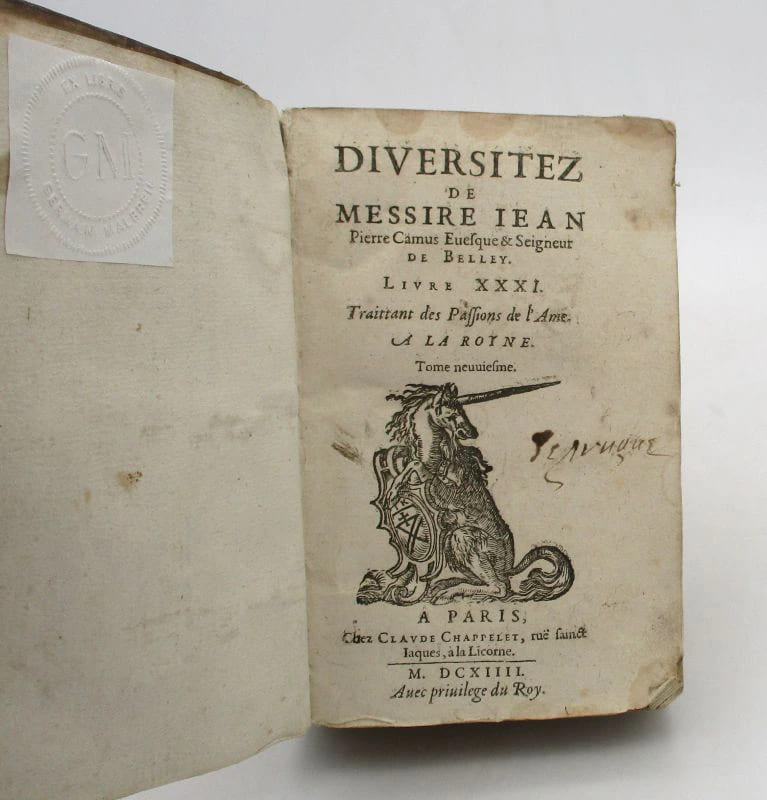
ref. 23902Paris, Claude Chappelet, 1614. In-8, [32]-698-[46] pp., parchemin souple à petits rabats, tomaison manuscrite au dos (important manques et taches à la reliure, mouillures).
ref. 39519Paris, Gallimard, 1951. In-12 (178 x 115 mm), cartonnage éditeur polychrome d’après la maquette de Mario Prassinos, 382 p., (1) f. d’achevé d’imprimer.
1950ref. 32092Dernier titre publié chez Charlot Paris, Charlot, (1er mai) 1950. 1 vol. (165 x 255 mm) de 79 p. et [2] f. Broché. Édition originale. Texte dédié à Pierre Galindo. Un des 280 exemplaires sur vélin pur fil de Lana (n° 10) - outre les 45 exemplaires sur le même papier réservés à l'auteur.
1908ref. 447961908 Paris. Jacques Lechevallier. 1908. 1 volume in-4, broché. 484 pp. ; 32 planches avec feuillets d'explication en regard.
ref. 32092Paris Charlot 1er mai 1950. 1 vol. 165 x 255 mm de 79 p. et 2 f. Broché. . Édition originale. Texte dédié à Pierre Galindo. Un des 280 exemplaires sur vélin pur fil de Lana n° 10 - outre les 45 exemplaires sur le même papier réservés à l'auteur. . Paru chez Charlot son éditeur historique Le Minotaure est le premier des huit essais qui constitueront le recueil de L'Été. Le manuscrit princeps est daté de 1939 mais la publication a été ajournée pour de multiples raisons et il faudra attendre 1946 pour voir le texte paraître en revue grâce à Jean Amrouche l'ami kabyle d'Albert Camus installé à Tunis. Ce dernier anime depuis la fin de la guerre la revue L'Arche d'Edmond Charlot. Dans son numéro 13 de février 1946 Camus publie donc une première version de sa « plaquette sur Oran » Le Minotaure avec l'épigraphe suivante de Gide : « Je l'imaginais à la cour du roi Minos inquiet de savoir quelle sorte d'inavouable monstre peut bien être le Minotaure ; s'il est si affreux que cela ou s'il n'est pas charmant peut-être. » La version définitive en volume est prête en 1949 avec quelques corrections au texte et l'épigraphe de Gide remplacée par une autre de Hölderlin. Cette période marque la fin de la célèbre enseigne algéroise : Edmond Charlot fait faillite malgré les succès de librairie qui caractérisent sa période d'après-guerre et Le Minotaure est l'un des derniers titres de son catalogue en même temps qu'il marque la fin de la collaboration de Camus avec Charlot lequel lancera cependant une nouvelle maison d'édition à Alger Rivages. Paris, Charlot, (1er mai) 1950. 1 vol. (165 x 255 mm) de 79 p. et [2] f. Broché. unknown
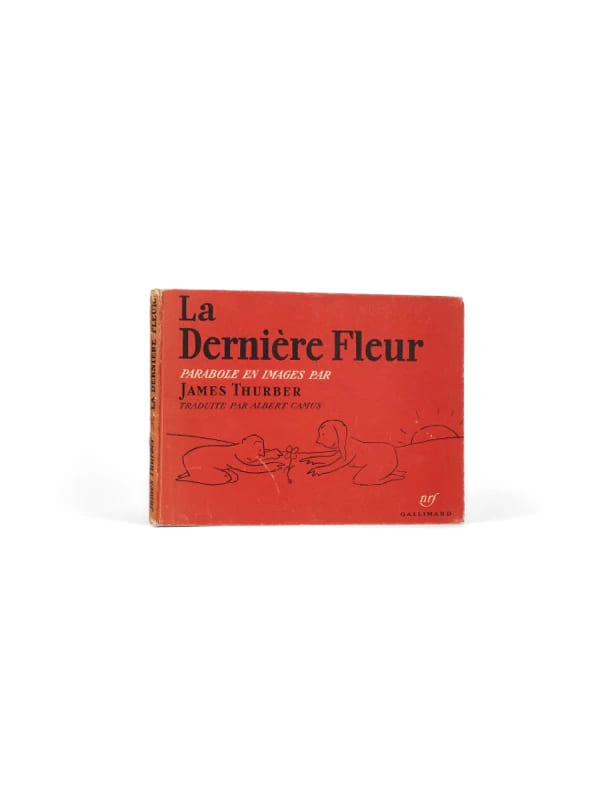
1952ref. 8005Camus, les Hommes et la fraternité Paris, Gallimard, (25 mars) 1952. 1 vol. (270 x 200 mm) non paginé. Cartonnage illustré de l'éditeur. Édition originale.
ref. 8005Paris Gallimard 25 mars 1952. 1 vol. 270 x 200 mm non paginé. Cartonnage illustré de l'éditeur. . Édition originale. . Rien d'étonnant à ce qu'Albert Camus traduise la Dernière fleur du conteur et dessinateur américain James Thurber. En effet après la parution de L'Homme révolté et la fratricide polémique qui s'en suivit avec Jean-Paul Sartre Camus est meurtri dépressif et littérairement stérile ; il lui est donc plus facile de transcrire que d'écrire. Et puis la parabole du « Mark Twain du XXe siècle » est une illustration de l'absurdité humaine : bâtisseur et destructeur l'Homme ruine inexorablement son oeuvre civilisatrice par la guerre et le ravissant livre de Thurber est livre une merveilleuse parabole. Comment l'auteur du Mythe de Sisyphe serait-il resté insensible à ce message désabusé et détaché Sans compter qu'il fait écho à son article contemporain de la déclaration de la Seconde Guerre mondiale : « Nous savons qu'à une certaine extrémité du désespoir l'indifférence surgit et avec elle le sens et le goût de la fatalité. . Tant d'efforts pour la paix tant d'espoirs mis sur l'homme tant d'années de lutte ont abouti à cet effondrement et à ce nouveau carnage! . C'est bien là peut-être l'extrémité de la révolte que de perdre sa foi dans l'humanité des hommes. Peut-être après cette guerre les arbres refleuriront encore puisque le monde finit toujours par vaincre l'histoire. Mais ce jour-là je ne sais combien d'hommes seront là pour les voir. » Le Soir républicain 17 septembre 1939. Bel exemplaire. Paris, Gallimard, (25 mars) 1952. 1 vol. (270 x 200 mm) non paginé. Cartonnage illustré de l'éditeur. unknown