Albert CamusBiblio.com
3844 risultati
1954rif. 10298Signed by Camus and the artist Pierre Eugene Clairin to the limitation page. Limited to 300 numbered copies of which this is number 254. Printed by Raymond Jacquet. Illustrated by Pierre Eugene Clairin with 12 original color lithographs including one on the title page three double-page and eight single page all with tissue guards. Publisher's loose sheets in paper wraps housed in a yellow and orange wrap and slipcase. French langauge. Minor staining to the slipcase otherwise this remains a nice clean copy with no previous owners' names or other defacements. 8.25 x 11.75 in 20.5 x 30 cm Noel Schumann paperback
1946rif. 202000326Knopf New York 1946. First edition. Condition: Very good in good dust jacket. Book has light toning from age discoloration along top edges but it does not bleed onto pages. Dust jacket has several tears and nicks creasing along spine. $2.00 indicated on dust jacket. Tan/beige cloth with maroon lettering on spine. Jacket design by Warren Chappell. Translated by Stuart Gilbert. The story of an ordinary man unwittingly drawn into a senseless murder on an Algerian beach. The classic novel of the absurd. Alfred A. Knopf hardcover
rif. 300420181611Edition originale 2002 numerotée sur velin pur fil seul grand papierun des 40 exemplaires numero 21pages non coupeesenvoi soigné Gallimard Nrf paperback
1946rif. 4902London: Hamish Hamilton 1946 1946. First edition in English. 8vo. 185x120mm. pp. iv 3-103 1. Grey cloth spine lettered in gilt. Original dustjacket illustrated by Edward Bawden. Bumping to head and foot of spine. Repair to top and bottom edges of dustjacket and two closed tears to top edge and slight chipping to bottom edge of rear of dustjacket but otherwise in very good condition and internally excellent. It is not common in a good jacket. Camus's concise dense absurdist novel of alienation first appeared in 1942. Stuart Gilbert's English translation was meant to published with the title The Stranger but as a Polish novel had recently been translated with this title Hamish Hamilton changed it to The Outsider which captures rather better the psychological darkness of the novel. London: Hamish Hamilton 1946 hardcover
1948rif. 24593London: Hamish Hamilton 1948. First UK edition first printing published by Hamish Hamilton in London in 1948. Translated from the French by Stuart Gilbert. A lovely copy with no inscriptions in the original Michael Ayrton-designed dust wrapper which is not price clipped. Some shadowing to the spine of the book the wrapper otherwise remaining particularly attractive. Camus's powerful account of an epidemic in the Algerian city of Oran exploring courage collective responsibility and the human response to suffering. One of the defining novels of post-war European literature with a memorable dust wrapper design. Hamish Hamilton unknown
1953rif. feb783351953: First Korean Edition of The Plague La Peste 페스트 Used. For more details please contact me Semunsha hardcover
1953rif. 73749Sous étui bordé et sous chemise en demi-maroquin rouge signés Patrice Goy et C. Vilaine. Couverture souple piquée. Rousseurs. En partie non coupé.
1951rif. 80569Couverture souple. Non coupé.
1950rif. 81829Protégé dans un étui-chemise signé DEVAUCHELLE. Couverture souple piquée. Rousseurs. En partie non coupé.
1953rif. 80262Nrf | Paris 1953 | 12 x 19 cm | broché
rif. 20166Paris, Gallimard, 1948. In-12, 233 pp., broché, couverture originale imprimée (dos partiellement décollé).
1956rif. 100121Paris Gallimard 1956 189x123mm, 169pp., in-12 broché. Edition originale, un des 225 exemplaires (122) sur vélin pur fil, 2ème papier après 35 Hollande. Neuf et non coupé.(100121)
rif. 410347Noël Schumann Alger 1954 In-4 ( 290 X 200 mm ), en feuilles sous couverture imprimée, chemise et étui ( Présentation de l'éditeur ). Edition originale de cette nouvelle d'Albert CAMUS, illustrée par Pierre Eugène CLAIRIN de 12 lithographies originales en couleurs dont une sur la page de titre, 3 sur double page et 8 in-texte. Tirage limité à 300 exemplaires numérotés, signés par l'auteur et l'artiste, celui-ci 1 des 260 exemplaires sur vélin ( N°52 ). Très bel exemplaire.
In-8, 270p. Edition originale sur papier ordinaire. Exemplaire du service de presse (achevé d'imprimer juin 1950). Enrichi d'un envoi autographe signé de l'auteur en page de faux-titre. "A Jacques Hebertot ces nouveaux "Justes" avec la gratitude et la fidèle amitié d'Albert Camus" Papier uniformément jauni, sinon très bel exemplaire.
1962rif. 77410Paris: Gallimard 1962. Fine. Gallimard Paris 1962 12.50 x 20.50 cm broché First edition one of 90 numbered copies on Holland paper deluxe issue. A very handsome full-margined copy. Gallimard unknown
1964rif. 77409Paris: Gallimard 1964. Fine. Gallimard Paris 1964 12.50 x 20.50 cm broché First edition one of 90 numbered copies on Holland paper deluxe issue. A very handsome full-margined copy. Gallimard unknown
1783rif. 10489Paris: Chez la Veuve DeSaint 1783. FIRST EDITION IN FRENCH. Including half-titles approbation and privilege du Roi. Volume I with the Greek and French translations on facing pages. Contemporary tree calf some wear to joints and corners; marbled edges some light waterstains in first volume. From the library of George Milton Smith with his bookplate.`. First edition. Camus' translation of Aristotle's descriptive zoology from Greek into French is a masterpiece of scholarship. This highly esteemed translation is much sought after for its extensive erudite commentaries and profound enlightenment of comparative anatomy. Divided into two books the first volume contains Aristotle's original Greek with Camus' French translation facing. Here he documents all the various manuscripts editions and translators cited in the work. The second volume a detailed study of natural history up to the modern time contains Camus' careful observations on the commentaries of other translators. This work is of particular importance for Camus' nomenclature of those living creatures originally described in Aristotle's account. He lists all of the animals found in Aristotle works including those "fanciful and primitive" and then details the differences in terms of the modern knowledge of natural history. So great was the influence of Aristotle that his teachings and thought were accepted and enlarged upon for nearly two millennia. He was acquainted with more than five hundred species of animals and had dissected and investigated in detail at least fifty kinds ranging over the entire animal kingdom. Many of his conclusions have stood the test of time. Among them may be mentioned his descriptions of the mechanisms of locomotion of the process of digestion in ruminants of the habits of bees of the mechanism of animal reproduction; his exposition of analogous structures in living bodies; and his methods of biological classification Eimas Heirs of Hippocrates 14. Camus 1740-1804 French revolutionist was a successful advocate before the Revolution. In 1789 he was elected by the third estate of Paris to the states general and attracted attention by his speeches against social inequalities. He was named archivist to the Constituent Assembly and in that capacity he organized the national archives and classified the papers of the different assemblies of the Revolution. He was restored to the office in 1796 and became absorbed in literary work. He remained an austere republican refusing to take part in the Napoleonic regime. This scarce work was included in Thomas Jefferson's library. Chez la Veuve DeSaint unknown
1783rif. 10489Paris: Chez la Veuve DeSaint 1783. FIRST EDITION IN FRENCH. Including half-titles approbation and privilege du Roi. Volume I with the Greek and French translations on facing pages. Contemporary tree calf some wear to joints and corners; marbled edges some light waterstains in first volume. From the library of George Milton Smith with his bookplate.`. First edition. Camus' translation of Aristotle's descriptive zoology from Greek into French is a masterpiece of scholarship. This highly esteemed translation is much sought after for its extensive erudite commentaries and profound enlightenment of comparative anatomy. Divided into two books the first volume contains Aristotle's original Greek with Camus' French translation facing. Here he documents all the various manuscripts editions and translators cited in the work. The second volume a detailed study of natural history up to the modern time contains Camus' careful observations on the commentaries of other translators. This work is of particular importance for Camus' nomenclature of those living creatures originally described in Aristotle's account. He lists all of the animals found in Aristotle works including those "fanciful and primitive" and then details the differences in terms of the modern knowledge of natural history. So great was the influence of Aristotle that his teachings and thought were accepted and enlarged upon for nearly two millennia. He was acquainted with more than five hundred species of animals and had dissected and investigated in detail at least fifty kinds ranging over the entire animal kingdom. Many of his conclusions have stood the test of time. Among them may be mentioned his descriptions of the mechanisms of locomotion of the process of digestion in ruminants of the habits of bees of the mechanism of animal reproduction; his exposition of analogous structures in living bodies; and his methods of biological classification Eimas Heirs of Hippocrates 14. Camus 1740-1804 French revolutionist was a successful advocate before the Revolution. In 1789 he was elected by the third estate of Paris to the states general and attracted attention by his speeches against social inequalities. He was named archivist to the Constituent Assembly and in that capacity he organized the national archives and classified the papers of the different assemblies of the Revolution. He was restored to the office in 1796 and became absorbed in literary work. He remained an austere republican refusing to take part in the Napoleonic regime. This scarce work was included in Thomas Jefferson's library. Chez la Veuve DeSaint unknown books
1948rif. 3117612New Yorl: Knopf. Near Fine in Near Fine dust jacket. 1948. First Edition; First Printing. Hardcover. First American edition. Near fine in a near fine dust jacket. 278pp. A few light traces of sophistication at spine ends and corners of jacket. Hint of wear at crest of spine on cloth Purple top stain mildly discolored as is the title on spine of jacket. Presents very nicely. One of the author's seminal works. ; 8vo 8" - 9" tall; 278 pages . Knopf hardcover
1714rif. 47068Henry Charpentier Cuir Paris 1714
rif. 81287Couverture beige avec titre en rouge. Intérieur très frais. Non coupé. A grands témoins.
rif. 29017Bruxelles Dynamo coll. « Brimborions » 14 janvier 1960. 1 vol. 120 x 190 mm de 10 p. et 1 f. Broché. . Édition originale. Un des onze premiers exemplaires sur hollande n° 5. . C'est dans la revue Confluences dans son numéro de juillet 1943 que paraît L'intelligence et l'échafaud. Les personnages « sont de curieux héros qui périssent tous de sentiments et vont chercher des maladies mortelles dans des passions contrariées » dit Camus selon une tradition du roman français qui est d'aller droit au but selon le prototype de La Princesse de Clèves. De son auteur Mme de Lafayette à Benjamin Constant et jusqu'à Proust le texte est ici tout entier fondé sur l'admiration de l'art classique : Camus y reviendra deux ans plus tard lorsqu'il préfacera les oeuvres de Chamfort ; il donnera également plusieurs résonances à ce texte dans les éditoriaux de Combat de l'année 1944. Celui du 12 octobre 1944 reprendra par exemple la formule de Goethe présente ici : « Mieux vaut une injustice qu'un désordre ». Cette plaquette est achevée d'imprimer le 14 janvier 1960 soit 10 jours après le décès accidentel de Camus sur les route de Bourgogne. Tirée à seulement 51 exemplaires elle paraît simultanément à l'autre hommage rendu par Pierre Aelberts pour sa collection Brimborions savoir le Albert Camus de Jean-Paul Sartre. Rare en grand papier. Bruxelles, Dynamo, coll. « Brimborions », 14 janvier 1960. 1 vol. (120 x 190 mm) de 10 p. et 1 f. Broché. unknown
1960rif. 29017Un des 11 exemplaires de tête. Bruxelles, Dynamo, coll. «Brimborions», 14 janvier 1960. 1 vol. (120 x 190 mm) de 10 p. et 1 f. Broché. Édition originale. Un des 11 premiers exemplaires sur vergé de Hollande justifiés et signés par l'éditeur (n° 5).
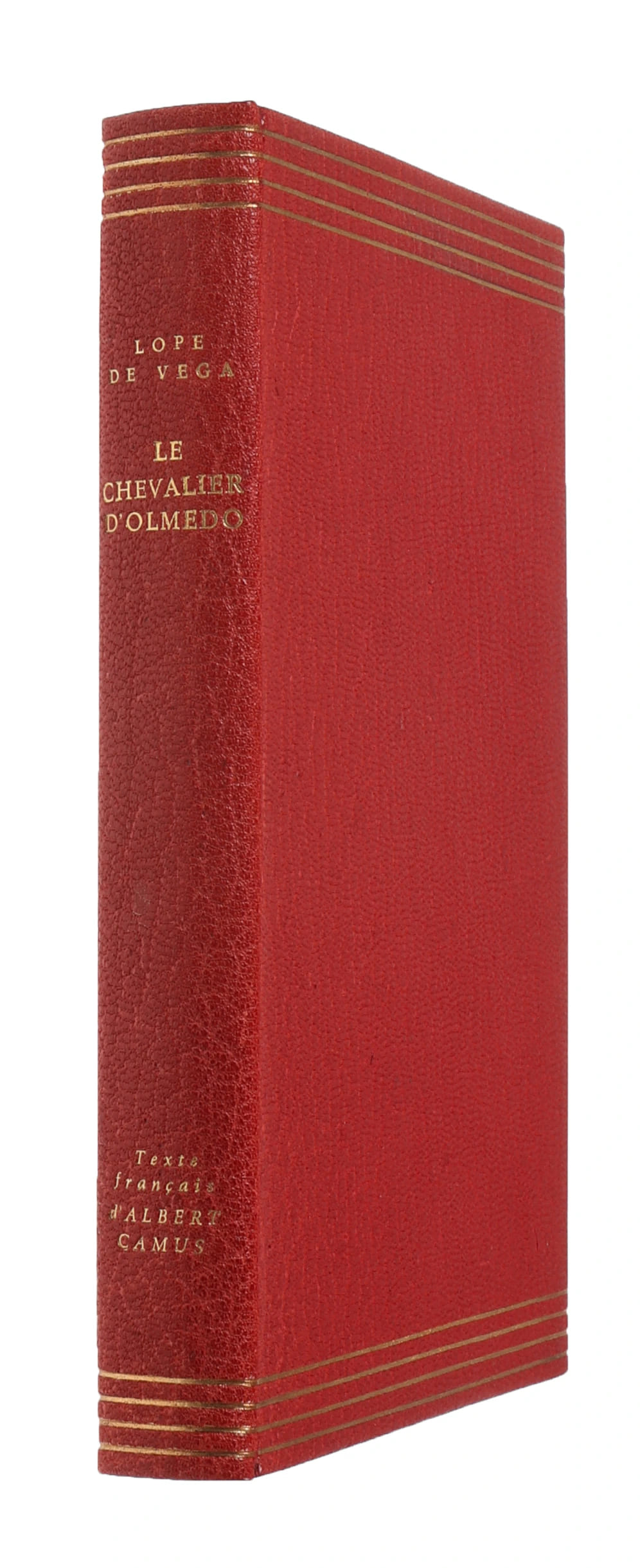
1957rif. 63532Paris Gallimard 1957. 8vo. Bound uncut with the original printed wrappers in an exquisite full red morrocco binding with quadruple gilt lines over boards and spie and gilt lettering to spine bound by Henning Jensen and gilt by Hagel Olsen. Top edge red. Gilt super ex libris to inside of front board. A splendid near mint copy in a wonderful elegant binding. First edition - nr. 3089 out of 3265 numbered copies on alfa Libert preceded by 65 copies on Lafuma Navarre - wonderful presentation-copy from Camus to Jean Marchat of Camus' translation of an early 17th century historical play by the Spanish dramatist Lope de Vega 1562-1635 Le chevalier d'Olmedo ES: El caballero de Olmedo; EN: The Knight from Olmedo. "For his historical plays Vega ransacked the medieval chronicle the romancero and popular legend and song for heroic themes chosen for the most part as throwing into relief some aspect either of the national character or of that social solidarity on which contemporary Spain’s greatness rested. The conception of the crown as fount of justice and bulwark of the humble against oppression inspires some of his finest plays. Peribáñez y el comendador de Ocaña Peribáñez and the Commander of Ocaña El mejor alcalde el rey The King the Greatest Alcalde and Fuente Ovejuna All Citizens Are Soldiers are still memorable and highly dramatic vindications of the inalienable rights of the individual as is El caballero de Olmedo The Knight from Olmedo on a more exalted social plane." see britannica.com Camus selected this play along with his own Caligula for the Festival D'Angers – founded in 1950 and still existing today as Festival D'Anjou – of which he was together with Jean Marchat artistic director in 1953 where he had translated the play La dévotion de la croix EN: Devotion to the Cross by Calderon de la Barca who succeeded de Vega. Camus returned as artistic director again in 1957: "For the month of June 1957 Camus had once more agreed to direct plays at the Festival D'Angers for the Théâtre des Mathurins. He told Maria Casarès that it was sheer baraka – Arabic for 'divine favor' but that baraka also meant seventy rehearsals . He had gone over it line by line with Maria Casarès and he was to spend the final weeks of that winter of 1957 polishing it" Lottman: 595. Starring the play were "Michel Herbault in the title role the knight who is murdered by his treacherous rival Don Rodrigo played by Jorris; Jean-Pierre Marielle; and Dominique Blanchar." Lottman: 597 After WWII Albert Camus 1913-1960 became as a novelist and playwright moralist and political theorist "the spokesman of his own generation and the mentor of the next not only in France but also in Europe and eventually the world" Cruickshank 2026.Jean Marchat 1902-1966 was a French actor and stage director who had starred in the festival in 1953 in the Calderón play. Together with marcel Herrand he was associate director of the Théâtre des Mathurins between 1939–1953. The presenation-inscription reads: "pour toi mon cher Jean / qui a présenté / à la cour d'Angers / avec l'affection de / ton vieil ami / Albert Camus". Sources and further reading: Aronson Ronald. Winter 2022 Edition. Albert Camus. In Edward N. Zalta & Uri Nodelman eds. The Stanford Encyclopedia of Philosophy. https://plato.stanford.edu/archives/win2022/entries/camus/ Britannica Editors 2026 August 23. Lope de Vega. Encyclopedia Britannica. https://www.britannica.com/biography/Lope-de-Vega Cruickshank J. 2026 July 31. Albert Camus. Encyclopedia Britannica. https://www.britannica.com/biography/Albert-Camus Lottman H. R. 1979. Albert Camus: A biography. Weidenfeld & Nicolson. Todd O. 1998. Albert Camus: A life B. Ivry Trans. Vintage. Zaretsky Robert 4 March 2018. 'No Longer the Person I Was': The Dazzling Correspondence of Albert Camus and Maria Casarès. Los Angeles Review of Books. Retrieved 04 September 2026. hardcover
1957rif. 63532(Paris) Gallimard, 1957. 8vo. Bound uncut with the original printed wrappers in an exquisite full red morrocco binding with quadruple gilt lines over boards and spie and gilt lettering to spine (bound by Henning Jensen and gilt by Hagel Olsen). Top edge red. Gilt super ex libris to inside of front board. A splendid, near mint copy in a wonderful, elegant binding.