Albert CAMUSLivre Rare Book
CAMUS (Albert)Livre Rare Book
Actuelles II. Chroniques 1948-1953.
ref. 13161Paris, NRF Gallimard, 1953. In-12, 186-(2) pp., broché.

Librairie Jacques Desse · Paris, Francia1850,00 €
4030 resultados
1953ref. 45741Gallimard | Paris 1953 | 12 x 19 cm | broché
1953ref. 46393Gallimard | Paris 1953 | 12 x 19 cm | broché
1953ref. 49565Gallimard | Paris 1953 | 12 x 19 cm | broché
ref. 37964Couverture beige avec titre en rouge. Intérieur très frais. Non coupé. A grands témoins.
1956ref. 85206Sous étui et chemise en demi-chagrin vert, signés Carine VILAINE. Couverture souple imprimée en vert. Non coupé et non rogné.
1948ref. 45740Gallimard | Paris 1948 | 12 x 19 cm | broché
1946ref. 46650Rombaldi | Paris 1946 | 29 x 39 cm | en feuilles sous chemise et étui
ref. 13161Paris, NRF Gallimard, 1953. In-12, 186-(2) pp., broché.
1939ref. 44692Alger [i.e. Algiers], (1939). 8vo. Entire 2nd issue of ""Rivages"" present. Uncut. Original printed wrappers, showing an outline map of the Mediterranean. A bit of brownspotting and a tiny tear to front wrapper. A bit of wear to lower capital, and minor wear to extremities. All in all a fine copy. [Été à Alger:] Pp. 87-91. (Entire issue: (16, -advertisements) pp., pp. (65)-128, (16, -advertisements) pp.
1939ref. 44692Alger i.e. Algiers 1939. 8vo. Entire 2nd issue of "Rivages" present. Uncut. Original printed wrappers showing an outline map of the Mediterranean. A bit of brownspotting and a tiny tear to front wrapper. A bit of wear to lower capital and minor wear to extremities. All in all a fine copy. Été à Alger: Pp. 87-91. Entire issue: 16 -advertisements pp. pp. 65-128 16 -advertisements pp. The very rare first printing of one of Camus' earliest literary productions namely the first part of his famous "Été à Alger" which was printed later the same year in his second book "Noces" for which there is an advertisement on the inside of the back wrapper in the second part of the very rare Algerian review "Rivages".In all only two numbers of "Rivages" appeared as it was interrupted due to the censorship at the beginning of the war. It was edited by Camus together with Gabriel Audisio René-Jean Clot Jacques Heurgon and Jean Hytier and was published by Edmond Charlot in Algiers. The aim of the review was to provide to the rest of the world with an insight in to the rich cultural life of the Mediterranean. When "Été à Alger" originally appeared in "Rivages" Camus had only published one book ""L'Énvers et l'Endroit" 1937. Later in 1939 his second book "Noces" which is announced in the present volume of "Rivages" appears. unknown
1946ref. 2405010Hamish Hamilton 1946. 1st UK 1st impression. Hardback. Near fine/Very good. The received wisdom is that our 'case-hardened' anti-hero Meursault is outside usual bourgeois notions of sensibility and emotion but this did not according to Sartre make Camus an existentialist a label the author himself also rejected. As an Algerian he was beyond the pale anyway the original stranger. First published in French in 1942 much adolescent angst has been expended since on this slim novella usually in Livre de Poche or Folio format. This version on the other hand is toute autre chose - a very handsome volume indeed with a superb cover by Edward Bawden. Given the strictures under which this was produced it's amazing to see it in such good condition today and it should be kept well away from any student bedroom. The book's boards are clean and good and just a little worn to top edge. Text block is fine with no foxing to this cheap war economy paper. The unclipped jacket has marginal losses to spine top and is slightly grubby verso. . Hamish Hamilton unknown
1921ref. K89F1Z5BMZW5Paris 1921. Paul Lechevalier colophon: printed by Jouve et Cie part 1 Winter Heidelberg part 2 Contemporary brown half morocco. With a photographical frontispiece portrait in the text volume and 133 lithographed plates including 120 coloured by hand. 2 text parts 4to bound in one volume and an atlas folio. 559 1; 72 pp. First and only edition of a well-illustrated and comprehensive study of the orchids of Europe and the Mediterranean published posthumously by the daughter of Edmond Gustave Camus 1852-1915 a pharmacist and botanist fascinated by the intricate taxonomy of the family Orchidaceae. Aimée Antoinette Camus 1879-1965 worked together with her father on this project until his death in 1915. She would continue the research and finally published the present work which is preceded by an obituary by Henri Lecomte and a bibliography of the elder Camus's his works. The present copy not only has the regular 110 of the 122 plates of the first part of the atlas coloured by hand but also 10 of the 11 plates of the second part. A very good copy well bound with only the spines slightly discoloured.l Nissen BBI 316; Stafleu & Cowan 971. unknown
1953ref. 55641Paris Gallimard 1953 In-16, demi-maroquin brun bandes, plats de papier bois, dos quatre nerfs; doublures et gardes de papier marbr, tte dore, non rogn, couverture imprime.Edition originale de cette adaptation par Albert Camus de la comdie la plus connue de la Renaissance franaise, et l'une des plus russies, pour laquelle Pierre de Larivey s'inspira d'une comdie italienne, elle-mme tire de Plaute et de Trence. La pice en trois actes fut joue en juin 1953 au Festival d'Angers, dans une mise en scne d'Albert Camus. Un des 65 premiers exemplaires numrots sur vlin pur fil. Dos lgrement dcolor.
1953ref. 75124Nrf | Paris 1953 | 12 x 19 cm | relié
1953ref. 49565Paris: Gallimard 1953. Fine. Gallimard Paris 1953 12 x 19 cm broché First edition an advance service de presse copy. Autograph inscription from Albert Camus to Raymond Peju. Spine lightly but insignificantly sunned. Gallimard unknown
1953ref. 46393Paris: Gallimard 1953. Fine. Gallimard Paris 1953 12 x 19 cm broché First edition an advance service de presse copy. Autograph inscription from Albert Camus to Constant Burniaux. Gallimard unknown
1953ref. 45741Paris: Gallimard 1953. Fine. Gallimard Paris 1953 12 x 19 cm broché First edition on ordinary paper. Autograph inscription from Albert Camus to J.P. Loiseau : "". pour le remercier encore.to thank him once more."" Spine lightly sunned. Gallimard unknown
1948ref. 45740Paris: Gallimard 1948. Fine. Gallimard Paris 1948 12 x 19 cm broché First edition an advance service de presse copy. Autograph inscription signed by Albert Camus to Henri Gouhier. Paper yellowed as usual spine sunned retaining its advertising slip. Gallimard unknown
1946ref. 46650Paris: Rombaldi 1946. Fine. Rombaldi Paris 1946 29 x 39 cm en feuilles sous chemise et étui First edition of only 100 copies numbered by Pierre-Eugène Clairin on pur fil de Lana paper plus a few hors commerce copies. Text by Albert Camus. With 7 etchings 2 drypoints and three original lithographs one in colors by Pierre-Eugène Clairin who has signed eight of the illustrations in pencil. A little light marginal worming a good copy complete with its chemise and slipcase with flaps. Rare. Rombaldi unknown
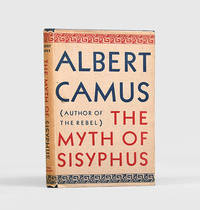
1955ref. 195244London: Hamish Hamilton 1955. One must imagine Sisyphus happy First edition in English including a new preface by Camus and collecting the title essay alongside "Summer in Algiers" "The Minotaur or The Stop in Oran" "Helen's Exile" "Return to Tipasa" and "The Artist and His Time". Camus's absurdist treatise on the philosophical problem of suicide was first published as Le Mythe de Sisyphe in 1942. Addressing his English readers Camus comments that "written fifteen years ago in 1940 amidst the French and European disaster this book declares that even within the limits of nihilism it is possible to find the means to proceed beyond nihilism. This book is in a certain sense the most personal of those I have published in English". It acts as a non-fictional companion to his novel L'Étranger 1942. The translator Justin O'Brien 1906-1968 was a professor of French at Columbia University who translated many works by Camus and certain works by Jean-Paul Sartre and André Gide including Gide's collected journals. Octavo. Original blue boards spine lettered in silver. With dust jacket. A few pages neatly marked up in pencil; jacket unclipped spine toned two short closed tears small chips to ends and corners: a very good copy in like jacket. hardcover
1955ref. 022279London: Hamish Hamilton. Original blue cloth in Dust Jacket. First English Edition. Provenance: From the library of Professor William B. Bjornstad with his small neat signature on the front free endpaper dated November 21 1955 the year of publication. Important statement of Camus philosophy of the absurd. Heffer written in small letters at foot of front flap of Dust Jacket Near Fine in Near Fine Dust Jacket. . Near Fine. Hardcover. 1st Edition. 1955. Hamish Hamilton hardcover
1951ref. 81830Protégé dans un étui-chemise signé DEVAUCHELLE. Couverture souple piquée. Rousseurs.
1962ref. 44658Gallimard | Paris 1962 | 12.50 x 19.50 cm | relié
1971ref. 78115Gallimard | Paris 1971 | 14.50 x 21.50 cm | broché
1953ref. 75124Paris: Nrf 1953. Fine. Camus a Reluctant Molière! Nrf Paris 1953 12 x 19 cm relié First edition of Albert Camus's theatrical adaptation one of 65 numbered copies on pur fil paper constituting the deluxe issue. Bradel-style binding in bronze-coloured half box calf boards covered with abstract-patterned paper smooth spine original wrappers and spine preserved binding signed by Thomas Boichot. Les Esprits has its roots in Camus's early theatrical career: he first adapted the play in 1940 for the Théâtre de lÉquipe the company he directed in Algiers and it was performed in Algeria in 1946. He revised it for the Angers Festival in June 1953 personally taking over the productions prepared by Marcel Herrand who had died just days before the premiere. Alongside it Camus staged his translation of Calderón's La Dévotion à la croix. First published in 1579 Larivey's comedy freely adapted from Lorenzino de' Medici's Aridosia owes its lasting reputation to Molière. In his foreword Camus describes it as « le modèle que prit Molière pour écrire son Avare » containing « le fameux monologue que Molière modifia à peine ». Condensing the original five acts into three Camus brings out the play's commedia dell'arte spirit recognising in Larivey's characters « dauthentiques figures darlequins et de ruffians » merely disguised under different names. In doing so he follows in the footsteps of Jacques Copeau his theatrical mentor. Less of an anomaly than it might initially seem this early theatrical venture infused with exuberance and playful lightness could well have served as a perfect prelude to Camus's cycle of the Absurd had he chosen to acknowledge it as such! Nrf hardcover