3983 risultati
1951rif. 92185Gallimard | Paris 1951 | 12 x 19 cm | Relié sous étui
1942rif. 80260Gallimard | Paris 1942 | 12 x 19 cm | broché sous chemise et étui
1951rif. 92185Paris: Gallimard 1951. Fine. Gallimard Paris 1951 12 x 19 cm Relié sous étui First edition one of 45 numbered copies on hollande most limited deluxe issue. Contemporary full red morocco spine with four raised bands framed with black fillets date gilt at foot taupe morocco doublures red silk endleaves gilt fillets and dots to board edges all edges gilt slipcase an elegant binding signed Favre-Petit-Mermet. A fine copy handsomely bound in full morocco with morocco doublures by Favre-Petit-Mermet. Gallimard hardcover

1946rif. 116373New York: Alfred A. Knopf 1946. First American edition of Camus' first novel and masterpiece. Octavo original beige cloth. Presentation copy inscribed by the author on the half-title page "A Muriel Sutman nous ne sommes pas des etrangers Albert Camus." Near fine in a near fine dust jacket. Jacket design by Warren Chappell. Translated by Stuart Gilbert. Housed in a custom half morocco clamshell box. Presentation copies of The Stranger are rare with only one appearing at auction in the past 70 years. Through the story of an ordinary man unwittingly drawn into a senseless murder on an Algerian beach Camus explored what he termed "the nakedness of man faced with the absurd." With the publication of this first novel L'Etranger The Stranger Camus introduced his lifelong attempt to reconcile a philosophy of heroic nihilism with "the ideal of human fraternity" Encyclopedia of Philosophy. It remains one of the classic works of the twentieth century. Alfred A. Knopf hardcover books
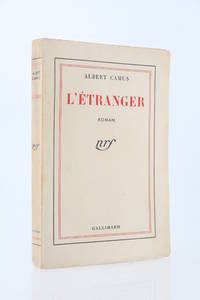
1942rif. 80260Paris: Gallimard 1942. Fine. Precious Advance Copy as Issued Gallimard Paris 1942 12 x 19 cm broché sous chemise et étui First edition first issue for which no grand papier deluxe copies were printed one of the rare service de presse advance copies. Some very discreet restorations to spine paper browned some discreet traces folds at the bottom of some leaves. A handsome copy as issued. The book is housed in a slipcase signed by Julie Nadot reproducing the original design of the cover and spine. This first edition of L'Étranger was printed on 21 April 1942 with a run of 4400 copies: 400 advance copies service de presse 500 copies without statement and 3500 copies with false statements from the second to eighth edition. The advance copies not intended for sale do not include the indication of price 25 francs on the back of the cover. Paper was rare in 1942 and Albert Camus being then an unknown author Gallimard did not print any deluxe grands papiers copies as was often the case. The advance copies or copies without false statements are particularly sought after. Precious and rare unsophisticated copy under an elegant slipcase by Julie Nadot. Gallimard unknown
rif. 5221ALBERT CAMUS 1913-1960. Camus was a Nobel Prize-winning French author best known for his absurdism and works like The Stranger and The Plague. AM. 5pgs. N.d. 1946. N.p. An autograph manuscript draft of Albert Camus’s famous “The Crisis of Man” or “The Human Crisis” speech. Camus delivered this landmark speech at Columbia University on March 28 1946 during his only trip to the United States. Asked to talk about the French sensibility Camus delivered a compelling meditation about the Second World War and the crisis facing all humanity. The tone is both stirring and thought-provoking. Camus had been a resistance fighter during the war and his experiences obviously color his speech particularly in his descriptions of atrocities committed during the war. In 2016 Columbia held an event to commemorate the 70th anniversary of Camus’s speech. There actor Viggo Mortensen read Camus’s speech to a sold-out crowd in the Miller Theatre – the same venue where Camus had spoken. Even three-quarters of a century after its debut “The Crisis of Man” remains relevant and timely and people continue to reflect on it today. This manuscript is Camus’s draft of the speech. As such it differs in some places from the version he actually delivered. The manuscript is written in French. The English translation is as follows: “When it was suggested to me to do lectures at the EUDA the United States I felt scruples and hesitated. I am not of the age to give lectures and It was in the reflex as well as the categorical affirmation since I don’t show myself in person at what is generally held to be the truth. Having taken notice of my scruples they gave the very polite response that the important thing was not that I have a personal opinion. What was important was that I would in a way bring to France the various elements of information that would permit my audience to form an opinion. As to what about it was proposed that I tell my listeners about the current state of French theater literature and even philosophy. I responded that it might be at least as interesting to speak about the extraordinarily hard work of the French railroad workers and the…of which the miners from the North seem to work. I was told patiently that you should never force your talent and that it was good that the specialists were treated by those who were suspicious of them and that since I had been interested in literary questions for a long time and thus certainly knew nothing about railroad switches it was only natural that I would be asked to speak about literature rather than the railroad. I understood right away. And I agreed in short to speak of what I knew and to give an idea of France. That is precisely why I chose to speak neither of literature nor of the theater. Because literature theater philosophy and maybe even the hard work of railroad workers and mail carriers intellectual research and the hard work of an entire people are only the reflections of a fundamental questioning of a struggle for life and for man reflections that for us make up the entire problem of the time. The French feel that man is quite threatened and that he cannot go on believing a certain idea of man who is not…And that is why out of loyalty to my country I chose to speak of my…And even if it were a matter of speaking about what I knew I did not believe I could do better than retrace as clearly as possible the spiritual experience of people of my generation because that experience has had the whole…of the world crisis and because it may bring a faint shimmer and faith to the destiny of the railroad workers and an aspect of today’s French sensibility. How did that happen In this world that is deprived of value in this desert of the heart where we live what did this revolt mean It made men who say no out of us. But at the same time we were men who say yes. We said no to this world to its essential absurdity to the abstractions that threatened us to the culture of death that was being prepared for us. By saying no we affirmed that things had been like that for long enough that there was a limit that could not be passed. But at the same time we affirmed everything that was beyond that limit; we affirmed that there was something in us that defended the scandal and that was impossible to humiliate too long. And of course that was a contradiction but one that had to make us reflect. We thought that this world was and would continue to be without any real value. But then again there we were fighting against Germany. The men of the Resistance whom I met and who read Montaigne on the trains where they carried their tracts showed at least to us that one could not understand the skeptics while having a notion of honor. But consequently through the simple fact of living of hoping and of fighting we affirmed something. But some thing had a general value – did it extend beyond the thoughts of the individual – did it seem to serve as a rule of conduct The answer is simple. The men I am talking about accepted their death at the start of their revolt. And that death proved that they were sacrificing themselves for the good of a pay-off that went beyond their personal existence and thus their individual destiny. What these revolutionaries defended against an enemy destine was a value that is shared by all men. – When the men were tortured in front of their concierge when the nights were purposefully chopped up when mothers saw themselves forced to condemn their children to death and when the just were buried like hogs these revolutionaries decided that something inside of them was being denied to them that did not belong to them alone but was a common bond where the men found their solidarity all ready. Yes that was the big lesson of these terrible years when the wrong done to a student in Prague would touch a blue-collar worker in a suburb of Paris and when the blood spilled on the banks of a central-European river would bring a Texas farmer to spill his on the soil of the Ardennes that he had never seen before. And that in itself was absurd and crazy impossible almost anyway to imagine. But that absurdity at the same time carried in it the lesson that we were all in a collective tragedy and what was at stake was our common dignity a feeling of communion with each other that was crucial to defend and to maintain. Aside from that we knew how to act and we learned how the individual in the most absolute moral denouement again can find enough values to rule his conduct. For if that communication between individuals in the mutual recognition of their dignity was the truth then it was that communication that had to be helped. And in order to maintain that communication it meant people had to be free because there is nothing in common between a master and a slave and you cannot talk and communicate with someone who is subservient. Yes servitude is a form of silence the most terrible of all. And in order to maintain that communication we had to make sure that injustice would disappear because there is no contact between one who is oppressed and one who profits from it. Envy too is in the domain of silence. And in order to maintain that communication we had to banish lying and violence for someone who lies closes himself off from other people and someone who tortures and uses force imposes the ultimate silence. Aside from the negation of the simple movement of our revolt we also drew moral strength from liberty and sincerity. 2 This crisis then is based on the impossibility of persuasion. People live and can do so only because of the notion that they have something in common where they can always meet. You always believe that by speaking humanely to a person you can get a humane reaction. Yet we have also discovered this: there are people you cannot persuade. It was impossible for a victim in concentration camps to even begin to explain to the SS who were beating her that they shouldn’t do it. The Greek mother whom I have mentioned could not persuade the German officer that the terrible choice he put her in was just impossible. It’s because the SS or the German officer didn’t represent a person anymore or persons but an instinct that had been elevated to an idea or a theory. Passion even if murderous would have been preferable. Because passion has an end and another passion another scream from the heart or flesh can convince it. But a person who is capable of caring sincerely about the ears that he himself has previously torn that man is not impassioned he is mathematical and no one can stop or convince him. 3This crisis is also about the replacement of natural objects with print that is to say the increase of bureaucracy. Contemporary man more and more puts an abstract and complicated machine between himself and nature which throws him back into solitude. When there is no more bread tickets appear. The French have only 1200 calories of nutrition a day but they have at least six different pieces of paper all stamped a hundred times. And it is like that all over the world where bureaucracy has not ceased to multiply. To come to America from France I used a lot of paper in both countries. So much paper that I suspect I could have printed this lecture on some of it and have it copied here without even having to show up. With the help of paper offices and functionaries we are creating a world where human warmth disappears where nobody can touch anybody else unless it is through the maze of what is called formalities. The German officer who flattered my comrade about his wounded ears thought he could do so because he had torn them and it was part of his job as a functionary so consequently that couldn’t be bad. To summarize one only dies or loves or kills anymore by permit. That is what you call at least I think so a good organization. 4 The crisis is also about the replacement of the real person with the political person. Individual passions are no longer possible only collective passions meaning abstract passions. We are all introduced to politics by agreeing or by force. What counts is not that you respect or spare the suffering of a mother but that a doctrine triumphs. And human pain is no longer a scandal but only a numeral in an addition whose terrible sum total cannot be calculated yet. 5 It is clear that all these symptoms are replicated in one single one which is at once the cult of effectiveness and that of abstraction. This is why today’s European knows only solitude and silence. And that is because he cannot join others with their values that they have in common. Since he is no longer defended by human respect based on his values the only alternative open to him from now on is to be victim or else executioner.” This highly-significant manuscript is in fine condition overall. It has some crossouts red pencil underlining light toning a couple of folded corners horizontal folds on every page and a small stain on the third page. unknown books
1946rif. 97850New York: Alfred A. Knopf 1946. First American edition of Camus' first novel and masterpiece. Octavo original beige cloth. Presentation copy inscribed by the author on the half-title page "A Vincent Sheean pour le remercier de savoir si bien parler de Stendhal Sympathiquement Albert Camus." The recipient Vincent Sheean was an American journalist and novelist. Sheean's most famous work was Personal History which won one of the inaugural National Book Awards: the Most Distinguished Biography of 1935. Film producer Walter Wanger acquired the political memoir and made it the basis for his 1940 film production Foreign Correspondent directed by Alfred Hitchcock. Sheean wrote the narration for the feature-length documentary Crisis 1939 directed by Alexander Hammid and Herbert Kline. He translated Eve Curie's biography of her mother Madame Curie 1939 into English. Sheean wrote Oscar Hammerstein I: Life and Exploits of an Impresario 1955 as well as a controversial biography of Dorothy Thompson and Sinclair Lewis Dorothy and Red 1963. He studied at the University of Chicago becoming part of a literary circle which included Glenway Wescott Yvor Winters Elizabeth Madox Roberts and Janet Lewis while he was there. Near fine in a near fine dust jacket. Jacket design by Warren Chappell. Translated by Stuart Gilbert. Housed in a custom half morocco clamshell box. Presentation copies of The Stranger are rare with only one appearing at auction in the past 70 years. Exceedingly scarce and desirable. Through the story of an ordinary man unwittingly drawn into a senseless murder on an Algerian beach Camus explored what he termed "the nakedness of man faced with the absurd." With the publication of this first novel L'Etranger The Stranger Camus introduced his lifelong attempt to reconcile a philosophy of heroic nihilism with "the ideal of human fraternity" Encyclopedia of Philosophy. It remains one of the classic works of the twentieth century. Alfred A. Knopf hardcover books
1946rif. 97850New York: Alfred A. Knopf 1946. First American edition of Camus' first novel and masterpiece. Octavo original beige cloth. Presentation copy inscribed by the author on the half-title page "A Vincent Sheean pour le remercier de savoir si bien parler de Stendhal Sympathiquement Albert Camus." The recipient Vincent Sheean was an American journalist and novelist. Sheean's most famous work was Personal History which won one of the inaugural National Book Awards: the Most Distinguished Biography of 1935. Film producer Walter Wanger acquired the political memoir and made it the basis for his 1940 film production Foreign Correspondent directed by Alfred Hitchcock. Sheean wrote the narration for the feature-length documentary Crisis 1939 directed by Alexander Hammid and Herbert Kline. He translated Ève Curie's biography of her mother Madame Curie 1939 into English. Sheean wrote Oscar Hammerstein I: Life and Exploits of an Impresario 1955 as well as a controversial biography of Dorothy Thompson and Sinclair Lewis Dorothy and Red 1963. He studied at the University of Chicago becoming part of a literary circle which included Glenway Wescott Yvor Winters Elizabeth Madox Roberts and Janet Lewis while he was there. Near fine in a near fine dust jacket. Jacket design by Warren Chappell. Translated by Stuart Gilbert. Housed in a custom half morocco clamshell box. Presentation copies of The Stranger are rare with only one appearing at auction in the past 70 years. Exceedingly scarce and desirable. Through the story of an ordinary man unwittingly drawn into a senseless murder on an Algerian beach Camus explored what he termed "the nakedness of man faced with the absurd." With the publication of this first novel L’Etranger The Stranger Camus introduced his lifelong attempt to reconcile a philosophy of heroic nihilism with “the ideal of human fraternity” Encyclopedia of Philosophy. It remains one of the classic works of the twentieth century. Alfred A. Knopf hardcover