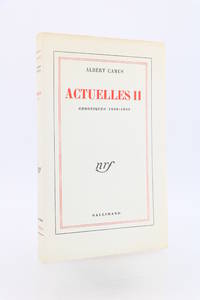
Albert CAMUSLivre Rare Book
Albert CamusLivre Rare Book
Actuelles II
Best.-Nr. 500292389Gallimard Sans date.

Démons et Merveilles · Joinville, Frankreich262,00 €
1953Best.-Nr. 46393Gallimard | Paris 1953 | 12 x 19 cm | broché
1953Best.-Nr. 47737Gallimard | Paris 1953 | 12 x 19 cm | broché
1953Best.-Nr. 49565Gallimard | Paris 1953 | 12 x 19 cm | broché
1953Best.-Nr. 63678Gallimard | Paris 1953 | 12 x 19 cm | relié
1953Best.-Nr. 92554Gallimard | Paris 1953 | 12 x 19 cm | Broché
1953Best.-Nr. 37971Couverture souple imprimée. Intérieur très frais. Non coupé.
Best.-Nr. 500292389Gallimard Sans date.
1950Best.-Nr. 12405Paris Gallimard 1950-1958 Prassinos Trois volumes in-12 cartonnage de l'éditeur beige et toile bleue pour le dernier, d'après les maquettes de Mario Prassinos (Huret, 90-92), 270, 186 et 212 pages. Bel ensemble sur vélin des papeteries Navarre de Voiron (n°1087/1050 pour le tome I, n°443/700 pour le tome II et n°397/1050 pour le tome III), édition en partie originale.
1953Best.-Nr. 28183Paris, Gallimard, 1950 et 1953. 2 vol. (120 x 190 mm) de 270 p. et 186 p. Brochés. Édition originale. Un des 260 exemplaires sur alfa mousse (n° 370 et 230).
1950Best.-Nr. 18878Par Albert Camus.Un des 130 sur vélin pur fil - Actuelle I (N°36) - Actuelle II (N°105) - Actuelle III (N°106).Editions originales. Paris Gallimard nrf - (1950) - (1953) - (1958). 270 p. - 186 p. - 212 p.Ouvrage broché sous couverture rempliée, imprimée en rouge et noir. Non coupé. Pas de rousseur. Très bon état. Format in-12°(19x12).
Best.-Nr. R150101698GALLIMARD .. 1977.. In-12. Broché. Bon état, Couv. convenable, Dos satisfaisant, Intérieur frais. 216 pages.. . . . Classification Dewey : 320-Science politique
Best.-Nr. 17414Paris, Gallimard, 1950. In-8, 267, broché, couverture originale imprimée (exemplaire fendu en deux, petites déchirures marginales et rousseurs).
1950Best.-Nr. R320110085GALLIMARD. 1950. In-12. Broché. Etat d'usage, Tâchée, Mors fendus, Intérieur frais. 270 pages - DATE ACHEVE D'IMPRIMER JUIN 1950.. . . . Classification Dewey : 70.4-Journalisme, chronique
Best.-Nr. LITT6283M1950 chez Gallimard - NRF. In-8, broché, 270 pages.
1950Best.-Nr. 48392Gallimard | Paris 1950 | 12 x 19 cm | broché sous chemise et étui
1950Best.-Nr. 100686Paris NRF Gallimard 1950 1 192x123mm, 267pp., in-12 broché. Edition originale, un des 260 (n°379) sur alfa mousse, 3ème papier après 23 Hollande et 130 pur fil. Non coupé, petites rousseurs en bas de couverture. (100686)
1950Best.-Nr. 056807Gallimard Broché Paris 1950 270 pages en format 12 - 18.5 cm - papier jauni
1953Best.-Nr. 92554Paris: Gallimard 1953. Fine. Gallimard Paris 1953 12 x 19 cm Broché First edition one of 260 numbered copies on alfa paper.Fine copy. Gallimard unknown
Best.-Nr. 500292389Gallimard. Sans date. Bon état Gallimard unknown
1953Best.-Nr. 63678Paris: Gallimard 1953. Fine. Rebels of all countries unite! Gallimard Paris 1953 12 x 19 cm relié First edition one of the review copies. A few marginal reading marks. Bradel binding in raspberry-red half morocco smooth spine with date at foot marbled paper boards original wrappers preserved top edge gilt. Binding signed by P. Goy & C. Vilaine. Signed autograph inscription from Albert Camus to Gilbert Sigaux his fellow contributor to Combat: "". avec l'affectueuse pensée de son vieux camarade.""A novelist winner of the 1949 Prix Interallié and journalist for Combat Sigaux had joined Camus in the activities of the Groupes de liaison internationale International Liaison Groups. The second volume of Camus's collected essays and commentaries Actuelles II brings together his polemical writings from 1948 to 1953. At its heart are the « Lettres sur la révolte » in which Camus responds to the attacks provoked by L'Homme révolté: those of André Breton the libertarians associated with Le Libertaire Francis Jeanson and through him Sartre. His letter to the editor of Les Temps modernes subsequently published under the title « Révolte et servitude » marked the definitive rupture between the two writers.Although Gilbert Sigaux like Camus had worked as a journalist for Combat and had published a highly favourable review of the first volume of Actuelles in its pages Camus's presentation of this new collection of politically engaged writings was far more than a gesture of professional gratitude.From November 1948 onwards the two men were united in a new struggle one fundamentally opposed to the Manichaean outlook for which Camus would later reproach Sartre:« Il ne sagit pas dajouter encore à la haine du monde et de choisir entre deux sociétés ».This conviction that uncompromising revolt need not entail the rejection of others was one of the founding principles of the Groupes de liaison internationale established in November 1948 at the initiative of the trade unionist Roger Lapeyre with Camus at their centre. Camus drafted most of the manifesto which Sigaux signed alongside him before becoming an active member of the organisation.Together they sought « de faire connaître en Europe lexistence des non-conformistes américains et des opposants russes de rendre une voix enfin à tout ce qui dans lhistoire déshonorée que nous vivons donnera à des millions de solitaires des raisons lucides et valables despérer ». Meeting at the offices of Force ouvrière in the rue de l'Université writers trade unionists and libertarians worked to support Spanish Republicans and refugees from Eastern Europe. Between 1949 and 1950 they published four bulletins one of which was devoted to forced labour in the USSR. Daniel Martinet himself a member would later write that their « seul ciment » was « la personnalité dAlbert Camus ». This humanist endeavour eventually came to an end following Camus's departure for South America and his illness in 1950 although as Martinet recalled « sans que les gens qui y avaient participé se perdent de vue » cf. Maitron.Actuelles II gives voice to the uncompromising yet fiercely independent political commitment that had brought the two men together through public interventions and a steadfast opposition to totalitarianism: Camus's speech opposing Francoist Spain's admission to UNESCO his address « Le pain et la liberté » to trade unionists in Saint-Étienne in May 1953 and his preface to Alfred Rosmer's memoir Moscou sous Lénine.An important review copy of this veritable manifesto of political independence personally inscribed by Camus to his « vieux camarade » a comrade in both the editorial battles of Combat and the wider struggle for their shared ideals. Gallimard hardcover
1958Best.-Nr. 52286Paris: Gallimard 1958. Fine. Gallimard Paris 1958 13 x 20 cm relié First edition one of 25 numbered copies on Hollande this one of 5 lettered hors commerce the tirage de tête. Half red morocco over marbled paper boards by Goy & Vilaine spine in six compartments endpapers and pastedowns of red paper covers and spine preserved top edge gil . A very good coop well-margined in a nice binding. Gallimard hardcover
1953Best.-Nr. 47737Paris: Gallimard 1953. Fine. Gallimard Paris 1953 12 x 19 cm broché First edition on ordinary paper. Handsome fine autograph inscription signed by Albert Camus : ""à Albert Béguin qui trouvera ici les raisons de mes désaccords avec Esprit avec mon bien cordial souvenir.to Albert Bégiun who will find here the reasons for my disagreements with the Spirit in friendly remembrance "" A little light spotting primarily to upper cover and ffep. Retaining its advertising notice entitled ""Lettres sur la révolte"". Gallimard unknown
1950Best.-Nr. 48392Paris: Gallimard 1950. Fine. Gallimard Paris 1950 12 x 19 cm broché sous chemise et étui First edition one of 23 numbered copies on Hollande paper the tirage de tête A fine unsophisticated copy. Gallimard unknown
1953Best.-Nr. 49565Paris: Gallimard 1953. Fine. Gallimard Paris 1953 12 x 19 cm broché First edition an advance service de presse copy. Autograph inscription from Albert Camus to Raymond Peju. Spine lightly but insignificantly sunned. Gallimard unknown
1953Best.-Nr. 46393Paris: Gallimard 1953. Fine. Gallimard Paris 1953 12 x 19 cm broché First edition an advance service de presse copy. Autograph inscription from Albert Camus to Constant Burniaux. Gallimard unknown