398 résultats
1818réf. 37713Paris, Hacquart, 1818, in-4, (8) CCXXII, 405 (1) pp, Demi-veau olive postérieur, dos lisse fileté à froid [Laurenchet], Édition originale du premier Codex pharmaceutique national français, rédigé en latin. La traduction française a paru quelques semaines plus tard, chez le même éditeur, sous le titre de Code des médicaments ou Pharmacopée française. Exemplaire authentifié par le timbre de la Faculté de médecine de Paris et par la signature autographe du doyen de la même Faculté. Cet ouvrage rare et fondamental fut publié par ordre du roi pour remplacer l'ancienne édition de 1748 qui "n'était plus au niveau des sciences chimiques". Sa réalisation, décidée à la suite de la réorganisation de la profession pharmaceutique en 1803 (loi du 21 germinal an XI), fut longue de quinze ans. La publication fut jugée sévèrement par la Société de Pharmacie de Paris, via son organe, le Journal de pharmacie de Paris, pour diverses raisons : l'obligation pour chaque officine de pharmacie d'en posséder un exemplaire fut considérée comme de la vente forcée, certains notèrent des maladresses dans les tournures latines, la classification des médicaments fut jugée incommode... (Sur ce sujet, voir Jean Flahaut, "La vie difficile du premier Codex national français", In: Revue d'histoire de la pharmacie, 88? année, n°327, 2000. pp. 337-344 [en Ligne].) Reliure moderne. Couverture rigide
1818réf. 88722Paris, Hacquart, 1818, in-4, [8]-CCXXII-405-[1] pp, Vélin rigide postérieur, Édition originale du premier Codex pharmaceutique national français, rédigé en latin. La traduction française a paru quelques semaines plus tard, chez le même éditeur, sous le titre de Code des médicaments ou Pharmacopée française. Exemplaire authentifié par le timbre de la Faculté de médecine de Paris et par la signature autographe du doyen de la même Faculté. Cet ouvrage rare et fondamental fut publié par ordre du roi pour remplacer l'ancienne édition de 1748 qui "n'était plus au niveau des sciences chimiques". Sa réalisation, décidée à la suite de la réorganisation de la profession pharmaceutique en 1803 (loi du 21 germinal an XI), fut longue de quinze ans. La publication fut jugée sévèrement par la Société de Pharmacie de Paris, via son organe, le Journal de pharmacie de Paris, pour diverses raisons : l'obligation pour chaque officine de pharmacie d'en posséder un exemplaire fut considérée comme de la vente forcée, certains notèrent des maladresses dans les tournures latines, la classification des médicaments fut jugée incommode... (Sur ce sujet, voir Jean Flahaut, "La vie difficile du premier Codex national français", In: Revue d'histoire de la pharmacie, 88? année, n°327, 2000. pp. 337-344 [en Ligne].) Couverture rigide
1918réf. 3041317Rom, Sumptibus Pontificii Instituti Biblici 1918. IV, 61 Seiten, mit 3 Facsimiles auf Tafeln, Gr. 8° (25 x 17,5 cm), Hardcover (gebunden), Priv.- Halbleineneinband.
1918réf. 3043109Rom, Sumptibus Pontificii Instituti Biblici 1918. IV, 61 Seiten, mit 3 Facsimiles auf Tafeln, Gr. 8° (25 x 17,5 cm), Hardcover (gebunden), Priv.- Halbleineneinband.
1918réf. 3110922Rom: Sumptibus Pontificii Instituti Biblici 1918. IV, 61 Seiten. Mit 3 Faksimiles auf Tafeln. Gr. 8° (25 x 17,5 cm). Orig.-Broschur. [Softcover / Paperback].
1982réf. 3118314Göttingen: Vandenhoeck & Ruprecht 1982. 103 Seiten. Gr. 8° (22,5-25 cm). Orig.-Broschur. [Softcover / Paperback].
1976réf. 21520Reprint, Gent, de Backer, 1976, in-8, (26), 128, (12)pp, cartonnage éditeur, Reprint en facsimilé de l'édtion parue à Paris en 1638. Avec une introduction de Pierre Julien (26), 128, (12)pp.
1839réf. 152511839 1 volume comprenant 2 tomes reliés ensemble (1 volume composed of 2 books linked together), cartonné in-octavo (hard-back in-octavo), dos muet gris (grey spine without title), papier vert aux plats (green paper on the covers), coupes frottées (rubbed cuts), toutes tranches peignées (all painting edges), manque la page de garde qui est en regard de la page de titre (it misses the endpaper in facing the title page), sans illustration (no illustration), rousseurs (redness marks), petites cicatrices de mouillures en début d'ouvrage en marge de queue (small scars of waterstains at the beginning of the work on the margin of bottom), LVI+XVI+535 pages et 1 feuillet (1 leaf) + 218 pages + 1 feuillet de catalogue de Béchet (1 leaf of Béchet's catalog), 1839 à à Paris Béchet Jeune Libraire de la Faculté de Médecine de Paris - 4 place de-l'Ecole-de-Médecine - 1841 à Paris Béchet Jeune et Labé Libraires de la Faculté de Médecine de Paris - 4 place de-l'Ecole-de-Médecine,
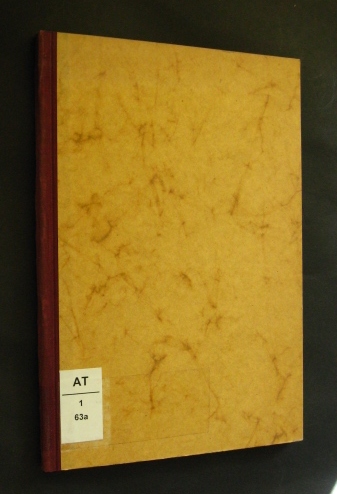
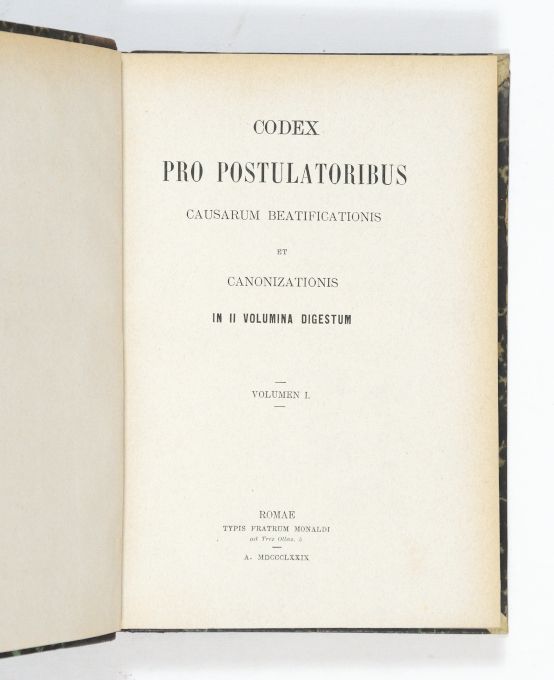
1879réf. 61152Rom, Typis Fratrum Monaldi, 1879. 8°. VIII, 100 S.; 2 Bll., 331 (1) S., HLdr. d. Zt. m. Rückenverg. u. goldgepr. Rückentitel.
2014réf. 72065Das Wilde Dutzend, 2014. Origi.Leinenband, gr.8°, 95 Seiten.
1993réf. CODEX100MCODEX SERAPHINIANUS – Luigi Serafini. Édition Franco Maria Ricci (1993) – langue française. Complet avec coffret 37x25,5cm / boîte d’origine. Excellent état, livre comme neuf, traces d'usage mineures sur le coffret quasi anodin.
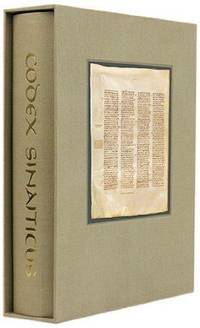
réf. 42603London: The British Library 2011. 2 Vols. folio 450 x 360 mm introduction volume: 31pp. orig. printed wrappers facimile volume: 822 pages of coloured facsimiles orig. cloth slip-case some light spotting. The facsimile is an enormous and extremely heavy book. Codex Sinaiticus is one of the worlds most remarkable books. Written in Greek in the fourth century it is the oldest surviving complete New Testament and one of the two oldest manuscripts of the whole Bible. No other early manuscript of the Christian Bible has been so extensively corrected and the significance of the Codex Sinaiticus for the reconstruction of the Christian Bibles original text the history of the Bible and the history of western book making is immense. This magnificent printed facsimile reunites the text now divided between the British Library the National Library of Russia St Catherines Monastery Mt Sinai and Leipzig University Library. London: The British Library, 2011 hardcover
1993réf. 2139365Schömberg: F. H. Baader und H.-J. Grieser 1993. 534, (8) Seiten. 8° (17,5-22,5 cm) Orig.-Kunstlederband mit goldgeprägtem Rückentitel. [Hardcover / fest gebunden].
2 Vols., folio (450 x 360 mm), introduction volume: 31pp., orig. printed wrappers, facimile volume: 822 pages of coloured facsimiles, orig. cloth, spine slightly creased, slip-case, the facsimile is an enormous and extremely heavy book. Codex Sinaiticus is one of the world's most remarkable books. Written in Greek in the fourth century, it is the oldest surviving complete New Testament, and one of the two oldest manuscripts of the whole Bible. No other early manuscript of the Christian Bible has been so extensively corrected, and the significance of the Codex Sinaiticus for the reconstruction of the Christian Bible's original text, the history of the Bible and the history of western book making is immense. This magnificent printed facsimile reunites the text, now divided between the British Library, the National Library of Russia, St Catherine's Monastery, Mt Sinai and Leipzig University Library.
2005réf. Q-1841547123Games Workshop 2005-01-01. Paperback. New. In shrink wrap. Looks like an interesting title! Games Workshop paperback
2018Einband leicht berieben, sonst in hervorragendem Zustand. - Welches Material verwendet der Künstler für sein Kunstwerk? Welche Bedeutung trägt das Material? Wie wird es eingesetzt und verändert? Diese für die Kunstgeschichte grundlegenden Fragen stellen sich auch allen, die sich mit mittelalterlichen Handschriften beschäftigen. In Codex und Material werden in zwölf Beiträgen Stoffe und Materialien zur Herstellung und Gestaltung eines Codex, ihre symbolische, ästhetische, sinnliche oder historisch-kulturelle Bedeutung sowie die technologischen Grundlagen untersucht. Ausgewiesene internationale Autorinnen und Autoren behandeln konkrete Elemente des Buches wie Einband und Schrift, Seiten- und Buchgestaltung (mise en page, mise en livre) sowie die unterschiedlichen Funktionen von Rolle und Codex für das Gefüge von Text und Bild. Weitere Themen sind die Wiederverwendung und Fragmentierung von Papier, Pergament und Stoff als Zeugnisse kontextueller Rezeption; die Konzipierung und Wahrnehmung des Bucheinbandes; die taktile Annährung an den Codex; das Spannungsverhältnis zwischen nachgewiesener und imaginierter Materialität am Beispiel des Goldes; die Effekte veristischer Materialwiedergabe und der Illusionismus in der Buchmalerei; die Verbindung zur transzendenten Welt durch materielle Erfahrung sowie die Grenzen der Materialität. Auf diese Weise leistet der streng thematisch konzipierte Band einen wichtigen Beitrag zum aktuellen, die Disziplinen übergreifenden wissenschaftlichen Diskurs über die materielle Seite von Generierung, ästhetischer Behandlung und Kommunikation von Wissen. ISBN 9783447109376
1965Riproduzione in facsimile del prezioso codice redatto in lingua greca. Volume in copertina rigida con legatura in pelle, titolo impresso in oro al piatto e al dorso, sovraccoperta originale il tutto contenuto in un robusto cofanetto editoriale muto. A chiusura del volume, in apposita tasca, è conservato un agile manuale introduttivo in lingua italiana di 22 pagine. Opera in condizioni eccellenti; spedizione in 24 ore dalla conferma dell'ordine.
1921réf. 132199Frankfurt a. M. Antiquariat Joseph Baer 1921. 312 Seiten. Mit 57 meist gefalteten Tafeln u. zahlreichen Abbildungen im Text. Originalbroschur. (Einband u. Seitenränder teils fleckig). 26x19 cm
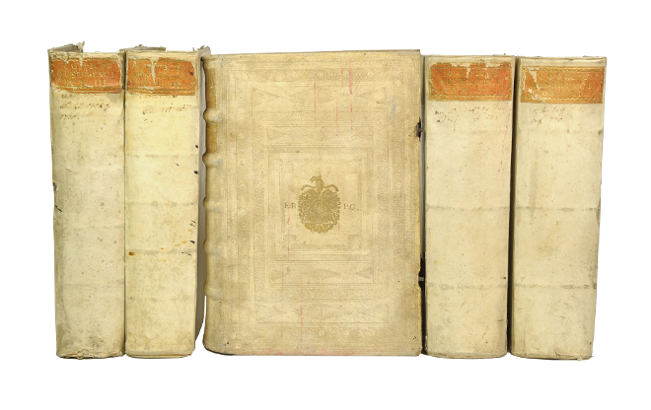
1777réf. 51944Wien (bzw. Leipzig), Voigt; Trattner bzw. Eisfeld, 1704-1777. Fol. Blindgepr. Schweinsldr.-Bd. d. Zt. a. 5 Bünden m. goldgepr. bischöflichem Wappensupralibros mit den Initialen ?E.P.P.C.?, goldgepr. Rückenschildern, dreiseitigem Farbschnitt u. einer (statt 2) Schließe (Bde. 1 u. 2 in einem Band) bzw. Pgmt.-Bde. d. Zt. m. goldgepr. Rückenschild (Bde. 3-6).
1932réf. 271043Typis Polyglottis Vaticanis, Romae, 1932. XX, 1034 Seiten. Originalhalbleinen. 24 cm
réf. 7335, Utrecht, Oosthoek, 1950., Gebonden in leder, goudopdruk op platen en rug, originele omslagwikkel, 18x26cm, 512pp + 469pp, geillustreerd z/w.
1611réf. 2812Wittenberg, Wolfgang Meissner u. Klemens Berger, 1611. 4to. Mit mehreren Vignetten u. Initialen in Holzschnitt. Titel in Rot u. Schwarz. 8 nn., 427 numer. (recte 426), 34 nn. Bl. Pgt. d. Zt.
1720réf. AUB-5887LIPSIAE, sumptibus J.O. FRIDERICI GLEDITSCHII B. FILII. Anno MDCCXX. Bel exemplaire relié, reliure d'origine plein parchemin, 29x23, page de titre, portrait gravé en pleine page, hommage, préface, 64 pages + 1028 pages + 792 pages + index omnium titulorum .
1648réf. 270600Antverpiae: Apud Ioannem & Iacobum Meursios<Meursius> 1648. [28] Bl., 504 S., [8] Bl., 296 S., [4] Bl., 170 S., [31] Bl. : Titelkupfer, Titelblatt in Rot- und Schwarzdruck. 2°. *Enth. jeweils mit eigenem Titelblatt u. Titelkupfer: Decretales D. Gregorii Papæ IX. Svæ Integritati Restitvtæ / Liber Sextvs Decretalivm D. Bonifacii Papæ VIII. Svæ Integritati Vna Cvm Clementinis Et Extravagantibvs, Restitvtvs* Der Einband wurde vermutlich in der ersten Hälfte 20. Jh. unterVerwendung des alten Leders restauriert - ist jedoch wieder defekt. Rücken lose beiliegend, vorderer Deckel fast lose* Text u. Kupfer schon und sauber* Namenseintrag von 1840 auf Titel und Vorsatz*.
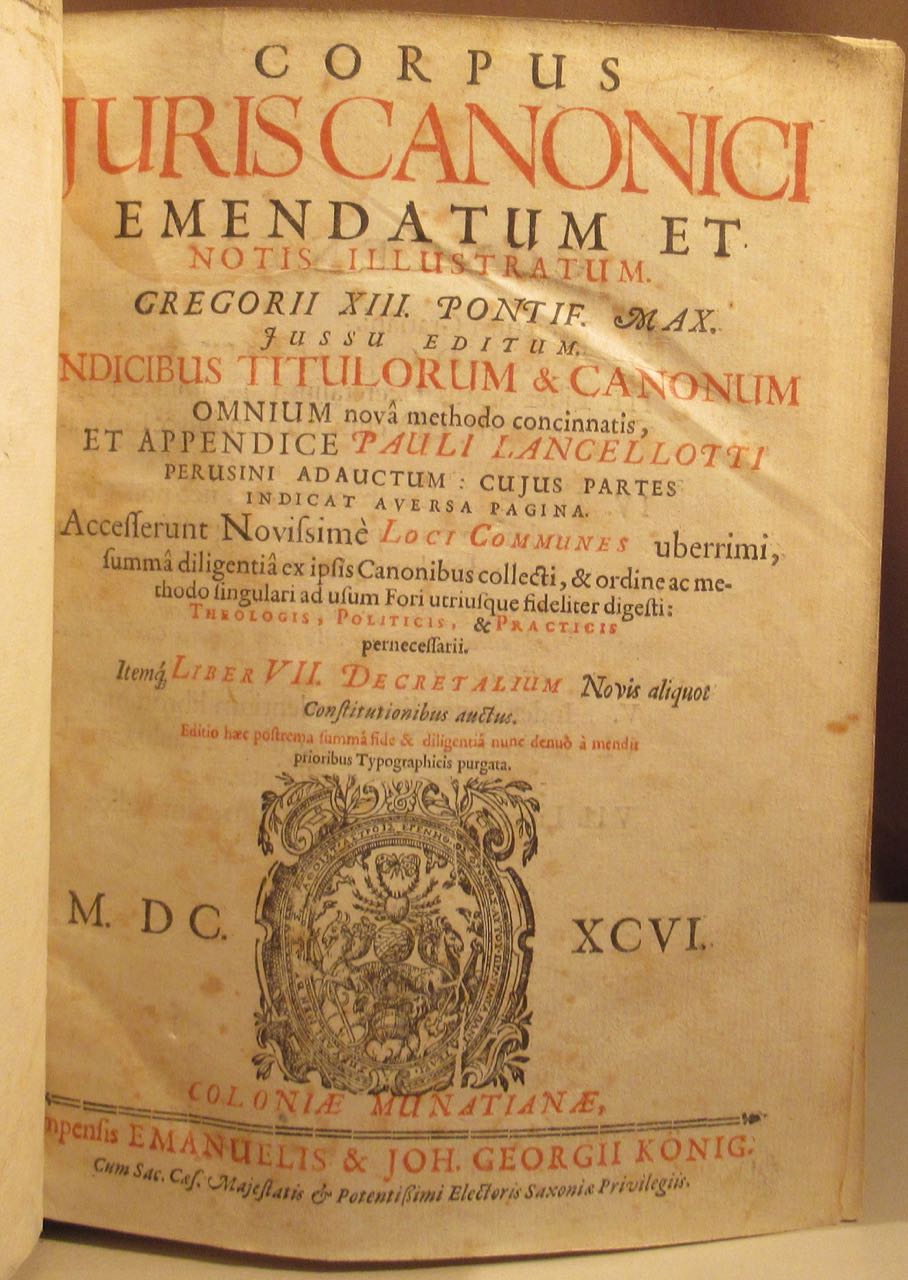
1696réf. 89630Coloniae Munatianae (Basel), König 1696. 1696. Gr.-8° Titel in Rot- u. Schwarzdruck m. Druckermarke, 16 Bll., 1279 Sp.; 6 Bll., 754 Sp.; 7 Bll., 406 Sp.; 4 Bll., 158 Sp., (1 S.); 42 Bll., 236 Sp., 10 Bll.; 8 Bll.; 43 Bll. Zweispaltig gedruckt, mit einigen Holzschnittvignetten. Schweinsleder der Zeit über Holzdeckeln.