ARRIEN.Livre Rare Book

8.123 resultados
1539ref. 12105Basilae, [Robert Winter], 1539. In-8 (100 x 155 mm) de 13-(2) pp. 1 p.bl. (640) pp. (∂8, a-z8, A-R8), peau de truie sur ais de bois estampée à froid, portraits couronnés en encadrement, dos à 3 nerfs (reliure de l'époque).
1821ref. 000071Paris Desoer 1821
1829ref. 4168Nebst praktischer Anweisung bei verschiedenen Manieren in der Steindruckerei etc. für Steinbereiter, Steinzeichner, Steindrucker und Liebhaber dieser Kunst. Aus dem Französischen. Zweite vermehrte Ausgabe. Mit 19 Abb. auf 6 gefalt. lithograph. Tafeln. Ulm, J. Ebner, 1829. Klein-8vo. (14,8 x 8,9 cm). 160 S. (ab S. 156 Anzeige). Marmorierter Halblederband d. Zt. [4 Warenabbildungen]
1900ref. 11031Paris, Imprimerie Nationale, 1900-1914. 29550 g 4 volumes in-folio, en feuilles sous portefeuilles, [1] fb., [5] ff., xxiv-490 pp.; [2] ff., 572 pp.; [3] ffb., [3] ff., 550 pp., [3] ffb.; [1] fb., xxvii-528 pp.. Illustré de 36 planches hors-texte dont 35 en couleurs et une sur double-page en noir; et d'innombrables fac-similés in-texte. Exemplaire dont les trois premiers volumes sont imprimés sur vélin et le dernier sur japon; et qui contient de plus un fascicule de présentation de [6] ff. et une carte de visite d'Arthur Christian, directeur de l'Imprimerie Nationale. Le quatrième tome, est paru en 1914, après la mort d'Anatole Claudin, et a été achevé sous la direction de Léopold Delisle et de Paul Lacombe. La publication de cet ouvrage fondamental et monumental est restée inachevée. Rare ensemble. Des rousseurs, salissures et restaurations aux portefeuilles. . (Catégories : Imprimerie, Bibliographie, )
1690ref. 42054La Correrie, Claude Faure, 1690. 2 parties en 1 vol. in-8 de (12) pp. (lettre-préface et table) 343-(3) pp., veau brun orné à froid, dos à nerfs, double encadrement et fleurons sur les plats, tranches rouges (reliure de l'époque).
1819ref. 3445Louis Janet, (Imprimerie de Richomme), s.d. (1819)
1933ref. 002794Paris, Librairie Plon (Imprimerie Lahure), 1933
Broadsheet. 1 p. Oblong folio (515 x 386 mm). With papered red wax seal. Folded. An ordinance outlawing Hungarian "Dreyer" coins (denars) in Lower Austria: within three months, all such coins had to be changed into Austrian currency at a rate of one "Dreier" to 2½ Viennese pfennigs. - Signed in their own hand by the Lower Austrian Deputy Governor Oswald Baron Eytzing, by the chancellor Dr. Gregor von Ödt, by Eustach von Althan, and by Dr. Elias Corning. Starzer, Regesten aus dem k. k. Archiv für Niederösterreich (1906), Nr. 5564.
1600ref. 15280Douai, Jean Bogart, 1600. In-8 de (8)-201-(7) ff., vélin rigide à recouvrements, titre manuscrit sur le dos, traces de lacets (reliure de l'époque).
1612ref. 42773Béziers, Jean Pech, 1612. Béziers, Jean Pech, 1612. In-12 sur deux colonnes de (18)-268-(1) pp. 1 f.bl. (12) pp. de table, caractères romains et italiques, basane marbrée, dos orné à nerfs, pièce de titre en maroquin rouge, tranches jaspées (reliure du XVIIIe siècle).
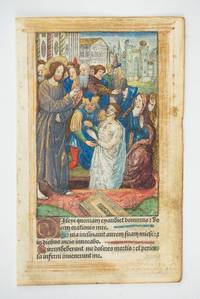
1520ref. ST12778-0887cParis: Gilles Hardouyn ca. 1520. 177 x 110 mm. 7 x 4 1/4". Single column 33 lines in an attractive gothic type. With hand-illuminated initials and a FULL-PAGE MINIATURE DEPICTING THE RAISING OF LAZARUS ILLUMINATED IN COLORS AND GOLD BY A CONTEMPORARY HAND. See Hilary Maddocks "A Book of Hours by Anthoine Vérard" University of Melbourne Collections issue 16 2015 pp. 19-20. One quarter-inch repair to the center of the leaf which on the recto slightly affects Lazarus' neck and on the verso affects three letters which have been neatly touched up a handful of small chips to the paint the architectural border somewhat rubbed in the lower right corner mild soiling to the margins; not without flaws but a richly and carefully colored leaf that is still pleasing. Richly painted and amply highlighted with brushed gold this leaf from a printed Book of Hours includes a large miniature depicting the raising of Lazarus. Christ stands arm extended in benediction over the newly reawakened Lazarus who gazes up at him standing upright in his grave. A crowd looks on with a well-dressed man crouched in front of the grave apparently having helped Lazarus to stand. Our illuminator has enhanced the drama of the moment with the rosy cheeks of the bystanders emphasizing Lazarus' deathly pallor and with Jesus' shimmering robe distinguishing him from the crowd. The faces and folds of cloth are delicately shaded and the minutely detailed lines of gold carefully applied stylistically tying this printed leaf to the fully hand-painted Books of Hours that printed versions were slowly replacing during the early years of the 16th century. The composition seems to come from a suite of illustrations designed by illuminator Jean Pichore fl. 1490-1521 done for the printer Gilles also Gillet Hardouyn. Gilles Hardouyn (?) unknown books
1520ref. ST12778-0887cParis: Gilles Hardouyn ca. 1520. 177 x 110 mm. 7 x 4 1/4". Single column 33 lines in an attractive gothic type. With hand-illuminated initials and a FULL-PAGE MINIATURE DEPICTING THE RAISING OF LAZARUS ILLUMINATED IN COLORS AND GOLD BY A CONTEMPORARY HAND. See Hilary Maddocks "A Book of Hours by Anthoine Vérard" University of Melbourne Collections issue 16 2015 pp. 19-20. One quarter-inch repair to the center of the leaf which on the recto slightly affects Lazarus' neck and on the verso affects three letters which have been neatly touched up a handful of small chips to the paint the architectural border somewhat rubbed in the lower right corner mild soiling to the margins; not without flaws but a richly and carefully colored leaf that is still pleasing. Richly painted and amply highlighted with brushed gold this leaf from a printed Book of Hours includes a large miniature depicting the raising of Lazarus. Christ stands arm extended in benediction over the newly reawakened Lazarus who gazes up at him standing upright in his grave. A crowd looks on with a well-dressed man crouched in front of the grave apparently having helped Lazarus to stand. Our illuminator has enhanced the drama of the moment with the rosy cheeks of the bystanders emphasizing Lazarus' deathly pallor and with Jesus' shimmering robe distinguishing him from the crowd. The faces and folds of cloth are delicately shaded and the minutely detailed lines of gold carefully applied stylistically tying this printed leaf to the fully hand-painted Books of Hours that printed versions were slowly replacing during the early years of the 16th century. The composition seems to come from a suite of illustrations designed by illuminator Jean Pichore fl. 1490-1521 done for the printer Gilles also Gillet Hardouyn. Gilles Hardouyn (?) unknown
First edition, 8vo (235 x 145mm), viii, 139, [1]pp., text browned as usual, orig. cloth, orig. printed label (effaced), rubbed, uncut, overall a very good copy of this scarce work. Isaac Leeser (1806-1868), a distinguished author, translator, editor, and a national leader of the American Jewish community, considered himself, first and foremost, an educator. This being his first published work since arriving in America, the first English translation of a textbook on the religious instruction of Jewish children. Provenance: Ink signature of Jos. Hess, 1831 on front paste-down; ownership stamp of Rabbi Sidney Kay, Southport (UK) to front free-endpaper. Rosenbach, American Jewish Bibliography. 321.
Crown 8vo (246 x 150 mm), ff. 63, tipped-in is a small folio sheet (280 x 213 mm) printed of one side only "Prices of Type and Materials Manufactured and Sold by Stephen Sutton & Co. at the Caxton Letter Foundry...", later quarter red morocco, green boards. A very rare specimen of printing types from this little known foundry. The specimen begins with 34 samples of different size font from "the most modern faces, cut by artists of first-rate skill and acknowledged talent." Then follows 27 priced specimens of "a beautiful and extensive assortment of Stereotype Ornaments." The tipped-in price list is printed in double-column and gives prices for type, wood type, leads' and metal furniture, galleys, brass rule, cases, frames, and furniture. At the foot is a list of "Agents for the Country": Mr. Joseph Graham, 2 Jewry Street, Aldgate; Mr Simmons, Artillery Lane, Bishopsgate Street; Messrs. Renshaw and Kirkman, Budge Row; Messrs. Shepherd and Sutton, Foster Lane. Provenance: From the typographical library of John Lewis (his bookplate) and John Brinkley (his signature). The only other copy recorded is that of The British Library.
1930ref. 178912Shanghai: Wah-Foong Printing Company and Type Foundry c. 1930. A rare example of a Republican-era printer's sampler offering clients a wide range of German lithographic inks to print halftones and text. Founded in 1915 Wah-Foong operated out of the British Concession and had a production plant and a Nanjing branch. In 1927 it moved the plant to 100 Lincoln Road Shanghai the address given on the front cover of this example. After the 1949 revolution the plant was absorbed into the state-run printing system as Shanghai Number One Matrix Plant. Landscape quarto. With dozens of leaves printed with specimen colours; blanks with cover sheets at end for mounting additional samples. Text in Chinese. Original red card wrappers front cover printed in black and white. Old shelf label on spine pencil annotations in text. Rubbed spine consolidated with adhesive one cover sheet torn away sample creased: very good. unknown
4to, 48ff. printed on one-side only (many of puzzles and diagrams), title within an ornamented border, orig. embossed decorated green cloth, re-backed with part of the orig. spine laid-down, all edges gilt, a nice copy. An extremely rare compilation of puzzles and oddities designed to occupy the mind during the 'blank hours of life'. Printed at the home of Nathaniel Brown Engleheart of Blackheath, on the little Parlour press, the author gives "An Apology in lieu of a Preface. Kind Reader! be not severely censorious. ? This little book has the production of the 'lighter' hours of a nearly 'worn out' mind that prays your lenience. ? It has been the result of endeavours to escape idleness, and to occupy those blank hours of life which in a greater or lesser degree assail all. In this respect its purpose has been fulfilled. ? It entertains no hope of 'Approval', it aspires only to 'Indulgence'.". The only other copy located is that of the British Library.
1565ref. 31640Basel Per Ambrosium et Aurelium Frobenios Fratres 1565 March -on colophon. Folio. One cont. full vellum w. six raised bands on back. The boards have perhaps been covered with vellum a bit later. A few wormholes to upper and lower part of back. Inner hinges a bit weak but binding sound. Some leaves brownspotted but overall internally nice. Cont. inscription in ink on top of t-p. "Domus Casa Professore Romana Socieded Jesu". Woodcut printer's device on t-p. Woodcut initials three of which are large 49 x 49 cm. 348 279 190 2 66 -Index pp. The rare first Langi/ Langum-edition and third Latin edition of the Opera of Justin. The first edition of the Opera in the original Greek appeared in 1551 Paris Stephanus. The first Latin edition appeared in 1554 Basel Dupuys the second the Galen-edition in 1555 Basel Hier. Froben & Nic. Episcopius and the third the Langi-edition in 1565. This is probably the best of the Latin editions and the Latin version of the Opera by Jo. Langi was also used for the standard Greek-Latin parallel editions of 1593 and 1615. Justin the Martyr 100 - 165 AD was a Christian philosopher who was brought up a pagan. He is primarily known for his dailogues and his apologies all of which are present here. The apologies constitute the earliest Christian ones of some length. He died a martyr in Rome after having been condemned a Christian by Q. Junius Rusticus. As a philosopher he dealt with Stocism Aristotelianism and Pythagoreanism before he meant to have found the truth in Platonism. Philosophically he is most interesting in his attempt to unite Christianity with philosophy i.e. Platonism as Boethius did a few centuries later and Justin actually anticipates the philosophy of history of Origin ca. 185 - ca. 255 and Eusebius ca. 260 - 340. He is very interesting when viewed as a thinker who represents the union of philosophy and thought with the new religious attraction in the Eastern part of the Empire under Antonius Pius i.e. Christianity.Graesse III:515 Adams J:497 not in Brunet. hardcover
1565ref. 31640Basel, Per Ambrosium et Aurelium, Frobenios Fratres, (1565, March, -on colophon). Folio. One cont. full vellum w. six raised bands on back. The boards have perhaps been covered with vellum a bit later. A few wormholes to upper and lower part of back. Inner hinges a bit weak, but binding sound. Some leaves brownspotted, but overall internally nice. Cont. inscription in ink on top of t-p. (""Domus Casa Professore Romana Socieded Jesu""). Woodcut printer's device on t-p. Woodcut initials, three of which are large (4,9 x 4,9 cm). 348, 279, 190, (2), (66, -Index) pp.
1883Complete series of 9 volumes + 1 supplement ; v,320 + 320 + 371 + xii,331 + viii,331 + xi,334 + xi,363 + ix,637 pp. + Supplement: 408pp. (Antwerp, 1955), original softcovers, vols. 1-9 are printed by J.E. Buschmann in Antwerp, published in the series "Uitgaven der Antwerpsche Bibliophilen" nos.12-15-26-29-30-31-32-33-34, Vols.1-7-8-9 are still uncut, Vol.8-9 in one physical volume, printed on handmade paper (except for vol.1), vols.3-6 with wide margins ; 26x18cm., weight: 7kg., [Rare complete set of the first and only edition of correspondence by Chr. Plantijn, 1555-1589], B102944
1883ref. B102944Antwerpen, Antwerpsche Bibliophilen 1883-1918 & 1955 Complete series of 9 volumes + 1 supplement ; v,320 + 320 + 371 + xii,331 + viii,331 + xi,334 + xi,363 + ix,637 pp. + Supplement: 408pp. (Antwerp, 1955), original softcovers, vols. 1-9 are printed by J.E. Buschmann in Antwerp, published in the series "Uitgaven der Antwerpsche Bibliophilen" nos.12-15-26-29-30-31-32-33-34, Vols.1-7-8-9 are still uncut, Vol.8-9 in one physical volume, printed on handmade paper (except for vol.1), vols.3-6 with wide margins ; 26x18cm., weight: 7kg., [Rare complete set of the first and only edition of correspondence by Chr. Plantijn, 1555-1589], B102944
2004EIGHTEEN VOLUME SET. Contains color and b&w plates. 310x240mm. Gilt hardcover. All volumes are in good condition. PLEASE NOTE: This item is overweight. We may ask for extra shipping costs.
1769ref. 36938Leipzig; Wien: Johan Paul Krauss 1769. First Edition. With 24 folding plates. xxv 436 12 index & errata; xl 524 18 index & errata. 1 vols. 8vo. Contemporary three quarter red morocco and marbled boards spine label. Exterior worn tear at foot of spine internally tight and clean. A very good copy. First Edition. With 24 folding plates. xxv 436 12 index & errata; xl 524 18 index & errata. 1 vols. 8vo. Includes notices of Berlin artists graphic arts engravers early woodcuts & woodcut books history of printing and account of a journey through Lower Saxony Westphalia & and Holland. Part Two with striking images from early printed books such as the "Eagle of John" from Ars Memorandi includes "a dissertation on the earliest forms of wood-cutting as applied to the illustration . Heinecken conjectures that Gutenberg took the idea of printing from the playing-card makers who are said to have been the first engravers of historical subjects intermingled with texts. . Heinecken is of opinion that their first productions were taken from wooden blocks." Bigmore & Wyman. Bigmore & Wyman p.320 Johan Paul Krauss unknown books
1740ref. 36937La Haye: La Veuve Le Vier et Pierre Paupie 1740. First edition. Engraved allegorical frontispiece by Schley. 2 parts in one volumes. 1 vols. 4to. Contemporary French mottled calf gilt spine marbled endpapers. Upper joint starting at bottom and apart from some minor toning this is a lovely unsophisticated copy in contemporary dress. First edition. Engraved allegorical frontispiece by Schley. 2 parts in one volumes. 1 vols. 4to. Printed by Prosper Marchand a Huguenot publisher and journalist who fled France in 1709 the work appeared at the 300th anniversary of the invention of printing. Marchand writes that he produced the book "a la sollicitation de quelques amis qui ont cru que le troisième jubile ou la troisième année séculaire de l'imprimerie reveilleroit infailliblement la curiosité du publique touchant l'origine de ce bel art at the request of some friends who believed that the third jubilee or the tercentenary of printing would infallibly wake the public curiosity concerning the origin of this beautiful art." The allegorical frontspiece by J.V. Schley show Minerva and Mercury descending from Heaven granting the gift of printing to Germany who in turn gives it to England Holland France and Italy. Bigmore & Wyman II p. 22 La Veuve Le Vier et Pierre Paupie unknown books
1789ref. 372509Nuremberg: Grattenauer 1789. First edition. 16 178 5 iindex pp. 1 vols. 4to. Near contemporary glazed brown calf spine gilt paste paper endleaves edges red. Some rubbing very good overall an attractive copy. First edition. 16 178 5 iindex pp. 1 vols. 4to. Important chroncile of the early printers of Nuremberg. Bigmore & Wyman II 114 Grattenauer unknown books
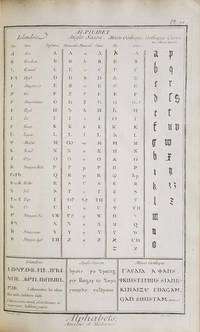
1772ref. 41090Paris 1772. Pp. 1-3 4 blank; 8 copper-engraved plates Goussier del. Prévost fecit.; 1-17 18 blank; 25 copper-engraved plates Goussier or Des Hauterayes del. Niodot Sculp. 1 vols. Folio. Removed. In later paper wrappers. Some soiling to margins adhesion of wrappers at gutter of first and last pages generally near fine. Pp. 1-3 4 blank; 8 copper-engraved plates Goussier del. Prévost fecit.; 1-17 18 blank; 25 copper-engraved plates Goussier or Des Hauterayes del. Niodot Sculp. 1 vols. Folio. An important selection of 33 printing-related plates from the Récueil de Planches that extraordinary illustrated supplement to the magnificent Encyclopédie of Diderot and d'Alembert. The plates depict the typefounding process and the alphabets and characters of more than 40 languages from Assyrian and Hebrew to Chinese Tibetan Japanese and Bengali; the explanatory text gives a concise account of the various arts and a more detailed account of linguistic scholarship current in the mid- to late eighteenth century. Printing and the Mind of Man describes the Encyclopedie as "a monument in the history of European thought; the acme of the age of reason; a prime motive force in undermining the ancien régime and in heralding the French Revolution; a permanent source for all aspects of eighteenth-century civilization." PMM 200; En français dans le texte 156 unknown books