8.143 resultados
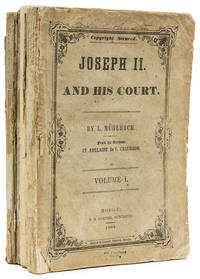
1864ref. 228980Mobile Alabama: S.H. Goetzel; Farrow & Bennett Printers 1864. First edition in English. 4 vols. 8vo. Printed wallpaper wrappers worn and fragile; back wrapper of Vol. II missing. In blue cloth drop-box. First edition in English. 4 vols. 8vo. Rare and telling example of printing in the confederacy toward the end of the war when paper was so scarce the publisher was forced to use wallpaper taken from Southern homes for the wrappers. Parrish 6437; Crandall M.L. Confederate imprints 3106 S.H. Goetzel; Farrow & Bennett, Printers unknown books
1875ref. 9365Paris: Ve. A. Morel 1875. First edition. 20 chromolithographic plates 5 uncolored architectural views. 1 vols. Folio. Half red morocco. Some rubbing and chipping with head of spine missing corners repaired with red cloth not unattractive. 2 Photographs of Sainte Chapelle loosely inserted paste marks to front free endpaper. Text and plates bright. First edition. 20 chromolithographic plates 5 uncolored architectural views. 1 vols. Folio. Very fine plates by Lemercier of Paris. Ve. A. Morel unknown books
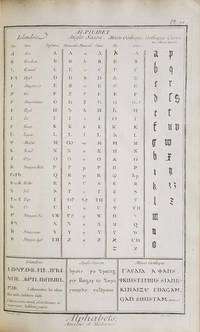
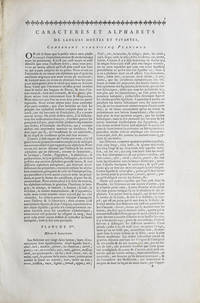
1772ref. 41090Paris 1772. Pp. 1-3 4 blank; 8 copper-engraved plates Goussier del. Prévost fecit.; 1-17 18 blank; 25 copper-engraved plates Goussier or Des Hauterayes del. Niodot Sculp. 1 vols. Folio. Removed. In later paper wrappers. Some soiling to margins adhesion of wrappers at gutter of first and last pages generally near fine. Pp. 1-3 4 blank; 8 copper-engraved plates Goussier del. Prévost fecit.; 1-17 18 blank; 25 copper-engraved plates Goussier or Des Hauterayes del. Niodot Sculp. 1 vols. Folio. An important selection of 33 printing-related plates from the Récueil de Planches that extraordinary illustrated supplement to the magnificent Encyclopédie of Diderot and d'Alembert. The plates depict the typefounding process and the alphabets and characters of more than 40 languages from Assyrian and Hebrew to Chinese Tibetan Japanese and Bengali; the explanatory text gives a concise account of the various arts and a more detailed account of linguistic scholarship current in the mid- to late eighteenth century. Printing and the Mind of Man describes the Encyclopedie as "a monument in the history of European thought; the acme of the age of reason; a prime motive force in undermining the ancien régime and in heralding the French Revolution; a permanent source for all aspects of eighteenth-century civilization." PMM 200; En français dans le texte 156 unknown books
1775ref. 36968Londres: Et se trouve a Paris chez D. C. Couturier père Imprimeur-Libraire aux Galeries du Louvre 1775. First edition in French. 45 1 errata pp. 1 vols. 8vo. Nineteenth-century quarter morocco and marbled boards. Minor rubbing else fine. First edition in French. 45 1 errata pp. 1 vols. 8vo. Bigmore & Wyman II p. 41 Et se trouve a Paris chez D. C. Couturier père, Imprimeur-Libraire, aux Galeries du Louvre unknown books
1769ref. 36938Leipzig; Wien: Johan Paul Krauss 1769. First Edition. With 24 folding plates. xxv 436 12 index & errata; xl 524 18 index & errata. 1 vols. 8vo. Contemporary three quarter red morocco and marbled boards spine label. Exterior worn tear at foot of spine internally tight and clean. A very good copy. First Edition. With 24 folding plates. xxv 436 12 index & errata; xl 524 18 index & errata. 1 vols. 8vo. Includes notices of Berlin artists graphic arts engravers early woodcuts & woodcut books history of printing and account of a journey through Lower Saxony Westphalia & and Holland. Part Two with striking images from early printed books such as the "Eagle of John" from Ars Memorandi includes "a dissertation on the earliest forms of wood-cutting as applied to the illustration . Heinecken conjectures that Gutenberg took the idea of printing from the playing-card makers who are said to have been the first engravers of historical subjects intermingled with texts. . Heinecken is of opinion that their first productions were taken from wooden blocks." Bigmore & Wyman. Bigmore & Wyman p.320 Johan Paul Krauss unknown books
1772ref. 41089Paris 1772. Pp. 1-17 18 blank; 25 copper-engraved plates Goussier or Des Hauterayes del. Niodot Sculp. 1 vols. Folio. Disbound. A very few spots in text leaves else fine. Pp. 1-17 18 blank; 25 copper-engraved plates Goussier or Des Hauterayes del. Niodot Sculp. 1 vols. Folio. An elegant and visually appealing selection of plates from the Récueil de Planches that extraordinary illustrated supplement to the magnificent Encyclopédie of Diderot and d'Alembert. The plates depict alphabets and characters of more than 40 languages from Assyrian and Hebrew to Chinese Tibetan Japanese and Bengali; the explanatory text gives a fully detailed account of the level of scholarship current in the mid to late eighteenth century. Printing and the Mind of Man describes the Encyclopedie as "a monument in the history of European thought; the acme of the age of reason; a prime motive force in undermining the ancien régime and in heralding the French Revolution; a permanent source for all aspects of eighteenth-century civilization." PMM 200; En français dans le texte 156 unknown books
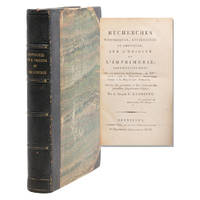
1799ref. 214620Brussels: Emmanuel Plon 1799. First edition. 2 engraved plates 5 text engravings. 1 vols. 8vo. Half morocco and marbled boards. Slight foxing. First edition. 2 engraved plates 5 text engravings. 1 vols. 8vo. Bigmore & Wyman I 418 "One of the monument of typographical bibliography" Emmanuel Plon unknown books
ref. 708464to. One-page a Warden & Company printed billhead illustrated with a group of "Worcester's Dictionaries" in the upper left corner 2 ¼ x 2 ½ inches. Warden asks Leonhardt for a lower quote for printing 500 stock certificates. Pencil calculations for the new quote in lower left corner final prices $13.50 one color plain $20 two colors. Folded for mailing but very good. unknown books
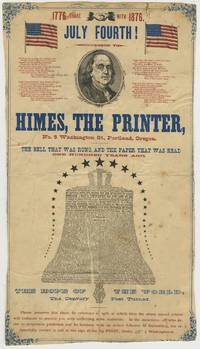
1876ref. BK0124Portland Oregon: Himes the Printer 1876. Illustrated broadside printed in red blue and black 12 ½ x 7 inches trimmed at edges and mounted to an album leaf. Tears to paper on verso from mounting with scattered soiling staining and handling wear; quite good overall. An Oregon Centennial broadside issued by Portland printer and later historian George H. Himes printed for the centennial of American independence. The sheet is headed "1776 Shake with 1876!" above clasped hands and a large "JULY FOURTH!" flanked by American flags. A portrait of Benjamin Franklin appears above Himes's enormous trade name while the lower half incorporates the Declaration of Independence within the outline of the Liberty Bell surrounded by thirteen stars and the slogans "THE HOPE OF THE WORLD" and "The Century Just Turned." The broadside repeatedly connects the history of American independence with the printer's trade. Verses surrounding Franklin celebrate him as the archetypal "printer boy" while Himes presents himself as his professional successor. The piece concludes with an optimistic request that customers retain his advertisement for another century: "Please preserve this sheet for reference in 1976 at which time the above named printer will endeavor to provide you with something more elaborate." Himes 1844-1940 had established himself as a printer in Portland by the 1870s advertising under the memorable name "Himes the Printer" at the same No. 5 Washington Street address printed here. He subsequently became an important figure in the preservation of Oregon history serving as a founder of the Oregon Historical Society and for decades as its assistant secretary and curator. An example of this broadside appears to be preserved in the George H. Himes papers at the University of Washington cataloged as a "Patriotic broadside used as printing sample by Himes 1876." We locate no other examples in the trade or institutional records searched. . Himes the Printer unknown books
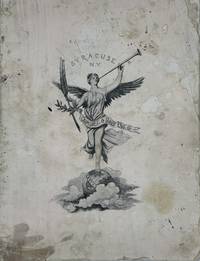
1891ref. 70472Syracuse NY: The company 1891. The company's "Third Annual Specimen Book." 4to. One-page typescript text. 12-pages of illustrations "copies from orders we have taken." Included are photographs half-tones and line engravings small vignettes 12 on facing pages to full-page plates from photographs and wash and pen drawings. Apparently not recorded on OCLC which does locate several later 1890s pamphlets printed by H.J. Ormsbee their stamp on rear wrapper successor to Ormsbee & Bailey. Disbound; worn along the spine storage soiling and wear at extremities. Good copy only. The company unknown books
1925ref. 30617Official Stenographic Reports 1925. Hardcover. Fine. Hardcover. Size: quarto. Discussion topics include: composing room equiptment importance of a composing room creating and designing printing typesetting machines poster printing and wood engraving practical talk to compositors and make-up for color. Fine in navy blue cloth boards with white paper label to front cover and no title to the spine. Slight toning to margins of pages. Previous owner's name to front page. 172 pages. BOB/112816. Official Stenographic Reports hardcover books
1942ref. S9519Philadelphia:: Westbrook Publishing Co. 1942. 1942. 8vo. 159 pp. Color frontis. numerous figs. Black cloth gilt-stamped cover and spine titles. Very good. Westbrook Publishing Co., 1942. hardcover books
1919ref. 219307Government Printing Office 1919. Hardcover. Very Good. Bound in blue cloth boards with a red spine label. Clean has a good binding no marks or notations. 748 pages. Government Printing Office hardcover books
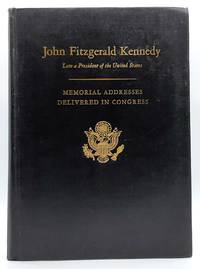
1964ref. 8813Washington DC: United States Government Printing Office 1964. First Edition. Hardcover. Very good. First Edition. Hardcover. 10 1/2" X 7 1/2". 911pp. Mild wear to black cloth over boards with rubbing and toning to covers. Corners are gently bumped. Pages are clean and unmarked. Binding is sound. With a stamp to front free endpaper reading "Compliments of Charles C. Diggs Jr Member of Congress." Charles Cole Diggs Jr. 1922-1998 was an American politician from Michigan and an early member of the civil rights movement as well as first chairman of the Congressional Black Caucus. United States Government Printing Office hardcover books
1994ref. 61580N.p.: American Printing History Association 1994. Edition limited to 200 copies folio consisting of a bifoliate title with introduction a list of the 28 contributors and 28 broadsides all contained in a natural linen folding box with a red morocco label on the upper cover; fine. From the library of Kim Merker. Introduction by editor Michael Peich designed by Jerry Kelly title page introduction and contributor list printed at the Stinehour Press. Selections from the work of Dwight Agner Harold Berliner Barbara Henry Allan Kornblum Henry Morris Michael Peich Gaylord Schanilec Neil Shaver Roderick Steinhour W. Thomas Taylor and many others. American Printing History Association unknown books
1934ref. 51138Louisville Ky: Standard Printing Company 1934. 8vo pp. 61 1; illustrated throughout; original black wrappers printed in silver rebacked in black library cloth; very good. Standard Printing Company unknown books
1971ref. 11512New York: Printing Week Library 1971. 12mo pp. 74; title-page vignette and wood engravings by John De Pol; fine in original gray paper-covered boards gilt. [Printing Week Library] unknown books
2020ref. 11157Tacoma WA 2020. Limited Edition. Hardcover. Fine in Fine Archival Box. Limited Edition. Hardcover. Quiet sophisticated and remarkably powerful Gabby's newest work is an exquisite blend of book art and binding. Gabby has from early in her career gone beyond her roots in design binding creating the text art and printing for several books now. Just as her design bindings push limits and explore possibilities so does her art and print work. It is a remarkable evolution. "Ralph Emerson wrote this poem "Blight" in July of 1843. He spoke out on climate change and the ways we could shift course by not blindly following others. In describing his travels to Europe while writing on life and nature Emerson said "same faces under new caps and jackets another turn of the old kaleidoscope." I took some liberties with Emerson's poem surrounding his words with photographs captured at Owen Beach in Washington state on a rainy winter day in 2019. This public beach in the middle of an urban old-growth forest will close for a year beginning in fall of 2020 to mitigate the effects of climate change and rising sea levels. Emerson's words of anger and disappointment at environmental destruction only resonate more with our current climate of melting glaciers and raging fires. As we continue to twist the kaleidoscope I remain optimistic we will find a way to rearrange these fragments and improve the view for future generations." artist statement This copy a 'making copy' adds tests of inks gouache type and design on a lot of the pages on the main book. The clamshell box includes a drawer of three separate folios of ink photo transfer and gouache. Inset into the drawer are two test covers as well more like miniature bindings of the big book. One is just the case and one has a separate small binding to test the structure. Housed in a custom box. Tight bright and unmarred. Brown textured paper boards by Hook Pottery Paper in a modified case binding letterpress printed with handset type on inkjet photo transfers silkscreen printed panels and acrylic painted Kozuke paper printing completed at Springtide Press with assistance from Jessica Spring; housed in an archival dropspine box. 4to. np. Illus. color plates. Numbered limited edition of 28 this being AP1. Signed by the artist. hardcover books
1872ref. 12672San Luis Potosi Mx 1872. 22pp. on a folded folio sheet. An intriguing issue of the San Luis Potosi state newspaper La Sombra de Zaragoza produced in the late-Spring of 1872. The paper was issued at irregular intervals at the time but was most frequently issued as a four-page paper printed on a single large folio sheet. Such is not the case in the present issue. Most of the first two pages of the paper print regulations for brokers working in the plaza of San Luis Potosi including new prohibitions and tariffs. The last part of the last column prints a public notice of an estate auction and an advertisement for the sale of the Velez Printing House. Page two ends with "Imp. del Gobierno." The second leaf is entirely comprised of eight forms of type imposed in quarto format indicating pages 129-136 of some larger work. Further research reveals that this second leaf prints one gathering of a larger pamphlet which appears on the second leaf of several issues in the full run of La Sombra de Zaragoza consulted at the Beinecke Library. The pamphlet is entitled Arancel de Aduanas Maritimas y Fronterizas de los Estados-Unidos Mexicanos published by the authorities of the state of San Luis Potosi. In an instance of historical echo in present times the pamphlet pertains to maritime and border customs tariffs imposed by the Mexican government. The presence of one quarto sheet of a larger pamphlet tacked onto the second leaf of the state newspaper seems to indicate that the Mexican government in San Luis Potosi in the mid-19th century sometimes pre-empted the work of the printers at La Sombra de Zaragoza to produce larger government publications. As such the present issue is at one and the same time an original periodical produced by the press in San Luis Potosi and a handsome example of mid-19th-century Mexican job printing. unknown books
1927ref. 004758Detroit: Fisher Body Corporation Fleetwood Body Corporation General Motors 1927. First edition. Wraps. Very Good. An extraordinarily beautiful sales catalogue organized around vivid colors as the title suggests. Folio 33 by 25 cm. xxx 30 2 pp. plus wraps. The colors are "Bird of Paradise" "Midnight Blue" "Angel Fish" "Morpho Menelans" emerald curite "Forest Green" "Th Grand Canyon" "Rose Coral" "Italian Waters" "Orchid" "Autumn" and the cars are all Cadillacs. All the cars have in fact two colors both of which are suggested by the color designation and each color and car receives a luxuriant two-page spread with three color illustrations: one for the inspiration for the particular color one of the car interior and one for the outer body. Accompanying the illustrations are fluid intoxicating descriptions that conjure up the imagery the sensate experience the fantasy with only passing mentions of some of the design specifics. The cars include Cabriolets a Roadster a Phaeton Imperials a Brougham a Town Sedan and a Convertible Coupe. One can see designs that both reach back to the fine coaches of a quickly receding era and the more comfortable sleeker cars to come. The brochure was released in conjunction with a road show showcase of the vehicles staged at fine hotels in New York Chicago Los Angeles and San Francisco the Commodore the Drake the Biltmore and the Palace respectively. Wear to the edges of the dust jacket the decorative paper covering the bound card-stock wrap0 with a few scratch lines on front soiling on rear and a few minor closed tears along edges. A hole to the white front fold-in of this jacket. Other than some light pencilled lettering a child's hand clean and bright within. Fisher Body Corporation, Fleetwood Body Corporation, General Motors unknown books
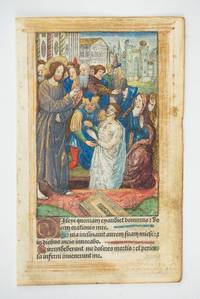
1520ref. ST12778-0887cParis: Gilles Hardouyn ca. 1520. 177 x 110 mm. 7 x 4 1/4". Single column 33 lines in an attractive gothic type. With hand-illuminated initials and a FULL-PAGE MINIATURE DEPICTING THE RAISING OF LAZARUS ILLUMINATED IN COLORS AND GOLD BY A CONTEMPORARY HAND. See Hilary Maddocks "A Book of Hours by Anthoine Vérard" University of Melbourne Collections issue 16 2015 pp. 19-20. One quarter-inch repair to the center of the leaf which on the recto slightly affects Lazarus' neck and on the verso affects three letters which have been neatly touched up a handful of small chips to the paint the architectural border somewhat rubbed in the lower right corner mild soiling to the margins; not without flaws but a richly and carefully colored leaf that is still pleasing. Richly painted and amply highlighted with brushed gold this leaf from a printed Book of Hours includes a large miniature depicting the raising of Lazarus. Christ stands arm extended in benediction over the newly reawakened Lazarus who gazes up at him standing upright in his grave. A crowd looks on with a well-dressed man crouched in front of the grave apparently having helped Lazarus to stand. Our illuminator has enhanced the drama of the moment with the rosy cheeks of the bystanders emphasizing Lazarus' deathly pallor and with Jesus' shimmering robe distinguishing him from the crowd. The faces and folds of cloth are delicately shaded and the minutely detailed lines of gold carefully applied stylistically tying this printed leaf to the fully hand-painted Books of Hours that printed versions were slowly replacing during the early years of the 16th century. The composition seems to come from a suite of illustrations designed by illuminator Jean Pichore fl. 1490-1521 done for the printer Gilles also Gillet Hardouyn. Gilles Hardouyn (?) unknown books
1880ref. S8009Washington D.C.:: Government Printing Office 1880. 1880. First edition. 4to. iv 528 pp. Frontis. port. index. Gray cloth gilt spine; covers off spine ends worn covers freckled by silverfish. Inscribed by S. S. Cox. Bookplate & rubber stamp top edge of Lawrence Badash. AS IS. Government Printing Office, 1880. hardcover books
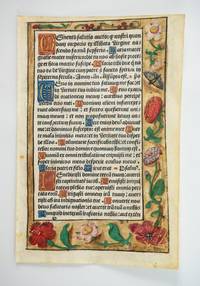
ref. ST20972b-cParis: Nicolas Vivien early 16th century. 197 x 130 mm. 7 3/4 x 5 1/8". Single column 28 lines gothic typeface. Ruled in red two one-line initials and two three-line initials painted in gold on red or blue ground and A LOVELY ANIMATED FULL PAINTED BORDER done by hand with trompe-l'oeil flowers one leaf also with a moth on painted gold ground. Top margin a little small light soiling to vellum borders with a couple superficial scratches and tiny smudges but in excellent condition overall. These beautifully embellished leaves from a printed Book of Hours demonstrate the enduring demand for manuscript illumination in the incunabular period and beyond. While the text here was completed on a printing press the initials and borders were done entirely by hand adding luxury and luster to otherwise unadorned pages. Although these leaves likely belonged to a Book of Hours printed in Paris possibly an edition printed for Nicolas Viven in or around 1503 the trompe-l'oeil style seen in the borders was particularly popular among Flemish and Netherlandish illuminators of the period. Because of the artist's use of subtle shading to indicate shadows the large blossoms here seem to pop off the page and one of the leaves contains a delicate little moth--attracted perhaps by the gleaming painted gold ground. Nicolas Vivien(?) unknown books
1913ref. TK0187Leipzig:: Julius Maser no date ca. 1913. 1913. Small 8vo. IV 96 pp. Beautifully illustrated with a couple of figures that are supported with an unnumbered but substantial number of plates 67 that are printed in different ways to become a printer's specimen book of printing forms. Original blue gilt-stamped cloth; rubbed. On various methods of printing. PROVENANCE: Rubber-stamp of Dr. Franz Karl Muck Buch-u. Musikalienhandlung Vienna; bookplate of Fr. W. Graeser bookplate showing a partly nude young girl with arms outstretched – with a deer/stag with antlers signed with two interlocked letter forms possibly 'AP' for Alice Pinkus. Julius Maser, [no date, ca. 1913]. hardcover books
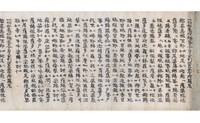
ref. 11486Scroll on paper 24 lines per dharani 17 characters per line body of the woodblock text: 240 x 494 mm. consisting of two joined sheets r: 553 mm. l: 585 mm. in length sutra text printed twice. Scroll 290 x 1138 mm. with later endpaper 68 mm. at beginning total length: 1206 mm. on a wooden roller some worming to text faint staining at foot. Most certainly Kofukuji Temple Nara: late Heian late 11th or early 12th century. An extremely early Kasuga-ban printing from the KÅfukuji temple. Our printed scroll appears to be a unique survival; we find no example in any library and it is unrecorded in all bibliographies. The earliest printed texts in Japan were dharani issued between 764 and 770; nothing more was printed until the late Heian period. "The first unequivocal record of textual printing in the Heian period 794-1185 comes from 1009 when Fujiwara no Michinaga recorded in his diary that 1000 copies of the Lotus Sutra had been printed although no copies of this seem to survive.The oldest extant example bearing a date is the Joyuishikiron which was printed in Nara by monks of the KÅfukuji temple in 1088."-Kornicki The Book in Japan pp. 118-19. In the Heian period of the "Six Temples" of Nara only KÅfukuji is known to have produced any printed books or scrolls. Our scroll was therefore most certainly printed at the KÅfukuji temple. The sutra has the general visual characteristics of late Heian printing: paler ink noticeably less jet-black than the ink usually found in Kamakura-era impressions but it should be said less pale than at least some of the surviving Heian impressions; slightly angular less brush-like letter-strokes; some noticeable variation in the firmness of the impression of the woodblock caused by uneven inking very typical of Heian-era printing; and fine-quality thin pale kÅzo paper. Kamakura-era printings tend to be characterized by jet-black sumi ink very even and well-inked impressions thick gampi paper stained a light yellow-brown with kÅryÅ clove and thick rounded letter-strokes in imitation of brush calligraphy. None of these typical Kamakura-era characteristics are present in this scroll. See Gardner Descriptive Catalogue of Japanese Books in the British Library Printed before 1700 London: 1993 p. 157. The sutra was translated from Sanskrit to Chinese by Amoghavajra ä¸ç©º C: Bukong; J: Fukū 705-74 a prolific and important translator of Esoteric scriptures and Esoteric versions of old scriptures. Born in southern India he went to China at age ten and was ordained. In 741 he went to study in Sri Lanka and India returning to China in 746 with some 500 Buddhist manuscript texts. In the following years he became one of the most politically powerful Buddhist monks in Chinese history and one of the Eight Patriarchs of the Doctrine in Shingon Buddhism. We know that this particular dharani sutra was one of the very earliest to be printed in East Asia - the oldest surviving complete printed scrolls today in both Chinese and Korean institutions are examples of the Treasure Chest Seal Dharani. A copy of the Sutra of the Whole-Body Relic Treasure Chest Seal Dharani dating from 975 is the earliest printed book in the collection of the National Library of China. The oldest surviving substantive Korean woodblock printing is a copy of the Sutra of the Whole-Body Relic Treasure Chest Seal Dharani published in 1007 year 10 of King Mokjong now kept at Chongjisa temple in Gaesong. The production of this scroll is most interesting. The two sheets of paper were first joined together and then the same woodblock was printed twice side by side. The two sheets are of slightly uneven length and part of the woodblock text on the right extends onto the left-hand sheet. The repeated recitation of the dharani was a meritorious act of faith for the followers of Buddha. Heian printing was - at least initially - characterized by repetitive printing for devotional purposes as an alternative to hand copying rather than for practical reading or study. In other words the first printed scrolls were really just longer and more elaborate versions of the suributsu multiple woodblock impressions periodically found rolled up inside Buddhist temple statues. This accords with our scroll which consists of two consecutive identical impressions of the Treasure Chest Seal Dharani. In the absence of other evidence to the contrary the repetitive printing and purely devotional nature of this scroll would tend to place its production more likely in the late 11th century or first years of the 12th rather than in the last decade or two of the Heian era - by which time scrolls clearly intended for study often with commentaries had become much more common. PROVENANCE: Ownership sumi in black seal of the "Horyuji issaikyo" 法隆寺一切経 at end of scroll and on verso where the two sheets of paper are joined. This particular seal is a variant of the seal used to mark the Horyuji's ownership of the Horyuji issaikyo manuscript sutra collection executed 1099-1131. Our variant seal was used to simply denote Horyuji ownership. As suggested in Nihon shakyo sokan our seal is of early Kamakura manufacture which means our printed scroll must predate that period. There is an early inscription on the outside of the front endpaper stating "hokyoin dharani." Our scroll was offered for sale by the Isseido Book Company in 1993 in its 90th anniversary catalogue describing it as a printing of the late Heian period. In remarkably fine condition. The outer blank margin of the left-hand sheet is somewhat dusty or smoky except for a large white circle where clearly a candle stand once was present. Preserved in two wooden boxes one fitting inside the other. ⧠We thank Prof. Peter Kornicki of Cambridge University for his essential help. unknown books