Apian, Petrus.MareMagnum

8124 resultados
Folio (210 x 294 mm). (40), DXII, (8) pp. Title page printed in red and black. With large emblematic title woodcut after Albrecht Dürer, hand-coloured around 1730; woodcut printer's device on verso of final leaf. With coloured woodcut arms of Raimund Fugger, 7 large woodcut initials showing astronomical and mathematical motifs, and 184 woodcut illustrations. Text surrounded by various woodcut borders throughout. Contemp. vellum with ms. spine title. Only edition. - Printed at the expense of the banker Raimund Fugger, this work presents classical inscriptions and statues collected all over Europe (of which many were in Fugger's own collection). The text is based on earlier studies by Peutinger, Pirckheimer, and others. An exceptionally fine work from the private press of Peter Apianus (1495-1552), mainly known as a mathematician and geographer. Title woodcut by Hans Brosamer (after Dürer) and Fugger's coat of arms (by M. Ostendorfer) splendidly hand-coloured and raised in gilt; undoubtedly the work of the book's previous owner, Johann Spiegler, who signs his name beneath the imprint on the title page ("Annumeror libris Joannis Spiegleri Juliomagensis"). Spiegler is known as a Constance miniaturist active during the first half of the 18th century (cf. Brun, SKL III, 1913) and is sometimes identified with the Constance painter Franz Joseph (Johann) Spiegler (1691-1757; cf. Thieme/Becker XXXI, 370f.). - Slight dampstains and edge tears near end; occasional paper loss remargined. Page tt1r (the printed area of which reaches far into the margin) lacks the final character of the right column. An uncommonly beautiful copy, last in the collection of the Maryland pharmaceutical investor Charles W. Newhall. VD 16, A 3086. IA 106.422. Adams A 1291. BM-STC (German) 37. Stalla 85. Brunet I, 342. Van Ortroy 109. Günther (Apian) 20f.
Folio (242 x 355 mm). (2), 116 pp. With woodcut printer's device on title-page, woodcut initials, 57 illustrations and maps (4 double-paged). Later binding reusing a leaf of Hebrew manuscript on vellum (containing prayers from the Yom Kippur liturgy, 14th or 15th century, Ashkenaz, probably German). First edition. - Belluzzi worked as a field engineer for the Medici in Florence. He died during an attack on a Sienese fortress in 1554. - First six leaves damaged at upper corner with some loss of text, stained at head. With autograph ownership of Philip III, Landgrave of Hesse-Butzbach (1581-1643), at foot of title-page ("Philippus Hassice Landgravius"). Philip was interested in science and astronomy (he corresponded with Galileo and Kepler) and had an observatory as well as a fine library. Later in the Darmstadt court library (crowned monogram stamp on title-page; inscription "Bibl. Aul. Darmst. Rep. 7 Loc. 2" to inside front cover). Last in the collection of Thomas Fremantle, 3rd Baron Cottesloe (1862-1956), commander of the Territorial Army and president of the Society for Army History Research, with his index card ("acquired 1930") loosely inserted. Edit 16, CNCE 4958. Cockle 794. Riccardi, p. 109f.
Folio (212 x 308 mm). (186) ff. With full-page woodcut on fol. 6v showing Saints Cosmas and Damian, the patron saints of physicians. Contemporary full vellum binding. First edition of this Renaissance dictionary of natural science compiled by Otto Brunfels, the "father of German botany", best known for pioneering the emancipation of that field from mediaeval herbalism. "Brunfels' passion for compiling and organizing reference material [...] was fully exhibited in his 'Onomastikón', a comprehensive dictionary containing a wealth of material related to medicine, botany, alchemy, and metrology" (DSB). Designed "for the use of physicians and apothecaries" (ibid.), the volume bears ample witness to the pre-eminence of Arabic medicine during the Middle Ages and early modern period, including a long discussion of Galenus, whose works were channeled into the West mainly through Arabic scholars, and entries on Ibn Sina (Avicenna), "natione Arabs, [...] a medicis Princeps vocatur", as well as Ibn Rushd (Averroes), "Avicennae coaevus, multae eruditionis philosophus et medicus, qui cum maxima laude et ipse Aristotelis libros est commentatus". - Insignificant browning with very slight brownstaining and worming near end (confined to margins); a few occasional humanist annotations with an 18th century handwritten note of acquisition (purchased from sale of the Wille library in St Petersburg) on the rear pastedown. A good, tight copy. VD 16, B 8525. Adams B 2928. BM-STC German 156. DSB II, 537. Ferchl 73. Wellcome I, 1106. Wightman 112.
8vo. 76 ff. - (Bound with) II: The same. Commentarius in Claudii Galeni de ossibus ad tyrones libellum [...]. Ibid., 1561. 37, (3) ff. Contemporary limp vellum (wanting ties). Two medical textbooks by the Parisian anatomist Dubois, widely used by French medical students in the mid-16th century. The present volume is heavily annotated by a contemporary owner who signs his name as "Mirard" (?) on the first title-page. The annotations are particularly extensive in the sections on blood vessels, muscles, and nerves. - Dubois (1478-1555, Latinized as "Sylvius") was the first to describe venous valves, which he injected with coloured liquids (although their function was discovered only later by William Harvey), and is credited with first having given names to the various muscles, previously simply numbered. His blind reverence for the ancient physicians, especially Galen, involved him in a public controversy with his most famous student, Vesalius, who had dared to expose the errors of the Greeks. A former classicist, Dubois is also the author of the first French grammar to be published in France. - Some waterstaining near end, the final leaf showing severe paper flaws with some loss to the index. The first 50 ff. show noticeable worming to the gutter, stronger near the beginning, but mostly without loss to text. An additional handwritten ownership from Montpellier, another center of French medical learning (signed "G. B. Minet", dated 1709), at the bottom of the title page. Durling 1259 & 1236. Wellcome I, 6183 & 6184. Adams S 2181 & S 2170. OCLC 14317273 & 1025189760. Cf. BM-STC French 141. Hirsch II, 220f.
Small folio (190 x 258 mm). "30" (but: 32), "48" (but: 40), (1) ff., final blank f. With large woodcut portrait of Indagine by Hans Baldung Grien on title page, full-page armorial woodcut on final page, and 111 woodcuts throughout the text. Also, two large woodcut initials: 9-line G and 8-line S, the latter designed by Hans Weiditz (cf. A. F. Johnson, Decorative initial letters, XLI). Early 20th century quarter leather over grey boards, spine titled in gilt. Extremely rare first edition of this important, profusely illustrated Renaissance work on the three occult sciences: astrology, physiognomy and chiromancy. Also called palmistry, chiromancy is the art of reading character and divination of the future by interpretation of the lines and undulations on the palm of the hand. Mediaeval palmistry was pressed into service by the witch-hunters; after a period of disrepute, it flourished again in the Renaissance, and a block-book on the subject was published as early as ca. 1480. Johannes Indagine (ca. 1467-1537, also known as Johannes Rosenbach, or von Hagen), a Carthusian Prior, was perhaps the most highly regarded German chiromancer of the sixteenth century and "an extremely learned man in many fields" (Gettings, An Illustrated History of Palmistry, p. 177). It is unknown where he gained his considerable knowledge of the natural sciences, namely of astronomy (to which he contributed the invention of two instruments) and chiromancy. He advised the Elector Albrecht von Brandenburg, Archbishop of Mainz, and it might have been Indagine's horoscopes which in 1519 caused the adjournment of the election of Charles V. - The present work was banned by the Inquisition, having been placed on the Index Librorum Prohibitorum under the decree of Pope Paul IV in 1559 (cf. Thorndike). "Possevin holds that this was on account of the author's astrology, but the other astrologers are all in Class 2. Indagine was placed in Class 1 for his letter to O. Brunfels, published at the end of the volume (which had undoubtedly come to attention in Rome): for this, the author was considered a Lutheran" (Reusch). Illustrated throughout with woodcuts by several artists, including the splendid portrait of the author and his coat of arms, both by Hans Baldung Grien, 11 pairs of physiognomic heads (the pair on fol. 5r also by Grien) and 26 (some repeated) mythological designs representing the signs of the Zodiac attributed to Hans Wechtlin, as well as 37 chiromantic hands (one of fingers only) and 27 numerous astrological diagrams. The work had a great effect on the study of chiromancy and is quoted down to our own day, marking the first beginnings of the fully-fledged astrological chiromancy which was to develop steadily over the next century and a half. - A good, clean copy with remains of six thumb indexes which mark the various parts. Includes the frequently missing two-leaf dedication to Archbishop Albrecht after the title, as well as the final blank; leaf 6 of the first part misbound before the text as usual. Rebound around 1900, trimmed rather closely, with an old catalogue description of this copy (erroneously describing it as incomplete) mounted on the front pastedown: in fact, no index or "blank 4th leaf" are missing (cf. the digitized BSB copy). Of great rarity. VD 16, R 3108. Adams I 88. BM-STC German 429. Ritter 1264. Schmidt 68. Muller II, p. 82, no. 103. Chrisman, Strasbourg Imprints, S15.2.3. Sabattini 282. BNHCat I 23. Zinner 1180. Osler 3049. Oldenbourg (Baldung Grien) L 203. Mende (Baldung Grien) 458-460. Reusch I, 280, note 6. Cf. Caillet 5388-9 (only editions of 1556 and later); Thorndike V, 65-66,175-176; Hollstein, Baldun Grien, n. 263; Zinner 157, 414 f., 433. H. Röttinger, Jahrb. der Kunstslgg. des Ah. Kaiserhauses Wien 27, 1907-1909 (attribution of the illustrations to Hans Wechtlin); Durling, 2531ff. (only editions of 1531 and later).
15064to. 26 unn. ff. (incl. last blank). - (Bound with) II: Solinus, Caius Julius. Polyhistor, seu rerum orbis memorabilium collectanea [...]. Cologne, Eucharius Cervicornus & Hero Fuchs, December 1520. XCII, (12) ff. With architectural woodcut title border. - (Bound with) III: Pomponius Mela. Cosmographia. (Paris), Jean Petit, (5 June 1513). XXX, (10) ff. With large stipple-engraved printer's device on title page. - (Bound with) IV: Herodian. Libri octo, in quibus hi imperatores continentur [...]. Angelo Politiano interprete. (Strasbourg, Matthias Schürer, November 1513). (6), LXXXV, (1) ff. - (Bound with) V: [Bruni] Aretino, Leonardo. De bello Gotthorum: seu de bello Italico adversus Gotthos libri quattuor. (Paris), [Guy Marchand für] Jean Petit, (31 March 1507). 48 ff. With large stipple-engraved printer's device on title page. Contemporary blindstamped dark-brown calf binding over wooden boards; pastedowns made of a 13th c. vellum ms. with fleuronnée initials. Fine Sammelband, containing the very scarce first edition of Peutinger's work dealing with the old borders of Gaul and Germania. Under the heading "De Lusitanis nautis qui in Indiam navigant", Peutinger discusses the travels of his fellow Augsburg citizens to the East Indies. Also includes poems by Sebastian Brant and Ringmann Philesius. - The volume contains four additional early prints: II: The work of the Roman geographer Gaius Julius Solinus (3rd c.). "The greater part of this work is taken from Pliny's 'Natural History' and Mela's 'Cosmographia'. It was revised in the sixth century under the title of 'Polyhistor'. It was a popular work in the middle ages" (Cox II, 336). - III: Rare Petit edition (ed. P. Phoenix) of the oldest preserved Roman geographical work. - IV: First edition of this Roman history to be printed in the German-spaking countries. - V: Rare edition of Bruni's history of the Gothic Wars. - Occasional insignificant waterstaining to inner margin; upper margin of first 10 ff. have small brownstain. Spine and clasps replaced; back cover shows traces of a nail, proving this to be a former chain binding. Altogether a fine, well-preserved sammelband with five rare French and Alsatian post-incunables. I: VD 16, P 2081. BM-STC German 689. Adams P 940. Muller II, 17, 41. Ritter 1678. - II: - VD 16, S 6964. BM-STC German 818. Schweiger II, 959. Not in Adams. - III: BM-STC French 308. Schweiger II, 606. Not in Adams. - IV: VD 16, H 2501. Muller II, 187, 110. Ritter 1197. Schmidt 113. Schweiger I, 137. Not in BM-STC German or Adams. - V: BM-STC French 84. Adams A 1554. IA 125.746. Potthast I, 172.
Folio (225 x 331 mm). (12), 747, (1) pp. With 2 (repeated) woodcut printer's devices to title page and final page as well as a half-page woodcut of surgical instruments at the end of the preliminaries. Modern blindstamped brown calf on four raised double bands. Rare edition of this commentary on the ninth book of the treatise dedicated by ar-Razi (also known as Rhazes; 850-923 or 932) to Almansor, the Prince of Chorosan (with the text). "The manual, known as 'Nonus Almansoris', was popular among mediaeval physicians" (cf. GAL S I, p. 419). The work discusses special pathology but excluding pyrology and was one of the most popular textbooks at medical schools and faculties well into the Middle Ages (cf. Hirsch/H. I, 171). Rhazes is considered the greatest mediaeval physician next to Avicenna; he also conducted alchemical experiments. According to his biographer al-Gildaki, he was blinded for refusing to share his secrets of chemistry. - A woodcut on the final page of the preliminaries depicts ten different surgical instruments, including a tongue depressor, a forceps, and various instruments for cauterization. Several minor waterstains throughout, but generally a fine copy. Provenance: Handwritten ownership of the Jesuit College of Louvain, dated 1637, on the title-page. VD 16, A 3222. Durling 249. Cf. Garrison/M. 3666.84; Poletti, p. 11; Wellcome I, 383; M. H. Fikri, Treasures from The Arab Scientific Legacy in Europe (Qatar 2009) no. 46, with double-page spread illustration on p. 82f. (1542 Venice edition).
Small 4to. 15 unnumbered ff. (lacking final blank). With several woodcut initials (including one depicting a pelican). Attractive 19th century red calf with giltstamped cover title and border. Rare first edition of this most copious 16th century Italian treatise on the theory of colours. Divided into 13 chapters, the work lists no less than 115 different names of colours. "Questo raro e singolare opusculo indica sul suo principio Toggetto con cui tu scritto, ed e forse l'opera più erudita che abbiasi, presa sotto l'aspetto seguente" (Cicognara). Cicognara described a 14-leaf edition without place or printer - very likely an incomplete copy of this present edition, which ends on f. 13 and is concluded by two leaves of poems. - Telesio (1482-1533), a native of Cosenza in Calabria, taught at Rome. Escapting the "Sacco di Roma", he fled to Venice, where he gained the chair of Latin at the Consiglio dei Dieci bekam. It was during these years that he composed his treatise on colours, the earliest of its kind ever to see print. Goethe quotes it in full in his own treatise on colours (Weimarana, pt. IV, pp. 174-193), following the 1545 Latin Basel edition; this is the longest quote in all of Goethe's works. - Telesio's nephew Bernardino, who had followed his uncle from Cosenza to Rome and Venice, would go on to publish his own treatise on colours in 1570. - Unappealing traces of moisture to the first five leaves. Spine somewhat sunned and rubbed. Edit 16, CNCE 37986. Cicognara 216. Adams and BM-STC Italian list later eds. only.
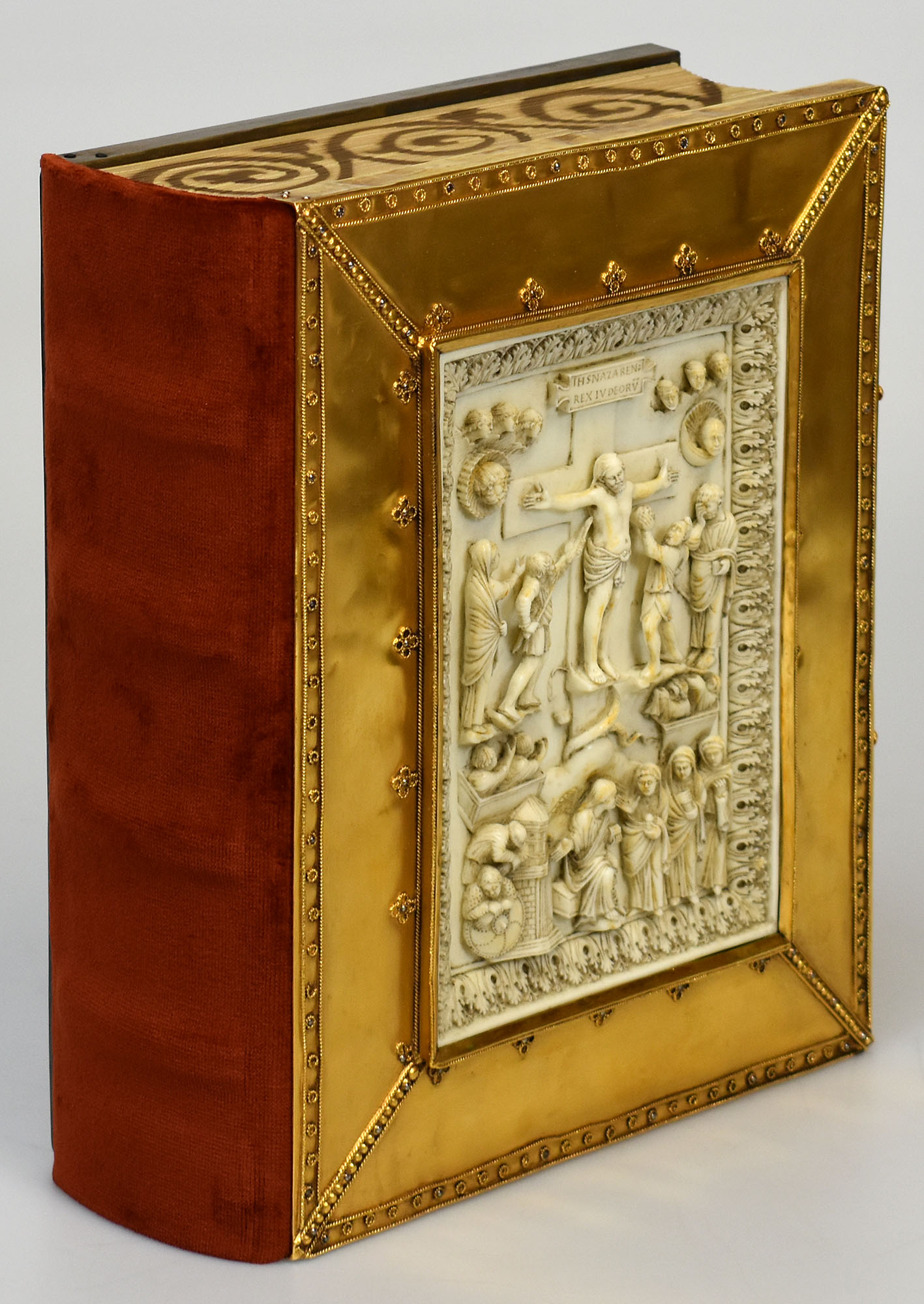
2010ref. 4026FBGütersloh/München, Faksimile-Verlag, 2010. Vitrine: 20 x 35 x 42 cm. 718; 168, XXXII Seiten. Faksimileband: Rostroter Original-Samteinband auf 4 Bünden mit Replikat eines Elfenbeinreliefs der Kreuzigungsszene, eingefasst in einen Rahmen aus verziertem Goldblech, auf dem Vorderdeckel, teilvergoldeter, durchbrochener Silberplatte, Papst Gregor den Großen darstellend, Buchschnitt mit gemaltem Ornamentschmuck und zwei vergoldeten Kettenschließen. Kommentarband: Original-Leinenband mit goldgeprägtem Deckel- und Rückentitel. Beides in Original-Glasvitrine mit Holzeinfassung und Samtkissen auf integrierter Kassette mit Leinenbezug für den Kommentarband. [12 Warenabbildungen]
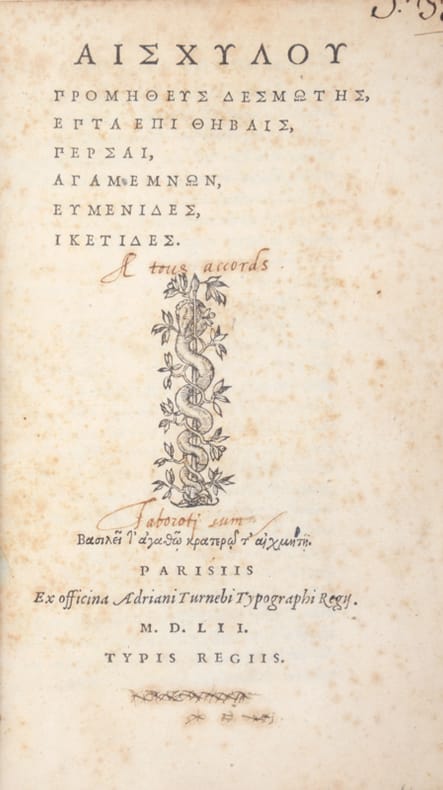
1552ref. 42167Paris, Adrien Turnèbe, 1552. In-12 de (8)-211-(1) pp. (sign. a4, A-N8, O2), caractères grecs, basane fauve granitée, dos lisse orné, pièce de titre en maroquin rouge, tranches jaspées (reliure du XVIIIe siècle).
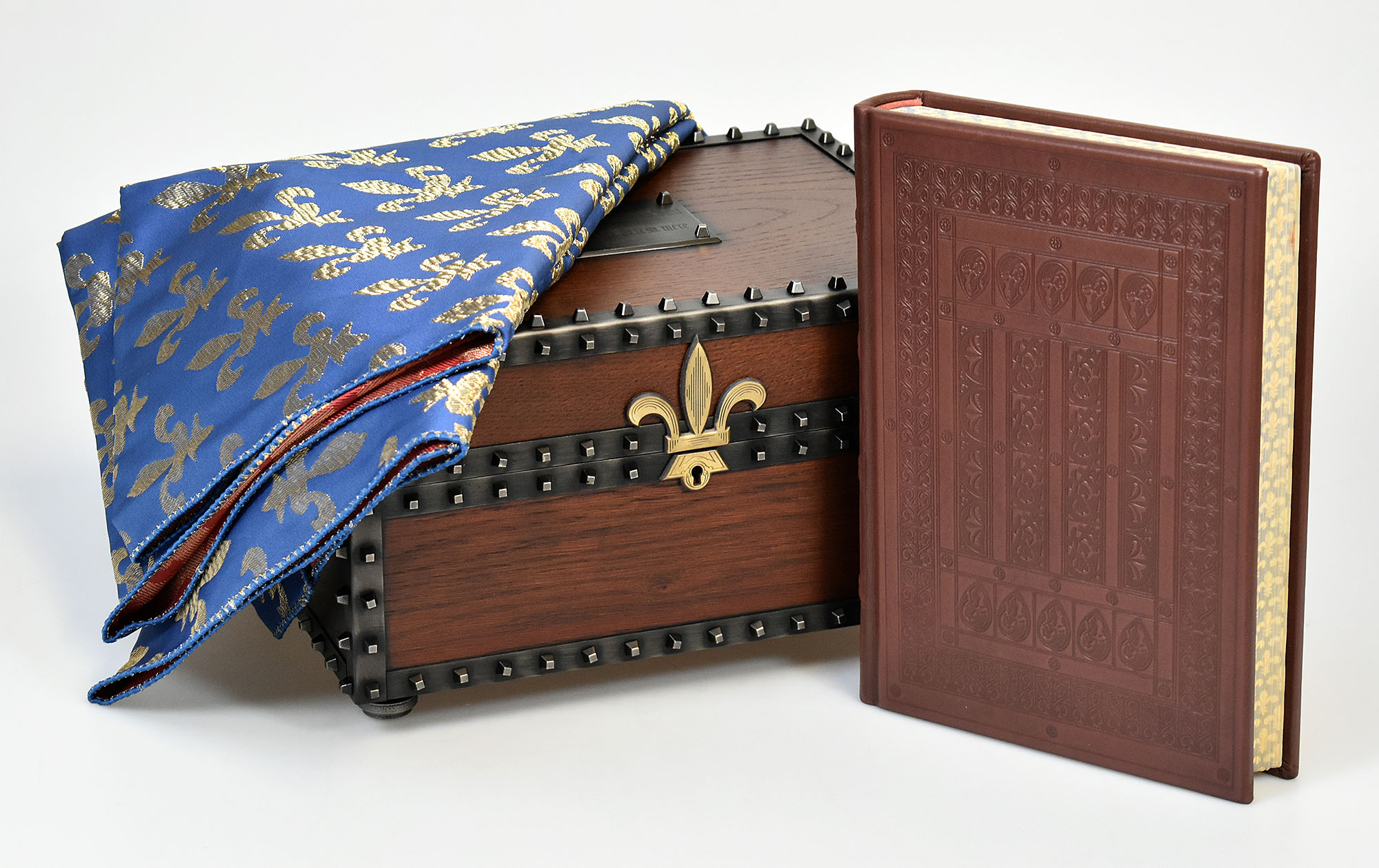
ref. 4028FBSimbach/Inn/Madrid, Verlag Müller & Schindler/Eikon Editores, 2021. Faksimilie: 4°. 29,5 x 22 cm. Schatulle: 34 x 26 x 20,5 cm. [192] Blatt. Original-Lederband auf 4 Bünden mit reicher ornamentaler Blindprägung und mit Fleurs de Lys verziertem Rundum-Blauschnitt in hölzerner Schatulle mit Eisenbeschlägen und gläsernem Fach für die mit Fleurs de Lys bestickte Chemise. [9 Warenabbildungen]
1846ref. ST19286London: Printed by Catchpool & Trent for Simpkin Marshall & Co 1846. FIRST EDITION. 320 x 255 mm. 12 1/2 x 10". xiii 3 96 pp. Publisher's original blind-decorated dun-colored cloth gilt titling to upper cover smooth spine newer endpapers. WITH 11 COLOR ENGRAVINGS after Frost by W. P. Chubb & Son printed in oil colors by George Baxter all with original tissue guards. Front free endpaper with small ink signature of John Hill. See: Francis Reid "Isaac Frost's 'Two Systems of Astronomy' 1846: Plebeian Resistance and Scriptural Astronomy" in "The British Journal for the History of Science" Vol. 38 No. 2 Jun. 2005 pp. 161-177. Cloth rather spotted corners bumped but the binding solid with no wear to joints or hinges. A few spots of foxing to title page half of the tissue guards with overall very faint foxing/browning the illustrations with minor foxing at edges and in margins but the images themselves clean and bright and all in all a really excellent copy the text wide-margined and quite clean and fresh and the plates with rich coloring. Illustrated with beautiful color plates this anti-Newtonian work promotes a view of the universe based on the backward-looking beliefs professed by a Protestant sect known as the Muggletonians. Named after co-founder Lodowicke Muggleton the Muggletonians emerged in London in 1651 based on the claims of two tailors who professed to be the "Last Witnesses" described in the Book of Revelation. Rejecting the new directions in philosophical reason Muggletonians believed in a purely scriptural interpretation of the universe. According to E. P. Thompson's 1994 "Witness Against the Beast" the Muggletonians had curious notions quite contrary to other Protestant denominations: they believed that the soul is mortal that Jesus and God are one and the same that Heaven was left without divine supervision from Jesus' death until the day of judgment that Heaven resides six miles above the Earth that God stands between five and six feet tall and other unconventional things. Although the sect initially avoided both worship and evangelizing during the 19th century some followers became more outspoken about their beliefs and even published books appealing to the general public. Our author Isaac Frost 1793-1858 was a prominent Muggletonian and successful owner of a brass foundry who along with his brother Joseph invested large sums to promote their belief system--the present work being an especially notable example. Divided into two main sections the text first describes the Newtonian system of heliocentric astronomy and then turns to Frost's scriptural interpretation and geocentric views. As Reid tells us "According to Frost Scripture clearly states that the Sun the Moon and the Stars are embedded in a firmament made of congealed water and revolve around the Earth that Heaven has a physical reality above and beyond the stars and that the planets and the Moon do not reflect the Sun's rays but are themselves independent sources of light. Our book was apparently written as a reaction against the lecturers who expressed Newtonian astronomy--which was often for them and their audiences simply shorthand for heliocentrism." The 11 plates that illustrate these extraordinary ideas are the work of George Baxter a pioneering printer who revolutionized color printing techniques by combining metal engravings with woodblock printing using oil-based inks to produce high-quality affordable prints. The plates here are appropriately ethereal and otherworldly utilizing a beautiful palette with subtle gradations and esoteric figures to create memorable pseudo-scientific imagery. Although this work appears at auction with some regularity it is almost always incomplete no doubt because the attractiveness of its plates encourages harvesting. Useful price comparisons include a complete copy said to be in fine condition selling for £7500 in 2016 and six loose prints from the book fetching £6875 in 2015. [Printed by Catchpool & Trent for] Simpkin, Marshall, & Co unknown
1846ref. ST19286London: Printed by Catchpool & Trent for Simpkin Marshall & Co 1846. FIRST EDITION. 320 x 255 mm. 12 1/2 x 10". xiii 3 96 pp. Publisher's original blind-decorated dun-colored cloth gilt titling to upper cover smooth spine newer endpapers. WITH 11 COLOR ENGRAVINGS after Frost by W. P. Chubb & Son printed in oil colors by George Baxter all with original tissue guards. Front free endpaper with small ink signature of John Hill. See: Francis Reid "Isaac Frost's 'Two Systems of Astronomy' 1846: Plebeian Resistance and Scriptural Astronomy" in "The British Journal for the History of Science" Vol. 38 No. 2 Jun. 2005 pp. 161-177. Cloth rather spotted corners bumped but the binding solid with no wear to joints or hinges. A few spots of foxing to title page half of the tissue guards with overall very faint foxing/browning the illustrations with minor foxing at edges and in margins but the images themselves clean and bright and all in all a really excellent copy the text wide-margined and quite clean and fresh and the plates with rich coloring. Illustrated with beautiful color plates this anti-Newtonian work promotes a view of the universe based on the backward-looking beliefs professed by a Protestant sect known as the Muggletonians. Named after co-founder Lodowicke Muggleton the Muggletonians emerged in London in 1651 based on the claims of two tailors who professed to be the "Last Witnesses" described in the Book of Revelation. Rejecting the new directions in philosophical reason Muggletonians believed in a purely scriptural interpretation of the universe. According to E. P. Thompson's 1994 "Witness Against the Beast" the Muggletonians had curious notions quite contrary to other Protestant denominations: they believed that the soul is mortal that Jesus and God are one and the same that Heaven was left without divine supervision from Jesus' death until the day of judgment that Heaven resides six miles above the Earth that God stands between five and six feet tall and other unconventional things. Although the sect initially avoided both worship and evangelizing during the 19th century some followers became more outspoken about their beliefs and even published books appealing to the general public. Our author Isaac Frost 1793-1858 was a prominent Muggletonian and successful owner of a brass foundry who along with his brother Joseph invested large sums to promote their belief system--the present work being an especially notable example. Divided into two main sections the text first describes the Newtonian system of heliocentric astronomy and then turns to Frost's scriptural interpretation and geocentric views. As Reid tells us "According to Frost Scripture clearly states that the Sun the Moon and the Stars are embedded in a firmament made of congealed water and revolve around the Earth that Heaven has a physical reality above and beyond the stars and that the planets and the Moon do not reflect the Sun's rays but are themselves independent sources of light. Our book was apparently written as a reaction against the lecturers who expressed Newtonian astronomy--which was often for them and their audiences simply shorthand for heliocentrism." The 11 plates that illustrate these extraordinary ideas are the work of George Baxter a pioneering printer who revolutionized color printing techniques by combining metal engravings with woodblock printing using oil-based inks to produce high-quality affordable prints. The plates here are appropriately ethereal and otherworldly utilizing a beautiful palette with subtle gradations and esoteric figures to create memorable pseudo-scientific imagery. Although this work appears at auction with some regularity it is almost always incomplete no doubt because the attractiveness of its plates encourages harvesting. Useful price comparisons include a complete copy said to be in fine condition selling for £7500 in 2016 and six loose prints from the book fetching £6875 in 2015. [Printed by Catchpool & Trent for] Simpkin, Marshall, & Co unknown books
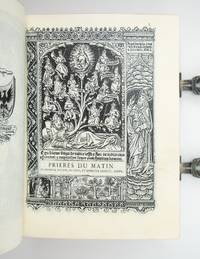
1858ref. ST21120Paris: Printed by J. Claye for Gruel & Engelman 1858. 155 x 117 mm. 6 1/8 x 4 5/8". 703 1 pp. VERY FINE GOTHIC-STYLE BLIND-STAMPED BROWN MOROCCO BY LÉON GRUEL stamp-signed at foot of spine covers with central panel showing the Tree of Jesse surrounded by the words "Egredietur virga de radice Iesse et flos deradice eius ascendet et requiescat super eum" A rod shall come forth from the root of Jesse and a flower shall grow out of his root and rest upon him" this framed by a roll of grapevines and floral vines oblique fleur-de-lys at each corner two silver square knot fore-edge clasps one catchplate replaced raised bands densely gilt turn-ins marbled endpapers and flyleaves all edges stained red. In a very fine brown morocco-backed buckram drop-back box with padded plush interior gilt lettering on spine. Title page and colophon with large device of Gruel & Engleman featuring two angels verso of title with printer's device of J. Claye each page with elaborate woodcut border featuring biblical scenes modelled on those in printed 15th century French Prayer books and seven miniatures Tree of Jesse Crucifixion Deposition Pentecost Trinity Conception of the Virgin Annunciation to the Virgin. Front flyleaf with a lengthy ink inscription to Mademoiselle Jeanne Ansart from printer Jules Claye in elegant calligraphic hand dated 1 December 1876. With three contemporary prayer cards and two commemorative cards--one for the ordination of a priest one for a nun professing her initial vows--laid in. See Judge "Léon Gruel: Master of Medieval Revival in Bookbinding" Encyclopedia of Design 2021 online: https://encyclopedia.design/2024/03/21/leon-gruel-master-of-medieval-revival-in-bookbinding/; Jeremy Norman "Master Printer Jules Claye Inscribes a Copy of a Book of Hours that He Printed on Vellum" History of Information online: https://www.historyofinformation.com/detail.phpid=5590. Faint rubbing to joints and extremities isolated trivial thumbing one small red smudge but A VERY FINE COPY--clean fresh and bright internally in a very lustrous binding with sharp impressions of the stamps. A luxurious volume in every way this is the only known copy printed on vellum of a 15th century-style prayer book created by distinguished Parisian publishers Gruel et Engelmann; it was bound by a celebrated craftsman who was an expert on the history of his craft and presented by the printer to a young woman perhaps to commemorate her taking religious vows. The firm that became Gruel et Engelmann had a complex evolution. It was founded as a bindery by Isidore Desforges in 1811 and after Desforges' daughter Catherine married Paul Gruel 1800-46 the latter took over the business in 1825. Following his death Catherine kept the bindery going for five years before marrying Parisian publisher Jean Engelmann d. 1875. The spouses merged their firms and combined their specialties to produce beautiful devotional books inspired by Medieval manuscript Books of Hours and early printed prayer books bound in appropriately historic styles. Catherine's son Léon Gruel 1840-1923 joined the firm as a binder and after his stepfather's death Gruel et Engelmann was run by Léon who headed the binding division and his stepbrother Edmond Engelmann who was in charge of the design and printing of books. In her "Bookbinders and their Craft" Prideaux says that the Gruel firm "always had the highest reputation . . . for initiative in artistic matters as well as for irreproachable execution in the detail of its many-sided achievements." The productions of Gruel et Englemann were informed by the collecting enthusiasms of the brothers--Léon's for historical bindings and Edmond's for illuminated manuscripts. Under their direction Gruel et Engelmann published and bound numerous works of devotion like the present "Paroissien" a service book that includes the texts and prayers in Latin and French used to celebrate Mass throughout the year. The author of "Manuel Historique et Bibliographique de l'Amateur de Relieure" and an expert on historical bindings Léon Gruel was adept at replicating any number of antiquarian bindings styles. As he noted in an interview with "The Bookman" in 1900 "Modern book binding has discovered nothing to equal the old designs and at best we can only copy." For this volume he chose the very appropriate Gothic style a particular favorite of his. According to the "Encyclopedia of Design" Gruel's "blend of reverence for the past with innovative application in the present allowed him to recreate historical styles with unparalleled accuracy and creativity." According to the former owner of this book distinguished bibliophile and rare book dealer Jeremy Norman Gruel et Engelmann never advertised a vellum printing of this title leading him to believe that their printer Jules Claye 1806-86--whom he considers "one of the great French trade printers of the mid-19th century"--printed this copy on vellum for himself. The sturdy vellum leaves make the text block here 63 mm. thick--a considerable bulk for a volume of this size. Claye recognized this and even concluded his lengthy and elegantly calligraphed inscription to Mlle. Jeanne Ansart with a graceful apology for the weight of the book: "As you approach the hour when God shall bless you / I offer prayers for you though we have never met / And I come to consecrate with a devout remembrance / The day you shall behold this new dawn. / This work of my handsI must admit / Is heavy for yours to bear yet it shall endure. / Forgive me remembering that our Divine Master / Climbed Golgotha beneath the burden of His cross." While it is possible that "the hour when God shall bless you" and "this new dawn" might indicate a marriage it seems more likely that this refers to Mlle. Ansart's taking the veil. The presence here of a Mass card that depicts a young woman professing her initial vows as a nun would seem to support this theory. Whatever path she chose Jeanne Ansart and successive owners cherished and carefully protected this luxurious volume over the years leaving it for us to savor visually and tactilely. [Printed by J. Claye for] Gruel & Engelman unknown
1858ref. ST21120Paris: Printed by J. Claye for Gruel & Engelman 1858. 155 x 117 mm. 6 1/8 x 4 5/8". 703 1 pp. VERY FINE GOTHIC-STYLE BLIND-STAMPED BROWN MOROCCO BY LÉON GRUEL stamp-signed at foot of spine covers with central panel showing the Tree of Jesse surrounded by the words "Egredietur virga de radice Iesse et flos deradice eius ascendet et requiescat super eum" A rod shall come forth from the root of Jesse and a flower shall grow out of his root and rest upon him" this framed by a roll of grapevines and floral vines oblique fleur-de-lys at each corner two silver square knot fore-edge clasps one catchplate replaced raised bands densely gilt turn-ins marbled endpapers and flyleaves all edges stained red. In a very fine brown morocco-backed buckram drop-back box with padded plush interior gilt lettering on spine. Title page and colophon with large device of Gruel & Engleman featuring two angels verso of title with printer's device of J. Claye each page with elaborate woodcut border featuring biblical scenes modelled on those in printed 15th century French Prayer books and seven miniatures Tree of Jesse Crucifixion Deposition Pentecost Trinity Conception of the Virgin Annunciation to the Virgin. Front flyleaf with a lengthy ink inscription to Mademoiselle Jeanne Ansart from printer Jules Claye in elegant calligraphic hand dated 1 December 1876. With three contemporary prayer cards and two commemorative cards--one for the ordination of a priest one for a nun professing her initial vows--laid in. See Judge "Léon Gruel: Master of Medieval Revival in Bookbinding" Encyclopedia of Design 2021 online: https://encyclopedia.design/2024/03/21/leon-gruel-master-of-medieval-revival-in-bookbinding/; Jeremy Norman "Master Printer Jules Claye Inscribes a Copy of a Book of Hours that He Printed on Vellum" History of Information online: https://www.historyofinformation.com/detail.phpid=5590. Faint rubbing to joints and extremities isolated trivial thumbing one small red smudge but A VERY FINE COPY--clean fresh and bright internally in a very lustrous binding with sharp impressions of the stamps. A luxurious volume in every way this is the only known copy printed on vellum of a 15th century-style prayer book created by distinguished Parisian publishers Gruel et Engelmann; it was bound by a celebrated craftsman who was an expert on the history of his craft and presented by the printer to a young woman perhaps to commemorate her taking religious vows. The firm that became Gruel et Engelmann had a complex evolution. It was founded as a bindery by Isidore Desforges in 1811 and after Desforges' daughter Catherine married Paul Gruel 1800-46 the latter took over the business in 1825. Following his death Catherine kept the bindery going for five years before marrying Parisian publisher Jean Engelmann d. 1875. The spouses merged their firms and combined their specialties to produce beautiful devotional books inspired by Medieval manuscript Books of Hours and early printed prayer books bound in appropriately historic styles. Catherine's son Léon Gruel 1840-1923 joined the firm as a binder and after his stepfather's death Gruel et Engelmann was run by Léon who headed the binding division and his stepbrother Edmond Engelmann who was in charge of the design and printing of books. In her "Bookbinders and their Craft" Prideaux says that the Gruel firm "always had the highest reputation . . . for initiative in artistic matters as well as for irreproachable execution in the detail of its many-sided achievements." The productions of Gruel et Englemann were informed by the collecting enthusiasms of the brothers--Léon's for historical bindings and Edmond's for illuminated manuscripts. Under their direction Gruel et Engelmann published and bound numerous works of devotion like the present "Paroissien" a service book that includes the texts and prayers in Latin and French used to celebrate Mass throughout the year. The author of "Manuel Historique et Bibliographique de l'Amateur de Relieure" and an expert on historical bindings Léon Gruel was adept at replicating any number of antiquarian bindings styles. As he noted in an interview with "The Bookman" in 1900 "Modern book binding has discovered nothing to equal the old designs and at best we can only copy." For this volume he chose the very appropriate Gothic style a particular favorite of his. According to the "Encyclopedia of Design" Gruel's "blend of reverence for the past with innovative application in the present allowed him to recreate historical styles with unparalleled accuracy and creativity." According to the former owner of this book distinguished bibliophile and rare book dealer Jeremy Norman Gruel et Engelmann never advertised a vellum printing of this title leading him to believe that their printer Jules Claye 1806-86--whom he considers "one of the great French trade printers of the mid-19th century"--printed this copy on vellum for himself. The sturdy vellum leaves make the text block here 63 mm. thick--a considerable bulk for a volume of this size. Claye recognized this and even concluded his lengthy and elegantly calligraphed inscription to Mlle. Jeanne Ansart with a graceful apology for the weight of the book: "As you approach the hour when God shall bless you / I offer prayers for you though we have never met / And I come to consecrate with a devout remembrance / The day you shall behold this new dawn. / This work of my handsI must admit / Is heavy for yours to bear yet it shall endure. / Forgive me remembering that our Divine Master / Climbed Golgotha beneath the burden of His cross." While it is possible that "the hour when God shall bless you" and "this new dawn" might indicate a marriage it seems more likely that this refers to Mlle. Ansart's taking the veil. The presence here of a Mass card that depicts a young woman professing her initial vows as a nun would seem to support this theory. Whatever path she chose Jeanne Ansart and successive owners cherished and carefully protected this luxurious volume over the years leaving it for us to savor visually and tactilely. [Printed by J. Claye for] Gruel & Engelman unknown books
4to. [287] ff. (B-C6, D-E8, F28 [!], G8, H6, J8, K4, L-N8, O6, P-Q8, R6, S-V8, X6, Y-Z8, a8, b4, c7 [6+1: includes "c medium" between c2 and c3], d-e8, f6, g-h8, i4, k-l8, m6, n-p8; published thus without a gathering A, agreeing with ÖNB copy). With title woodcut, 8 pp. of musical notes, and numerous (32 large, 12 almost full-page, and hundreds of small) woodcuts in the text (wanting the woodcut map and the folding plate on musical theory). Contemp. wooden boards with blindstamped pigskin spine and one central brass clasp. The first encyclopedic work in modern European history. The first Strasbourg edition, a revision of the Freiburg first edition published the previous year. In the manner of a dialogue between teacher and student, the book discusses the sciences and liberal arts, including music (with notes), medicine, geometry, surveying, etc. Grüninger modified several woodcuts from the first edition and added others; he also incorporated a brief Hebrew grammar by Conrad Pellicanus, making this the first Strasbourg-printed book to include Hebrew type (cf. Schmidt). - Among the illustrations are a map of the world on f. c6r and many charming miniature woodcuts in the margins. Occasionally, details of the initials (F11r) and woodcuts (e.g., F18v, c2v [salamander], and c3v [dragon]) have been coloured in red. Several contemporary underlinings and marginalia, including a lengthy note on earthquakes that supplements the printed text by additional sources, such as the Arabian astronomer Abu Ma'shar: "Erdbebung bedeute straff Gottes. Naturliche Ursachen nemlich die Hitz und würckung etlicher Planeten, mit der Sonnen, als Martis, Iovis, Saturni, und sönderlich sagt Albumasar vom Saturno. Bedeuten stets künfftig Unglück, wie auch Plinius danen saget, das kein Erdbidem zu Rom geschehen sey one Bedeutung künfftiger ding [...]" (c5v). Some browning and fingerstaining; quires S and e misbound; several small edge defects (larger in d5, k6); paper defects to D4 and (almost touching text) d6. Some worming near beginning and end of volume, also concerning the binding; some damage to spine-ends. VD 16, R 1034. BM-STC 731. Proctor 9891. Schmidt (Grüninger) 66. Ritter 1984. Muller 24, 26. Smith, Rara, 82. Sabin 69123. Ferguson (Reisch) 201f. Alden/L. 504/2. Zinner 849. Eitner VIII, 183. Not in Adams.
1684ref. 24285Edo Tokyo: Hyoshiya Ichirobe Hayashi-shi Yoshinaga First month 1684 But Third month 1680. A large woodcut map of Edo Tokyo with fine handcolouring on joined and folded paper. The map is breathtaking in its detail and features many paintings of important landmarks temples bridges and people who are often pictured working or fishing from boats on the waterways running through Tokyo. A stunning and very rare woodblock map beautifully and unusually handcoloured. Roads blocks buildings open areas canals and waterways are all vividly laid out on this huge and most impressive map. 123.5 by 149.5 cm. folded within paper covers folds to 28 by 18 cm now preserved in a fine clamshell box. A remarkably well preserved and very rare item with some light rubbing due to age and as to be expected. A bit of old worming or light soiling and occasional small repairs but in all quite astonishing in its quality and beautifully preserved with bright and vivid colour and detail. AN EXTRAORDINARY ITEM REMARKABLE FOR BOTH ITS CARTOGRAPHIC DETAIL AND ITS ARTISTIC BEAUTY. The wood block printing shows land tenures of Daimyo and Hatamoto. It also shows temples and shrines includes a distance chart and descriptive listing of Daimyo showing crests and halberds. There is also a inset of the eastern portion of Edo. Hyoshiya Ichirobe (Hayashi-shi Yoshinaga) unknown
4to. (32) pp. With woodcut illustration to title-page. 18th century half calf over cardboard. Marbled endpapers. The first of the two undated editions of the "Mirror of the Art of Dying Well" by the Italian theologian, canonist, statesman, and cardinal Domenico Capranica (1400-58), published by Quentell in the 1490s. Pellechet cites one edition dated around 1496, and another dated around 1498. Although slightly differing in text, both editions bear an "Accipies" woodcut, showing a teacher inspired by the Holy Ghost (in the form of a dove on his shoulder) lecturing two disciples, which was used by Quentell between 1490 and 1500. A 17th or 18th century Latin note in ink below the woodcut mentions its recurring appearance in Quentell publications: "N. Haec figura sequenti etiam operi, ab Henrico Quentell Coloniae impresso, praefixa est". - A popular genre of devotional literature of the Middle Ages, "ars moriendi" works were widely distributed both in manuscript and printed form. Capranica created his "Speculum" in 1452; it saw a German translation in 1473. - Binding somewhat rubbed. Paper evenly browned throughout. A few contemporary marginal notes and underlinings. Bookplates of the numismatist and bibliophile Jean-Baptiste Colbert de Beaulieu (1905-95) and of Jean Stefgen to front and back flyleaf. Another ownership, dated 20 July 1874, in pencil to front flyleaf. Several bibliographical notes in pencil to flyleaves. Hain 14912. Goff A-1097. GW 2608. BMC I, 282. Proctor 1415. Pellechet 1338. Polain 971. Voullieme 304. Graesse VI, I, 460. Schreiber-Heitz, Die deutschen "Accipies" und Magister cum discipulis-Holzschnitte als Hilfsmittel zur Inkunabel-Bestimmung, 18.
8vo (105 x 159 mm). (3), 69 (but: 68), (1) ff. With two different woodcut devices to title-page and colophon; several pretty woodcut initials. Contemporary Italian carta rustica binding. Rare first Italian edition of these Fables of Bidpai. Reprinted in 1610 and again in 1872. First translated from the Pehlevi version into Arabic under the title "Kalilah wa-dimnah" by Ibn al-Muqaffa and subsequently into Greek by Simeon Seth, whose version is known under the title of "Stephanites kai Ichnelates". From this version the present Italian one is derived. - The ancient Sanskrit Panchatantra fables, a classic of the genre, are thought to have been assembled ca. 200 BC out of stories from an even older oral tradition. The stories became known in Europe through Hebrew translations of Arabic versions under the name Bidpai. Featuring animals as a mirror for human behaviour, the fables were intended to educate people, especially young rulers. - Binding a little stained. Interior shows occasional browning and very minor staining; old ink annotations to pastedown and flyleaf. An appealing copy. Chauvin II, p. 24, no. 38A. BM-STC Italian 309. Edit 16, CNCE 35122. OCLC 22606298. Not in Adams.
Folio (230:340 mm). (18) pp., 1 bl. f., 551 (but: 549), (4), 552-651, (41) pp. Attractively blindstamped contemp. pigskin binding over bevelled wooden boards. 2 brass clasps. Second issue by Herwagen (printed by him previously in 1550), first published at Ortona in 1518. The author "defends Catholicism against Judaism and also stands up for Reuchlin as regards the assaults of his contemporaries" (cf. Fürst). With many Hebrew passages and quotations. At the end: Reuchlin's "De arte cabbalistica" (not included in the first edition). This famous work on cabbalistic art is written in the form of a discussion between three men: the Jew Simon, the Muslim Marranus, and the Pythagorean Philolaus, who come together for talks at Frankfurt/Main, the residence of the Jew. - Altogether well-preserved. Very rare. VD 16, C 4616. Adams C 2420. Benzing 102. Goed. I, 416, 20. Fürst I, 314.
1861THE ONLY COPY PRINTED ON VELLUM OF THIS IMPORTANT AND BEAUTIFUL PUBLICATION. Two volumes, complete. FIRST AND ONLY COMPLETE EDITION, and first and only critical edition of the works of Pierre de Brach, an important 16th-century poet from Bordeaux, a close friend of Montaigne and many other key French Renaissance literary figures. ABOUT HALF THE WORKS ARE PUBLISHED HERE FOR THE FIRST TIME: Dezeimeris had discovered an important manuscript which included many texts thought lost forever, including the "Tombeau et regrets funebres sur la mort d'Aymee" and the second book of the "Amours". Extensive scholarly apparatus, notes, and index. Edition limited to 260 copies, of which this is THE UNIQUE COPY beautifully printed (by Gounouilhou of Bordeaux) on FINE VELLUM, with numerous woodcut ornaments, headpieces, and tailpieces. Title-pages printed in red and black, with large woodcut printer's device. Text in Italic type, notes in Roman type. Two engraved portraits on chine applique and two wood-engraved plates. 4to. Attractively bound in contemporary half red morocco. Top edge gilt, other edges uncut. Minimal traces of wear to bindings, else a fine set. Vicaire I, 919 (citing this copy); Brunet supp. I, 167 (citing this copy): "Belle publication." Viollet le Duc (I, 333): "C'etait un ecrivain correct, un versificateur elegant et harmonieux, bien superieur sous ce rapport a tous les poetes ses contemporains. On peut lui reprocher de manquer de la verve et de l'entrainement de Ronsard, par exemple; mais comme forme de langage, c'est un auteur des plus remarquables et assurement digne d'Ítre etudiÈ." 19th century French books printed on vellum are rare, and in such a large format they are extremely rare.
328 Bll. Blindgepr. Lederband der Zeit über Holzdeckeln auf 5 Doppelbünden. Reste von Messingschließen. Folio (300:411 mm). Dritter Druck von Gregors erstem und umfangreichstem Werk. Gregors historische, vor allem aber allegorisch-moralische Auslegung des Buches Hiob "wurde vom 7. Jh. an eifriger gelesen als andere Schriften der Kirchenväter" (KLL). Seine Homilien zum Buch Hiob bestehen in "Ansprachen, die er für Mönche [...] gehalten hatte. Er gab damit ein Beispiel monastischer Bibelauslegung; sie war gekennzeichnet durch den Verzicht auf spekulative und philologische Fragen; sie zielte direkt ab auf das geistliche und moralische Leben der Mönche [...] Dieses Buch gehörte zur Regellektüre mittelalterlicher Leser" (Kurt Flasch, Das philosophische Denken im MA [Stgt. 2013], S. 165). Gerardy (S. 22) datiert den Druck nach dem Wasserzeichen "um 1476". - Ohne das weiße Schlussblatt, sonst komplett und breitrandig mit Témoins. Vor allem zu Beginn und gegen Ende merklich wasserrandig, stellenweise in den Schriftspiegel hineinreichend, mit vereinzelten Ausbesserungen. Der massive Einband ohne das zehnteilige Beschläge, fachmännisch restauriert. Von den beiden Schließen sind nur die oberen Haften und der an einem Leinwandband angebrachte Haken des unteren Schließbands erhalten. Spiegel erneuert; am vorderen Innendeckel das alte hs. Rückenschildchen. HC 7927. Goff G-429. GW 11431. BMC I, 246. Proctor 1177. BSB-Ink G 317; Pell. 5377. Polain 1714. Voull., Bln. 868,3 & Köln 508. Nicht im IGI oder bei Oates. Zur Datierung: Theo Gerardy, "Gallizianimarke, Krone und Turm als Wasserzeichen in großformatigen Frühdrucken", in: Gutenberg-Jb. 1971 S. 11-23.
ref. 16006Ulm, Johann Zainer, sans date, [pas après 1478]. Petit in-folio gothique (20 x 29 cm) de (418) ff. à 40 lignes par page, sans foliotation, réclames ni signatures dont 2 feuillets blancs (1er et 371e), peau de truie sur ais de bois biseautés, dos à trois nerfs, décor géométrique estampé à froid dans un encadrement de médaillons, titre manuscrit en noir sur le dos, fermoirs, traces de cabochons (reliure de l'époque).
15864to ; 1st edition thus. 18th Century Full Leather, 4to, 4 parts in 1 volume: [148] + [112] + [119] + [128] leaves, with four sectional woodcut title pages within elaborately decorated architectural framework, their first appearance. Steinschneider, M. Cat. librorum hebraeorum, 47, 277; Cowley, 83; VD 16; ZV 17573. The Pentateuch with the Early and Later Prophets and Hagiographa. Pointed Hebrew with cantillation. Title and further information on colophon. Some opening words have woodcut decorated frames. The title page designs were so impressive that they were used again in later editions such as the Frankfurt am Oder Hebrew Bible of 1595. With extensive scholarly notations in Latin in a 17th Century hand to margins and blank rectos of well over 400 pages. Signatures in Arabic and Roman numerals: Pts. 1-2. 1-654 (334 blank, 654 verso blank) -- pt. 3. 1-304 (303 verso blank, 304 blank) -- pt. 4. 1-324 (11 verso blank, 324 verso blank). Haftarot and Pesukim are recorded in the margins. Place of printing from colophon, which is on verso of last leaf: "Nidpas be-mitsvat Yohanan u-Khonrad Ruihl ha-ahim." SUBJECT(S): Bible. Hebrew -- Versions. Haftarot. OCLC: 123017672. OCLC-Worldcat lists copies worldwide (HUC, Yale, Cambridge, Edinburgh Univ, Oxford, British Lib, NLI, Bar Ilan), with only two in the US. Eight leaves missing (91-104). In the final volume, Ketuvim, four leaves show a touch of outer margin loss, with an additional seven leaves showing substantial margin loss but touching only a letter or two of text. Thirteen leaves show enough margin loss that text is affected though never more than the outer portion of the top six lines of any leaf. Three leaves with margin notes are affected. Margin notes predate the 18th century binding and in many cases appear to have suffered some loss with trimming and rebinding in the 18th Century. 16th Century rag paper and internal binding remain very nice. Beautiful 18th Century British binding with leather spine label and armorial bookplate on front pastedown remain outstanding. Very Good Condition thus. No copies appearing at auction in the last 25 years. Rare and important, with significant period marginalia. (KH-10-7)
Folio. (36), 172, (10), 173-213, (1 blank) ff. Only preserving the front board in contemporary sheepskin parchment. First edition to be edited by Durastante, with commentary by Nicolai Mutoni, of three important late 15th-century treatises on pharmacology and medical botany. The first work, Luminare maius by Giovanni Giacomo Manlio di Bosco (fl. 1490-post 1500), is a commentary on ancient Arabic and Greek pharmacological works, especially the Arabic treatises of Yuhanna Ibn Masawayh known in the West as Mesue the elder (ca. 777-857). It gives instructions for preparing numerous medicines, indicating the quantities of the ingredients and describing each ingredient. The second work, Lumen apothecariorum by Quirico de Augustis de Tortona of Milan (fl. 1486-97), complements it with descriptions of hundreds of medicinal preparations, including many oils and syrups. The third work, Thesaurus aromatariorum by Paulus de Suardis (fl. 1479-81), gives recipes for about 500 aromatic medicines, oils, syrups, etc. The three together formed what was probably the most extensive pharmacological encyclopaedia of its day. - Title-page slightly browned, with some wormholing, a few leaves with some minor water stains, the last quire nearly detached and only preserving the front board, but most of the text still good. Durling 2943. ICCU 005328. USTC 840129.