8218 resultados
1880ref. S8009Washington D.C.:: Government Printing Office 1880. 1880. First edition. 4to. iv 528 pp. Frontis. port. index. Gray cloth gilt spine; covers off spine ends worn covers freckled by silverfish. Inscribed by S. S. Cox. Bookplate & rubber stamp top edge of Lawrence Badash. AS IS. Government Printing Office, 1880. hardcover books
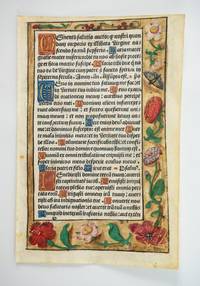
ref. ST20972b-cParis: Nicolas Vivien early 16th century. 197 x 130 mm. 7 3/4 x 5 1/8". Single column 28 lines gothic typeface. Ruled in red two one-line initials and two three-line initials painted in gold on red or blue ground and A LOVELY ANIMATED FULL PAINTED BORDER done by hand with trompe-l'oeil flowers one leaf also with a moth on painted gold ground. Top margin a little small light soiling to vellum borders with a couple superficial scratches and tiny smudges but in excellent condition overall. These beautifully embellished leaves from a printed Book of Hours demonstrate the enduring demand for manuscript illumination in the incunabular period and beyond. While the text here was completed on a printing press the initials and borders were done entirely by hand adding luxury and luster to otherwise unadorned pages. Although these leaves likely belonged to a Book of Hours printed in Paris possibly an edition printed for Nicolas Viven in or around 1503 the trompe-l'oeil style seen in the borders was particularly popular among Flemish and Netherlandish illuminators of the period. Because of the artist's use of subtle shading to indicate shadows the large blossoms here seem to pop off the page and one of the leaves contains a delicate little moth--attracted perhaps by the gleaming painted gold ground. Nicolas Vivien(?) unknown books
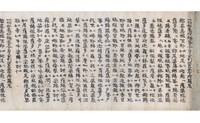
ref. 11486Scroll on paper 24 lines per dharani 17 characters per line body of the woodblock text: 240 x 494 mm. consisting of two joined sheets r: 553 mm. l: 585 mm. in length sutra text printed twice. Scroll 290 x 1138 mm. with later endpaper 68 mm. at beginning total length: 1206 mm. on a wooden roller some worming to text faint staining at foot. Most certainly Kofukuji Temple Nara: late Heian late 11th or early 12th century. An extremely early Kasuga-ban printing from the KÅfukuji temple. Our printed scroll appears to be a unique survival; we find no example in any library and it is unrecorded in all bibliographies. The earliest printed texts in Japan were dharani issued between 764 and 770; nothing more was printed until the late Heian period. "The first unequivocal record of textual printing in the Heian period 794-1185 comes from 1009 when Fujiwara no Michinaga recorded in his diary that 1000 copies of the Lotus Sutra had been printed although no copies of this seem to survive.The oldest extant example bearing a date is the Joyuishikiron which was printed in Nara by monks of the KÅfukuji temple in 1088."-Kornicki The Book in Japan pp. 118-19. In the Heian period of the "Six Temples" of Nara only KÅfukuji is known to have produced any printed books or scrolls. Our scroll was therefore most certainly printed at the KÅfukuji temple. The sutra has the general visual characteristics of late Heian printing: paler ink noticeably less jet-black than the ink usually found in Kamakura-era impressions but it should be said less pale than at least some of the surviving Heian impressions; slightly angular less brush-like letter-strokes; some noticeable variation in the firmness of the impression of the woodblock caused by uneven inking very typical of Heian-era printing; and fine-quality thin pale kÅzo paper. Kamakura-era printings tend to be characterized by jet-black sumi ink very even and well-inked impressions thick gampi paper stained a light yellow-brown with kÅryÅ clove and thick rounded letter-strokes in imitation of brush calligraphy. None of these typical Kamakura-era characteristics are present in this scroll. See Gardner Descriptive Catalogue of Japanese Books in the British Library Printed before 1700 London: 1993 p. 157. The sutra was translated from Sanskrit to Chinese by Amoghavajra ä¸ç©º C: Bukong; J: Fukū 705-74 a prolific and important translator of Esoteric scriptures and Esoteric versions of old scriptures. Born in southern India he went to China at age ten and was ordained. In 741 he went to study in Sri Lanka and India returning to China in 746 with some 500 Buddhist manuscript texts. In the following years he became one of the most politically powerful Buddhist monks in Chinese history and one of the Eight Patriarchs of the Doctrine in Shingon Buddhism. We know that this particular dharani sutra was one of the very earliest to be printed in East Asia - the oldest surviving complete printed scrolls today in both Chinese and Korean institutions are examples of the Treasure Chest Seal Dharani. A copy of the Sutra of the Whole-Body Relic Treasure Chest Seal Dharani dating from 975 is the earliest printed book in the collection of the National Library of China. The oldest surviving substantive Korean woodblock printing is a copy of the Sutra of the Whole-Body Relic Treasure Chest Seal Dharani published in 1007 year 10 of King Mokjong now kept at Chongjisa temple in Gaesong. The production of this scroll is most interesting. The two sheets of paper were first joined together and then the same woodblock was printed twice side by side. The two sheets are of slightly uneven length and part of the woodblock text on the right extends onto the left-hand sheet. The repeated recitation of the dharani was a meritorious act of faith for the followers of Buddha. Heian printing was - at least initially - characterized by repetitive printing for devotional purposes as an alternative to hand copying rather than for practical reading or study. In other words the first printed scrolls were really just longer and more elaborate versions of the suributsu multiple woodblock impressions periodically found rolled up inside Buddhist temple statues. This accords with our scroll which consists of two consecutive identical impressions of the Treasure Chest Seal Dharani. In the absence of other evidence to the contrary the repetitive printing and purely devotional nature of this scroll would tend to place its production more likely in the late 11th century or first years of the 12th rather than in the last decade or two of the Heian era - by which time scrolls clearly intended for study often with commentaries had become much more common. PROVENANCE: Ownership sumi in black seal of the "Horyuji issaikyo" 法隆寺一切経 at end of scroll and on verso where the two sheets of paper are joined. This particular seal is a variant of the seal used to mark the Horyuji's ownership of the Horyuji issaikyo manuscript sutra collection executed 1099-1131. Our variant seal was used to simply denote Horyuji ownership. As suggested in Nihon shakyo sokan our seal is of early Kamakura manufacture which means our printed scroll must predate that period. There is an early inscription on the outside of the front endpaper stating "hokyoin dharani." Our scroll was offered for sale by the Isseido Book Company in 1993 in its 90th anniversary catalogue describing it as a printing of the late Heian period. In remarkably fine condition. The outer blank margin of the left-hand sheet is somewhat dusty or smoky except for a large white circle where clearly a candle stand once was present. Preserved in two wooden boxes one fitting inside the other. â§ We thank Prof. Peter Kornicki of Cambridge University for his essential help. unknown books
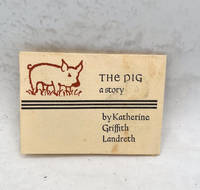
1983ref. 18049Los Angeles: Printed by Ward Ritchie at Laguna Verde Imprenta for Dawson's Book Shop 1983 Fragment of a miniature with each page measuring 3 7/16 x 2 7/16." The published book ran to 16 pp. This fragment is half is essentially half of it but it includes the pig illustration on the title and the pig-themed decorative initial by Gloria Stuart. Printed on Tovil handmade paper. Some light soiling and staining. Very good. Inscribed in pencil by Ward Ritchie to Gloria Stuart: "To Gloria my favorite artist. Love Ward". This is one of the scarcest Laguna Verde Imprenta titles the entire edition consisting of only twenty-five copies. OCLC notes nine copies in libraries. It is also one of only two miniatures produced by the press the other being A Little Quince. Printed by Ward Ritchie at Laguna Verde Imprenta for Dawson's Book Shop, books
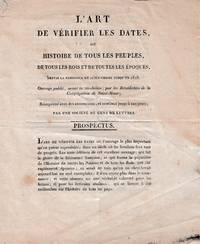
1817ref. 21138Paris: Valade 1817. First Edition. As issued. Good; some dust soiling; old creases. 4to 4 pp. Folded sheet; watermarked laid paper. Publisher's prospectus for a reimprint of a popular general history series that had begun in 1743. Promising 12 volumes describing the volume size shape and materials. After Westphalia and a few years it appears history needed a refresh and that's what the new publication proports to do. [Valade] unknown books
1921ref. 21107New York City: Max N Maisel 1921. First Yiddish language edition. Original publisher's blue cloth. Very good; some staining to the cloth of volume 1. Chipped dustjacket present for volume 2 only. Some moderate spotting throughout. 8vo I - 6 3 - 364 pp. frontispiece of Darwin; II - 8 9 - 368 pp.; III - 6 9 - 312 pp. Text illustrations throughout. Unsigned. This edition also contains volume 1 of J A Thomson's Essay on Darwinism Freeman #1138; OCLC locating only the APS copy. [Max N Maisel] hardcover books
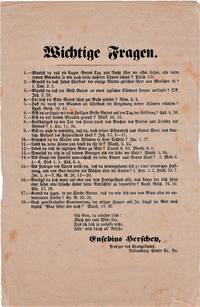
ref. 21176As issued. Overall very good; moderate browning; untrimmed. Four handbills printed recto only on milled paper and measuring appx. 195 x 210 mm. An eclectic group of PA German handbills comprising three songs and one Evangelical guide to self reflection. They are undated but appear to be from the 1840s. They are: 1 Ein Reife Lied by H Danner; 2 Ein schönes geistliches Lied; 3 Trost für die Trauernden in Zion - WITH - Erklarung der Kinder Zion's; 4 Wichtige Fragen by Eusebius Herschey of Rabersburg PA. possibly after 1860. None are in Arndt with any printing or OCLC. unknown books
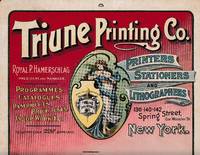
1910ref. 17100New York: Triune Printing ca1910. As issued. Good; some marginal finger soiling and spotting. Broadside on glazed board. It measures 362 x 284 mm. A full color lithograph that was a sample of the kind and quality of work that the Triune firm was capable of producing. They were located at the corner of Spring and Wooster in NYC. Triune Printing unknown books
1791ref. 843Germantown: Michael Billmeyer 1791. First American Edition. Contemporary blind stamped calf; clasps missing. Good; spotting throughout; last 10 leaves with a tide mark along the top edge; binding rubbed. 4to 8 1 - 785 1 - errata 2 - index pp. Weichenhan's 16th century work elucidating the tenets of the Schwenkfelders with a new six page preface identified as originating in Montgomery County Pennsylvania. The new preface describes the reasons for printing this text. It was printed at the expense of the United Friends. Evans notes that as a piece of typography paper and binding it is a very creditable piece of bookmaking. The copy offered here is in its original Billmeyer binding. The Schwenkfelders comprised a small Anabaptist sect founded in Silesia in the 16th century. Like the Quakers they disavowed communion and baptism. In 1734 the entire sect emigrated to Montgomery County in Pennsylvania. Though small in number the sect had a reputation for a devotion to reading and education and had amassed an outstanding library by the latter part of the 18th century. Arndt #803; Evans #23975. Michael Billmeyer unknown books
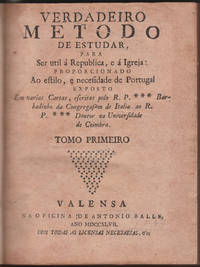
1747ref. 65Valensa Actually Lisbon: Antonio Balle Unknown 1747 Actually 1751. Second Edition. Contemporary calf; rebacked; spine laid down; hinges reinforced. Fair copy; overall browning; headlines on several leaves are gouged out affecting page numbers. Library release stamp on the verso of the first title page. 4to. I: 12 12 - 264 ; II: 4 12 - 243244 pp. A scarce and according to Palau important tract in the development and introduction of modern pedagogical concepts into Spain. The first edition of 1746 was seized and destroyed. The second edition was clandestinely printed see Martins Livros clandestinos . A revolutionary book in opposing the Jesuits and with very interesting comments on the teaching of the sciences medicine jurisprudence literary aesthetics and the education of women. The book generated a considerable polemical literature. Palau citing the first # 360777. Antonio Balle [Unknown] unknown books
1988ref. 2348145Rochester: The Press of the Good Mountain School of Printing Management and Sciences Rochester Institute of Technology 1988. Limited Edition. Large Softcover. Near Fine. 10x7x0. Scott Mary Jo. Limited edition one of 5000 copies. Paperback in jacket. Ink gift note on front flyleaf. 1988 Large Softcover. xiii 3 79 1 pp. A history of the award celebrating typographic excellence and its first twenty recipients. The Press of the Good Mountain, School of Printing Management and Sciences, Rochester Institute of Technology paperback books
1943ref. 2349401Washington D.C.: United States Government Printing Office 1943. Small Softcover. Good. Front hinge loosening bottom corner creased ROTC doodle in pencil on front wrapper. 1943 Small Softcover. iv 220 pp. Includes black-and-white photographs and diagrams. Includes: General; The Soldier Without Arms; The Soldier with Arms; Drill for Foot Troops; Drill for Units with Animal-Drawn Carts or Pack Animals; Drill for Units with Motor Carriers; Drill for Motor and Wagon Units; Formations of Battalion and Regiment; Ceremonies; Extended Orders; Signals; Appendix: Special Ceremonial Parade; Index. United States Government Printing Office paperback books
1940ref. 2334796Washington D.C: United States Navy Department Hydrographic Office/Government Printing Office 1940. Large Hardcover. Very Good/No Jacket. 0x0x0. Ink owner stamps a few small blemishes to boards. 1940 Large Hardcover. x 263 pp. These tables consist of tabulated solutions of the navigational triangle so arranged as to yield computed altitude and azimuth angle by inspection. The scheme of precomputing such values for ready use is a long-established one. It is in the scope arrangement and convenience of interpolation developed by the Hydrographic Office that these tables are unique. The tables are applicable equally to observations of the sun moon planets and navigational stars whether observed in north or south latitude. For convenience the values for only 10 degrees of latitude are included in each volume. This series of tables commonly known as H.O. Pub No. 214 is intended primarily for marine navigation. United States Navy Department, Hydrographic Office/Government Printing Office hardcover books
1928ref. 2322769Washington DC: United States Government Printing Office 1928. Soft Cover. Good. 1928 reprint of 1926 edition. Tear to upper spine edge wear. A dictionary of the technical terms used in the construction and description of aircraft. United States Government Printing Office paperback books
1878ref. 13937On board the U.S.S. Trenton European Station. ca.1878-1881. Pamphlets Printed Aboard American Naval Vessels A curious pair of imprints printed on a U.S. Navy shipboard press sometime not long after the Civil War. The first the INSPECTION. pamphlet describes what an inspector should look for and contains the colophon "From the Press of U.S. Flagship Trenton European Station." The second pamphlet which describes the equipment to be carried on boats contains no colophon but is identical to the first in style and makeup and was found with the first pamphlet so it seems reasonable to assume that it is a product of the same press. Two pamphlets. 12; 16pp. 12mo. Fastened with bronze tack. Slight staining else good. unknown books
1626ref. ST21074Antwerp: Balthasar Moretus 1626. ONE OF 50 COPIES ON VELLUM PRINTED FOR THE KING OF SPAIN and 25 copies on paper. 257 x 185 mm. 10 1/4 x 7 1/4". 8 p.l. 91 pp.Translated by Nicolas Grudius. Handsome dark brown crushed morocco tooled in gilt and blind by the Club Bindery for Robert Hoe stamp-signed and dated 1903 on front turn-in and with Hoe's monogram on front pastedown covers with frame of double gilt rules enclosing repeated blind-stamped medallions central panel with blind-ruled lozenge and rectangle the latter with oblique gilt fleurons at corners raised bands spine compartments ruled in blind with gilt fleuron centerpiece and gilt floral buds at corners gilt lettering vellum endleaves all edges gilt tiny invisible repairs at top of spine and front joint. With two full-page armorial engravings by Cornelius Galle one the arms of the Spanish monarch the other the insignia of the Order engraved head- and tailpieces. Front pastedown with morocco bookplate of Robert Hoe as well as engraved bookplates of Arthur & Charlotte Vershbow and David Godine. Bibl. Belg. I 692; Voet II 1017; Van Praet V:161-2; Brunet Supp. I:291; USTC 1007848. Boards slightly bowed as almost inevitable with vellum books text a bit wavy also as expected occasional faint smudges or dustsoiling at edges but AN EXTREMELY PLEASING COPY the vellum creamy and bright the binding very lustrous. This is the luxurious vellum printing of the rules of the Order of the Golden Fleece bound in 16th century style for the renowned bibliophile Robert Hoe by the workshop he co-founded and supervised for much of its existence. Founded in 1429 by Philip Duke of Burgundy the exclusive Order of the Golden Fleece was the most distinguished knighthood in the Holy Roman Empire being limited to just 24 members. Its primary purpose was to preserve and protect the Catholic faith as well as to uphold the 12 knightly virtues outlined by Philip: Faith Charity Justice Sagacity Prudence Temperance Resolution Truth Liberality Diligence Hope and Valor. Those deserving to be collared with the order's golden necklace featuring an appended ram that gave the group its name swore to support their monarch militarily and in return they were exempt from taxes as well as being entitled to be tried for any crimes by a jury restricted to their fellow knights. The "Rules" or "Statutes" that make up the text here dictate the very strict obligations and behavioral guidelines for its members including proscriptions against such things as fleeing a battle out of cowardice or embracing beliefs antithetical to the Church along with a number of procedural decrees governing for example how exactly to participate in ceremonial occasions. The earliest Latin edition of the "Constitutiones" translated from the French by the secretary of the Order Flemish poet Nicolaus Grudius 1504-70 was printed by Guillaume Silvius at the Plantin Press in 1566. In total four vellum editions were issued over the next 200 years all now rare. The present copy collates as the 1626 edition issued by Balthasar Moretus which the Belgian national bibliography tells us was printed for the king of Spain with 50 copies on vellum and 25 on paper. Our copy was bound in 1903 for Robert Hoe 1839-1909 a founder of the Grolier Club and one of the world's great book collectors. After Grolier was established in 1884 it soon became apparent that the country's few established hand binders were overtaxed in providing repairs and rebinding for the club members' rapidly accumulating acquisitions. As a consequence in 1895 Grolier members along with Edwin Holden and other wealthy collectors established the Club Bindery in order to attract European craftsmen to provide close to home fine quality binding work rivalling what was available abroad. The Club Bindery was in operation until 1909 with Hoe being its most influential manager and client. It provided bindings that tended to be traditional in style--though frequently with elaborate decoration--and that lived up to its patrons' expectations in terms of excellence. Our volume later passed into the hands of another Grolier Club member Arthur Vershbow 1922-2012 and his wife Charlotte 1924-2000. All early editions of this work are scarce; we were able to trace just one other copy of our vellum-printed edition at auction sold for 11700 at van de Wiele in 2024. Balthasar Moretus unknown books
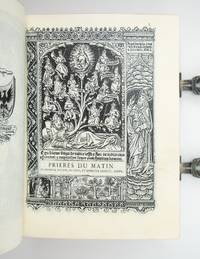
1858ref. ST21120Paris: Printed by J. Claye for Gruel & Engelman 1858. 155 x 117 mm. 6 1/8 x 4 5/8". 703 1 pp. VERY FINE GOTHIC-STYLE BLIND-STAMPED BROWN MOROCCO BY LÉON GRUEL stamp-signed at foot of spine covers with central panel showing the Tree of Jesse surrounded by the words "Egredietur virga de radice Iesse et flos deradice eius ascendet et requiescat super eum" A rod shall come forth from the root of Jesse and a flower shall grow out of his root and rest upon him" this framed by a roll of grapevines and floral vines oblique fleur-de-lys at each corner two silver square knot fore-edge clasps one catchplate replaced raised bands densely gilt turn-ins marbled endpapers and flyleaves all edges stained red. In a very fine brown morocco-backed buckram drop-back box with padded plush interior gilt lettering on spine. Title page and colophon with large device of Gruel & Engleman featuring two angels verso of title with printer's device of J. Claye each page with elaborate woodcut border featuring biblical scenes modelled on those in printed 15th century French Prayer books and seven miniatures Tree of Jesse Crucifixion Deposition Pentecost Trinity Conception of the Virgin Annunciation to the Virgin. Front flyleaf with a lengthy ink inscription to Mademoiselle Jeanne Ansart from printer Jules Claye in elegant calligraphic hand dated 1 December 1876. With three contemporary prayer cards and two commemorative cards--one for the ordination of a priest one for a nun professing her initial vows--laid in. See Judge "Léon Gruel: Master of Medieval Revival in Bookbinding" Encyclopedia of Design 2021 online: https://encyclopedia.design/2024/03/21/leon-gruel-master-of-medieval-revival-in-bookbinding/; Jeremy Norman "Master Printer Jules Claye Inscribes a Copy of a Book of Hours that He Printed on Vellum" History of Information online: https://www.historyofinformation.com/detail.phpid=5590. Faint rubbing to joints and extremities isolated trivial thumbing one small red smudge but A VERY FINE COPY--clean fresh and bright internally in a very lustrous binding with sharp impressions of the stamps. A luxurious volume in every way this is the only known copy printed on vellum of a 15th century-style prayer book created by distinguished Parisian publishers Gruel et Engelmann; it was bound by a celebrated craftsman who was an expert on the history of his craft and presented by the printer to a young woman perhaps to commemorate her taking religious vows. The firm that became Gruel et Engelmann had a complex evolution. It was founded as a bindery by Isidore Desforges in 1811 and after Desforges' daughter Catherine married Paul Gruel 1800-46 the latter took over the business in 1825. Following his death Catherine kept the bindery going for five years before marrying Parisian publisher Jean Engelmann d. 1875. The spouses merged their firms and combined their specialties to produce beautiful devotional books inspired by Medieval manuscript Books of Hours and early printed prayer books bound in appropriately historic styles. Catherine's son Léon Gruel 1840-1923 joined the firm as a binder and after his stepfather's death Gruel et Engelmann was run by Léon who headed the binding division and his stepbrother Edmond Engelmann who was in charge of the design and printing of books. In her "Bookbinders and their Craft" Prideaux says that the Gruel firm "always had the highest reputation . . . for initiative in artistic matters as well as for irreproachable execution in the detail of its many-sided achievements." The productions of Gruel et Englemann were informed by the collecting enthusiasms of the brothers--Léon's for historical bindings and Edmond's for illuminated manuscripts. Under their direction Gruel et Engelmann published and bound numerous works of devotion like the present "Paroissien" a service book that includes the texts and prayers in Latin and French used to celebrate Mass throughout the year. The author of "Manuel Historique et Bibliographique de l'Amateur de Relieure" and an expert on historical bindings Léon Gruel was adept at replicating any number of antiquarian bindings styles. As he noted in an interview with "The Bookman" in 1900 "Modern book binding has discovered nothing to equal the old designs and at best we can only copy." For this volume he chose the very appropriate Gothic style a particular favorite of his. According to the "Encyclopedia of Design" Gruel's "blend of reverence for the past with innovative application in the present allowed him to recreate historical styles with unparalleled accuracy and creativity." According to the former owner of this book distinguished bibliophile and rare book dealer Jeremy Norman Gruel et Engelmann never advertised a vellum printing of this title leading him to believe that their printer Jules Claye 1806-86--whom he considers "one of the great French trade printers of the mid-19th century"--printed this copy on vellum for himself. The sturdy vellum leaves make the text block here 63 mm. thick--a considerable bulk for a volume of this size. Claye recognized this and even concluded his lengthy and elegantly calligraphed inscription to Mlle. Jeanne Ansart with a graceful apology for the weight of the book: "As you approach the hour when God shall bless you / I offer prayers for you though we have never met / And I come to consecrate with a devout remembrance / The day you shall behold this new dawn. / This work of my handsI must admit / Is heavy for yours to bear yet it shall endure. / Forgive me remembering that our Divine Master / Climbed Golgotha beneath the burden of His cross." While it is possible that "the hour when God shall bless you" and "this new dawn" might indicate a marriage it seems more likely that this refers to Mlle. Ansart's taking the veil. The presence here of a Mass card that depicts a young woman professing her initial vows as a nun would seem to support this theory. Whatever path she chose Jeanne Ansart and successive owners cherished and carefully protected this luxurious volume over the years leaving it for us to savor visually and tactilely. [Printed by J. Claye for] Gruel & Engelman unknown books
ref. 40754COLOR PRINTING: Violet Blue New York: International Art Publishing Co. ca. 1896. $285.00 Folding fan with ten die-cut leaves each approximately 2" x 6 3/4" Each leaf printed with a monthly calendar March/April and November/December pairs are on one leaf. Each leaf beacutifully chromolithographed February-December with seasonal landscaped: January with a young girl and the ttitle. Edges decorated with die-cut purple and white violets. Alos with gilt accents. Stiff glossy card leaves. Metal eyelet at the handle-end threaded with gray cord ending in two tassels. Some fraying to tassels. LAst leaf November/December a bit fragile reinforced on verso with small piece of document tape. A clean bright near fine item. OCLC records no copies. 40754. unknown books
ref. 21879PRINTING A LIST OF BOOKS ON PRINTING.THE BOOKS AND PAPERS IN THE RALPH GREEN COLLECTION. Williamsburg: The College of William and Mary 1962. 4to. Comb-binding. 39 pages printed on the recto only. First edition. Very good. unknown books
ref. 35708COLOR PRINTING PICTURES AND SONGS FOR THE LITTLE ONES AT HOME. London: Thomas Nelson and Sons 1865. 8vo. Publisher's cloth. 16 leaves printed on one side only with 15 color plates. First edition. This is a very nice example of color printing by Thomas Nelson who used a transfer lithography method very similar to Baxter's color printing technique. In it Nelson transferred the images from steel engravings as opposed to Baxter taking his images from wood blocks. Then Nelson used oil based colors to print the image as did Baxter producing very bright and vivid colors. The color images in this book are quite small 1 1/2 x 1 3/4 inches and are pasted on the pages all printed in brown ink with gold borders and vignettes that surround the color plates. Some sporadic foxing and slight cover discoloration but a good example of a seldom seen Victorian method of color printing. unknown books
ref. 37459COLOR PRINTING CHRISTLICHES GEDENKBUCH. St. Louis: Eden Publishing House circa 1900. 8vo. Chromolithographic cloth binding all edges gilt. Unpaginated with 12 chromolithographic plates and all other pages with a pictorial border of flowers and nature scenes printed in brown ink. First edition. A stunningly fine copy with raised flowers on the spine and front board. Each month begins with a piece of biblical verse with a chromolithographic border and German text printed in several colors and gold. Rare. We could not find a copy cited by OCLC. The publication was meant for daily reflection on the bible. unknown books
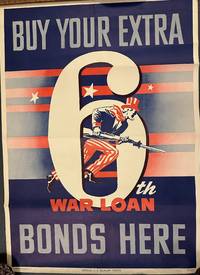
1944ref. 3374361944. Original Poster. Offset Lithograph. 26.75 x 19.25 inches. WWII poster advertising War Bonds as part of the Sixth War Loan drive. In patriotic red white and blue it shows Uncle Sam charging into battle with rifle and bayonet. With folds as issued. One small closed tear to right margin. Very good condition. unknown books
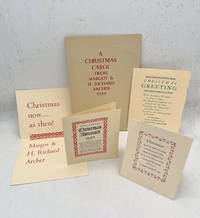
1948ref. 18014Claremont California and Williamstown Massachusetts: various dates ca. 1948-1954 Very good to fine condition. The cards include the following: Christmas: A poem by Martin Armstong. Printed by Saul & Lillian Marks at the Plantin Press 1948 4 1/4 x 5 3/8 printed in black and red; A Christmas Carol From Margot & H. Richard Archer. Printed by the Castle Press 1949 6 1/8 x 9 3/8" black and red; Poor Robin's Christmas Almanack Printed by the Castle Press 1951 4 1/4 x 5 3/8" black and red; Christmas Greetings Printed by the Hippogryph Press 1954 4 x 6 in. printed in green with Autograph Note signed by the Archers; and Christmas now… as then! n.d. printed by Grant Dahlstrom 6 x 9 books
1885ref. 6213Valladolid 1885. About very good. 28pp. plus folding table. Original grey printed wrappers. Wrappers with two moderate losses at fore edge; slight tear at fore edge into the text. Minor wear else. Extremely rare first edition of the founding statues of a printing house employing inmates of the Hospital for the Poor in Valencia. The regulations outline every facet of the new operation and include over a dozen model forms for use in the Escuela de Typografica. The printing establishment employed both permanent and temporary workers and was housed in the Palace of the Provincial Council due to "lack of suitable premises in the Hospital." Temporary workers included assistant typesetters and servant boys employed as volume demanded; twelve workers were to be sourced from the hospital itself to learn typesetting and bookbinding. The text explains that the purpose of the creation of the School of Typography and Bookbinding at the hospital is to give "artistic-professional education to those residents who wish it". Training was to last three years and be comprised of three groups. The first to learn typesetting and exercises in compositing; the second group to learn correction and imposition on plates and with the press; and the third pagination techniques for monographs and periodicals the study of presses and machines and other "theoretical and practical elements of bookbinding and publishing." Further chapters detail pay rates individual responsibilities of each staff member and procurement of materials. We find no copies in OCLC though one copy is located at the private Fundacion Universitaria Española in Madrid. books
1918ref. 30961New York: Carey Printing Co. / Dittman Color Printing Company 1918. Very Good. New York: Carey Printing Co. / Dittman Color Printing Company 1918. First Edition. Folio 30cm.; recent orange cloth with gilt-tooled reverse calf onlays from original binding all edges gilt 4611pp.; typographic and decorative designs throughout text printed within orange decorative border. Textblock a bit shaken in binding with both front and rear free endpaper expertly reaffixed along gutter light soil throughout else a Very Good example in a fine new binding. Date of publication provided by the Preface. Monumental type specimen catalog and reference issued by one of the leading print firms in Manhattan during World War I. The Preface provides two reasons for issuing such a massive catalog firstly "to display various faces sizes and styles of types in order to aid the copy-writer to select a type face best adapted to the subject" and secondly as a reference work "to which the expert or the layman may refer and be enlightened." On the facing leaf the Company pleads with the reader "do not mutilate this book. Carey Printing Co. / Dittman Color Printing Company unknown books