SCUPOLI (Laurent), DESMARETS DE SAINT-SORLIN (Jean).Livre Rare Book

8,034 results
1654ref. 42470Imprimé au Chasteau de Richelieu, Paris, Pierre Le Petit et Henry Le Gras, 1654. In-16 (140 x 90 mm) de (8)-57 pp. vélin souple, titre manuscrit sur le dos et le premier plat (reliure de l'époque).
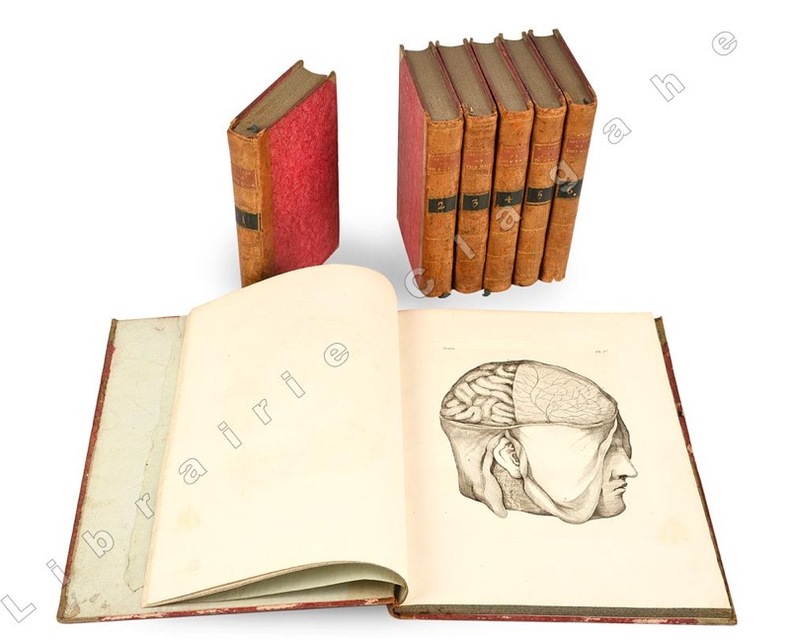
1805ref. 21362Paris, L. Duprat-Duverger, imprimerie de Baudouin, an XIII-1805 ; 6 tomes in-8 et Atlas grand in-4° (338 mm), demi-veau fauve et petits coins de vélin, pièces de titre décorées rouge-orangé et de tomaison décorées vert-empire, plat de papier rouge à l’époque, tranches mouchetées (reliure de l’époque); XI, 88, 332 pp., frontispice de Girodet, gravé par Robert De Launay, [1] f. serpente imprimée de l’explication de l’estampe ; [2] ff. (Table et Errata) ; 446 pp., [1] f. (Errata) ; 444 ; 410 ; 372 ; 372; 360 pp. ; Atlas : [1] f. Titre, IV pl. pour les Mémoires ; 35 planches sur le cerveau (XXXII et II bis, V bis et XXIIbis), dont 8 doubles.
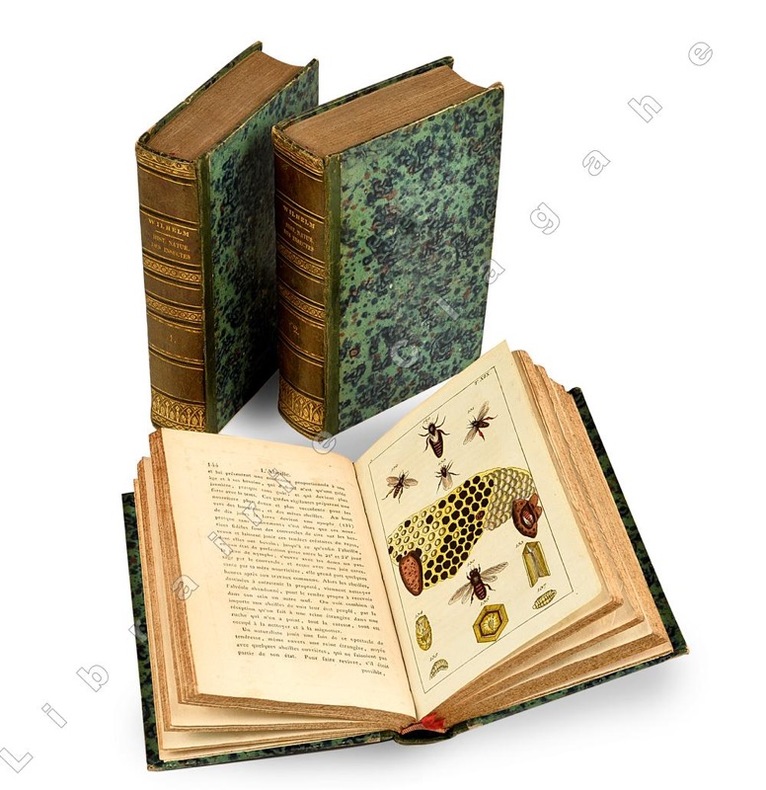
1798ref. 21300Basle, Henry Haag, 1798-1804 ; 3 tomes in-8, demi veau glacé vert foncé, dos à faux nerfs de filets à froid et dorés, roulettes décoratives, plaquette à décor de cathédule en queue, titre doré (reliure de l’époque) ; LII, 397 ; 435 ; 384 pp. et trois frontispices en noir et blanc gravés par Leizelt, une planche dépliante en noir et 150 (47, 52, 52) planches hors texte soigneusement aquarellées et gommées, soit 154 planches en tout.
1911LIMITED EDITION OF 306 COPIES. RARE large, ornate edition of Dante Alighieri's 'Divine Comedy', published on the alleged 700th anniversary of the Comedia. The text is heavily annotated, and is prefaced by the Italian poet Gabriele D'Annunzio. The edition features numerous woodcuts and text decorations reproduced from the 15th-century Venice edition of the Comedia. This exemplar is not numbered, meaning it is probably one of the first 6 copies. 415x310mm. XI+524 pages. Brown cloth Hardcover, masterfully restored from a damaged and partially missing cover. Cover corners bumped. Pages wavy with somewhat rough edges. Pages slightly yellowing. [SUMMARY]: In spite of the damage to cover it has previously sustained, this rare and impressive edition of a great literary masterpiece has been restored and is in good condition. PLEASE NOTE: This item is overweight. We may ask for extra shipping costs.
1881ref. 2080502106504268Not Available 1881. Soft Cover. Fine. Number of books: 1 Not Available paperback
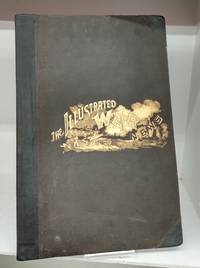
1885ref. 145249Toronto 1885. Vol. I No. 1 April 4th 1885 - Vol. I No. 18 August 1st 1885. Hardcover. Good. 152 p. 46 cm. Numerous b&w engravings. 15 unnumbered inserts of tinted illustrations. Map of battleground of Batoche. Map of the North-West Territories. Respined and recornered in black leather. Black cloth with gilt impressing. Some wear including chipped edges. Hinges repaired internally. Some tears chips rough edges to text block. Label removed from title page leaving residue. Hole in rear free endpaper. Tape repairs. Lacks 4 p. supplementay Honour Roll. Weekly reporting on the violent five-month insurgency against the Canadian government fought mainly by Métis and their native allies in 1885. Articles convey the latest news from the northwest the mounted police medals for bravery bios and so on. Contains numerous scenes of Western towns battles military life and training as well as portraits and caricatures. Much advertising mainly Toronto. Peel 1460. Land 1245. hardcover
Small 8vo (150 x 100 mm). (8), 112 ff. With the title in a woodcut border with 6 putti (without wings) and 8 fantastic beasts in and growing out of stylized foliage, incorporating Sessa's device (a cat with a mouse in its mouth) in the foot; Sessa's woodcut device (cat with a mouse in its mouth, now in a crowned wreath with initials MS) on the otherwise blank final page; 1 woodcut decorated initial (as S designed with a gap in the central stroke to accommodate the profile of a man, possibly intended as Dante). Set in an Aldine-style italic (with upright capitals).19th-century (?) sheepskin parchment , sewn on 3 recessed supports, sprinkled edges. Fourth edition (the last before 1723) of Dante's important philosophical allegory in autobiographical form, expressing his love of wisdom and knowledge personified as a beautiful lady named Philosophy, and his view that they lead to virtue and worldly happiness. Dante presents the story as a metaphorical banquet where he is content to eat the crumbs that fall from the plates of the wise: "the first extended piece of original expository prose in the Italian vernacular" (Lansing). Dante began work on it around 1304, ten years after completing his verse Vita nuova, his elevation of courtly love poetry into sacred love poetry that centred around his love for the beautiful and virtuous Beatrice, an idealized picture of a real lady of the Florentine court who died in 1590. In the intervening years he had developed a great love for philosophy, literally meaning the love of wisdom (a deep understanding of human nature and the physical universe) that leads to virtue. This idea was to infuse the Convivio. He finished only four of its projected fifteen "trattati", and never widely circulated the Convivio during his life, but it represents a turning point in his writing. It appears to have given him a new inspiration so that he set it aside around 1307 to begin work on his Divine comedy, where he returned to verse but merged his first love, the more human and religious Beatrice of the Vita nuova, with his new love, Philosophy, to create the new version of Beatrice that he honours in the Divine comedy. The first treatise introduces the story, while each of the others begins with a canzone expressing a particular aspect of Dante's love for Philosophy, followed by the main text explaining its literal and symbolic meaning. The whole therefore forms an encyclopedia of secular knowledge, intended for the education of both men and women. It also passionately pleads for the use of the Tuscan vernacular Italian at a time when learned works were usually written in Latin. The fourth book was politically subversive, proclaiming that the love Dante describes ennobles the soul, and attacking the Holy Roman Emperor Frederick II's notion that nobility comes from inheritance and manners. Many elements, including the cosmology, return in the Divine comedy. - All surviving manuscripts of the Convivio are believed to derive from a single lost manuscript that was unfortunately corrupt, so the work has long been a challenge to its editors. It was first printed at Florence in 1490 under the title Convivio, the "amoroso" of the present title being added for the second edition published at Venice in 1521, emphasizing the importance of love in Dante's text. "Convivio" means banquet, but like the English convivial, its etymology (living together) gives it connotations of the pleasures of human relations. The text of the present edition follows that of 1521. - With numerous points in the text marked by a charming contemporary manuscript pointing hand in the margin. In very good condition, with only a tiny hole on the edge of the woodcut border, a small hole where the ink of one marginal pointing hand has eaten through the paper and an occasional minor spot. An unfinished work by Dante, important in its own right, as an early example of literary Italian prose and as part of the genesis of the Divine Comedy. Adams D 119. Edit 16, 1161. Gamba, Serie ... Italiana letteratura 419. Mambelli, Edizioni Dantesche 803. Sander, Dante Alghieri 2331. USTC 808776. For the text: R. Lansing, "Convivio", in: Dante encyclopedia, pp. 224-232.
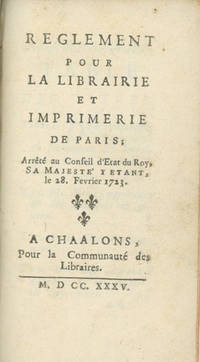
1735ref. 28870Chaalons' i.e. Châlons-sur-Marne 'pour la Communauté des Libraires' 1735 1735. New edition apparently unrecorded. Not found on OCLC or the Union Catalogue of France CCFr. A fine copy. 12mo contemporary polished continental calf marbled paper endpapers blind-ruled borders red morocco spine label gilt decorations and lettering a.e. stained red. Woodcut tailpieces. By the late 17th century the French government attempted to regulate all aspects of printing and the distribution of books in and around Paris. In 1686 those regulations were codified in the Édit du Roy pour le Règlement des Imprimeurs et Libraires de Paris and the Édit du Roy pour le Règlement des Relieurs et doreurs de Livres. Further revisions were made 30 years later and after some disagreements two editions of the code were published in 1723 and 1731 in the form of a decree. The code was extended to all of France in 1744 and remained in effect until 1777. This edition is a provincially printed version of the 1723 edition printed in Châlons-sur-Marne in 1735. The code is divided into 123 articles and is remarkably comprehensive in its regulation of all aspects of the trade including the import of books old and new bound and unbound and of imported printing types; books sold by subscription; requirements for the apprenticeships to booksellers and printers; the widows of booksellers and of printers; proofreaders; type founders; traveling booksellers; fairground booksellers and printers; prohibited books; auctions and inventories of libraries and bookstores et al. From the library of 19th century Châlons librarian and local historian Amédée Lhote with his bookplate on the front paste-down and ink ownership stamp in the margin of the final page of text; a bookseller's catalogue entry for the Histoire de l'imprimerie a Châlons 1895 on the rear paste-down. Marginal notations in ink on two leaves. Chaalons' [i.e. Châlons-sur-Marne], 'pour la Communauté des Libraires', 1735 unknown
2 Vols., small folio (305 x 190 mm), xxxiii, [3], 49-458; [4], 582, [2]pp., text in English and Persian, occasional marginal pencil notes, title page and terminal leaf to both volumes browned, staining to inner upper corner of leaves to start and end of volume two, later vellum-backed marbled boards, title in manuscript to spines. One of the most extensive Persian grammars written in English. "Matthew Lumsden (1777?1835), orientalist, was fifth son of John Lumsden of Cushnie, Aberdeenshire, and a cousin of Sir Harry Burnett Lumsden (1821?1896), army general. After education at King's College, Aberdeen, he went to India as assistant professor of Persian and Arabic in the College of Fort William, and in 1808 succeeded to the professorship. In 1812 he was appointed secretary to the Calcutta Madrasa, and superintended various translations of English works into Persian then in progress. From 1814 until 1817 he had charge of the East India Company's press at Calcutta, and in 1818 he became secretary to the stationery committee."?(Oxford DNB). Provenance: John L. Platts? signature in pencil to title page.
1556ref. 44944Sens, Gilles Richeboys, 1556. 3 parties en 1 vol. petit in-4 (15 x 22,5 cm) de (12)-95-(1) pp. 174 pp., 1 f. blanc, 70 pp. (1) f. (sign. A6, a-m4, A-Y4, Aa-Ii4), veau fauve, dos orné à nerfs, encadrement et motif cental dorés sur les plats, tranches dorées (reliure de l’époque).
4to. (23) ff. Printed in red and black. With full-page woodcut on verso of title-page and 15 woodcut genealogical diagrams, some full-page. Modern half vellum over marbled boards. Important collection of commentaries on the canon law of marriage and inheritance among blood relations; a standard work of the Middle Ages that saw more than 59 incunabular editions. Compared to Höltzel's first issue, produced in 1505, the present edition has been expanded by 5 leaves. Of the 15 woodcuts showing various degrees of relation, six are by Hans Baldung Grien, whose first works of woodcut book illustration these are. The new woodcut on leaf e2v ist not by Baldung, but by an imitator. The finely printed woodcut on the verso of the title-page, the work of an unidentified artist, shows St. Jerome kneeling before a crucifix with a fortified city in the background. - Trimmed rather closely with insignificant loss to some of the printed marginal glosses. Light brownstaining to title-page; an old blue crayon annotation to the colophon. VD 16, J 321. BM-STC German 31. Adams A 1056. IA 105.179. Panzer VII, 443, 29. Oldenbourg L 2. Kat. Karlsruhe I Anm. Dodgson, Cat. I, 510, 23. Kat. Baldung-Ausstellung Nürnberg 1961, Nr. 26. Oettinger/Knappe, Nr. 71.
Folio (185 x 292 mm). (2), XXIII ff. With title woodcut, 13 woodcuts in the text (one partly coloured), and one full-page woodcut on verso of final leaf. Modern boards with giltstamped red label to spine. First edition of this interesting chronicle of Ottoman history arranged as a series of short chapters, each dedicated to one of the twelve sultans who reigned up to 1543, ending with Suleiman I. The woodcut illustrations, mostly taken from Steiner's 1533 German edition of Marino Barlezio's Scanderbeg biography (and some from the 1532 "Itinerary"), show the principal events during the reign of each, mostly scenes of sieges and battles. The full-page woodcut by Leonhard Beck originates from the famous "Theuerdank", the poetic work by Emperor Maximilian I, and shows the protagonist on horseback. - From the library of Werner Habel, with his ownership stamp to flyleaf. VD 16, T 1838. Adams 1139. BM-STC German 867. Göllner I, 810. Apponyi 1726. Kertbeny 587. Riant 3522.
4to. (2) ff., (1), LXII, (1) pp., (2) ff. With etched armorial title and 62 large etched portraits in the text by Virgil Solis and Jost Amman. Contemporary vellum boards using a late 15th century vellum manuscript in red, blue and brown ink. Expanded fourth edition with the etchings by Solis and Amman. The French original edition of the main text had first appeared in Lyon in 1570, published by Clement Baudin under the title "Chronique sommairement traitée des faits héroiques de tous les rois de France". The title page shows the French arms, held by two genii; the etchings in the text show medaillon portraits surrounded by elaborate scrollwork borders, with little historical scenes inserted below. "Ammans's borders appear darker throughout than those of Solis and are marked out by being containing an abundant wealth of minute details. The scrollwork is less plastic than that of Solis, and humans are more frequently depicted" (cf. O'Dell-Franke). - The title illustration and the third portrait (showing Merovech) are weak impressions, the others crisp and well-defined throughout. Provenance: handwritten bibliographical notes and ownership (dated 1823) by Johann Andreas Boerner (1785-1862), the noted Nuremberg print dealer and auctioneer, on the flyleaf. Later in the Max and Maurice Rosenheim Collection (round paper label on inside front cover), dispersed at Sotheby's in 1923. Very rare; a single copy in VD 16 (BSB Munich). VD 16, B 1901. Becker 81b. Cf. Ebert 518. O'Dell-Franke 149.
2 rad. Tafeln (ca. 556 x 328 mm und 546 x 290 mm). Folio. Die beiden berühmten, nach Volcher Coiters Biographen Robert Herrlinger "vollends originell[en] und wegweisend[en]" Kinderskelett-Tafeln aus den "Externarum et internarum principalium humani corporis partium tabulae" (Nürnberg, 1572). Nachdem der jungverstorbene Mediziner Coiter (1534-76), ein in Nürnberg wirkender Friese, nach seiner Zeit in Italien an keiner Universität mehr lehrte, hatte das Werk zunächst nur einen sehr eingeschränkten Leserkreis, und seine "Auflage kann nicht groß gewesen sein" (Herrlinger, 57). Bei den hier vorliegenden Tafeln handelt es sich um "die ältesten bisher bekannten [Abbildungen] aus dem Gebiet der Embyrologie und Kinderanatomie. Es handelt sich um zwei große Falttafeln von über einem halben Meter Höhe [...] Die erste zeigt das Skelett eines halbjährigen Kindes von schräg vorne, die zweite von schräg hinten; auf dieser ist als 'Abb. 3' ein kleines Skelett einer dreimonatigen Fehlgeburt hinzugefügt [...] Alle Abbildungstafeln sind wie immer mit V.C.D. signiert. Wenn sie auch nicht völlig korrekt sind, so ist vor allem an den beiden großen Kinderskeletten bemerkenswert, wie Coiter versucht, in reiner Schwarz-Weiß-Technik Knorpel und Knochen als zwei verschiedene Materialien zu kennzeichnen: er punktiert den Knorpel und läßt den Knochen weiß. Noch heute ist diese Art der Knorpeldarstellung üblich [...] Coiters Kinderskelette haben Schule gemacht. Felix Platter bringt in seinem anatomischen Lehrbuch von 1583 ebenfalls, als zweiter, Kinderskelette, die ohne Coiter kaum denkbar sind [...] Wirklich neue, bessere Abbildungen vom foetalen und vom kindlichen Skelett gab erst Thomas Kerckring (1670). Coiters Abbildungen waren ein ganzes Jahrhundert lang maßgebend gewesen" (ebd., S. 80). - Etwas braunfleckig; kl. Einrisse alt hinterlegt. VD 16, ZV 3754. R. Herrlinger, Volcher Coiter (Nürnberg, 1952), S. 79ff. (mit Abb.).
1772ref. 15319, , 1772-1777. 4 pièces en 2 volumes in-8, texte encadré, veau marbré, dos lisse orné à la grotesque, pièces de titre en maroquin rouge et de tomaison en maroquin noir, tranches rouges (reliure de l'époque).
Folio (205 x 303 mm). (42) ff. With one large woodcut in text. Modern half calf. Extremely rare, early edition: "a work of the utmost importance for German military science, in many ways nothing less than fundamental" (Jähns, p. 484). One of the most interesting early 16th century books on the art of warfare; one of three undated issues. Treats sieges and occupations, various kinds of weaponry and their application. The woodcut shows the siege of a city. The BM copy cited by Cockle (with different quire signatures and surmised publication date of 1525) is not traceable in the BM General Catalogue. Ott von Echterdingen was General of the Artillery under Emperor Maximilian I and Emperor Charles V (cf. ADB XXIV, 558f.). - Some browning throughout. Provenance: from the collection of Thomas Fremantle, 3rd Baron Cottesloe (1862-1956), commander of the Territorial Army and president of the Society for Army History Research. VD 16, O 1453. Jähns 483. Bonnemann, Rodler 9. BM-STC German 478. Cf. Cockle 508. Jordan 2748. Fairfax Murray 235. BMC XIV, 418, 740. Weller, Repertorium Suppl. 341.
1639Folio. I: Lanndhandvest. Des Löblichen Hertogthumbs Steyr, darinnen Keyserliche, Königliche, und Landtsfürstliche Freyhaiten, Statua, Landtgebruch and andere Satz [...]. (4), 67, (1) ff. (Augsburg, Michael Manger), 1583. - II: Des Löblichen Fürstenthumbs Steyer Gerichtsordnung: Wie vor der Landtshauptmanschafft und dem Schrannengericht Procediert werden solle Reformiert Im Jahr/1618 [...]. (4), 48 ff. Graz, Widmanstetter, 1620. - III: Des Löblichen Fürstenthumbs Steyer Landt- und Peindlich Gerichtsordnung [...]. (7), 56, (1) ff. (Augsburg, Michael Manger), 1583. - IV: Bergwercksordnung. (2), 50, (3) ff. Graz, Widmanstetter, 1617. - V: Deß Fürstenthumbs Steyr BerckrechtsBüchel [...]. (6) ff. Graz, Sebastian Haupt, 1639. - VI: New verfaste ZechendtOrdnung, im Fürstenthumb Steyr. (6) ff. Graz, Sebastian Haupt, [c. 1605, from Austrian National Library copy]. - VII: In allgemainen der Dreyer Lande Steyr, Khärndten, unnd Crain [...] Landttag. (10) ff. (Graz), [Zacharias Bartsch], (1578). With 3 title pages printed in red and black, one woodcut title border and large heraldic woodcut (IV), and 3 page-sized woodcuts in the text. Several woodcut vignettes. Contemporary vellum. These separately published regimes are "of the utmost importance for Austrian legal history" (cf. A. Huber, quoted in Europ. Rechtsgeschichte). Discusses administrative and civil law, legal procedure, treatment of the "villains", and various crimes (murder, manslaughter, personal injury, theft, adultery, infanticide, abduction, polygamy, magic, poisoning, violation, etc.) and their punishment. - Binding somewhat wormed and with traces of cuts; altogether a very appealing volume with seven interesting works of 16th-century practical law. Very rare throughout, none of the works in OCLC. I: VD 16, S 8762. BM-STC German 841. Sauer & Auvermann (Europäische Rechtsgeschichte) 2190. Stubenrauch 1367. Stobbe II, 410. Not in Adams. - II: VD 17, 1:015904M. Bibliogr. Widmannstadiana 332. Not in Sauer & Auvermann. Stubenrauch 3291. - III: VD 16, S 8770. BM-STC German 841. Not in Adams. Sauer & Auvermann 2190. Stubenrauch 2336. Stobbe II, 410. - IV: Not in VD 17, KVK, OCLC. Bibliogr. Widmannstadiana 315. Cf. Stubenrauch 316 (1620 ed.). - V: VD 17, 7:708395V. Bibliogr. Widmannstadiana 379. Not in ÖNB. Cf. Stubenrauch 647 (1663 and 1682 eds.). - VI: VD 17, 1:015875K. Not in Stubenrauch. - VII: Not in VD 16 or Stubenrauch.
14954to. Gothic type, 33 lines. 8 unnumbered ff. Modern half calf with marbled boards and gilt-stamped title to spine. Probably the first separate edition of the 'Canones', taked from Astesanus de Ast's principal work, the 'Summa de casibus conscientiae'. GW cites an undated Leipzig edition, as well as the Vienna edition printed the following year. A specialty of this present printing is its simultaneous use of a woodcut title line together with letter printing on fol. 1, "an experiment not found elsewhere" (BMC). - Traces of a small, obliterated stamp on t. p., otherwise a very fine, well-preserved copy in an attractive binding. GW 2747. Goff A 1158. HC 4340. BMC II, 465. ISTC ia01158000.
8vo. 72 ff. Contemporary full vellum with remains of a giltstamped spine label. All edges coloured. Second Giunta edition of the "Corbaccio", which first appeared in 1487 and was first (and similarly anonymously) printed by Filippo Giunta in 1516: "una materiale ristampa di questa edizione, fatta pagina a pagina e riga a riga" (Gamba); "ces deux editions sont assez rares" (Brunet). This bawdy satire, supposedly based on a Florentine widow who turned down Boccaccio, was as popular as it remains controversial for its scurrilous and misogynistic elements. The text is prefixed by a letter from Filippo Giunta's son Bernardo "a'gli amatori della lingua Toscana"; leaves 57ff. contain Boccaccio's letter to Pino di Rossi. - Provenance: with engraved bookplate of Lord Robert Spencer (1747-1831), British Whig politician, to front pastedown. The youngest son of Charles Spencer, 3rd Duke of Marlborough, the hero of the Seven Years' War, Lord Robert was the nephew of the politician John Spencer, 5th paternal great grandfather of Diana, Princess of Wales, and brother of George Spencer, the great-great-great grandfather of Sir Winston Churchill. - Occasional light brownstaining and slight traces of worming to the blank lower margins of the first two leaves, but altogether a well-preserved, charming and authentic example of this rare and desirable edition. Edit 16, CNCE 6267. Adams B 2182. Renouard Supplément, p. XLIX, no. 79. Brunet I, 1016. Gamba 203 (note). Panzer VII, 40f., 219. Bandini, Juntarum Typographiae Annales II, 199. OCLC 612050557. Cf. Hayn/Gotendorf I, 398 (citing later Italian editions only). Not in BM-STC Italian.
Small 8vo. (8), 64 ff. With woodcut device to title-page, 1 woodcut initial and 1 full-page emblematic woodcut at the end. - (Bound with) II: Rosello, (Lucio) Paolo. Due dialoghi […]. Uno, in cui si tratta il modo di conoscere, et di far la scelta d’un servitore, & de l’ufficio suo. L’altro, de la vita de cortegiani, intitolato la patientia. Venice, (Comin da Trino di Monferrato, 1549). 24 ff. With publisher's device to title-page and full-page, different device to the reverse. Contemporary boards. First editions: two rare Italian Renaissance treatises about prudent household management, including the role and treatment of family and servants, directed at the paterfamilias and couched in the form of dialogues. "Though the first treatises of this type appeared in the 16th century, penned by humanists, their production intensified after 1550, when they also acquired a different and broader meaning [...] While in the first examples of the genre the household was perceived as a metaphor for the health of the polity, in the following century a well-regulated household became an indication of the noble quality of its master and an expression of civilized behaviour" (Cavallo/Storey, Healthy Living in Late Renaissance Italy [OUP, 2013], p. 42). Above all, books of the "oeconomica" genre aimed to "define the responsibilities of each member of the family and household - husband, wife, children, and different ranks of servants - and how they should behave towards one another. Special attention is also given to manners and attitudes appropriate to the social standing, age, and gender [...], but they also contain practical advice on how to make a house salubrious by orienting the building correctly as regards sun and wind, and through the layout and size of the rooms and windows" (ibid., p. 43). Caggio's treatise not only includes such architectural considerations (cf. fol. 57f.), but generally provides an uncommonly detailed window into the familial mores of his native Palermo during the mid-16th century, frequently betraying the pervasive misogyny of Sicilian society: the two-page table of contents promises answers to problems such as, "Why did nature make men robust and valorous and women weak and of little spirit", and further along gives advice on, "What damages are caused by wives who are pompous, proud, and domineering". - The 1549 treatise by Rosello, a Padovan cleric frequently at odds with the censorship of his church, contains two dialogues. The first develops the subject of the mutual education of master and servant, demonstrating that the latter will show all the more "prudentia, modestia, gentilezza, & costumi civili" (fol. 13r) if the master is indulgent and forbearing toward him. The second notoriously portrays life at court as an anarchic war of all against all in which the courtier, lacking a specific professional or classical education, must continually adapt to circumstances like a chameleon (cf. M. Hinz, Rhetorische Strategien des Hofmannes [1992], p. 239). - Binding rather severely rubbed, extremeties bumped; book's contents inscribed on upper cover. Interior shows occasional weak waterstains. Several old annotations to endpapers and title-page (some in Italian); a cipher alphabet is inscribed to the lower endpaper. Provenance: from the collection of the historian and director of the Viennese court library, Sebastian Tengnagel (1563-1636), who willed his large private library to the Emperor in 1633 (cf. Alphons Lhotsky, Die Wiener Palatina und die Geschichtsforschung unter Sebastian Tengnagel, in: Aufsätze und Vorträge III [1972], p. 242ff.). His autograph ownership is on the title-page: "Ex lib. Sebast. Tengnagel I.V.D. et Caes. Biblioth.", and it is possible that the cipher alphabet is also written by him. The pastedown shows the later bookplate of the library of Pfannberg castle in Styria, the collection of the Austrian industrialist Baron Franz Mayr von Melnhof (1810-89). I: Edit 16, CNCE 8270. BM-STC Italian 136. Not in Adams. - II: Edit 16, CNCE 53725. BM-STC Italian 587. Not in Adams. For the author cf. Jöcher III, 2224.
1566Large 8vo. (20), 424 (not: 423) pp., 1 bl. f., (18) pp. With woodcut printer's device on t. p. Contemp. blindstamped pigskin, monogrammed and dated "I.V.S | 1566". Wants ties. First edition, first printing, of this first and most important biography of Melanchthon. Camerarius was able to consult a large amount of personal correspondence, a fact which makes this work a valuable source to this day. - Wide-margined copy, slightly browned with insignificant waterstain near upper edge. Slight worming to t. p. repaired; numerous contemp. marginalia. The appealingly blindstamped binding can be attributed to the Swabian bookbinder Wolfconrad Schwickart (cf. Goldschmidt, Gothic & Renaissance Bookbindings 227). Somewhat rubbed; modern front pastedown. From the library of Neidstein castle in in the Oberpfalz region of Bavaria. VD 16, C 502. IA 130.520. Hartfelder 624, 43. Schottenloher 15023. Ebert 3391.
Small 8vo (155 x 100 mm). (4), "134" (= 136), (2) ff. With Aldus's woodcut anchor and dolphin device on the title-page, repeated on the verso of the otherwise blank final leaf, and spaces with guide letters left for 2 5-line and about 60 3-line manuscript initials (not filled in). Set in an Aldine italic (with upright capitals) with occasional words (mostly names) in roman and frequent passages in Greek. Gold-tooled mottled calf (ca. 1700?), sewn on 5 supports (vellum tapes?), each board with a frame made with a 2 mm roll, the spine with a gold-tooled red morocco label in the 2nd of 6 compartments but otherwise decorated as a single field filled with a 7 mm roll of diagonal lines (the bands on the spine are nearly flat), gold-tooled board edges, headbands in brown and beige, dark brown ribbon marker, marbled endpapers (Dutch pattern, curled, close to Wolfe 12), red edges. First edition to include Muret's important and influential commentaries, of the poems of the passionate (if self-centred) Roman poet Catullus (84-ca. 54 BCE), often given the collective title Carmina. Both the poems and the commentaries appear here in the original Latin. Although the poems are not numbered and there is no table of contents, Muret's present edition established the order for the numbering from 1 to 116 that remains in use, even though poems 18-20 are now usually omitted as false attributions and a few are sometimes divided into two poems distinguished with "a" and "b". Poems 18 and 19 are addressed to the fertility god Pirapus, best known for his enormous perpetual erection, and poem 20 is also a Priapeia. Among the 113 poems universally accepted as authentic, many are addressed to "Lesbia", whom Catullus passionately loved. He gave her this pseudonym in allusion to the Greek love poems of Sappho from the Island of Lesbos, which influenced him strongly. She is generally identified as Clodia, the wife of a Roman nobleman. Catullus was one of her several lovers and he names and rails against some of the others. While Catullus's greatest passions were heterosexual, poems 48, 50 and 99 express romantic and sexual interests in men. In his poems he is quick to attack others, both politically and personally, and after he fell out with two male friends he wrote poem 16, threatening to sexually abuse them. - Catullus' poems, with the exception of poem 62, survive only in corrupt manuscripts from the 1360s or later, so establishing their texts remains a difficult task today. De Spira at Venice published the first edition in 1472 and Muret generally follows the order established in by the 1490s, though with some additions. The scholarly editions by Statius (1566) and Scaliger (1577) follow his order and at least the latter includes many of his notes. Skinner notes that they were "better text critics than Muret and less interesting commentators". Paulus Manutius produced a second edition with Muret's commentaries in 1558. - The French humanist Marc-Antoine Muret (1526-1585), recognised as a brilliant scholar in his teens, taught at Paris from 1551, when he published his first book there. Accused of being a Huguenot and a homosexual, he had to flee Paris in late 1553 but Adus Manutius's son Paulus, who had taken charge of the family's Venice printing office, offered him shelter. The present book was Muret's first publication in Venice, with his preliminary note date 15 October 1554. He was well-versed in Greek and first pointed out that Catullus modelled poem 51 (to Lesbia) on a poem by Sappho, inserting the original Greek in his commentary. He also sometimes inserts poems he wrote himself. - With minor damage to the lower outside corner of the first few leaves, not approaching the text, but still in very good condition. The hinges are slightly worn and the spine label has a small chip, but the binding is otherwise also very good. A seminal edition of Catullus's passionate and often erotic poems, especially important as the first edition of his extensive and important commentaries. Adams C 1145. Edit 16, 10364. Gay/Lemonnyer I, 498. Renouard 162. Marilyn Skinner, Companion to Catullus, passim. USTC 821188.
1782ref. 12394Aux Deux-Ponts, [Parme, Stamperia Reale, Giambattista Bodoni], 1775 [1782]. 13 vol. grand in-8, veau marbré, dos lisses ornés, pièces de titre en maroquin rouge, et de tomaison en maroquin rouge sur pièce de maroquin vert, tranches dorées (reliure de l'époque).
8vo. (48), 283, (5) pp. (including errata leaf and priviledge at end). - Bound with (II): Cardona, Juan Bautista. De expungendis haereticorum propriis nominibus etiam de libris qui de religione ex professo non tractant. Rome, Giuseppe de Angelis, 1576. 152 pp. With woodcut printer's device on title-page. Contemporary limp vellum with ms. spine title. First edition of this notorious 16th century defence of censorship, couched as a dialogue between Theotimus and Nicolaus, which includes biting attacks on authors who were thought to threaten public morals - notably Rabelais. Other widely-received works of a particularly corrupting character that Dupuyherbault (ca. 1490-1566) singles out for criticism include the Arthurian literary cycle, Merlin's prophecies (highly esteemed in the Middle Ages), Ogier the Dane, and especially the 13th century Roman de la Rose: indeed, the author of this work (he writes) must have suffered the fate of Judas, unless he repented of his sins (p. 131). Dupuyherbault is also one of the earliest scholars to note that catalogues of banned books are prone to being exploited as lists of recommended reading by persons who otherwise would have remained ignorant of their existence (p. 238). - Very rare: a single copy in auction records since 1963. A German translation appeared as early as 1581. - II: "A curious little work" (Reusch) in which Cardona, who was himself involved with the Roman Congregation's expurgation efforts, provides an elaborate argument for striking also the names of the heretic authors from their expurged books. The Spaniard J. B. Cardona (1511-89), bishop of Tortosa, suggests that this would bring greater honour to Christ while denying the heretic the honour he craves, whereas preserving their names would be tantamount to giving credit where none is due. The only cases in which the heretic authors' names are to be kept are those in which they are mentioned by pious or learned men with the purpose of refuting or slighting them. "A member of the Index Congregation, Cardinal Gabriel Paleotto, agreed with Cardona and prompted him to have his treatise printed. Gregory XIII accepted the dedication of the work and issued the relevant decree 'for the said reasons as well as for others'" (cf. Reusch I, 454). Rare; a single copy in auction records internationally. - Rather light browning throughout the volume, but an attractive and well-preserved book. I: BM-STC French 145. Adams D 1154. Reusch I, 284. - II: BM-STC Italian 149. Edit 16, CNCE 9486. Reusch I, 453f. OCLC 872432320. Not in Adams.
15708vo. (28) pp., 2 bl. ff., (16), 439, (1) pp. With woodcut printer's device on title-page and large device on final leaf; several woodcut initials. - (Bound with) II: Naogeorg [i. e. Kirchmeyer], Thomas. Rubricae, sive summae capitulorum iuris canonici, omnibus tam iura disce[n]tibus, quam aliarum artium studiosis scitu cumprimis utiles ac necessariae, nunc primum [...] editae. Basel, no printer, [ca. 1551]. (32), 301, (1) pp. Contemporary limp vellum. Wants ties. Extremely rare first edition of what is probably the earliest comprehensive history of the German Peasants' Wars, focusing on the insurrections in Upper Swabia and around Lake Constance, which were put down in 1525. Even the 1573 German translation, which is much more common, is regarded as "very rare" (cf. RA 68, Nr. 77). No copy of the present original edition in auction records since 1950. - Old handwritten ownership notes to title-page (monograms HF and MK in Lat in and Hebrew; "Laurentius Rudanthi" [?], etc.). - II: First edition of this early collection of problems in canon law, intended for legal training. It was composed by the well-known Lutheran theologian and neo-Latin poet Thomas Kirchmeyer (1508-63), who had left the Dominican order in 1526, during his brief year of law school at Basel in 1551. - A good, insignificantly browned copy. I: VD 16, G 2283. BM-STC German 362. Adams G 782. Schottenloher 34770c. Jöcher II, 1027. - II: VD 16, K 992. Cf. NDB XVIII, 729.