8,031 results
ref. 10426Tacoma WA 2020. Limited Edition. Hardcover. Fine in Fine Archival Box. Limited Edition. Hardcover. Quiet sophisticated and remarkably powerful Gabby's newest work is an exquiste blend of book art and binding. Gabby has from early in her career gone beyond her roots in design binding creating the text art and printing for several books now. Just as her design bindings push limits and explore possibilities so does her art and print work. It is a remarkable evolution. "Ralph Emerson wrote this poem "Blight" in July of 1843. He spoke out on climate change and the ways we could shift course by not blindly following others. In describing his travels to Europe while writing on life and nature Emerson said "same faces under new caps and jackets another turn of the old kaleidoscope." I took some liberties with Emerson's poem surrounding his words with photographs captured at Owen Beach in Washington state on a rainy winter day in 2019. This public beach in the middle of an urban old-growth forest will close for a year beginning in fall of 2020 to mitigate the effects of climate change and rising sea levels. Emerson's words of anger and disappointment at environmental destruction only resonate more with our current climate of melting glaciers and raging fires. As we continue to twist the kaleidoscope I remain optimistic we will find a way to rearrange these fragments and improve the view for future generations." "The words were written by Ralph Emerson in 1843 about the perils of human influence on the world around us. I match his words with my photographs of Owen beach here in Tacoma WA that is about to be renovated because of rising tides and erosion from climate change. The text goes in and out the clear border mimics the tide or erosion and the paper was scrubbed with a brillo pad to feel used. I feel optimistic about our chances to help parts of our planet with more exposure to what is going on. The words were written by Ralph Emerson in 1843 about the perils of human influence on the world around us. I match his words with my photographs of Owen beach here in Tacoma WA that is about to be renovated because of rising tides and erosion from climate change. The text goes in and out the clear border mimics the tide or erosion and the paper was scrubbed with a brillo pad to feel used. I feel optimistic about our chances to help parts of our planet with more exposure to what is going on." artist statement. Tight bright and unmarred. Brown textedup paper boards by Hook Pottery Paper in a modified case binding letterpress printed with handset type on inkjet photo transfers silkscreen printed panels and acrylic painted Kozuke paper printing completed at Springtide Press with assistance from Jessica Spring; housed in an archival dropspine box. 4to. np. Illus. color plates. Numbered limited edition of 28 this being 21. Signed by the artist. hardcover books
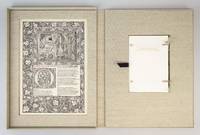
ref. ST20503McMinnville Oregon: Phillip J. Pirages 2019. No. VII OF 47 COPIES numbered I-XLVII bound in flexible vellum from a total edition of 165 COPIES. Text: 244 x 154 mm. 9 1/8 x 6 1/8"; Case: 502 x 372 mm. 19 3/4 x 14 5/8". ii 75 pp. Bound in flexible vellum with ties inspired by Kelmscott Press bindings by Amy Borezo who also constructed the case holding the volume and leaves. The book printed letterpress on Zerkall Book Laid Vellum paper by Arthur Larson at Horton Tank Graphics. Book layout by Jill Mann. EACH COPY WITH FIVE LEAVES: ONE FROM THE KELMSCOTT CHAUCER WITH woodcut borders woodcut beginning word and A WOODCUT SCENE DESIGNED BY EDWARD BURNE-JONES AND ONE EACH FROM THE PRESSES OF FOUR GERMAN PRINTERS FROM THE 1470s--PETER SCHOEFFER JOHANN MENTELIN GÜNTHER ZAINER AND ANTON KOBERGER the Zainer leaf featuring at least one woodcut initial. The incunabular leaves consistently excellent with only minor defects and the Kelmscott leaves which were never part of a bound volume in entirely fine condition. This is a unique leaf book in the way that it combines three elements: a significant private press production involving people at the top of their craft a scholarly commentary that contributes to a further understanding of the history of printing and--most important--five leaves: one from the Kelmscott Press "Works" of Geoffrey Chaucer and four from books issued by German printers at work in the 1470s. The book has been printed and bound by hand by gifted professionals; the essay addresses a topic of significance to typophiles in a considerably more thoroughgoing way than has been done before; and the assemblage of leaves represents a powerful visual reinforcement of the text as well as an opportunity to share in the ownership of four important incunabula along with the extraordinary Kelmscott Chaucer. The story of the production is heavy on serendipity: in the winter of 2012 after purchasing a very incomplete copy of the Kelmscott Chaucer at auction we considered the possibility of producing a leaf book but because the Chaucer--universally considered to be one of the most beautiful books ever printed--had been written about by so many different people in so many different ways we didn't know what aspect was left for us to explore. The one topic we fastened on as thus far inadequately examined is the origin of the work's typeface. We soon learned that Morris who is known to have owned more than 500 incunables most admired--and was consequently most likely to have been influenced in his typographic design by--Peter Schoeffer of Mainz Johann Mentelin of Strassburg Günther Zainer of Augsburg and Anton Koberger of Nuremberg. Over the course of the years succeeding the purchase of the defective Chaucer we were fortunate beyond all expectation to acquire incomplete books from each of these four eminent printers. As a result the present leaf book will allow the reader not only to read in the accompanying essay about the influence on Morris of his typographic forebears but also to compare with his or her own eyes the resemblances between the Kelmscott leaf and the leaves from four centuries earlier. The essay comes in one of three bindings which reflect the degree of decorative elaboration on the accompanying Kelmscott leaf: linen-backed paper boards in imitation of the small format Kelmscott publications with a leaf containing text and small initials; floral patterned cloth after a Morris design with a leaf containing multiple six-line initials; or in the most deluxe version as here in flexible vellum with ties with a leaf featuring a full woodcut frame one or more prominent woodcut initials and a very large and striking Edward Burne-Jones woodcut scene. Phillip J. Pirages unknown
ref. ST15039cAMcMinnville Oregon: Phillip J. Pirages 2019. ONE OF 47 COPIES numbered I-XLVII bound in flexible vellum from a total edition of 165 COPIES. Text: 244 x 154 mm. 9 1/8 x 6 1/8"; Case: 502 x 372 mm. 19 3/4 x 14 5/8". ii 75 pp. Bound in flexible vellum with ties inspired by Kelmscott Press bindings by Amy Borezo who also constructed the case holding the volume and leaves. The book printed letterpress on Zerkall Book Laid Vellum paper by Arthur Larson at Horton Tank Graphics. Book layout by Jill Mann. EACH COPY WITH FIVE LEAVES: ONE FROM THE KELMSCOTT CHAUCER WITH woodcut borders woodcut beginning word and A WOODCUT SCENE DESIGNED BY EDWARD BURNE-JONES AND ONE EACH FROM THE PRESSES OF FOUR GERMAN PRINTERS FROM THE 1470s--PETER SCHOEFFER JOHANN MENTELIN GÜNTHER ZAINER AND ANTON KOBERGER the Zainer leaf featuring at least one woodcut initial. ◆The incunabular leaves consistently excellent with only minor defects and the Kelmscott leaves which were never part of a bound volume in entirely fine condition. This is a unique leaf book in the way that it combines three elements: a significant private press production involving people at the top of their craft a scholarly commentary that contributes to a further understanding of the history of printing and--most important--five leaves: one from the Kelmscott Press "Works" of Geoffrey Chaucer and four from books issued by German printers at work in the 1470s. The book has been printed and bound by hand by gifted professionals; the essay addresses a topic of significance to typophiles in a considerably more thoroughgoing way than has been done before; and the assemblage of leaves represents a powerful visual reinforcement of the text as well as an opportunity to share in the ownership of four important incunabula along with the extraordinary Kelmscott Chaucer. The story of the production is heavy on serendipity: in the winter of 2012 after purchasing a very incomplete copy of the Kelmscott Chaucer at auction we considered the possibility of producing a leaf book but because the Chaucer--universally considered to be one of the most beautiful books ever printed--had been written about by so many different people in so many different ways we didn't know what aspect was left for us to explore. The one topic we fastened on as thus far inadequately examined is the origin of the work's typeface. We soon learned that Morris who is known to have owned more than 500 incunables most admired--and was consequently most likely to have been influenced in his typographic design by--Peter Schoeffer of Mainz Johann Mentelin of Strassburg Günther Zainer of Augsburg and Anton Koberger of Nuremberg. Over the course of the years succeeding the purchase of the defective Chaucer we were fortunate beyond all expectation to acquire incomplete books from each of these four eminent printers. As a result the present leaf book will allow the reader not only to read in the accompanying essay about the influence on Morris of his typographic forebears but also to compare with his or her own eyes the resemblances between the Kelmscott leaf and the leaves from four centuries earlier. Phillip J. Pirages unknown
ref. ST20503McMinnville Oregon: Phillip J. Pirages 2019. No. VII OF 47 COPIES numbered I-XLVII bound in flexible vellum from a total edition of 165 COPIES. Text: 244 x 154 mm. 9 1/8 x 6 1/8"; Case: 502 x 372 mm. 19 3/4 x 14 5/8". ii 75 pp. Bound in flexible vellum with ties inspired by Kelmscott Press bindings by Amy Borezo who also constructed the case holding the volume and leaves. The book printed letterpress on Zerkall Book Laid Vellum paper by Arthur Larson at Horton Tank Graphics. Book layout by Jill Mann. EACH COPY WITH FIVE LEAVES: ONE FROM THE KELMSCOTT CHAUCER WITH woodcut borders woodcut beginning word and A WOODCUT SCENE DESIGNED BY EDWARD BURNE-JONES AND ONE EACH FROM THE PRESSES OF FOUR GERMAN PRINTERS FROM THE 1470s--PETER SCHOEFFER JOHANN MENTELIN GÜNTHER ZAINER AND ANTON KOBERGER the Zainer leaf featuring at least one woodcut initial. The incunabular leaves consistently excellent with only minor defects and the Kelmscott leaves which were never part of a bound volume in entirely fine condition. This is a unique leaf book in the way that it combines three elements: a significant private press production involving people at the top of their craft a scholarly commentary that contributes to a further understanding of the history of printing and--most important--five leaves: one from the Kelmscott Press "Works" of Geoffrey Chaucer and four from books issued by German printers at work in the 1470s. The book has been printed and bound by hand by gifted professionals; the essay addresses a topic of significance to typophiles in a considerably more thoroughgoing way than has been done before; and the assemblage of leaves represents a powerful visual reinforcement of the text as well as an opportunity to share in the ownership of four important incunabula along with the extraordinary Kelmscott Chaucer. The story of the production is heavy on serendipity: in the winter of 2012 after purchasing a very incomplete copy of the Kelmscott Chaucer at auction we considered the possibility of producing a leaf book but because the Chaucer--universally considered to be one of the most beautiful books ever printed--had been written about by so many different people in so many different ways we didn't know what aspect was left for us to explore. The one topic we fastened on as thus far inadequately examined is the origin of the work's typeface. We soon learned that Morris who is known to have owned more than 500 incunables most admired--and was consequently most likely to have been influenced in his typographic design by--Peter Schoeffer of Mainz Johann Mentelin of Strassburg Günther Zainer of Augsburg and Anton Koberger of Nuremberg. Over the course of the years succeeding the purchase of the defective Chaucer we were fortunate beyond all expectation to acquire incomplete books from each of these four eminent printers. As a result the present leaf book will allow the reader not only to read in the accompanying essay about the influence on Morris of his typographic forebears but also to compare with his or her own eyes the resemblances between the Kelmscott leaf and the leaves from four centuries earlier. The essay comes in one of three bindings which reflect the degree of decorative elaboration on the accompanying Kelmscott leaf: linen-backed paper boards in imitation of the small format Kelmscott publications with a leaf containing text and small initials; floral patterned cloth after a Morris design with a leaf containing multiple six-line initials; or in the most deluxe version as here in flexible vellum with ties with a leaf featuring a full woodcut frame one or more prominent woodcut initials and a very large and striking Edward Burne-Jones woodcut scene. Phillip J. Pirages unknown books
ref. ST15039cAMcMinnville Oregon: Phillip J. Pirages 2019. ONE OF 47 COPIES numbered I-XLVII bound in flexible vellum from a total edition of 165 COPIES. Text: 244 x 154 mm. 9 1/8 x 6 1/8"; Case: 502 x 372 mm. 19 3/4 x 14 5/8". ii 75 pp. Bound in flexible vellum with ties inspired by Kelmscott Press bindings by Amy Borezo who also constructed the case holding the volume and leaves. The book printed letterpress on Zerkall Book Laid Vellum paper by Arthur Larson at Horton Tank Graphics. Book layout by Jill Mann. EACH COPY WITH FIVE LEAVES: ONE FROM THE KELMSCOTT CHAUCER WITH woodcut borders woodcut beginning word and A WOODCUT SCENE DESIGNED BY EDWARD BURNE-JONES AND ONE EACH FROM THE PRESSES OF FOUR GERMAN PRINTERS FROM THE 1470s--PETER SCHOEFFER JOHANN MENTELIN GÜNTHER ZAINER AND ANTON KOBERGER the Zainer leaf featuring at least one woodcut initial. ◆The incunabular leaves consistently excellent with only minor defects and the Kelmscott leaves which were never part of a bound volume in entirely fine condition. This is a unique leaf book in the way that it combines three elements: a significant private press production involving people at the top of their craft a scholarly commentary that contributes to a further understanding of the history of printing and--most important--five leaves: one from the Kelmscott Press "Works" of Geoffrey Chaucer and four from books issued by German printers at work in the 1470s. The book has been printed and bound by hand by gifted professionals; the essay addresses a topic of significance to typophiles in a considerably more thoroughgoing way than has been done before; and the assemblage of leaves represents a powerful visual reinforcement of the text as well as an opportunity to share in the ownership of four important incunabula along with the extraordinary Kelmscott Chaucer. The story of the production is heavy on serendipity: in the winter of 2012 after purchasing a very incomplete copy of the Kelmscott Chaucer at auction we considered the possibility of producing a leaf book but because the Chaucer--universally considered to be one of the most beautiful books ever printed--had been written about by so many different people in so many different ways we didn't know what aspect was left for us to explore. The one topic we fastened on as thus far inadequately examined is the origin of the work's typeface. We soon learned that Morris who is known to have owned more than 500 incunables most admired--and was consequently most likely to have been influenced in his typographic design by--Peter Schoeffer of Mainz Johann Mentelin of Strassburg Günther Zainer of Augsburg and Anton Koberger of Nuremberg. Over the course of the years succeeding the purchase of the defective Chaucer we were fortunate beyond all expectation to acquire incomplete books from each of these four eminent printers. As a result the present leaf book will allow the reader not only to read in the accompanying essay about the influence on Morris of his typographic forebears but also to compare with his or her own eyes the resemblances between the Kelmscott leaf and the leaves from four centuries earlier. Phillip J. Pirages unknown books
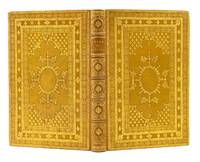
1882ref. ST16453Glasgow: Printed by Robert Anderson for Private Circulation 1882. ONE OF ONLY 50 COPIES. 195 x 122 mm. 7 3/4 x 4 7/8". 1 p.l. x 103 1 pp.From George Bannatyne's manuscript compiled A.D. 1568. BEAUTIFUL CITRON CRUSHED MOROCCO ELABORATELY TOOLED IN GILT BY RAMAGE stamp-signed on front turn-in covers with six concentric frames--intricate filigree roll pointillé-tooled floral vine and alternating small ornaments--enclosing a central panel with cornerpieces semé with rows of fleurs-de-lys large oval medallion at center radiating ornate fleurons raised bands spine compartments with large central medallion containing a vase of flowers delicate tooling in corners gilt titling turn-ins framed by filigree roll and alternating small ornaments brown and tan silk jacquard endleaves patterned in a Medieval motif top edge gilt. Printer's device on title page decorative woodcut initials and headpieces. Spines evenly sunned to a warm honey brown corners lightly rubbed short faint scratch to lower board but the binding virtually unworn and happily free of the splaying that plagues vellum books. Leaves lightly rumpled but A VERY FINE COPY the vellum leaves creamy clean and bright and the binding glittering with gold. Printed on luxurious vellum and limited to just 50 copies presumably for private circulation among friends of the printer this is a lovely edition of 16th century poems by a mysterious author believed to have been a poet and musician associated with the court of Mary Queen of Scots. This work contains all 36 extant poems attributed to Scott ca. 1520-82/3 including what is considered to be his most historically important work "Ane New Yeir Gift to Quene Mary" 1562 written in support of the young Scottish queen caught between Catholic and Protestant agendas. His other poems consist largely of lyric verses on love and sexuality which DNB describes as possessing "exceptional metrical variety and vernacular directness" with "a musician's ear for rhythm and melody." Scott's poems are known to us via the Bannatyne manuscript now held in the National Library of Scotland which ranks among the most important documents of Scottish Medieval literature. Written by George Bannatyne in 1568 during a period of confinement due to an outbreak of plague it contains a mixture of both secular and religious material including the sole extant copies of several texts. In the preface to the present work the publisher notes that Scott's poetry has been faithfully reproduced from that manuscript and thus "for the first time accurately printed." Very little is known regarding the life of Alexander Scott but he seems to have been attached to the court of Mary Stuart through John Erskine a guardian and counselor to the queen. Given the very limited number of copies made it is not surprising that this work is extremely rare on the market. Printed [by Robert Anderson] for Private Circulation unknown
1882ref. ST16453Glasgow: Printed by Robert Anderson for Private Circulation 1882. ONE OF ONLY 50 COPIES. 195 x 122 mm. 7 3/4 x 4 7/8". 1 p.l. x 103 1 pp.From George Bannatyne's manuscript compiled A.D. 1568. BEAUTIFUL CITRON CRUSHED MOROCCO ELABORATELY TOOLED IN GILT BY RAMAGE stamp-signed on front turn-in covers with six concentric frames--intricate filigree roll pointillé-tooled floral vine and alternating small ornaments--enclosing a central panel with cornerpieces semé with rows of fleurs-de-lys large oval medallion at center radiating ornate fleurons raised bands spine compartments with large central medallion containing a vase of flowers delicate tooling in corners gilt titling turn-ins framed by filigree roll and alternating small ornaments brown and tan silk jacquard endleaves patterned in a Medieval motif top edge gilt. Printer's device on title page decorative woodcut initials and headpieces. Spines evenly sunned to a warm honey brown corners lightly rubbed short faint scratch to lower board but the binding virtually unworn and happily free of the splaying that plagues vellum books. Leaves lightly rumpled but A VERY FINE COPY the vellum leaves creamy clean and bright and the binding glittering with gold. Printed on luxurious vellum and limited to just 50 copies presumably for private circulation among friends of the printer this is a lovely edition of 16th century poems by a mysterious author believed to have been a poet and musician associated with the court of Mary Queen of Scots. This work contains all 36 extant poems attributed to Scott ca. 1520-82/3 including what is considered to be his most historically important work "Ane New Yeir Gift to Quene Mary" 1562 written in support of the young Scottish queen caught between Catholic and Protestant agendas. His other poems consist largely of lyric verses on love and sexuality which DNB describes as possessing "exceptional metrical variety and vernacular directness" with "a musician's ear for rhythm and melody." Scott's poems are known to us via the Bannatyne manuscript now held in the National Library of Scotland which ranks among the most important documents of Scottish Medieval literature. Written by George Bannatyne in 1568 during a period of confinement due to an outbreak of plague it contains a mixture of both secular and religious material including the sole extant copies of several texts. In the preface to the present work the publisher notes that Scott's poetry has been faithfully reproduced from that manuscript and thus "for the first time accurately printed." Very little is known regarding the life of Alexander Scott but he seems to have been attached to the court of Mary Stuart through John Erskine a guardian and counselor to the queen. Given the very limited number of copies made it is not surprising that this work is extremely rare on the market. Printed [by Robert Anderson] for Private Circulation unknown books
First edition, small 8vo (131 x 81 mm), [24], 112, 117-172pp., (i.e. 168pp., as 113-16 omitted in the pagination), mounted woodcut frontispiece of a male archer, early ownership signature to title partially erased, upper corner of D1 restored with a loss of a few letters which have been added in ms. blank lower corner of M3 repaired, occasional light soiling and staining, marbled endpapers, eighteenth-century green morocco, tooled in gilt, overall a very good copy. Written when he was sixty-six years old, this is probably the last book which Markham wrote, and is one of his scarcest. "The practical instruction which he proceeds to give to the would-be-archer, of the bow and its use, the shooting-glove, the string, the shaft, the steel of the arrow, the feather, and the arrow-head, is reminiscent of Asham and may indeed be derived from his Toxophilus."?Poynter. Only two other copies have appeared at auction over the last 70 years, the Macclesfield copy sold by Sotheby's 14th April 2005 lot 1311 ?6,600 and the Fox Pointe copy sold by Forum Auctions 10th July 2019 lot 104 ?5000. STC 17333; Poynter, 40; Cockle, 129; Schwerdt II, p.10; Lake & Wright, p.199.
1790ref. ST14261Paris: Drouhin 1790. FIRST EDITION. 265 x 205 mm. 10 3/8 x 8". Two volumes. VERY ATTRACTIVE CONTEMPORARY MARBLED CALF GILT IN A NEOCLASSICAL DESIGN covers with a cresting palmette frame featuring ornate urn ornaments at corners flat spine divided into compartments by Greek key roll floral spray centerpieces one green and one black label marbled endpapers. With 55 PLATES OF COSTUMES designed by Philippe Chéry and engraved by Pierre-Michel Alix 50 of these PRINTED IN COLOR five in black and white a couple of these with color highlights applied by hand and with a color portrait of the author from the 1802 edition tipped in at front. Colas 717; Hiler p. 542; Lipperheide 3203; Cohen-de Ricci 227; Brunet IV 1135. One corner worn to board joints and extremities lightly rubbed but the bindings lustrous and generally very attractive. First volume slightly browned throughout second volume occasionally so volume II with two-inch marginal stain to upper gutter affecting four quires and six plates but not touching text or images two plates with pen marks in margins touching lettering but not image other trivial defects but still an excellent copy internally the colors especially clear and pleasing. This is an elegant production with the Neoclassical binding being the perfect complement to the color engravings of ancient Greek and Roman costumes that illustrate the present history of theatrical attire. In the two volumes here theater critic and historian Jean Charles Le Vacher de Charnois 1749-92 covers Classical tragedies and comedies as well as later interpretations of these dramas by playwrights including Racine. Le Vacher de Charnois intended a series of books encompassing as the title indicates theatrical costumes from all nations and from the ancient to the modern; however the French Revolution interrupted his scheme and as a monarchist he was imprisoned in 1792 for his writings in support of the aristocracy. It was long thought that he had died in the massacres at the Abbaye prison in September of that year but later research indicates that he may have been executed during the Reign of Terror in 1794. The artists who illustrated this work were at the opposite end of the political spectrum. Painter Philippe Chéry 1759-1838 studied with Jacques-Louis David and adopted his master's passionate support for the Revolution as well as his Neoclassical style. Engraver Pierre-Michel Alix 1762-1817 was a specialist in color printing best known for his portraits of leaders of the French Revolution and later of Napoleon and First Empire dignitaries. While the handsome binding here is unsigned the palmette roll on the covers is very similar but not identical to one used by Bozerian see Culot "Jean-Claude Bozerian" roll #44 and plate #XXIV. Perhaps our binder had trained in that atelier as the design and workmanship are certainly of that level. Drouhin unknown
1790ref. ST14261Paris: Drouhin 1790. FIRST EDITION. 265 x 205 mm. 10 3/8 x 8". Two volumes. VERY ATTRACTIVE CONTEMPORARY MARBLED CALF GILT IN A NEOCLASSICAL DESIGN covers with a cresting palmette frame featuring ornate urn ornaments at corners flat spine divided into compartments by Greek key roll floral spray centerpieces one green and one black label marbled endpapers. With 55 PLATES OF COSTUMES designed by Philippe Chéry and engraved by Pierre-Michel Alix 50 of these PRINTED IN COLOR five in black and white a couple of these with color highlights applied by hand and with a color portrait of the author from the 1802 edition tipped in at front. Colas 717; Hiler p. 542; Lipperheide 3203; Cohen-de Ricci 227; Brunet IV 1135. One corner worn to board joints and extremities lightly rubbed but the bindings lustrous and generally very attractive. First volume slightly browned throughout second volume occasionally so volume II with two-inch marginal stain to upper gutter affecting four quires and six plates but not touching text or images two plates with pen marks in margins touching lettering but not image other trivial defects but still an excellent copy internally the colors especially clear and pleasing. This is an elegant production with the Neoclassical binding being the perfect complement to the color engravings of ancient Greek and Roman costumes that illustrate the present history of theatrical attire. In the two volumes here theater critic and historian Jean Charles Le Vacher de Charnois 1749-92 covers Classical tragedies and comedies as well as later interpretations of these dramas by playwrights including Racine. Le Vacher de Charnois intended a series of books encompassing as the title indicates theatrical costumes from all nations and from the ancient to the modern; however the French Revolution interrupted his scheme and as a monarchist he was imprisoned in 1792 for his writings in support of the aristocracy. It was long thought that he had died in the massacres at the Abbaye prison in September of that year but later research indicates that he may have been executed during the Reign of Terror in 1794. The artists who illustrated this work were at the opposite end of the political spectrum. Painter Philippe Chéry 1759-1838 studied with Jacques-Louis David and adopted his master's passionate support for the Revolution as well as his Neoclassical style. Engraver Pierre-Michel Alix 1762-1817 was a specialist in color printing best known for his portraits of leaders of the French Revolution and later of Napoleon and First Empire dignitaries. While the handsome binding here is unsigned the palmette roll on the covers is very similar but not identical to one used by Bozerian see Culot "Jean-Claude Bozerian" roll #44 and plate #XXIV. Perhaps our binder had trained in that atelier as the design and workmanship are certainly of that level. Drouhin unknown books
1640ref. 13895Parisiis, E Typographia regia, 1640. In-folio de (2)-550 p. 1 feuillet blanc, veau olive glacé, dos orné à 6 nerfs, triple filet doré sur les plats, dentelle intérieure, tranches dorées (reliure de la fin du XVIIIe siècle).
1783ref. 41804Paris, Imprimerie Royale, 1783. In-8 (199 x 120 mm) de (4)-49 pp., maroquin rouge, titre en long sur le dos «ÉPREUVE DE LA NOUVELLE PRESSE DE L’IMPR. ROYALE» encadré d’un double filet doré, triple filet doré d’encadrement sur les plats armes royales serties de la mention « Imprimerie royale », roulette dorée sur les coupes, dentelle intérieure, doublures et gardes de moire bleue, tranches dorées (reliure de l’époque).
8vo. 62, (2) ff. With wodcut printer's device on title page. Contemporary limp vellum with later giltstamped orange spine label and ms. spine title. Very rare Italian edition of the "Kitab al-Jawami", an Arabic work on the interpretation of dreams by an "Achmet, son of Seirim" - almost certainly identical with the 8th century Muslim mystic Abu Bakr Muhammad ibn Sirin. The work survived in a Greek translation ("Biblion oneirokritikon") prepared in the 12th century. "The author Ahmed served as interpreter of dreams to Caliph Al-Mamun around 820 [...] The mediaeval conflation of medicine with astrology originated with the Arabs. Through the Salernitanian school, which had many Arabic works translated, the notion reached Europe in the 11th century, where it remained predominant as late as the 17th and 18th century [...] In 1577 J. Loewenklau published a Latin translation of the Oneirokritiká of Ahmed, whom he calls Apomasar" (cf. Schöll). - Slight waterstaining and old ink ownerships and annotations to title page. BM-STC Italian 338. Edit 16, CNCE 40443 (title misspelt: "insonnii"). OCLC 1002786023. Not in Adams. Cf. GAL I, 66. Schöll, Geschichte der griechischen Literatur III, 487. Graesse, Bibl. mag. et pneum. 97.
8vo. 86, (2) pp. Title-page printed in red and black. With 2 woodcut illustrations in the text. Contemporary full vellum with fore-edge flap. Rare compilation on ballistics and artillery, incorporating early treatises on fireworks and warfare, regimental regulations (VD 16, G 1057), and an educational work on the art of war written for Emperor Maximilian, here printed in a different blackletter reminiscent of Schönsperger's Theuerdank fraktur, the famous ornamental typeface specially cut for Maximilian in 1512. - Some browning; a few edge flaws. Interior lower hinge repaired. Quite charmingly bound in a contemporary vellum binding with a flap. Rare: Only 5 copies known in institutional collections (Wolfenbüttel; Staatsbibliothek Berlin; Amsterdam, University Library; Antwerp, Vlaamse Erfgoedbibliotheek; Univ. of Aberdeen). The Flemish Heritage Library erroneously attributes authorship to Franz Joachim Brechtel (1554-93), whose work on the same subject first appeared at Nuremberg in 1591. Provenance: from the collection of Thomas Fremantle, 3rd Baron Cottesloe (1862-1956), commander of the Territorial Army and president of the Society for Army History Research (purchased from Sotheran's, December 1936). VD 16, B 9134 (a single record). USTC 615040. Richter (Egenolffs Erben) 484. OCLC 248948877. Cf. Jähns 653 (1597 edition). Not in Kat. der k. k. Kriegs-Bibliothek.
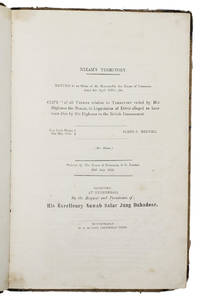
1854ref. ABC_47435Secunderabad near Hyderabad: Robert Hudson Columbian Press 1854. Contemporary half calf orange and blue marbled sides over paper boards gold-tooled double fillets on the spine red sprinkled edges. 33 x 22 cm. The extremely rare Hyderabad edition of the official British papers relating to the so-called Hyderabad debt crisis during which Lord Dalhousie the Governor-General of India and General James Stuart Fraser the British Resident in Hyderabad orchestrated a "shakedown" of the Nizam of Hyderabad whom they claimed owed the British an astounding 7.4 million rupees. This resulted in the Nizam of Hyderabad having to cede the wealthy cotton-growing province of Berar to the British to clear his debts. The first edition of this account appeared at London in 1854 as part of the serial publication of parliamentary papers and the present Hyderabad edition probably later in the same year the first separate publication. It was printed and published by the Columbian Press in Secunderabad "by the request and permission of His Excellency Nawab Salar Jung Bahadoor" the Prime Minister of the Hyderabad State who believed that the papers portrayed Dalhousie and Fraser in a bad light. Nawab Sir Mir Turab Ali Khan Salar Jung I 1829-1883 also known as Salar Jung I was an Indian nobleman who served as Prime Minister of Hyderabad State between 1853 and 1883 and was also the regent for the sixth Nizam Asaf Jah VI from 1869 to 1883.The present work is the ultimate insiders account from the British perspective of the crisis surrounding the Nizam's staggering debt to the British government featuring transcriptions or summaries of all the official correspondence and documents of Lord Dalhousie General Fraser and other colonial senior officials. The present work is extremely rare in this Indian Secunderabad/Hyderabad edition we have not been able to trace any other copy on the market or institutionally. Supposedly the Salar Jung Museum in Hyderabad holds a copy of the same edition but we were not able to verify it.With an owner's inscription "Margaret D. Stubbs" and an orange printer's label "Secunderabad Columbian Press R. Hudson" both on the front pastedown. The binding is somewhat worn without affecting its structural integrity the outer margin of 6 leaves between pp. 52-69 and pp. 83-84 are folded in. With a minor tear in the foot margin of the title-page near the gutter and occasionally very slight staining. Otherwise in good condition.l Cf. WorldCat 941776603 electronic version of the first ed.; for the background: H.G. Briggs The Nizam his history and relations with the British Government London 1861; Kumari Sarjini Regani The cession of Berar in: Indian History Congress 20 1957 pp. 525-259. Robert Hudson, Columbian Press, hardcover
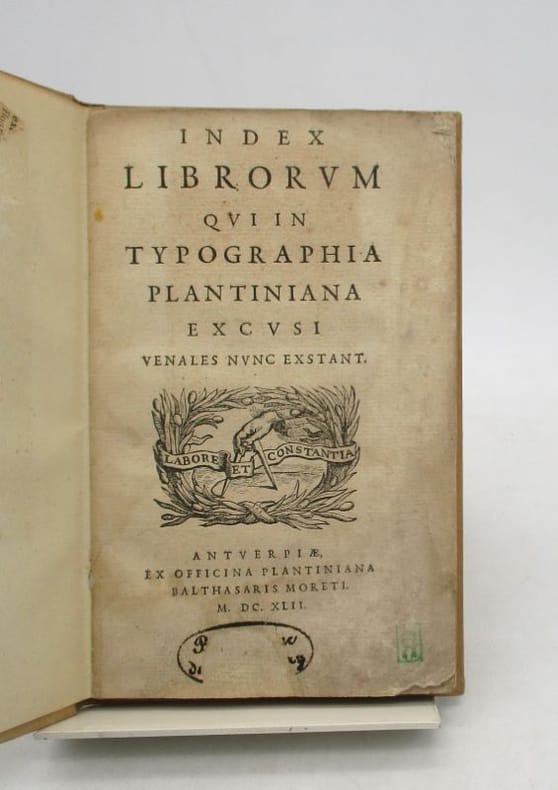
ref. 22751Anvers, Balthazar Moret II - Imprimerie plantinienne , 1642. In-12, 79 pp., cartonnage de papier moderne, dos long (traces de poussière et frottements au cartonnage, manques angulaires sans atteinte, parfois restaurés, pâles mouillures sans gravité, quelques taches et rousseurs).
1538ref. 16624Paris, [Pierre Sergent], 1538. In-8 gothique (15 x 9 cm) de (8)-196 ff. (sign. Ø8, A-X8, AA-CC8, DD4), veau tabac, dos orné à nerfs, triple filet doré d’encadrement sur les plats, tranches dorées (Koehler).
8vo. (28) pp., 2 blank ff., 284, (2) pp., final blank leaf. With woodcut title vignette and 115 woodcuts in the text (6 of which in original hand colour, 1 partly coloured). - (Bound with) II: Lucanus, Marcus Annaeus. De bello civili apud Pharsaliam libri X. Cologne, Walther Fabritius, 1560. (336) pp. With woodcut title vignette. Contemporary blind-tooled calf over wooden boards with bevelled edges and two brass clasps, lozenge-shaped floral roll-tools enclosing plate-stamps of "Justitia" and "Lucrecia", upper cover bearing monogram "ALG" and date "1573". A fine, later Latin edition of the famous "Narrenschiff", originally published in German verse in 1494 and translated by the author's student Jacob Locher in 1497. This is the first edition to contain the outstanding narrative woodcuts by Tobias Stimmer (1539-84), showing the fools and their companions in Renaissance costume. The first six illustrations are coloured by a contemporary hand. - One of literature's most famous satires: before Goethe's "Werther" arrived on the scene, this work was the most successful book ever published in Germany. In his "Ship of Fools", Brant describes the voyage of a ship bearing one hundred fools, to the fools' paradise of Narragonia, thereby satirizing the follies of his time including representatives of every human and social type. "[T]he first original work by a German which passed into world literature [... it] helped to blaze the trail that leads from medieval allegory to modern satire, drama and novel of character" (PMM). Erwin Panofsky called the book "a remarkably complete mirror of human life", based upon the "universality of Brant's self-righteous surliness [...] and the picturesqueness of his metaphors" (Panofsky, p. 30). Incidentally, the book also contains the earliest literary reference to the discovery of America: "Hesperiae occiduae rex Ferdinandus, in alto Aequore nunc gentes repperit innumeras" ("Ferdinand, King of the West, recently discovered innumerable peoples across the high seas", p. 132). - Bound with this is an uncommon Cologne edition of Lucanus's epic "Pharsalia", esteemed throughout antiquity and the Middle Ages for its stylistic and historical merits. - Light brownstaining and occasional light waterstains throughout. A few underlinings in red ink to the "Pharsalia". Upper hinge starting, but binding generally in fine condition. Provenance: Handwritten ownership of Virgilius Fetius of Oettingen in Bavaria (gift from Johann Nortman in February 1577), dated 1578, on the flyleaf. Bookplate of the Bohemian industrialist and art collector Karl Adalbert Lanna (1805-66) to front pastedown; a shelfmark, dated 16 March 1888, written on lower flyleaf. Latterly in the library Werner Habel (his ownership stamp to verso of upper flyleaf). I: VD 16, B 7081. BNHCat B 874. BM-STC German 147. Adams B 2673. - II: VD 16, L 2905 (A 4393). Schweiger II.1, 562. Not in Adams or BM-STC German.
1764ref. 43525A Paris, Imprimé par l'Auteur, et se vend chez Barbou, 1764-1766. 2 vol. in-8 (161 x 105 mm) de (3)-V à XXXII-323-[5] ; (2)-XLIV-306 pp., planches, veau marbré, dos orné à nerfs, pièces de titre et de tomaison en maroquin lavallière, tranches rouges (reliure de l'époque).
15294to. 36 unnumbered ff. With broad figural woodcut title border, a figural woodcut initial, and a large woodcut vignette on last leaf verso. Modern vellum. Very rare second edition of this Hebrew grammar, written in Latin by the Italian orientalist Agatho Guidacerio from Rocca-Coragio in Calabria (1477-1542?). As was the first edition, this revision is dedicated to his patron Leo X (Giovanni Medici). - Year of printing in Greek. A few pencil markings and contemporary ms. marginalia and notes. Inner margin slightly waterstained throughout; the unclothed torso of the female figure in the printer’s device on the last leaf has been contemporarily obscured in ink. - Extremely rare; no copy established in libraries internationally or in the past 30 years’ trade. Jewish Encyclopedia (in JBA S45, 21f.). Hoefer, NBG XXII, 537. Cf. Michaud, Biogr. Univ. XVIII, 100. Cf. Jöcher Suppl. I, 295 (cites Paris, 1537 as 1st ed.). Cf. Fürst I, 346 (Paris, 1539). Cf. Steinschneider I, 1022, 5167 (Paris, 1540). Not in BM-STC French. Not in Adams. For printer’s device and title border cf. Renouard, Marques typogr. Paris, 384.
8vo. (32), 651, (1) pp. Contemporary half vellum over pigskin with handwritten spine title and shelfmark. Second posthumous edition (by Giano Matteo Durastante) of the extensive commentary on book (kitab) 1, part (fen) 1 of Avicenna's systematic "Canon of Medicine" by one of the leading Renaissance humanist physicians of Italy, Giambattista da Monte (1498-1551), first published in 1557. A corrected and enlarged edition of the work previously edited by W. Lublin and published in Venice in 1554. "The newly added chapter De membris (p. 553-605) is followed by 2 others: De facultatibus and De virtutibus naturalibus ministrantibus" (Durling). - Avicenna's Arabic "Qanun" was widely translated throughout the Middle Ages and remained the basis of medical training in the West as late as the mid-17th century. It continues in use to this day in parts of the Arab world. Through this encyclopedic work, the author exerted "perhaps a wider influence in the eastern and western hemispheres than any other Islamic thinker" (PMM). "The 'Qanun' [...] contains some of the most illuminating thoughts pertaining to distinction of mediastinitis from pleurisy; contagious nature of phthisis; distribution of diseases by water and soil; careful description of skin troubles; of sexual diseases and perversions; of nervous ailments" (Sarton, Introduction to the History of Science). The present part offers a definition of medicine and is mainly dedicated to a discussion of the four humours and temperaments. - Binding slightly wormed; vellum somewhat creased. Paper occasionally wormed and waterstained. Edit 16, CNCE 15945. Wellcome I, 4428. OCLC 1157690416. Cf. Durling 3273, Adams M 1681 (1557 ed.), PMM 11. Not in BM-STC Italian, Osler, Waller, or Garrison/M.
5 Bde. und Index in 2 Bdn. Mit 6 wdh. Druckermarken. Blindgepr. Schweinslederbände der Zeit. Reste von Schließen. Folio (265 x 375 mm). Schöner, sehr seltener Pariser Nachdruck der lateinischen Gesamtausgabe, die 1530 bei Froben in Basel erschien, erstmals von Philipp Montanus besorgt. - Mit 3 Blattweisern (ein vierter verloren). Einige Wurmgänge (auch im Text); durchgehend gleichmäßig schwach gebräunt. Die Schweinslederbände etwas berieben, hübsch blindgeprägt mit drei verschiedenen Rollenstempeln. Exemplar aus der Bibliothek der Ingolstädter Franziskaner mit deren hs. Besitzvermerk des frühen 18. Jhs. sowie Stempel an Titel und Vorsatz. Hoffmann II, 412. BM-STC French 244 (nur Bd. 1). Diese Ausgabe nicht bei Adams.
8 Bde. in 3 und Appendixband. Zus. 9 Bde. in 4. Mit 4 wdh. Druckermarken. Blindgepr. Schweinslederbände der Zeit auf 5 Bünden über Holzdeckeln. Folio (250:370 mm). Erste Ausgabe dieses mehrfach wiederaufgelegten Pionierwerks der französischen Patristikforschung und -kritik. Der Theologe Marguerin de la Bigne (um 1546-95) war Kanonikus von Bayeux und Doktor der Sorbonne. Er "unternahm eine zur leichteren Widerlegung der Magdeburger Centuriatoren längst gewünschte Sammlung aller Väter und Kirchenschriftsteller, soweit von einzelnen derselben nicht bereits größere Editionen vorlagen. Dieß ist die über 200 Schriftsteller enthaltende Bibliotheca" (Wetzer/W.). - Kaum gebräunt; Ecken bestoßen mit Fehlstellen im Bezug. Die hübschen, unterschiedlich beriebenen Einbände zeigen innerhalb einer Bogenfries- und einer Ornamentwerksrolle eine jeweils mit den Initialen "I.B." bezeichnete Tugendenrolle (Haebler I, 54: I.B., V, Nr. 1) sowie im Mittelfeld Crucifixus-, Auferstehungs-, Justitia- und Fortuna-Platten (z. B. Haebler I, 57: I.B. Varia, Nrn. I und II), außerdem Reichswappen und Porträtplatte Maximilians II. "Unter den Initialen I. B. verbergen sich ohne Zweifel eine ganze Anzahl von Druckern [und Bindern...] Das Nürnberger Meisterbuch verzeichnet als ersten Buchbinder vor Begründung der Innung den Joachim Bruck" (Haebler I, 51f.). Zeitgenöss. hs. Besitzvermerk am Kopf des Titels alt überklebt; Stempel der Haller Ritter-Waldauf-Bibliothek. Der kaiserliche Protonotar Florian Waldauf (auch: Baldauf; um 1450-1510; 1495 in Antwerpen Gegenzeichner des Vorvertrags zur habsburgisch-spanischen Doppelhochzeit) und seine Frau Barbara hatten 1501 der Pfarrkirche in Hall eine Marienkapelle, eine Reliquiensammlung und ein Predigtamt gestiftet. Die Stadt Hall als Verwalterin der Waldauf-Stiftung hatte dafür zu sorgen, "das alle jar etliche puecher nach anzaigen des predigers zum predigambt gekauft und in der heiligen capellen liberei an ketten gehangen und versorgt werden"; ferner sollten der Bibliothek Bücher aus den Nachlässen der Prediger und Meßkapläne zukommen. Entgegen der Anordnung Waldaufs wurde die Bibliothek kaum durch gezielte Ankäufe vermehrt, sondern größtenteils durch die zufällige Übernahme von Büchern und Schenkungen, hauptsächlich von Geistlichen, Stiften und Schülern. Der bekannteste Vorbesitzer ist Johannes Eck. "Nach 400 Jahren ihres Bestehens und nur fallweisem Zuwachs schien das Interesse am Fortbestand der Ritter-Waldauf-Bibliothek als geschlossener Sammlung verlorenzugehen. Obendrein war das Stiftungsvermögen im Ersten Weltkrieg vollends untergegangen. Während des Zweiten Weltkriegs wurde eine unbekannte Anzahl wertvoller Handschriften und Drucke an Privatpersonen in Hall und Umgebung ausgehändigt, um sie vor der Beschlagnahmung durch die Nationalsozialisten zu sichern. Nach Kriegsende wurde jedoch keines dieser Bücher rückerstattet" (Hdb. der hist. Buchbestände in Dtl.). Adams L 4. Wetzer/Welte II, 812. BM-STC French 249 (nur Appendixband).
Folio (240 x 349 mm). (21) ff., 1 blank f., 468 ff., With woodcut printer's device to title-page (repeated on verso of final leaf) and several optical and geometrical sketches, tables, etc. Contemporary blindstamped full calf over wooden boards. Traces of clasps. Second Basel edition of this important geographico-historical compendium, published by the famed humanist printers Froben and Episcopius, who had previously printed the work in 1530. - The Italian Humanist Raffael Maffei (1451-1522) served as "scriptor apostolicus" to the court of Pope Paul II but also studied theology and philosophy with the Greek scholar George of Trebizond (1395-1484). Only later did he relocate to Volterra, where he created his most famous works. First published in Rome in 1506, his "Commentaria" offer a veritable encyclopedia of Renaissance knowledge: of the 38 "books", the first twelve treat of geography, the next eleven of famous men in history, with the remainder discussing modern science and scholarship, especially language and philology. Within this framework Maffei touches upon subjects so diverse as plants and animals, metals, gems, architecture, mathematics, geometry, optics, astronomy and astrology, grammar, rhetorics, and the fine arts. Specifically, he mentions the voyages of Christopher Columbus (ff. 139f.) and the geography of Muslim Arabia (f. 131) as well as the discoveries of the Portuguese and Spanish seafarers. The massive work served Conrad Gesner as a source for his "Bibliotheca universalis". The present edition contains a detailed index and includes, at the end, the author's translation of Xenophon's dialogue "Oikonomikos". - Binding a little scuffed with professional repairs, also to spine. An old ownership erased from the title-page; a small wormhole to the blank margin of the final four leaves. A good copy. VD 16, M 115. Adams M 103. Sabin 43768. Harrisse (BAV) 257 & Add. 146. Alden/Landis 544/13.
1509ref. 41391[Paris], François Regnault, [1509]. Petit in-8 gothique à deux colonnes (98 x 130 mm) de CXII ff. (sign. a-o8), maroquin rouge, dos lisse orné, pièces de titre dont une en pied en maroquin noir, triple filet doré d'encadrement sur les plats, tranches dorées (reliure du XVIIIe siècle).