Busbecq, Ogier Ghislain de.MareMagnum

8,039 results
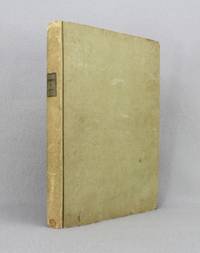
8vo. 186 ff. Contemporary boards. First publication of these four Turkish letters. Busbecq, a Fleming, was Emperor Ferdinand's ambassador at the Porte from 1555 to 1562. "The first collected edition of all four letters appeared at Paris in 1589. The first letter was printed at Antwerp in 1581, and the second in 1582" (Atabey). Busbecq's letters contain observations of Turkish life and analyses of the Ottoman state. - Insignificant browning; a few old underlinings. Title and endpapers have dated ownerships. Of the utmost rarity, no copy at auction internationally (only the second edition). Adams B 3331. Graesse I, 580. OCLC 457194296. Cf. Blackmer 249. Göllner II, 2026 (both the 1595 Frankfurt second edition).
8vo. (24), 207, (1) ff. With Giunta's woodcut device on title-page and repeated on the otherwise blank last leaf. Modern brown morocco. Second edition, the first printed by Giunta, of Galen's "On the composition of medicine according to locality", edited and translated into Latin by Johann Winter von Andernach (1505-74). Andernach's translation was first printed in the previous year in Paris by Simon Colines. "There is no name more illustrious in the whole history of medicine than that of Galen [...] Written in Greek, this Galenic treasure reached the Latin Western World only through Arabic translations" (Hagelin). - The recipes, mostly taken from earlier authorities such as Andromachus, Asclepiades, Pharmacion, Archigenes and others, are arranged from head to foot, starting with ailments of the hair, head, ears and nose, eyes, face and teeth, and mouth, and continuing down the body through the respiratory tract, stomach and liver, genitalia, kidney and bladder, and ending with sciatica and gout of the feet. - "During the 1530s the eminent printer, Luca Antonio Giunta (1517-37), decided to publish a comprehensive edition of Galen's works in Latin so that physicians would no longer have to rely on writings from Greek and Arabic sources. Montanus, who led the editorial effort, chose many noted authorities and scholars to aid in the massive undertaking" (Heirs of Hippocrates). Giunta's editions of Galen are considered the most import together with those of Aldus, and together with those Froben considered the most readable. - With the stamp of the Birmingham University library bindery on the end pastedown. Some underscoring and early manuscript annotations. Some wormholes through the title-page and smaller ones through a few following leaves, dampstains throughout and one leaf with a tear; a fair copy. Durling, A chronological census of renaissance editions and translations of Galen 1536.9. Durling 1862. USTC 831429. Wellcome I, 2564. Cf. DSB V, pp. 227-235; Garrison, History of medicine, pp. 116f.; Hagelin, Rare and important medical books, pp. 12-15; Heirs of Hippocrates 37.
1772ref. 44477Paris, , 1772. In-8 sur un grand papier vergé (204 x 132 mm) de 2 ff.n.ch. (titre et frontispice), (1)-8-124 pp., figures et texte gravés, veau marbré, dos lisse orné, pièce de titre de maroquin rouge, triple filet doré d'encadrement sur les plats, filet doré aux coupes, roulette intérieure, tranches rouges (reliure de l'époque).
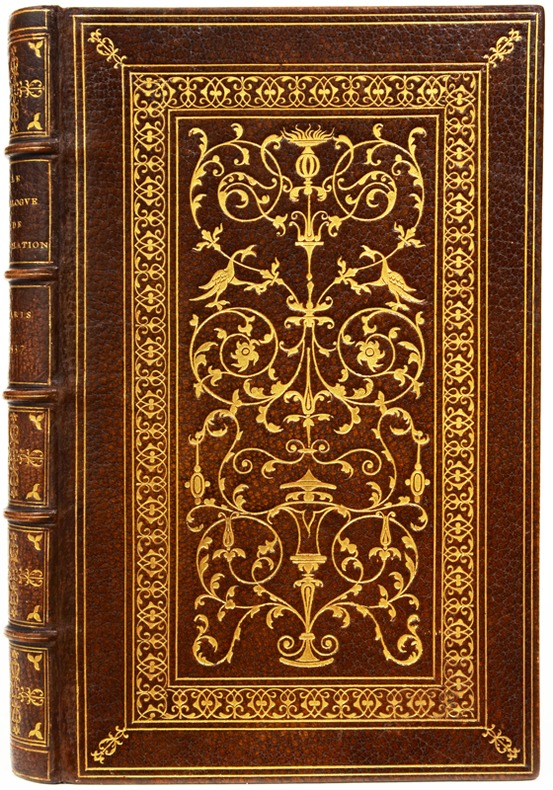
1537ref. 14346Paris, Pierre Sergent, 1537. In-8 gothique (160 x 100 mm) de (160) ff. (sign. A-V8), maroquin Lavallère, dos orné à nerfs, sur les plats motif de rinceaux disposés en candélabres à l'antique dans un un encadrement de filets et frise dorés, tranches dorées, dentelle intérieure (reliure du XIXe siècle).
1645ref. 40232Charleville, Hubert Raoult et Gédéon Poncelet, 1645. Petit in-8 (10,5 x 17 cm) de 15-(5) pp. 364 pp., maroquin fauve décoré à petits fers, dos orné de fleurons, sur les plats deux encadrements entre lesquels est dorée une frise, à l'intérieur de l'encadrement central est doré un chiffre C couronné dans un ovale entouré d'ornements, tranches dorées (reliure de l'époque).
4to. (8), "225" [= 215], (1 blank); "80" [= 72] pp. Including: Nicander of Colophon. Alexipharmaca. In Nicander Theriaca scholia auctoris incerti, et vetusta et utilia. In eiusdem Alexipharmaca diversorum auctorum scholia. 3 parts in 1 volume. Each part with its own title-page, with a woodcut caduceus device on all three. Set in roman and Greek types. 17th-century(?) richly gold-tooled red morocco, gilt edges; subtly rebacked, with the original backstrip laid down. Bilingual edition (Greek & Latin) of two medical hexametric poems by the Hellenistic poet and physician Nicander of Colophon (fl. second century BC), followed by a part with ancient scholia in Greek. The two poems are followed by comments by its translator, the Parisian pharmacist Jean de Gorris (1505-1577). They were first published separately in 1549 and 1556 and here for the first time published together. Nicander wrote at least 20 works, but "only his Theriaca (958 hexameters on poisonous creatures and on antidotes for their bites and stings) and Alexipharmaca (630 hexameters on antidotes to poisons) are extant". - "Nicander's influence on later Greek and Latin literature was considerable. Not only did Virgil, Ovid, and Antoninus Liberalis draw on his works, but Lucan, Pliny the Elder, Erotian, Aelian, and Athenaeus of Naucratis also benefited from direct or indirect familiarity with Nicander. In the 1st century BC the enormously learned scholar Didymus ("Chalcenterus") appears to have made extensive use of Nicander's lexicographic contributions. Although Dioscorides only twice cites Nicander's views in his Materia Medica, Galen in his pharmacological works quotes a number of verse passages from Nicander. Papyrus fragments from the 1st to 3rd centuries AD further confirm Nicander's popularity in the Roman empire" (Von Staden). - With the bookplate of the British politician John Thynne, Baron Carteret of Hawnes, dated 1841. Washed, with some faint early manuscript notes. Durling notes that, like in our copy, a general title-page is lacking in their copy, but this appears to be as usual. Internally in very good condition. Rebacked, lower hinge weakened, front hinge professionally repaired. Durling 3341. USTC 160585. Wellcome I, 4530. Cf. H. Von Staden, "Nicander" in N. Wilson, Encyclopedia of ancient Greece (2006).
1514ref. 15290Venetiis, In aedibus Aldi et Andreae soceri, 1514. In-8 de (4) ff. dont 1 f.bl., 230 ff. (signatures *4, a-z, A-E8, F6) veau fauve, dos lisse orné, pièce de titre en maroquin rouge, tranches dorées, nom de l’auteur en lettres capitales ciselées sur la gouttière, non rogné (relié vers 1800).
1786ref. 42884À Londres [Montargis, Claude Lequatre], 1786. In-16 de (8)-156 pp., (20) ff. d'échantillons de papier, basane fauve, dos lisse orné, pièce de titre en veau vert, triple filet doré d'encadrement sur les plats, gardes de papier dominoté, tranches dorées (reliure de l'époque).
1786ref. 44364À Londres [Montargis, Claude Lequatre], 1786. In-16 de (8)-156 pp., (20) ff. d'échantillons de papier, maroquin vert, dos lisse orné, pièce de titre en maroquin vert, roulette dorée d'encadrement sur les plats, tranches dorées (reliure de l'époque).
1523ref. 44374Cologne, Eucharius Cervicornus pour Gottfried Hittorp, s.d. , (1523). In-8 de 139-(13) ff., (sign. a-s8, *8), table, titre à encadrement gravé, bois gravé, caractères grecs et romains.ÉRASME. Parabolarum, seu Similium liber elegantissimus. Argentinae, apud J. Knoblouchum (Strasbourg, Johann Knobloch) 1521. 103-(5) ff., (sign. A-O8), titre à encadrement gravé, caractères italiques.ÉRASME. Opus de conscribendis epistolis, quod quidam & mendosum & mutilum ediderant, recognitum ab authore, & locupletatum. Argentorati (Strasbourg) Knobloch, 1522. 178 (i.e. 180) ff., (sign. A-Y8, Z4), titre à encadrement gravé, caractères italiques.3 pièces reliées en 1 vol. in-8 (105 x 170 mm), peau de truie sur ais de bois biseautés, décor estampé à froid à encadrement de motifs floraux et animaliers, dos à trois nerfs, titre manuscrit au dos, deux fermoirs (reliure de l'époque).
ref. 40919Madrid: Imprenta Real 1799. 4to 254 x 172 mm in 2 parts 2 74 1 75--147 leaves printed on one side only on alternate rectos and versos within woodcut borders wide-margin copy printed on thick paper title with vignette of the arms of the King of Spain single sheet of printed prices tipped-in a nice clean copy marbled endpapers contemporary tree calf light stain to lower board spine leather lettering piece slightly rubbed a very nice copy. The most important Spanish type specimen. The Imprenta Real Madrid was set up in 1780 when the State took over the equipment of the printer Francisco Manuel de Mena whose heirs were unable to discharge their debts towards the State. This was the first type specimen book from the Imprenta Real and it contains many roman and italic types including some cut by Geronimo Gil for the Royal Library. "The book is in two parts. The first comprises an ambitious collection of excellent roman and italic types followed by Greek types fine in the largest and smallest sizes a few pages of Arabic and a little Hebrew. Apart from Gil's fonts and others of that style there are a number of lighter fonts both in roman and italic that while distinctly 'old style' show the taste for lighter letter-forms which was then making headway in Spain. A second collection of type of decidedly more modern cut begins on page 75. The tendency toward less "nourished" lighter letters is clearly seen in these over-finished monotonous character types by no means so interesting as those of Part I. Following these is a large display of capital letters in roman and italic shaded initials Greek capital letters and a repertoire of 'flowers' A few are original but a great many of these 'flowers' were derived from Holland France and England and others from various perfectly recognizable sources; but they are rendered in such a way as to be transmuted into very Spanish Design."Updike. Provenance: Bookplate of Jules Laloux secretary for the Compagnie Typographique Paris. Updike II pp. 85-86. Madrid: [Imprenta Real,] 1799 hardcover
1882ref. ST12705Paris: A. Quantin 1882. UNIQUE COPY ON VELLUM printed for M. A. Werlé. 206 x 140 mm. 8 1/8 x 5 1/2". xxxii 247 pp. 1 leaf colophon.With a bio-bibliographical notice by Fernand Drujon. Pleasing burgundy Jansenist crushed morocco by Canape et Corriez stamp-signed in gilt on front turn-in dated 1930 on rear turn-in raised bands turn-ins richly gilt marbled endpapers all edges gilt on the rough. Decorative head- and tail-pieces throughout and eight engraved plates comprised of a frontispiece portrait in four states one on vellum three on paper and an allegorical vignette also in four states. Verso of front free endpaper with ex-libris of Jean Furstenberg. ◆Two small dark spots to upper cover a couple of leaves with naturally occurring minor discoloration to vellum but A FINE COPY--especially clean fresh and bright internally and in a lustrous unworn binding. Given its illustrious provenance and its singular status as the only copy printed on vellum this is a quintessentially bibliophilic copy of the poems of French cleric and diplomat Cardinal François-Joachim de Pierre de Bernis 1715-94. Admired as a witty epigrammist at the court of Louis XV where Madame de Pompadour presided Bernis composed poems on such conventional themes as love and the natural world but also verses contemplating manners and mores fashion independence and love of country. Since none of his poems was published before his death he was not widely known as a poet during his lifetime but in another sphere he performed important service to his country as France's ambassador to Rome. He provided shelter and succour there for refugees from the French Revolution earning the papal epithet "Protector of the Church of France." The present work was printed for Count Alfred Werlé whose father had inherited the Veuve Clicquot Champagne house from the Widow Clicquot. Alfred took over the operation in 1884 and greatly expanded the Veuve Clicquot-Ponsardin vineyards. The volume subsequently passed into the library of the great collector Jean or Hans Furstenberg 1890-1982 who put together one of the finest collections of 18th century books ever assembled. In 1974 the Furstenberg collection was sold en bloc to Dr. Otto Schäfer whose marvelous library had already become distinguished for its fine and historic bindings. A. Quantin unknown
1882ref. ST12705Paris: A. Quantin 1882. UNIQUE COPY ON VELLUM printed for M. A. Werlé. 206 x 140 mm. 8 1/8 x 5 1/2". xxxii 247 pp. 1 leaf colophon.With a bio-bibliographical notice by Fernand Drujon. Pleasing burgundy Jansenist crushed morocco by Canape et Corriez stamp-signed in gilt on front turn-in dated 1930 on rear turn-in raised bands turn-ins richly gilt marbled endpapers all edges gilt on the rough. Decorative head- and tail-pieces throughout and eight engraved plates comprised of a frontispiece portrait in four states one on vellum three on paper and an allegorical vignette also in four states. Verso of front free endpaper with ex-libris of Jean Furstenberg. ◆Two small dark spots to upper cover a couple of leaves with naturally occurring minor discoloration to vellum but A FINE COPY--especially clean fresh and bright internally and in a lustrous unworn binding. Given its illustrious provenance and its singular status as the only copy printed on vellum this is a quintessentially bibliophilic copy of the poems of French cleric and diplomat Cardinal François-Joachim de Pierre de Bernis 1715-94. Admired as a witty epigrammist at the court of Louis XV where Madame de Pompadour presided Bernis composed poems on such conventional themes as love and the natural world but also verses contemplating manners and mores fashion independence and love of country. Since none of his poems was published before his death he was not widely known as a poet during his lifetime but in another sphere he performed important service to his country as France's ambassador to Rome. He provided shelter and succour there for refugees from the French Revolution earning the papal epithet "Protector of the Church of France." The present work was printed for Count Alfred Werlé whose father had inherited the Veuve Clicquot Champagne house from the Widow Clicquot. Alfred took over the operation in 1884 and greatly expanded the Veuve Clicquot-Ponsardin vineyards. The volume subsequently passed into the library of the great collector Jean or Hans Furstenberg 1890-1982 who put together one of the finest collections of 18th century books ever assembled. In 1974 the Furstenberg collection was sold en bloc to Dr. Otto Schäfer whose marvelous library had already become distinguished for its fine and historic bindings. A. Quantin unknown books
First and only edition, small folio (305 x 190 mm), [12], xix, [1], 705, [1]pp., woodcut title page vignette in Arabic, woodcut head- and tail-pieces, several leaves folding, a couple of minor repairs to inner margin of title, recent half calf to style, marbled boards, spine tooled in gilt, red morocco spine label lettered in gilt, a handsome copy with text clean and fresh. This volume 'forms a complete treatise in itself, since the it exhausts the Science of Arabic Inflexion'?Preface. All published, the intended second volume of Arabic "syntax" never made it to print.
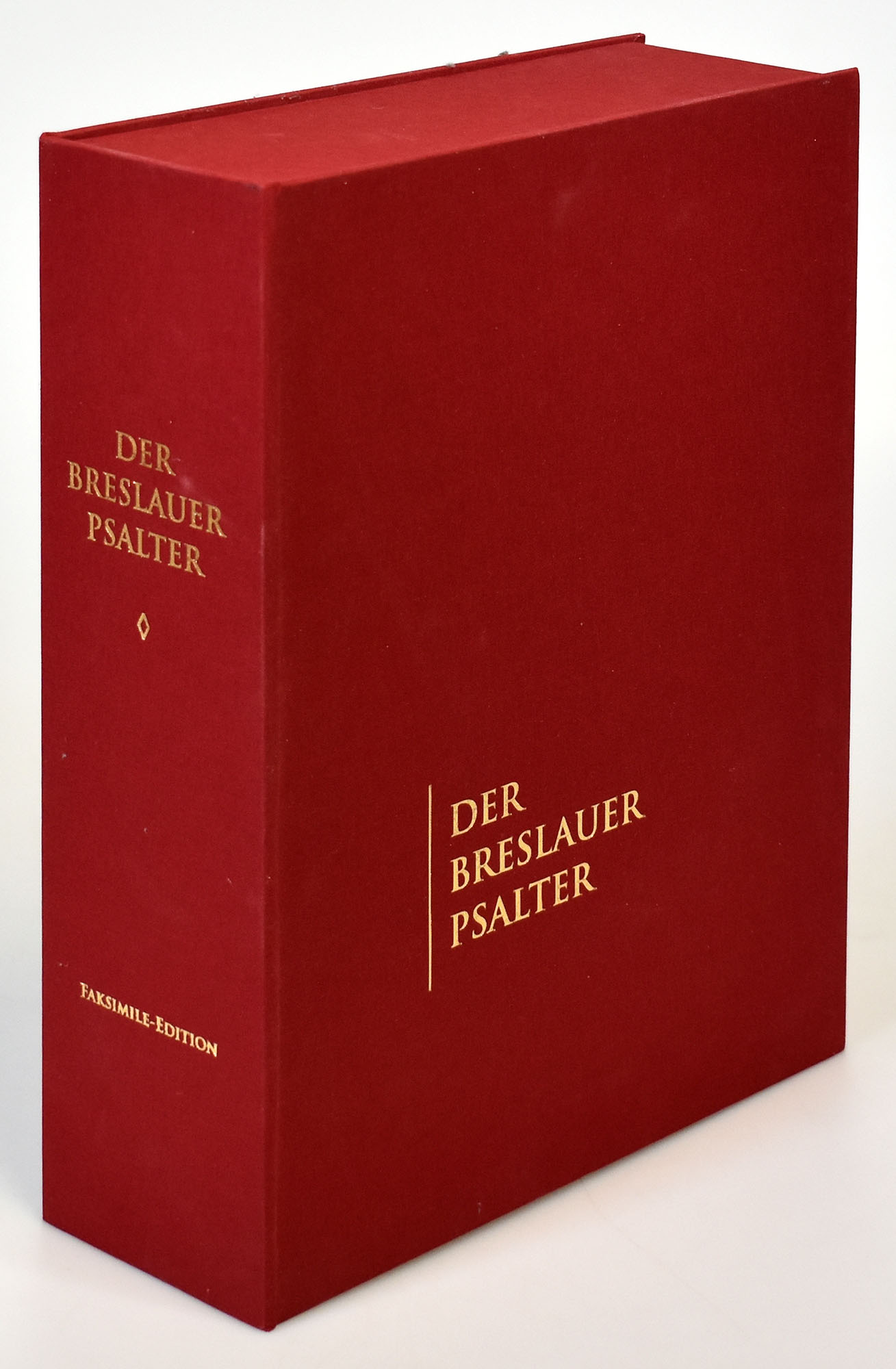
ref. 4036FBLuzern, Quaternio Verlag, 2018. Kassette: 37 x 28 x 10 cm. Bände: 34 x 23,5 cm. 147 Blatt; 310 Seiten. Original-Lederband auf 5 Bünden mit goldgeprägtem Rückentitel und Rundum Goldschnitt und Original-Leinenband mit goldgeprägtem Rückentitel in Original-Leinenkassette mit goldgeprägtem Titel. [10 Warenabbildungen]
4to. 2 pts. in 1 vol. (8), 368, (18) pp., final blank. (8), 305 (but: 307), (13) pp. Both title pages printed in red and black. With 2 different woodcut title vignettes and numerous text woodcuts. Contemp. blindstamped pigskin over wooden boards with bevelled edges. Remains of clasps. All edges red. Principal alchemical work of the Swiss physician, botanist and zoologist Gessner: the first complete German edition of the "Thesaurus de remediis secretis", translated by the Zürich theologian Johann Rudolf Landenberger and the physician Johann Jakob Nüscheler. The first part had appeared in German in 1555; only in 1569 did Caspar Wolf edit the posthumous Latin first edition of the second part, based on Gessner's notes. "This collection of recipes for medicines, the distillation of essential oils, and winemaking was first published under the pseudonym Euonymus Philiatrus because Gesner considered it not quite up to his own exact standards. It became his most popular book" (Wellisch). The woodcuts picture various destillation apparatus. - Binding rather rubbed; interior somewhat fingerstained; paper defects to the final three leaves of the index professionally restored (including portions of lost text). As always, the year of printing on the title page, stated as "1582" in Roman numerals, has been corrected to "1583" in slightly different ink. Contemp. ownership of the surgeon Christoff Zirckendorffer in red and brown ink ("A[nn]o 16[0]1 Jar") on the flyleaf. VD 16, G 1809, ZV 25033. Graesse III, 69. Wellisch A 32.18 & B2.14. Wellcome I, 2789. Ferguson I, 315 (note). Vischer (Zürcher Druckschriften des 15. u. 16. Jhs.) K 96. Cf. Durling 2084. Schoene 13415ff.
1535ref. 42543Lyon, Denys de Harsy, 1535-1536. In-4 gothique de CXXV-(11) ff. (sign. A-R8), 4 feuillets liminaires manuscrits, maroquin brun janséniste, dos à nerfs, frise dorée intérieure, tranches dorées sur marbrure (Chambolle-Duru).
1517ref. 41471Paris, Jehan Petit, (1517 ca). In-16 gothique (87 x 119 mm) de (259) ff. (sign. A-Z , a-i , k ), veau fauve glacé, dos orné à nerfs, pièces de titre en maroquin fauve et vert, triple filet doré d'encadrement sur les plats, filet et frise dorées intérieures, tranches dorées (Petit succr de Simier).
1796ref. ST12327Paris: P. Didot l'aîné 1796. ONE OF 100 COPIES. 330 x 235 mm. 13 x 9 1/4". 2 p.l. 165 1 pp. Original gray boards flat spine dark gray paper title label two-thirds of the leaves UNOPENED. Engraved printer's device on title page and SEVEN FINE COLOR-PRINTED ENGRAVINGS AFTER PEYRON BY CHAPUY AND LAVALLÉE SOME FINISHED BY HAND. Cohen-de Ricci 730; Brunet III 1860. ◆A couple of very small brown spots and just a hint of soiling as well as minor abrasions to covers corners somewhat mashed as expected isolated trivial foxing to text but A VERY FINE COPY clean and bright internally with vividly colored plates and in a surprisingly sturdy and generally well-preserved original temporary publisher's binding. This is the fine Levy copy of a strictly limited Large Paper edition of a handsomely illustrated work offered here in what seem to be the publisher's temporary boards mostly unopened and virtually untouched internally. Attractively printed with enormous margins the text of the first and by far the most important work here is a prose poem on love supposedly translated from the Greek by one of the great political philosophers of the Enlightenment Charles de Secondat Baron de Montesquieu 1689-1755. In its own day the work was popular largely because of its racy content; today it is considered as a more serious accomplishment by modern scholars who are inclined to see it as a philosophical fable. The colophon informs us that this limited edition was printed with a new type cut and cast by Firmin Didot "with such perfection that up to this moment none other can equal it." The dramatic and animated plates are strikingly different from the Eisen engravings in other editions of this work and are more modern in sensibility than the usual 18th century French engravings. The colophon notes that the plates were broken after the 100 copies of this edition were printed. Our copy was in the outstanding library of American bibliophile Jacques Levy 1905-80 a man of wide-ranging interests who assembled an eclectic collection over 40 years always with a discriminating eye toward visually pleasing and historically important bindings and illustration. In his sale Sotheby's described our binding as being publisher's boards and although the volume seems almost too well preserved to be original we are persuaded by the collector's reputation that this is the correct characterization. P. Didot l'aîné unknown
1796ref. ST12327Paris: P. Didot l'aîné 1796. ONE OF 100 COPIES. 330 x 235 mm. 13 x 9 1/4". 2 p.l. 165 1 pp. Original gray boards flat spine dark gray paper title label two-thirds of the leaves UNOPENED. Engraved printer's device on title page and SEVEN FINE COLOR-PRINTED ENGRAVINGS AFTER PEYRON BY CHAPUY AND LAVALLÉE SOME FINISHED BY HAND. Cohen-de Ricci 730; Brunet III 1860. ◆A couple of very small brown spots and just a hint of soiling as well as minor abrasions to covers corners somewhat mashed as expected isolated trivial foxing to text but A VERY FINE COPY clean and bright internally with vividly colored plates and in a surprisingly sturdy and generally well-preserved original temporary publisher's binding. This is the fine Levy copy of a strictly limited Large Paper edition of a handsomely illustrated work offered here in what seem to be the publisher's temporary boards mostly unopened and virtually untouched internally. Attractively printed with enormous margins the text of the first and by far the most important work here is a prose poem on love supposedly translated from the Greek by one of the great political philosophers of the Enlightenment Charles de Secondat Baron de Montesquieu 1689-1755. In its own day the work was popular largely because of its racy content; today it is considered as a more serious accomplishment by modern scholars who are inclined to see it as a philosophical fable. The colophon informs us that this limited edition was printed with a new type cut and cast by Firmin Didot "with such perfection that up to this moment none other can equal it." The dramatic and animated plates are strikingly different from the Eisen engravings in other editions of this work and are more modern in sensibility than the usual 18th century French engravings. The colophon notes that the plates were broken after the 100 copies of this edition were printed. Our copy was in the outstanding library of American bibliophile Jacques Levy 1905-80 a man of wide-ranging interests who assembled an eclectic collection over 40 years always with a discriminating eye toward visually pleasing and historically important bindings and illustration. In his sale Sotheby's described our binding as being publisher's boards and although the volume seems almost too well preserved to be original we are persuaded by the collector's reputation that this is the correct characterization. P. Didot l'aîné unknown books
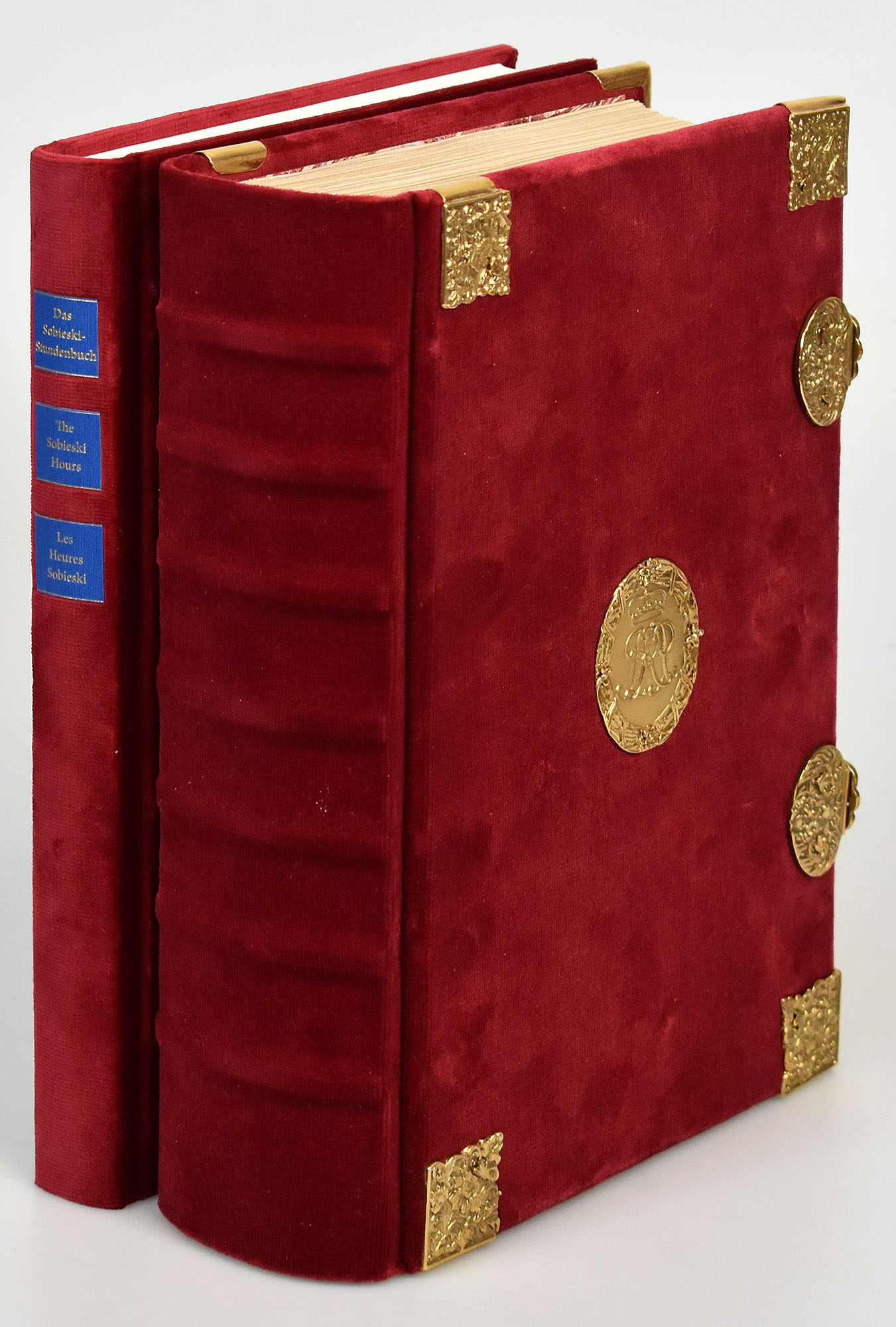
ref. 4042FBLuzern, Quaternio Verlag, 2016. Bände: 29,5 x 20,5 cm. Schuber: 234 Blatt; 351 Seiten. Original-Samteinband mit vergoldeten Medaillons, Zierecken und 2 Schließen und Rundum-Goldschnitt sowie Original-Samteinband mit goldgeprägten Titeln auf blauen Rückenschildchen in geschlossenem Original-Acrylglasschuber. [10 Warenabbildungen]
2020ref. 11157Tacoma WA 2020. Limited Edition. Hardcover. Fine in Fine Archival Box. Limited Edition. Hardcover. Quiet sophisticated and remarkably powerful Gabby's newest work is an exquisite blend of book art and binding. Gabby has from early in her career gone beyond her roots in design binding creating the text art and printing for several books now. Just as her design bindings push limits and explore possibilities so does her art and print work. It is a remarkable evolution. "Ralph Emerson wrote this poem "Blight" in July of 1843. He spoke out on climate change and the ways we could shift course by not blindly following others. In describing his travels to Europe while writing on life and nature Emerson said "same faces under new caps and jackets another turn of the old kaleidoscope." I took some liberties with Emerson's poem surrounding his words with photographs captured at Owen Beach in Washington state on a rainy winter day in 2019. This public beach in the middle of an urban old-growth forest will close for a year beginning in fall of 2020 to mitigate the effects of climate change and rising sea levels. Emerson's words of anger and disappointment at environmental destruction only resonate more with our current climate of melting glaciers and raging fires. As we continue to twist the kaleidoscope I remain optimistic we will find a way to rearrange these fragments and improve the view for future generations." artist statement This copy a 'making copy' adds tests of inks gouache type and design on a lot of the pages on the main book. The clamshell box includes a drawer of three separate folios of ink photo transfer and gouache. Inset into the drawer are two test covers as well more like miniature bindings of the big book. One is just the case and one has a separate small binding to test the structure. Housed in a custom box. Tight bright and unmarred. Brown textured paper boards by Hook Pottery Paper in a modified case binding letterpress printed with handset type on inkjet photo transfers silkscreen printed panels and acrylic painted Kozuke paper printing completed at Springtide Press with assistance from Jessica Spring; housed in an archival dropspine box. 4to. np. Illus. color plates. Numbered limited edition of 28 this being AP1. Signed by the artist. hardcover
2020ref. 11157Tacoma WA 2020. Limited Edition. Hardcover. Fine in Fine Archival Box. Limited Edition. Hardcover. Quiet sophisticated and remarkably powerful Gabby's newest work is an exquisite blend of book art and binding. Gabby has from early in her career gone beyond her roots in design binding creating the text art and printing for several books now. Just as her design bindings push limits and explore possibilities so does her art and print work. It is a remarkable evolution. "Ralph Emerson wrote this poem "Blight" in July of 1843. He spoke out on climate change and the ways we could shift course by not blindly following others. In describing his travels to Europe while writing on life and nature Emerson said "same faces under new caps and jackets another turn of the old kaleidoscope." I took some liberties with Emerson's poem surrounding his words with photographs captured at Owen Beach in Washington state on a rainy winter day in 2019. This public beach in the middle of an urban old-growth forest will close for a year beginning in fall of 2020 to mitigate the effects of climate change and rising sea levels. Emerson's words of anger and disappointment at environmental destruction only resonate more with our current climate of melting glaciers and raging fires. As we continue to twist the kaleidoscope I remain optimistic we will find a way to rearrange these fragments and improve the view for future generations." artist statement This copy a 'making copy' adds tests of inks gouache type and design on a lot of the pages on the main book. The clamshell box includes a drawer of three separate folios of ink photo transfer and gouache. Inset into the drawer are two test covers as well more like miniature bindings of the big book. One is just the case and one has a separate small binding to test the structure. Housed in a custom box. Tight bright and unmarred. Brown textured paper boards by Hook Pottery Paper in a modified case binding letterpress printed with handset type on inkjet photo transfers silkscreen printed panels and acrylic painted Kozuke paper printing completed at Springtide Press with assistance from Jessica Spring; housed in an archival dropspine box. 4to. np. Illus. color plates. Numbered limited edition of 28 this being AP1. Signed by the artist. hardcover books
4to. (8), 231, (1) pp. With a large figurated woodcut "C" initial by Hans Holbein. 18th century half vellum with ms. spine title. First edition of Hus's principal work, commonly known in English as "Treatise on the Church", ascribed to Adam Petri's Basel printshop on the basis of typographical features. Written in 1413 at the castle of one of Hus's protectors in Kozí Hrádek, near Sezimovo Ústí, the book evidences the author's strong intellectual and spiritual ties with the English reformer John Wyclif, whose like-titled "De ecclesiae" has been written in 1378 (Hus however, unlike Wyclif, did not reject the notion of transsubstantiation). "This treatise became Huss's 'apologia pro sua vita', the defense of the views which he had drawn from Wyclif and advocated. [... It] has a place of first importance among works on the church [...] It is the best known work on the subject issued from Augustine to the Reformation period [and] has had a permanent influence upon the development of the idea of the church" (Schaff, Introduction to the 1915 edition, p. xi-xxxi). - A little more than a century after Hus was burned at the stake in Constance, Luther was sent a manuscript copy of the work and, upon reading it, enthusiastically embraced Hus's central tenets, famously writing to Georg Spalatin in February 1520 that "without knowing it, we are all Hussites". But half a year later, two printed versions appeared almost simultaneously in 1520 - one under the original title used here, the other entitled "De causa Boemica" (printed by Anshelm in Hagenau; the precise order of publication remains unclear). These first printings "enabled others to evaluate (or even emulate) Luther's conclusion [... The text was presented] in a disinterested manner, thus allowing an unbiased judgment of its contents"; it was published without polemical introduction or prologue, and the title page, "which did not mention Hus by name, contained the simple epigraph: 'I beg you, my kind reader, to attend not to who speaks, but to what is said'" (Haberkern). - Occasional slight brownstaining; a few insignificant wormholes to blank lower margin near end; old library shelfmark in ink to front pastedown. Quires M and Q bound out of order (3-4-1-2), but a complete, well-preserved and wide-margined copy. Quite scarce: only three copies in auction records internationally since 1975. VD 16, H 6173. BM-STC German 438. Adams H 1210. BNHCat H 630. Haberkern, Patron Saint and Prophet: Jan Hus in the Bohemian and German Reformations [Oxford 2016], p. 158.
8vo. 116 (but: 117), (1) SS. 19th century red morocco with richly gilt inner dentelle, leading edges gilt, marbled pastedowns. All edges gilt. Very rare first Latin edition of this controversial pamphlet, previously published in French as "Discours merveilleux de la vie, actions & deportements de la royne Catharine de Medicis" ("Paris 1563", but in fact printed in the autumn of 1574). This stinging indictment of Catherine de Medici was reprinted several times and also saw a German translation, "Öffentliches Ausschreiben der übelbefriedigten Stände in Frankreich" (i.e., "Public announcement made by the malcontent estates in France"), edited by Johann Fischart. - "The most controversial book associated with the name of Henri Estienne; this notorious biography of Catherine de Médicis, in the form of a violent Huguenot pamphlet against her, has long been attributed to Henri Estienne, although serious doubt has been cast on this attribution" (Schreiber). The anonymous author presents himself as a Catholic who insists the Huguenots should not have been butchered, but rather converted by means of theological argument. "Undoubtedly the writer is a member of the large party of malcontents, many of whom - at least after the massacre - were Catholics, who hoped that all men of national spirit from both persuasions might unite to throw off the cruel yoke of the Queen mother's rule and end the civil wars. Among the many Huguenot pamphlets of the time, this is the one to aim the sharpest arrows at the Queen mother. It contains a vitriolic account of the Queen's life, describing her family and upbringing in the most disparaging terms and revealing all the schemes, misdeeds and crimes committed since the beginning of her rule in 1560 [...] Repeatedly the author points out how she makes use of the precepts of her Florentine compatriot Macchiavelli" (A. Hauffen, Fischart-Studien, in: Euphorion 8 [1901], S. 536f.). - Light browning and very occasional light staining, sumptuously bound in the 19th century. Adams S 1754. BM-STC French, Suppl. 22. Renouard 143, 8. Schreiber 196.