8,033 results
(4), CXXV, (1) Bll. With two-part armorial woodcut on title-page and 27 woodcuts in the text (8 by H. Schäufelein, 15 (?) by H. Weiditz). Modern marbled boards. Folio (212 x 304 mm). First German edition of "the first systematic study to address explicitly and exclusively the universal education of women", at the same time a fine and rare woodcut book. Commissioned by the wife of Henry VIII, Catherine of Aragon, who was at the time rearing her own daughter, Mary Tudor, Vives' treatise was translated and adapted by numerous followers (here by the Bavarian Humanist Christopher Bruno) and thus was read in almost every European vernacular, often by women themselves. The present translation is dedicated to Maria Jacobaea of Baden-Sponheim (1507-80), duchess consort of Bavaria, and to her daughter Mechthild of Bavaria (1532–65). - Vives' work consists of 3 books, one for each stage of woman's life: maidenhood, marriage, and widowhood. Although the author specifically adapted his prose style for a female readership, the treatise is hardly pro-woman: "the 'Education' is determined to be both a reference book for men on how to control their women, as well as an edifying treatise for women to absorb as a source of proper behaviour" (Kolsky). Nevertheless, Vives' praise of women's intellectual capacity and his advocation of some form of universal learning for females are viewed as landmarks for modern historians of women and gender. According to Pollie Bromilow, the dozens of vernacular translations were partly aimed at women themselves, who had no knowledge of Latin; and thus a large segment of its readership during the 16th century was in fact female. - Even browning and brownstaining throughout due to paper stock; some light waterstains. A few leaves show repairs in the lower margin and occasionally beyond, and a single leaf has a larger part torn out from the outer margin (no loss to text). - A fundamental document for the role of women in Early Modern society; only two copies in the trade since 1935. VD 16, V 1867. BM-STC German 899. Hayn/G. VIII, 135. Muther 1126. Musper L 181. Oldenbourg L 215. Not in Adams. Cf. Kolsky, Making Examples of Women: Juan Luis Vives' The Education of a Christian Woman. Bromilow, "An Emerging Female Readership of Print in Sixteenth-Century France?", French Studies (2013) Vol. 67, pp. 155-169.
1503In-folio (28,8 x 20,5 cm.); 10 cc.nn., 59 cc., 1 bl., 14 cc.nn, 1 bl.; with two woodcuts (15,8 x 12,9 cm) and 30 full-page calligrams in red and black, poems arranged in such a way that it forms a thematically related image. Bound in XVIII century half-leather.
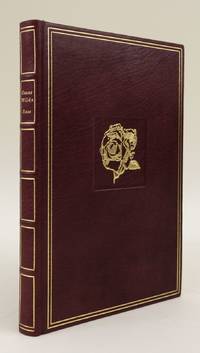
1982ref. ST16482Bayreuth: Printed by Chr. Scheufele Offizin Stuttgart for Bear Press 1982. No. 1 OF 10 COPIES ON VELLUM plus a "special" edition of 25 copies and 185 copies on Kochi Japanese paper. 223 x 148 mm. 8 7/8 x 5 3/4". 50 pp. 2 leaves.Translated and with an afterword by Wolfram Benda. Publisher's fine burgundy morocco by Erwin Lehr upper cover with gilt rose in recessed square flat spine with gilt titling turn-ins with gilt fillet frame pale yellow silk pastedowns. In the original burgundy suede slipcase. With three large initials in burnished gold and four signed and numbered original etchings by Peter Klitsch. Printed in red and black. Signed in the colophon by the artist the binder and the publisher/translator. In mint condition. This is the splendid deluxe version of a finely crafted private press edition of Wilde's fairy tales "The Nightingale and the Rose" "The Happy Prince" and "The Selfish Giant." It is the third work issued by the Bear Press founded in 1979 by literary scholar Wolfram Benda and still in operation. According to the firm's website "at a time when the craftsmanship and ethos of the artisan in bookmaking have been damaged by ever-increasing industrialization and neglect . . . The Bear Press . . . tries to achieve the highest possible degree of technical and artistic perfection in its printed works." The font used to print the text and the artist chosen to illustrate each work are carefully selected to express "the individual author's personality and intention." Even the discriminating aesthete Wilde 1854-1900 would be pleased with the choices here especially for the luxurious vellum printing: the type is set in refined Walbaum Antiqua and shown off with special effect by the creamy leaves; the etchings by Austrian artist Peter Klitsch b. 1934 are meticulous detailed and reminiscent of the work of Wilde's friend Aubrey Beardsley; and the binding is the epitome of tasteful restraint flawlessly executed with premium materials. The three tales here first appeared in 1888 and are bittersweet in their themes of love and self-sacrifice. His stories for children were one of Wilde's early successes and DNB notes "Their permanent place in child affections refutes the vulgarism that Wilde's literary reputation arose from his legal notoriety. In all cases the fairy tales are on the child's side celebrating the courage and generosity of the poor and vulnerable while their satire mocks the kind of pomposity and hypocrisy children can recognize." We have been able to trace just two other copies of the vellum printing at auction in ABPC and RBH. [Printed by Chr. Scheufele Offizin, Stuttgart, for] Bear Press unknown
1982ref. ST16482Bayreuth: Printed by Chr. Scheufele Offizin Stuttgart for Bear Press 1982. No. 1 OF 10 COPIES ON VELLUM plus a "special" edition of 25 copies and 185 copies on Kochi Japanese paper. 223 x 148 mm. 8 7/8 x 5 3/4". 50 pp. 2 leaves.Translated and with an afterword by Wolfram Benda. Publisher's fine burgundy morocco by Erwin Lehr upper cover with gilt rose in recessed square flat spine with gilt titling turn-ins with gilt fillet frame pale yellow silk pastedowns. In the original burgundy suede slipcase. With three large initials in burnished gold and four signed and numbered original etchings by Peter Klitsch. Printed in red and black. Signed in the colophon by the artist the binder and the publisher/translator. In mint condition. This is the splendid deluxe version of a finely crafted private press edition of Wilde's fairy tales "The Nightingale and the Rose" "The Happy Prince" and "The Selfish Giant." It is the third work issued by the Bear Press founded in 1979 by literary scholar Wolfram Benda and still in operation. According to the firm's website "at a time when the craftsmanship and ethos of the artisan in bookmaking have been damaged by ever-increasing industrialization and neglect . . . The Bear Press . . . tries to achieve the highest possible degree of technical and artistic perfection in its printed works." The font used to print the text and the artist chosen to illustrate each work are carefully selected to express "the individual author's personality and intention." Even the discriminating aesthete Wilde 1854-1900 would be pleased with the choices here especially for the luxurious vellum printing: the type is set in refined Walbaum Antiqua and shown off with special effect by the creamy leaves; the etchings by Austrian artist Peter Klitsch b. 1934 are meticulous detailed and reminiscent of the work of Wilde's friend Aubrey Beardsley; and the binding is the epitome of tasteful restraint flawlessly executed with premium materials. The three tales here first appeared in 1888 and are bittersweet in their themes of love and self-sacrifice. His stories for children were one of Wilde's early successes and DNB notes "Their permanent place in child affections refutes the vulgarism that Wilde's literary reputation arose from his legal notoriety. In all cases the fairy tales are on the child's side celebrating the courage and generosity of the poor and vulnerable while their satire mocks the kind of pomposity and hypocrisy children can recognize." We have been able to trace just two other copies of the vellum printing at auction in ABPC and RBH. [Printed by Chr. Scheufele Offizin, Stuttgart, for] Bear Press unknown books
1513ref. 15517Paris, [Thomas Kees], 1513. In-8 de (32) ff. (sign. a-d8).Deuxième édition en caractères gothiques ornée de lettrines, publiée trois ans après l'originale, sortie des presses parisiennes de Thomas Kees, identifiables au matériel typographique employé. Colophon : Impressum Parisius Anno. MCCCCCXIII die XXIII mensis novembris. Traduction du "Sermo in vigilia Nativitatis Domini" par Bartolomeo Meduna, suivie de "Devotissima expositio sancti Thome super salutatione angelica". Brunet V, 160 ; Moreau, II, Inventaire, 716.SAVONAROLA (Girolamo). Fratris Hieronymi Savonarole de Ferrariis ordinis predicatorum Expositio in psalmos Miserere mei Deus. Qui regis Israel, et tris versus psalmi. In te Domine speravi. S.l.n.d. (Paris, Josse Bade, circa 1508). In-8 de (40) ff. (Sig. a-e8).Second tirage des Psaumes sorti des presses de Josse Bade vers 1508 avec sa marque au titre qui porte la devise "Prelum Ascensianum". Brunet V, 159 ; Moreau I, Inventaire, 176 ; Renouard, Josse Badius, III, p.248, E-2.SAVONAROLA (Girolamo). Eruditorium confessorum Fratris Hieronymi Savonarole Ferrariensis ordinis predicatorum. Venundantur ab Joanne Parvo, Henrico Jacobi et Ascensio (Paris, Jean Petit, Henri Jacobi et Josse Bade), 1510. In-8 de (56) ff. (sig. a-g8).Deuxième édition publiée l'année de l'originale augmentée de l'Épître de Jodocus Guido à Malignus Papa, maître de la jeunesse studieuse. Colophon : Finem cepit in edibus ascensianis ad XIIII calendas octobres anno MDX ad calculum romanum (18 septembre 1510). Moreau, Inventaire, I, 189 ; Brunet V, 165 ; Panzer VII, 545, 386 ; Renouard, Josse Badius, III, p. 246, C-1.PARENTINIS (Bernardus de). Lilium misse in quo omnes difficultates || officij misse sacrique canonis secundum sanctum Thomam summopere enodantur. Venundatur vero Parisius a Johanne Paruo in vico diui Jacobi sub lilio aureo sedente (Paris, Philippe Pigouchet pour Jean Petit, 1510). In-8 de (7) ff. 1 f.bl., CXLIX ff. (1) f. (sig. A8 a-t8).Belle impression en caractères gothiques sur deux colonnes ornée de lettrines, sortie des presses de Jehan Petit avec sa marque typographique sur le titre et la grande marque gravée pleine-page de Philippe Pigouchet au verso de l'ultime feuillet. Colophon : Nouissime autem exaratum Parisius per Philippum Pigouchet pro Johanne Paruo Anno christiane salutis M.v.c.x. solExceptioe vero Decembris claudente vicesimam. Quelques notes manuscrites marginales à l'encre du temps. Panzer VII, 546, 393 ; Moreau, Inventaire, I, 22.4 pièces reliées en 1 vol. in-8 (145 x 105 mm), peau de truie sur ais de bois estampée à froid, dos à trois nerfs, titre et cote manuscrits postérieurs sur le dos, deux fermoirs, parchemin de réemploi sur les gardes (reliure de l'époque).
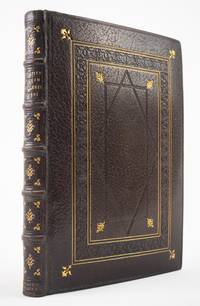
1626ref. ST21074Antwerp: Balthasar Moretus 1626. ONE OF 50 COPIES ON VELLUM PRINTED FOR THE KING OF SPAIN and 25 copies on paper. 257 x 185 mm. 10 1/4 x 7 1/4". 8 p.l. 91 pp.Translated by Nicolas Grudius. Handsome dark brown crushed morocco tooled in gilt and blind by the Club Bindery for Robert Hoe stamp-signed and dated 1903 on front turn-in and with Hoe's monogram on front pastedown covers with frame of double gilt rules enclosing repeated blind-stamped medallions central panel with blind-ruled lozenge and rectangle the latter with oblique gilt fleurons at corners raised bands spine compartments ruled in blind with gilt fleuron centerpiece and gilt floral buds at corners gilt lettering vellum endleaves all edges gilt tiny invisible repairs at top of spine and front joint. With two full-page armorial engravings by Cornelius Galle one the arms of the Spanish monarch the other the insignia of the Order engraved head- and tailpieces. Front pastedown with morocco bookplate of Robert Hoe as well as engraved bookplates of Arthur & Charlotte Vershbow and David Godine. Bibl. Belg. I 692; Voet II 1017; Van Praet V:161-2; Brunet Supp. I:291; USTC 1007848. Boards slightly bowed as almost inevitable with vellum books text a bit wavy also as expected occasional faint smudges or dustsoiling at edges but AN EXTREMELY PLEASING COPY the vellum creamy and bright the binding very lustrous. This is the luxurious vellum printing of the rules of the Order of the Golden Fleece bound in 16th century style for the renowned bibliophile Robert Hoe by the workshop he co-founded and supervised for much of its existence. Founded in 1429 by Philip Duke of Burgundy the exclusive Order of the Golden Fleece was the most distinguished knighthood in the Holy Roman Empire being limited to just 24 members. Its primary purpose was to preserve and protect the Catholic faith as well as to uphold the 12 knightly virtues outlined by Philip: Faith Charity Justice Sagacity Prudence Temperance Resolution Truth Liberality Diligence Hope and Valor. Those deserving to be collared with the order's golden necklace featuring an appended ram that gave the group its name swore to support their monarch militarily and in return they were exempt from taxes as well as being entitled to be tried for any crimes by a jury restricted to their fellow knights. The "Rules" or "Statutes" that make up the text here dictate the very strict obligations and behavioral guidelines for its members including proscriptions against such things as fleeing a battle out of cowardice or embracing beliefs antithetical to the Church along with a number of procedural decrees governing for example how exactly to participate in ceremonial occasions. The earliest Latin edition of the "Constitutiones" translated from the French by the secretary of the Order Flemish poet Nicolaus Grudius 1504-70 was printed by Guillaume Silvius at the Plantin Press in 1566. In total four vellum editions were issued over the next 200 years all now rare. The present copy collates as the 1626 edition issued by Balthasar Moretus which the Belgian national bibliography tells us was printed for the king of Spain with 50 copies on vellum and 25 on paper. Our copy was bound in 1903 for Robert Hoe 1839-1909 a founder of the Grolier Club and one of the world's great book collectors. After Grolier was established in 1884 it soon became apparent that the country's few established hand binders were overtaxed in providing repairs and rebinding for the club members' rapidly accumulating acquisitions. As a consequence in 1895 Grolier members along with Edwin Holden and other wealthy collectors established the Club Bindery in order to attract European craftsmen to provide close to home fine quality binding work rivalling what was available abroad. The Club Bindery was in operation until 1909 with Hoe being its most influential manager and client. It provided bindings that tended to be traditional in style--though frequently with elaborate decoration--and that lived up to its patrons' expectations in terms of excellence. Our volume later passed into the hands of another Grolier Club member Arthur Vershbow 1922-2012 and his wife Charlotte 1924-2000. All early editions of this work are scarce; we were able to trace just one other copy of our vellum-printed edition at auction sold for 11700 at van de Wiele in 2024. Balthasar Moretus unknown
1626ref. ST21074Antwerp: Balthasar Moretus 1626. ONE OF 50 COPIES ON VELLUM PRINTED FOR THE KING OF SPAIN and 25 copies on paper. 257 x 185 mm. 10 1/4 x 7 1/4". 8 p.l. 91 pp.Translated by Nicolas Grudius. Handsome dark brown crushed morocco tooled in gilt and blind by the Club Bindery for Robert Hoe stamp-signed and dated 1903 on front turn-in and with Hoe's monogram on front pastedown covers with frame of double gilt rules enclosing repeated blind-stamped medallions central panel with blind-ruled lozenge and rectangle the latter with oblique gilt fleurons at corners raised bands spine compartments ruled in blind with gilt fleuron centerpiece and gilt floral buds at corners gilt lettering vellum endleaves all edges gilt tiny invisible repairs at top of spine and front joint. With two full-page armorial engravings by Cornelius Galle one the arms of the Spanish monarch the other the insignia of the Order engraved head- and tailpieces. Front pastedown with morocco bookplate of Robert Hoe as well as engraved bookplates of Arthur & Charlotte Vershbow and David Godine. Bibl. Belg. I 692; Voet II 1017; Van Praet V:161-2; Brunet Supp. I:291; USTC 1007848. Boards slightly bowed as almost inevitable with vellum books text a bit wavy also as expected occasional faint smudges or dustsoiling at edges but AN EXTREMELY PLEASING COPY the vellum creamy and bright the binding very lustrous. This is the luxurious vellum printing of the rules of the Order of the Golden Fleece bound in 16th century style for the renowned bibliophile Robert Hoe by the workshop he co-founded and supervised for much of its existence. Founded in 1429 by Philip Duke of Burgundy the exclusive Order of the Golden Fleece was the most distinguished knighthood in the Holy Roman Empire being limited to just 24 members. Its primary purpose was to preserve and protect the Catholic faith as well as to uphold the 12 knightly virtues outlined by Philip: Faith Charity Justice Sagacity Prudence Temperance Resolution Truth Liberality Diligence Hope and Valor. Those deserving to be collared with the order's golden necklace featuring an appended ram that gave the group its name swore to support their monarch militarily and in return they were exempt from taxes as well as being entitled to be tried for any crimes by a jury restricted to their fellow knights. The "Rules" or "Statutes" that make up the text here dictate the very strict obligations and behavioral guidelines for its members including proscriptions against such things as fleeing a battle out of cowardice or embracing beliefs antithetical to the Church along with a number of procedural decrees governing for example how exactly to participate in ceremonial occasions. The earliest Latin edition of the "Constitutiones" translated from the French by the secretary of the Order Flemish poet Nicolaus Grudius 1504-70 was printed by Guillaume Silvius at the Plantin Press in 1566. In total four vellum editions were issued over the next 200 years all now rare. The present copy collates as the 1626 edition issued by Balthasar Moretus which the Belgian national bibliography tells us was printed for the king of Spain with 50 copies on vellum and 25 on paper. Our copy was bound in 1903 for Robert Hoe 1839-1909 a founder of the Grolier Club and one of the world's great book collectors. After Grolier was established in 1884 it soon became apparent that the country's few established hand binders were overtaxed in providing repairs and rebinding for the club members' rapidly accumulating acquisitions. As a consequence in 1895 Grolier members along with Edwin Holden and other wealthy collectors established the Club Bindery in order to attract European craftsmen to provide close to home fine quality binding work rivalling what was available abroad. The Club Bindery was in operation until 1909 with Hoe being its most influential manager and client. It provided bindings that tended to be traditional in style--though frequently with elaborate decoration--and that lived up to its patrons' expectations in terms of excellence. Our volume later passed into the hands of another Grolier Club member Arthur Vershbow 1922-2012 and his wife Charlotte 1924-2000. All early editions of this work are scarce; we were able to trace just one other copy of our vellum-printed edition at auction sold for 11700 at van de Wiele in 2024. Balthasar Moretus unknown books
Folio (215 x 300 mm). (16), 272, (24) pp. With woodcut device on t. p. (Minerva and Mercury holding the wing tips of a rising phoenix), woodcut portrait on reverse, and printer's device on final leaf, as well as numerous mathematical diagrams in the text. Contemporary Italian limp vellum with ms. spine title. First Latin edition of one of the major works by Proclus Lycaeus (412-485), founder and head of the neo-Platonic school of Athens: a commentary on the first book of Euclid's "Elements of Geometry", the "oldest mathematical textbook in the world still in common use today" (PMM). Includes the text of the theorems, set within ornamental woodcut framings, and the geometrical diagrams. The editor and translator Francesco Barozzi (1537-1604) taught at the University of Padua. He was later charged with sorcery (in particular, he was said to have caused a torrential rainstorm over his native Crete) and condemned by the Inquisition in 1587. "Barocius' edition of Proclus' commentary on the first book of Euclid's 'Elements' was the first important translation of this work, for it was based on better manuscripts than previous efforts had been. The translation, published in 1560, was completed by Barocius at the age of twenty-two" (DSB). His portrait on the reverse of the title page is cut within a magnificent border. - Old ms. ownership on flyleaf obliterated (probably in the early 19th century); old ownership stamp over title woodcut erased, replaced by a different coat of arms in ink, very likely that of the Italian comital family Antico (insignificant bleeding to reverse). Occasional slight waterstaining, still an exceptionally appealing, clean copy. Edit 16, CNCE 33726. Adams P 2138. BM-STC Italian 540. Mortimer 403. Honeyman 2543. DSB I, 468. Brunet IV, 895. Riccardi I/1, 82, 1 ("Bella e rara edizione"). Cf. PMM 25.
4to. 22 ff. (a7, b8, c7: wants first and last blanks). 32 lines, Gothic type. Rubricated throughout, 3 four-line lombardic initials, red penwork decoration at beginning of text. Later cream-coloured calf in contemporary style, with blind rules and stamped cover title "Tractatus De Turcis". Third edition of this polemical treatise against the Ottomans. Mainly contains prophecies referring to the Turks (by Merlin, Cyrillus, Joachim of Fiore, St. Hildegarde, Catherine of Siena, Methodius, etc.). Also one of the earliest texts to mention Hungary, and one of the very few works printed by Zeninger: "Conrad Zeninger (from Mainz) produced a mere 10-odd books between 1480 and 1482" (cf. Halle 70). The prophecy referring to the King of Hungary (fol. a[5]r) is reprinted by Fraknói Vilmos, "Schlauch Lörincz szatmári püspöknek Török János által gyüjtött könyvtára", in: Magyar Könyvszemle 2 (1877), p. 77-90, at: 77f. (cf. Apponyi). The date is based on the mention of the death of Mehmet II on fol. A[4]v. - Some browning, with slight waterstain throughout in lower margin; first and final leaf washed. Slight paper flaw in fol. 1 (not touching text); final leaf restored. Faint traces of a later ms. page count are visible near the lower edge. Occasional 16th-century marginalia. A fine copy of this rare work, rubricated throughout. HC 15681. Goff T-503. GW M48133. BMC II, 460. BSB-Ink T-437. Oates 1077. Proctor 2229. Walsh I, 794. Pellechet 11154. Halle 70 (Newe Zeitungen), 11. Apponyi 10. Hohenemser 2169. Geldner I, 173.
4to (140 x 196 mm). (4), 52 ff. Modern half vellum over marbled boards. First edition, containing "the earliest of Bacon's authentic works to be printed" (DSB). Often referred to as one of Bacon's most important writings, it occupies leaves 37 to 52 of the volume. "A very rare book which [...] contains the editio princeps of Roger Bacon's 'De mirabili potestate artis et naturae' which is identical with his 'Epistola de secretis [...]'. This book, which has often been reprinted and translated, is, according to Hoefer, one of the most remarkable and at the same time one of the most authentic works by Roger Bacon. It contains almost prophetic gleams of the future course of science, dealing with automobiles, flying machines, diving-bells, telescopes, burning-mirrors, a sort of gun-powder, etc. As all the books edited by Oronce Finé it is beautifully printed and adorned with fine criblé initials" (Duveen). Bacon's enumeration of these "wonderful machines for flying, lifting weights, and driving carriages, ships, and submarines. and so on, which he believed had been made in antiquity and could be made again" (DSB I, 380), appears on leaf 42, while the oft-quoted allusion to the composition of power of gun-powder is on leaf 52r. Indeed, the ascription of the invention of gun-powder to Bacon is very doubtful, to say the least (cf. Sarton II, p. 958). - Edited by Oronce Finé, who prefixed Bacon's treatise with another by Claudius Coelestinus (ca. 1400), discussing miracles, secrets, the influence of planets and comets etc. Coelestinus may have been, like Bacon, a Franciscan friar: he is referred to by Finé in his preface as "Frater", and is so described in the heading to the work. - Light brownstaining throughout; several near-contemporary annotations and underlinings. Extremely rare: only three copies in postwar auction records (one offered by Lathrop Harper in 1976 for $3,500; two more sold at Sotheby's in 1989 and 2004, each commanding in excess of £5,000). Adams C 2307. BM-STC French 118. Renouard (Colines) 355. Duveen 36f. Rosenthal 190. Caillet 2416. Graesse, Bibl. mag. et pneum., p. 49. Thorndike II, ch. 61. DSB I, 384. Ferguson I, 64 (note). Hoefer I, 395. Sarton II, 963. Brüning I, 223. Wellcome 1178. Durling 979. Waller 12126. Hodgson, Hist. of Aeronautics, 68 f. Liebmann/Wahl, no. 927.
4to. 62 ff. 30-33 lines and heading line (Roman type 17:145G, 22:89G); several woodcut Greek interspersions (K6v & I3r). With full-page woodcut on reverse of title page, additional full-page woodcut on f. Jiv, and 17 half-page woodcuts in the text (with some repeats). Mid-18th-century boards using an 18th-century antiphonary. First edition of the author's first important work, an exhortation to fight the Turks, couched as a Latin tragedy. Jakob Locher (1471-1528) had been created poet laureate but months before. The volume is concluded by a "Dyalogus" against all forms of heresy (and including encomia and dedicatory addresses to the Emperor and the nobles of court and clergy). - Contains fine woodcuts, some of which were used previously in the Strasbourg editions of Terence and the Ship of Fools; at least six blocks were cut originally for this book. "The opening woodcut depicts the author and newly crowned poet laureate" (cf. von Arnim). This is the earlier impression without the armorial woodcut on fol. B6r (as in Schramm); the final line of fol. J3r still reads "tekos" (for "telos"). Typographical errors "Jacboi" on fol. L2r; "Daum" (for "Datum") in final line of fol. L3r; colophone reads "anno christo". A pinhead-sized wormhole throughout the blank margin (not touching text). Top edge trimmed rather closely in places; a few underlinings by a contemporary hand. Altogether a fine, very clean copy. Extremely rare; last seen in the trade more than a decade ago (Shipperdson-Field-Nakles copy, Christie's New York, 17 April 2000, lot 22: $15,275). HC 10153*. Goff L-264. GW M18631. BMC I, 112. BSB-Ink L-206. Schreiber 4513. Grüninger 32. Schramm XX, 23. Slg. Schäfer 212. Goedeke I, 427, 9.
Folio. 8 vols. With 8 woodcut title vignettes and 8 woodcuts in the text. Contemp. blindstamped pigskin bindings over wooden boards, some monogrammed and dated, some with preserved clasps. Second Jena edition of the collected works (in various impressions for various publishers), edited by Amsdorf, Aurifaber, Rörer, Soltz and others. Each volume begins with a brief introduction and an index (a complete index was separately published by Timotheus Kirchner in 1564). Includes: vol. 1 (Richtzenhayn/Rebart 1564), vol. 2 (ibid. 1563); vol. 3 (Richtzenhayn 1573), vol. 4 (ibid. 1560), vol. 5 (Rödinger's heirs 1557), vol. 6 (Richtzenhayn/Rebart 1568), vol. 7 (Rödinger's heirs 1558), vol. 8 (Rebart's heirs 1580). For the woodcuts monogrammed "PG" in vols. I-VII cf. Nagler (Monogrammisten) IV, 2967, 14. Vol. VIII shows the three Saxon Princes with their coats of arms and a 12-line verse encomium, "Des Luthers Bücher gros und klein". The pretty blindstamped bindings show roll-tools and platestamps, various dates and monogrammes. This set was assembled by the Saxon theologian Dr. Carl Friedrich Bonitz (1775-1835), preacher of the afternoon mass at the Leipzig University Church in 1800, then active in Langensalza from 1802 onwards (and superintendent in 1809). His autograph ownership is on the flyleaf of each volume (dated 1807 in the first). Among Bonitz's works are studies in the Pauline epistles and a "Geschichte der Lutherischen Religions- und Kirchenverbesserung" (1805). - Some browning throughout; occasional slight waterstaining; bindings rubbed. Altogether a well-preserved made-up set from the library of a Saxon protestant theologian of the early 19th century. VD 16, ZV 24 1682, L 3355, L 3381, L 3349, L 3330, L 3367 or ZV 21399, L 3336 and L 3389. Aland 572ff. Goedeke II, 151. Cf. BM-STC German 534 (another made-up set).
Folio. 10 unnumbered ff. Title printed in red and black with full-page woodcut of the instrument in question (repeated on f. 2v) and numerous woodcut diagrams. Modern half morocco over red boards. First edition of one of the rarest works by the Austrian astronomer and instrument maker. The "Quadratum geometricum", a new geodetic measuring instrument, was invented by Peurbach himself, and its use is here described for the first time. - From the library of Werner Habel, with his ownership stamp, signature and acquisition date (1977) to front pastedown. Previously in the collections of Count Wladyslaw Hrabia Bielinski and Zygmunt Czarnecki, with their stamps to title. Rare, only a single copy recorded at auction within the last 60 years. VD 16, P 2054. Adams P 2270. BNHCat P 943.
4to (165 x 211 mm). 280 ff. With title woodcut and 112 large woodcuts by Albrecht Dürer, the Master of Heintz-Narr and others. - (Bound with) II: (Lilienstayn, Jacob). Tractatus contra Waldenses fratres erroneos quos vulgos vocat Pickardos fratres sine regula: sine lege: & sine obedie[n]tia [...] Quo[rum] multi sunt in moravia plus[quam] in bohemia. [Nuremberg, Johann Weißenburger, 1505]. 36 (instead of 40) ff. 18th century calf over wooden boards with two clasps. First edition to contain Dürer's illustrations from Sebastian Brant's "Ship of Fools", with the woodcuts from the 1494 edition as well as several taken from the Latin edition. Geiler von Kaisersberg seized upon the human vices denounced in the "Ship of Fools" and treats them from the viewpoint of Christian philosophy. "Disregarding the Lübeck Bible, this is the most important woodcut cycle published before the Apocalypse [...] The first fully rounded moral genre pictures in history" (cf. Winkler, Dürer und die Illustrationen zum Narrenschiff [Berlin 1951]). The exact extent of Dürer's contribution to the 'Narrenschiff' woodcuts was long a subject of controversy; since Winkler's work, he is generally regarded as the book's principal artist (cf. Murray, p. 165; see also Strauss, Albrecht Dürer, Woodcuts and Wood Blocks [New York 1980], p. 64-81, who attributes several of the woodcuts to the young Dürer). - II: Bound in the same volume is a very rare polemical work against the Bohemian Brethren. The Viennese scholar Adauctus Voigt called this "one of the most remarkable of books [...] The author, a Dominican and professor of theology, spent nearly three years among the Brethren, probably in disguise, so as to investigate their true religious constitution and customs" (Abhandlungen einer Privatgesellschaft in Böhmen, ed. by Ignaz v. Born, vol. 6 [Prague 1784], p. 344). - Binding somewhat rubbed; spine repaired. Title-page of "Navicula" has old handwritten ownerships (some deleted); numerous old annotations and manicules in the text (mostly slightly trimmed during re-binding in the 18th centruy). The missing leaves 37-40 at the end of the second work are supplied in photocopy. Two leaves of "Registrum Capitulorum" and 1 blank, from another book, are bound between the two works. Altogether a good copy, very slightly browned and stained. I. VD 16, G 778; Adams G 316; Dacheux 50; Kristeller 623; Meder S. 274; Muller 21, 89; Panzer VI, S. 54, 232; Proctor/Isaac 9995; Ritter 959; Schmidt 48; STC 335. - II. Adams L 672 (erroneously dated "c. 1535"). Panzer IX, 108, 12. Proctor/Isaac 11043. BM-STC German 501.
4to. 32 pp. With printer's woodcut device on the title-page and different device under the colophon; several woodcut initials. Followed by a 49-page manuscript index (beginning with instructions to the "amice lector" on the verso of the colophon) on 28 blank leaves bound after the printed text. 19th century boards with red morocco spine lettered and decorated in gilt. The first edition of the 16th century: a very rare reprint of the incunable published in 1494, the first separate edition to be based on the criticism of the Renaissance scholar Ermolao Barbaro. Dedicated to Pope Alexander VI. Mela's description of the ancient world, based on good sources and written during the reign of Emperor Claudius, is the oldest Roman geography to have survived. This edition was not equipped with an index, but a contemporary humanistic owner rectified the fault by crafting his own: the humanistic "cancelaresca" manuscript provides a list of all cities, places and even subjects mentioned, a total of some 1,000 references to 227 paragraph numbers (which the owner, too, provided in brown ink throughout the inner margins of the book). - Occasional slight foxing and waterstaining to margins near end, but a fine copy of this rare book. Edit 16, CNCE 58712. Schweiger II.2, 606. Ebert 13608. Graesse V, 401: "Reimpr. rare de l'edition ... de 1494". Not in Adams, BM-STC Italian, or Riccardi. Not in Brunet or Dibdin.
Folio (204 x 325 mm). 161 (instead of 220) hand-numbered woodcut plates in early 18th-century colour, mounted on backing paper and missing parts supplemented by hand. Later half calf with 18th-c. spine label. All edges sprinkled in red. First edition of Jost Amman's encyclopedic book of costumes. A strongly fragmented copy, as usual; in the early 19th century, the plates were mounted on backing paper by the owner, the trained landscape painter Jakob Linckh (1786-1841) from Stuttgart (cf. Thieme/B. 23, 254), who also coloured the volume throughout and supplemented all missing parts of the images and even of the text by hand. Linckh, who had studied in Rome, visited Greece in 1810. There he met Byron, who commissioned him to provide the illustrations for Hobhouse's travel book. - Wants 59 plates altogether; the remainder are trimmed closely at the upper edge, and most have severe defects in the lower half. Although the present collection begins with the plate showing the Emperor, as originally issued, the remaining woodcuts follow no apparent order. 20 plates show costumes of Turkey, Arabia, Persia, Egypt, and Ethiopia; others depict Greeks, Russians, and Englishmen. 28 plates show the costumes of today's Italy; German cities are well represented, as are France and Spain, Bohemia and Hungary. Also includes the famous picture of the Brazilian Tupinamba Indians: a man with a crown and belt of feathers, a knife, and a bow and arrow, beside a long-haired woman carrying a baby in a knotted sling. The illustration is an adaptation of two cuts from the "Recueil de la diversité des habits" (Paris, 1562; Antwerp, 1572) by Francois Descerpz, "one of the first likenesses of the Brazilian Indian" (Borba de Moraes). - Title page shows Jakob Linckh's autograph ownership (dated 1825); somewhat later stamped ownership of Anton Franzin (possibly the like-named Tyrolean law clerk, c. 1840) to flyleaf. VD 16, W 1487 (BSB copy incomplete). Lipperheide 7-8 (both copies incomplete). Andresen I, 234. Becker 140. Borba de Moraes II, 373f. Maggs, Bibl. Americana 1-214 ("This book is excessively rare in a complete state").
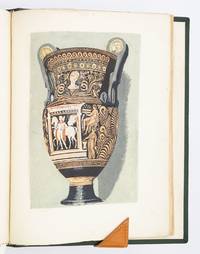
1822ref. ST17561London: Published for the Proprietor by Longman Hurst Rees Orme and Brown 1822 1823. FIRST EDITION ONE OF 227 COPIES. 288 x 220 mm. 11 3/8 x 8 5/8". 3 p.l. vi 2 100 8 103-118 pp. 2 leaves. Pleasing 20th century rich green crushed morocco gilt-framed covers and smooth spine gilt lettering to spine edges untrimmed. In a burgundy calf-backed clamshell box meant for this book but for some reason substantially larger green morocco title label on spine. WITH 60 ENGRAVED ILLUSTRATIONS as called for in Abbey 48 PRINTED IN COLORS including decorative title page dedication with Earl Spencer's coat of arms six plates with a total of 18 color ink specimens two type specimen plates four engravings of printing presses Columbian Press in two states one before letters nine defaced plates printed recto-verso and six headpieces three color printed 28 engraved plates printed in colors: five in a single block six in two to four blocks 14 in five to nine blocks and three full-color in 13 14 and 29 blocks respectively as called for in the contents and in Abbey. Front pastedown with the bookplate of the Robin Collection. Abbey Life 233; Ray "England" 99. Occasional mild thumbing otherwise nothing but the most trivial imperfections--quite a fine copy internally clean and fresh with pleasing colors in a very appealing unworn binding. This virtuoso production was in Ray's opinion Savage's magnum opus a work that was "both a highly idiosyncratic volume and a notable landmark in the history of color printing from wood." Printer and engraver William Savage 1770-1843 was in Ruari McLean's words "the first true colour printer of the nineteenth century in England." One of his great innovations which made possible color printing as seen here was a new formulation of ink. DNB reports "Printing ink in England at that time was of a very poor quality and Savage by various experiments made a printing ink without any oil in its composition. This made it more serviceable for artistic work and easier to manufacture." Savage's inks transferred so cleanly from the engraved wooden block to the paper that the blocks did not have to be wiped between impressions--speeding up the process considerably especially when as here one image could require up to 29 colored blocks. The oil-free inks were also less inclined to smear or to bleed through the paper. While Savage's elaborate methods were not economically viable for mass printing of color-illustrated works his improvements to printing ink and his use of multiple blocks paved the way for the use of chromolithography. The engravings in this work are rare because the work was strictly limited and because Savage despite some protests fulfilled his promise to subscribers that all the blocks would be destroyed. While the plate count in the work can vary from copy to copy the present item collates as indicated by the table of contents and includes Clymer's Columbian Press plate in two states as called for by Abbey. This work appears on the market from time to time but seldom in the kind of agreeable condition seen here. Published for the Proprietor by Longman, Hurst, Rees, Orme, and Brown unknown
1822ref. ST17561London: Published for the Proprietor by Longman Hurst Rees Orme and Brown 1822 1823. FIRST EDITION ONE OF 227 COPIES. 288 x 220 mm. 11 3/8 x 8 5/8". 3 p.l. vi 2 100 8 103-118 pp. 2 leaves. Pleasing 20th century rich green crushed morocco gilt-framed covers and smooth spine gilt lettering to spine edges untrimmed. In a burgundy calf-backed clamshell box meant for this book but for some reason substantially larger green morocco title label on spine. WITH 60 ENGRAVED ILLUSTRATIONS as called for in Abbey 48 PRINTED IN COLORS including decorative title page dedication with Earl Spencer's coat of arms six plates with a total of 18 color ink specimens two type specimen plates four engravings of printing presses Columbian Press in two states one before letters nine defaced plates printed recto-verso and six headpieces three color printed 28 engraved plates printed in colors: five in a single block six in two to four blocks 14 in five to nine blocks and three full-color in 13 14 and 29 blocks respectively as called for in the contents and in Abbey. Front pastedown with the bookplate of the Robin Collection. Abbey Life 233; Ray "England" 99. Occasional mild thumbing otherwise nothing but the most trivial imperfections--quite a fine copy internally clean and fresh with pleasing colors in a very appealing unworn binding. This virtuoso production was in Ray's opinion Savage's magnum opus a work that was "both a highly idiosyncratic volume and a notable landmark in the history of color printing from wood." Printer and engraver William Savage 1770-1843 was in Ruari McLean's words "the first true colour printer of the nineteenth century in England." One of his great innovations which made possible color printing as seen here was a new formulation of ink. DNB reports "Printing ink in England at that time was of a very poor quality and Savage by various experiments made a printing ink without any oil in its composition. This made it more serviceable for artistic work and easier to manufacture." Savage's inks transferred so cleanly from the engraved wooden block to the paper that the blocks did not have to be wiped between impressions--speeding up the process considerably especially when as here one image could require up to 29 colored blocks. The oil-free inks were also less inclined to smear or to bleed through the paper. While Savage's elaborate methods were not economically viable for mass printing of color-illustrated works his improvements to printing ink and his use of multiple blocks paved the way for the use of chromolithography. The engravings in this work are rare because the work was strictly limited and because Savage despite some protests fulfilled his promise to subscribers that all the blocks would be destroyed. While the plate count in the work can vary from copy to copy the present item collates as indicated by the table of contents and includes Clymer's Columbian Press plate in two states as called for by Abbey. This work appears on the market from time to time but seldom in the kind of agreeable condition seen here. Published for the Proprietor by Longman, Hurst, Rees, Orme, and Brown unknown books
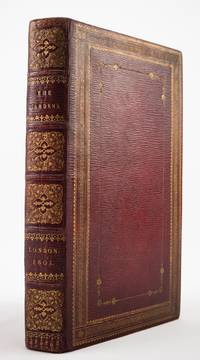
1805ref. ST21016London: Printed by T. Bensley 1805. APPARENTLY THE ONLY COPY PRINTED ON VELLUM. 260 x 152 mm. 10 x 1/4 x 6". 2 p.l. 146 pp. 1 leaf notes. Translated by Maria Henrietta Montolieu. Very pleasing contemporary straight-grain scarlet morocco gilt by Charles Hering binder's ticket on verso of front flyleaf covers bordered with a wide frame of multiple patterned rolls with rosette cornerpieces enclosing a delicate frame of a dotted roll cornered small floral tools raised bands spine gilt in compartments wide turn-ins sumptuously gilt cream silk endleaves with gilt borders and fleuron cornerpieces all edges gilt. WITH EIGHT ENGRAVINGS BY FRANCESCO BARTOLOZZI IN TWO STATES one on gold silk and the second on paper. EXTRA-ILLUSTRATED with two engravings depicting Princess Izabela Czartoryska and her daughter Zofia. A Large Paper Copy. Henrey 624. See also Clemens Alexander Wimmer "The Princess and the Poles" Historic Gardens Review no. 10 2002: 14-17. Spine slightly darkened joints and edges with minor barely noticeable wear vellum a bit and naturally rumpled and consequently the book yawning a bit a handful of light spots but still an extremely appealing copy with fine impressions of the plates vast margins and a special story to tell. Printed on vellum richly bound and illustrated with attractive plates on silk this is an extraordinarily luxurious copy of Delille's famous poem on gardens that almost certainly belonged to a noblewoman whose gardens are mentioned in the text. First published in 1780 our poem condemns formal gardens and broad promenades in favor of a gardening art which hides its artistry by reproducing the asymmetrical groupings of nature and careless bounty of the countryside. This view accords with the translation of Virgil's "Georgics" done by Delille 1738-1813 in 1769 a version that brought him great acclaim for its supple and sonorous versification. In fact it so pleased the Count of Artois the future Charles X that he named Delille abbot of Saint-Séverin; however revolution disrupted things and the poet for a time led a wandering life in Switzerland Germany and England where this updated and expanded version of "Gardens" was published in 1801. The present special edition includes the plates which had appeared as head- and tailpieces in the first edition but now used as stand-alone plates in two states. These were executed by Bartolozzi after originals by Portuguese neoclassical painter Francisco Vieira. In addition to the called-for suite of illustrations our copy includes two inserted plates portraits of Princess Izabela Czartoryska 1745-1835 and her daughter Zofia. Czartoryska was a major figure in the Polish Enlightenment as a writer and patron of the arts as well as an advocate for improving the lives of the poor. She is best remembered for the sprawling gardens at her palace in Pu awy which included a formal garden a "wild promenade" or landscape park and multiple structures including the neoclassical Temple of the Sibyl which became one of Poland's first museums. She made the acquaintance of the author while travelling through Paris in 1791 and the two struck up a friendship. She financially backed the second edition of the work in exchange for a mention of her gardens which duly appears in heightened verse on pp. 11-13: "Favoured Pulhavi! You from Heaven obtain / Each separate charm Earth's choicest scenes contain; / Bright glow thy features fresh from Nature's hand / Excite our wonder and our praise command." The presence of this poetic tribute--and especially the inserted plates showing the princess and her daughter-- clearly suggest that the our apparently unique luxury edition must have been a presentation copy to Czartoryska herself. The present copy is as striking outside as it is inside. Charles Hering was the most distinguished and influential English binder of the first decade of the 19th century and although his career was brief from about 1795-1812 Ramsden focuses on his work as representing the transition in binding styles from those of the German émigrés of the late 18th century to the new generation of binders headed by Charles Lewis. Dibdin states that until "the star of Charles Lewis rose above the bibliopegistic horizon no one could presume to 'measure business' with Hering. There was a strength squareness and a good style of work about his volumes which rendered him deservedly a great favourite." We have been unable to trace any other copies of the present edition on vellum. Printed by T. Bensley unknown
1805ref. ST21016London: Printed by T. Bensley 1805. APPARENTLY THE ONLY COPY PRINTED ON VELLUM. 260 x 152 mm. 10 x 1/4 x 6". 2 p.l. 146 pp. 1 leaf notes. Translated by Maria Henrietta Montolieu. Very pleasing contemporary straight-grain scarlet morocco gilt by Charles Hering binder's ticket on verso of front flyleaf covers bordered with a wide frame of multiple patterned rolls with rosette cornerpieces enclosing a delicate frame of a dotted roll cornered small floral tools raised bands spine gilt in compartments wide turn-ins sumptuously gilt cream silk endleaves with gilt borders and fleuron cornerpieces all edges gilt. WITH EIGHT ENGRAVINGS BY FRANCESCO BARTOLOZZI IN TWO STATES one on gold silk and the second on paper. EXTRA-ILLUSTRATED with two engravings depicting Princess Izabela Czartoryska and her daughter Zofia. A Large Paper Copy. Henrey 624. See also Clemens Alexander Wimmer "The Princess and the Poles" Historic Gardens Review no. 10 2002: 14-17. Spine slightly darkened joints and edges with minor barely noticeable wear vellum a bit and naturally rumpled and consequently the book yawning a bit a handful of light spots but still an extremely appealing copy with fine impressions of the plates vast margins and a special story to tell. Printed on vellum richly bound and illustrated with attractive plates on silk this is an extraordinarily luxurious copy of Delille's famous poem on gardens that almost certainly belonged to a noblewoman whose gardens are mentioned in the text. First published in 1780 our poem condemns formal gardens and broad promenades in favor of a gardening art which hides its artistry by reproducing the asymmetrical groupings of nature and careless bounty of the countryside. This view accords with the translation of Virgil's "Georgics" done by Delille 1738-1813 in 1769 a version that brought him great acclaim for its supple and sonorous versification. In fact it so pleased the Count of Artois the future Charles X that he named Delille abbot of Saint-Séverin; however revolution disrupted things and the poet for a time led a wandering life in Switzerland Germany and England where this updated and expanded version of "Gardens" was published in 1801. The present special edition includes the plates which had appeared as head- and tailpieces in the first edition but now used as stand-alone plates in two states. These were executed by Bartolozzi after originals by Portuguese neoclassical painter Francisco Vieira. In addition to the called-for suite of illustrations our copy includes two inserted plates portraits of Princess Izabela Czartoryska 1745-1835 and her daughter Zofia. Czartoryska was a major figure in the Polish Enlightenment as a writer and patron of the arts as well as an advocate for improving the lives of the poor. She is best remembered for the sprawling gardens at her palace in Pu awy which included a formal garden a "wild promenade" or landscape park and multiple structures including the neoclassical Temple of the Sibyl which became one of Poland's first museums. She made the acquaintance of the author while travelling through Paris in 1791 and the two struck up a friendship. She financially backed the second edition of the work in exchange for a mention of her gardens which duly appears in heightened verse on pp. 11-13: "Favoured Pulhavi! You from Heaven obtain / Each separate charm Earth's choicest scenes contain; / Bright glow thy features fresh from Nature's hand / Excite our wonder and our praise command." The presence of this poetic tribute--and especially the inserted plates showing the princess and her daughter-- clearly suggest that the our apparently unique luxury edition must have been a presentation copy to Czartoryska herself. The present copy is as striking outside as it is inside. Charles Hering was the most distinguished and influential English binder of the first decade of the 19th century and although his career was brief from about 1795-1812 Ramsden focuses on his work as representing the transition in binding styles from those of the German émigrés of the late 18th century to the new generation of binders headed by Charles Lewis. Dibdin states that until "the star of Charles Lewis rose above the bibliopegistic horizon no one could presume to 'measure business' with Hering. There was a strength squareness and a good style of work about his volumes which rendered him deservedly a great favourite." We have been unable to trace any other copies of the present edition on vellum. Printed by T. Bensley unknown books
4to. (32) pp. With woodcut illustration to title-page. 18th century half calf over cardboard. Marbled endpapers. The first of the two undated editions of the "Mirror of the Art of Dying Well" by the Italian theologian, canonist, statesman, and cardinal Domenico Capranica (1400-58), published by Quentell in the 1490s. Pellechet cites one edition dated around 1496, and another dated around 1498. Although slightly differing in text, both editions bear an "Accipies" woodcut, showing a teacher inspired by the Holy Ghost (in the form of a dove on his shoulder) lecturing two disciples, which was used by Quentell between 1490 and 1500. A 17th or 18th century Latin note in ink below the woodcut mentions its recurring appearance in Quentell publications: "N. Haec figura sequenti etiam operi, ab Henrico Quentell Coloniae impresso, praefixa est". - A popular genre of devotional literature of the Middle Ages, "ars moriendi" works were widely distributed both in manuscript and printed form. Capranica created his "Speculum" in 1452; it saw a German translation in 1473. - Binding somewhat rubbed. Paper evenly browned throughout. A few contemporary marginal notes and underlinings. Bookplates of the numismatist and bibliophile Jean-Baptiste Colbert de Beaulieu (1905-95) and of Jean Stefgen to front and back flyleaf. Another ownership, dated 20 July 1874, in pencil to front flyleaf. Several bibliographical notes in pencil to flyleaves. Hain 14912. Goff A-1097. GW 2608. BMC I, 282. Proctor 1415. Pellechet 1338. Polain 971. Voullieme 304. Graesse VI, I, 460. Schreiber-Heitz, Die deutschen "Accipies" und Magister cum discipulis-Holzschnitte als Hilfsmittel zur Inkunabel-Bestimmung, 18.
8vo (105 x 159 mm). (3), 69 (but: 68), (1) ff. With two different woodcut devices to title-page and colophon; several pretty woodcut initials. Contemporary Italian carta rustica binding. Rare first Italian edition of these Fables of Bidpai. Reprinted in 1610 and again in 1872. First translated from the Pehlevi version into Arabic under the title "Kalilah wa-dimnah" by Ibn al-Muqaffa and subsequently into Greek by Simeon Seth, whose version is known under the title of "Stephanites kai Ichnelates". From this version the present Italian one is derived. - The ancient Sanskrit Panchatantra fables, a classic of the genre, are thought to have been assembled ca. 200 BC out of stories from an even older oral tradition. The stories became known in Europe through Hebrew translations of Arabic versions under the name Bidpai. Featuring animals as a mirror for human behaviour, the fables were intended to educate people, especially young rulers. - Binding a little stained. Interior shows occasional browning and very minor staining; old ink annotations to pastedown and flyleaf. An appealing copy. Chauvin II, p. 24, no. 38A. BM-STC Italian 309. Edit 16, CNCE 35122. OCLC 22606298. Not in Adams.
Folio (230:340 mm). (18) pp., 1 bl. f., 551 (but: 549), (4), 552-651, (41) pp. Attractively blindstamped contemp. pigskin binding over bevelled wooden boards. 2 brass clasps. Second issue by Herwagen (printed by him previously in 1550), first published at Ortona in 1518. The author "defends Catholicism against Judaism and also stands up for Reuchlin as regards the assaults of his contemporaries" (cf. Fürst). With many Hebrew passages and quotations. At the end: Reuchlin's "De arte cabbalistica" (not included in the first edition). This famous work on cabbalistic art is written in the form of a discussion between three men: the Jew Simon, the Muslim Marranus, and the Pythagorean Philolaus, who come together for talks at Frankfurt/Main, the residence of the Jew. - Altogether well-preserved. Very rare. VD 16, C 4616. Adams C 2420. Benzing 102. Goed. I, 416, 20. Fürst I, 314.
1861THE ONLY COPY PRINTED ON VELLUM OF THIS IMPORTANT AND BEAUTIFUL PUBLICATION. Two volumes, complete. FIRST AND ONLY COMPLETE EDITION, and first and only critical edition of the works of Pierre de Brach, an important 16th-century poet from Bordeaux, a close friend of Montaigne and many other key French Renaissance literary figures. ABOUT HALF THE WORKS ARE PUBLISHED HERE FOR THE FIRST TIME: Dezeimeris had discovered an important manuscript which included many texts thought lost forever, including the "Tombeau et regrets funebres sur la mort d'Aymee" and the second book of the "Amours". Extensive scholarly apparatus, notes, and index. Edition limited to 260 copies, of which this is THE UNIQUE COPY beautifully printed (by Gounouilhou of Bordeaux) on FINE VELLUM, with numerous woodcut ornaments, headpieces, and tailpieces. Title-pages printed in red and black, with large woodcut printer's device. Text in Italic type, notes in Roman type. Two engraved portraits on chine applique and two wood-engraved plates. 4to. Attractively bound in contemporary half red morocco. Top edge gilt, other edges uncut. Minimal traces of wear to bindings, else a fine set. Vicaire I, 919 (citing this copy); Brunet supp. I, 167 (citing this copy): "Belle publication." Viollet le Duc (I, 333): "C'etait un ecrivain correct, un versificateur elegant et harmonieux, bien superieur sous ce rapport a tous les poetes ses contemporains. On peut lui reprocher de manquer de la verve et de l'entrainement de Ronsard, par exemple; mais comme forme de langage, c'est un auteur des plus remarquables et assurement digne d'Ítre etudiÈ." 19th century French books printed on vellum are rare, and in such a large format they are extremely rare.
328 Bll. Blindgepr. Lederband der Zeit über Holzdeckeln auf 5 Doppelbünden. Reste von Messingschließen. Folio (300:411 mm). Dritter Druck von Gregors erstem und umfangreichstem Werk. Gregors historische, vor allem aber allegorisch-moralische Auslegung des Buches Hiob "wurde vom 7. Jh. an eifriger gelesen als andere Schriften der Kirchenväter" (KLL). Seine Homilien zum Buch Hiob bestehen in "Ansprachen, die er für Mönche [...] gehalten hatte. Er gab damit ein Beispiel monastischer Bibelauslegung; sie war gekennzeichnet durch den Verzicht auf spekulative und philologische Fragen; sie zielte direkt ab auf das geistliche und moralische Leben der Mönche [...] Dieses Buch gehörte zur Regellektüre mittelalterlicher Leser" (Kurt Flasch, Das philosophische Denken im MA [Stgt. 2013], S. 165). Gerardy (S. 22) datiert den Druck nach dem Wasserzeichen "um 1476". - Ohne das weiße Schlussblatt, sonst komplett und breitrandig mit Témoins. Vor allem zu Beginn und gegen Ende merklich wasserrandig, stellenweise in den Schriftspiegel hineinreichend, mit vereinzelten Ausbesserungen. Der massive Einband ohne das zehnteilige Beschläge, fachmännisch restauriert. Von den beiden Schließen sind nur die oberen Haften und der an einem Leinwandband angebrachte Haken des unteren Schließbands erhalten. Spiegel erneuert; am vorderen Innendeckel das alte hs. Rückenschildchen. HC 7927. Goff G-429. GW 11431. BMC I, 246. Proctor 1177. BSB-Ink G 317; Pell. 5377. Polain 1714. Voull., Bln. 868,3 & Köln 508. Nicht im IGI oder bei Oates. Zur Datierung: Theo Gerardy, "Gallizianimarke, Krone und Turm als Wasserzeichen in großformatigen Frühdrucken", in: Gutenberg-Jb. 1971 S. 11-23.