Peutinger, Konrad.MareMagnum

8,183 results
15064to. 26 unn. ff. (incl. last blank). - (Bound with) II: Solinus, Caius Julius. Polyhistor, seu rerum orbis memorabilium collectanea [...]. Cologne, Eucharius Cervicornus & Hero Fuchs, December 1520. XCII, (12) ff. With architectural woodcut title border. - (Bound with) III: Pomponius Mela. Cosmographia. (Paris), Jean Petit, (5 June 1513). XXX, (10) ff. With large stipple-engraved printer's device on title page. - (Bound with) IV: Herodian. Libri octo, in quibus hi imperatores continentur [...]. Angelo Politiano interprete. (Strasbourg, Matthias Schürer, November 1513). (6), LXXXV, (1) ff. - (Bound with) V: [Bruni] Aretino, Leonardo. De bello Gotthorum: seu de bello Italico adversus Gotthos libri quattuor. (Paris), [Guy Marchand für] Jean Petit, (31 March 1507). 48 ff. With large stipple-engraved printer's device on title page. Contemporary blindstamped dark-brown calf binding over wooden boards; pastedowns made of a 13th c. vellum ms. with fleuronnée initials. Fine Sammelband, containing the very scarce first edition of Peutinger's work dealing with the old borders of Gaul and Germania. Under the heading "De Lusitanis nautis qui in Indiam navigant", Peutinger discusses the travels of his fellow Augsburg citizens to the East Indies. Also includes poems by Sebastian Brant and Ringmann Philesius. - The volume contains four additional early prints: II: The work of the Roman geographer Gaius Julius Solinus (3rd c.). "The greater part of this work is taken from Pliny's 'Natural History' and Mela's 'Cosmographia'. It was revised in the sixth century under the title of 'Polyhistor'. It was a popular work in the middle ages" (Cox II, 336). - III: Rare Petit edition (ed. P. Phoenix) of the oldest preserved Roman geographical work. - IV: First edition of this Roman history to be printed in the German-spaking countries. - V: Rare edition of Bruni's history of the Gothic Wars. - Occasional insignificant waterstaining to inner margin; upper margin of first 10 ff. have small brownstain. Spine and clasps replaced; back cover shows traces of a nail, proving this to be a former chain binding. Altogether a fine, well-preserved sammelband with five rare French and Alsatian post-incunables. I: VD 16, P 2081. BM-STC German 689. Adams P 940. Muller II, 17, 41. Ritter 1678. - II: - VD 16, S 6964. BM-STC German 818. Schweiger II, 959. Not in Adams. - III: BM-STC French 308. Schweiger II, 606. Not in Adams. - IV: VD 16, H 2501. Muller II, 187, 110. Ritter 1197. Schmidt 113. Schweiger I, 137. Not in BM-STC German or Adams. - V: BM-STC French 84. Adams A 1554. IA 125.746. Potthast I, 172.
Folio (225 x 331 mm). (12), 747, (1) pp. With 2 (repeated) woodcut printer's devices to title page and final page as well as a half-page woodcut of surgical instruments at the end of the preliminaries. Modern blindstamped brown calf on four raised double bands. Rare edition of this commentary on the ninth book of the treatise dedicated by ar-Razi (also known as Rhazes; 850-923 or 932) to Almansor, the Prince of Chorosan (with the text). "The manual, known as 'Nonus Almansoris', was popular among mediaeval physicians" (cf. GAL S I, p. 419). The work discusses special pathology but excluding pyrology and was one of the most popular textbooks at medical schools and faculties well into the Middle Ages (cf. Hirsch/H. I, 171). Rhazes is considered the greatest mediaeval physician next to Avicenna; he also conducted alchemical experiments. According to his biographer al-Gildaki, he was blinded for refusing to share his secrets of chemistry. - A woodcut on the final page of the preliminaries depicts ten different surgical instruments, including a tongue depressor, a forceps, and various instruments for cauterization. Several minor waterstains throughout, but generally a fine copy. Provenance: Handwritten ownership of the Jesuit College of Louvain, dated 1637, on the title-page. VD 16, A 3222. Durling 249. Cf. Garrison/M. 3666.84; Poletti, p. 11; Wellcome I, 383; M. H. Fikri, Treasures from The Arab Scientific Legacy in Europe (Qatar 2009) no. 46, with double-page spread illustration on p. 82f. (1542 Venice edition).
Small 4to. 15 unnumbered ff. (lacking final blank). With several woodcut initials (including one depicting a pelican). Attractive 19th century red calf with giltstamped cover title and border. Rare first edition of this most copious 16th century Italian treatise on the theory of colours. Divided into 13 chapters, the work lists no less than 115 different names of colours. "Questo raro e singolare opusculo indica sul suo principio Toggetto con cui tu scritto, ed e forse l'opera più erudita che abbiasi, presa sotto l'aspetto seguente" (Cicognara). Cicognara described a 14-leaf edition without place or printer - very likely an incomplete copy of this present edition, which ends on f. 13 and is concluded by two leaves of poems. - Telesio (1482-1533), a native of Cosenza in Calabria, taught at Rome. Escapting the "Sacco di Roma", he fled to Venice, where he gained the chair of Latin at the Consiglio dei Dieci bekam. It was during these years that he composed his treatise on colours, the earliest of its kind ever to see print. Goethe quotes it in full in his own treatise on colours (Weimarana, pt. IV, pp. 174-193), following the 1545 Latin Basel edition; this is the longest quote in all of Goethe's works. - Telesio's nephew Bernardino, who had followed his uncle from Cosenza to Rome and Venice, would go on to publish his own treatise on colours in 1570. - Unappealing traces of moisture to the first five leaves. Spine somewhat sunned and rubbed. Edit 16, CNCE 37986. Cicognara 216. Adams and BM-STC Italian list later eds. only.
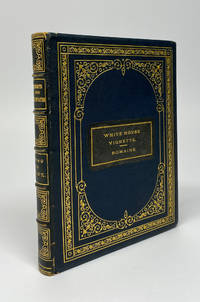
1895ref. 11071n. p. but Washington: U. S. Treasury Department Bureau of Engraving and Printing 1895. Hardcover. Near fine. Square octavo 21 numbered leaves of portrait plates plus four unnumbered. Bound in full crushed navy morocco with elaborate gilt tooling to boards spine compartments and edges with gilt dentelles all edges gilt and marbled endpapers. In near fine condition overall very well-preserved with a few tiny nicks to the corners and some scattered internal foxing mostly at the gutters and borders; and not on the proof images. The first two engravings depict the U. S. Capitol Building and the White House. The last two portraits of sitting President Grover Cleveland and his wife Frances are each SIGNED by their subjects in different ink below the images. The main contents consist of extremely well-executed and quite familiar portraits of the presidents; the very portraits that were used by the Bureau of Engraving and Printing on official U. S. banknotes. These Treasury Department specimen books were produced in very small numbers and presented to important diplomats cabinet secretaries members of Congress and the like. The proof engravings contained within were designed for use on official US banknotes though some of the images were likely never used on actual money. At the turn of the 21st century numismatic experts had counted 47 known examples. Several more have come to auction primarily numismatic since then but they remain extremely rare in the trade. No two specimen books are exactly alike. We could trade one example closely matching the contents of ours however that copy was in a different binding and did not include the signed portraits of President and Mrs. Cleveland. The name "Romaine" is stamped on the gilt-stamped morocco label on the front board and is almost certainly the surname of the intended recipient of this volume though without any further context nor any bookplates or written provenance we are unable to identify this person. When these books do occasionally come to auction there is much buzz. It is difficult to imagine a more interesting and treasured sort of volume for anyone who has an interest in numismatics and rare books. A rare chance to own a special volume of American printing history. (U. S. Treasury Department Bureau of Engraving and Printing) hardcover
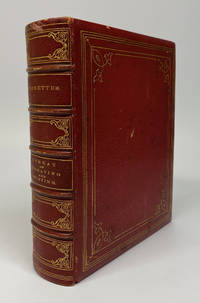
1875ref. 11070Washington DC: U. S. Treasury Department Bureau of Engraving and Printing 1875. Hardcover. Near fine. Small quarto unpaginated. Bound in full red crushed morocco with gilt borders edges spine title and compartments. All edges gilt. 144 engravings plus frontispiece and engraved title page. A near fine example with some small nicks to the boards and some mild scattered foxing internally. An extraordinary volume one of a small and undetermined number of these U. S. Treasury specimen books. These were printed and bound by the Treasury Department's Bureau of Engraving and Printing and presented to a select few diplomats cabinet secretaries and members of Congress. The proof engravings contained within were designed for use on official US banknotes though some of the images were likely never used on actual money. At the turn of the 21st century numismatic experts had counted 47 known examples. Several more have come to auction primarily numismatic since then but they remain extremely rare in the trade. No two specimen books are exactly alike; they usually contain a number of portraits of Presidents and other notable politicians but some as in our copy contain a number of vignettes of major events and places in US history along with more abstract concepts such as "Loyalty" and "Liberty and Union." Some significant examples herein include "Reconstruction" "Valley Forge" "The Patent Office" and far too many more to list. A number of the engravings have no caption and some of these are the most alluring. For example one of the largest images depicts a Native American man sitting on a cut-down tree head in hands as though he is weeping. Before him is a modern city with dozens of billowing smokestacks. Clearly this image is meant to portray the imminent conclusion to the United States Government's closing of the frontier and final usurpations of land from Indigenous people. It almost goes without saying that each and every one of the vignettes and portraits is of the most excellent quality both in design and execution as both the artists and the printing tools were of the highest order of the day. Though undated the title page names George B. McCartree as Chief of the BEP on the title page a position he held from 1869-1876 which would approximate the date. When these books do occasionally come to auction there is much buzz. It is difficult to imagine a more interesting and treasured sort of volume for anyone who has an interest in numismatics and rare books. A rare chance to own a special volume of American printing history. U. S. Treasury Department Bureau of Engraving and Printing hardcover
2 exceedingly rare early Spanish prints by Miguel de Eguía of writings by Saint Bonaventure. – Author, Content: Present volume contains early Spanish translations of (1) the »Stimulus Amoris« (13th ct., The String of Love) and (2) the »Soliloquium de quatuor mentalibus exercitiis« (1259/60, Soliloquy [i.e. monologue] About the Four Spiritual Exercises), two devotional works written by or in case of (1) attributed to Saint Bonaventure, [i.e. Giovanni Fidanza, 1221-74], a Cardinal and head of the Minor friars, who became one of the most influential theologians and philosophers of the medieval ages. – Printer: Both volumes of present Sammelband were printed in the print shops of Miguel de Eguía (1495-1546) in Logroño and Alcalá, one of the foremost and progressive Spanish printers of his time, a publisher of Eramus. Eguía's prints are known for their distinctive type setting in puristic gothic and round typefaces, their illustrative and ornamental wood-cut initials of an artistic nature (of which 4 and 8 resp. are set here), the use of red and black inks and the good quality of the paper. Moreover Eguía was famous for renewing Spanish printing by using Renaissance-style architectural borders. Present wood-cut title-pages are a good examples: »Estimulo de Amor« consists of a central typographic title printing with a from of emblematic illustrations combined with floral ornaments, »Soliloquio« additionally incorporates a portrait of the reading Bonaventure. – Condition: (1) Fragments of partly erased former owner's remarks as well as of erased owner's stamp on l. ai; (2) Leave g4 (printer's blank) missing; pp. aiiir, a(6)v, br, biiiv, c(7)r, e(5)r, f(3)r and f(5) with very few underlinings and marginal notes. Some leaves with slight foxing and little water stains at margins. – Rarity, Holdings: Although incunables and early prints of Bonaventure's works in the original Latin and in translation, as well as prints by the Spanish master Eguía are frequently traded at auction, no auction results at all are available for present editions, according to RBH and JBP/JAP/APO. – As of August 6th 2022 USTC, OCLC/WorldCat, KVK and viaLibri Library Search locate only 6 holdings in institutional holdings worldwide for (1), at Barcelona (Bibl. de Catalunya, missing title leave, Prov: Bibl. Marès), Evora (Bibl. Publica), Lisboa (BNP), Madrid (BNE), Oviedo (UL), València (UL) and London (BL), i.e. the only copy outside the Iberian peninsula. Only 5 copies are known for (2), at Barcelona (CRAI), Madrid (BNE [2 copies], Bibl. Islámica) and Sevilla (Bibl. Capitular Y Colombina), with no copy outside spain. – Reference: (1) USTC, no. 335139; CCPB 119730-4; BCMarès I 161; BLC 37, 64; Heredia 3928; Salva 3863; Palau 290249; Porbase 224252; Wilkinson (Iberian Books) 2110. – (2) USTC, no. 335148; CCBE S. XVI, B, 2722; García 74; Martín Abad 147; Palau 290228; Wilkinson (Iberian Books) 2106. – De la Fuente Arranz, Fernando: "Miguel de Eguía." Diccionario Biográfico Español, on-line. URL: https://dbe.rah.es/biografias/49363/miguel-de-eguia. 7th August 2022.
1732Very Good Turkish, Ottoman (1500-1928) Contemporary quarter dark burgundy leather bdg. Grey cloth boards. Four compartments at spine. Cr. 8vo. (20 x 14 cm). In Ottoman script (Old Turkish with Arabic letters). 96 p. [48 leaves]. 19 lines on each page. Printed on paper with European watermarks. A small tear up to the last page with no loss of text. Overall a fine copy. The 9th incunable of the Islamic world, written by Ibrahim Müteferrika and printed in his legendary Basmahane. Known as the most significant work by Müteferrika, this incunable is a political and state-theoretical treatise composed in order to improve the Ottoman government. In his book, Ibrahim Müteferrika used the sources written in Latin in the Europe of his period, and he presented it to Sultan Mahmud I right after the Patrona Halil Revolt (1730). Müteferrika divided the state forms of government in Europe into three groups with the titles "monarkiya" [i.e. monarchy], "aristokrasiya" [i.e. aristocracy], and "demokrasiya] [i.e. democracy]. In the work, the importance of the sciences (physics, astronomy, and geography) in the state administration was emphasized, and it was stated that a solid-state order could not be established in a country where these sciences were not developed. In addition to this, he used the term "Nizâm-i Cedîd" [i.e. The New Order] for the first time and stated that the Ottoman Empire should definitely adopt and implement the new military orders of the 18th century Europe. In addition, this work is one of the earliest in which the "democracy" term is used in the Islamic world. The book was published in French in Vienna and Paris in 1769 (Traite de la tactique ou méthode artificielle pour l'ordonnance des troupes, Vienne, 1769. Translated by Karl Emerich Alexander von Reviczky von Revisnye [Baron Reviczki]), and was translated from French into Russian in 1777. One of only 500 copies. The volume appeared in 1732, about one and a half years after the uprising of Patrona Halil Revolt which had overthrown the system of Sultan Ahmed III and Grand Vizier Damad Ibrahim. The writing, recalling the characteristics of Ottoman siyâsetnâme [i.e. the book of politics], calls the attention of the Ottoman leaders to the results of the state and military development and to the reasons for the strategic superiority of the rival European powers, while strongly condemning the several centuries long disinterest of the Ottomans to the external world. An important feature of the work is to break with the hitherto prevailing nostalgic attitude to bygone golden ages. Although observes the stylistic conventions in as much he speaks contemptuously about the Christian nations, in the content, already turns away from the indifference referring to the superiority of Islam. It announces in a list organized by items the reasons for the state's weakness and the conditions of rising. In harmony with the main aspects of contemporary Ottoman reforms, the work mainly focuses on the necessity of the reorganization of the army. It also offers a broader historical background by describing after the Greek philosophers the various types of states (6v-7v), or by treating the origins and reasons for the success of the foundations of European culture, the Roman Empire (19v-20v). The concept "Nizâm-I Cedîd" (i.e. the New Order), which would be used for the newly organized military formations of Sultan Selîm III (1789-1807), appears here for the first time referring to the modernized European army (17v-18r). "The utopistic optimism of Risâle-i Islâmîye may have had some rational basis, if one takes into account the Karlovci Treaty (1699) which was a rather positive correction in contrast to the previous series of Turkish failures in the Balkans, the European 'internal wars' of the first decade of the 18th century, and the experiences of the reform and peace years of the Tulip Period. However, the Usûl ül-hikem. was already inspired by the atmosphere after the Pozarevac Treaty (1718) which was a further stro
Folio (240 x 369 mm). (6), 474 (but: 475), (3), 475-604, (15) ff. With woodcut title-page printed in red and black, 18 woodcut borders, 4 of which full-page size, and 136 woodcuts in the text, including a full-page depiction of the symbols of the Four Evangelists, a world map, and a full-length portrait of Joshua. Woodcut printer's device on title and at the end of the text. Contemporary calf over wooden boards with bevelled edges; two clasps. Second edition of the famous Melantrich Bible, published five times between 1549 and 1577. The present edition features for the first time the Bohemian version of a comparison of the Evangelists (translated from German by Jan Stránenský), surrounded by woodcut borders. It also contains the third Maccabees and the voyages of St. Paul, both translated by Sixt d'Ottersdorf, and originally published in the first edition. Richly illustrated throughout with. The small world map shows the three continents, Europe, Asia and Africa. - With contemporary ownership and a Czech note in a different hand to flyleaf. Second printer's device has added handwritten motto "Super omnes gentes" and additional ownership. Folios 203 and 343 are used twice; later, the foliation omits 404. The woodcut depicting the Fall of Man censored with sanguine pencil. Severe paper flaws to the margins near beginning and end of the volume with substantial text loss, partly remargined with paper 18th century paper. The title-page, the table of contents, and 3 full-page woodcut borders are retouched in ink by a contemporary hand. Several pages show small inkstains; a larger stain on ff. 442-450. Margins fingerstained and partly waterstained. Some underlinings, notes and cancellations in pencil and pen by contemporary and modern hands. From the library of the Viennese collector Werner Habel, with his signed and stamped ownership, dated 1982, to the pastedown. His note of acquisition from 1981 is loosely enclosed. Graesse I, 371. Darlow/Moule 2182 (note, no. 3).
8vo (12 x 17 cm). 147, (1) pp. With woodcut printer's device, 3 stipple-engraved initials, and a woodcut on the last page. Contemporary limp vellum. First Latin edition of this alchemical work, first published in Venice in 1544 as "La Espositione di Geber philosopho". Written in the form of a dialogue, the first part contains a conversation between a certain Demogorgon and Geber (whom Demogorgon addresses as "most learned nephew of Mahomet") about the latter's works. In the second part Demogorgon interviews Raymond Lull about his "Lignum vitae" and the discovery of a remedy to prolong human life. Kopp suspects that the anonymous author Bracesco was a 16th century physician and alchemist from Orzinuovi near Brescia. - Binding a little rubbed, lacking ties. Interior somewhat browned and stained throughout, the first leaves more so. Curiously, the first 26 pages in particular (but also a few later pages) have been mutilated by an early owner, who obscured and excised particular words from the text (apparently mainly concerning the word "vitriolum"); these lacunae have been rebacked with paper and the missing text supplied by the hand of a later owner. Some worming to lower gutter of the first 16 leaves, with slight loss. With contemporary ink marginalia in Latin throughout. Adams J 8. BM-STC French 238. Rosenthal 337. Brüning 247 (all s. v. Geber). Ferguson I, 123. CG XL, 1024. Baudrier III, 46. Palau 143878. Alchemy and the Occult 18.4. Bolton, Select Bibl. of Chemistry, p. 972. OCLC 18153918. For Jabir see GAL I 241; GAL S I 426ff.
8vo. (104) pp. With woodcut printer's device, 94 woodcut illustrations and 4 woodcut portraits of the evangelists. Contemporary full vellum with giltstamped monogramm "JM" to front cover and handwritten spine-title. First printing of 1547, and the first edition to include the medallion portraits of the Evangelists. There were two editions of the "Icones" printed by Frellon in 1547, following the original one of 1538. The 1547 editions are often merely cited as issues, but the text was entirely reset. - An excellent woodcut book featuring 94 highly appealing illustrations, depicting scenes from the Old Testament as well as the Totentanz, likely carried out by Veit Specklin or Hans Lützelburger after drawings by Hans Holbein the Younger (ca. 1497-1543). Each woodcut is accompanied by a Latin text and a French quatrain by Gilles Corrozet (1510-68). With a Latin preface by Nicolas Bourbon (ca. 1503-50), revealing Hans Holbein's name, and a French preface by Corrozet. - Upper board slightly warped. Paper lightly foxed throughout; 2 pages rather browned. 20th century bookplate of K. D. Dahmen mounted to pastedown. A good copy of this masterpiece of early modern book illustration. Adams B 1963. Mortimer (French) 281. Murray 244. Hollstein 14A,100. Baudrier V, 209.
Folio (215 x 310 mm). (14), 18, (6), CXXVI, (4) ff. With 35 woodcuts in the text, initials, and printer's device on recto of final leaf. Contemporary vellum. First edition of Beda's collected writings on historical and astronomical chronology. The section "On the Reckoning of Time" (De temporum ratione) includes an introduction to the traditional ancient and medieval view of the cosmos, including an explanation of how the spherical earth influenced the changing length of daylight, of how the seasonal motion of the sun and moon influenced the changing appearance of the new moon at evening twilight, and a quantitative relation between the changes of the tides at a given place and the daily motion of the moon. "Ce volume contient les principaux traités de l'auteur sur le calendrier" (Houzeau/L.). The woodcut world map on d1, evidently redrawn from those of Petrus de Alliaco and Ambrosius Macrobius (Shirley 12 & 13), shows the four continents of the old world surrounded by water, the southern hemisphere labeled as "nobis incognita frigida". - Very slightly browned; title page shows insignificant fingerstaining; otherwise an excellent copy with a very few contemporary marginalia. VD 16, B 1440. Zinner 1657. Houzeau/L. 1074.
4to (170 x 225 mm). (48), 407, (1) pp. (with blank leaf *4). With woodcut initials and headpieces, 42 engravings (maps and plans) with letterpress captions on versos (bound as double-page plates). Contemporary limp vellum with ms. title to spine, lacking 2 pairs of ties. First edition with Palladio's illustrations. - Italian edition of Caesar's "Commentarii de bello Gallico" and "Commentarii de bello civili", using Francesco Baldelli's twenty-year-old translation, with engraved plates by Andrea Palladio depicting most of Caesar's campaigns, including the famous siege of Alesia. "In the preface, Palladio explains that the illustrations had originated out of a project he had set for his two sons, Orazio and Leonida. Palladio decided to complete the project and publish the illustrations after the death of both his sons ins 1572. Pallado dedicated the book to Giacomo (Jacopo) Buoncompagni, the natural son of Pope Gregory XIII" (Witcombe, Copyright in the Renaissance [Leiden 2004], p. 265). In his introduction, Palladio notes that while fortifications are all very well, a determined army will always overcome them, and it is better to train an army properly along the lines of the Roman army (as Machiavelli had also stated), just as in architecture the Romans had not been surpassed by later generations (cf. J. R. Hale, "Andrea Palladio, Polybius and Julius Caesar", Renaissance War Studies [1983], pp. 471-486). - Binding wrinkled with a few slight spine flaws. Foot of title-page excised (just touching date); a few captions shaved. Provenance: extract from English sale catalogue pasted to front flyleaf. Armorial bookplate of Vice-Admiral Sir Thomas Francis Fremantle (1765-1819), close friend of Admiral Nelson, to pastedown. Latterly in the collection of his descendant Thomas Fremantle, 3rd Baron Cottesloe (1862-1956), commander of the Territorial Army and president of the Society for Army History Research (purchased from Pickering & Chatto, 2 August 1901, 12s). Edit 16, CNCE 8188. BM-STC Italian 135. Adams C 86. Mortimer, Harvard Italian 97. Schweiger II.1 55. Thieme/Becker XXVI, 165.
Folio (218 x 304 mm). 101 ff., final blank. With woodcut printer's device at the end and numerous woodcut initials. Modern red morocco, blindstamped to style, with gilt spine and inner dentelle. Marbled endpapers. All edges sprinkled in red. In cloth slipcase. A rare medical compendium drawing strongly on the Arabic physicians who dominated the medieval medical schools of France and Northern Italy, including the author's treatise on fevers (fol. 68 ff.), based on Avicenna, who is variously quoted. Some of the surprisingly modern ailments discussed include tinnitus (fol. 40), diabetes (fol. 61), and manic depression (an extensive chapter, fol. 13-16). This is the third edition of the collection first published thus in 1501 (not counting the only incunabular edition of 1485). "Concoreggio, born in Milan around 1380, was made professor in Bologna in 1404 before teaching at the Universities of Pavia, Florence and (in 1439) Milan. His works are composed after the model of the Arabs, without much personal observation, and were published as a collection after his death in Pavia around the year 1440" (cf. Hirsch). - Some waterstaining to margins (more pronounced near beginning). Bound in a sumptuous modern morocco binding decorated with rollstamps showing Renaissance heads, likely for the 20th-century physician and collector Piergiorgio Borio (his bookplate on the front pastedown). Only 3 copies in Italy (Biblioteca comunale dell'Archiginnasio Bologna; Biblioteca Angelica Roma; Biblioteca Casanatense Roma). Edit 16, CNCE 14741. Durling 1008. Hirsch VI, 645. Sangiorgio, Cenni storici sulle due Università di Pavia e di Milano (1831), p. 57f. Brambilla I, 128. Astruc 211.
Folio (225 x 318 mm). 2 parts in one volume. (36), CXXXIII (but: 134), 106 ff. Later full vellum with old giltstamped red label to spine. The first authoritative work of antiquity on the 'materia medica', the branch of science treating remedial substances, based on the author's first-hand research throughout the Middle East. This is the rare first printing of this edition with the commentary by G. B. Egnatio: the third Latin (altogether the fourth) edition of Dioscorides, the first to contain the translation of Ermolao Barbaro. The appendix contains the first edition ever of "Corollarii", Barbaro's conclusions, sometimes considered a separate work by bibliographers. - "Dioscorides' work is the authoritative source on the materia medica of antiquity. He described over 600 plants and plant principles" (Garrison/M.). "Very little is known about its author [...], except that he was a Cilician Greek who lived in the time of Claudius and Nero, and that he travelled widely in the Middle East, probably as a physician in the Roman army [...] It is no exaggeration to say that from its publication until well into the 17th century [...] all botanical studies were based on this book, and the greater part of any new botanical matter published during the 16th and 17th centuries was in the form of commentary on Dioscorides [...] It is only with the rise of modern scientific botany in the 18th century that his influence began to wane" (PMM). - Occasional light browning with more noticeable brownstaining to final leaves; a few wormholes (some within the text). A small paper flaw to the lower edge of the last few pages. - Provenance: 1) 17th-century ink ownership of Sinobaldi di Verona to title-page; 2) French bookseller Lucien Scheler (1902-99) with his collation mark "Coll. complet / L.S." pencilled to pastedown. Edit 16, CNCE 17255. IA 154.303, 112.852. Bird 669. Panzer VIII, 429, 767. Proctor/Isaac 12338. Wellcome I, 1794. Choulant, Hdb. ält. Med. 80 (erroneously stating "s. l. e. a.") & 82. Durling 1140. Haeser II, 9. Johnston, The Cleveland Herbal, Botanical, and Horticultural Collections (Kent, 1992), no. 28. Not in Adams, Lesky, Osler or Waller. Cf. PMM 20.
Folio (222 x 332 mm). (6), 131 ff., final blank f. With 20 woodcuts in the text. - (Bound with) II: Floridus (Sabinus), Franciscus. Kriegsübung dess fürtrefflichsten und streitbarsten ersten Römischen Kaisers Julii [...]. Strasbourg, Hans Knobloch & Georg Messerschmidt, 1551. (4), 153 ff., final blank f. - (Bound with) III: Stumpf, Johannes. Keyser Heinrychs des vierdten Hertzogen zu Francken und am Rhyn etc. fünfftzigjärige Historia [...]. Zurich, Christoph Froschauer (the Elder), 1556. (10), 134 (instead of 137) ff. With 104 woodcuts in the text. Contemporary blindstamped leather on four raised double bands with two clasps; handwritten title to uppermost spine compartment. Second edition of one of the 16th century's most important treatises on warfare and military history, previously published in 1555. The fine woodcuts are not by Jost Amman, as are those of his well-known and similarly titled "Kriegsbuch", but rather were cut by an unidentified artist after drawings by Virgil Solis. - Bound with this rare and well-preserved work are two other contemporaneous editions of (military) historiography: Heinrich von Eppendorff's German translation of "De C. Iulii Caesaris praestantia" by Franciscus Floridus in a fine Strasbourg impression, and a Swiss chronicle of the times and rule of Emperor Henry IV (1050-1106), characterized by intense conflicts with the Pope (lacking the final three leaves and blank, containing "Ein Sendtbrieff Sant Ulrychen, Graaffen zu Kyburg"). - Slight browning throughout, waterstaining to gutter near the end. Handwritten ownership of N. V. Wernsdorff, dated 1559, on front pastedown, with note about his having passed away in Denmark and a slightly later ownership by Degenhard Grimm. Latterly in the library of the Viennese collector Werner Habel (1939-2015) with his handwritten and stamped ownership, dated 1978, to flyleaf. Binding well preserved with finely roll-tooled designs to covers; both clasps intact. I: VD 16, F 3129. Adams F 1075. Jähns 549. Not in BM-STC German. - II: VD 16, F 1675. Adams F 636. Muller II, 340, 58 & III, 443, 27. Ritter 872. Not in BM-STC German. - III: VD 16, S 9869. BM-STC German 839. Not in Adams.
8vo. 60 ff. With Giunta's device on the title-page (a Florentine lily with the L. A. initials). Later vellum with more recent end leaves. First edition of Jacob Mantino's translation into Latin of the fourth part of the first book of Ibn Sina's Canon of Medicine (original title: al-Qanun fi at-Tibb), divided into 31 chapters. Mantino dedicated it to the Doge of the Venetian Republic, Andrea Gritti (1455-1538). - Jacob Mantino (1490-1549) was a Jewish doctor, rabbi and philosopher. He was born in Spain, but he, his family and the Jewish community in Tortosa were forced to flee after refusing Catholic baptism, as decreed by King Ferdinand II and Queen Isabella I of Spain. Mantino grew up in Italy and studied philosophy and medicine at the universities of Bologna and Padua. Most of his adult life was spent being a doctor to the pope and other prominent members of society like cardinals, bishops and ambassadors in Bologna, Verona, Venice and Rome. He was also involved in the (religious) controversy over Henry VIII's divorce from Catharine of Aragon. In 1549, just before his death, he moved to Damascus as ambassador of Venice. Mantino's intellectual production focused on the translation of scientific works from Hebrew and Arabic into Latin, especially medical and philosophical treatises by leading authors of the medieval period, including Moses ben Maimon (Maimonides), Ibn Rushd (Averroes), and Ibn Sina (Avicenna). - Abu 'Ali al-Husayn Ibn Sina (also known by his Latinized name Avicenna, 980-1037) was one of the most prominent intellectuals of the medieval period and of the Islamic Golden Age. He was a Persian polymath; he wrote works on an incredible wide variety of subjects, including philosophy, medicine, astronomy, geography, psychology, Islamic theology, physics, and even poetry. Ibn Sina is mainly known for his medical encyclopaedia The Canon of Medicine, which became a standard medical text for medical students until the late 17th century. - The present work was printed by one of the most successful and important late 15th and early 16th century Italian publishers, Lucantonio Giunta (1457-1538). He was originally from Florence, but was active in Venice from 1489. He was a member of the Giunta family of printers, publishers and booksellers, who were active throughout Europe. - With owner's inscriptions on the front and back paste-downs and on the title-page, and some marginal annotations in brown ink. The paste-downs are partially covered by the newer, slightly foxed, end leaves. The binding is somewhat stained, light water staining to the first half of the work, small restored tears in the outer margin of leaves d1 and d2 without affecting the text. Otherwise in good condition. Durling 397. Edit 16, CNCE 3543. USTC 811590.
12mo. 418, (42) pp. Contemporary brown morocco with straight and curved fillets stamped in blind and gilt, central medallion with the author's name on both covers, fleur-de-lis stamps to corners and in spine compartments, structured by three raised bands. Edges goffered and gilt. Pretty and scarce edition in miniscule italics, meticulously printed by Gryphius, "l'un des hommes les plus savants de son temps, qui fut le maître de Jean de Tournes et, sans doute aussi, celui de l'imprimeur Estienne Dolet" (Béraldi). - Charmingly bound in full contemporary morocco with the characteristic stamps of Marcantonio Guillery of Rome: a wide band whose two lines variously interlock in the shape of two Cs, sparingly decorated with a variety of small ornaments, encloses a large central compartment neatly filled with tendril designs, at the centre of which an oval cartouche contains the name of the author. Guillery was one of the masters of Roman bookbinding in the mid-16th century; only a small number of his works survive. "He was a son of a French printer, Etienne Guillery of Lunéville, who established himself in Rome at the beginning of the century and married an Italian wife. The date of the son's birth is unknown [...] He bound seventy-one volumes for [Giovanni Battista] Grimaldi, almost half the total extant, but not more than thirty books bound by him are known outside the Apollo and Pegasus collection: a surprisingly small œuvre for a binder of his skill and taste with a working life of over twenty years" (Hobson). - Light foxing to interior. Hinges and spine-ends imperceptibly restored; in immaculate condition. - Provenance: 1) From the library of the famous French collector of fine bindings, Henri Béraldi (1849-1931; cf. Bogeng I, 197f.), with his bookplate to the front pastedown. 2) Acquired at the Béraldi sale (I, 29 May 1934, lot 17) by the French tobacco industrialist and philatelist Maurice Burrus (1882-1959); his bookplate to the front flyleaf and his purchase note on the lower flyleaf. 3) Acquired at the Burrus sale (Paris, 15 Nov. 1971, lot 78) by the French industrialist and philanthropist Paul Louis Weiller (1893-1993). An additional, earlier but unidentified bookplate on the lower pastedown, referencing a Théophile Belin catalogue. Gültlingen, Lyon V, 937. Baudrier, VIII, 205. Schweiger 2.1, 488. Hobson, Apollo and Pegasus, p. 89, no. 11. Not in Adams or BM-STC French. Cf. Hobson/Culot, Italian and French 16th Century Bookbindings, p. 25f.
4to. (8), 434, (2) pp. With woodcut title border by Hans Holbein. - (Bound with) II: The same. [Dikduk de-lishan arami. In hakhasda'ah] Chaldaica grammatica [...]. Ibid., 1527. (8), 212, (4) pp. Both works have woodcut printer's devices at the end. Contemporary blindstamped browns calf with 2 clasps. Sammelband containing two rare works by Münster: the first grammar of Aramaic written in Germany, a principal work, and the first German-produced Aramaic dictionary. "His dictionary [was] adapted from Pagninus's excerpt of Nathan Ben Yehiel's Arukh [...] Münster's most important work [...] was his Aramaic grammar, the first of its kind. The 'Chaldean' element in the Bible has of course long since been recognised, and people like Aurogallus and Fagius had treated the subject earlier in connection with their Hebrew studies. But just as Sanctes Pagninus was the first to exclude deliberately the Aramaic vocabulary from his Hebrew dictionary (1529), so Münster was the first to publish both a grammar and a dictionary devoted solely to Aramaic [...] A special feature of this grammar is the lexicographical introduction to the rabbinical Bible commentaries, with various Latin-Hebrew wordlists of technical terms. Münster also gives examples of the Sephardi and Ashkenazi rabbinical script in woodcut [...] The author compares the Aramaic with Arabic (called by him Saracenica lingua) which he quotes in transcription" (Smitskamp). - Binding restored; endpapers replaced. Obliterated contemp. ownership to t. p.; a few contemp. marginalia near the beginning of the grammar. I: VD 16, M 6657. Burmeister 23. BM-STC German 633. Adams M 1920. Steinschneider 2014, 6. Hieronymus 236 (note). Smitskamp 8d (note). BNHCat M 841. OCLC 13588558. - II: VD 16, M 6648. Burmeister 3 (& p. 11). BM-STC German 632. Adams M 1903. Steinschneider 6591, 6. Smitskamp 8. Leslau 398. BNHCat M 827. OCLC 20468455.
Small 4to (20 x 14 cm). XXXVIII, (2) ff. Title-page with a 4-piece woodcut border (using material from Laurent Hylaire). Modern limp sheepskin parchment. Third edition of a collection of three medical and gastronomical texts by two 15th century Italian physicians. All were published separately for the first time at the end of the 15th century, the first collected edition appeared in 1508. - The first, "Pillarium" by Pantaleone di Confienza, is one of the earliest treatises dealing exclusively with pills as remedies for all kinds of diseases. He treats all kinds of aspects of pills, including their various (natural) substances of pills, their various forms (powders, tablets, tinctures, extracts, etc.), their physiological and pathological effects, the preparation and conservation, etc. - The second, "Summa lacticiniorum", by the same author, is the first treatise specifically devoted to cheese and Dalby calls it a "landmark" in the literary discourse for cheese. "It opens with a general section discussing the nature of milk and the range of products made from its, especially cheese; it outlines the variety of cheeses, relating them to the seasons, the climate, the origin of the milk and the methods of making and maturing. In part two Pantaleone surveys the regional and local cheeses known to him, beginning in his own native norther Italy [...] He continues his cheese itinerary through Savoie and across France [...] He thinks little of German cheese, but considers the English ones that he had seen on sale at Antwerp equal in quality to the best Italian kinds" (Dalby). - The third, a treatise on medical ethics by Gabriele Zerbi (1445-1505), aims to protect the integrity of physicians and the medical profession. - Manuscript notes at the last page and a few pages with some underscoring and other marks. Waterstain throughout at the foot, larger towards the end, and the last leaves with wormholes; a good copy. Baudrier II, 431 & V, 98. Durling 3438. USTC 155658 (9 copies). Cf. Dalby, Cheese: a global history (2009), p. 117; Di Troggio, "Confienza, Pantaleone" in: Treccani Enciclopedia Italiana (online ed.).
15954to. (8), 365 [but: 371], (25) pp. Title page printed in red and black. With 67 half-page woodcuts in the text (mostly views of cities) and woodcut printer's device. Contemporary vellum with multiple gilt and blindstamped cover fillets, large gilt lozenge-shaped central compartment with heraldic supralibros bearing the legend "Nicolaus Haunolt Sac[rae] Caes[aris] M[ajesta]tis [...] Secretarius". Corner fleurons; spine sparsely gilt. First edition; reprinted without changes in 1608. "Contains descriptions of Florida, New-France, New-Spain, Nova Galicia, Yucatan, Cuba, Brazil, Peru, etc." (Sabin). Also with views of Constantinople, Jerusalem, Genoa, London, Rostock, Rome, Vienna, Prague, Riga, Zurich, Genf, Bremen, Dresden, Geneva, Lubeck, Cologne, Leipzig, Mainz, Marburg, Munich, Nuremberg, Strasbourg, Trier, Ulm, Venice, Wittenberg and many others. - From the library and with the bookplate of Nicolaus Haunolt, whose biography can be traced up to the year 1586 (cf. Yerasimos, Stephane. Les voyageurs dans l'Empire Ottoman (XIVe-XVIe siécles). Ankara 1991. In: Turkish Biographical Archive G 18, 68). However, other books from the Imperial secretary's library printed as late as 1597 could be established in public and private collections. - Slightly browned throughout; last f. has small section cut out (no loss to text). Title page with ms. ownership of the Piarists' school in Tata near Györ (dated 1767). Very pretty and well-preserved copy in a decorative contemporary binding with interesting provenance. VD 16, R 3024. Adams R 694. Bachmann 14. Muller 1376. Sabin 73000. Alden 595.
ref. 15691Paris, Enguilbert I, Jean I et Geoffroy I de Marnef (impr Philippe Pigouchet), 1491. In-8 gothique (143 x 100 mm) de (96) feuillets, maroquin brun, dos a 5 nerfs, quadruple filet d'encadrement et fleurons aux angles a froid sur les plats, tranches dorées (reliure du XIXe siècle).
ref. 4038FBLuzern, Quaternio Verlag Luzern, 2020. 28.5 cm x 18.5 cm. 184 Blatt; 333 Seiten. Original-Lederband auf 4 Bünden mit Blindprägung nach Streicheisenlinien, Rundum-Rotschnitt und 2 verzierten Messingschließen und Original-Leinenband in Original-Lederkassette mit goldgeprägtem Wappensupralibros. [10 Warenabbildungen]
1531ref. 43504Paris, Philippe Le Noir, sans date, (1531). Petit in-4 gothique (130 x 187 mm) de 75-(6) ff. [sign. A8 B-Q4 R6], table, vélin à petit rabats, dos muet, traces de lacet (reliure de l'époque).
1582ref. 15603Paris, Imprimé Par Jean Le Blanc pour Julien Duval, 1582. Petit in-8 gothique de (108) ff. [aaaa8-oooo8]. 2 grand bois portent les initiales JLB (pour Julien Le Blanc) et 30 petites vignettes sur bois la plupart signées JLB. Imprimé en rouge et noir. Nombreuses initiales ornées. Les Quinze Effusions du tres precieux sang de nostre sauveur et redempteur Jésus-Christ. S.l.n.d. [Paris, Jean Leblanc, 1585]. Petit in-8 gothique de (8) ff. [A8]. 9 grands bois in texte portant les initiales JLB. Initiales ornées. La Vie de Madame Sainte Marguerite, vierge et martyre avec son oraison. Imprimé à Paris par Jean Leblanc, 1585. Petit in-8 gothique de (8) ff. [A8]. Vignette sur bois au titre. Les 3 pièces reliées en 1 vol. petit in-8 (11 x 7 cm), maroquin rouge, triple filet doré en encadrement sur les plats, dos lisse orné, pièces de titre en maroquin vert, dentelle dorée sur les tranches et filet doré sur les coupes, signet de soie bleue, tranches dorées (reliure du XVIIIe siècle).
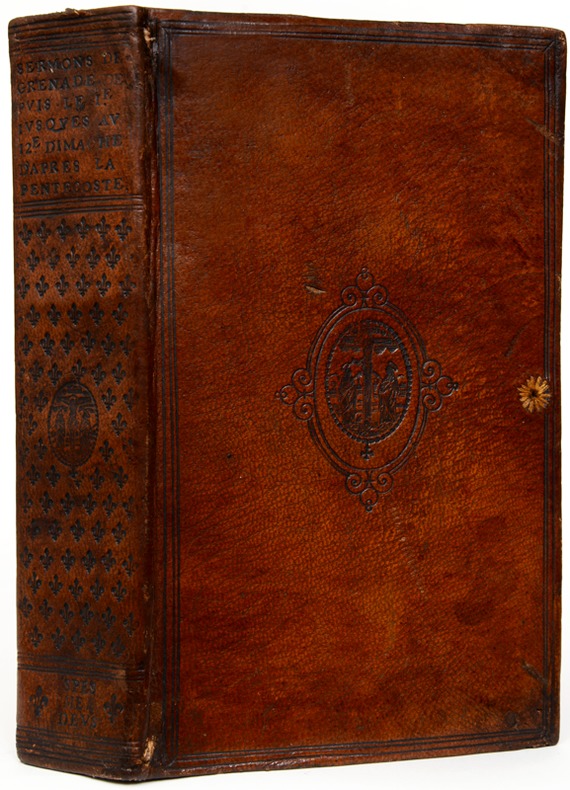
1585ref. 39802Paris, Guillaume Chaudiere, 1585. In-8 réglé (11 x 18 cm) de (8)-399-(13) ff. (sign. a8 A-Z8 Aa-Zz8 AAa-EEe8 FFf4), maroquin souple brun, dos lisse semé de fleurs de lys orné d’un médaillon ovale figurant la Crucifixion, titre et devise royale « Spes mea Deus » en pied de dos, médaillon de la Crucifixion répété sur les plats, triple filet à froid d’encadrement, oeillet de fil ocre, tranches dorées (reliure de l'époque).