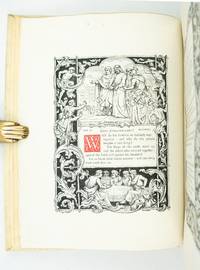
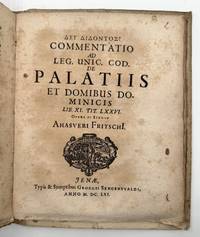
8,165 results
4to (142 x 196 mm). 51, (1) ff. Modern half calf using 18th century gilt calf spine and modern marbled boards. Rare second edition of Agostino Ricci's "De motu octavae sphaerae", edited by the French mathematician Oronce Finé, originally published in 1513 by Giolito in Trino. Discussing both spherical geometry and kabbalistic theories, the treatise denies the existence of a ninth heavenly sphere by refusing a presumed oscillation of equinoctials and the connected variation in the ecliptic. Ricci (Ricius) was a disciple of Abraham Zacuto, a Spanish Jew who moved to Portugal after the 1492 expulsion of Jewish people from Spain, and whose perpetual almanac was used for all navigational tables (including Vasco da Gama's ones) from its publication in 1496 until Nunez's tables of 1537. - This edition is an important work also for the history of typography. Colineus was one of the pioneers who introduced Italian Renaissance typography to France. This movement, which established many of the still-present typographical idioms, would culminate in the 1530s with books featuring the Roman types developed by Claude Garamond and other masters. - Issued without the "Epistola" mentioned on the title-page (as explained in the colophon). Annotated throughout in a rather rough contemporary hand with numerous underlinings and manicules. An excellent copy. BM-STC French 376. Adams R 519. Steinschneider 2143ff. Houzeau/Lancaster 2355. Lalande p. 42. NUC pre-1956, NR 0236124. Renouard (Colines), p. 22. BN 151, col. 716. OCLC 31083036.
4to (220 x 150 mm). (4), 95, (13) pp. Half vellum (ca. 1892). First complete edition, in the original Latin, of one of the most famous and longest of De Thou's poems, a didactic verse in about 2780 hexameters devoted to hunting with falcons and other birds of prey, composed in three "libri" and addressed to François, Duke of Alençon, Anjou and Brabant (1555-84), the youngest son of the late King Henri II and Catherine de' Medici, and brother of the reigning King Henri III. It is the first major Latin work on the subject of falconry. Book 1 discusses the various kinds of birds of prey used in falconry and how to choose one, book 2 discusses their care and feeding, training and the practice of hunting with them, and book 3 discusses their medical care. De Thou anonymously published an advance version of books 1 and 2 at Bordeaux in 1582, but his own correspondence indicates that he had only a few copies of that edition printed, primarily to send them to colleagues (including Pierre Pithou, Claude Dupuy and Joseph Scaliger) for their corrections and suggestions. Harvard University has the only known copy of that edition, and De Thou decided not to complete it but instead to make extensive revisions and add the third book for the present edition, beautifully printed by the King’s Printer in Paris. The poem ends on p. 95, with the next page containing an “important” (Harting) note about the various kinds of birds of prey used for falconry and giving their French and Latin names. The last six leaves contain Thou’s 11-page letter to Philippe Huralt (1528-99), French chancellor under King Henri III, on the subject of falconry, and on the last page the corrigenda. Falconry was so popular in France from the reign of François I to that of Louis XIII that it can be considered the national pastime of the French nobility, as well as the prominent clergy, military figures and politicians in that period, 1515-1643. - With a modern armorial bookplate of the Verne d’Orcet family, whose great library on the subject of hunting was begun ca. 1900. Formerly side-stitched through 4 holes, B1 and B4 no longer conjugate but still securely attached, a faint marginal stain in the lower outside corner of the last few leaves and the foot of the title-page slightly thumbed, but still in very good condition and with large margins. The outer free endleaf at front and back slightly browned, but the binding also very good. Adams T 657. Harting 306. Souhart 461. De Smet (ed.), La fauconnerie à la Renaissance: le Hieracosophion, passim (a critical edition and French translation with extensive commentary). De Smet, Thuanus: the making of Jacques-Auguste de Thou, pp. 51-66. French vernacular books 88799. Kinser, Works of Jacques Auguste de Thou (1966), 7 (pp. 205-207). Sotheby’s (Marcel Jeanson coll.) 28 Feb. to 1 March 1987, lot 560. Thiébaud 897. USTC 171837. Cf. Schwerdt, p. 261 (1582 & 1587 eds.).
1538ref. 15643Bâle, Thomas Platter, 1538. In-8 grec (170 x 100 cm) de (8)-382-(2) ff., maroquin noir estampé, dos à trois nerfs (reliure de l'époque).
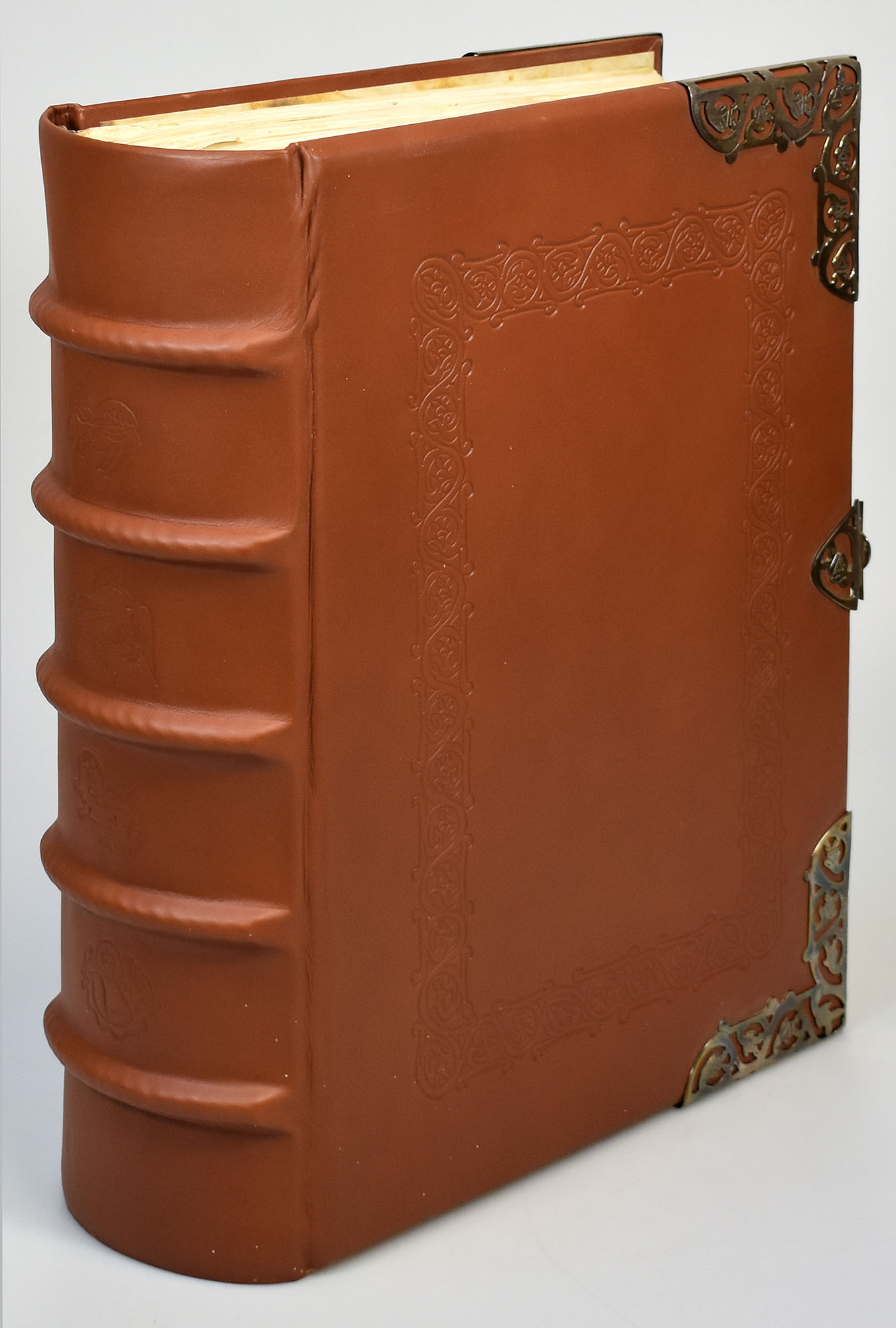
1997ref. 4061FBGütersloh, Wertkontor/Belser Verlag, 1997/2020. Faksimile: 2°. 49 x 38 cm. Kommentar: 4°. 31 x 22 cm. 516 Blatt; 90 Seiten. Blindgeprägter Original-Lederband mit insgesamt 4 Eckbeschlägen und einer verzierten Schließe aus Sterlingsilber eingeschlagen in Veloursdecke mit Schleifenverschluss und Original-Leinenband mit goldgeprägtem Deckeltitel. [12 Warenabbildungen]
12mo. (58) ff. Gothic type. With lombards and rubrication throughout. With 36 woodcuts, of which 30 in original hand colour, 3 recurring woodcuts full-page sized (twice in colour). Modern full calf with giltstamped and blindstamped spine. Rare Latin edition of the illustrated devotional prepared by the Dominican friar Bertholdus around 1350. Intended for day-to-day worship, this popular prayer book is divided into 24 parts, each prayer corresponding to an hour of the day, and each concerned with an event in the Life of Christ, commencing with the Annunciation and concluding with the Last Judgement. - The work was first published in German under the title "Zeitglöcklein des Lebens und Leidens Christi"; the first Latin edition appeared in 1488. The present edition is not dated, but VD 16 considers it to be published ca. 1503, Grebe dates it ca. 1507. - 16th century notes in Latin to title-page and last page. - Top margin of fol. e8 reinforced. Last page narrowly cut with slight loss to the handwritten notes. An attractively coloured copy. HC 8930. Goff B-509. GW IV, Sp. 57a. Schramm VIII, 27. Proctor 1482. BMC I, 303. VD 16, B 2190. Grebe (Landen) 29. ISTC ib00509000.
1585Folio. 5 vols. (22) ff. (last blank), 24 ff., 1226, (2) pp. (6), (11) ff., 1 blank f., 870, (2) pp. (4), 18 ff., 986, (2) pp. (6), 15 ff., 1 blank f., 927, (1) pp. (2), 14 ff., 791, (1) pp. Title-page printed in red and black throughout. Two different printer's devices to title-page and final leaf of each volume. Contemporary blindstamped pigskin over wooden boards; 2 clasps each. Nicolini's rare five-volume collection of Synods, surpassing all previous collections (cf. LThK). - All volumes but the first bear a ms. dedication on the front flyleaf: "Dises Buech ist dem Herrn Spitelmaister unnd seinem Convent zu Memmingen von Herr Jacob Fugger dem Eltern verehrt worden Imm December Ao. 1588"; all volumes are marked on their spines as "Donum generosi dni. Baronus Jacobi Fuggeri" (the original flyleaf of vol. 1 is probably lost). Jacob Fugger (1542-98; after 1560: Herr von Babenhausen, Wellenburg und Boos) was the son of the banker Anton Fugger (nephew and successor of Jacob Fugger "the Wealthy"). He was known as "the Elder" to distinguish him from his like-named nephew (1567-1626) who in 1588 was still a student in Rome and later became Bishop of Constance. - Slight worming throughout, more pronounced in vol. 2 (especially near beginning and end; some loss to text). The splendid, exceptionally well-preserved pigskin bindings (slightly rubbed, back cover of vol. 2 showing minute chafing, otherwise perfect) are probably the work of the Augsburg master Jakob Bitmer (cf. Haebler). Adams C 2773. Edit 16, CNCE 13060. LThK VI, 185. OCLC 6967756. Not in BM-STC Italian. Binding's plate stamps: Haebler I, 55f.: I.B. VI, plates I & II.
(6) Bll., 39 Zeilen. Mit großem Titelholzschnitt. Moderner Halbpergamentband über Marmordeckeln. 4to. Bislang nicht nachgewiesene Inkunabelausgabe der klassischen katholischen Beichtanweisung. Der bemerkenswerte Titelholzschnitt zeigt eine Beichtszene, hinter dem Beichtstuhl ein Teufel, der seinen (im Spruchband gedruckten) Spruch "Cras, cras" ("morgen, morgen") einflüstert. - Diese Schrift, erstmals um 1471 erschienen, erlebte allein in der Inkunabelzeit über 100 bekannte Ausgaben; die vorliegende ist über den Gesamtkatalog der Wiegendrucke nicht ermittelbar. - Der aus Lissabon stammende Dominikaner-, dann Augustiner- und schließlich Benediktinermönch Escobar (um 1367-1430) promovierte 1393 in Wien zum Doktor der Theologie und war später Bischof von Ciudad Rodrigo (1408), Ajaccio (1422) und Titular-Erzbischof von Megara (1428). Der päpstliche "poenitentiarius minor" war einer der am häufigsten gedruckten Autoren des späten 15. Jahrhunderts. - Etwas fleckig und mit kl. Quetschfalten.
4to (152 x 208 mm). 3 volumes. (6), 236 ff. (6), 203 ff. (8), 284 ff. With woodcut printer's device to title-pages. Early 19th century full vellum with giltstamped spines and double labels. All edges gilt and goffered with a floral design. Rare collection of correspondence by significant personalities and rulers, including Andrea Doria, Annibale Caro, Baldassare Castiglione, Bernardo and Pietro Bibiena, Cardinal Bessarion, Lorenzo and Cosimo de' Medici, Pietro Gonzaga, Hieronimo Fracastoro, Giovanni Bembo, Francesco Guiccardini, Emperor Charles V, Pope Clement VII (Giulio de' Medici), etc. Important both as historical and linguistic documents; the definitive edition. - Ruscelli was a prolific and versatile Italian scholar who published on topics ranging from cartography to alchemy. A native of Viterbo, he eventually settled in Venice, where the first edition of "Delle Lettere Di Principi" was published in 1562 in a single volume. The collection demonstrates the rich social context of 16th century Venice, as Ruscelli himself is a classic example of the multidisciplinary Renaissance man. - Light foxing throughout and occasional light soiling or waterstaining. A prettily bound set with 19th century collection stamp to title-pages of vols. 1 and 3. Edit 16, CNCE 16617. Adams L 564. BM-STC Italian 376. Melzi II, 115f. Gamba 1470 ("a very valuable collection").
8vo. (16), 168 (misnumbered: 167) pp. Title-page printed in red and black. With a woodcut in the text. Contemporary limp vellum with ties. All edges red. Very rare first German edition of this collection of alchemical works. The preface ("Typographus lectori") by the Basel printer Peter Perna, who printed the first Latin edition of the "Auriferae artis" in 1572, mentions Geber (Jabir ibn Hayyan), Avicenna (Ibn Sina), Rhases (al-Razi), Arnaldus de Villanova, and Raymond Lull. - The present edition is of special importance for containing the first German printing of Bacon's "Lapidis philosophorum" (pp. 109-168; not present in the Latin edition). Bacon believed that certain alchemical metals, produced under the influence of the stars and planets, were capable of prolonging human life. The book describes the various steps of alchemical art necessary for producing the Philosopher's Stone and for completing the Opus Magnum. The volume also contains the "Satzungen der Goldkunst" ("Propositions of the Art of Gold") and "Turba philosophorum" ("Philosophy of the Art of Gold"). - Binding a little rubbed and rather stained; upper cover warped; light edge damage. Interior somewhat browned and stained throughout with occasional dampstaining in the margins; corners a little buckled. Title-page a little dust-stained and trimmed closely at the upper edge. Wants front free endpaper; corners torn from lower free endpaper. VD 16, A 4356. Kopp II, 344. Brüning 693. Cf. Ferguson I, 405 (1608 reprint). Not in Adams or BM-STC German.
15114to. 2 pts in 1 vol. (14), LX, (50) ff. - (Bound after) II: Arator. Arator poeta christianissimus in actus apostoloru[m]. [Leipzig, Melchior Lotter the elder, c. 1512]. 58 (instead of 60) ff. (last blank). - (Bound with) III: Sallustius Crispus, Caius. C. Crispi Salustii bellum Catilinarum. Item. Bellum Iugurthinum eiusdem. Item. Variae rationes ex libris eiusdem historiarum exceptae. Item. C. Crispi Salustii Vita. (Strasbourg, Matthias Schürer, August 1512). XCV (instead of XCIV!) ff. - (Bound with) IV: Vergilius, Polydorus. Proverbiorum liber, quo paroemiae insigniores omiu[m] fere scriptorum luculentissima enarratione explicantur. (Ibid., Nov. 1511). (6), XLVII, (1) ff. (Bound with) - V: The same. De inventoribus rerum libri tres. M. Antonii Sabellici de artium inventoribus ad Bassam carmen elegantissimum. [...] Ex secunda recognitione. (Ibid., June 1512). Contemporary wooden boards with blind-tooled pigskin spine (defective back cover restored). Wants ties. I: Pretty edition by Johann Camers; published only two days after Cuspinianus's (more common) Vienna edition (printed by J. Winterburger). With a dedication by the publishers to Francesco II Sforza, about "ars illa imprimendi". Denis explains the simultaneous publication of two Florus editions in Vienna by a possible quarrel between Camers and Cuspinianus. Slightly browned and fingerstained; numerous marginialia and notes by a contemporary humanist's hand. - II: Second 16th-c. edition. An epic recasting of the Acts of the Apostles, explaining the stories with far-fetched allegories and numerology. First quire misbound (A1, 5, 2, 6); wants ff. A3-4. Waterstained throughout. T. p. and beginning with remargined paper defects; numerous marginialia and notes by a contemporary humanist's hand. - III: Rare Strasbourg edition of Sallust. Before the last leaf (with a brief Life of the author and the imprint), this copy contains an additional leaf from Schürer's 1513 Sallust edition (VD 16, S 1368), with a different Life of Sallust and the imprint of that edition. T. p. somewhat stained; numerous marginalia by a contemporary humanist's hand. - IV: First work of the Italian-English humanist, first printed in 1498: one of the most popular Renaissance collections of proverbs. Somewhat browned and stained; occasional waterstains. Some passages in Greek. - V: Early edition of this oft-printed principal work: a veritable encyclopaedia of humanist memorial culture, treating the origins of philosophy, medicine, astrology, pharmacy, magic, etc. "Remplie de détails et d'anecdotes curieuses" (Caillet III, 675). - Slightly browned and waterstained; last leaf professionally remargined. Altogether a fine sammelband on classical and neo-Latin literature and historiography in a contemporary binding. I: VD 16, F 1685. Denis 55 a, b. Graesse II, 604. BNH F 303, C 157. Not in Adams or BM-STC German. - II: VD 16, A 3185. BM-STC German 39. Not in Adams. - III: VD 16, ZV 13683. Muller II, 184, 87. Ritter 2060. Schmidt 82. Not in Adams or BM-STC German.- IV: VD 16, V 770. Muller II, 181, 61. Ritter 2396. Schmidt 58. Not in Adams or BM-STC German.- V: VD 16, V 745. Adams V 425. Muller II, 184, 90. Ritter 2397. Schmidt 74. Not in BM-STC German.
Crown 16mo in 8s (12 x 8 cm). 229, (11) pp. With a 6-line space (with a printed guide letter) left for a manuscript initial (not filled in) and 2 vine-leaf ornaments, Vervliet 56 & 80. Set in 3 sizes of roman type, the smallest including special pharmacological characters. Modern sheepskin parchment, but with gilt edges perhaps from an earlier binding. Only known copy of the Jean Ruel issue of the very rare second (?) Paris edition of one of the most important early pharmacological books, with about 250 medicinal recipes arranged alphabetically, written by Thibault Lespleigney (1496-1550), apothecary and professor of medicine and pharmacology at Tours, where he first published it as Dispensarium medicinarum in 1538. It inevitably owes something to the ca. 1100 Antidotarium Nicolai, first printed in 1471 and almost the only comprehensive book on the subject when Lespleigney wrote, but it also foreshadows the pharmacopoeias. The term pharmacopoeia (meaning drug-compounding) was coined only in 1561, but is now used to refer to a collection of recipes officially authorized by a government or medical or pharmaceutical association, the first being Valerius Cordus, Dispensatorium (Nürnberg, written in 1542 but published posthumously in 1546). Before that books of recipes by leading pharmacologists served a similar role without any official authorization. Lespleigney's was the most important in France and enormously influential. About 10 editions appeared from 1538 to 1543 in Tours, Lyon, Paris and even Antwerp and Venice. François Chappuys revised, corrected and expanded Lespleigney's text for the second edition (Lyon, 1539), giving it the present title, and nearly all later editions, including the present, follow his revised text. The present edition clearly resembles Arnoul and Charles l'Angelier's 1541 Paris edition in style and layout, but does not follow it line by line. We have not seen the 1540 l'Angelier edition, with the same pagination as 1541, so they may be two issues of a single edition. We have also not seen what may be other issues of the present 1543 Paris edition, reported under various publishers: Jean Foucher, Vivant Gaultherot and Jean du Chemin. All three have the same pagination as the present edition, and at least the Gautherot shares a misprint (p. 206 numbered "209"), the same collation and the same VD16 fingerprint (ame- s,m- g*i* mepr, based on A2r, A6r, A7r and A7v: VD16 fingerprints substitute "*" for "æ"). So we probably have one or two Paris editions in 1540 and 1541 serving as the model for a 1543 Paris edition in four simultaneous issues. The USTC reports 2 copies of the 1540 Paris edition but no other Paris edition or issue. The Bibliotheque Nationale has a copy of the Du Chemin issue of the 1543 Paris edition and notes 2 further copies of the edition, in London (Foucher issue) and Stuttgart (Gaultherot issue). ICCU reports another at the Bibliotheca Comunale Ariostea in Ferrara (Gaultherot issue) and gives its VD16 fingerprint. The Casanata Library in Rome has a copy of the 1541 Paris edition, viewable on Google Books. All editions are very rare: the USTC records 0 to 3 copies for most and more (5 or 7) only for two editions: Venice 1542 and Lyon 1543. After 1543, Lespleigney's work lost popularity, perhaps due to the success of Cordus's 1546 Dispensatorium, but further editions appeared at Lyon under the title Enchiridion from 1546 to 1561, and the only other known Ruel edition appeared at Paris in 1567 (BMC STC French), all still very rare. - The book collates: 16mo: A-P8 = 120 ll., with I1, I3, K1 and K3 missigned K1, K3, L1 and L3 respectively. It is imposed with two 8-leaf quires worked together in each sheet (except that quire P may have been imposed alone, work and turn), so that each pair of consecutive quires contains one watermark divided at the upper fore-edge of leaves 5 and 6 in one quire, and the point-holes fall at the foot of leaves 3 and 4 (on the line where the sheet was divided to make two quires, so half of a point-hole can appear along the edge). Quire B shows a watermark shield (bearing a merchant's mark with some sign or letters above an upside-down 4) topped by a quatrefoil and with a letter or letters(?) below (about 38 x 18 mm, centred in a 21 mm space between chainlines); quires C, E, G, K, L and O show a watermark crown (about 26 x 23 mm) topped by a quatrefoil, with 3 circles in the slightly arched base and letters(?) below (possibly M followed by a curl, or SM), centred on a chainline, with about 22 mm between chainlines. - The fore-edge fold of H5/6 was carelessly opened, so that the upper outside corner of H5 is attached to H6 instead of H5, a couple pages show minor smudges and there is an occasional small marginal stain or tear, but the book is otherwise in very good condition and almost untrimmed, so that the tears that divided the sheets into half-sheets are mostly preserved at the foot (revealing point holes on several leaves) and part of a fore-edge fold survives. The boards are slightly bowed but the binding is also in very good condition. Unique issue of a very rare early edition of a rare but popular and influential pharmacological book of about 250 medicinal recipes: a predecessor of the pharmacopoeias that appeared in and after 1546. Cf. BM-STC French 263 (1576 Ruel ed.). Durling 2801-2803 (Venice 1542, Lyon 1543 & Lyon 1556 eds.). Moreau 1536-40, no. 1863 (1540 Paris ed.). Schelenz, Geschichte der Pharmazie, pp. 437-438 (1538 & 1542 Tours eds.). USTC 147783 (2 copies of 1540 Paris ed.). Dorveaux, Notice sur les vie et les oeuvres de Thibault Lespleigney (1898), pp. 46-48 (1543 Paris ed., Du Chemin issue). Claude Viel, Deux figures du monde pharmaceutique Tourangeau: Thibault Lespleigney et Maurice Javillier, in: Revue d'Histoire de la pharmacie, pp. 239-245, at pp. 243-244 (Tours 1538, Lyon 1539 & Tours 1542 eds.). KVK & WorldCat (4 copies of the 1543 Paris ed.: 2 Gaultherot, 1 Foucher & 1 Du Chemin). Not in Adams; Brunet; Garrison & Morton; Graesse; Heirs of Hippocrates; Honeyman; Norman Library; Osler; Waller; Wellcome Library.
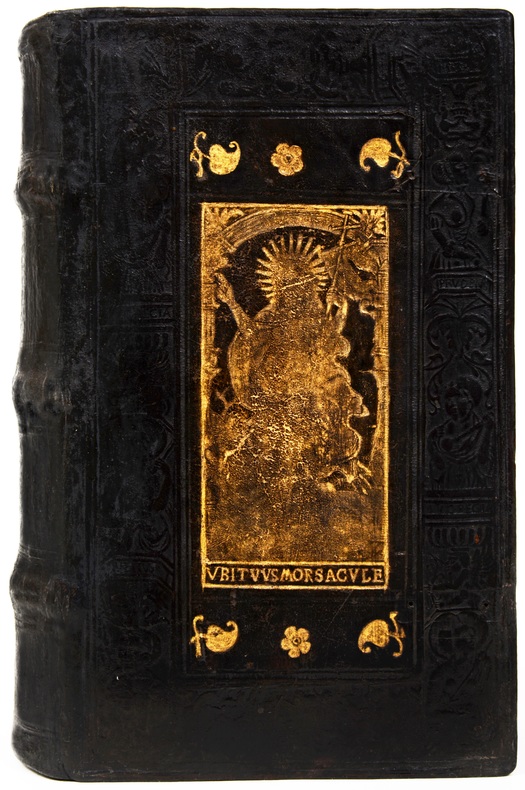
8vo. (86) pp. With woodcut coat of arms (coloured in red and blue) on the title page; several initials and numerous musical notes in the text. Contemporary vellum. Early edition of one of the principal treatises of musical instruction produced in the 16th century, containing a wealth of pioneering theories and practical examples; first published in this form in 1537. It also boasts the first consistently executed example of a canon (still called "fuga"), with references to compositions by Josquin and Walther. - Based on the works of Rhaw and Agricola, Listenius's treatise avails itself of Melanchthon's new educational methods and "became very popular as a school primer in Germany and Austria, and had appeared in more than 40 editions before 1583. The treatise was primarily for teaching singing, and is arranged in a novel manner. Each subject is treated in a series of short, simple rules copiously illustrated with music examples. In the section on mensural music Listenius used the canon [...] for his examples. For the first time, in addition to the traditional terms 'musica theoretica' and 'musica practica', he introduced the term 'musica poetica', by which he meant instruction in composition. The term remained in general use in Germany for over a century" (K. W. Niemöller, New Grove XI, 28). - Contemporary handwritten ownership of "Joannes Thenn S." in a humanist hand on the title page (no relationship could be traced to the Franconian Johann Thenn who had become master of the Salzburg mint in 1500); numerous Latin underlinings and marginalia by the same writer in red and brown ink throughout (covering some 30 pages). Latterly in the library of the French musical scholar Henry Prunières (1861-1942), who in 1920 founded "La Revue Musicale", with his etched bookplate to pastedown. VD 16, L 2026. Eitner VI, 190. RISM (Écrits impr.) 507. Cf. Hirsch I, 322 (1549 ed.); Wolffheim I, 777 (1550 ed.); also Adams and BM-STC German cite only later editions.
ALL PUBLISHED of this abortive yet spectacular attempt at a comprehensive survey of natural history, THE FIRST BOOK ON ZOOLOGY WITH COLOR-PRINTED (as opposed to hand-colored) PLATES. Comprises a general preface describing the entire project (by Dufart), an introduction to this volume (by Manuel), 101 GORGEOUS FULL-PAGE COLOR-PRINTED STIPPLE-ENGRAVED PLATES OF MAMMALS IN EXOTIC LANDSCAPES (usually two scenes per plate, after Deseve and other artists), and descriptive notes on each mammal depicted (by Manuel). 30 pp., 101 plates, 60 pp. Dedicated to Napoleon. Text printed on fine wove paper, plates on very fine, thick wove paper. After the appearance of this volume, the project was suspended because the publishers could not find enough subscribers (there is a list of the 24 who subscribed to this first volume on the back of the half-title). The reasons for this failure are obvious: each volume cost a staggering 60 francs (not including the binding) and the images of the animals, although bright, beautiful, and charming, are not particularly accurate. Large thick 8vo. BOUND IN CONTEMPORARY FULL CRIMSON MOROCCO, WITH ELEGANT GILT DECORATION ON COVERS AND SPINE. All edges gilt. Light wear to extremities of binding, but still very attractive. Internally bright. Two copies in NUC. QuÈrard (La France littÈraire, V, 497) doubts the very existence of this work: "...ne paraÓt avoir ÈtÈ que projetÈ, car on n'en trouve mention nulle autre part que dans le vol. de M. Debray." An extremely rare, unusual, and altogether stunning book.
4to. XL, (1) ff. (several errors in foliation, but complete, lacking only final blank). Decorated initials. 19th century boards (spine repaired). First edition thus of the satires of Persius, published but a month before the death of the editor, Murmellius. The work is preceded by a short biography of Persius, taken from Petrus Crinitus. Finely printed in a small "lettre bâtarde", including some Greek type, with legenda in the margins for the comments, and the main text printed in a slightly larger type, with the lines set widely apart. Georg Kloß copy, with his bookplate on the front pastedown and the relevant catalogue clipping from his sale (described as bound with an additional work) pasted above. The Frankfurt physician Georg Franz Burkhard Kloß (1787-1854) was also a noted historian of freemasonry. His rather notorious sale was held at Sotheby's in London in 1835. This volume contains long 18th c. notations on the title-page about the rarity of this edition as well as a contemporary humanist's extensive marginalia in Latin from fol. C1v to D2r, then again on D5v and D6v (slightly trimmed at rebinding), mostly pertaining to the text, but also to the commentary. These early handwritten annotations were boldly attributed to Melanchthon by Samuel L. Sotheby in his 1835 catalogue of the Kloß library, an unsustainable notion against which the collector himself spoke out clearly (cf. G. Kloß, Ueber Melanchthons angebliche Handschriften, welche in dem Catalogue of the Library of Dr. Kloss verzeichnet sind, in: Serapeum 2 [1841], no. 24, p. 369-377). In his monumental account of Melanchthon research throughout the centuries, Wilhelm Hammer provided similarly critical reviews of Sotheby's relevant publications: "[Wimmelt] von Sach- und Druckfehlern [...] Die hier zusammengestellten 'Privatexemplare' [Melanchthons] entsprechen nicht den Tatsachen [...] Eine höchst unsinnige Veröffentlichung" ("Abounds with factual and setting errors [...] The 'private copies of Melanchthon' here assembled are not in accordance with fact [...] A deeply misguided publication", cf. Die Melanchthonforschung im Wandel der Jahrhunderte 36 [1968], pp. 96 & 110). Subsequently in the collection of Cosmo (Cosmas) Nevill, Esq. of Holt, Leicestershire, with his 19th century engraved bookplate. Nevill would have acquired the book from the Kloß sale. - Some browning and minor dampstains. Pasteboards rubbed, extremeties bumped, spine professionally restored, as is a tear in the title page. Final index leaf H3 repaired by an early owner with loss of text (colophon on verso preserved). A slight wormtrack in top margin of H1 and H2 repaired (with slight text loss to H2). Very rare; only two copies located in North America (at Ann Arbor & Columbia); none in Britain. VD 16, P 1610. Schweiger 708. Panzer VI, 377.270. Moreau/Renouard V, 254. Sotheby's, Catalogue of the Library of Dr. Kloss, of Franckfort a. M., Professor (auction catalogue, London 1835), no. 2507 (this copy: "Melancthon's copy, with marginal notes"). Not in Adams or BM-STC German.
Folio (222 x 320 mm). (4), 253 ff. Title page printed in red and black. With woodcut title border (birds and grapes) by Hans Wechtlin and page-sized woodcut by Urs Graf at the end of preliminary matter. Contemp. blindstamped pigskin. Two clasps. Early edition of this influential collection of Lives of the Saints, first published in Vicenza in 1493. "A very valuable work with a wide circulation. In his arrangement of the various lives he follows the calendar of the Church. The collection [...] went through many editions, the last of which (the eighth) appeared in Venice, 1616" (Cath. Encyclopedia, s.v.). Fine Strasbourg print; Urs Graf's splendid woodcut shows the Ascension of the Christ. - Binding rather severely rubbed. Some worming to beginning and end; occasional brown- and waterstaining. Late 16th-c. ms. ownership and large engr. bookplate to front pastedown. VD 16, P 1881. BM-STC German 644. Adams N 45. Ritter 1856.
4to (140 x 196 mm). (6), 70 ff. With 35 woodcut diagrams in the text. Modern half vellum over marbled boards. First edition, rare (the earlier editions cited by Houzeau/L. are ghosts). Albert Pighius was born at Kampen in Holland ca. 1490 and died at Utrecht in 1542. Primarily a mathematician, he spent much time at the University of Paris, where this book was written. In this treatise, one of his polemical attacks against those who put the sciences of astronomy and astrology to base uses and employ them merely for the making of idle prognostications and popular almanacks, he praises Peurbach and Regiomontanus as true scientists, denouncing as a fraud the "Nova Astronomia" of Marcus Beneventanus. - Light waterstain to top edge of title-page; upper edge trimmed fairly closely throughout. A few ink annotations in a roughly contemporary hand. An excellent copy. Adams P 1179. Houzeau/Lancaster 2373f. Lalande 43. Renouard (Colines), p. 40f. Renouard, ICP, III, 386. Poggendorff II, 450. OCLC 33631427. Not in BM-STC French, Mortimer, or Caillet.
Folio (217 x 298 mm). 198 ff. With one woodcut initial. Late 19th c. boards. Edges sprinkled in red. Fine post-incunabular printing of this important medical compendium and pharmacopoeia, replete with Arabic-derived terminology, strongly based on Avicenna, Serapion the Younger (Ibn Wafid), and Dioscorides. Matthaeus Silvaticus, active around 1300, "was one of the most important mediaeval botanists and pharmacologists. His magnificent compilation from works of earlier physicians, with occasional observations and opinions of his own, presents its subjects in alphabetical order, making this effectively a kind of dictionary. The book's principal value lies in the explanations of various specialist terms from all fields of medicine, in particular several of Arabic origin" (cf. Hirsch/Hübotter IV, 117). - Occasional light browning. Annotated throughout in red ink by a contemporary physician's hand. A good copy despite the unsophisticated modern binding. Edit 16, CNCE 69665. Durling 4206. Panzer VIII, 404, 543. Proctor/Isaac 12960. Wellcome I, 5972. Not in Adams, Bird, Lesky, Osler, or Waller.
FIRST EDITION OF THOU'S HISTORY OF THE 16TH CENTURY, A MASTERPIECE OF FRENCH HISTORIOGRAPHY. 18, 684, 36 pp., complete. Jacques-Auguste de Thou (1553-1617), was one of the great statesmen and scholars of his time, and the Historiarum is his most important work. THIS IS THE TRUE FIRST EDITION, printed folio (another edition, in two volumes 8vo--with some large-paper copies printed 4to--was published later the same year). Moreover, the TITLE-PAGE IS IN THE FIRST STATE, which is exceedingly rare. Beautifully printed by Robert Estienne (1559-1630), with the title in red and black and attractive woodcut head- and tail-pieces throughout. Folio. Beautifully bound in recent quarter vellum and marbled boards. FINE AND BRIGHT, both inside and out, with excellent margins and bright white paper. Peignot II, 159 (pointing out that this work was suppressed from the moment of publication). An outstanding copy of a rare and important book: the only other copy I have located of the first edition with the first-state title-page is the Oxford copy.
Folio (277 x 207 mm). 163 (statt 164, fehlt Titelbl.) Bll. (a8-1, b8, c6, d-f8, g-h6, i-l8, m-o6, p8, q6, r-y6.8, z8). Gotische Type, zweispaltig zu 44 Zeilen (Komm. 54-55 Z.), Spatien für einzumalende Initialen. Diagramme auf Bl. b7v und f2r. Blindgeprägter Kalbslederband des frühen 16. Jhs. über Holzdeckeln auf vier Bünden, zweifach gerahmt, beide Deckel außen mit Bordüre, vorn im Mittelfeld Muster aus rhombischen Herzstempeln mit Krone und Blattwerkstempeln; hinten im inneren Rahmen außen quadratische aneinandergereihte Stempel mit Ast und blütenbesetztem Zweig; 1 gepunzter Schließbeschlag (v. 2). Die Innendeckel bezogen mit Fragment aus Conrad Tocklers astronomischer Vorhersage "Judicium Lipsense", Leipzig 1503 oder 1508. Zweite bei Quentel gedruckte Ausgabe dieses Kommentars zu den "Summulae logicales" des Petrus Hispanus (Papst Johannes XXI.), mit dem Text dieses für die mittelalterliche scholastische Logik wohl wirkmächtigsten und verbreitetsten Werks. Darin werden "die Formen der dialektischen Disputation vorgeführt [...], anschließend die logica modernorum entwickelt und eine semantische Analyse der aristotelischen Begriffslogik [...] entfaltet" (LexMA V, 544). Die Illustrationen auf Bl. b7v und d4r zeigen jeweils ein logisches Quadrat, die auf Bl. f2r die "arbor porphyriana". Auf Bl. n2v das bekannte Merkgedicht für die Schlussmodi. - Der französische Dominikaner Johannes Versoris (gest. wohl zwischen 1482 und 1485) gilt als einer der bedeutendsten Aristoteleskommentatoren der thomistischen Schule. "Seine Bücher [...] erschienen [...] in den letzten 20 Jahren des 15. bis in den Anfang des 16. Jahrhunderts, nicht selten ohne Jahr und Druckort, vielfach auch gedruckt bei Heinrich Quentel in Köln, der eifrig thomistische Werke verlegte; sie müssen viel gebraucht worden sein, da von einer Anzahl mehrere Auflagen rasch hintereinander gedruckt worden sind" (ADB 39, 637). - Einband berieben und stellenweise mit Bezugsdefekten; Schließen verloren. Die Innengelenke etwas gelockert; erste vorhandene Seite mit angeklebtem Falz des Vorsatzblattes und minimalem Eckdefekt (kein Textverlust); die letzten Blätter mit kleinen Wurmlöchern. Unterschiedlich gebräunt, zu Anfang auch gering wasserrandig. Einige zeitgenössische Tintenmarginalien (teils bei der Bindung etwas angeschnitten). Über ISTC nur in 18 Bibliotheken nachweisbar, sämtlich in Europa. H 16036. GW, M50203. BSB-Ink V-154. Ohly-Sack 2909. ISTC iv00238300. Voulliéme Köln 1241. Nicht bei Goff.
1626ref. ST19298Antwerp: M. Snyders 1626. FIRST EDITION. 135 x 82 mm. 5 1/4 x 3 1/4". 39 of 40 leaves lacking C4. Two volumes one as issued the other a companion volume containing related plates without any title page. Very pretty late 18th or early 19th century red morocco covers bordered by delicate cresting roll with leaf cornerpieces smooth spine gilt in compartments with leafy centerpieces gilt lettering turn-in with gilt floral roll pale blue watered silk endleaves all edges gilt. Supplemental volume in late 19th century red half morocco over red paper boards similarly tooled spine. Housed together in a custom-made modern wooden box with sliding panel closure a heart mosaic in multi-colored hard-grain leather on its sides. Amoris Divini WITH engraved title page and 38 of 39; lacking plate XXXIV ENGRAVED PLATES 35 OF THEM ON VELLUM ALL DELICATELY COLORED AND HEIGHTENED IN GOLD plates 19 29 30 31 and 36 bound after text pages for plates 31 36 29 30 and 34 respectively; second volume with 45 plates on paper though without any text including many of these same emblems apparently from a later edition of this work ALL DAINTILY HIGHLIGHTED WITH GILT. Front pastedown of first volume with monogram book label in colors and gilt verso of front free endpaper with oval armorial bookplate "Ex Museo Van Der Helle" see below. De Vries "De Nederlandsche Emblemata" 121; Landwehr "Low Countries" 33; Praz p. 254; Brunet I 240 this copy; Delbergue-Cormont "Bibliothèque de M. Van der Helle" Paris 10 Février 1868 lot 69 this copy. Amoris spine very slightly dulled occasional hints of marginal thumbing but A LOVELY COPY clean and fresh internally with rich colors and glistening gold in a well-preserved binding; supplemental plates with faint marginal browning but excellent internally the engravings gently shimmering with gold and the binding with few signs of wear. The main volume here comprises a collection of emblems illustrating concepts of human and divine love; it is made all the more special by being printed on vellum beautifully hand colored and then delicately highlighted with gold. The emblems depict Divine Love as a beardless young man with nimbus who always represents love in its purest form. Human love or worldly love is variously embodied in a winged Cupid sometimes blindfolded who represents erotic love and who is accompanied by symbols of treasure or power that represent worldly desires. Landwehr Praz and De Vries make no mention of a vellum edition but Brunet describes one copy on vellum painted in colors and gold which he says sold at the Duriez auction. That book appeared as lot 3216 in "Catalogue des livres imprimés et manuscrits composant la bibliothèque de feu M. L.-M.-J. Duriez de Lille membre de la Société des Bibliophiles français" Paris J.-S. Merlin 1827 where its binding description matches our copy. Having uncovered no other hand-colored copies on vellum in auction records or in OCLC we think it quite likely that the present volume is in fact the Duriez copy. Louis Duriez 1753-1825 was a Lille lawyer of sufficient skill and cleverness to move without incident from serving as lieutenant provost for his district under King Louis XVI to becoming receiver of the district of Lille after the revolution 1791 and purchasing the estate of an aristocrat which had been seized by the state. He rose to successively more important and remunerative governmental positions and was named Knight of the Royal Order of the Legion of Honor in 1814. In 1820 he was one of the founding members of the Société des Bibliophiles français an elite group limited to 24 scholarly collectors. After his death his collection of more than 5000 carefully chosen works was dispersed at 59 auctions held between 22 January and 1 April 1828 at Maison Silvestre in Paris. A perusal of the lots on offer finds a strong emphasis on fine bindings works on vellum and illustrated books many noting hand coloring. The emblems in the second thinner book here on paper without coloring--but with gold highlighting allow the reader to experience the pleasure to be found in comparing the degrees of decoration and opulence of the two volumes. These illustrations likely come from one of the later printings of this title each of which added new emblems to the original 39 called for in Landwehr and Praz. It is not clear when or by whom this second volume was wedded to the first. After its presumed residence in the Duriez collection our copy of the 1626 edition and perhaps its sidecar volume moved to another distinguished library--that formed by the scholarly and erudite French collector M. Van Der Helle of Lille who amassed a collection particularly rich in illustrated books and works on vellum. In the catalogue for the sale of his library in 1868 Paris auction house Delbergue-Cormont described him as a bibliophile "of the school of Renouard . . . who only liked irreproachable copies." We bought this item without being warned that it is slightly defective but given its distinguished provenance and the many other features it has going for it we did not ask the seller to take it back. M. Snyders unknown
1626ref. ST19298Antwerp: M. Snyders 1626. FIRST EDITION. 135 x 82 mm. 5 1/4 x 3 1/4". 39 of 40 leaves lacking C4. Two volumes one as issued the other a companion volume containing related plates without any title page. Very pretty late 18th or early 19th century red morocco covers bordered by delicate cresting roll with leaf cornerpieces smooth spine gilt in compartments with leafy centerpieces gilt lettering turn-in with gilt floral roll pale blue watered silk endleaves all edges gilt. Supplemental volume in late 19th century red half morocco over red paper boards similarly tooled spine. Housed together in a custom-made modern wooden box with sliding panel closure a heart mosaic in multi-colored hard-grain leather on its sides. Amoris Divini WITH engraved title page and 38 of 39; lacking plate XXXIV ENGRAVED PLATES 35 OF THEM ON VELLUM ALL DELICATELY COLORED AND HEIGHTENED IN GOLD plates 19 29 30 31 and 36 bound after text pages for plates 31 36 29 30 and 34 respectively; second volume with 45 plates on paper though without any text including many of these same emblems apparently from a later edition of this work ALL DAINTILY HIGHLIGHTED WITH GILT. Front pastedown of first volume with monogram book label in colors and gilt verso of front free endpaper with oval armorial bookplate "Ex Museo Van Der Helle" see below. De Vries "De Nederlandsche Emblemata" 121; Landwehr "Low Countries" 33; Praz p. 254; Brunet I 240 this copy; Delbergue-Cormont "Bibliothèque de M. Van der Helle" Paris 10 Février 1868 lot 69 this copy. Amoris spine very slightly dulled occasional hints of marginal thumbing but A LOVELY COPY clean and fresh internally with rich colors and glistening gold in a well-preserved binding; supplemental plates with faint marginal browning but excellent internally the engravings gently shimmering with gold and the binding with few signs of wear. The main volume here comprises a collection of emblems illustrating concepts of human and divine love; it is made all the more special by being printed on vellum beautifully hand colored and then delicately highlighted with gold. The emblems depict Divine Love as a beardless young man with nimbus who always represents love in its purest form. Human love or worldly love is variously embodied in a winged Cupid sometimes blindfolded who represents erotic love and who is accompanied by symbols of treasure or power that represent worldly desires. Landwehr Praz and De Vries make no mention of a vellum edition but Brunet describes one copy on vellum painted in colors and gold which he says sold at the Duriez auction. That book appeared as lot 3216 in "Catalogue des livres imprimés et manuscrits composant la bibliothèque de feu M. L.-M.-J. Duriez de Lille membre de la Société des Bibliophiles français" Paris J.-S. Merlin 1827 where its binding description matches our copy. Having uncovered no other hand-colored copies on vellum in auction records or in OCLC we think it quite likely that the present volume is in fact the Duriez copy. Louis Duriez 1753-1825 was a Lille lawyer of sufficient skill and cleverness to move without incident from serving as lieutenant provost for his district under King Louis XVI to becoming receiver of the district of Lille after the revolution 1791 and purchasing the estate of an aristocrat which had been seized by the state. He rose to successively more important and remunerative governmental positions and was named Knight of the Royal Order of the Legion of Honor in 1814. In 1820 he was one of the founding members of the Société des Bibliophiles français an elite group limited to 24 scholarly collectors. After his death his collection of more than 5000 carefully chosen works was dispersed at 59 auctions held between 22 January and 1 April 1828 at Maison Silvestre in Paris. A perusal of the lots on offer finds a strong emphasis on fine bindings works on vellum and illustrated books many noting hand coloring. The emblems in the second thinner book here on paper without coloring--but with gold highlighting allow the reader to experience the pleasure to be found in comparing the degrees of decoration and opulence of the two volumes. These illustrations likely come from one of the later printings of this title each of which added new emblems to the original 39 called for in Landwehr and Praz. It is not clear when or by whom this second volume was wedded to the first. After its presumed residence in the Duriez collection our copy of the 1626 edition and perhaps its sidecar volume moved to another distinguished library--that formed by the scholarly and erudite French collector M. Van Der Helle of Lille who amassed a collection particularly rich in illustrated books and works on vellum. In the catalogue for the sale of his library in 1868 Paris auction house Delbergue-Cormont described him as a bibliophile "of the school of Renouard . . . who only liked irreproachable copies." We bought this item without being warned that it is slightly defective but given its distinguished provenance and the many other features it has going for it we did not ask the seller to take it back. M. Snyders unknown books
1935ref. 6911935 - reliure - Sanjian Shuwu 三閒書屋 - Yinyu ji 引玉集 (« Recueil pour attirer le jade ») 木刻五十九幅 - Deuxième tirage, avril 1935 - In-8 (19,5 × 15,5 cm) reliure cartonnée de l'éditeur, dos noir, pièce de titre contrecollée sur le premier plat - 68 pages - 59 reproductions de gravures sur bois soviétiques imprimées au procédé collotype (珂羅版) d'après les tirages originaux fournis par les artistes - Comprend un texte de Chen Jie (陳節), traduction abrégée d'un essai de A. D. Chegodaev consacré à la gravure soviétique contemporaine - Tirage limité à 215 exemplaires, dont 15 exemplaires hors commerce - Diffusion assurée par la librairie Uchiyama (內山書店), Shanghai - Ouvrage en chinois - Avec des œuvres de Dmitri Isidorovich Mitrokhin, A. Kravchenko, N. Piskarev, Vladimir Andreevich Favorsky, P. Pavlinov, A. Goncharov, M. Pikov, Sergei Mikhalovich Mocharov, L. Khizhinsky, Nikolai Vasilievich Alekseev et Sergei Mikhailovich Pozharsky - A PROPOS : Rare anthologie consacrée à la gravure soviétique moderne, publiée à Shanghai par 三閒書屋 et diffusée par la librairie Uchiyama (內山書店). L'ouvrage réunit cinquante-neuf reproductions en collotype de gravures sur bois réalisées par plusieurs figures majeures de l'école russe et soviétique de la gravure des années 1920-1930, parmi lesquelles Vladimir Favorsky, Dmitri Mitrokhin, Alexei Kravchenko et Pavel Pavlinov. Accompagné d'une traduction abrégée par Chen Jie d'un essai de l'historien de l'art soviétique A. D. Chegodaev, ainsi que d'une préface, d'un catalogue des planches et d'une postface, le volume fut conçu comme une introduction à l'estampe contemporaine soviétique pour le public chinois. Témoignage remarquable des échanges artistiques sino-soviétiques dans le Shanghai républicain des années 1930, il s'inscrit dans le contexte du mouvement de la Nouvelle Gravure (新興木刻運動), alors en plein essor sous l'influence des milieux intellectuels de gauche et des réseaux culturels gravitant autour de la librairie Uchiyama et de la figure de Lu Xun. Les reproductions furent réunies à partir de documents et publications soviétiques découverts au début des années 1930, notamment par l'intermédiaire de la revue Graphika. /// ENGLISH: Sanjian Shuwu (三閒書屋) - Yinyu ji (引玉集, “Collection to Draw Forth Jade”): Fifty-Nine Woodcuts (木刻五十九幅) - Second printing, April 1935 - Octavo (19.5 × 15.5 cm), publisher's boards with black spine and mounted title label on upper cover - 68 pages - 59 collotype (珂羅版) reproductions of Soviet woodcuts printed from original impressions supplied by the artists - Includes a text by Chen Jie (陳節), an abridged translation of an essay by A. D. Chegodaev on contemporary Soviet printmaking - Limited edition of 215 copies, including 15 non-commercial presentation copies - Distributed by Uchiyama Bookstore (內山書店), Shanghai - Text in Chinese - Featuring works by Dmitri Isidorovich Mitrokhin, Alexei Kravchenko, Nikolai Piskarev, Vladimir Andreevich Favorsky, Pavel Pavlinov, Aleksandr Goncharov, Mikhail Pikov, Sergei Mikhailovich Mocharov, Leonid Khizhinsky, Nikolai Vasilievich Alekseev and Sergei Mikhailovich Pozharsky. ABOUT: Rare anthology devoted to modern Soviet wood engraving and printmaking, published in Shanghai by Sanjian Shuwu and distributed through Uchiyama Bookstore (內山書店). The volume gathers fifty-nine collotype reproductions of woodcuts by several leading figures of the Russian and Soviet printmaking revival of the 1920s and 1930s, including Vladimir Favorsky, Dmitri Mitrokhin, Alexei Kravchenko and Pavel Pavlinov. Accompanied by Chen Jie's abridged translation of an essay by Soviet art historian A. D. Chegodaev, as well as a preface, plate catalogue and postface, the work was conceived as an introduction to contemporary Soviet printmaking for Chinese readers. A remarkable testimony to Sino-Soviet artistic exchanges in Republican-era Shanghai, it belongs to the context of the New Woodcut Movement (新興木刻運動), then flourishing under the influence of left-wing intellectual circles and cultural networks associated with Uchiyama Bookstore and the figure of Lu Xun. The reproductions were assembled from Soviet books, periodicals and documentary sources discovered in the early 1930s, notably through the journal Graphika. /// 中文:三閒書屋出版 — 《引玉集:木刻五十九幅》 — 1935年4月再版 — 32開(19.5 × 15.5厘米)精裝本,黑色書脊,封面貼書名籤 — 68頁 — 收錄蘇聯木刻作品59幅,以珂羅版工藝依據藝術家提供之原拓本複製印製 — 附陳節摘譯 A. D. Chegodaev(契戈達耶夫)論蘇聯現代版畫藝術之文章 — 限印215部,其中15部為非賣贈送本 — 上海內山書店代售 — 中文版 — 收錄 Dmitri Isidorovich Mitrokhin、Alexei Kravchenko、Nikolai Piskarev、Vladimir Andreevich Favorsky、Pavel Pavlinov、Aleksandr Goncharov、Mikhail Pikov、Sergei Mikhailovich Mocharov、Leonid Khizhinsky、Nikolai Vasilievich Alekseev 及 Sergei Mikhailovich Pozharsky 等藝術家作品。關於本書:本書為三閒書屋於上海出版、由內山書店代售之珍稀蘇聯現代木刻版畫選集。全書收錄59幅以珂羅版精印之蘇聯木刻作品,作者均為1920至1930年代俄羅斯及蘇聯版畫復興運動的重要藝術家,其中包括弗拉基米爾·法沃爾斯基(Vladimir Favorsky)、德米特里·米特羅欣(Dmitri Mitrokhin)、阿列克謝·克拉夫琴科(Alexei Kravchenko)及帕維爾·帕夫利諾夫(Pavel Pavlinov)等人。書中除收錄陳節摘譯之蘇聯藝術史家 A. D. Chegodaev 論文外,尚附序言、圖版目錄及後記,旨在向中國讀者介紹蘇聯當代版畫藝術。本書不僅是研究俄蘇版畫的重要文獻,亦是1930年代上海中蘇藝術交流的珍貴見證。其出版背景與中國新興木刻運動(新興木刻運動)密切相關,反映了左翼知識界、內山書店文化網絡以及魯迅所倡導之版畫思想的深遠影響。書中圖版主要彙集自1930年代初傳入中國之蘇聯書籍、期刊及藝術資料,其中包括《Graphika》等重要出版物。
1862ref. ST20857London: Edmund Evans for Sampson Low Son and Co 1862. ONE OF PERHAPS 10 COPIES PRINTED ON VELLUM. 260 x 195 mm. 10 1/4 x 7 3/4". vii 1 235 1 pp. Publisher's stiff vellum smooth spine with gilt lettering edges untrimmed. In a modern felt-lined blue buckram drop-back box. Decorative initials in red or blue title page and text leaves with full criblé border of vined foliation occasionally inhabited eight or 10 leaves with more extensive illustrations at head or foot all engraved by W. J. Linton after illustrations by John Franklin. Front pastedown with ex-libris of Marion Hope Rattey. A Large Paper Copy. McLean "Victorian Book Design" p. 184. Short thin cracks to head and tail of front joint spine vaguely soiled upper cover with two very small brown spots and one trivial red mark occasional mild rumpling or naturally occurring variations in the grain or thickness of the vellum as usual a couple of minor smudges but still a very agreeable copy the binding solid and without the splaying common in vellum books the interior clean fresh and bright and the margins extraordinarily wide. This is an infrequently encountered copy of a beautiful Victorian book on vellum issued by one of the era's top printers. The volume was printed by Edmund Evans 1826-1905 who is now best remembered for his illustrations and advances in color wood engravings. Relatively little is known about this book's production: Ruari McLean tells us that it was "entirely printed" by Evans but it is unknown whether he was responsible for the design as well McLean remarks that "if Evans was responsible for its design it shows his superiority in book-making". We also are unsure how many copies were printed on vellum although the general consensus is 10. Regardless as McLean tells us "it is one of the prettiest books of the 'sixties" with sharp deep impressions of the type on the rich creamy vellum jewel-like colored initials and elegant wood-engraved illustrations. These illustrations are the work of John Franklin ca.1800-68 a painter and draftsman who was highly respected in his own time. The precisely realized borders feature idealized human forms posed within a robust botanical largely acanthus context the figures posing with balletic grace their expressive faces often turned gently away from the reader. The size of the leaf here is significant: the untrimmed edges retain their tiny printing pinholes which would normally have been trimmed away with regrettable loss. And not surprisingly our vellum printing is almost never seen: we could trace just two copies at auction since 1924. Former owner Marion Hope Rattey 1922-97 was likely the daughter of bibliographer Clifford C. Rattey 1886-1970 whose impressive library featured incunabula and block prints. [Edmund Evans for] Sampson Low, Son, and Co unknown
1862ref. ST20857London: Edmund Evans for Sampson Low Son and Co 1862. ONE OF PERHAPS 10 COPIES PRINTED ON VELLUM. 260 x 195 mm. 10 1/4 x 7 3/4". vii 1 235 1 pp. Publisher's stiff vellum smooth spine with gilt lettering edges untrimmed. In a modern felt-lined blue buckram drop-back box. Decorative initials in red or blue title page and text leaves with full criblé border of vined foliation occasionally inhabited eight or 10 leaves with more extensive illustrations at head or foot all engraved by W. J. Linton after illustrations by John Franklin. Front pastedown with ex-libris of Marion Hope Rattey. A Large Paper Copy. McLean "Victorian Book Design" p. 184. Short thin cracks to head and tail of front joint spine vaguely soiled upper cover with two very small brown spots and one trivial red mark occasional mild rumpling or naturally occurring variations in the grain or thickness of the vellum as usual a couple of minor smudges but still a very agreeable copy the binding solid and without the splaying common in vellum books the interior clean fresh and bright and the margins extraordinarily wide. This is an infrequently encountered copy of a beautiful Victorian book on vellum issued by one of the era's top printers. The volume was printed by Edmund Evans 1826-1905 who is now best remembered for his illustrations and advances in color wood engravings. Relatively little is known about this book's production: Ruari McLean tells us that it was "entirely printed" by Evans but it is unknown whether he was responsible for the design as well McLean remarks that "if Evans was responsible for its design it shows his superiority in book-making". We also are unsure how many copies were printed on vellum although the general consensus is 10. Regardless as McLean tells us "it is one of the prettiest books of the 'sixties" with sharp deep impressions of the type on the rich creamy vellum jewel-like colored initials and elegant wood-engraved illustrations. These illustrations are the work of John Franklin ca.1800-68 a painter and draftsman who was highly respected in his own time. The precisely realized borders feature idealized human forms posed within a robust botanical largely acanthus context the figures posing with balletic grace their expressive faces often turned gently away from the reader. The size of the leaf here is significant: the untrimmed edges retain their tiny printing pinholes which would normally have been trimmed away with regrettable loss. And not surprisingly our vellum printing is almost never seen: we could trace just two copies at auction since 1924. Former owner Marion Hope Rattey 1922-97 was likely the daughter of bibliographer Clifford C. Rattey 1886-1970 whose impressive library featured incunabula and block prints. [Edmund Evans for] Sampson Low, Son, and Co unknown books
1661ref. 372198Cologne: Kinchium 1661. Mallinckrot: Engraved additional title dated 1639. 20 125 11pp. Kortholt: 8 56pp. Fritsch: 6 74 2pp. 4to. Early drab paper boards alla rustica binding on three cords manuscript title on spine text uncut. Foxing and heavily toned. Provenance: Princes of Liechtenstein armorial bookplate. Mallinckrot: Engraved additional title dated 1639. 20 125 11pp. Kortholt: 8 56pp. Fritsch: 6 74 2pp. 4to. Mallinckrot's monograph published on the occasion of the celebration of the second centenary of Gutenberg's invention is the first thorough investigation of the early testimonies to the discovery of printing with the author in favor of Mainz against Haarlem. The work contains the first use of the word "incunabula" in connection with printing. The additional title engraved by Loeffler includes portraits of Gutenberg Faust and Shakespeare and a scene in a printing shop. The second work here bound following Mallinckrot is Protestant theologian Kortholt's study on the origins of mathematics and astronomy asserting the Greeks were taught by Chaldeans and Egyptians. Bigmore & Wyman 2:16 Kinchium unknown