8,165 results
First and only edition, small folio (305 x 190 mm), [12], xix, [1], 705, [1]pp., woodcut title page vignette in Arabic, woodcut head- and tail-pieces, several leaves folding, a couple of minor repairs to inner margin of title, recent half calf to style, marbled boards, spine tooled in gilt, red morocco spine label lettered in gilt, a handsome copy with text clean and fresh. This volume 'forms a complete treatise in itself, since the it exhausts the Science of Arabic Inflexion'?Preface. All published, the intended second volume of Arabic "syntax" never made it to print.
1882ref. ST12705Paris: A. Quantin 1882. UNIQUE COPY ON VELLUM printed for M. A. Werlé. 206 x 140 mm. 8 1/8 x 5 1/2". xxxii 247 pp. 1 leaf colophon.With a bio-bibliographical notice by Fernand Drujon. Pleasing burgundy Jansenist crushed morocco by Canape et Corriez stamp-signed in gilt on front turn-in dated 1930 on rear turn-in raised bands turn-ins richly gilt marbled endpapers all edges gilt on the rough. Decorative head- and tail-pieces throughout and eight engraved plates comprised of a frontispiece portrait in four states one on vellum three on paper and an allegorical vignette also in four states. Verso of front free endpaper with ex-libris of Jean Furstenberg. ◆Two small dark spots to upper cover a couple of leaves with naturally occurring minor discoloration to vellum but A FINE COPY--especially clean fresh and bright internally and in a lustrous unworn binding. Given its illustrious provenance and its singular status as the only copy printed on vellum this is a quintessentially bibliophilic copy of the poems of French cleric and diplomat Cardinal François-Joachim de Pierre de Bernis 1715-94. Admired as a witty epigrammist at the court of Louis XV where Madame de Pompadour presided Bernis composed poems on such conventional themes as love and the natural world but also verses contemplating manners and mores fashion independence and love of country. Since none of his poems was published before his death he was not widely known as a poet during his lifetime but in another sphere he performed important service to his country as France's ambassador to Rome. He provided shelter and succour there for refugees from the French Revolution earning the papal epithet "Protector of the Church of France." The present work was printed for Count Alfred Werlé whose father had inherited the Veuve Clicquot Champagne house from the Widow Clicquot. Alfred took over the operation in 1884 and greatly expanded the Veuve Clicquot-Ponsardin vineyards. The volume subsequently passed into the library of the great collector Jean or Hans Furstenberg 1890-1982 who put together one of the finest collections of 18th century books ever assembled. In 1974 the Furstenberg collection was sold en bloc to Dr. Otto Schäfer whose marvelous library had already become distinguished for its fine and historic bindings. A. Quantin unknown
1882ref. ST12705Paris: A. Quantin 1882. UNIQUE COPY ON VELLUM printed for M. A. Werlé. 206 x 140 mm. 8 1/8 x 5 1/2". xxxii 247 pp. 1 leaf colophon.With a bio-bibliographical notice by Fernand Drujon. Pleasing burgundy Jansenist crushed morocco by Canape et Corriez stamp-signed in gilt on front turn-in dated 1930 on rear turn-in raised bands turn-ins richly gilt marbled endpapers all edges gilt on the rough. Decorative head- and tail-pieces throughout and eight engraved plates comprised of a frontispiece portrait in four states one on vellum three on paper and an allegorical vignette also in four states. Verso of front free endpaper with ex-libris of Jean Furstenberg. ◆Two small dark spots to upper cover a couple of leaves with naturally occurring minor discoloration to vellum but A FINE COPY--especially clean fresh and bright internally and in a lustrous unworn binding. Given its illustrious provenance and its singular status as the only copy printed on vellum this is a quintessentially bibliophilic copy of the poems of French cleric and diplomat Cardinal François-Joachim de Pierre de Bernis 1715-94. Admired as a witty epigrammist at the court of Louis XV where Madame de Pompadour presided Bernis composed poems on such conventional themes as love and the natural world but also verses contemplating manners and mores fashion independence and love of country. Since none of his poems was published before his death he was not widely known as a poet during his lifetime but in another sphere he performed important service to his country as France's ambassador to Rome. He provided shelter and succour there for refugees from the French Revolution earning the papal epithet "Protector of the Church of France." The present work was printed for Count Alfred Werlé whose father had inherited the Veuve Clicquot Champagne house from the Widow Clicquot. Alfred took over the operation in 1884 and greatly expanded the Veuve Clicquot-Ponsardin vineyards. The volume subsequently passed into the library of the great collector Jean or Hans Furstenberg 1890-1982 who put together one of the finest collections of 18th century books ever assembled. In 1974 the Furstenberg collection was sold en bloc to Dr. Otto Schäfer whose marvelous library had already become distinguished for its fine and historic bindings. A. Quantin unknown books
ref. 40919Madrid: Imprenta Real 1799. 4to 254 x 172 mm in 2 parts 2 74 1 75--147 leaves printed on one side only on alternate rectos and versos within woodcut borders wide-margin copy printed on thick paper title with vignette of the arms of the King of Spain single sheet of printed prices tipped-in a nice clean copy marbled endpapers contemporary tree calf light stain to lower board spine leather lettering piece slightly rubbed a very nice copy. The most important Spanish type specimen. The Imprenta Real Madrid was set up in 1780 when the State took over the equipment of the printer Francisco Manuel de Mena whose heirs were unable to discharge their debts towards the State. This was the first type specimen book from the Imprenta Real and it contains many roman and italic types including some cut by Geronimo Gil for the Royal Library. "The book is in two parts. The first comprises an ambitious collection of excellent roman and italic types followed by Greek types fine in the largest and smallest sizes a few pages of Arabic and a little Hebrew. Apart from Gil's fonts and others of that style there are a number of lighter fonts both in roman and italic that while distinctly 'old style' show the taste for lighter letter-forms which was then making headway in Spain. A second collection of type of decidedly more modern cut begins on page 75. The tendency toward less "nourished" lighter letters is clearly seen in these over-finished monotonous character types by no means so interesting as those of Part I. Following these is a large display of capital letters in roman and italic shaded initials Greek capital letters and a repertoire of 'flowers' A few are original but a great many of these 'flowers' were derived from Holland France and England and others from various perfectly recognizable sources; but they are rendered in such a way as to be transmuted into very Spanish Design."Updike. Provenance: Bookplate of Jules Laloux secretary for the Compagnie Typographique Paris. Updike II pp. 85-86. Madrid: [Imprenta Real,] 1799 hardcover
4to. (36) pp. Modern marbled boards. Very rare treatise: a report from the dean and medical faculty to the magistrate of Vienna, stating that they had inspected the city's pharmacies by order of the government, since "astrology" had predicted a plague epidemic for this year. Their evaluation is followed by a discussion of the nature of the plague, its causes (including eclipses and comets), and methods to prevent and to cure the disease (cf. Denis). - Possible authors are Crato von Krafftheim (1519-85) and Franz Emrich (1496-1560). Crato had developed an "Electuarium salutis Cratonis" against the plague, a popular mixture of theriac, mithridate, terra sigillata, bolus armenus, bezoar, and other remedies. That the use of "Thyriackh" is discouraged (fol. E2v) reinforces the case for Emrich's authorship: after the university reforms of 1537 he was the standard bearer of the modern hippocratic-galenic school of medicine, which disapproved of the previously favoured Arabic authorities. Indeed, the chapter on food and drink begins with a praise of Galen. In 1554 he published, under his own name, a treatise on plague prevention entitled "Ratschlag zu Verhüetung pestilentzischer Ansuechung". - Some browning and fingerstaining; trimmed rather closely in some places. VD 16, ZV 28156. BNHCat W 177. Denis, p. 398, no. 416. Lesky 710. Not in Durling, Adams, or BM-STC German.
16mo (12.5 x 8 cm). [44], [4 blank], 499, [8], [5 blank] pp. With dozens of woodcut illustrations in text. Contemporary limp sheepskin parchment. Third edition in the original Latin, of the first part of Conrad Gesner's very popular book of secrets. It primarily concerns distillation and its use in making medicines, with most of the woodcuts illustrating furnaces, glassware and other equipment for distilling. It discusses the various kinds of distillation, the equipment and techniques, aqueous solutions, the making of medicines from a wide variety of plants, animals and minerals (including metal salts), extracting oils, etc. - "The work begins with a short historical introduction which says that the Greeks and Romans could not yet distil and claims that the art was invented by the Barbarians, Carthaginians and Arabs shortly after the famous Hellenistic physicians. He gives a few short notes on Arabian scientists like Mesue, Avicenna and Bulcasis, describing their methods of making rose-oil" (Forbes). - Conrad Gesner (1516-65), a Zurich scholar of remarkable breadth who wrote on bibliography, botany, zoology, medicine and pharmacology, published the first volume of his De remediis secretis in 1552 under the pseudonym Euonymus Philiatrus. It quickly went through many editions and was translated into French, German, Italian and English by 1559. A second part appeared posthumously, edited by Gesner's student Caspar Wolf (1532-1601) and Froschauer, who printed its first edition. - Binding soiled and a few stains and smudges throughout; a good copy. USTC 151668. Wellcome I, 2778. Not in Durling. Cf. Forbes, A short history of the art of distillation, pp. 120-126.
8vo. (8), 247, (1) ff. With woodcut printer's device on title-page, repeated on recto of final leaf. Contemporary limp vellum with traces of ties and remannts of a handwritten spine title. The twelve books on medicine by Alexander of Tralles, the first parasitologist in medical history (and the younger brother of Anthemius, architect of the Hagia Sophia), issued together with al-Razi's classic treatise on smallpox and measles ("Kitab fi al-Jadari wa al-Hasaba"): the first book ever published on smallpox, also known as "Peri loimikes" or "De pestilentia". - Indeed, Al-Razi was the first physician in the history of medicine to distinguish between smallpox and measles, and consider them as two different diseases. The influence of his diagnostic concepts on Muslim medicine was very clear, especially on Ibn Sina. This work gained great popularity in Europe and was also translated into French, English and German; Brockelmann states it saw some 40 Latin editions between 1498 and 1866. - Al-Razi (also known as Rhazes; 850-923 or 932) is considered the greatest mediaeval physician next to Avicenna; he also conducted alchemical experiments. According to his biographer al-Gildaki, he was blinded for refusing to share his secrets of chemistry. - Binding professionally repaired along the edges. Occasional browning and staining, some waterstaining near the end. 18th century ink ownership "A. Gonnella" to title-page. Rare; a single copy in auction records (Swann, 1 March 1979, Sale 1132: Distinguished Collection of Historic Medicine, lot 9). Edit 16, CNCE 1120. Wellcome I, 212. Durling 152. Cf. GAL S I, 419, no. 3. M. H. Fikri, Treasures from the Arab Scientific Legacy in Europe, No. 44 (Venice 1555 ed.). Not in Adams or BM-STC Italian.
8vo. (168) pp. With printer's woodcut device to title-page and final page. 18th century full calf with remains of a gilt spine label; florally gilt spine; all edges red. Marbled endpapers. Silk divider. Scarce work on medicine among the Arabs, referencing Avicenna and Rhazes among other authorities. "The thought of the Arabs was not derivative [...] The original nature of Arab contributions has had an impact on Europe [...] The book by Jacobus Allaxinus found an audience for its treatise [...] on medical topics in the viewpoint of both European and Arabic medicine" (Jordan, The Mentally Retarded, p. 75). - Occasional light brownstains to margins, otherwise a very good, prettily bound copy. Rare: a single copy in auction records of the last 40 years internationally. BM-STC French 11. Durling 172. Wellcome I, 222. Jöcher I, 280. OCLC 14325907. Not in Adams.
8vo. 186 ff. Contemporary boards. First publication of these four Turkish letters. Busbecq, a Fleming, was Emperor Ferdinand's ambassador at the Porte from 1555 to 1562. "The first collected edition of all four letters appeared at Paris in 1589. The first letter was printed at Antwerp in 1581, and the second in 1582" (Atabey). Busbecq's letters contain observations of Turkish life and analyses of the Ottoman state. - Insignificant browning; a few old underlinings. Title and endpapers have dated ownerships. Of the utmost rarity, no copy at auction internationally (only the second edition). Adams B 3331. Graesse I, 580. OCLC 457194296. Cf. Blackmer 249. Göllner II, 2026 (both the 1595 Frankfurt second edition).
8vo. (24), 207, (1) ff. With Giunta's woodcut device on title-page and repeated on the otherwise blank last leaf. Modern brown morocco. Second edition, the first printed by Giunta, of Galen's "On the composition of medicine according to locality", edited and translated into Latin by Johann Winter von Andernach (1505-74). Andernach's translation was first printed in the previous year in Paris by Simon Colines. "There is no name more illustrious in the whole history of medicine than that of Galen [...] Written in Greek, this Galenic treasure reached the Latin Western World only through Arabic translations" (Hagelin). - The recipes, mostly taken from earlier authorities such as Andromachus, Asclepiades, Pharmacion, Archigenes and others, are arranged from head to foot, starting with ailments of the hair, head, ears and nose, eyes, face and teeth, and mouth, and continuing down the body through the respiratory tract, stomach and liver, genitalia, kidney and bladder, and ending with sciatica and gout of the feet. - "During the 1530s the eminent printer, Luca Antonio Giunta (1517-37), decided to publish a comprehensive edition of Galen's works in Latin so that physicians would no longer have to rely on writings from Greek and Arabic sources. Montanus, who led the editorial effort, chose many noted authorities and scholars to aid in the massive undertaking" (Heirs of Hippocrates). Giunta's editions of Galen are considered the most import together with those of Aldus, and together with those Froben considered the most readable. - With the stamp of the Birmingham University library bindery on the end pastedown. Some underscoring and early manuscript annotations. Some wormholes through the title-page and smaller ones through a few following leaves, dampstains throughout and one leaf with a tear; a fair copy. Durling, A chronological census of renaissance editions and translations of Galen 1536.9. Durling 1862. USTC 831429. Wellcome I, 2564. Cf. DSB V, pp. 227-235; Garrison, History of medicine, pp. 116f.; Hagelin, Rare and important medical books, pp. 12-15; Heirs of Hippocrates 37.
1772ref. 44477Paris, , 1772. In-8 sur un grand papier vergé (204 x 132 mm) de 2 ff.n.ch. (titre et frontispice), (1)-8-124 pp., figures et texte gravés, veau marbré, dos lisse orné, pièce de titre de maroquin rouge, triple filet doré d'encadrement sur les plats, filet doré aux coupes, roulette intérieure, tranches rouges (reliure de l'époque).
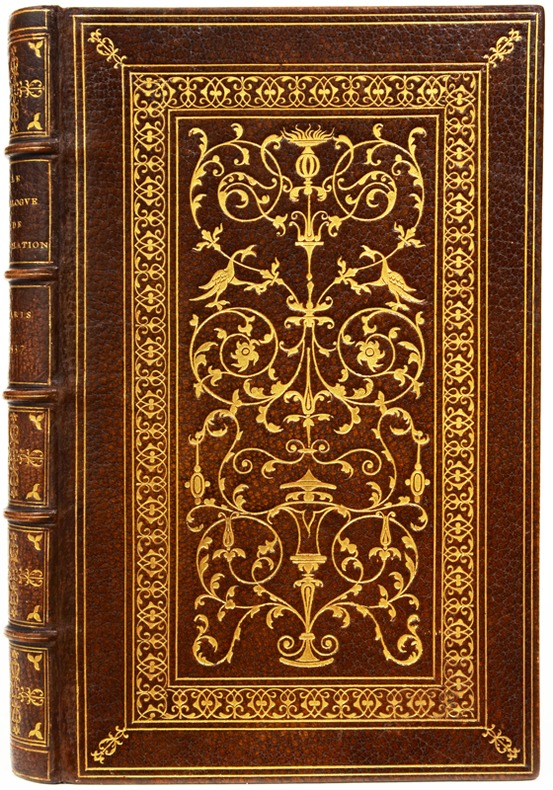
1537ref. 14346Paris, Pierre Sergent, 1537. In-8 gothique (160 x 100 mm) de (160) ff. (sign. A-V8), maroquin Lavallère, dos orné à nerfs, sur les plats motif de rinceaux disposés en candélabres à l'antique dans un un encadrement de filets et frise dorés, tranches dorées, dentelle intérieure (reliure du XIXe siècle).
1645ref. 40232Charleville, Hubert Raoult et Gédéon Poncelet, 1645. Petit in-8 (10,5 x 17 cm) de 15-(5) pp. 364 pp., maroquin fauve décoré à petits fers, dos orné de fleurons, sur les plats deux encadrements entre lesquels est dorée une frise, à l'intérieur de l'encadrement central est doré un chiffre C couronné dans un ovale entouré d'ornements, tranches dorées (reliure de l'époque).
4to. (8), "225" [= 215], (1 blank); "80" [= 72] pp. Including: Nicander of Colophon. Alexipharmaca. In Nicander Theriaca scholia auctoris incerti, et vetusta et utilia. In eiusdem Alexipharmaca diversorum auctorum scholia. 3 parts in 1 volume. Each part with its own title-page, with a woodcut caduceus device on all three. Set in roman and Greek types. 17th-century(?) richly gold-tooled red morocco, gilt edges; subtly rebacked, with the original backstrip laid down. Bilingual edition (Greek & Latin) of two medical hexametric poems by the Hellenistic poet and physician Nicander of Colophon (fl. second century BC), followed by a part with ancient scholia in Greek. The two poems are followed by comments by its translator, the Parisian pharmacist Jean de Gorris (1505-1577). They were first published separately in 1549 and 1556 and here for the first time published together. Nicander wrote at least 20 works, but "only his Theriaca (958 hexameters on poisonous creatures and on antidotes for their bites and stings) and Alexipharmaca (630 hexameters on antidotes to poisons) are extant". - "Nicander's influence on later Greek and Latin literature was considerable. Not only did Virgil, Ovid, and Antoninus Liberalis draw on his works, but Lucan, Pliny the Elder, Erotian, Aelian, and Athenaeus of Naucratis also benefited from direct or indirect familiarity with Nicander. In the 1st century BC the enormously learned scholar Didymus ("Chalcenterus") appears to have made extensive use of Nicander's lexicographic contributions. Although Dioscorides only twice cites Nicander's views in his Materia Medica, Galen in his pharmacological works quotes a number of verse passages from Nicander. Papyrus fragments from the 1st to 3rd centuries AD further confirm Nicander's popularity in the Roman empire" (Von Staden). - With the bookplate of the British politician John Thynne, Baron Carteret of Hawnes, dated 1841. Washed, with some faint early manuscript notes. Durling notes that, like in our copy, a general title-page is lacking in their copy, but this appears to be as usual. Internally in very good condition. Rebacked, lower hinge weakened, front hinge professionally repaired. Durling 3341. USTC 160585. Wellcome I, 4530. Cf. H. Von Staden, "Nicander" in N. Wilson, Encyclopedia of ancient Greece (2006).
1514ref. 15290Venetiis, In aedibus Aldi et Andreae soceri, 1514. In-8 de (4) ff. dont 1 f.bl., 230 ff. (signatures *4, a-z, A-E8, F6) veau fauve, dos lisse orné, pièce de titre en maroquin rouge, tranches dorées, nom de l’auteur en lettres capitales ciselées sur la gouttière, non rogné (relié vers 1800).
1786ref. 42884À Londres [Montargis, Claude Lequatre], 1786. In-16 de (8)-156 pp., (20) ff. d'échantillons de papier, basane fauve, dos lisse orné, pièce de titre en veau vert, triple filet doré d'encadrement sur les plats, gardes de papier dominoté, tranches dorées (reliure de l'époque).
1786ref. 44364À Londres [Montargis, Claude Lequatre], 1786. In-16 de (8)-156 pp., (20) ff. d'échantillons de papier, maroquin vert, dos lisse orné, pièce de titre en maroquin vert, roulette dorée d'encadrement sur les plats, tranches dorées (reliure de l'époque).
1523ref. 44374Cologne, Eucharius Cervicornus pour Gottfried Hittorp, s.d. , (1523). In-8 de 139-(13) ff., (sign. a-s8, *8), table, titre à encadrement gravé, bois gravé, caractères grecs et romains.ÉRASME. Parabolarum, seu Similium liber elegantissimus. Argentinae, apud J. Knoblouchum (Strasbourg, Johann Knobloch) 1521. 103-(5) ff., (sign. A-O8), titre à encadrement gravé, caractères italiques.ÉRASME. Opus de conscribendis epistolis, quod quidam & mendosum & mutilum ediderant, recognitum ab authore, & locupletatum. Argentorati (Strasbourg) Knobloch, 1522. 178 (i.e. 180) ff., (sign. A-Y8, Z4), titre à encadrement gravé, caractères italiques.3 pièces reliées en 1 vol. in-8 (105 x 170 mm), peau de truie sur ais de bois biseautés, décor estampé à froid à encadrement de motifs floraux et animaliers, dos à trois nerfs, titre manuscrit au dos, deux fermoirs (reliure de l'époque).
THE ONLY COPY PRINTED ON VELLUM OF THE POET'S FIRST BOOK, ILLUSTRATED WITH THREE ORIGINAL HORS-TEXTE DRYPOINTS BY FRANTISEK PAVELKA. 71 pp. Edition limited to 500 numbered copies, of which this is COPY NUMBER 1, THE ONLY COPY PRINTED ON VELLUM. Inscribed and signed below the justification by the author (to himself, apparently) in Czech: "The first copy of the first edition of my first book." Also inscribed and signed by the publisher on the rear pastedown. Both inscriptions dated December 21, 1926. 8vo. Beautifully bound in full hand-painted pigskin. Top edge gilt, other edges uncut. FINE AND BRIGHT. Czech books printed on vellum are of the utmost rarity.
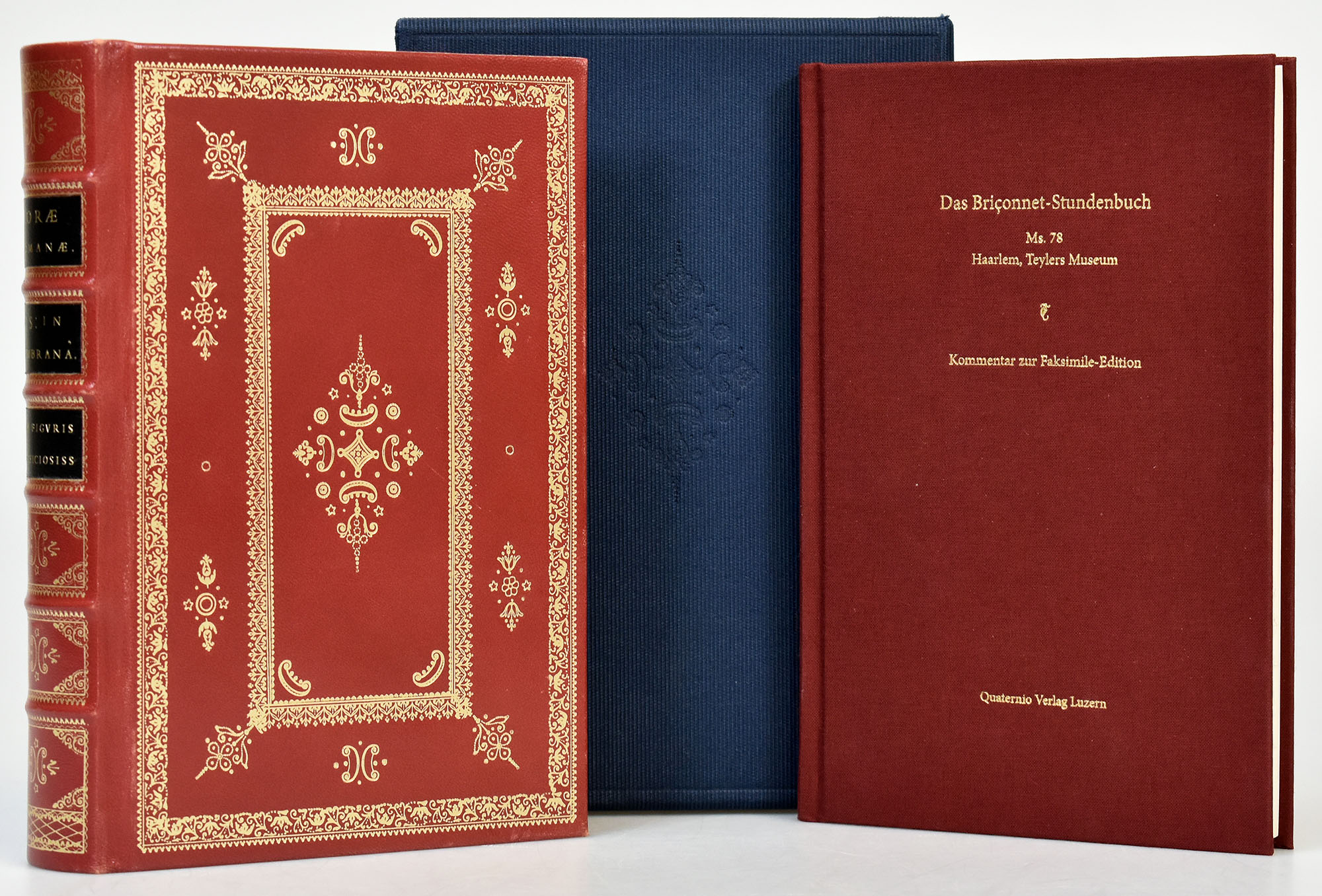
ref. 3840FBLuzern, Quaternio Verlag, 2020. 8°. 22 x 15,5 cm. [144] Blatt; 175 Seiten. Faksimile: Original-Lederband mit reicher Deckel-, Rücken- und Kantengoldprägung, marmorierten Vorsätzen und Rundum-Goldschnitt. Kommentar: Original-Leinenband. Original-Leinenschuber. [9 Warenabbildungen]
1784Very Good Turkish, Ottoman (1500-1928) Original dark brown handsome full leather bdg. with a traditional flap. Folio. (32 x 22 cm). In Ottoman script (Old Turkish with Arabic letters). [2], [6], 238 leaves. The size of the text block in red borders: 25.5 x 14.5 cm. 33 lines on each page. Printed on paper with European watermarks. The size of the text block in red borders: 25 x 14.5 cm. 33 lines on each page. Printed on paper with European watermarks. Handwritten title on the bottom edge. A fine copy. The 19th incunable of the Islamic world, printed by Ibrahim Müteferrika's legendary Basmahane. The publication of Ottoman chronicles which began in 1734 with the edition of Naimâ's history, continued after a long break in 1783. This volume, containing the works of three court chroniclers who followed each other in rapid succession, is a chronological continuation of Mehmed Râsid's history, published by Müteferrika. Arpaemînizâde Mustafa Sâmî (deceased 1734) was the court's historian from 1730 to 1733, Sâkir Hüseyin (died 1742) in 1733, and Subhî Mehmed (ca. 1711-1769) from 1739 to 1745. The work of the three chroniclers is known as one coherent historiography, which presents the events of Ottoman history from 1730 to 1744. This work is a particularly valuable source on the Habsburg-Ottoman war between 1736 and 1739, in which Subhî participated in person. The prestige of the work, which offers detailed data on the administrative events (appointments, dismissals, and other biographical communications) is further increased by the fact that Subhî in many cases used original documents. This chronicle includes the events between the years 1730-1743. Contents: Ahd-i Humâyûn [i.e. Imperial constitutional declaration]., Zikr-i tecdîd-i san'at-i tab' [i.e. Preface on the Muteferrika Press of Vasif Efendi]., Fihrist-i târîh-i Sami ve Sakir ve Subhi [i.e. Contents of the work]., Text., History of Subhi. The workshop of Müteferrika began its historical mission in 1728. They published 17 works in 22 volumes. The printing house served as a means to the long-term goal of Müteferrika, his efforts to broaden the horizon and modernize the knowledge of Ottoman society and Islamic civilization. This is evidenced by the subjects of the books selected for publishing, the motivations put forth in the publisher's introductions, as well as by the documents illuminating the background of the publication of each book, also published in print. In 1742, with the publication of the Persian dictionary of Hasan Suûrî, a chapter of Ottoman book printing came to an end. With the death of Müteferrika, the printing of Turkish books was temporarily interrupted. The first generation of Ottoman-Turkish prints was soon followed by a new series when in 1756 Ahmed and Ibrâhîm Efendi (the latter perhaps the founder's son, according to speculative sources) made an attempt to resurrect the legacy of Müteferrika through the possession of a decree obtained from the Sultan. However, this experiment did not prove to be lasting, as it did not last longer than the new edition of the first Turkish printed book, the Lugat-i Vankûlî. After this, for several decades there was no continuation to the Turkish book printing established by Müteferrika, until in 1783 the workshop was put in operation again for the publication of six more works. The subjects of these late 18th century works were dominated by history and military technology, thus Müteferrika's strategy of book distribution made its way hand in hand with the efforts of modernization of the Ottoman state. The second edition of Lugat-i Vankûlî followed the principles of the first edition, and its introduction was composed on the model of the introductory pages of the two last books published under Müteferrika's supervision. The works published after 1783 display a noticeable development in typography not only as to its somewhat refined visual impression but also in its structure. For example, the d+h and r+h ligatures, (For more info please visit our website)
1785Very Good Turkish, Ottoman (1500-1928) Original dark brown handsome full leather bdg. with a traditional flap. Folio. (32 x 22 cm). In Ottoman script (Old Turkish with Arabic letters). [9], 288 leaves. The size of the text block in red borders: 25 x 14.5 cm. 33 lines on each page. Printed on paper with European watermarks. Handwritten title on bottom edge. Marginal cutting on the first page. Overall a very good copy. The 20th incunable of the Islamic world, printed by Ibrahim Müteferrika's legendary Basmahane. Süleymân Izzî succeeded Mehmed Subhî Efendi (ca. 1711 - 1769) in 1745 as an official court historian (vaka'nüvis) and held this office until 1753, and is known as one of the three chroniclers for coherent historiography, representing the events in the Ottoman history from 1730 to 1744 and is a particularly valuable source on the Habsburg-Ottoman War between 1736 and 1739, as proven by his chronicle titled "Tevârîh-i Sâmî ve Sâkir ve Subhî", published in 1784. During this time, he recorded the contemporary events taking place between 1744 and 1753 in the Ottoman Empire. This work was the last item in a series of chronicles published by the printing house founded by Müteferrika. Franz Babinger writes that some parts of the book have been translated into German. Hammer translated one of the parts in question into German. All published, Izzi has planned the third part of his work, but this third part was never published. Contents: "Ahd-i Hümâyûn".; "Zikr-i iâde-i fenn-i tiba'at" [i.e. On the book pressing and publishing with a preface by Ahmed Vâsif Efendi].; "Fihrist-i Târîh-i Izzî" [i.e. Content of Izzi's history].; Izzî tarihinin birinci bölümü [i.e. The first chapter].; Izzî tarihinin ikinci bölümü [The second chapter]. The workshop of Müteferrika began its historical mission in 1728. They published 17 works in 22 volumes. The printing house served as a means to the long-term goal of Müteferrika, his efforts to broaden the horizon and modernize the knowledge of Ottoman society and Islamic civilization. This is evidenced by the subjects of the books selected for publishing, the motivations put forth in the publisher's introductions, as well as by the documents illuminating the background of the publication of each book, also published in print. In 1742, with the publication of the Persian dictionary of Hasan Suûrî, a chapter of Ottoman book printing came to an end. With the death of Müteferrika, the printing of Turkish books was temporarily interrupted. The first generation of Ottoman-Turkish prints was soon followed by a new series, when in 1756 Ahmed and Ibrâhîm Efendi (the latter perhaps the founder's son, according to speculative sources) made an attempt to resurrect the legacy of Müteferrika through the possession of a decree obtained from the Sultan. However, this experiment did not prove to be lasting, as it did not last longer than the new edition of the first Turkish printed book, the Lugat-i Vankûlî. After this for several decades there was no continuation to the Turkish book printing established by Müteferrika, until in 1783 the workshop was put in operation again for the publication of six more works. The subjects of these late 18th century works were dominated by history and military technology, thus Müteferrika's strategy of book distribution made its way hand in hand with the efforts of modernization of the Ottoman state. The second edition of Lugat-i Vankûlî followed the principles of the first edition, and its introduction was composed on the model of the introductory pages of the two last books published under Müteferrika's supervision. The works published after 1783 display a noticeable development in typography not only as to its somewhat refined visual impression, but also in its structure. For example, the d+h and r+h ligatures, characteristic of the first generation of Müteferrika's printed books, are replaced by separate letters. This extremely rare presented book is from the seven publications of this late period of the
8vo. (132) ff. With 2 different woodcut devices. - (Bound with) II: [Melekhet ha-dikduk]. Institutiones grammaticae in Hebraeam linguam [...]. (144) ff. With several musical notes and two woodcut devices. Modern vellum, in custom-made cloth case. I: Second edition of Münster's "Proverbs", previously published in 1520, together with his first own work ever, an introduction to Hebrew grammar. Numerous contemporary Hebrew and Latin marginalia. - II: Only edition of Münster's second publication, a foundation stone of modern Hebrew studies. Includes (fol. r1 ff.) the co-called Jonas polyglot in Hebrew, Chaldaic, Greek, and Latin, with other matter. Contemp. ownership obliterated from t. p.; lower corner defective (remargined professionally; losses supplied in pencil). Numerous contemp. marginalia, mostly in Latin. Both works are very rare; the former has not been seen at auctions since 1950. I: VD 16, B 3564. Burmeister 137. Hantzsch 234.2-4. Adams B 1536. Steinschneider (Bodl.) 11.51. Panzer VI, 244, 540. Vinograd Mem 1256. OCLC 71515193. Not in BM-STC. - II: VD 16, M 6685. Burmeister 2. Hantzsch 220.2. Adams M 1931. BM-STC German 633. Steinschneider (Hdb.) 1374. Panzer VI, 245, 541. Wolfheim I, 865. Graesse IV, 623. OCLC 22612604.
Royal 8vo (245 x 155 mm), title printed within a heavy border of flowers, followed by 115 leaves of specimens printed on one side only, of which two a folding, some occasional offsetting, cont. cloth-backed boards with wine auction sale particulars pasted over boards, manuscript paper spine label, uncut and partial unopened, an attractive copy. Bigmore & Wyman I, p. 243 mentioning only 1816, 1824 & 1827 editions; B&J citing the Oxford copy; Mosley locating four copies with between 91 and 118 leaves (Oxford, Cambridge, V&A, and Columbia University Library); OCLC adds the Huntington and Detroit copies; none added by JISC; not in the British Library or St Brides Catalogue. Berry & Johnson p. 49; Mosley, 135.
1640ref. 13895Parisiis, E Typographia regia, 1640. In-folio de (2)-550 p. 1 feuillet blanc, veau olive glacé, dos orné à 6 nerfs, triple filet doré sur les plats, dentelle intérieure, tranches dorées (reliure de la fin du XVIIIe siècle).