8,165 results
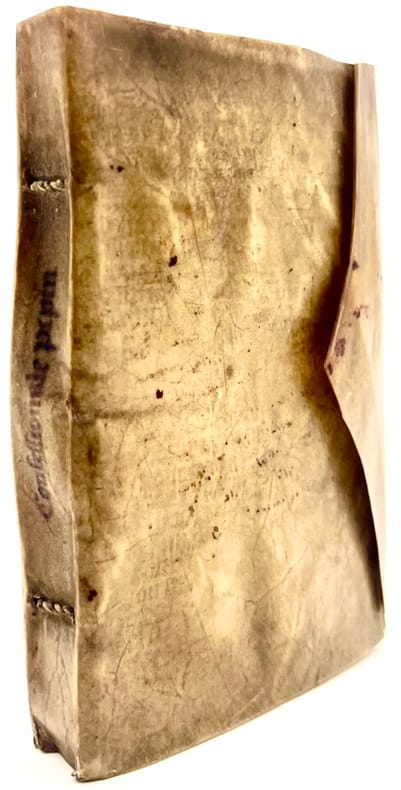
1661ref. 372198Cologne: Kinchium 1661. Mallinckrot: Engraved additional title dated 1639. 20 125 11pp. Kortholt: 8 56pp. Fritsch: 6 74 2pp. 4to. Early drab paper boards alla rustica binding on three cords manuscript title on spine text uncut. Foxing and heavily toned. Provenance: Princes of Liechtenstein armorial bookplate. Mallinckrot: Engraved additional title dated 1639. 20 125 11pp. Kortholt: 8 56pp. Fritsch: 6 74 2pp. 4to. Mallinckrot's monograph published on the occasion of the celebration of the second centenary of Gutenberg's invention is the first thorough investigation of the early testimonies to the discovery of printing with the author in favor of Mainz against Haarlem. The work contains the first use of the word "incunabula" in connection with printing. The additional title engraved by Loeffler includes portraits of Gutenberg Faust and Shakespeare and a scene in a printing shop. The second work here bound following Mallinckrot is Protestant theologian Kortholt's study on the origins of mathematics and astronomy asserting the Greeks were taught by Chaldeans and Egyptians. Bigmore & Wyman 2:16 Kinchium unknown books
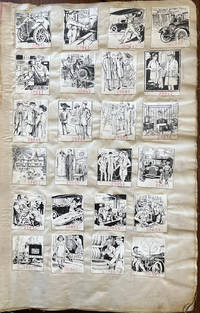
1920ref. 61659New York: American Publishing & Engraving Co. J.J. Schultz & Co. 184 William St. Bookbinder ca. 1920-1939. Thick folio. 13 x 19 x 3.5 in. 135 leaves numbered reverse in pencil on versos of last half. on linen with 4274 camera-ready clipart samples all w/ inventory numbers rubber stamped below the image sized approx. 2 x 2 in. throughout arranged in montages of 24 28 32 & 40 per page each carefully mounted some crossed out w/ annotation “Killed” and others worn through at the lower right corner of some leaves while just a few have been removed and in once case clipped from the upper fore-edge of the leaf. Contemporary light gray/beige buckram soiled dampstained wear at fore-edges partially shaken rebacked still a VG- exemplar. An extraordinary printing & engraving firm’s factory sample catalogue for over 4000 of their camera-ready clipart advertisements for subscribing businesses following World War II through the Great Depression and the New Deal programs of President Roosevelt. This superlative archive of images traces Art Deco styles spanning nearly two decades advertising campaigns printing styles fonts and with almost not repeated images offered by American Publishing & Engraving Co. AP&E Co. to their extensive client list. In addition these engravings capture the revolutionary changes in American industry and commerce with nearly 50% devoted to the automobile industry including automobile manufacturers and dealerships accessory suppliers automobile repair public safety from bad driving the fast-growing electric motors and battery industries and more. Ford the Dodge Brothers Buick Studebaker Cadillac Plymouth Auburn Chrysler Essex Auburn-Cord DeSoto Hudson Terraplane and many others all are featured here advertising their service departments features speed and more. A significant portion also reveal the very real needs to wash the cars clean engines repaint the lacquer update the automobile tops replace batteries repair radiators and the always pressing need to maintain safety equipment and tires. Interspersed as well are automobile movers commercial body builders for trucks and commercial delivery vehicles with a significant percentage showing cylinder grinding engine rebuilding boiler repair and other very necessary secondary market needs as metal alloys and tolerances were far less durable with breakdowns an ever pressing problem for the motorist. Public safety notices reflecting the impact of the Progressive Era illustrate the dangers of the automobile with many indicating streetcars potentially hitting stalled cars which had not been repaired properly gridlock automobile accidents from ignoring traffic signals and police traffic officers as well as speeders hitting pedestrians or ignoring motorcycle police traps. Early in the sample illustrations are many reflecting the interest in building large Tudor Revival or Arts & Crafts homes installing electric lighting new furniture stylish clothes & shoes beautiful Oriental carpets and jewelry and watches for young flapper-era women. There are also promotional ads for Art & Stained Leaded Glass windows for homes interior decorators a panoply of beauty products many reflecting the Flapper Era hair and dress styles as well as evolution of the Art Deco lettering. As the AP&E Co. continued to add their sample engravings through the Great Depression not only is there a greater emphasis on repairing automobiles shoes recovering furniture and even repairing mattresses reflecting the belt tightening of the 1930’s but there are also increasing influences of more streamlined automobiles introduction of appliances such as refrigerators appearance of beer ads following the repeal of Prohibition and the fast growing radio industry. American Publishing & Engraving Co. based out of New York was one of a myriad of job printer engraving firms who emerged at the end of the 19th Century and initially specialized in publishing local histories and genealogies for historical societies by subscription typically with illustrations. Although this cataloguer could find no specific trade reference either in contemporary magazines or newspapers they appear to have operated out of the same locations as the Atlantic Publishing & Engraving Co. with some overlap and by the beginning of the 20th Century had largely dispensed with publishing local histories engraved portraits or vanity press projects. Contemporary court cases and other references indicate that they operated a subscription service for businesses advertising art to be run in magazines newspapers pulps or added to trade literature for matchbook covers business flyers etc. and by 1916-1925 were managed by Thomas W. Smith. No similar factory sample collection or published collection located in Worldcat. American Publishing & Engraving Co., J.J. Schultz & Co., 184 William St., Bookbinder, hardcover
4to. (8), 231, (1) pp. With a large figurated woodcut "C" initial by Hans Holbein. 18th century half vellum with ms. spine title. First edition of Hus's principal work, commonly known in English as "Treatise on the Church", ascribed to Adam Petri's Basel printshop on the basis of typographical features. Written in 1413 at the castle of one of Hus's protectors in Kozí Hrádek, near Sezimovo Ústí, the book evidences the author's strong intellectual and spiritual ties with the English reformer John Wyclif, whose like-titled "De ecclesiae" has been written in 1378 (Hus however, unlike Wyclif, did not reject the notion of transsubstantiation). "This treatise became Huss's 'apologia pro sua vita', the defense of the views which he had drawn from Wyclif and advocated. [... It] has a place of first importance among works on the church [...] It is the best known work on the subject issued from Augustine to the Reformation period [and] has had a permanent influence upon the development of the idea of the church" (Schaff, Introduction to the 1915 edition, p. xi-xxxi). - A little more than a century after Hus was burned at the stake in Constance, Luther was sent a manuscript copy of the work and, upon reading it, enthusiastically embraced Hus's central tenets, famously writing to Georg Spalatin in February 1520 that "without knowing it, we are all Hussites". But half a year later, two printed versions appeared almost simultaneously in 1520 - one under the original title used here, the other entitled "De causa Boemica" (printed by Anshelm in Hagenau; the precise order of publication remains unclear). These first printings "enabled others to evaluate (or even emulate) Luther's conclusion [... The text was presented] in a disinterested manner, thus allowing an unbiased judgment of its contents"; it was published without polemical introduction or prologue, and the title page, "which did not mention Hus by name, contained the simple epigraph: 'I beg you, my kind reader, to attend not to who speaks, but to what is said'" (Haberkern). - Occasional slight brownstaining; a few insignificant wormholes to blank lower margin near end; old library shelfmark in ink to front pastedown. Quires M and Q bound out of order (3-4-1-2), but a complete, well-preserved and wide-margined copy. Quite scarce: only three copies in auction records internationally since 1975. VD 16, H 6173. BM-STC German 438. Adams H 1210. BNHCat H 630. Haberkern, Patron Saint and Prophet: Jan Hus in the Bohemian and German Reformations [Oxford 2016], p. 158.
8vo. 116 (but: 117), (1) SS. 19th century red morocco with richly gilt inner dentelle, leading edges gilt, marbled pastedowns. All edges gilt. Very rare first Latin edition of this controversial pamphlet, previously published in French as "Discours merveilleux de la vie, actions & deportements de la royne Catharine de Medicis" ("Paris 1563", but in fact printed in the autumn of 1574). This stinging indictment of Catherine de Medici was reprinted several times and also saw a German translation, "Öffentliches Ausschreiben der übelbefriedigten Stände in Frankreich" (i.e., "Public announcement made by the malcontent estates in France"), edited by Johann Fischart. - "The most controversial book associated with the name of Henri Estienne; this notorious biography of Catherine de Médicis, in the form of a violent Huguenot pamphlet against her, has long been attributed to Henri Estienne, although serious doubt has been cast on this attribution" (Schreiber). The anonymous author presents himself as a Catholic who insists the Huguenots should not have been butchered, but rather converted by means of theological argument. "Undoubtedly the writer is a member of the large party of malcontents, many of whom - at least after the massacre - were Catholics, who hoped that all men of national spirit from both persuasions might unite to throw off the cruel yoke of the Queen mother's rule and end the civil wars. Among the many Huguenot pamphlets of the time, this is the one to aim the sharpest arrows at the Queen mother. It contains a vitriolic account of the Queen's life, describing her family and upbringing in the most disparaging terms and revealing all the schemes, misdeeds and crimes committed since the beginning of her rule in 1560 [...] Repeatedly the author points out how she makes use of the precepts of her Florentine compatriot Macchiavelli" (A. Hauffen, Fischart-Studien, in: Euphorion 8 [1901], S. 536f.). - Light browning and very occasional light staining, sumptuously bound in the 19th century. Adams S 1754. BM-STC French, Suppl. 22. Renouard 143, 8. Schreiber 196.
4to. (82) ff. (A-T4, V6). 29 lines, text partly surrounded by commentary. Later half vellum. Latin edition of this famous medical manual, arranged at Salerno in the 12th century and published in various incunabular editions. This instructional poem and the commentary that accompanies it, often attributed to the 13th-century Montpellier alchemist Arnoldus de Villanova (cf. E. Wickersheimer, in: Comptes rendus du XIIIe Congrès international d'histoire de la médecine, 1954, p. 226-234 [Aquilon 570]), preserved its exceptional influence in Western Europe well into the 19th century. - Quire Q misbound but complete; some browning and fingerstaining; margins show some wrinkling. Several old marginalia and underlinings; later ms. note to title page: "Arnoldinus in Scholam Salernitanam". Very rare; a single record in ABPC (Swann, 24 Jan. 1980, lot 1792). CR 5053. Goff R-77. GW M37397. BSB-Ink R-50. Klebs 830.12. Sander 6391. Pellechet 1289. BMC V, 598. Edit 16, CNCE 60481. Cf. Essling 609f.
(6) Bll. (d. l. w.). Antiqua (Type 10:80R), 37-38 Zln. Mit einer schwarzgrundigen Initiale in Holzschnitt. Spätere Broschur. Dreiseitiger Rotschnitt. 4to. Erste Ausgabe dieser fingierten Huldigung König Maximilians durch sechs antike Städte. Vermutlich in Pordenone verfaßt, wo Caviceo mehrere Jahre lebte und 1489 vom dort anwesenden Kaiser Friedrich III. zum iuris utriusque doctor promoviert wurde. Das Werk beginnt mit einer Erwähnung der Vertreibung der Ungarn aus Österreich bis Stuhlweißenburg/Székesfehérvár: "Die 6 Städte sind Babylon, Troya, Byzanz, Athen, Carthago und Jerusalem. Sie alle huldigen Maximilian und flehen um seinen Schutz [...] Eingestreut zahlreiche Hinweise auf zeitge[nö]ssische Begebenheiten" (Apponyi). Der Theologe J. Caviceus (1443-1511) studierte zu Bologna und trat in die Dienste des Piermaria Rossi, Herrn von Berceto, und seines Sohnes Guido, des Capitano der Republik Venedig. Seit 1492 wirkte er nacheinander als Generalvikar der Diözesen Rimini, Ferrara, Florenz und Siena. - Druckerzuschreibung nach GW (von BMC und Indice generale VI bestritten). Das erste Blatt recto alt mit Einfassungslinie umrahmt; bei der Neubindung im Bug verstärkt; am vorderen Vorsatz eine englische Notiz zum Verfasser aufgezogen (um 1880). - Sehr selten, auf deutschen Auktionen der letzten Jahrzehnte nur die zweite Ausgabe nachweisbar (Hartung & Hartung, 98 [2000], Nr. 103, EUR 4346). HC 4805. Goff C-355. GW 6433. BSB-Ink C-204. Pellechet 3455. Proctor 7374. BMC VII, 1146. IGI 2655. Sajó-Soltész 955. Apponyi 1551.
1538ref. 15510Paris, Pierre Vidoue, 1538. In-8 gothique (145 x 90 mm) de (111) ff. (sign. A-N8 O7), maroquin rouge, dos lisse orné, triple filet doré d'encadrement sur les plats, roulette intérieure, tranches dorées (reliure du XVIIIe siècle).
8vo (2 [instead of 14], 180 [instead of 188], (16) pp. With engraved title-page and 1 [instead of 3] double-page battle formation, 28 full-page maps and 2 full-page engravings by Michelangelo Marelli, all within the pagination. Woodcut printer's device on colophon leaf at end. 19th century half vellum over marbled boards. First edition; rare. - An NCO's pocket-sized manual containing general scientific and military information on architecture, geography, mathematics, duelling, drill, etc. The maps, which are the most famous of the book's illustrations, are almost exclusively of Mediterranean islands (with captions and sea monsters), particularly in the Aegean (cf. Zacharakis/Scutari 1499/1003-1518-1022), and include Rhodes, Crete, Cyprus, Malta (Ganado 1985, p. 231; not in MoM), Sicily (Dufour/L. 85), Elba, Corsica, Sardinia (not in Piloni), and Mallorca. The final map is of Great Britain (Shirley 124). - Occasional browning and waterstaining, lacking 6 leaves of preliminaries and pp. 29-36 (gatherings chi2 and ²chi2), including 2 battle plans. Slight loss to title, surviving battle plan slightly trimmed. Binding rubbed, showing minor staining. - Provenance: Faded contemporary Italian inscription on title ("Ex libris Joachimi Sabatini"?). Later in the collection of Thomas Fremantle, 3rd Baron Cottesloe (1862-1956), commander of the Territorial Army and president of the Society for Army History Research (purchased from Sotheran's, December 1936). Edit 16, CNCE 18852. Brunet II, 1235. Olschki 4539. Cockle 548. Mortimer 184. Ayala 25. NMM III, pt. 1, no.38. Shirley T.FRRR-1a. OCLC 954791711. Not in Atabey or Blackmer.
8vo. "162" [= 163], (1) pp. With a woodcut device on title-page and a larger version on the last page, both partly coloured by hand. Rubricated throughout. 19th-century vellum. First edition of a French translation from the Greek by the French physician Jean Canappe, of two chapters (5 and 9) from Galen's pharmaceutical work later translated into Latin as the De simplicium medicamentorum facultatibus. Canappe would publish a full translation a few years later as Le livre des simples (1545). - "There is no name more illustrious in the whole history of medicine than that of Galen [...] Written in Greek, this Galenic treasure reached the Latin Western World only through Arabic translations" (Hagelin). - With the bookplate of Etienne Récamier (1833-98), Bibliothèque Lyonnaise 1858-93, some partly removed owner's inscriptions on title-page and a few other inscriptions throughout. Some occasional smudges and stains, but otherwise in good condition. Durling, A chronological census of renaissance editions and translations of Galen 1542.11. Krivatsy, Suppl. 16th century, 86. USTC 24275. Not in Wellcome. Cf. DSB V, pp. 227-235; Hagelin, Rare and important medical books, pp. 12-15.
Folio (215 x 317 mm). Two parts in one volume, each with separate title page. (6 [instead of 8], CCCLIII, (1) pp. (8), CCLXXVIII (wanting final leaf with printer's device). Title page printed in red and black; with woodcut illustrations throughout. Contemporary half leather binding with roll-tools on five raised double bands; covers appealingly covered with the remains of a 15th-century musical manuscript on vellum. Second German edition of this widely received compilation. The main text derives from Antoine Geuffroy's "Estat de la court du grand Turc", first published in 1542; the other texts include the slavery account of Bartolomej Djurdjevic (Georgijevic), the exhortations of Bessarion and Pius II against the Turks, Breydenbach on the Armenians, and Aventinus's panegyric on Charles V. Also contains a discussion of the life of Mahomet, the Muslim religion and its rites. The second part deals almost exclusively with the reign of Sultan Suleyman the Magnificent. Includes the impressive plans and maps of Cairo, Constantinople, and Tunis. - Some worming near beginning; some edge flaws and paper damage (remargined). Rather browned throughout with some waterstaining; occasional contemporary ink marginalia. Old library stamps of the Graz Friars Minor on title page. VD 16, G 1911. BM-STC German 408. Adams G 561. Chauvin XII, p. 166, no. 638. Göllner 1692. Hammer 1044. Kertbeny 896. Cf. Atabey 492 (1573 ed.). Not in Blackmer or Cobham-Jeffrey.
1611ref. 16494Chambéry, Geoffroy Dufour, [1611]. In-12 de (6)-219 pp., 1 f.bl., maroquin rouge, dos à nerfs, dentelle intérieure, tranches dorées sur marbrure (Hardy).
8vo. 79, (1) pp. - (Bound after) II: Mock, Jakob. De causis concretionis et dissolutionis rerum quarundam, tam extra quam intra corpus humanum. Tractatio historica, philosophica et medica, secundum veterum ac recentiorum placita descripta, & in tres partes distributa. Freiburg im Breisgau, Martin Böckler, 1596. (16), 288, (14) pp., final blank leaf. Contemporary full vellum; lacks ties. Final and best 16th century edition of this alchemical work originally written in Arabic, the first edition having appeared at Paris in 1559. The legendary Byzantine monk Morienus is said to have gone to Alexandria to study with the Arabian scholar Adfar, whose favourite student he became. Subsequently settling in Jerusalem as a hermit, he devoted his life to the hermetic arts before he learned that Khalid, the Sultan of Egypt, "was desirous to find some one who could interpret for him the writings of Hermes and of Adfar" (Ferguson II, 109). Morienus supposedly went to Egypt and instructed Khalid in the art of creating the elixir for the philosopher's stone. "The ultimate fate of Morienus is unknown, but his conversations with Kalid must have been committed to writing, and they may have come to the West about the time of the Crusades. They were in Arabic, but to make them available they were translated into Latin in February, 1182, by Robertus Castrensis, with a short preface" (Ferguson). No Arabic sources have been discovered, for which reason the attribution has been considered apocryphal, but the author does use chemical terminology with Arabic roots, such as "al-natron". The book marks the beginning of western preoccupation with alchemy, previously almost entirely unknown in mediaeval central Europe, and even Goethe quotes from it in his "Theory of Colours". - II: Bound first is a rare medical work by Jakob Mock, professor at Freiburg and a good friend of Fabricius Hildanus. This would seem to be part 1 only (caption title: "De aquarum quarundam affectionibus ratione coagulationis vel indurationis & dissolutinis, & alias"); no more published. - Unidentified 19th century library stamp to front pastedown. Covers slightly warped; long yapp edge of the vellum binding trimmed away along lower half of the book. Interior lightly browned, some light, mainly marginal spotting and brownstaining, a few darker spots occasionally affecting letters. Old handwritten ownership of "Claudius Cuppinius" on title-page of Mock's work, with an additional note in the same hand, dated 1691, on the flyleaf. I: VD 16, M 6354. Wellcome 4458. Neu 2849. Duveen 413f. Schmieder, Geschichte der Alchemie, p. 123. Brüning 646. Mellon Collection 50 (illustrated p. 160). Cf. Ferguson II, 108f. Not in Adams or BM-STC German. - II: VD 16, M 5707. BM-STC German 623. Adams M 1528. Durling 3199. Wellcome 4372. Jöcher III, 563.
1929Lucky Strike cigarette ad on back cover provides a truly classic and timeless example of a mis-timed advertisement. Consider that the great Wall St. stock market crash of 1929 occurred mere days before this issue hit the newsstands. Beneath the caption "An Ancient Prejudice has been removed" appears a clenched fist labeled as "American Intelligence" breaking a heavy chain. Top left a paranoid miser stacks his gold by candlelight. Top right a wealthy couple visits their palatial bank. Text beneath miser reads "Hoarding gold with the fanatical zeal of the miser has vanished. American Intelligence sponsors thousands of banking institutions to which the individual (i.e. the wealthy couple) safely entrusts his wealth." The message is clear. Readers should put their trust (and money) in the banks, and shun gold. This issue was likely printed just as the Great Crash occurred, causing countless financial institutions to go under - and destroying even more individual fortunes. (The ad goes on to claim that cigarettes have similarly overcome the prejudice against them.) A truly stunning work which deserves to be preserved and reflected upon in this age of limitless fiat currency printing. Average wear with three-inch crease to lower corner of back cover. Suitably framed and mounted, this ad will make a superlative office display for any precious metals executive. Magazine
1534ref. 43491Paris, Claude Chevallon, 1534. Petit in-8 gothique à deux colonnes (110 x 160 mm) de (224) ff. le dernier blanc (sign. A-Z8, AA-EE8), lettrines historiées, texte rubriqué, vélin souple avec rabat en forme de portefeuille, titre manuscrit en long (reliure de l'époque).
98 SS., letztes weißes Blatt. Mit figürlicher Holzschnitt-Initiale. Marmorbroschur. 4to. Erste und einzige Ausgabe des Hauptwerks: Porzio behandelt die Seele und den Intellekt des Menschen und macht sich dabei die materialistischen Ansichten seines Lehrers Pietro Pompanazzi zu eigen, indem er die Sterblichkeit der individuellen Seele vertritt (vgl. Ziegenfuß II, 304). Im 23. Kapitel setzt sich Porzio mit den Argumenten Averroes' in Bezug auf das dritte Buch von Aristoteles' Abhandlung "De Anima" auseinander. Aufgrund seiner mangelnden Orthodoxie hinsichtlich der Frage der Unsterblichkeit wurde der Verfasser heftig angegriffen. - Porzio (1497-1554) lehrte Philosophie und Medizin in Pisa, später in Neapel (vgl. Poggendorff II, 506). "His philosophic theory was identical with that of Pomponazzi, whose 'De immortalitate animi' he defended and amplified in a treatise 'De mente humana'. There is told of him a story which illustrates the temper of the early humanistic revival in Italy. When he was beginning his first lecture at Pisa he opened the meteorological treatises of Aristotle. The audience, composed of students and townspeople, interrupted him with the cry 'Quid de anima' ('We would hear about the soul'), and Porzio was constrained to change the subject of his lecture. He professed the most open materialism, denied immortality in all forms and taught that the soul of man is homogeneous with the soul of animals and plants, material in origin and incapable of separate existence" (Enylopaedia Britannica, 11th ed., s.v.). - Schöner Druck, durchgehend leicht braunfleckig. Aus der Bibliothek des Medizinhistorikers Walter Pagel (1898-1983). Edit 16, CNCE 34588. BM-STC Italian 537. Adams P 1962. Durling 3745.
Folio (208 x 290 mm). (17), 154 ff. With engr. title page and 42 full-page engravings in the text. Contemp. vellum in later slipcase. First Italian edition, second printing with the year on the title page changed from 1559 to 1560. Valverde's famous anatomy boasts beautiful engravings, mainly based on Vesalius, but with many improvements. "Setting of type unchanged, but many of the plates have been re-engraved (and reversed)" (Cushing). - Binding rubbed and wormed. Several carefully restored tears to t. p.; several leaves professionally restored (plate on leaf 96 covered with paper slip), some brownstaining. Cushing, Vesalius VI.D.-36. Durling 4532. Haller I, 215. Hirsch/Hübotter I, 123. Mortimer 513. Waller 9800.
2020ref. 11157Tacoma WA 2020. Limited Edition. Hardcover. Fine in Fine Archival Box. Limited Edition. Hardcover. Quiet sophisticated and remarkably powerful Gabby's newest work is an exquisite blend of book art and binding. Gabby has from early in her career gone beyond her roots in design binding creating the text art and printing for several books now. Just as her design bindings push limits and explore possibilities so does her art and print work. It is a remarkable evolution. "Ralph Emerson wrote this poem "Blight" in July of 1843. He spoke out on climate change and the ways we could shift course by not blindly following others. In describing his travels to Europe while writing on life and nature Emerson said "same faces under new caps and jackets another turn of the old kaleidoscope." I took some liberties with Emerson's poem surrounding his words with photographs captured at Owen Beach in Washington state on a rainy winter day in 2019. This public beach in the middle of an urban old-growth forest will close for a year beginning in fall of 2020 to mitigate the effects of climate change and rising sea levels. Emerson's words of anger and disappointment at environmental destruction only resonate more with our current climate of melting glaciers and raging fires. As we continue to twist the kaleidoscope I remain optimistic we will find a way to rearrange these fragments and improve the view for future generations." artist statement This copy a 'making copy' adds tests of inks gouache type and design on a lot of the pages on the main book. The clamshell box includes a drawer of three separate folios of ink photo transfer and gouache. Inset into the drawer are two test covers as well more like miniature bindings of the big book. One is just the case and one has a separate small binding to test the structure. Housed in a custom box. Tight bright and unmarred. Brown textured paper boards by Hook Pottery Paper in a modified case binding letterpress printed with handset type on inkjet photo transfers silkscreen printed panels and acrylic painted Kozuke paper printing completed at Springtide Press with assistance from Jessica Spring; housed in an archival dropspine box. 4to. np. Illus. color plates. Numbered limited edition of 28 this being AP1. Signed by the artist. hardcover
2020ref. 11157Tacoma WA 2020. Limited Edition. Hardcover. Fine in Fine Archival Box. Limited Edition. Hardcover. Quiet sophisticated and remarkably powerful Gabby's newest work is an exquisite blend of book art and binding. Gabby has from early in her career gone beyond her roots in design binding creating the text art and printing for several books now. Just as her design bindings push limits and explore possibilities so does her art and print work. It is a remarkable evolution. "Ralph Emerson wrote this poem "Blight" in July of 1843. He spoke out on climate change and the ways we could shift course by not blindly following others. In describing his travels to Europe while writing on life and nature Emerson said "same faces under new caps and jackets another turn of the old kaleidoscope." I took some liberties with Emerson's poem surrounding his words with photographs captured at Owen Beach in Washington state on a rainy winter day in 2019. This public beach in the middle of an urban old-growth forest will close for a year beginning in fall of 2020 to mitigate the effects of climate change and rising sea levels. Emerson's words of anger and disappointment at environmental destruction only resonate more with our current climate of melting glaciers and raging fires. As we continue to twist the kaleidoscope I remain optimistic we will find a way to rearrange these fragments and improve the view for future generations." artist statement This copy a 'making copy' adds tests of inks gouache type and design on a lot of the pages on the main book. The clamshell box includes a drawer of three separate folios of ink photo transfer and gouache. Inset into the drawer are two test covers as well more like miniature bindings of the big book. One is just the case and one has a separate small binding to test the structure. Housed in a custom box. Tight bright and unmarred. Brown textured paper boards by Hook Pottery Paper in a modified case binding letterpress printed with handset type on inkjet photo transfers silkscreen printed panels and acrylic painted Kozuke paper printing completed at Springtide Press with assistance from Jessica Spring; housed in an archival dropspine box. 4to. np. Illus. color plates. Numbered limited edition of 28 this being AP1. Signed by the artist. hardcover books
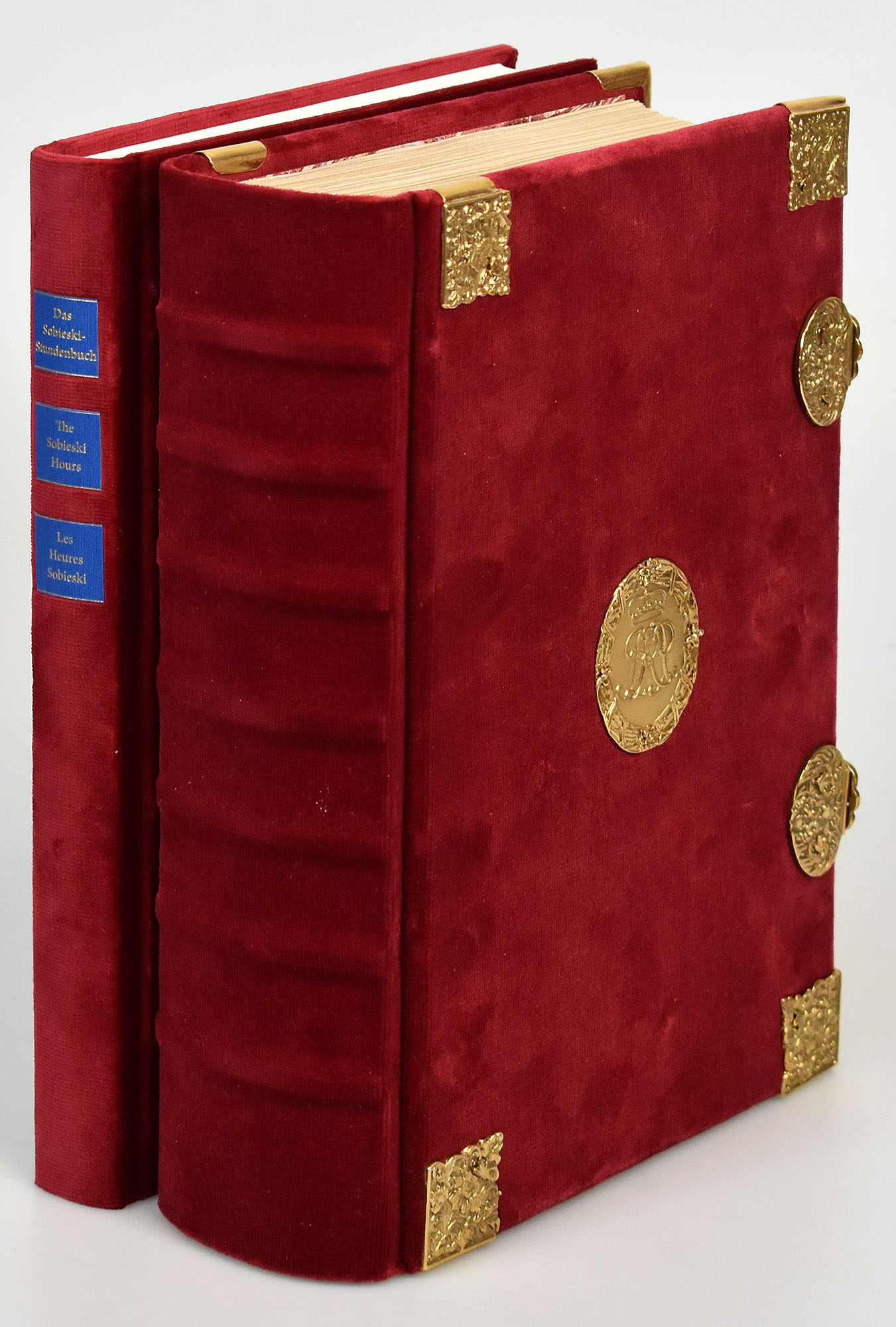
ref. 4042FBLuzern, Quaternio Verlag, 2016. Bände: 29,5 x 20,5 cm. Schuber: 234 Blatt; 351 Seiten. Original-Samteinband mit vergoldeten Medaillons, Zierecken und 2 Schließen und Rundum-Goldschnitt sowie Original-Samteinband mit goldgeprägten Titeln auf blauen Rückenschildchen in geschlossenem Original-Acrylglasschuber. [10 Warenabbildungen]
1796ref. ST12327Paris: P. Didot l'aîné 1796. ONE OF 100 COPIES. 330 x 235 mm. 13 x 9 1/4". 2 p.l. 165 1 pp. Original gray boards flat spine dark gray paper title label two-thirds of the leaves UNOPENED. Engraved printer's device on title page and SEVEN FINE COLOR-PRINTED ENGRAVINGS AFTER PEYRON BY CHAPUY AND LAVALLÉE SOME FINISHED BY HAND. Cohen-de Ricci 730; Brunet III 1860. ◆A couple of very small brown spots and just a hint of soiling as well as minor abrasions to covers corners somewhat mashed as expected isolated trivial foxing to text but A VERY FINE COPY clean and bright internally with vividly colored plates and in a surprisingly sturdy and generally well-preserved original temporary publisher's binding. This is the fine Levy copy of a strictly limited Large Paper edition of a handsomely illustrated work offered here in what seem to be the publisher's temporary boards mostly unopened and virtually untouched internally. Attractively printed with enormous margins the text of the first and by far the most important work here is a prose poem on love supposedly translated from the Greek by one of the great political philosophers of the Enlightenment Charles de Secondat Baron de Montesquieu 1689-1755. In its own day the work was popular largely because of its racy content; today it is considered as a more serious accomplishment by modern scholars who are inclined to see it as a philosophical fable. The colophon informs us that this limited edition was printed with a new type cut and cast by Firmin Didot "with such perfection that up to this moment none other can equal it." The dramatic and animated plates are strikingly different from the Eisen engravings in other editions of this work and are more modern in sensibility than the usual 18th century French engravings. The colophon notes that the plates were broken after the 100 copies of this edition were printed. Our copy was in the outstanding library of American bibliophile Jacques Levy 1905-80 a man of wide-ranging interests who assembled an eclectic collection over 40 years always with a discriminating eye toward visually pleasing and historically important bindings and illustration. In his sale Sotheby's described our binding as being publisher's boards and although the volume seems almost too well preserved to be original we are persuaded by the collector's reputation that this is the correct characterization. P. Didot l'aîné unknown
1796ref. ST12327Paris: P. Didot l'aîné 1796. ONE OF 100 COPIES. 330 x 235 mm. 13 x 9 1/4". 2 p.l. 165 1 pp. Original gray boards flat spine dark gray paper title label two-thirds of the leaves UNOPENED. Engraved printer's device on title page and SEVEN FINE COLOR-PRINTED ENGRAVINGS AFTER PEYRON BY CHAPUY AND LAVALLÉE SOME FINISHED BY HAND. Cohen-de Ricci 730; Brunet III 1860. ◆A couple of very small brown spots and just a hint of soiling as well as minor abrasions to covers corners somewhat mashed as expected isolated trivial foxing to text but A VERY FINE COPY clean and bright internally with vividly colored plates and in a surprisingly sturdy and generally well-preserved original temporary publisher's binding. This is the fine Levy copy of a strictly limited Large Paper edition of a handsomely illustrated work offered here in what seem to be the publisher's temporary boards mostly unopened and virtually untouched internally. Attractively printed with enormous margins the text of the first and by far the most important work here is a prose poem on love supposedly translated from the Greek by one of the great political philosophers of the Enlightenment Charles de Secondat Baron de Montesquieu 1689-1755. In its own day the work was popular largely because of its racy content; today it is considered as a more serious accomplishment by modern scholars who are inclined to see it as a philosophical fable. The colophon informs us that this limited edition was printed with a new type cut and cast by Firmin Didot "with such perfection that up to this moment none other can equal it." The dramatic and animated plates are strikingly different from the Eisen engravings in other editions of this work and are more modern in sensibility than the usual 18th century French engravings. The colophon notes that the plates were broken after the 100 copies of this edition were printed. Our copy was in the outstanding library of American bibliophile Jacques Levy 1905-80 a man of wide-ranging interests who assembled an eclectic collection over 40 years always with a discriminating eye toward visually pleasing and historically important bindings and illustration. In his sale Sotheby's described our binding as being publisher's boards and although the volume seems almost too well preserved to be original we are persuaded by the collector's reputation that this is the correct characterization. P. Didot l'aîné unknown books
1535ref. 42543Lyon, Denys de Harsy, 1535-1536. In-4 gothique de CXXV-(11) ff. (sign. A-R8), 4 feuillets liminaires manuscrits, maroquin brun janséniste, dos à nerfs, frise dorée intérieure, tranches dorées sur marbrure (Chambolle-Duru).
1517ref. 41471Paris, Jehan Petit, (1517 ca). In-16 gothique (87 x 119 mm) de (259) ff. (sign. A-Z , a-i , k ), veau fauve glacé, dos orné à nerfs, pièces de titre en maroquin fauve et vert, triple filet doré d'encadrement sur les plats, filet et frise dorées intérieures, tranches dorées (Petit succr de Simier).
4to. 2 pts. in 1 vol. (8), 368, (18) pp., final blank. (8), 305 (but: 307), (13) pp. Both title pages printed in red and black. With 2 different woodcut title vignettes and numerous text woodcuts. Contemp. blindstamped pigskin over wooden boards with bevelled edges. Remains of clasps. All edges red. Principal alchemical work of the Swiss physician, botanist and zoologist Gessner: the first complete German edition of the "Thesaurus de remediis secretis", translated by the Zürich theologian Johann Rudolf Landenberger and the physician Johann Jakob Nüscheler. The first part had appeared in German in 1555; only in 1569 did Caspar Wolf edit the posthumous Latin first edition of the second part, based on Gessner's notes. "This collection of recipes for medicines, the distillation of essential oils, and winemaking was first published under the pseudonym Euonymus Philiatrus because Gesner considered it not quite up to his own exact standards. It became his most popular book" (Wellisch). The woodcuts picture various destillation apparatus. - Binding rather rubbed; interior somewhat fingerstained; paper defects to the final three leaves of the index professionally restored (including portions of lost text). As always, the year of printing on the title page, stated as "1582" in Roman numerals, has been corrected to "1583" in slightly different ink. Contemp. ownership of the surgeon Christoff Zirckendorffer in red and brown ink ("A[nn]o 16[0]1 Jar") on the flyleaf. VD 16, G 1809, ZV 25033. Graesse III, 69. Wellisch A 32.18 & B2.14. Wellcome I, 2789. Ferguson I, 315 (note). Vischer (Zürcher Druckschriften des 15. u. 16. Jhs.) K 96. Cf. Durling 2084. Schoene 13415ff.
ref. 4036FBLuzern, Quaternio Verlag, 2018. Kassette: 37 x 28 x 10 cm. Bände: 34 x 23,5 cm. 147 Blatt; 310 Seiten. Original-Lederband auf 5 Bünden mit goldgeprägtem Rückentitel und Rundum Goldschnitt und Original-Leinenband mit goldgeprägtem Rückentitel in Original-Leinenkassette mit goldgeprägtem Titel. [10 Warenabbildungen]