8,091 results
ref. 24256Paris, Imprimerie de H. Jansen, an 4 (1796). In-18 ; 262 pp.-(1) f. bl., frontispice et 3 figures hors-texte, le tout par Robin gravé par Pauquet. Plein maroquin bleu marine, dos à nerfs orné, plats ornés d'un double encadrement à la Du Seuil avec fleurons angulaires, dentelle dorée intérieure, gardes et contre-gardes de tranches dorées (rel. 19è s.).
1777ref. 1804180107Paris: De Imprimerie Royale 1777. Hardcover. Good. Vol. 38 XXXVIII. Thick quarto 26 x 20 cm. Bound in contemporary full calf. Hinges cracked. Rubbing to cover. Spine head and tail chipped. Gilt ruled spine compartments. All edges red. Marbled end pages. 8 290 2 597 p. 4 nautical plates 3 of which are fold outs. Pages are clean and unmarked. This is an oversized or heavy book which requires additional postage for international delivery outside the US. Paris: De Imprimerie Royale hardcover
2026ref. LRB27001264Paris: Editions Recreasoft 2026 Langue : Français. Environ 776 pages. Français : Réimpression à la demande. Édition originale : 1740. Table des matières du onzième tome consacré aux dix premiers volumes de l'Histoire et des Mémoires de l'Académie Royale des Inscriptions et Belles-Lettres ouvrage utile pour l'orientation bibliographique et la consultation des volumes précédents. Il s'agit d'un témoignage intéressant sur l'érudition académique du XVIIIe siècle avec un contenu destiné à faciliter le repérage des articles mémoires et pièces savantes. Images du livre non contractuelles English : Print-on-demand reprint. Original edition : 1740. Table of contents for the eleventh volume covering the first ten volumes of the Histoire et Mémoires of the Académie Royale des Inscriptions et Belles-Lettres a useful bibliographical aid for locating articles memoirs and scholarly pieces in the earlier volumes. It offers a valuable record of eighteenth-century academic erudition and the organization of learned material. Book images are non-contractual. Editions Recreasoft. Softcover. New. Editions Recreasoft paperback
Folio (ca. 225 x 322 mm). (6), 159 ff. Title-page printed in red and black; with woodcut title vignette. - (Bound after) II: Paulus of Aegina. Opus de re medica. Cologne, Johann Soter, 1534. (52), 507, (1) pp. With woodcut title-vignette and printer's device. - (And) III: The same. De chirurgia liber [...]. Basel, [Johann Bebel], 1533. (2), 29, (5) ff. With woodcut printer's device. Original blindstamped full pigskin (dated 1562) with 4 raised bands, 8 brass bosses, and 2 brass clasps. Giltstamped cover-title (oxydized) and handwritten spine title. First Latin edition of the first two books, namely the medical and therapeutic section, of "al-Tasrif", a 30-volume Arabic encyclopaedia on medicine and surgery written ca. 1000 CE by the Arab physician Abulcasis, edited by the physician Paul Ricius, and containing "what is probably the earliest description of haemophilia" (Garrison/M.). Abu al-Qasim, hailed as the "father of modern surgery", specialized in curing diseases by cauterization. He designed several devices used during surgery for purposes such as inspection of the interior of the urethra, applying and removing foreign bodies from the throat, inspection of the ear, etc. In his "Tasrif" he described how to ligature blood vessels almost 600 years before Ambroise Paré. Al-Qasim was also the first to describe a surgical procedure for ligating the temporal artery for migraine. His use of catgut for internal stitching is still practised in modern surgery. - II: Second Latin edition of the "Medical Compendium" by the 7th century Byzantine physician Paul of Aegina, translated by the humanist and physician Johann Winter from Andernach, first published in Paris in 1532. The "Medical Compendium" in seven books remained a standard text throughout the Arabic world for more than eight centuries. The most complete encyclopedia of medical knowledge of its time, it covers 1) hygiene and dietetics; 2) fevers; 3) topical illnesses from head to toe; 4) skin diseases and ailments of the intestines; 5) toxicology; 6) surgery; 7) the composition of medicines. The sixth book on surgery in particular was referenced in Europe and the Arab world throughout the Middle Ages, and is of special interest for surgical history. Indeed, Paul's reputation was particularly great in the Islamic world: the Arabic translation of his works by Hunayn ibn Ishaq was widely received, and it is said that he was especially consulted by midwives, whence he received the name of "al-Qawabeli", or "the Accoucheur". "Paulus Aegineta was the most important physician of his day and a skilful surgeon. He gave original descriptions of lithotomy, trephining, tonsillectomy, paracentesis and amputation of the breast; the first clear description of the effects of lead poisoning also comes from him" (Garrison/M., p. 7). - III: Rare first Latin edition of book six of Paul of Aegina's "Compendium", the celebrated book on surgery, edited by the physician Johannes Bernardus Felicianus. - Some near-contemporary handwritten marginalia in red and black ink. Bookplate of the French neurologist Maurice Villarett (1877-1946), remembered for his studies and experiments involving precision localization of vascular lesions of the brain, to front pastedown. Binding bears blindstamped initials "BF"; the ornaments include floral and tendril motifs as well as heads and vases. Covers somewhat wormed, slightly rubbed. Interior somewhat wormed throughout, wormholes in the first 21 ff. repaired with Japanese paper. Occasionally brownstained; paper slightly wavy. A good copy of two groundbreaking works in the history of medicine. I: VD 16, A 63. Durling 21. Waller 175. Proctor 10896. Wellcome 11. Garrison/M. 3048. Choulant 374, 1. Not in Schnurrer. - II: VD 16, P 1030. Adams II, 494. Wellcome 4866. Durling 3552. Choulant 142, II. Cf. Garrison/M. 36, note (1532 ed.). - III: VD 16, P 1029. Adams II, 492. Choulant 143, III, 3. BNHCat P 166. Cf. Durling 3550 (1532 ed.). Not in Wellcome.
Folio (302 x 220 mm). 68 ff. Gothic letter, two columns, 65 lines plus headline. With 5- and 13-line white-on-black woodcut initials, numerous woodcut illustrations of surgical equipment, and woodcut printer's device beneath colophon. Contemporary vellum over carta rustica, lettered in manuscript on upper cover together with the name of the owner, Hieronymus Tattus. Stored in modern black cloth solander case with spine label. The earliest printing of the Surgery of Abu al-Qasim al-Zahrawi, a section of his great "Al-Tasrif": the "first rational, complete and illustrated treatise on surgery and surgical instruments. During the Middle Ages it was the leading textbook on surgery until superseded by Saliceto" (Garrison/M. 5550). This publication pre-dates by nearly two decades the first independent printing. It includes nearly 200 woodcut illustrations of surgical instruments, including a forceps for extracting a dead fetus - a device of the author's own invention, still in use in modified form. - Abu al-Qasim, hailed as the "father of modern surgery", specialized in curing disease by cauterization and designed several surgical devices. He described how to ligature blood vessels almost 600 years before Ambroise Paré and was also the first to describe a surgical procedure for ligating the temporal artery for migraine. His use of catgut for internal stitching is still practised in modern surgery. - Al-Qasim's treatise, by far the longest of the four contained in this volume, is accompanied by two ophthalmological works, the first by the tenth-century oculist 'Ali Ibn Isa of Baghdad, known as Haly Jesus in the Western tradition. In his principal work, "Kitab Tadhkirat al-kahhalin" (GAL S I, 884), which long remained the classical training manual for ophthalmologists, Ibn Isa describes 130 eye diseases and discusses 141 treatments. The Latin translation, available to Western medicine since the 13th century, continued in use by medical schools as late as the early 18th century. - The other work "De oculis", ascribed to Canamusali, is in fact a compilation by David Armenicus (Sack). Prefixed to these is the surgery treatise of Guy de Chauliac (Guido de Cauliaco), physician to several popes in Avignon in the 14th century and "the most eminent surgeon of his time" (Garrison/M. 5556). Locatellus had previously issued the text of Chauliac's treatise in 1498, after this highly important work had first been printed at Lyon in 1478. - A few small wormholes in gutter. Binding soiled and scraped at foot of upper cover, vellum covering shrunk and lacking two pairs of ties. - Provenance: owned by the 16th-century Milanese physician Girolamo Tattus, "vir ... in medicina facienda clarissimi nominis" (Della Torre di Rezzonico, Disquisitiones Plinianae II [Parma, 1767], p. 224), with his inscription on the title-page and upper cover, as well as several autograph annotations to the text. The son of Francesco Tatti, a member of the College of the Physicians of Milan, Girolamo flourished around 1570. His writings have remained unpublished (cf. Argelati, Bibliotheca Scriptorum Mediolanensium [Milan, 1745], col. 1821). He is known to have owned and annotated an illuminated manuscript of Pliny's "Naturalis Historiae", written by Hieronymus Baliocus of Novara in 1479 for Gian Matteo Bottigella of Pavia and his wife Bianca Visconti, later owned by Matteo Luigi Canonici (1727-1805) and acquired in 1817 by the Bodleian Library, Oxford (now Canon. Class. Lat. 295). - Extremely rare: this is the only copy ever to have appeared in the trade, sold at Sotheby's in 1988. Hain 4810 (I). Copinger 1550. Goff G-564. GW 11707. Klebs 497.1. Essling 1247. Ohly-Sack 1330. Oates 2005. Bod-Inc. G-275. Sheppard 4244, 4245, 4246. Proctor 5100. BMC V, 453. BSB-Ink. G-430. Döring-Fuchs G-173. Wellcome 3017. Cf. DSB XIV, 585. GAL I, 239 (276), 24, no. 1.
Folio (210 x 325 mm). 328 pp. Set in roman type. Titles within a ornamental woodcut border, with 8 full-page woodcuts by Hans Wechtlin and numerous woodcuts in the text. Rebound in the 19th century by Ludwig Eichhorn in half roan, brown paper spine label with manuscript title, drawn circle on the back board with the (faded) title within it, manuscript title on the bottom edge, new pastedowns and endpapers. Two esteemed 16th century medical works, originally written in the 4th and 11th century, here issued together in an early printed edition. Especially the second work in this early printed book is important: it is the only exclusively surgical work left by an Arab source. This treatise was written by Albucasis (Abu al-Qasim al-Zahwari) and was translated into Latin at Toledo by Gerard of Cremona (ca. 1114-87). Albucasis, a native of Cordoba in Moorish Spain, was an Arab physician of the 11th century who is sometimes described as "the father of surgery". The present work, which is the 30th and most popular volume of his 30-volume medical encylopedia entitled "Kitab al-Tasrif", can without doubt be regarded as the principal work of Albucasis, which established his authority. It is the first illustrated surgical guide ever written. - Albucasis' treatise is divided into three books, each treating a different surgical topic: the first, cauterization (a procedure recommended by the Prophet, the medical practice of burning a part of the body to remove or close off a part of it), the second on cutting and bloodletting, and the third on luxations of the limbs. It contains numerous small woodcuts of surgical instruments within the text. The author describes these instruments and how and when to use them. Added to the text of Albucasis are eight rather gruesome full-page woodcuts of specific operations, made by the German renaissance artist Hans Wechtlin (active between at least 1502 and 1526), probably his only surviving work. They show (1) a man wounded by many instruments, (2) a cauterization, (3) an amputation, (4) the extraction of an arrow, (5) bloodletting, (6) a full-page skeleton, and (7 & 8) trepanning operations. These woodcuts were not made specifically for this work, but were re-used by Schott after they had appeared in a manual printed by the German surgeon Hans von Gersdorff in 1517, entitled "Feldtbuch der Wundartzney". - Albucasis' surgical treatise was first printed (in Latin) in 1497. His guide remained a famous pharmacopoeia as late as the mid-16th century. The contents and descriptions contributed to many technological innovations in medicine, especially concerning the tools required for specific operations. - The work of Albucasis is preceded by the "Rerum medicarum libri quator", a therapeutic compendium written by the 4th century Greek physician Theodorus Priscianus, also known under his pseudonym Octavianus Horatianus. It here appears in print for the first time, in a Latin translation, though originally written in Greek, and edited by Hermann von Neuenahr (ca. 1492-1530), a German humanist with particular interest in medicine and pharmacy besides history and theology. The work is better known as the "Euporista" (Easily Obtained Remedies). - Priscianus' work consists of four books, treating several diseases and their remedies: the first two books treat external and internal diseases, the third gynecology, and the last physiology. - Both works together are printed by the German printer Johann Schott (1477-1548), the son of the printer Martin Schott and the grandson of the pioneering printer Johann Mentelin in Strasbourg. - Contemporary inscription in ink on last blank page in the same hand as the manuscript title written on the bottom edge. Binding a little worn and showing some stains, with two holes in the front board and two in the back board, probably from (now lost) clasps. A few tiny holes in the first two pages. The first four leaves browned, some minor foxing to the title-page. Paper slightly browned overall. Title in ink on the lower edge. A small tear in the first two full-page woodcuts, printed on both sides of the same leaf, not affecting the illustrations. Some stains in the margins throughout, not affecting the text or plates, otherwise in very good condition. VD 16, T 84. Adams P 2119. Choulant, Handb. 217. Durling 3764. Stillwell, Awakening III, 532. Wellcome I, 5256.
1969ref. 138131(Frankfurt, Polygraph), 1969. M. einigen Abb. 40 S. OPp.
197631p. Title decorated in red. Running title printed in red. Designed and printed by Henry Morris at the Bird & Bull Press. Tall 8vo. Original stitched printed wraps. Limited Edition of only 176 copies. Very nice copy. PRESS/W34
1950Ex-library copy with the usual stamps and markings. Interior pages clean and unmarked; tight binding. 334 pages. Wear to top and bottom of spine. Many b&w photos and illustrations. Photo of table of contents available.
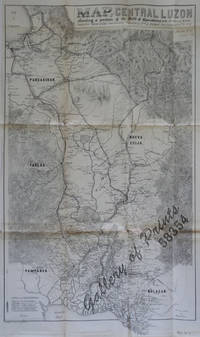
1899ref. 58354EXTREMELY RARE photo lithograph map. Condition: with folds as issued with professionally repaired tears and discolouration along folds. Reference: not in Quirino. Government Printing Office, Washington.
1900ref. 58356photo lithograph. EXTREMELY RARE very large map and probably the largest specifically Luzon map published during the Philippine-American War. Condition: with folds as issued with professionally repaired tears and discolouration along folds. Reference: Griffin #559 Government Printing Office, Washington.
2009ref. 62435BBNew York, PPP Edition, 2009. 4°. 32 x 23 cm. 440 Seiten. Gebundener Original-Pappband.
ref. 70456, Brepols, 2026 Hardback, Pages: 347, Size:156 x 234 mm, Illustrations:25 b/w, 22 col., Language: English. ISBN 9782503610641.
1937102p. Bookseller's label. Endpapers stained. 8vo. Original full cloth binding, slightly worn and soiled. Original priced dust jacket, inside flap clipped. Spine darkened with small loss at head and tail. Hardbound. First Printing. LIT BOX 2
1908ref. 68381908. Paris éditions Garnier Frères 1908 -Reliure pleine toile 11 5 cm x 18 cm 360 pages 107 gravures 3 lithos hors-texte de A. Broquelet - Texte de A. Broquelet et Léon Brégeaut - Mors fatigués sinon bon état
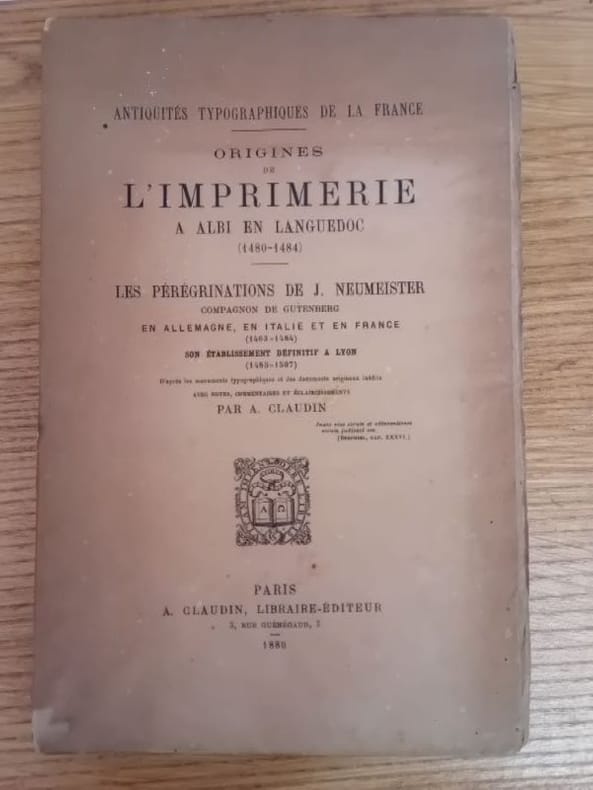
1880ref. 87581880 Paris Claudin 1880 16 x 25 cm Broché, couverture rempliée, sur-couverture vélin 104 pp Ex. sur Vélin, "Tiré à petit nombre". Envoi à "Mr L'abbé Albanès". 15 planches H.T. sur papier fort (dont une dépliante).
1875ref. 1246791875-1877 Lyon, Imprimerie d'Aimé Vingtrinier - 1875 (sur la page de titre) 1876-1877 (sur la couverture) - Fort in-4, reliure demi-toile bleu modeste, pièce de titre au dos, couverture d'origine conservée - 105 pages de gravures
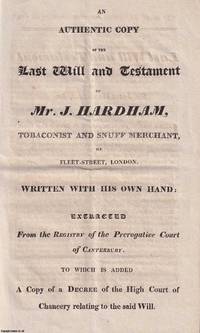
1814ref. 355419J. Baxter Printer Chichester 1814. Softcover Booklet - Unbound Pages. Fair condition. This composite publication is a rare survivor remarkable both for its regional reprinting of a parliamentary act and for its role in the legal disputes surrounding Hardham's estate. Hardham well known in his day as a Fleet Street tobacconist and friend of David Garrick left the interest from his property to support the poor of Chichester. His heirs contested the will arguing that the growing number of poor placed an unsustainable burden on the estate; the Chancery decree printed here records the failure of that challenge. Hardham’s business had flourished through Garrick's patronage at Drury Lane where his snuff was famously recommended from the stage and his shop appears in several contemporary engravings of Fleet Street. For further biographical detail see Warwick William Wroth's entry in DNB vol. 24. A highly unusual and scarce 1814 Chichester printing combining two eighteenth‑century texts: An Authentic Copy of the Last Will and Testament of Mr. J. Hardham Tobacconist and Snuff Merchant of Fleet Street London originally dated 1772 together with the Chancery decree concerning its provisions; and An Act for the better Relief and Employment of the Poor; and for enlightening the Streets Passages and open Places within the City of Chichester… first issued 1753. The two works are here issued as a single folio the Act 18 pp. placed before the Will 13 pp. As a result the Act has borne the brunt of two centuries of handling: the printed first page is markedly discoloured creased and edge-worn; the text shows browning turned corners and scattered contemporary annotations. By contrast the Will protected as the second item remains notably clean and largely unmarked. The final leaf blank save for a contemporary ink note shows the expected wear of a page long exposed and has in turn shielded the contents behind it. The folio has been lightly folded along its height suggesting it once travelled in a pocket or bundle of legal papers. Size: Folio 17 x 28 cms. Category: Antiquarian & Rare; Special Interest. This item may require more postage than the rates shown for delivery outside the UK. If extra postage is required we will contact you before processing your order and you will be given the details and option to decline the extra cost. J. Baxter, Printer, paperback
1930ref. ABE-3409155447Methuen London 1930 SIGNED in ink on the Front End Paper 'Jim and Roz Coxon from Alan Herbert July 1930'. No jacket and a bit scruffy but this a rare signed forst edition. Language: eng Language: eng 0.0 Language: eng 0.0 Language: eng 0.0 Language: eng. Signed by Author. 1st Edition. Hardcover. Very Good. Methuen London hardcover
1928ref. ABE-6610061219Jonathan Cape London 1928 Near Fine when the age 1928 is considered. This lacks a jacket but it does have a bright silver binding black spine and clean title label. A brilliant short story collection in a collectable state. Trimmed text block at the top the other two edges are untrimmed. Language: eng Language: eng 0.0 Language: eng 0.0 Language: eng 0.0 Language: eng. 1st Edition. Hardcover. Near Fine. Jonathan Cape London hardcover
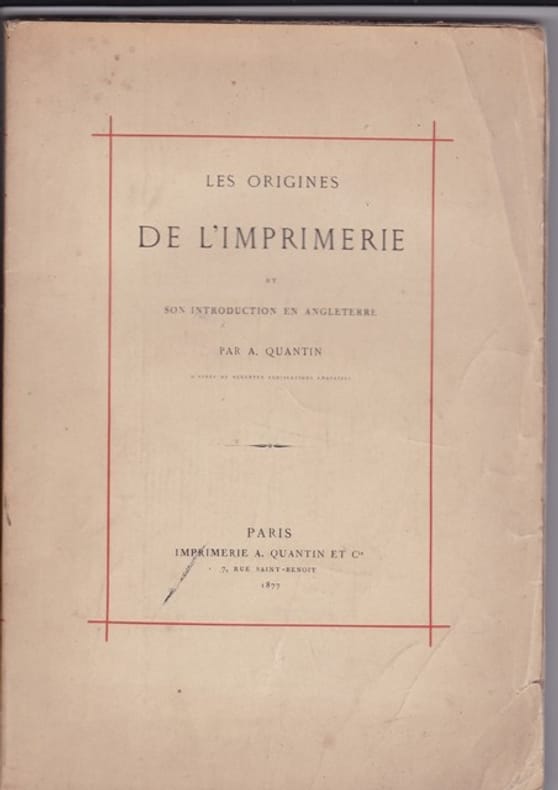
1877ref. 29FdParis Quantin 1877 In4 - broché - 70 pages - défauts aux plats - Tirage à 275 Ex - celui ci N. 272
8vo. 192 pp. With woodcut printer's device, headpiece and initial. Contemporary half vellum over marbled boards with faded handwritten spine-title. Second Italian, and second vernacular edition of the celebrated "Epistolae Magni Turchi", a best-selling 15th century literary invention by Laudivio Zacchia of Vezzano. Here translated by the ubiquitous Lodovico Dolce, these letters purport to represent the correspondence of Sultan Mehmet II, the conqueror of Constantinople and Byzantium (still alive at the time of writing), with governors and potentates from Persia to the Mediterranean islands, Greece, and Italy. Through this albeit fictitious collection Laudivio could highlight Turkish/Islamic territorial ambitions, as well as, by implication, political and ethical differences between East and West, not always to the credit of his Christian contemporaries. - A reissue of the 1562 first edition. The little collection proved hugely popular, calling for more than twenty incunabular editions, all now individually rare, and further reprints in the 16th and 17th centuries. - Occasional light brownstaining; lower corner of fol. C6 torn away, affecting a single letter; a tiny marginal paper flaw to fol. M2. BM STC-Italian 455. Göllner 1047. Blackmer 955. Edit 16, CNCE 26436. Tiraboschi, Storia della letteratura italiana III, 177.
Third edition, first Irish, small 8vo (157 x 95 mm), [6], 482pp., cont. calf, lower joints split but holding firm, morocco spine label, lettered in gilt. Provenance: The Lawes Agriculture Library, Rothamsted Research Institute.
Second edition, [182]pp., title in English and Bengali, text in Bengali throughout, slight browning of first few leaves, original cloth, printed paper label, a nice copy. Not in Darlow and Moule.