Diogenes Laertius.MareMagnum

8,065 results
15244to. (20), 391, (1) pp. With woodcut printer's device on final leaf and several woodcut initials. Contemporary vellum with faded handwritten title to spine. Rare Latin edition of the famous work. The Greek editio princeps was not to be published until 1533 (Froben). The translation is based upon that of the Camaldolese priest Ambrosius Traversari (1386-1439) and had been already printed in 1472; the present edition (edited by Curio and Michael Bentinus) is the first of the 16th c. and the first one to be printed in the German-speaking countries. “In Valentin Curios Planung seiner noch jungen Offizin, zudem aber vor allem erstmals in textlicher Revision und Ergänzung nach einer griechischen Handschrift” (Hieronymus). - Some waterstaining to the margins throughout, unattractive damage and small wormhole to edges near end (occasionally touching the printed marginalia). Several contemporary manuscript marginalia and underlinings. VD 16, D 1837. Adams D 486. BM-STC German 244. Hieronymus, GG 92. Schweiger I, 97. Hoffmann I, 568.
Third edition, 3 parts in one,16mo (115 x 78mm), ff. [4], 182, [2], 53 [i.e. 55], lacks final blank G8, occasional shaving of head-lines, some light damp-staining of the first 50 leaves, title of part 2 with small repair on outer blank margin, front free endpaper with small piece excised from upper margin, early nineteenth century marbled boards with paper spine and Ms. label, a nice copy. Jodocus Clichtoveus, Flemish Reformhumanist important and controversial Catholic theologian of the Reformation period; one of the most influential teachers at the Sorbonne in Paris, initially stood on the side of the humanists and suggested a result of religious disputes on the side of strict scholasticism. As followers of moderate reforms, he turned decisively against Luther. Provenance: Contemporary Ms. note on upper blank margin of title; ownership inscription of R. R. Duke, Rector of Birlingham, on front paste-down. Adams, 2199.
4to (193 x 134 mm). (52) ff., with large woodcut on title-page of a physician in his study, surrounded by books and jars, repeated on verso, as well as 66 half-page woodcuts of plants. Gothic type, 33 lines per page. An exceptionally large, broad-margined copy, with frequent contemporary Latin annotations (often untrimmed). Bound in brown morocco ca. 1900, all edges gilt. Ex-libris Fairfax Murray (his numbered label on pastedown, this copy described as #669 in his Catalogue). Light spotting throughout; lower blank corner of title-page discreetly repaired. With a handwritten letter enclosed from a curator at the Cambridge University Library, addressed to "Dr. Fleming" and dated 7th March [19]49, discussing this copy. The Fairfax Murray copy of a landmark botanical incunable, being the first or second illustrated edition of "one of the earliest Western documents showing a revival of interest in botany" (Hunt I, p. 4). Following unillustrated Italian printings in 1477 and 1482, the Genevan Jean Belot (printer of the 1495 "Fasciculus temporum", the 'Fardelet du temps') issued two variants of the present work, each employing 66 woodcuts illustrating the herbs of medieval medicine followed by an appendix of 12 (unillustrated) chapters on the medical qualities of various spices. Fairfax Murray cites this as the earliest edition in his collection, based on the state of the woodcuts. - Belot's two printings were imitated in a series of four further editions by his fellow Genevan printer Louis Cruse, also undated but easily distinguishable from the present ones due to their use of fewer woodcuts. Lökkös attributes the first edition to ca. 1495 and the present edition to ca. 1496, and claims that they must have been printed in quick succession: "L'erreur de numérotation des chapitres (xxix pour xxvi) n'est pas corrigée dans la deuxième edition. Ce fait semble confirmer l'hypothèse d'une sortie très rapprochée de la première. L'erreur 'cognoscre' du colophon se retrouve également dans l'exemplaire de la British Library" (Lökkös, p. 163). - Describing the medicinal properties of 77 herbs and spices, the work is written in 2,269 verses of Latin hexametre, a poetic form probably employed as a mnemonic device for physicians or apothecaries. In the 15th century, these verses were confused with a lost poem "De herbis" by the Augustan poet Aemilius Macer ['Floridus'], hence the attribution on the title-page. - "The text titled 'De Viribus Herbarum' (On Properties of Plants) has been traditionally attributed to Odo de Meung (Odo Magdunensis), who is believed to have lived during the first half of the 11th century and was from Meung on the Loire [...] The text was further expanded, including new data from the translation of Arabic texts into Latin in Salerno from the end of the 11th century onward. If this is the case, this text is good evidence of the continuity of scientific activity in the Middle Ages: its most ancient parts come from a period when there was a revival of interest in botany and a recovery of the classical tradition, while the most recent additions integrate the contribution of the Arabic world" (Hunt Botanical Library, online exhibition "Order from Chaos: The Birth of Modern Botany", 2009). - Having belonged to the celebrated collector, art dealer, and Pre-Raphaelite painter Charles Fairfax Murray (1849-1919), the present copy is in a magnificent state of preservation. Relative to the British Library copy, the present copy is much larger (193 x 134 mm vs 183 x 130 mm). It is unwashed, and most of the annotations by a contemporary pharmacist have been preserved almost in their entirety. The Fairfax Murray catalogue describes the binding as "brown morocco extra, gilt edges in rough"; the present copy is cited in most bibliographical studies of "De Viribus Herbarum" including that of Lökkös. Hain, Reichling, and the BMC fail to record the present variant with the error "cognoscre" on the penultimate line of the final leaf. Fairfax Murray #669 (this copy). On the chronology of the Genevan editions of Macer Floridus cf. Delarue in Genava 2 (1924), pp.177-86, and Lökkös, Catalogue des incunables imprimés à Genève, #86 (citing this copy); ISTC im00003000, showing 22 copies (of which 7 defective), including just 3 complete copies in US libraries; cf. also Hunt, I, p. 4; Goff M-3; Klebs 637.2; Hain/C. 10418; BMC VIII 371 (none of which notes the variant "cognoscre").
(8) SS. Papierner Heftstreifenrücken. 4to. Seltene humanistische Elegie auf Christi Himmelfahrt; eine von zwei Druckvarianten im selben Jahr. - Minimal braunfleckig; kl. Wurmspur. Wohl einem altem Sammelband entnommen; am Titel alte hs. Numerierung "18". VD 16, S 9121.
Crown 16mo in 8s (12 x 8 cm). 229, (11) pp. With a 6-line space (with a printed guide letter) left for a manuscript initial (not filled in) and 2 vine-leaf ornaments, Vervliet 56 & 80. Set in 3 sizes of roman type, the smallest including special pharmacological characters. Modern sheepskin parchment, but with gilt edges perhaps from an earlier binding. Only known copy of the Jean Ruel issue of the very rare second (?) Paris edition of one of the most important early pharmacological books, with about 250 medicinal recipes arranged alphabetically, written by Thibault Lespleigney (1496-1550), apothecary and professor of medicine and pharmacology at Tours, where he first published it as Dispensarium medicinarum in 1538. It inevitably owes something to the ca. 1100 Antidotarium Nicolai, first printed in 1471 and almost the only comprehensive book on the subject when Lespleigney wrote, but it also foreshadows the pharmacopoeias. The term pharmacopoeia (meaning drug-compounding) was coined only in 1561, but is now used to refer to a collection of recipes officially authorized by a government or medical or pharmaceutical association, the first being Valerius Cordus, Dispensatorium (Nürnberg, written in 1542 but published posthumously in 1546). Before that books of recipes by leading pharmacologists served a similar role without any official authorization. Lespleigney's was the most important in France and enormously influential. About 10 editions appeared from 1538 to 1543 in Tours, Lyon, Paris and even Antwerp and Venice. François Chappuys revised, corrected and expanded Lespleigney's text for the second edition (Lyon, 1539), giving it the present title, and nearly all later editions, including the present, follow his revised text. The present edition clearly resembles Arnoul and Charles l'Angelier's 1541 Paris edition in style and layout, but does not follow it line by line. We have not seen the 1540 l'Angelier edition, with the same pagination as 1541, so they may be two issues of a single edition. We have also not seen what may be other issues of the present 1543 Paris edition, reported under various publishers: Jean Foucher, Vivant Gaultherot and Jean du Chemin. All three have the same pagination as the present edition, and at least the Gautherot shares a misprint (p. 206 numbered "209"), the same collation and the same VD16 fingerprint (ame- s,m- g*i* mepr, based on A2r, A6r, A7r and A7v: VD16 fingerprints substitute "*" for "æ"). So we probably have one or two Paris editions in 1540 and 1541 serving as the model for a 1543 Paris edition in four simultaneous issues. The USTC reports 2 copies of the 1540 Paris edition but no other Paris edition or issue. The Bibliotheque Nationale has a copy of the Du Chemin issue of the 1543 Paris edition and notes 2 further copies of the edition, in London (Foucher issue) and Stuttgart (Gaultherot issue). ICCU reports another at the Bibliotheca Comunale Ariostea in Ferrara (Gaultherot issue) and gives its VD16 fingerprint. The Casanata Library in Rome has a copy of the 1541 Paris edition, viewable on Google Books. All editions are very rare: the USTC records 0 to 3 copies for most and more (5 or 7) only for two editions: Venice 1542 and Lyon 1543. After 1543, Lespleigney's work lost popularity, perhaps due to the success of Cordus's 1546 Dispensatorium, but further editions appeared at Lyon under the title Enchiridion from 1546 to 1561, and the only other known Ruel edition appeared at Paris in 1567 (BMC STC French), all still very rare. - The book collates: 16mo: A-P8 = 120 ll., with I1, I3, K1 and K3 missigned K1, K3, L1 and L3 respectively. It is imposed with two 8-leaf quires worked together in each sheet (except that quire P may have been imposed alone, work and turn), so that each pair of consecutive quires contains one watermark divided at the upper fore-edge of leaves 5 and 6 in one quire, and the point-holes fall at the foot of leaves 3 and 4 (on the line where the sheet was divided to make two quires, so half of a point-hole can appear along the edge). Quire B shows a watermark shield (bearing a merchant's mark with some sign or letters above an upside-down 4) topped by a quatrefoil and with a letter or letters(?) below (about 38 x 18 mm, centred in a 21 mm space between chainlines); quires C, E, G, K, L and O show a watermark crown (about 26 x 23 mm) topped by a quatrefoil, with 3 circles in the slightly arched base and letters(?) below (possibly M followed by a curl, or SM), centred on a chainline, with about 22 mm between chainlines. - The fore-edge fold of H5/6 was carelessly opened, so that the upper outside corner of H5 is attached to H6 instead of H5, a couple pages show minor smudges and there is an occasional small marginal stain or tear, but the book is otherwise in very good condition and almost untrimmed, so that the tears that divided the sheets into half-sheets are mostly preserved at the foot (revealing point holes on several leaves) and part of a fore-edge fold survives. The boards are slightly bowed but the binding is also in very good condition. Unique issue of a very rare early edition of a rare but popular and influential pharmacological book of about 250 medicinal recipes: a predecessor of the pharmacopoeias that appeared in and after 1546. Cf. BM-STC French 263 (1576 Ruel ed.). Durling 2801-2803 (Venice 1542, Lyon 1543 & Lyon 1556 eds.). Moreau 1536-40, no. 1863 (1540 Paris ed.). Schelenz, Geschichte der Pharmazie, pp. 437-438 (1538 & 1542 Tours eds.). USTC 147783 (2 copies of 1540 Paris ed.). Dorveaux, Notice sur les vie et les oeuvres de Thibault Lespleigney (1898), pp. 46-48 (1543 Paris ed., Du Chemin issue). Claude Viel, Deux figures du monde pharmaceutique Tourangeau: Thibault Lespleigney et Maurice Javillier, in: Revue d'Histoire de la pharmacie, pp. 239-245, at pp. 243-244 (Tours 1538, Lyon 1539 & Tours 1542 eds.). KVK & WorldCat (4 copies of the 1543 Paris ed.: 2 Gaultherot, 1 Foucher & 1 Du Chemin). Not in Adams; Brunet; Garrison & Morton; Graesse; Heirs of Hippocrates; Honeyman; Norman Library; Osler; Waller; Wellcome Library.
15908vo. (4), 192, (12) pp. With woodcut printer's device to t. p. and four large woodcuts. 18th-c. dark brown calf (damaged). Second edition of the well-known book on Roman dining habits, first published in 1588. Also contains relevant texts by classical authors such as Ovid, Terence, and Propertius. Rare Sanctandreana imprint; usually encountered with Commelin's name on the title page (only two copies thus in VD 16). The large woodcus show various feasts. - Binding rubbed; extremities severyl bumped. Interior somewhat brownstained and with 17th-c. marginalia (trimmed by binder's knife upon rebinding c. 1750); numerous later pencil underlinings. VD 16, ZV 3209. IA 135.411. Adams C 1630. Vicaire 174. Georg 22. Palau 66773. Not in BM-STC German.
8vo. 79, (1) pp. - (Bound after) II: Mock, Jakob. De causis concretionis et dissolutionis rerum quarundam, tam extra quam intra corpus humanum. Tractatio historica, philosophica et medica, secundum veterum ac recentiorum placita descripta, & in tres partes distributa. Freiburg im Breisgau, Martin Böckler, 1596. (16), 288, (14) pp., final blank leaf. Contemporary full vellum; lacks ties. Final and best 16th century edition of this alchemical work originally written in Arabic, the first edition having appeared at Paris in 1559. The legendary Byzantine monk Morienus is said to have gone to Alexandria to study with the Arabian scholar Adfar, whose favourite student he became. Subsequently settling in Jerusalem as a hermit, he devoted his life to the hermetic arts before he learned that Khalid, the Sultan of Egypt, "was desirous to find some one who could interpret for him the writings of Hermes and of Adfar" (Ferguson II, 109). Morienus supposedly went to Egypt and instructed Khalid in the art of creating the elixir for the philosopher's stone. "The ultimate fate of Morienus is unknown, but his conversations with Kalid must have been committed to writing, and they may have come to the West about the time of the Crusades. They were in Arabic, but to make them available they were translated into Latin in February, 1182, by Robertus Castrensis, with a short preface" (Ferguson). No Arabic sources have been discovered, for which reason the attribution has been considered apocryphal, but the author does use chemical terminology with Arabic roots, such as "al-natron". The book marks the beginning of western preoccupation with alchemy, previously almost entirely unknown in mediaeval central Europe, and even Goethe quotes from it in his "Theory of Colours". - II: Bound first is a rare medical work by Jakob Mock, professor at Freiburg and a good friend of Fabricius Hildanus. This would seem to be part 1 only (caption title: "De aquarum quarundam affectionibus ratione coagulationis vel indurationis & dissolutinis, & alias"); no more published. - Unidentified 19th century library stamp to front pastedown. Covers slightly warped; long yapp edge of the vellum binding trimmed away along lower half of the book. Interior lightly browned, some light, mainly marginal spotting and brownstaining, a few darker spots occasionally affecting letters. Old handwritten ownership of "Claudius Cuppinius" on title-page of Mock's work, with an additional note in the same hand, dated 1691, on the flyleaf. I: VD 16, M 6354. Wellcome 4458. Neu 2849. Duveen 413f. Schmieder, Geschichte der Alchemie, p. 123. Brüning 646. Mellon Collection 50 (illustrated p. 160). Cf. Ferguson II, 108f. Not in Adams or BM-STC German. - II: VD 16, M 5707. BM-STC German 623. Adams M 1528. Durling 3199. Wellcome 4372. Jöcher III, 563.
engraved vignette on title, 2 folding plates, index at end,125, [17]pp. Two works in one, 12mo, bookplate of Revd., Geo., Innes, College, Warwick. contemporary calf, upper cover detached, lower joint a little wormed, gilt title and date on spine.
1547(32) SS. Mit 2 verschiedenen großen Holzschnittdruckermarken am Titel und am letzten Bl. recto. Mehrere figurale Holzschnittinitialen. - (Beigebunden) II: Ders. De proportione papae ad concilium, et de utroque eiusdem principatu, ad sanctiss. D. N. Iulium III Pon. Max. [Parma, Seth Viotti, nicht vor 1550]. (84) SS. Mit großer Holzschnittdruckermarke am Titel. - (Beigebunden) III: Muzio, Girolamo. De Romana ecclesia tractatus. Pesaro, [Erben nach Bartolomeo Cesano], 1563. (30) SS., l. w. Bl. Mit großer Holzschnittdruckermarke am Titel. Flexibler Pergamentband der Zeit. 4to. Jeweils erste Ausgabe dieser kirchenrechtlichen Traktate. Der aus Parma gebürtige italienische Philosoph, Mediziner und Theologe Cesare Delfini (gest. 1566 in Rom) betätigte sich auch als Astronom (vgl. Hoefer XIII, 462); der italienische Humanist und Polemiker Girolamo Muzio (1496-1576) "widmete sich seit 1551 ganz dem Studium der religiösen Fragen" (LThK). - Die Vorsätze etwas stärker gebräunt; am Titel zeitgenöss. hs. Besitzvermerk der Wiener Jesuiten; am vorderen Innendeckel späterer hs. Signaturvermerk der Wiener Unbeschuhten Augustiner (18. Jh.). I: BM-STC Italian 212. IA 151.044. Bongi I, 200. Edit 16, CNCE 16420. - II: IA 151.046. Edit 16, CNCE 16421. - III: BM-STC Italian 458. Adams M 2078. Edit 16, CNCE 47054. Vgl. LThK VII, 400.
4to. 32 pp. With printer's woodcut device on the title-page and different device under the colophon; several woodcut initials. Followed by a 49-page manuscript index (beginning with instructions to the "amice lector" on the verso of the colophon) on 28 blank leaves bound after the printed text. 19th century boards with red morocco spine lettered and decorated in gilt. The first edition of the 16th century: a very rare reprint of the incunable published in 1494, the first separate edition to be based on the criticism of the Renaissance scholar Ermolao Barbaro. Dedicated to Pope Alexander VI. Mela's description of the ancient world, based on good sources and written during the reign of Emperor Claudius, is the oldest Roman geography to have survived. This edition was not equipped with an index, but a contemporary humanistic owner rectified the fault by crafting his own: the humanistic "cancelaresca" manuscript provides a list of all cities, places and even subjects mentioned, a total of some 1,000 references to 227 paragraph numbers (which the owner, too, provided in brown ink throughout the inner margins of the book). - Occasional slight foxing and waterstaining to margins near end, but a fine copy of this rare book. Edit 16, CNCE 58712. Schweiger II.2, 606. Ebert 13608. Graesse V, 401: "Reimpr. rare de l'edition ... de 1494". Not in Adams, BM-STC Italian, or Riccardi. Not in Brunet or Dibdin.
4to. (4), 62, (6) pp. With woodcut printer's device on title page (repeated on final page) and 3 woodcut initials. Sewn. Early edition of a frequently reissued manual on classical coins, measurements, and weights, edited and introducted by Giovanni Battista Egnazio. Page 58 gives the diagram of an ancient measurement. - Slightly browned throughout. Apparently removed from an old sammelband; contemporary marginalia on p. 13 trimmed by binder's knife. Old ownership and notes on the preserved lower wrapper cover or interleaf. VD 16, P 4394. BM-STC German 713. Cf. Heckethorn (The Printers of Basle) 114, 6 (1530 Hieronymus Froben edition). Not in Adams.
8vo. (16), 279, (23) pp., final blank f. Half vellum using a leaf from an antiphonary. First Latin edition of Alessio's "De secretis", still in six books. The author is commonly identified with the alchemist Girolamo Ruscelli (1520-66). "Das Werk gehört nach Caillet zur 'haute philosophie hermetique'. Es enthält außer alchemistischen auch viele kosmetische Rezepte, ferner solche gegen Pest, Schlangengift, Ungeziefer, wie auch Konfekt, Einmachen von Früchten, Druckerschwärze, Putzmittel, Schlafmittel usw., des weiteren sehr frühe Beispiele zur Syphilis-Therapie und Arsenikverbindungen zur Haarvertilgung" (Horn/Arndt). "Une des premières éditions de ces célébres secrets que l'on considère comme merveilleux. Quelques personnes qui ont fait l'essai de plusieurs affirment que les résultats sont prodigieux" (Caillet). Sections on making wine, ink, soap, toothpaste, etc. From 1569 onwards Perna also published a German translation. - Somewhat brownstained and waterstained throughout; a few contemporary marginalia; extensive notes by a contemporary hand on reverse of title-page and at the end. Very rare; no copy in auction records of the past decades. VD 16, R 3835. Durling 110. Wellcome 178. Ferchl 455. Ferguson I, 22 (note). Duveen 15 (note). Cf. Caillet I, 177ff. Rosenthal 754. Graesse (Bib. magica) 50. Simon 33.
4to. (16), 56 (misnumbered "59"), 78 pp. Two parts with woodcut printer's device to title-page, bound separately in modern wrappers. First edition. - A treatise on wedding ceremonies and marriage law by the French jurist Brisson (1531-91), drawing on classical authors such as Aristotle, Cicero, Pliny, Ovid, Seneca, and Plutarch. Brisson was privy councillor to King Henry III, was promoted to Président a Mortier in 1580 and assigned First President of the Parliament by the Catholic League in 1589. - Some notes and underlinings in ink. Paper somewhat brownstained and waterstained at the margins, slightly wormed. BM-STC French 82. Adams B 2849. Cf. Jöcher I, 1385f ("De veteri ritu nuptiarum et iure connubiorum").
75 Bll., l. w. Bl. Mit Wappenholzschnitt am Titel. Halbpergamentband. Dreiseitiger Farbschnitt. 4to. Seltene zweite Ausgabe (die erste in Deutschland gedruckte) des oft aufgelegten und übersetzten Werks: eine Geschichte des sogenannten Mailändischen Kriegs, der zunächst zur Vertreibung, schließlich aber zur Wiedereinsetzung Francesco Sforzas II. als Herzog von Mailand führte. Der italienische Schriftsteller und Staatsmann (1487-1537) Capella war Sekretär des Herzogs und zeitweise auch Minister; er berichtet hier als intimer Kenner der Ereignisse und Hintergründe. - Stellenweise unbedeutend braunfleckig; es fehlen die Vorsatzblätter. Gutes Exemplar. VD 16, C 792. BNHCat C 204. BM-STC German 179. Adams C 582. IA 131.486.
16 SS. Mit figürlicher Holzschnitt-Initiale. Marmorbroschur. 4to. Seltene erste Ausgabe dieser Papst Paul III. gewidmeten Abhandlung, angeregt vom Fall eines deutschen Mädchens namens Margarete Weiss, das zwei Jahre lang ohne Essen und Trinken auskam. Über denselben Gegenstand hatte bereits 1542 Gerard Bucold in Paris eine Schrift veröffentlicht. - Der auch als Verfasser medizinischer Schriften in Erscheinung getretene Philosoph Simone Porzio (1497-1554), ein Schüler Pietro Pompanazzis, wirkte als Lehrer der Philosophie in Pisa und Neapel. Er vertrat gegen die Widerstände des Klerus die Sterblichkeit der individuellen Seele (vgl. Ziegenfuß II, 304). - Schöner, eleganter Antiquadruck, teils leicht braunfleckig. Aus der Bibliothek des Medizinhistorikers Walter Pagel (1898-1983). Edit 16, CNCE 34589. BM-STC Italian 537. Durling 3746. Wellcome I, 5222. Bird 1990. Brunet IV, 830. Graesse V, 419. Hirsch/H. V, 660. Osler 3726. Vgl. Adams P 1963. Nicht bei Eales (Cole Library), Ebert, Lesky oder Waller; nicht in Wolfenbüttel.
First Edition, 4to, [viii],207,[9]pp., title vignette, two old small neat stamps, half calf, marbled sides, slightly rubbed.
8vo. (24), 168, 26, (5), (1 blank) pp. With woodcut device on title-page and a woodcut portrait of Rondelet at the last page of the preliminaries. Contemporary limp sheepskin parchment. Very rare first edition of an early pharmalogical book by the famous French phycisian, naturalist and botanist Guillaume Rondelet (1507-66), professor at the university of Montpellier, best known for his work on fishes De piscibus marinis (1554), the standard work on ichtyology for over a century. He was a good friend of Rabelais, whose character Rondibilis is said to be based on Rondelet, and among his students appear prominent names such as Clusius, Lobel, Gesner and Belon. The present work primarily deals with weights and measures used in medicine, with at the end a 26-page index with about 35 entries per page, listing both herbs and medicines. A second edition was published a year later by Plantin, followed by other editions in 1563 and 1564. - With owner's inscription of Pierre Gauthier (late 19th century?) on flyleaf. Waterstain at the head and fore-edge margin and the binding slightly soiled and rubbed along the extremities, otherwise in good condition. USTC 113136 (5 copies). Cf. Durling 3925 (1563 ed.); Voet (1561 Plantin edition); Wellcome 551 (1561 and 1564 eds.); for Rondelet: DSB XI, 527f.; Hagelin, Old and rare books on materia medica, p. 102.
1566Large 8vo. (20), 424 (not: 423) pp., 1 bl. f., (18) pp. With woodcut printer's device on t. p. Contemp. blindstamped pigskin, monogrammed and dated "I.V.S | 1566". Wants ties. First edition, first printing, of this first and most important biography of Melanchthon. Camerarius was able to consult a large amount of personal correspondence, a fact which makes this work a valuable source to this day. - Wide-margined copy, slightly browned with insignificant waterstain near upper edge. Slight worming to t. p. repaired; numerous contemp. marginalia. The appealingly blindstamped binding can be attributed to the Swabian bookbinder Wolfconrad Schwickart (cf. Goldschmidt, Gothic & Renaissance Bookbindings 227). Somewhat rubbed; modern front pastedown. From the library of Neidstein castle in in the Oberpfalz region of Bavaria. VD 16, C 502. IA 130.520. Hartfelder 624, 43. Schottenloher 15023. Ebert 3391.
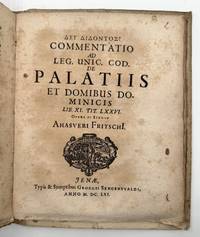
1661ref. 372198Cologne: Kinchium 1661. Mallinckrot: Engraved additional title dated 1639. 20 125 11pp. Kortholt: 8 56pp. Fritsch: 6 74 2pp. 4to. Early drab paper boards alla rustica binding on three cords manuscript title on spine text uncut. Foxing and heavily toned. Provenance: Princes of Liechtenstein armorial bookplate. Mallinckrot: Engraved additional title dated 1639. 20 125 11pp. Kortholt: 8 56pp. Fritsch: 6 74 2pp. 4to. Mallinckrot's monograph published on the occasion of the celebration of the second centenary of Gutenberg's invention is the first thorough investigation of the early testimonies to the discovery of printing with the author in favor of Mainz against Haarlem. The work contains the first use of the word "incunabula" in connection with printing. The additional title engraved by Loeffler includes portraits of Gutenberg Faust and Shakespeare and a scene in a printing shop. The second work here bound following Mallinckrot is Protestant theologian Kortholt's study on the origins of mathematics and astronomy asserting the Greeks were taught by Chaldeans and Egyptians. Bigmore & Wyman 2:16 Kinchium unknown books
1661ref. 372198Cologne: Kinchium 1661. Mallinckrot: Engraved additional title dated 1639. 20 125 11pp. Kortholt: 8 56pp. Fritsch: 6 74 2pp. 4to. Early drab paper boards alla rustica binding on three cords manuscript title on spine text uncut. Foxing and heavily toned. Provenance: Princes of Liechtenstein armorial bookplate. Mallinckrot: Engraved additional title dated 1639. 20 125 11pp. Kortholt: 8 56pp. Fritsch: 6 74 2pp. 4to. Mallinckrot's monograph published on the occasion of the celebration of the second centenary of Gutenberg's invention is the first thorough investigation of the early testimonies to the discovery of printing with the author in favor of Mainz against Haarlem. The work contains the first use of the word "incunabula" in connection with printing. The additional title engraved by Loeffler includes portraits of Gutenberg Faust and Shakespeare and a scene in a printing shop. The second work here bound following Mallinckrot is Protestant theologian Kortholt's study on the origins of mathematics and astronomy asserting the Greeks were taught by Chaldeans and Egyptians. Bigmore & Wyman 2:16 Kinchium unknown
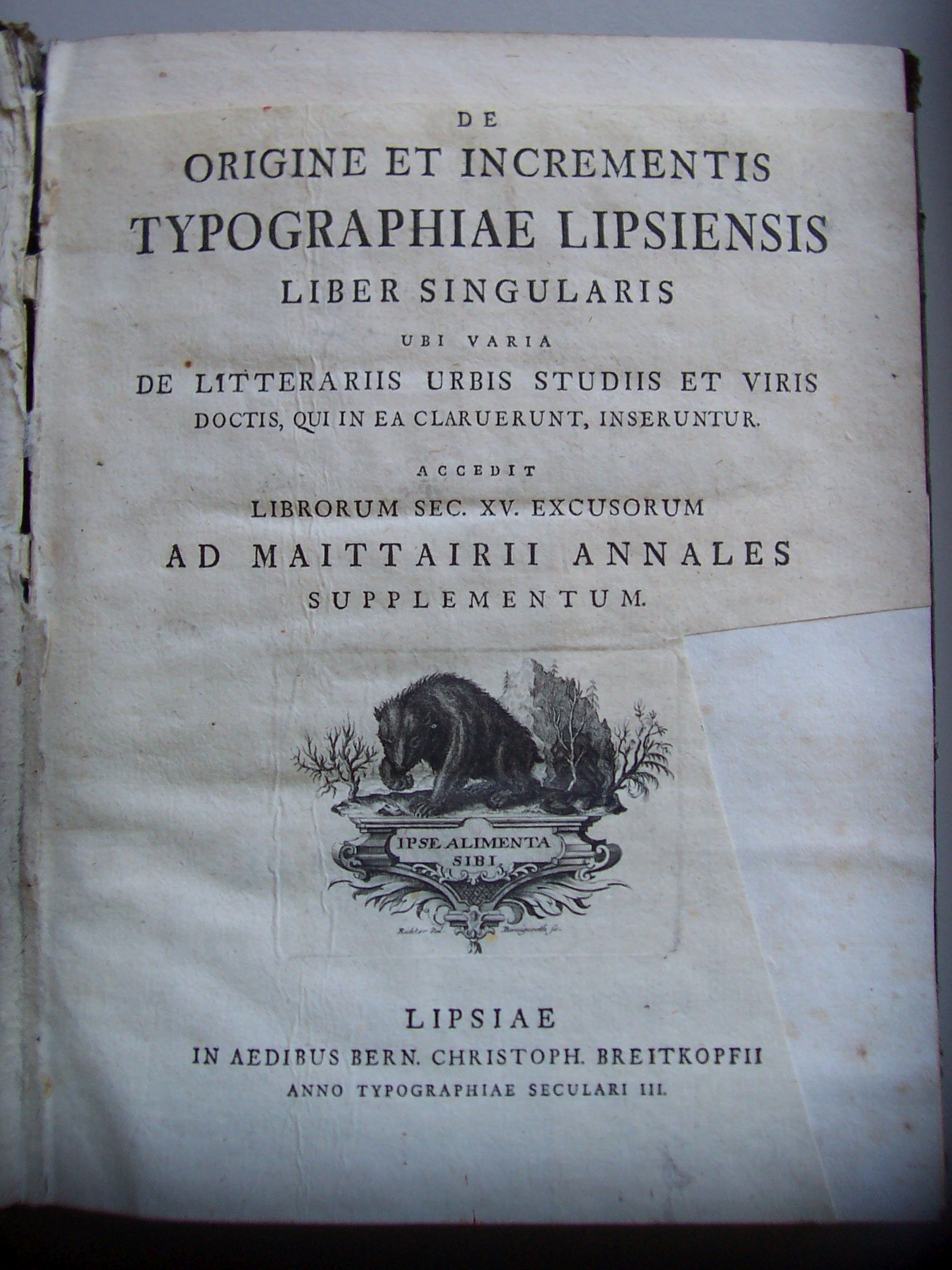
1740ref. 187774Leipzig, Breitkopf & Härtel, (1740). Kl.-4°. M. gest. Tit.- u. Kopfvign. (Druckerei). 4 Bl., 147 S., 10 Bl. weiß. Schlichter Ppbd. d. Zt. Einbd. stark beschabt u. bestoßen. Papierbezug am Rücken teils fehlend. Vord. Vorsatz fehlt. Notiz von alter Hd. a. Innendeckel. Größ. hinterl. Ausschnitt a. Tit. Gebräunt, teils leicht braunfl. 1 S. m. Randmarginalien.
4to. 162 pp., fol. 163-164, (2) pp. (a-s4 t6 u6, without the 'Epigrammata' announced on the title). With woodcut title border and a border in the text by Hans Holbein the younger, 2 woodcuts in the text (1 full-page) by Ambrosius Holbein, and 6 woodcut initials; printer's device on final page. Modern giltstamped full calf. Rare third, revised edition (the first one printed in Basel) of the famous "ideal state" novel that gave its name to a whole literary genre. Edited by Erasmus of Rotterdam, whom More had sent the manuscript in 1516. The second part, about the ideal constitution for a state, was written first, while More was an envoy in Flanders in 1515, while part one was written only in 1516, after his return to England. The two woodcuts by Ambrosius Holbein, Hans's elder brother, include the famous bird's-eye view of the island of Utopia (a full-page illustration) and the charming scene showing the story's fictional traveller, Raphael Hythlodaeus, in discussion with More himself and his Antwerpian friend Peter Gilles (Aegidius), with More's young assistant John Clement (later to become a Royal Physician and More's son-in-law) approaching them. Like 'Gulliver's Travels', Utopia was written "as a tract for the times, to rub in the lesson of Erasmus; it inveighs against the new statesmanship of all-powerful autocracy and the new economics [...], just as it pleads for religious tolerance and universal education [...] More had all Swift's gift for utterly convincing romance: the beginning, when Rafael Hythlodaye recounts his voyages, has a vividness which draws the reader on into the political theory. [More] is a saint to the Catholic, and a predecessor of Marx to the Communist. His manifesto is and will be required reading for both, and for all shades of opinion between" (PMM). - Insignificant browning; endpapers somewhat fingerstained, but a beautiful, clean copy. Handwritten ownership of Gerard van Assendelft, dated 1603, at the top edge of the title-page. VD 16, M 6299. Adams M 1756. Panzer VI, 205, 222. Isaac 14177. Heckethorn 100, 90. Bezzel (Erasmusdrucke) 912. Hieronymus 260. Kat. Basel 1960, 343, 341, 120f. Gibson 3. Van der Haeghen III, 41. Cf. PMM 47.
First edition, CLII, 90pp., illustrs., orig. printed wrappers.
4to (142 x 196 mm). 51, (1) ff. Modern half calf using 18th century gilt calf spine and modern marbled boards. Rare second edition of Agostino Ricci's "De motu octavae sphaerae", edited by the French mathematician Oronce Finé, originally published in 1513 by Giolito in Trino. Discussing both spherical geometry and kabbalistic theories, the treatise denies the existence of a ninth heavenly sphere by refusing a presumed oscillation of equinoctials and the connected variation in the ecliptic. Ricci (Ricius) was a disciple of Abraham Zacuto, a Spanish Jew who moved to Portugal after the 1492 expulsion of Jewish people from Spain, and whose perpetual almanac was used for all navigational tables (including Vasco da Gama's ones) from its publication in 1496 until Nunez's tables of 1537. - This edition is an important work also for the history of typography. Colineus was one of the pioneers who introduced Italian Renaissance typography to France. This movement, which established many of the still-present typographical idioms, would culminate in the 1530s with books featuring the Roman types developed by Claude Garamond and other masters. - Issued without the "Epistola" mentioned on the title-page (as explained in the colophon). Annotated throughout in a rather rough contemporary hand with numerous underlinings and manicules. An excellent copy. BM-STC French 376. Adams R 519. Steinschneider 2143ff. Houzeau/Lancaster 2355. Lalande p. 42. NUC pre-1956, NR 0236124. Renouard (Colines), p. 22. BN 151, col. 716. OCLC 31083036.
Folio. (12), 157, (2), (1 blank) ff. With the title within a decorative metal-cut (?) panel. Set in roman types. Contemporary limp sheepskin parchment; rebacked in calf, with new endpapers, but preserving the original paste-downs. First edition of Jean Ruel's translation into Latin of Dioscorides's standard work on pharmacology, "De materia medica" (books 1-5), the most important botanical book up on to the 16th century, followed by four books on poison "De venenis" and "De venenatis animalibus" (books 6-9). - Dioscorides (ca. 40-90 AD), a Greek in the service of the Roman Empire, assembled all that was then known concerning the medicinal uses of plants, animals and minerals, adding information from his own experience accompanying the Roman army to Spain, the Middle East, North Africa and elsewhere, where he came to know many Persian, Indian and other exotic medicines. Though his work appeared in Latin from 1478 and in the original Greek from 1499, the present translation by Jean Ruel was first published here. "Often considered a herbal, [it] deals with all three natural kingdoms: plant, mineral and animal. It describes all the substances known to Dioscorides that were used as primary ingredients for medicines, and constitutes an encyclopedia on the topic. ... [It] contains just over one thousand chapters [each dealing with another medicine] and features 794 plants, 104 animals and 105 minerals. Most of the chapters contain the following information: the most common name of the drug and its possible synonyms; a description of the natural element producing the drug (for a vegetal drug, the whole plant); the part used as a drug, possibly with its preparation; the therapeutic properties of the drug; the diseases for which the drug was used, including the preparation and administration of the medicine; when appropriate, the falsifications and methods of authentication of the drug; and other uses of the drug, such as in cosmetics, veterinary medicine, of handicraft" (Glick). - "While Hippocratic and Galenic medical theory and practice were readily adopted by the physicians of the Islamic era-a system that has persisted down to our time in traditional and folk medicine throughout the Near and Middle East, it was the Ketâb al-haoaes (Book of the herbs), a translation of Dioscorides' famed treatise on materia medica by Estefan b. Basîl and his master the celebrated physician-translator Honayn b. Eshaq (b. 192/808 at Hira), that constituted the original source of knowledge and inspiration for medical and pharmacological writers … in the lands of Islam in the Middle Ages and afterwards. Dioscorides described approximately 600 plants, mainly of the Mediterranean area, providing for every item equivalent names in some other languages, its provenience, a short morphological description, and then a statement of its medicinal properties and uses. Dioscorides was held in great esteem by all the physicians and scholars in the Islamic period" (Encyclopaedia Iranica). - With embossed initials on leaf d5. Title-page slightly thumbed, a waterstain at the foot of the last few leaves, but otherwise internally in very good condition. Binding soiled. Durling 1139. USTC 144550. Wellcome I, 1782. Cf. T. Glick, Medieval science, technology and medicine: an encyclopedia, p. 152.