DEACON RichardMareMagnum

8,143 results
19768vo., First Edition, with a portrait frontispiece and numerous illustrations and plans (a number full-page) in the text; cloth, a very good, clean copy. EDITOR'S WORKING COPY, WITH NUMEROUS ANNOTATIONS AND REVISIONS IN A NEAT HAND THROUGHOUT; PAGES 97-98 CUT TO EXCLUDE ONE ILLUSTRATION ('Caxton and his Press from a painting by Vivian Forbes). SOLD WITH TWO A.L.s. FROM THE AUTHOR TO HIS EDITOR AUDREY WILLIAMSON (AT FREDERICK MULLER) DISCUSSING WORKS IN PROGRESS (IN PARTICULAR THE AUTHOR'S 'THE HISTORY OF THE JAPANESE SECRET SERViCE' ALSO PUBLISHED BY MULLER IN 1982) AND A RELEVANT CUTTING.
4to, 206pp., of typescript, from the library of Owen Morris, orig. cloth.
4to, 300pp., frontis., facsimiles, orig. cloth, d.w. slightly torn.
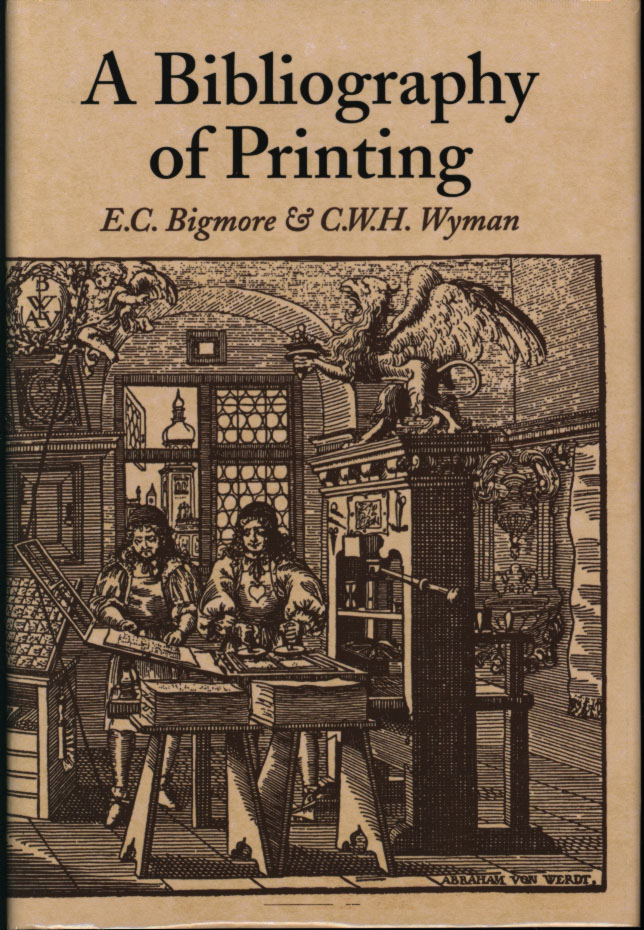
Second Edition, 484pp., limited to 450 copies, orig. cloth. Philip Gaskell has presented 129 additions and amendments to 724 entries, including 56 completely new entries and 20 entries for editions previously not seen but since discovered.
First edition, 420pp., illustrs., orig. cloth, d.w. 724 Items fully described.
3 Vols., in one, illustrs., in the text, orig. cloth, d.w. Since its original publication in 1880 this famous work has established itself as the greatest work in its chosen field. Many thousands of books and monographs are fully described, many with detailed collations.
2001ref. 6616EBDelaware/London, Oak Knoll Press & The British Library, 2001. Groß-8°. 23,5 cm. Nicht durchgehend paginiert. Original-Pappband. Original-Schutzumschlag.
3 Vols., in one, 56; 80; 42, xxivpp., one of 75 copies on large paper, four of the leaves in the first section (pgs 9/10, 19/20, 25/6 and 37/8) with tears (no loss of text), orig. cloth, hinges worn, spine a little creased, uncut.
3 Vols., in one, 12mo, 56; 80; 42, xxivpp., one of 275 copies, cont. half calf, corners rubbed, edges marbled. Bound with: GOLDSMID (Edmund) Some Political Satires of the Seventeenth Century. Edinburgh: Privately Printed, 1885. 2 vols., 62; 75pp., one of 275 copies.
Second Edition, 3 vols., frontispiece in each volume (offset), 9 plates, illustrs., in the text, orig. cloth, hinges torn, one spine lacking. Windle & Pippin A38b; Jackson 49.
First edition, 3 vols., bound in 4, 4to (279 x 185 mm), ONE OF 100 COPIES PRINTED ON THICK AND LARGE PAPER WITH EXTRA PLATES, [4], xxv, [7], 462,lxxix, [1]; [2], 555, [1]; [2], 298; [2], 299-622, lxiipp., with the author's wood-engraved device on each title-page, a wood engraving of the elaborately-quartered coat of arms of the Roxburghe Club on the dedication page, 85 engraved plates ((including the private plate of 'Diana de Poictiers' in vol. 2, which was apparently destroyed after only 50 copies had been printed, and a proof of the 'Prater' plate in vol. 3), 62 illustrations printed on fine and thin "India" paper and mounted on the text leaves, 55 other illustrations in the text, with the additional sixty engraved plates on 52 leaves from Lewis' Series of Groups bound in at the appropriate places as designated by Lewis in his 'Directions to the binder', contemporary notes in pencil to several endpapers and a few within the text, text and plates have staining of varying degrees, pale stain to many lower margins, a little damage to endpapers where bookplates have been removed, full red hard grain red morocco,,covers waterstained, spines lettered in gilt, all edges gilt. Unfortunately this handsome large paper copy has suffered from water damage sometime in the past, additional photographs are available upon request. This set with the additional set of etchings on india paper by George Lewis, of a classic work of the utmost importance for its wealth of eye-witness information and anecdotes about printed books, manuscripts, buildings, other artefacts and people, both from past centuries and from the author's own day, for the extraordinary collection of illustrations, mostly drawn during the tour itself, and finally as a sumptuous piece of book production. As soon as the book appeared, leading scholars derided Dibdin for his lack of scholarship, especially concerning early manuscripts and printed books. But one must distinguish between the extensive and extremely useful information about things and people Dibdin saw during his 1818 tour, and his own interpretations and conclusions, which now serve only as a window to the attitudes of the time. Dibdin's enthusiasm, readable style and entertaining anecdotes, moreover, caught the mood of his age, making the book extremely popular and influential. Lewis' A Series of Groups... was intended to accompany Dibdin's Tour but was rejected by Dibdin as unworthy of his book. Lewis, most perturbed, issued them at his own expense and presented his case in the eight-page Advertisement which was separately printed. Jackson 48; 56; 56n: Windle & Pippin A38a; A44; D13.
ref. 1120GBLJZMVHardcover. Very Good. Like new hardcover . No readers' or remainder marks. In no dustjacket 1st ed. first printing. PU Press. hardcover
1897pp. ix, 309 + Plus frontis and full page illustrations with tissue guards by Gibson; Wiles; Wenzell; Carleton. Uncut. Top edge gold gilt. Some foxing and damp staining. Inked presentation from Galveston, TX only three months after the horrible Galveston Flood where over 8,000 people died. 8vo. Original green cloth binding decorated with gold and white vines. Gilt lettered. Signed binding by Margaret Armstrong. Margaret Neilson Armstrong (18671944) was a 20th-century American designer, illustrator, and author. She is best known for her book covers in the Art Nouveau style. Lower rear board has some discoloration. Nice copy. Fine books from earlier Christmas seasons make great gifts today. CHRISTMAS/W70
ref. 77600New York, Duschnes, 1945, 3 TOMES reliés en un volume in 4 pleine toile éditeur rouge (2 coins légèrement émoussés) T.1 : 12pp., 449pp., T.2 : 7pp., 412pp., T.3 : 6pp., 115pp., nombreuses illustrations
ref. 91217aafLondon, The Holland Press & Oak Knoll Books, 1978, in-8vo, XII + 449 p. + VII + 412 p. + VI + 115 p., fully illustr. in bl./wh., orig. clothbound. Ill. Jackett. Fine copy.
1887ref. 9813Bourg, Imprimerie Victor Authier, 1887 ; in-8, broché ; 15 pp., couverture vert clair imprimée.
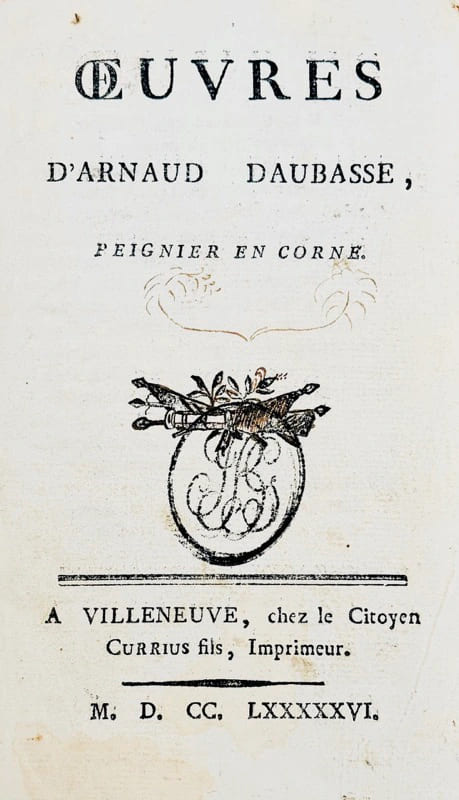
1796ref. 44815Villeneuve, chez le citoyen Currius fils, imprimeur M. CC. LXXXXXVI, (1796). In-8 de (4)-153-[1 bl.] basane marbrée, dos lisse orné, pièce de titre rouge, tranches rouges (reliure de l'époque).
1802ref. 15330Paris, Baudouin, Renouard, 1802. In-8 de (4)-138 pp.CAMUS (Armand-Gaston). Histoire et procédés du polytypage et de la stéréotypie. Paris, Baudouin, an X (1802). In-8 de (4)-135 mal chiffré 335 pp. et 6 hors-texte. 2 pièces reliées en 1 vol. in-8, basane racinée, dos lisse orné, pièce de titre en maroquin rouge (reliure de l'époque).
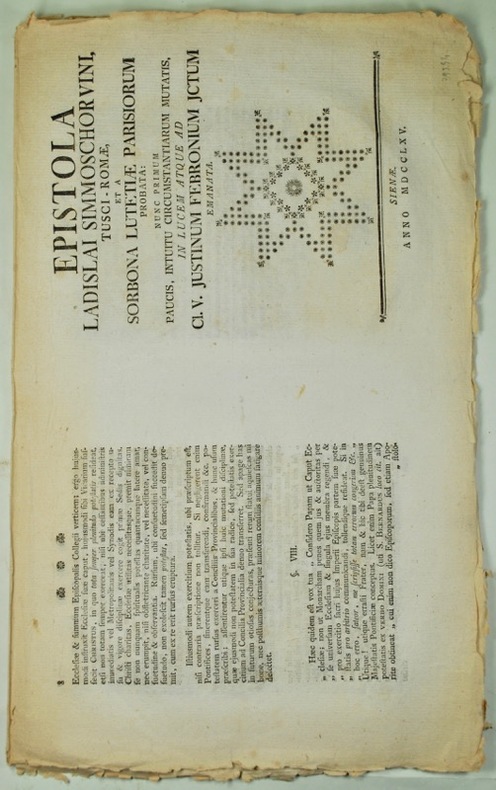
1765ref. 39594Sienne, , 1765. 1 feuille (45 x 36 cm) pliée en deux et 1 feuillet (22 x 36 cm), les deux imprimés recto verso.
1767ref. 39595Augsburg, Innsbruck, Joseph Wolff, 1767. 21 feuilles (43 x 36 cm) pliées en deux, imprimées recto verso.
1828ref. 42654Paris, A. Mesnier (Excudebat Didot natu Minor), 1828. In-32 (80 x 50 mm) de VIII-229 pp., demi-maroquin violine à petits coins, dos lisse orné, non rogné (Relié par Lesné).
1844ref. 44457Chalons-sur-Marne, Imprimerie lithographique Barbat, 1844. In-4 de 1 frontispice (4)-315-(3) pp., cartonnage décoré, tranches dorées, couverture et dos conservés, étui.
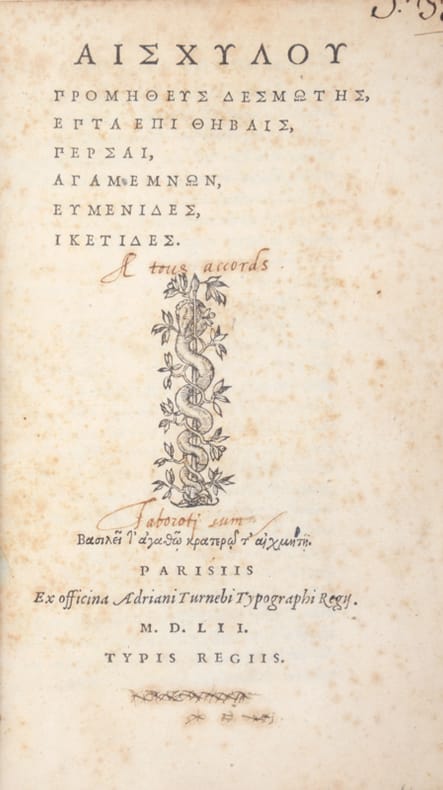
1552ref. 42167Paris, Adrien Turnèbe, 1552. In-12 de (8)-211-(1) pp. (sign. a4, A-N8, O2), caractères grecs, basane fauve granitée, dos lisse orné, pièce de titre en maroquin rouge, tranches jaspées (reliure du XVIIIe siècle).
1785Very Good Turkish, Ottoman (1500-1928) Original dark brown handsome full leather bdg. with a traditional flap. Folio. (32 x 22 cm). In Ottoman script (Old Turkish with Arabic letters). [9], 288 leaves. The size of the text block in red borders: 25 x 14.5 cm. 33 lines on each page. Printed on paper with European watermarks. Handwritten title on bottom edge. Marginal cutting on the first page. Overall a very good copy. The 20th incunable of the Islamic world, printed by Ibrahim Müteferrika's legendary Basmahane. Süleymân Izzî succeeded Mehmed Subhî Efendi (ca. 1711 - 1769) in 1745 as an official court historian (vaka'nüvis) and held this office until 1753, and is known as one of the three chroniclers for coherent historiography, representing the events in the Ottoman history from 1730 to 1744 and is a particularly valuable source on the Habsburg-Ottoman War between 1736 and 1739, as proven by his chronicle titled "Tevârîh-i Sâmî ve Sâkir ve Subhî", published in 1784. During this time, he recorded the contemporary events taking place between 1744 and 1753 in the Ottoman Empire. This work was the last item in a series of chronicles published by the printing house founded by Müteferrika. Franz Babinger writes that some parts of the book have been translated into German. Hammer translated one of the parts in question into German. All published, Izzi has planned the third part of his work, but this third part was never published. Contents: "Ahd-i Hümâyûn".; "Zikr-i iâde-i fenn-i tiba'at" [i.e. On the book pressing and publishing with a preface by Ahmed Vâsif Efendi].; "Fihrist-i Târîh-i Izzî" [i.e. Content of Izzi's history].; Izzî tarihinin birinci bölümü [i.e. The first chapter].; Izzî tarihinin ikinci bölümü [The second chapter]. The workshop of Müteferrika began its historical mission in 1728. They published 17 works in 22 volumes. The printing house served as a means to the long-term goal of Müteferrika, his efforts to broaden the horizon and modernize the knowledge of Ottoman society and Islamic civilization. This is evidenced by the subjects of the books selected for publishing, the motivations put forth in the publisher's introductions, as well as by the documents illuminating the background of the publication of each book, also published in print. In 1742, with the publication of the Persian dictionary of Hasan Suûrî, a chapter of Ottoman book printing came to an end. With the death of Müteferrika, the printing of Turkish books was temporarily interrupted. The first generation of Ottoman-Turkish prints was soon followed by a new series, when in 1756 Ahmed and Ibrâhîm Efendi (the latter perhaps the founder's son, according to speculative sources) made an attempt to resurrect the legacy of Müteferrika through the possession of a decree obtained from the Sultan. However, this experiment did not prove to be lasting, as it did not last longer than the new edition of the first Turkish printed book, the Lugat-i Vankûlî. After this for several decades there was no continuation to the Turkish book printing established by Müteferrika, until in 1783 the workshop was put in operation again for the publication of six more works. The subjects of these late 18th century works were dominated by history and military technology, thus Müteferrika's strategy of book distribution made its way hand in hand with the efforts of modernization of the Ottoman state. The second edition of Lugat-i Vankûlî followed the principles of the first edition, and its introduction was composed on the model of the introductory pages of the two last books published under Müteferrika's supervision. The works published after 1783 display a noticeable development in typography not only as to its somewhat refined visual impression, but also in its structure. For example, the d+h and r+h ligatures, characteristic of the first generation of Müteferrika's printed books, are replaced by separate letters. This extremely rare presented book is from the seven publications of this late period of the
1784Very Good Turkish, Ottoman (1500-1928) Original dark brown handsome full leather bdg. with a traditional flap. Folio. (32 x 22 cm). In Ottoman script (Old Turkish with Arabic letters). [2], [6], 238 leaves. The size of the text block in red borders: 25.5 x 14.5 cm. 33 lines on each page. Printed on paper with European watermarks. The size of the text block in red borders: 25 x 14.5 cm. 33 lines on each page. Printed on paper with European watermarks. Handwritten title on the bottom edge. A fine copy. The 19th incunable of the Islamic world, printed by Ibrahim Müteferrika's legendary Basmahane. The publication of Ottoman chronicles which began in 1734 with the edition of Naimâ's history, continued after a long break in 1783. This volume, containing the works of three court chroniclers who followed each other in rapid succession, is a chronological continuation of Mehmed Râsid's history, published by Müteferrika. Arpaemînizâde Mustafa Sâmî (deceased 1734) was the court's historian from 1730 to 1733, Sâkir Hüseyin (died 1742) in 1733, and Subhî Mehmed (ca. 1711-1769) from 1739 to 1745. The work of the three chroniclers is known as one coherent historiography, which presents the events of Ottoman history from 1730 to 1744. This work is a particularly valuable source on the Habsburg-Ottoman war between 1736 and 1739, in which Subhî participated in person. The prestige of the work, which offers detailed data on the administrative events (appointments, dismissals, and other biographical communications) is further increased by the fact that Subhî in many cases used original documents. This chronicle includes the events between the years 1730-1743. Contents: Ahd-i Humâyûn [i.e. Imperial constitutional declaration]., Zikr-i tecdîd-i san'at-i tab' [i.e. Preface on the Muteferrika Press of Vasif Efendi]., Fihrist-i târîh-i Sami ve Sakir ve Subhi [i.e. Contents of the work]., Text., History of Subhi. The workshop of Müteferrika began its historical mission in 1728. They published 17 works in 22 volumes. The printing house served as a means to the long-term goal of Müteferrika, his efforts to broaden the horizon and modernize the knowledge of Ottoman society and Islamic civilization. This is evidenced by the subjects of the books selected for publishing, the motivations put forth in the publisher's introductions, as well as by the documents illuminating the background of the publication of each book, also published in print. In 1742, with the publication of the Persian dictionary of Hasan Suûrî, a chapter of Ottoman book printing came to an end. With the death of Müteferrika, the printing of Turkish books was temporarily interrupted. The first generation of Ottoman-Turkish prints was soon followed by a new series when in 1756 Ahmed and Ibrâhîm Efendi (the latter perhaps the founder's son, according to speculative sources) made an attempt to resurrect the legacy of Müteferrika through the possession of a decree obtained from the Sultan. However, this experiment did not prove to be lasting, as it did not last longer than the new edition of the first Turkish printed book, the Lugat-i Vankûlî. After this, for several decades there was no continuation to the Turkish book printing established by Müteferrika, until in 1783 the workshop was put in operation again for the publication of six more works. The subjects of these late 18th century works were dominated by history and military technology, thus Müteferrika's strategy of book distribution made its way hand in hand with the efforts of modernization of the Ottoman state. The second edition of Lugat-i Vankûlî followed the principles of the first edition, and its introduction was composed on the model of the introductory pages of the two last books published under Müteferrika's supervision. The works published after 1783 display a noticeable development in typography not only as to its somewhat refined visual impression but also in its structure. For example, the d+h and r+h ligatures, (For more info please visit our website)