Antiquariat.de

850 résultats
2000réf. FAKS0496Hildesheim, Olms 2000. 4°. [652], [638] S. m. s/w Illustr., OPpbd., tadelloser Zustand. Dem Nachdruck liegt das Exemplar des Gutenberg.Museums Mainz zugrunde
1984réf. 39037Frankfurt , Olten und Wien, Büchergilde Gutenberg, 1984. 109 S., 3 Bl. Mit 10 farbigen Illustrationen und beiliegender signierter und numerierter Original-Lithographie von Michael Mathias Prechtl. 4° (31,5 x 20,5 cm). Original-Leinwand in Original-Pappschuber.
1986réf. 39010(Frankfurt), Büchergilde Gutenberg, (1986). 299 S. Mit zahlreichen farbigen Abbildungen und beiliegender signierter und numerierter Original-Radierung von Michael Mathias Prechtl. 4° (32 x 24,5 cm). Original-Leinwand in Original-Pappschuber. [2 Warenabbildungen]
1969réf. BN115230Springer Berlin Heidelberg Springer Berlin 1969. 1969. Softcover. Grundlagen der Betriebswirtschaftslehre Grundlagen der Betriebswirtschaftslehre Springer Berlin Heidelberg, Springer Berlin paperback
réf. 042584Mainz, Selbstverlag/F. Kupferberg. 1830 bzw. 1831; ... mit mehr als dritthalb Hundert noch ungedruckten Urkunden, welche die Genealogie Gutenberg's, Fust's und Schöffer's in ein neues Licht stellen; Erster Band: XII, (1 Bl.), 630 S., mit 1 gestochenen SW-Porträtfrontispiz von B. Merck nach Handt; Dritter Band: XIV, 548 S., mit 1 gestochenen SW-Porträtfrontispiz von J. Lehnhardt, Mainz, mit Register für Bd. 1 bis 3; Halbleder der Zeit, rundum Rotschnitt, Rücken unter Verwendung der Originalrücken professionell stabilisiert; Vorsätze teils etwas fleckig, Papier weitestgehend fleckenfrei, sehr wenige Unterstreichungen in Rotstift, Ecken etwas bestossen Halbleder 20,9 cm Befriedigend [7 Warenabbildungen]
1986réf. 39038Frankfurt, Olten und Wien, Büchergilde Gutenberg, 1986. 189 S., 3 Bl., 4 Bl. Textbeilage. Mit 16 farbigen Illustrationen und beiliegender signierter und numerierter Original-Radierung von Michael Mathias Prechtl. 4° (31,5 x 21 cm). Original-Leinwand in Original-Pappschuber. [2 Warenabbildungen]
1989réf. 39039Frankfurt und Wien, Büchergilde Gutenberg, 1989. 171 S., 2 Bl. Mit 18 farbigen Illustrationen und beiliegender signierter und numerierter Original-Radierung von Michael Mathias Prechtl. 4° (31,5 x 21 cm). Original-Leinwand mit Schutzumschlag in Original-Pappschuber. [2 Warenabbildungen]
1968réf. 10332New York: Brussel & Brussel 1968. Oversized. Three volumes gilt stamped and linen bound in issued slipcase. Very good. This copy belonged to Mel Kavin of Kater-Craft's bindery in Pico Rivera CA. It was gifted to him by the Dean of Library Services at Mt. San Antonio College after she toured his facility in 1972. Her letter thanking him has been affixed to the back of the slipcase and the gift receipt from the publisher is also included. Brussel & Brussel unknown
1877réf. 19584Um 1877. Ca. 36,5 cm x 50 cm.
1989réf. 39005(Frankfurt und Wien), Büchergilde Gutenberg, (1989). 203 S., 2 Bl. Mit ganzseitigen farbigen Illustrationen von Dieter Kliesch und Original-Aquarell auf dem Vortitel. Kl.-4° (25,5 x 18 cm). Original-Leinwand mit Schutzumschlag in Original-Leinwand. [2 Warenabbildungen]
In-16° (19x13 cm), pp (2), 56, (2), brossura decorata muta coeva. Ottimo e fresco esemplare. Rara edizione originale di queste due lettere scritte a Francois Xavier Laire da Giovanni Battista Audiffredi, domenicano e studioso, divenuto bibliotecario della Casanatense, che portò ad altissimi livelli e fondatore della catalogazione scientifica. La trattazione è una sorta di recensione duramente critica verso la catalogazione di incunaboli e cinquecentine del padre Laire uscita nel 1778, considerata lacunosa e priva di scientificità. Particolare approfondimento sulla attribuzione di quale sia la prima Bibbia stampata da Gutemberg che apre una disputa sulle presunte differenze fra la Bibbia della Casanatense e quella di Parigi. Una terza lettera qui in embrione, probabimente mai sviluppata, si ripropone un contro-catalogo delle pubblicazioni romane del XV secolo, ad emendazione della suddetta bibliografia del padre Laire, opera che effettivamente vide la luce nel 1783.
1899réf. 371914Germany or Austria 1899. 70mm diameter. Fine. 70mm diameter. Robert Hoe III commissioned Ralph Goddard to design a statue to celebrate Gutenberg in 1899 and simultaneously had bronze and silver medals produced in a limited quantity to commemorate the occasion of Gutenberg's 500th birthday and the first American statue devoted to the printer. unknown
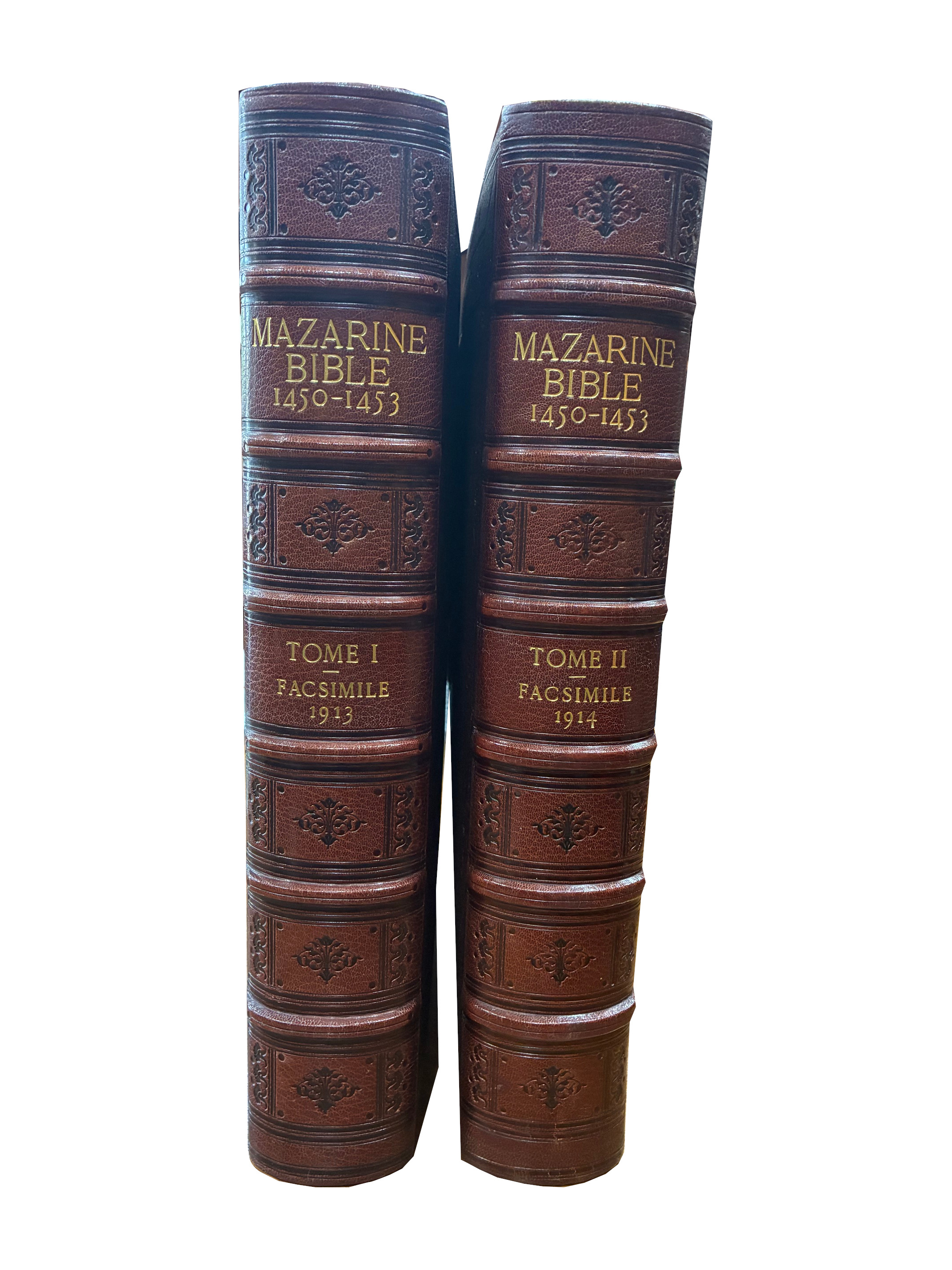
2004réf. 50852Münster, Bibliotheca Rara Verlagsgesellschaft, 2004. 2 Faksimilebände des Exemplars der 42zeiligen Gutenberg-Bibel Inc. 1 in der Bibliothéque Mazarine zu Paris, mehrfarbiger Druck, Ledereinbände mit Goldprägung, Wiedergabe der 1286 Seiten in 2 Bänden im Originalformat von 36 x 27 cm. Reproduktion des Qualitäts- Wasserzeichenpapieres in 160 g, durchgehend farbig illuminiert mit Textauszeichnungen u. Linienwerk in den Federzeichnungen der Initiale. Text der Vulgata-Bibelfassung des Hieronymus gesetzt in der Textura. Mit Begleitband (71 Seiten, ca. 28,6 cm x 37,5 cm mit Essays von Christian Galantaris, Pierre Gasnault u. Eberhard König)
1966réf. 959F36New York City: The General Theological Seminary 1966 . Cloth. Very Good Indeed. 12.5" by 8.5". None. A very scarce privately produced facsimile of the General Theological Seminary's own copy of the Gutenberg Bible produced by the Seminary themselves. A two volume very scarce facsimile of The General Theological Seminary of New York's own copy of the Gutenberg Bible. It appears that the Seminary produced this monochrome facsimile with no intention of wider distribution.The Seminary's Gutenberg Bible was sold in 1978 for $2.2 million to the Württembergische Landesbibliothek in Stuttgart Germany.Present here is a two volume facsimile of the Seminary's copy of the Bible the earliest major book printed in Europe using mass-produced metal movable type. It marked the start of the Gutenberg Revolution and the age of printed books in the West.The Seminary locked the Bible in a vault for security reasons and only placed it on view under guard on a small number of occasions.The seminary's Gutenberg Bible acquired in 1898 was notable for being the first incomplete copy restored to completeness after a forged leaf was replaced with an authentic one in 1953.With the bookplate of the General Theological Seminary Library to the pastedowns. In cloth bindings. Externally excellent. Boards lightly age toned to perimeters. Shelf wear to back strip tail with bumps to back strip heads. Library labels to front and rear pastedowns. Internally firmly bound. Pages generally exceptionally clean and bright with the odd handling marks to text block fore edge. Very Good Indeed The General Theological Seminary hardcover
1956réf. 2411010352xbvkOhne Druckvermerk (wohl Dresden, 1956). Insgesamt 36 unnummerierte Seiten auf kräftigem Büttenpapier, die ersten beiden und letzten drei S. unbedruckt. - Kartonierter Originalumschlag mit montiertem lithographisch gestaltetem Umschlag; quadrat-8vo.(ca. 14 x 14 cm).
1760réf. 73331760 Argentorati, Joh. Gothofredum Bauer, 1760. In-4, (3) ff., 120, 42 pp., (5) ff., 7 pl. h. t., Édition originale. Schoepflin a contribué plus qu'aucun de ses prédécesseurs à l'histoire de l'origine de l'imprimerie (B. et W.). Il publie des documents d'archives concernant Gutenberg. Les derniers chapitres s'étendent sur l'activité des premiers imprimeurs alsaciens. Parmi les fac-similés, des exemples des productions de Jean Mentelin.Interirieur parfait état , bien complet de ses planches depliantes sans defauts de pliage ... A regreter la reliure faite d'un cartonnage et un parchemin formant le dos .... mêmeen bon etat , parait un peu rustique pour un tel ouvrage ...
1985réf. 2111050485xbvkBerlin, Edition Handpresse Gutsch, 1985. Buch: 11 Blätter braunes Büttenpapier (4 seitlich unaufgeschnitten), davon 9 einseitig bedruckt mit Gedichten, abwechselnd mit 9 seitlich unaufgeschnittenen Doppelblättern mit illustriertem Titelblatt, Druckvermerk, 2. illustr. Titelblatt, 14 ganzseitigen Farblinolschnitten und kurzer Künstlerbiographie. - Brauner Halbledereinband mit beigefarbenem farblich changierendem Grobleinenbezug; Folio (ca. 37 x 25 cm) / MANUSKRIPT: grossformatige Halbleinenkladde der Zeit.
1985réf. 20759Paris, Editions Les Incunables, 1985. 3 volumes in-folio: 2 reliés en plein maroquin rouge, dos à nerfs ornés de caissons dorés, pièces de titre et tomaison verte et beige, triple filet dorés sur les plats, double sur les coupes, roulette dorée sur les chasses, tranches dorées, étuis; 1 volume en pleine toile d'éditeur.
réf. 47416München Idion-Verlag 1977-79. 2° insg. 1282 S. mit ca. 100 Miniaturen m. Goldfolienauflage. Kommentarbd.; 2° 200 S. mit zahlr. Abb. und einem Faksimile der «Tabula Rubricarum». Faksimile: Orig.-Holzdeckeleinbände m. braunem Kalbslederüberzug auf 6 echten Doppelbünden. Rückentitel u. deprägte Deckelrosette in Kart.-Schubern. Kommentarbd.: OLwd. Rücken der Bände beschienen ein Rücken mit Wasserflecken u. leichten Kratzspuren innen tadell. Kommentarbd. berieben u. etwas gebrauchspurig. Schuber berieben. Insgesamt sehr gutes Exemplar Eins Exempl. 57 von 895 arabisch num. Exemplaren zusätzlich 60 römisch num. «Archivexemplare». Die Wiedergabe erfolgte im Lichtdruck bis zu zwölf Farben Druck auf Bütten mit dem von Gutenberg benutzten Wasserzeichen Ochsenkopf mit Stab und Stern. "Die 42zeilige Bibel ist eine vollständige Bibel denn sie enthält alle Bücher des Alten und des Neuen Testamentes. Diese sind in einer lateinischen Übersetzung wiedergegeben. Gut drei Jahre arbeitete Gutenberg an der Herstellung der Bibel. Dieses "Werk der Bücher" wie es in einer zeitgenössischen Urkunde heißt war ein großangelegtes Druckunternehmen das viele hochqualifizierte Fachkräfte beschäftigte. - Der Kommentarband hrsg. von Wieland Schmidt und Friedrich Adolf Künsemüller mit Beiträgen von Severin Corsten Ilona Hubay Eberhard König Otto Mazal P. Robert Weber und einem Vorwort von Ekkehard Vesper. Prächtiges Faksimile einer Gutenberg-Bibel! 010 München, Idion-Verlag, 1977-79 unknown
1961réf. 2307210013Pageant Books New Jersey 1961. Hardcover. Very Good. 0x0x0. Beautiful Facsimile of Gutenberg's Iconic Bible 2 volume set. Large heavy folios; 48 x 35 cm. Near fine. Bound in publisher's cloth in burgundy slip cases. Hardcover. Very good bindings and cover. Clean unmarked pages. Books are as new minor shelf wear to slip cases at edge. Contents: I. Genesis-Psalms; II. Proverbs-Revelation "This is the first Gutenberg facsimile ever printed in the United States and only the second in the world. The reproduction derives from the Ansel Verlag edition which was based on the copy in the Koniglichen Bibliothek in Berlin and the copy in the Standischen Landes- bibliothek in Fulda considered by authorities to be the most beautifully illuminated of the 47 copies known to exist." Colophon. The text pages have been printed by lithography and the illuminated pages by sheet-fed gravure. The edition has been hand bound in two volumes and is limited to 1000 numbered sets. Originally printed at Mainz 1454 or 1455 in black and red. Rubricated in red. Initials and running titles in red and blue most of the initials floriated or decorated with faces animals etc. Many large initials illuminated in gold one also in silver and decorated in many colors mostly with floral designs but also with miniatures birds etc. the decoration often filling one or more whole margins of the page. This is an oversized or heavy book which requires additional postage for international delivery outside the US. Pageant Books, New Jersey hardcover
1790réf. 3401A L'Isle de France, de l'Imprimerie Royale. M. DCC. LXXXX vol.in-8 (17,7 x 12 cm), titre, VIII pp., 140 pp. 12 pp., reliure modeste du dix-neuvième siècle, demi-basane neutre, titre calligrapié sur une étiquette au dos. Détails du contenu : Remarques historiques, VIII pp., Calendrier de janvier à décembre 1790, 48 pp.- Calculs et renseignements astronomiques, tableau dépliant du calcul de longitude suivant M. Willaumez, 18 pp. - Idée de la rade de Port-Louis, Enumération récente des habitans (sic) de la Terre. Statisfiques mondiales. Observations météorologiques au Port-Louis du 1er décembre1788 au 30 novembre 1789. Pronostics Météorologiques, 12 pp. - Idée de l'Isle de France (Historique). Renseignements administratifs. Gouvernement, Armée, Huissiers, Conseil Supérieur créé par Edit du Roi en 1771. Juridiction Royale, Avocats, Notaires, Imprimerie Royale, Clergé de l'Isle de France, Milice Coloniale, etc.,(38 pp). - Idée de l'Isle de Bourbon (Historique). Gouvernement, Armée, Conseil Supérieur par Edit du Roi. Juridiction, Notaires, Bureau des Postes, Soeurs de charité, Milice Coloniale, Paroisse de Saint-Paul, Sainte Suzanne et Saint André, Saint Benoit, Paroisse de Riviere d'abord. - Hygiène, Médecine, liste nominative de Centenaires, Anecdotes. Mesures et Poids divers, etc. (du pied du Roi ou de Paris et des différentes mesures), (23pp.). Arrivées et Départs des vaisseaux du Port-Louis, Isle de France. Depuis le 1er Décembre 1788 jusqu'au 1er Décembre 1789 (exclusivement (10 pp.). (ouvrage complet, en état d'usage, une double page désagrafée). "C'est à peu près entre 1760 et 1770 que l'invention de Gutenberg fit son apparition dans les colonies françaises du Nouveau Monde et de l'Orient dès le XVIème siècle ; il est vrai, des Portugais avaient introduit des presses dans plusieurs des pays lointains. Ce n'étaient là, toutefois, que des presses missionnaires dirigées par des religieux, jésuites principalement et qui ne servirent qu'à la propagation de la foi parmi les infidèles. La production des Presses de l'Ile de France peut se diviser ainsi : les almanachs, les journaux ou gazettes, les publications officielles, etc. Les almanaches qui comptent parmi les premiers "incunables" de l'Isle de France sont d'un intérêt tout particulier. Les annonces, Affiches et Avis divers pour les Colonies des Isles de France et de Bourbon, de Lambert, vécurent jusqu'en 1790. (Références bibliographiques : Auguste Toussaint, Revue Outre-Mers, 1948. Les débuts de l'imprimerie aux Iles Mascareignes).
1961réf. 45289Pageant Books New Jersey 1961. Fine Facsimile copy. Hardback. Text reproduced lithographically and the illuminations by sheet-fed gravure. Specially produced 100% rag content. An exceptional achievement exceptionally well-preserved in slip-cases. Additional detail &c. On request. ; 0 pages; Hand-bound in 2 volumes and limited to 1000 sets. Derived from the Ansel Verlag edition itself based on the copy in the Koniglichen Bibliothek in Berlin and the celebrated Standischen Landesbibliothek Fulda copy. Pageant Books, New Jersey hardcover
1913réf. 001619Leipzig: Insel Verlag 1913. Two volumes complete 1913-1914 - Volume I - 648p; Volume II - 632p. Publisher's blind stamped morocco by Riviere & Son raised bands spines in seven panels title in gilt to second volume number and date in gilt to fourth remaining panels with central floral spray and volute tools to side in blind. Covers with outer double panel joined by mitred corners with occasional flower heads and elongated volutes to margins again in blind title and original publisher to head and foot in gilt central panel with blind roll presumably showing Gutenberg's head with a central arabesque inner edges with blind roll combed and curled marbled endpapers a.e.g. Bright and clean. The first complete facsimile of the Gutenberg Bible reproduced from the richly illuminated copies in the Koniglichen Bibliothek Berlin and the Standischen Landesbibliothek Fulda and attractively produced and bound. First Thus. Hardback. Very Good. Elephant Folio. Facsimile. Insel Verlag hardcover
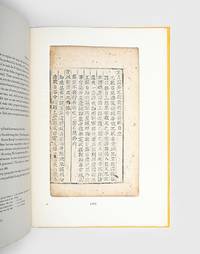
1966réf. 192593Los Angeles: Dawson's Book Shop 1966. Moveable metal type three decades before the Gutenberg Bible Excellently preserved evidence of moveable-type printing in East Asia over 30 years before the Gutenberg Bible 1454-55. Pleasingly the specimen is a full page. Copies of McGovern's catalogue sometimes only have a half-page sample as his supply was limited. Experimentation with moveable type began in Asia in the 11th century. The oldest surviving book printed with this technology is the Baegun hwasang chorok buljo jisimcheyojeol 1377 also known as Jikji which was issued in Korea and is now known only through a single copy of Volume II held at the Bibliothèque nationale de France. In the early 15th century the Korean royal family set up the Office of Typecasting to supervise the production of high-quality bronze type for general use and the Kyongja-Ja type used for this 1422 specimen was cast by decree of King Sejong the Great in 1420. Editions produced with moveable types in 15th-century Korea were small numbering only a few hundred copies and they were already highly prized in their day. McGovern became interested in these books while serving with the US Army in the country and Specimen Pages of Korean Movable Types - the first major work on the subject published in English - remains authoritative. Of the edition of 300 95 "primary copies" were numbered I-XCV this is number XIV and issued with original specimens. For the remaining 205 McGovern commissioned facsimiles of the earliest samples. This catalogue also contains a page printed with the Kabin-Ja type created in 1434 as an improvement on the small characters of Kyongja-Ja and a sample employing type cast in 1455 contemporary with Gutenberg's breakthrough in Mainz. 1422 specimen: 315 x 190 mm 11 columns of 21 characters. Catalogue: Folio. With 22 original printed leaves laid in. Duplicate example of specimen 7B loosely inserted. Original white quarter linen gilt lettering on red ground sides of yellow handmade paper bottom edge untrimmed. Housed in original blue cloth slipcase. 1422 specimen in excellent condition with just a little old marking and creasing predating the compilation of the catalogue. Bookplate of Elmer Belt 1893-1980 American urologist. Binding lightly rubbed and marked: a fine copy in very good slipcase some sunning and scuffing small repair at foot. hardcover
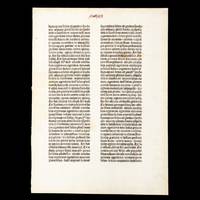
réf. 45670Mainz : Johannes Gutenberg circa 1454-55. Single folio leaf 390 x 286 mm printed recto and verso black gothic lettering of forty-two lines in double columns large two-line initial letter rubricated in red; ox-head watermark clearly visible at the centre of the leaf; light foxing neat paper reinforcement along margin probably from when included in the leaf book A Noble Fragment; a fine example housed in a card chemise and protective custom clamshell box lettered in gilt. A LEAF FROM THE FIRST WESTERN BOOK PRINTED BY MOVABLE TYPE THE GUTENBERG BIBLE. Leaf 68 of the Gutenberg Bible with the text of Numbers 7:38 - 8:12 from the Vulgate Old Testament the fourth book of the Hebrew Bible and the fourth of the five books of the Torah. The Gutenberg Bible is the Vulgate - the Latin version of the Hebrew Old Testament and the Greek New Testament that is largely based on the translations made by Saint Jerome in the late 4th and early 5th century. It is perhaps the most famous and important book in the world as it was the first complete book printed in Western culture using the radical technology of movable pieces of type. The introduction of this form of printing ushered in an information revolution whose impacts on literacy education humanism and ultimately democracy are incalculable. As the first of all first editions - the earliest incunable - the Gutenberg Bible represents in some sense the ""holy grail"" of early printed books. Only forty-eight copies are known to have survived of which twenty-one are complete all now held in public collections; a single leaf extracted from an incomplete copy captivates the imagination when we contemplate the lasting significance the printing revolution of the Renaissance has had for all humanity. Significantly this leaf includes the distinctive ox- or bull's-head watermark clearly visible at the very centre. This is one of three watermarks used in the Gutenberg Bible the others being a bunch of grapes and a walking ox. The paper was imported from Caselle in Piedmont Northern Italy one of the main paper-making centres in Europe in the 15th century. 'The Gutenberg Bible has never been surpassed. Of all the arts printing at its birth reached perfection more nearly than any other.' A. Edward Newton 'Its printers were competing in the market hitherto supplied by the producers of high-class manuscripts. The design of the book and the layout of the book were therefore based on the book-hand and manuscript design of the day and a very high standard of press-work was required - and obtained - to enable the new mechanical product to compete successfully with its hand-produced rivals. Standards were set in quality of paper and blackness of ink in design and professional skill which the printers of later generations have found difficult to maintain.' Printing and the Mind of Man. Provenance: This leaf is almost certainly an example of a 'Noble Fragment’ originated with an imperfect copy of the Gutenberg Bible which had previously formed part of the collections of Carl Theodor von Pfalz-Sulzbach 1724-99 Prince Elector Count-Palatine and Duke of Bavaria and Sulzbach the coat-of-arms of Carl Theodor and his first wife Maria Elisabeth was stamped on the previous binding the Hofbibliothek at Mannheim and subsequently the Royal Library at Munich soon after 1799. In 1832 it was sold as a duplicate - for about 350 florins - to the Hon. Robert Curzon Baron Zouche 1810-1873 later famous as the author of Visits to Monasteries of the Levant 1849 who was in Munich at the time see White; thence it was passed on to his descendants. It was sold at auction by Curzon’s great-niece 17th Baroness Zouche in 1920 Sotheby’s 9 November lot 70 £2750 to the English-born New York dealer Joseph Sabin from whom it was acquired by another New York dealer Gabriel Wells. Although the Bible contained both the Old and New Testaments it was missing 50 out of an original 643 leaves and a good portion of its illuminations had been excised. Wells decided to take the Bible apart entirely selling or donating sections and individual leaves to the general public. This allowed institutions to acquire leaves for teaching purposes or to complete their own copies of the Bible and gave individual buyers a chance to own a piece of bibliographic history. The New York Times commented that Wells was “spreading the Gospel among the rich.” Most of the individual leaves were slip-cased in leather portfolios and accompanied by an essay Wells commissioned from the scholar and bibliophile Alfred Edward Newton titled ‘A Noble Fragment Being a Leaf of the Gutenberg Bible 1450-1455.’ As noted by Dr. Eric White Scheide Librarian and Assistant University Librarian for Special Collections Rare Books and Manuscripts Princeton University Library 'The ""Noble Fragments"" are identifiable by their neatly alternating red and blue lombard headlines smaller initials and chapter numerals. These were the work of a skilled artisan probably working in Mainz who also rubricated The Gutenberg Bible now at the Roland's Library in Manchester'. - Editio princeps : A History of the Gutenberg Bible Turnhout Belgium : Harvey Miller Publishers 2017 p. 135. The rubrication of this example aligns with other examples of Gutenberg Bible leaves we have handled originating from copies presented by Wells as A Noble Fragment. hardcover