221 Ergebnisse
1664pp. (8), 448. Engraved title. Uncut and deckle edged. 24mo. [142 x 80 mm.]. Nineteenth century full leather binding. Spine perished. The Holland House copy with engraved Ex Libris and shelf marks. Important Latin & Greek dictionary / lexicon. Line for line reprint of the Louis Elzevier 1651 edition. The Dutch family of Elzevier (Elzevir; Elsevier) were the foremost printers of their time. They produced a vast variety of well printed scholarly and popular books; many in a very small handy format. Louis Elzevier, the founder of the firm, produced his first book in Leiden in 1583. The 'golden age' of Elzevier printing was between 1620 and 1680. The Elzevier dynasty probably produced their last publication in 1770. Willems 1343. AN UNCUT ELZEVIER IS AN EXTREMELY RARE FIND. **PRICE JUST REDUCED! SMALL BOX2/SHU30
1634pp. (16), 310, (34). Duysendt engraved title + Woodcut Illustration. Small 24mo. [120 x 65 mm.] Old English full leather binding. Spine worn. All edges gold gilt. Edited by Marcus Zuerius Boxhornius. The second of four Elzevier editions issued in 1634. Willems 412. "Jolie edition peu commune" - Brunet V:85. "A beautiful little volume" - Dibdin II: 384. Sallust was a famed Roman historian and politician . He was tribune of the people (52 B.C.) and praetor (46). He was ejected (50) from the senate ostensibly for adultery, but more probably because of his partisanship for Caesar. He served with Caesar after his praetorship and was his governor in Numidia; he was subsequently accused of misusing his governorship for personal gain. His principal works are the Bellum Catilinae, on the conspiracy of Catiline and his account of the Jugurthine War, Bellum Jugurthinum. His history of Rome is extant only in fragments; it probably covered the period 78 B.C. to 67 B.C. As a historian Sallust was important as one of the first to write historical monographs dealing with sharply limited events and periods. Although his style is consciously archaic, it is distinguished by its terseness and directness. His character sketches are particularly impressive and vivid, and his work has found as many imitators as critics - Columbia Encyclopedia. Very Scarce. **PRICE JUST REDUCED! SMALL BOX 2/Ron4
1649pp. 624, (24). Engraved title. 24mo. [116 x 60 mm.] Contemporary full leather binding with elaborately gilt spine. Manuscript Ex Libris of Ludovici Brisout de Barneville, Counselor to the Royal Court, 1836. This is supplementary work to the Elzevier 1634-1640 edition of Tacitus. Dibdin II:452; Willems 1094. Tacitus was one of the greatest of Roman historians. He was a friend of Pliny the Younger a nd married the daughter of Cnaeus Julius Agricola. In A.D. 97 he was appointed substitute consul under Nerva, and later he was proconsul of Asia. The first of his works was the Dialogus [dialogue], a discussion of oratory in the style of Cicero, demonstrating to some degree why Tacitus was celebrated as an eloquent speaker; this work was long disputed, but his authorship is now generally accepted. Tacitus then wrote a biography of Agricola, expressing his admiration for his father-in-law as a good and able man. His small treatise De origine et situ Germanorum [concerning the origin and locatio n of the Germans], commonly called the Germania or Germany, supplies (along with the earlier account of Julius Caesar) the principal written material on the Germanic tribes. It is a picture of the sim ple Germans glorified by comparison with the corruption and luxurious immorality of the Romans. This moral purpose and severe criticism of contemporary Rome, fallen from the virtuous vigor of the old republic, also underlies his two long works, commonly called in English the Histories and the Annals. The extant books of the Histories cover only the reign of Galba (A.D. 68?69) and the beginning (to A.D. 70) of the reign of Vespasian but give a thorough view of Roman life?persons, places, and events. The surviving books of the Annals tell of the reign of Tiberius, of the last years of Claudius, and of the first years of Nero. The account contains incisive character sketches, ironic passages, and eloquent moral conclusions. The declamatory writing of the Dialogus is replaced in the historical works by a polished and highly individual style, a wide range of vocabulary, and an intricate and startling syntax - Columbia Encyclopedia. **PRICE JUST REDUCED! SMALL BOX 2/RON3
1663(xii), 362, (19) + Beautifully engraved title page. 24 mo. 140 mm. Worn later full leather binding that should be rebacked. All edges gold gilt. Important collection of legal aphorisms and comments on Cannon Law, etc. The Dutch family of Elzevier (Elzevir; Elsevier) were the foremost printers of their time. They produced a vast variety of well printed scholarly and popular books; many in a very small handy format. Louis Elzevier, the founder of the firm, produced his first book in Leiden in 1583. The 'golden age' of Elzevier printing was between 1620 and 1680. The Elzevier dynasty produced their last publication in 1770. Willems 1301. **PRICE JUST REDUCED! SMALL BOX 6
1640pp. (12), 414 (i.e.404), [28]. Printer's device (the Hermit) on title page. 24mo. 13 cm. Latin text. Worn original full leather binding, boards detached. The Dutch family of Elzevier (Elzevir; Elsevier) were the foremost printers of their time. They produced a vast variety of well printed scholarly and popular books; many in a very small handy format. Louis Elzevier, the founder of the firm, produced his first book in Leiden in 1583. The 'golden age' of Elzevier printing was between 1620 and 1680. The Elzevier dynasty probably produced their last publication in 1770. Gaius Plinius Caecilius Secundus, born Gaius Caecilius or Gaius Caecilius Cilo (61 c. 113), better known as Pliny the Younger, was a lawyer, author, and magistrate of Ancient Rome. Pliny's uncle, Pliny the Elder, helped raise and educate him. Pliny the Younger wrote hundreds of letters, of which 247 survive and are of great historical value. Some are addressed to reigning emperors or to notables such as the historian Tacitus. Pliny served as an imperial magistrate under Trajan and his letters to Trajan provide one of the few surviving records of the relationship between the imperial office and provincial governors. Willems 506; Copinger 3646. **PRICE JUST REDUCED! SMALL BOX 4
1634pp. [16], 310, [34] + Engraved title page by Duysent. Foxed. Latin text. 24mo. 14 cm. Lovely 18th century full leather binding, joints cracked. Copinger 4054; Willems 412n. Edited by Marcus Zuerius Boxhorn (1612-1653), to whom the dedication is addressed. The Elzeviers published four distinct editions under this date. This issue is the second reimpression. Early manuscript ownerships. Scarce. The Dutch family of Elzevier (Elzevir; Elsevier) were the foremost printers of their time. They produced a vast variety of well printed scholarly and popular books; many in a very small handy format. Louis Elzevier, the founder of the firm, produced his first book in Leiden in 1583. The 'golden age' of Elzevier printing was between 1620 and 1680. The Elzevier dynasty probably produced their last publication in 1770. **PRICE JUST REDUCED! SMALL BOX 6
1649pp. 624, (24). Engraved title. 24mo. [116 x 60 mm.] Nice contemporary full leather binding with gold spine. A supplementary work to the Elzevier 1634-1640 edition of Tacitus. The Dutch family of Elzevier (Elzevir; Elsevier) were the foremost printers of their time. They produced a vast variety of well printed scholarly and popular books; many in a very small handy format. Louis Elzevier, the founder of the firm, produced his first book in Leiden in 1583. The 'golden age' of Elzevier printing was between 1620 and 1680. The Elzevier dynasty probably produced their last publication in 1770. Dibdin II:452; Willems 1094. **PRICE JUST REDUCED! SMALL BOX 6
1671pp. [8], 328. Engraved title page. Foxed. 24mo. 13 cm. Worn contemporary full leather binding. This is a page-for-page reprint of the 1650 Elzevier editions; and the second of two impressions of 1671 (without the preliminary headpiece). Willems 1462n. Valerius Maximus was a widely read Roman author, but little is known of his life. This work, [Nine Books of Memorable Deeds and Sayings] was written around A.D. 30 and is a miscellany of anecdotes about a variety of subjects. It was especially important as a source for writers and orators. The Dutch family of Elzevier (Elzevir; Elsevier) were the foremost printers of their time. They produced a vast variety of well printed scholarly and popular books; many in a very small handy format. Louis Elzevier, the founder of the firm, produced his first book in Leiden in 1583. The 'golden age' of Elzevier printing was between 1620 and 1680. The Elzevier dynasty probably produced their last publication in 1770. **PRICE JUST REDUCED! SMALL BOX 6
1650pp. 369, (13) + Engraved title. One leaf torn across the top with loss of about 10 lines. Old damp stain. 32 mo. [115 x 66 mm.]. Worn contemporary paper boards binding. Little is known about Suetonius' life except that he was briefly the private secretary of Emperor Hadrian. His work, De vita Caesarum [Concerning the Lives of the (Twelve) Caesars] survives almost in full. In it he does little to hide the sexual activities or moral depravity of the Roman court. There are also fragments of a much larger collection of biographies, De viris illustribus [Concerning Illustrious Men]. He gathered together all sorts of anecdotes, and the resultant biographies are lively and informative. The Dutch family of Elzevier (Elzevir; Elsevier) were the foremost printers of their time. They produced a vast variety of well printed scholarly and popular books; many in a very small handy format. Louis Elzevier, the founder of the firm, produced his first book in Leiden in 1583. The 'golden age' of Elzevier printing was between 1620 and 1680. The Elzevier dynasty probably produced their last publication in 1770. Willems 1118; Rahir, Les Elzevier, 1133. Small Box OST 5
1675pp. (24), 348, (21). Handsome engraved title page by Decker. Fine woodcut initials and devices. All edges gold. 24mo. [127 x 72 mm]. Early 19th century English full crimson leather binding, modestly gold gilt, in the style of Sir John Thorold's Syston Park Library books. Engraved Ex Libris of Sir John Trollope, M.P. (1800-1874), who owned the hamlet of Ashton and was a book collector. The Trollopes were related to the great book collecting Thorold family, and probably used their binder for this book. Frontinus was the Roman Military Governor in Britain, and later, the superintendent of the water works at Rome. this book was bought from Maggs in 1977 by Edwin Wolf II, famed for his connections to the great bookseller Rosenbach and the Library Company of Philadelphia. This is a fine, Elzevier-like edition of this important treatise on the stratagems of war. Fine and scarce. **PRICE JUST REDUCED! SMALL BOX 1
1663pp. 239; 168; 120; 192. French text. Lightly foxed. 24mo. [124 x 72 mm.] Later full leather gold binding. Leather doublures. Boards detached. All edges gold. The pagination mix in this copy does not appear to conform to any other edition that has been bibliographically described. See: Willems 868 / 1305 / & 1317; Brunet IV:145. Henry III (15511589) was King of France from 1574 until his death as well as King of Poland and Grand Duke of Lithuania from 1573 to 1575. RARE. **PRICE JUST REDUCED! SMALL BOX 2
1659engr. t.p. 388, [17] p. 13 cm. Signatures: A-R12(R12 blank). Hardcover Very good condition in full vellum Dedicatory 'epistre' signed: Girard, archidiacre d'Angoulesme.
Best.-Nr. 29119In-8, plein veau marbré de l'époque, dos à nerfs orné de caissons dorés (mors fendus), (2) f., 547 p., (36) f. d'index, titre frontispice de R. Persyn gravé. Amstelodami, Apud Ludovicum et Danielem Elzevirios [Amsterdam, Louis et Daniel Elzevier], 1659.
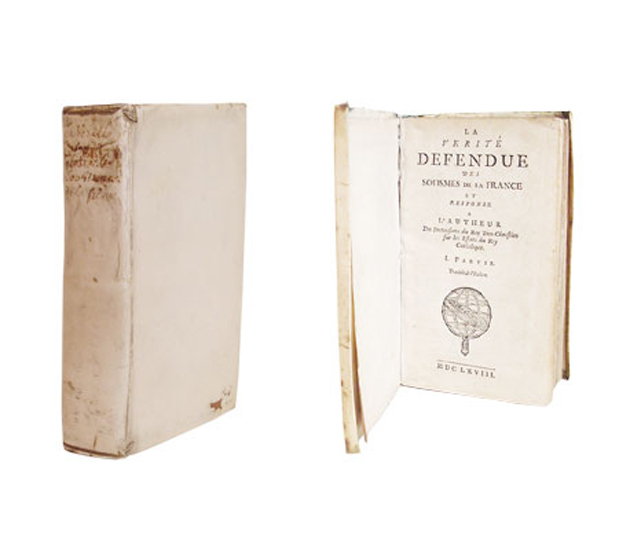
Best.-Nr. 294292 tomes reliés en un volume petit in-12, plein vélin ivoire cordé à petits rabats de l'époque, 160, (2) p. et (1) f. blanc, 242, (2) p. S.l.n.e. [La Haye, Steucker], 1668.
Best.-Nr. 30500In-12 (128 x 74 mm), plein vélin ivoire cordé à rabats de l'époque, (1) f. de frontispice gravé, 417 p., (1) f. blanc, titre inclus. Leide, Jean Elzevier, 1658.
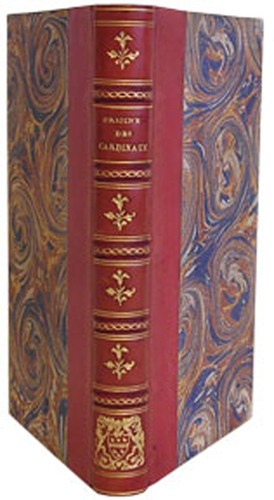
Best.-Nr. 33482Petit in-12, demi-veau cerise, dos à nerfs ornés d'une guirlande et soulignés de doubles filets dorés, fleurons entrenerfs, armes dorées en pied, titre doré, tranches marbrées (rel. du XIXe), (4), 143, (1), 42, 112 p. Cologne, Pierre Ab Egmont [i.e. Bruxelles, François Foppens], 1665.
Best.-Nr. 34344Petit in-12, broché, couverture de papier moderne, 96 p. (quelques rousseurs), bandeaux et culs de lampe. Amsterdam, Henri Wetstein, 1693.
Best.-Nr. 34348Petit in-12, broché, couverture de papier moderne, 60 p., bandeaux et culs de lampe. Amsterdam, Henri Wetstein, 1693.
Best.-Nr. 33867In-12, plein vélin rigide ivoire à petits rabats, pièce de titre de maroquin olive, tranches mouchetées rouges (rel. du XIXe), 424 p. (titre inclus) et (2) p. de table, titre-frontispice gravé. Leide, Jean Elzevier, 1664.
Best.-Nr. 33870In-12, plein vélin rigide ivoire à petits rabats, pièce de titre de maroquin olive, tranches rouges (rel. du XIXe s.), 388, (18) p., titre-frontispice gravé. Amsterdam, Louis et Daniel Elzevier, 1663.
Best.-Nr. 33989Petit in-12, plein vélin ivoire à la Bradel, pièce de titre de veau bordeaux (rel. moderne), 48 p., frontispice gravé, bandeaux et culs de lampe. Suivant la copie imprimée à Paris [i.e. Hollande, Elzevier], 1680.
Best.-Nr. 34093Petit in-12, broché, couverture de papier marbré moderne, (2), 68 p., titre gravé, bandeaux et culs de lampe. Suivant la copie imprimée à Paris [Amsterdam, Abraham Wolfgang], 1664.
Best.-Nr. 34099In-12 broché, couverture de papier marbré moderne, (2), 62 p., frontispice gravé. Suivant la copie imprimée à Paris [Amsterdam, Abraham Wolfgang], 1663.
Best.-Nr. 34106Petit in-12, demi-veau havane moucheté à coins, dos à nerfs, titre doré, daté en pied (rel. moderne), (2), 59 p., planche frontispice gravée. Suivant la copie imprimée à Paris [Amsterdam, Abraham Wolfgang], 1664.
Best.-Nr. 34107Petit in-12, demi-veau havane moucheté à coins, dos à nerfs, titre doré, daté en pied (rel. moderne), (2), 76 p., planche frontispice gravée. Suivant la copie imprimée à Paris [Amsterdam, Abraham Wolfgang], 1664.