1 531 résultats
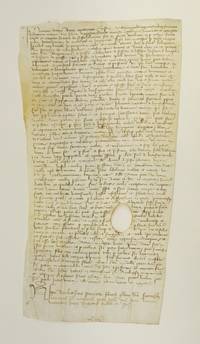
1429réf. ST12778-0360Italy 1429. 323 x 173 mm. 12 3/4 x 6 3/4". Single column 60 lines in a neat cursive script. Notarial signature at lower left; verso with a date and notations in contemporary hands. ◆Vellum trimmed a little close four horizontal and three vertical fold creases slight darkening to verso five very small holes no text obscured and one larger naturally-occurring hole in the text otherwise in excellent condition with a very clear hand. This is a notarized document recording an agreement made between the chapel and convent i.e. the whole community of the house of St. John a group of female religious located in the parish of St. Peter and the brothers of Bonsignioribus another religious house in the parish of St. Laurence Major. The women of St. John agree to pay to the brothers of Bonsignioribus a sum of 11 libras 8 soldas and 9 denarios. The reason for this payment is unclear pending further investigation into some of the more abbreviated portions of the text. The document is of additional interest for the fact that several female members of the house of St. John are mentioned by name. Based on these names and that of the notary Ambrosius Spanzota . . . Parmensis it would appear that the document was written in Italy possibly in Parma and that the two houses were also located there. unknown books
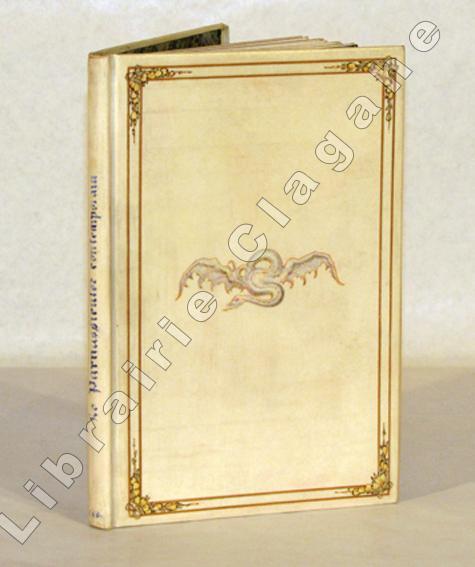
1867réf. 18178Paris, Librairie Centrale (J. Lemer, éditeur), 1867 ; in-16, bradel de vélin-parchemin rigide à recouvrement, titre manuscrit en caractères gothiques bleus, plats décorés d’un encadrement doré et rouge orné, dans les coins, d’une composition de fruits tenus par un ruban noué, dragon volant au centre du plat supérieur, d’après celui qui orne la couverture et la page de titre tête dorée, étui bordé (Levitzky) ; 36 pp. , couverture en papier sulfurisé simili parchemin, en rouge et noir, l’eau-forte serait de Delor en frontispice.
1970réf. 009657Vaduz Brunidor 1970 In-folio En feuilles, couverture à rabats, chemise et étui toilé éditeur.
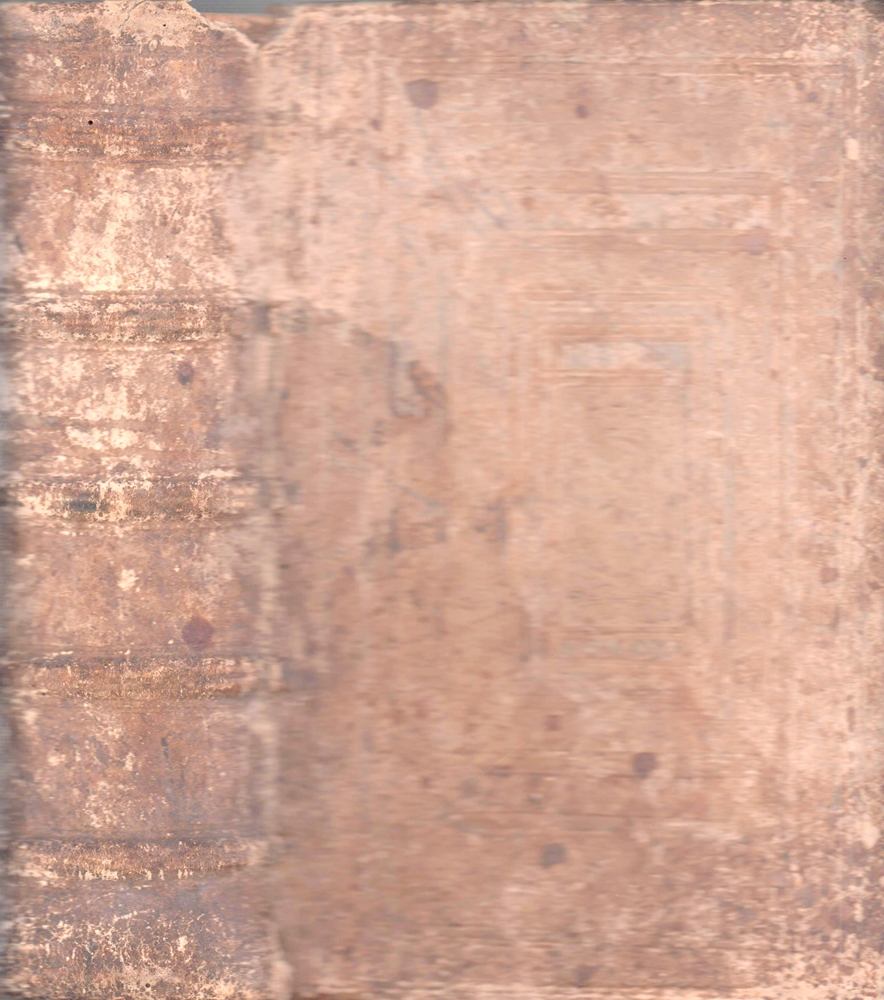
1669In -4°, pp. (12), 1144, (24); legatura alle armi (famiglia Colonna), piena pergamena, titolo ms al dorso. Difetti alla legatura. La vita della carmelitana genovese Maria Vittoria Centurione (1586-1645, in religione Paola Maria di Gesù), fondatrice dei monasteri delle Carmelitane scalze di Vienna e di Gratz. Di nascita napoletana e famiglia genovese, fu la prima a introdurre in Austria l’ordine teresiano. Oltre a notazioni interessanti sul peso della vita spirituale, si trovano in questo volume considerazioni originali sulla natura umana di Cristo (cfr. Moriones, “Dictionnaire de Spiritualité”, s.v.). The life of Maria Vittoria Centurione (1586-1645, Paola Maria di Gesù as a nun), who established the carmelite monasteries in Wien and Gratz. Beyond interesting notations on the spiritual life, in this book there are original considerations on the human nature of Christ.
1926réf. 009380Paris Marcel Seheur 1926 In-4 Broché, couverture rempliée
1592réf. 14640Lyon, Q. Hug. A Porta, Fratres de Gabiano (Excudebat Guichardus Jullieron anno 1592), 1592 ; in-8 (164), plein vélin ivoire à recouvrements de l'époque ; (8), 312, (7) index, (1 bl.) ; 34 pp., (1) p., (1 bl.), 2 ff. blancs.
1600réf. 88394Frankfurt a. M. Johannes Saur, 1600. [8], 791, [25] Seiten (Index), 1 Blatt. - /// Zusammen mit: [2.] Opera quae extant omnia Plutarchi Chaeronei: Ethica sive moralia complectentia interprete Herm Cruserio denuo recognita ... Ebda. 1605. 742; [32] Seiten (Index). - // Beide Werke mit Titelholzschnitten, Holzschnitten von Jost Amman (1539-1591) im Text u. geschnitt. Zierinitialen. 4to. 34 x 24 x 10 cm. Blindgeprägtes Pgt. d. Zt. auf 5 Bünden.
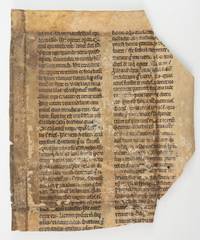
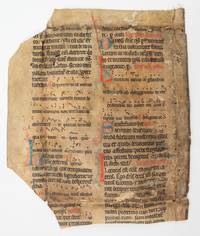
réf. ST21124c-02France or Low Countries 14th century. 270 x 461 mm. 10 5/8 x 18 1/8". Double columns 32 lines in a gothic book hand. Rubrics and staves in red three two-line initials in red or blue with contrasting penwork now quite faded. Unevenly trimmed missing at most a line of text at the bottom of each column and several words or part-words at corners of outer columns vellum with soiling browning small holes and paper residue consistent with having been used in a binding but the text entirely legible on one side and legible with effort on the other rather darkened side. From a noted Missal with large penwork initials this leaf was once used as the cover for a binding yet remains substantially complete. The text here comes from the Temporale containing the cycle of moveable feasts in the Christian year and includes Wednesday Feria IV after the fourth Sunday of Lent with a long passage from John 9. The musical notation on this leaf is highly developed consisting of a four-line staff clef marker and square neumes. unknown
réf. ST21124c-02France or Low Countries 14th century. 270 x 461 mm. 10 5/8 x 18 1/8". Double columns 32 lines in a gothic book hand. Rubrics and staves in red three two-line initials in red or blue with contrasting penwork now quite faded. Unevenly trimmed missing at most a line of text at the bottom of each column and several words or part-words at corners of outer columns vellum with soiling browning small holes and paper residue consistent with having been used in a binding but the text entirely legible on one side and legible with effort on the other rather darkened side. From a noted Missal with large penwork initials this leaf was once used as the cover for a binding yet remains substantially complete. The text here comes from the Temporale containing the cycle of moveable feasts in the Christian year and includes Wednesday Feria IV after the fourth Sunday of Lent with a long passage from John 9. The musical notation on this leaf is highly developed consisting of a four-line staff clef marker and square neumes. unknown books
réf. ST21065BNortheastern France or Rhineland early 14th century. 345 x 239 mm. 13 1/2 x 9 3/8". Single column nine lines of music and text in a gothic hand. Rubrics and staves in red calligraphic initials in black one-line initials in red or blue some with contrasting penwork each leaf with at least one large initial measuring a line of text plus a full stave in blue or red with blue and red penwork often extending several lines above or below. Later ink foliation in upper right corners; a couple leaves with remnants of older manuscript leaves enforcing the gutter. See: de Hamel Christopher. "Medieval and Renaissance Manuscripts from the Library of Sir Sydney Cockerell" British Library Journal 13 1987. Trimmed a little close at the top occasionally cutting into penwork decoration light to moderate soiling to vellum some leaves with light creasing small stains and/or wormholes a few leaves with more noticeable flaws but still in very good presentable condition. From a manuscript fragment that once passed through the hands of Sir Sydney Cockerell the leaves in this group appear to come from a rarely seen liturgical text called a Sequentiary. Consisting of sung hymns called "sequences" performed between the Alleluia and Gospel readings during Mass a Sequentiary could be either a standalone volume or part of a longer work such as a Gradual or Missal. The script here is a neat and legible gothic book hand with simple but attractive lettering in blue and red with contrasting penwork; there are also some interesting calligraphic initials in black--some with little spikes or other flourishes--that might warrant further study. These leaves were previously bound into a later perhaps 18th century limp vellum binding the pastedown of which contained a tipped-on handwritten note from Cockerell 1867-1962 who was William Morris' private secretary and the director of the Fitzwilliam Museum for nearly 30 years. Cockerell attributed this manuscript to Northern France and suggested a date of ca. 1280 we believe it dates a little later noting that it was probably made for Dominican use based on the presence of the sequences for St. Peter Martyr and St. Dominic. It is unclear whether Cockerell actually owned this manuscript at one point or served as a consultant for a dealer or a private collector as he was known to do: in the words of de Hamel Cockerell became "the arbiter of quality before whom generations of collectors and scholars brought their acquisitions and attributions for judgement. . . . Dyson Perrins Yates Thompson Chester Beatty Pierpont Morgan St John Hornby Lord Kennet Francis Wormald Eric Millar J. R. Abbey and many others never felt that a manuscript acquisition was truly made until Sydney Cockerell had seen and approved it." De Hamel also notes that Cockerell "gave away sold or exchanged manuscripts on many occasions during his life of collecting" making it difficult to know exactly how this manuscript may have crossed his path or for how long it was in his possession. His appraisal does however suggest that this manuscript was in a defective state from at least the 1920s and probably a good deal earlier than that. Most of the choir book leaves that we offer for sale come from 15th and early 16th century manuscripts typically Italian or Spanish in origin; the present leaves offer an uncommon opportunity to purchase earlier specimens of musical notation from an unusual liturgical text with distinguished if uncertain ownership history and at an attainable price. The price given here is for a single leaf; for additional leaves from this same manuscript please see our website. unknown
réf. ST21065BNortheastern France or Rhineland early 14th century. 345 x 239 mm. 13 1/2 x 9 3/8". Single column nine lines of music and text in a gothic hand. Rubrics and staves in red calligraphic initials in black one-line initials in red or blue some with contrasting penwork each leaf with at least one large initial measuring a line of text plus a full stave in blue or red with blue and red penwork often extending several lines above or below. Later ink foliation in upper right corners; a couple leaves with remnants of older manuscript leaves enforcing the gutter. See: de Hamel Christopher. "Medieval and Renaissance Manuscripts from the Library of Sir Sydney Cockerell" British Library Journal 13 1987. Trimmed a little close at the top occasionally cutting into penwork decoration light to moderate soiling to vellum some leaves with light creasing small stains and/or wormholes a few leaves with more noticeable flaws but still in very good presentable condition. From a manuscript fragment that once passed through the hands of Sir Sydney Cockerell the leaves in this group appear to come from a rarely seen liturgical text called a Sequentiary. Consisting of sung hymns called "sequences" performed between the Alleluia and Gospel readings during Mass a Sequentiary could be either a standalone volume or part of a longer work such as a Gradual or Missal. The script here is a neat and legible gothic book hand with simple but attractive lettering in blue and red with contrasting penwork; there are also some interesting calligraphic initials in black--some with little spikes or other flourishes--that might warrant further study. These leaves were previously bound into a later perhaps 18th century limp vellum binding the pastedown of which contained a tipped-on handwritten note from Cockerell 1867-1962 who was William Morris' private secretary and the director of the Fitzwilliam Museum for nearly 30 years. Cockerell attributed this manuscript to Northern France and suggested a date of ca. 1280 we believe it dates a little later noting that it was probably made for Dominican use based on the presence of the sequences for St. Peter Martyr and St. Dominic. It is unclear whether Cockerell actually owned this manuscript at one point or served as a consultant for a dealer or a private collector as he was known to do: in the words of de Hamel Cockerell became "the arbiter of quality before whom generations of collectors and scholars brought their acquisitions and attributions for judgement. . . . Dyson Perrins Yates Thompson Chester Beatty Pierpont Morgan St John Hornby Lord Kennet Francis Wormald Eric Millar J. R. Abbey and many others never felt that a manuscript acquisition was truly made until Sydney Cockerell had seen and approved it." De Hamel also notes that Cockerell "gave away sold or exchanged manuscripts on many occasions during his life of collecting" making it difficult to know exactly how this manuscript may have crossed his path or for how long it was in his possession. His appraisal does however suggest that this manuscript was in a defective state from at least the 1920s and probably a good deal earlier than that. Most of the choir book leaves that we offer for sale come from 15th and early 16th century manuscripts typically Italian or Spanish in origin; the present leaves offer an uncommon opportunity to purchase earlier specimens of musical notation from an unusual liturgical text with distinguished if uncertain ownership history and at an attainable price. The price given here is for a single leaf; for additional leaves from this same manuscript please see our website. unknown books
réf. 110751L'Edition d'Art H. Piazza et Cie, 1904, 1 volume in-8 de 230x170 mm environ, 261 pages, reliure signée S. de Lancker plein chagrin aubergine, dos à 5 nerfs portant titres dorés, tranche de tête dorée, gardes ornées de motifs dorés, sous étui recouvert du même papier que les gardes avec ouverture en cuir assorti et intérieur en suédine bleu clair, feuillets non rognés, couvertures et dos illustrés conservés. Exemplaire numéroté N° 185, un des 260 exemplaires sur papier vélin à la cuve, de Blanchet frères et Kléber, numérotés de 41 à 300, avec 1 dessin original non retenu pour le livre, et 63 compositions aquarellées, certains rehaussées à l'or, ainsi que quelques ornements décoratifs, par Manuel ORAZI. Dos et ouverture de l'étui insolés avec des frottements sur les mors et les coiffes et sur l'étui.
1602réf. 82392In Venetia: Appresso Gio. Battista Ciotti 1602. Due parti in un volume di cm. 30 pp. 12 524; 395. Frontespizio in rosso e nero con marchio tipografico. Leg. del tempo in cart. alla rustica e dorso ricoperto posteriormente in carta marmorizzata. Esemplare genuino e ben conservato. Edizione originale di quest'opera considerata il più importante e fortunato dei vocabolarî italiani anteriori a quello della Crusca ed il primo dizionario europeo moderno fornito di definizioni. Nel corso del xvii secolo si ebbero tre ristampe ampliata. Cfr. Gamba 2757 che cita la successiva edizione del 1617. Edizione Originale. Appresso Gio. Battista Ciotti unknown
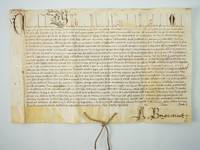
1597réf. ST12778-0365Rome 1597. 220 x 350 8 5/8 x 13 3/4". Single column 25 lines in a papal chancery hand. Elaborate lettering all across top line of text especially the first initial and at lower right corner. Lower margin with several signatures in ink; verso with brief notes in ink; remains of hemp tie for appended seal which has been cut away. Soft creases from folding four vertical one horizontal a handful of letters obscured apparently intentionally in the first and second lines very minor soiling to recto the verso being the hair side with overall darkening as usual but generally in excellent condition the script being done in a strong hand with intriguing scribal flourishes. This Papal Bull grants a marriage dispensation between Centio Balzani and Margarite Brancazze setting aside the impediment of consanguinity. Like others of its kind the document takes its name from the lead seals called "bullae" that were issued with official documents of the papacy lacking in the present example as a way of ensuring their authenticity. Apart from the very rare Solemn Privilege like Innocent III's famous granting of England in 1214 to his involuntary vassal King John there are three categories of Papal Bulls: Simple Privileges also called Solemn Letters Letters of Grace which confirm privileges and rights but are somewhat smaller and Mandates which are differentiated by their use of hemp ties as opposed to silk as is the case here. An online search finds nothing about the couple named in the bull but the document reveals that they were petitioning for a dispensation because they fell into the third and fourth degrees of consanguinity meaning that they shared at least one common ancestor. Although marrying within four degrees of consanguinity was prohibited by the church it was not uncommon for the Holy See to issue dispensations allowing such marriages to take place--particularly for the privileged classes. Two place names have been erased on this document obscuring both the name of the archbishop to whom the bull is addressed and the residence of Margarite. However we acquired this document along with two similar bulls relating to Naples and it would seem likely that the present item relates to the same city we can see that both obscured names begin with an "N". Pope Clement VIII born Ippolito Aldobrandini 1536-1605 led the Catholic Church from 1592 until his death. He is known for presiding over the final phase of the Counter-Reformation approving the revised Vulgate Bible and mediating peace between France and Spain including the reconciliation of King Henry IV of France with the Catholic Church. unknown
1597réf. ST12778-0365Rome 1597. 220 x 350 8 5/8 x 13 3/4". Single column 25 lines in a papal chancery hand. Elaborate lettering all across top line of text especially the first initial and at lower right corner. Lower margin with several signatures in ink; verso with brief notes in ink; remains of hemp tie for appended seal which has been cut away. Soft creases from folding four vertical one horizontal a handful of letters obscured apparently intentionally in the first and second lines very minor soiling to recto the verso being the hair side with overall darkening as usual but generally in excellent condition the script being done in a strong hand with intriguing scribal flourishes. This Papal Bull grants a marriage dispensation between Centio Balzani and Margarite Brancazze setting aside the impediment of consanguinity. Like others of its kind the document takes its name from the lead seals called "bullae" that were issued with official documents of the papacy lacking in the present example as a way of ensuring their authenticity. Apart from the very rare Solemn Privilege like Innocent III's famous granting of England in 1214 to his involuntary vassal King John there are three categories of Papal Bulls: Simple Privileges also called Solemn Letters Letters of Grace which confirm privileges and rights but are somewhat smaller and Mandates which are differentiated by their use of hemp ties as opposed to silk as is the case here. An online search finds nothing about the couple named in the bull but the document reveals that they were petitioning for a dispensation because they fell into the third and fourth degrees of consanguinity meaning that they shared at least one common ancestor. Although marrying within four degrees of consanguinity was prohibited by the church it was not uncommon for the Holy See to issue dispensations allowing such marriages to take place--particularly for the privileged classes. Two place names have been erased on this document obscuring both the name of the archbishop to whom the bull is addressed and the residence of Margarite. However we acquired this document along with two similar bulls relating to Naples and it would seem likely that the present item relates to the same city we can see that both obscured names begin with an "N". Pope Clement VIII born Ippolito Aldobrandini 1536-1605 led the Catholic Church from 1592 until his death. He is known for presiding over the final phase of the Counter-Reformation approving the revised Vulgate Bible and mediating peace between France and Spain including the reconciliation of King Henry IV of France with the Catholic Church. unknown books
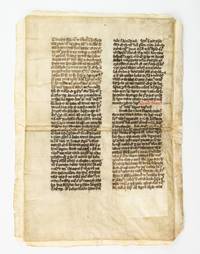
réf. ST20837eFrance mid-13th century. 321 x 230 mm. 12 5/8 x 9". Double column 39 lines in a dense gothic hand. Rubric in red. Recovered from a binding and so the vellum a bit creased and soiled though less soiled than is often seen some tiny remnants of later printed text from reuse but the text almost entirely legible and the leaf surprisingly well preserved overall with its very substantial margins fully intact. Once serving as a cover for a later book this leaf seems to come from an unpublished collection of sermons incorporating biblical excerpts such as Revelation 12:1 "A great sign appeared in heaven: A woman clothed with the sun and the moon under her feet and on her head a crown of twelve stars". The lack of decoration and simple rubrication suggest that the parent manuscript was made for utilitarian purposes at a time when a need for such books increased due in part to the rise of mendicant orders like the Franciscans and Dominicans. Members of these orders rejected traditional monastic isolation and instead settled in urban centers to preach and minister to the people. It is unusual and very lucky that this leaf survives completely intact as Medieval manuscripts used in later bindings were often cut down in size to make smaller covers or used as waste paper for pastedowns or other binding elements. Considerable rewarding research remains to be done to identify the content here along with its various religious and social contexts. unknown
réf. ST20837eFrance mid-13th century. 321 x 230 mm. 12 5/8 x 9". Double column 39 lines in a dense gothic hand. Rubric in red. Recovered from a binding and so the vellum a bit creased and soiled though less soiled than is often seen some tiny remnants of later printed text from reuse but the text almost entirely legible and the leaf surprisingly well preserved overall with its very substantial margins fully intact. Once serving as a cover for a later book this leaf seems to come from an unpublished collection of sermons incorporating biblical excerpts such as Revelation 12:1 "A great sign appeared in heaven: A woman clothed with the sun and the moon under her feet and on her head a crown of twelve stars". The lack of decoration and simple rubrication suggest that the parent manuscript was made for utilitarian purposes at a time when a need for such books increased due in part to the rise of mendicant orders like the Franciscans and Dominicans. Members of these orders rejected traditional monastic isolation and instead settled in urban centers to preach and minister to the people. It is unusual and very lucky that this leaf survives completely intact as Medieval manuscripts used in later bindings were often cut down in size to make smaller covers or used as waste paper for pastedowns or other binding elements. Considerable rewarding research remains to be done to identify the content here along with its various religious and social contexts. unknown books
réf. ST21124c-01France or Low Countries 14th century. 270 x 230 mm. 10 3/4 x 9". Double columns 32 lines in a gothic book hand. Rubrics and staves in red several initials measuring two or more lines in red or blue with contrasting penwork. Unevenly trimmed missing at most a line of text at the bottom of each column and several words or part-words at corners of outer columns vellum with soiling browning small holes and paper residue consistent with having been used in a binding one side quite darkened but the text there legible with effort nevertheless and entirely legible on the other side. From a noted Missal with numerous large penwork initials this leaf was once used as the cover for a binding yet remains substantially complete. The text here comes from the Temporale containing the cycle of moveable feasts in the Christian year and includes text for Tuesday and Wednesday Feria III and IV of Passion Week. The musical notation on this leaf is highly developed consisting of a four-line staff clef marker and square neumes. unknown
réf. ST21124c-01France or Low Countries 14th century. 270 x 230 mm. 10 3/4 x 9". Double columns 32 lines in a gothic book hand. Rubrics and staves in red several initials measuring two or more lines in red or blue with contrasting penwork. Unevenly trimmed missing at most a line of text at the bottom of each column and several words or part-words at corners of outer columns vellum with soiling browning small holes and paper residue consistent with having been used in a binding one side quite darkened but the text there legible with effort nevertheless and entirely legible on the other side. From a noted Missal with numerous large penwork initials this leaf was once used as the cover for a binding yet remains substantially complete. The text here comes from the Temporale containing the cycle of moveable feasts in the Christian year and includes text for Tuesday and Wednesday Feria III and IV of Passion Week. The musical notation on this leaf is highly developed consisting of a four-line staff clef marker and square neumes. unknown books
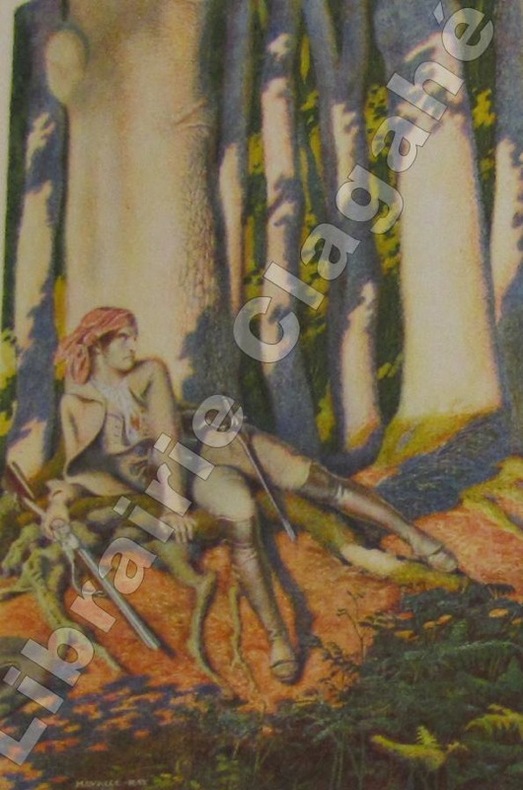
1912réf. 2165Paris, Société Normande du livre illustré, 1912, in-4; demi-chagrin maroquiné bordeaux à coins, dos à cinq nerfs, tête dorée, couv. et dos conservés, étui bordé; X-266 pp., (3) ff., 11 planches en couleurs de Maurice Ray gravées sur cuivre au repérage.
1980réf. 010059Paris Michèle Broutta 1980 In-4 carré En feuilles, sous emboitage toilé de l'éditeur
1953réf. 20364Paris, Editions Louis Conard, Jacques Lambert libraire-éditeur, 1953 ; 4 tomes in-8, brochés, ; I. 1830-1863 : XII, 343 pp. ; II. 1864-1871 : 319 pp. ; III. 1872-juin 1877 : 365 pp. ; IV. juillet 1877-mai 1880 : 362 pp. ; soit en tout 1278 lettres.
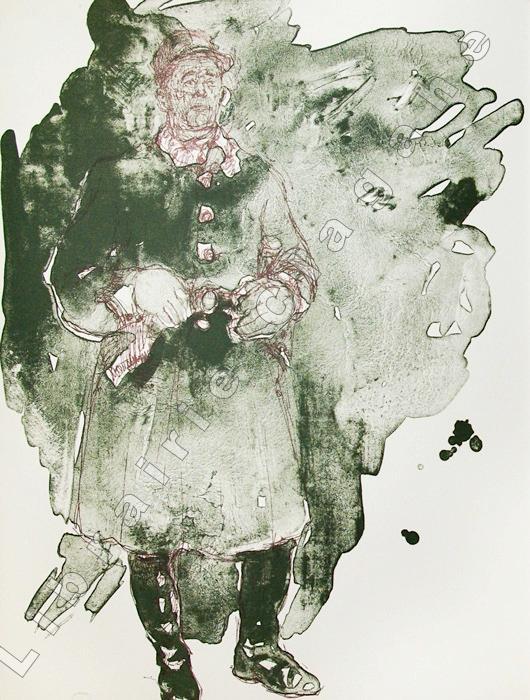
1966réf. 12447Paris - Bièvres, Pierre de Tartas, 1966 ; in-folio en feuilles sous couverture beige muette, coffret d'éditeur de tissu marron, titre lavande, intérieur de suédine grise ; (106) pp., (2) ff. blancs, 18 lithographies originales en couleurs, dont 7 à doubles pages et 3 en marge du livre par Jean Commère.
1956réf. 000420(Saint-Maurice d'Ételan) (Pierre Bettencourt) 1956 In-8 carré Broché Ed. originale
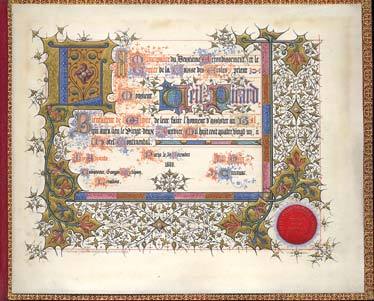
1881réf. 1235Un feuillet de vélin richement enluminé, cachet de cire rouge " Mairie de la Bourse " sous chemise en plein chagrin bordeaux, " A Monsieur Veil Picard " à froid, roulette dorée d’encadrement sur les plats intérieurs.