1 531 résultats
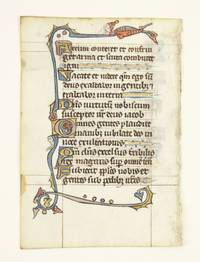
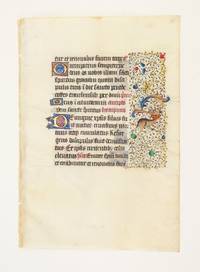
réf. ST17060NFrance probably Besançon 3rd quarter of 15th century. 239 x 165 mm. 9 3/8 x 6 1/2". Single column 15 lines in an elegant gothic book hand. Rubrics in dark pink line enders in pink and blue with white tracery and gold bezant one- and two-line initials painted gold on pink and blue ground with white tracery each side with a panel border decorated with hairline vines gold bezants and ivy and colorful flowers and acanthus RECTO BORDER INHABITED BY A CHARMING DOG-LIKE CREATURE. ◆A small light stain in border decoration largely masked by dense hairline vines but IN FINE CONDITION--bright clean and well preserved. From a large Book of Hours probably produced in Besançon this leaf features very pretty panel borders including one with a particularly charming inhabitant in the form of a dog-like creature with no front legs wearing an orange collar and emitting an acanthus leaf from its mouth. Imaginative touches like this and luxurious elements such as the several dozen gilt bezants and ivy leaves in each border and the unusually wide margins point to this manuscript having been quite a costly production. For additional leaves from this same manuscript at different price points please check our website. unknown
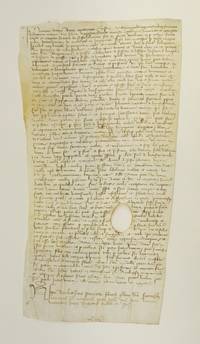
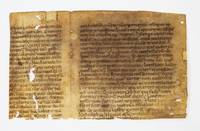
1429réf. ST12778-0360Italy 1429. 323 x 173 mm. 12 3/4 x 6 3/4". Single column 60 lines in a neat cursive script. Notarial signature at lower left; verso with a date and notations in contemporary hands. ◆Vellum trimmed a little close four horizontal and three vertical fold creases slight darkening to verso five very small holes no text obscured and one larger naturally-occurring hole in the text otherwise in excellent condition with a very clear hand. This is a notarized document recording an agreement made between the chapel and convent i.e. the whole community of the house of St. John a group of female religious located in the parish of St. Peter and the brothers of Bonsignioribus another religious house in the parish of St. Laurence Major. The women of St. John agree to pay to the brothers of Bonsignioribus a sum of 11 libras 8 soldas and 9 denarios. The reason for this payment is unclear pending further investigation into some of the more abbreviated portions of the text. The document is of additional interest for the fact that several female members of the house of St. John are mentioned by name. Based on these names and that of the notary Ambrosius Spanzota . . . Parmensis it would appear that the document was written in Italy possibly in Parma and that the two houses were also located there. unknown
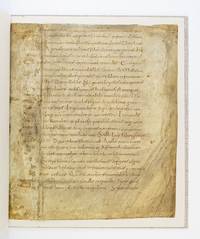
réf. ST17766Probably Germany third quarter of ninth century. 285 x 245 mm. 11 1/4 x 9 3/4". Single column 25 lines in a Caroline minuscule book hand. Tipped into a paper folder and presented in a tan cloth binding with ink notation on spine and a small sticker on upper cover. Rubrics in red. Front pastedown of folder with the bookplate of the Schøyen collection. With several pages of typed and handwritten notes including Bernard Rosenthal's cataloguing and a copy of a letter from Bernhard Bischoff to Rosenthal concerning the dating of the leaf. ◆Recovered from a binding and thus with some expected browning staining and wrinkling a long vertical fold through the text touching a couple letters of each line recto with the first few words of each line roughened and somewhat obscured a couple of other words a bit hard to make out but the vast majority of text very legible with fore and tail margins very ample and in all quite a good specimen representing a remarkable survival. Featuring a lovely Caroline miniscule hand this very early leaf from a Lectionary may have been made for the use of a particular church or individual and comes with recent distinguished scholarship and provenance. Although the text here contains familiar passages from the Old and New Testaments their juxtaposition in this context presents a bit of a conundrum: as the enclosed cataloguing explains the story of the wicked husbandmen from Matthew followed by the story of Esau surrendering his birthright to Jacob from Genesis "is an irregular and indeed unrecorded liturgical sequence of texts and suggests that this particular collection of lections was compiled for a particular church or private chapel." It is also possible that the Lectionary was made for the use of an individual rather than an institution with certain needs or preferences—perhaps a scholar or theologian or even a Carolingian nobleman many of whom were literate and educated. The hand here is an excellent example of the legible and elegant Caroline minuscule that dominated Western Europe in this period; distinctive letter forms include clubbed ascenders such as on the letters "b" "d" and "l" a long "s" with the shaft on the line and the use of the ampersand as a general abbreviation for the letters "et" occurring anywhere in a word for example "conter&" for "conteret". Termed the "integrated ampersand" this usage is especially characteristic of Caroline minuscule manuscripts of the late eighth and ninth centuries. Our leaf comes with bookseller Bernard M. Rosenthal's catalogue description noting that it was "Purchased from Schab New York Feb. 1969." William H. Schab was a book and art dealer in the firm of Gilhofer and & Ranschburg in Vienna before fleeing Austria in 1938 and settling in New York where he founded his own business. Also included here is a copy of a handwritten note regarding the date of the present leaf from renowned paleographer Bernard Bischoff. The leaf was also featured in Quaritch's 1991 catalogue 1147 Bookhands of the Middle Ages V no. 25.5 and was until recently part of the Schøyen Collection their MS 623. Four additional pages of cataloguing are also included here. Despite having been used as binding scrap at some point in its life this leaf is very well preserved with no words lost from trimming with distinctly visible ink and in a clear and very pleasing hand. unknown
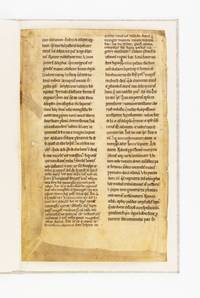
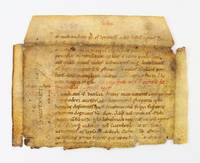
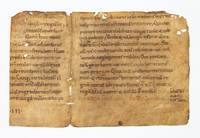
réf. ST17768England second half of 12th century but before 1180. 313 x 198 mm. 12 1/4 x 7 3/4. Double column 32 lines in a lovely late Caroline hand verso with some lines erased and corrected in a smaller hand. Mounted in a fine tan cloth folder between sheets of textured acid-free paper. Front pastedown with book label of the Schøyen Collection with their shelf mark MS 237 written in ink. ◆Recovered from a binding and thus with overall toning and soiling recto somewhat browned from binder's glue but almost entirely confined to three margins and the verso virtually unaffected other trivial imperfections but in surprisingly good condition given its history the very rich ink especially dark and well preserved. This is an exceptionally lovely example of an early English book hand standing at the crossroads of the Caroline and proto-gothic calligraphic traditions. According to Thompson "In the twelfth century the scribes seem to have vied with each other in producing the best types of book-writing of which they were capable with the result that remarkable precision in the formation of the letters was attained and that the century may be named as excelling all others for the beauty of its MSS." "Greek and Latin Paleography" p. 436 The present leaf certainly lives up to this description being notable for its exceptionally neat and legible script written with uncommonly pretty and regular letter forms by a practiced and confident hand. The Caroline tradition is apparent in certain tendencies such as the use of "&" for "et" and the lack of biting curves between letters while a shift toward the proto-gothic can be seen in the vertical and compressed letter forms as well as the increased use of abbreviations and ligatures. Although the present work has often been credited to Haymo of Halberstadt due to a longstanding error in attribution reaching back to the 15th century modern scholarship now recognizes Haimo of Auxerre a monk at the Abbey of Saint-Germain in Auxerre d. ca. 875 as its true author. A prominent theologist and writer during the Caroline Renaissance Haimo produced a number of influential commentaries on various books of the Bible. The provenance on this leaf can be traced back as far as the mid-19th century when it was auctioned at Sotheby's on 21 August 1858 lot 119.2 sold as part of an album containing various leaves and fragments put together by Philip Bliss 1787-1857 registrar of the University of Oxford. It then went into the celebrated collection of Sir Thomas Phillipps 1792-1872 and was eventually sold by the Robinson Brothers on 24 April 1911 lot 390.3. This leaf has previously appeared in Quartich's catalogue 1036 "Bookhands of the Middle Ages" no. 79.5 and was most recently in the collection of Martin Schøyen his MS 237.
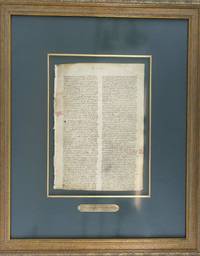
réf. ST12778-0799Italy ca. 1275. 272 x 193 mm. 10 3/4 x 7 1/2". Double column 67 lines of text in a pleasing regular gothic hand. In a very attractive 21 1/2 x 17 1/2" walnut frame of antique design with the leaf in a sunken compartment with a gold lip a brass label below the compartment. Once purchased from Quaritch with their description on the back. ◆Formerly used as the flyleaf in a binding so slightly soiled text with minor fading a very small portion perhaps one or two lines of the text trimmed off at bottom half a dozen small round wormholes but still an attractive legible example of an unusual text. The Quaritch description says that the leaf is from "a Medieval medical work based on Galen concerned with fevers especially those that last a single day 'febres ephemerae'; the present leaf contains the text of chapters 4-7. The author speaks about bloodletting not . . . for the young or elderly baths honey the better kind is clean clear and of sharp odor and delicate Roman women. He cites Hippocrates and the 'Regimen Sanitatis' of Salerno as well as his own writings 'Quisquis igitur se non exercet in meis libris non poterit intelligere' 'Whoever then does not train himself in my own books will not be able to understand'. The text has a strong Galenic tone although it is not a translation of Galen's 'De Differentiis Febrium' and suggests a Medieval work based on Galen and possibly from the great Salerno medical school. The vocabulary includes post-classical words such as 'acetositas' acidity and even some words unrecorded in the massive 'Thesaurus Linguae Latinae' Oxford Medieval Latin Dictionary and Du Cange such as 'crapulositas' drunkenness and 'indigestabilitas.'" The leaf has obvious interest for its content and it is well presented in its attractive frame. unknown
réf. ST12668bHNortheastern France probably Arras late 15th century. 146 x 95 mm. 5 3/4 x 3 3/4". Single column 15 lines in a pleasing bâtarde hand. Rubrics in red one- and two-line initials in brushed gold on a red or blue ground EACH SIDE OF LEAF WITH A BRUSHED GOLD PANEL BORDER WITH VERY PRETTY ILLUSIONISTIC FLOWERS AND FRUITS and intricate strapwork design in colors; WITH TWO SMALL MINIATURES measuring approximately 40 x 25 mm. depicting John the Baptist and John the Evangelist shown with their attributes. Headlines written in French in a later 18th century calligraphic hand. ◆Light soiling a touch of paint loss to frames and background not very noticeable and not affecting the figures otherwise an excellent specimen generally clean and smooth with ample margins winning decoration and shining gold. From a charmingly decorated 15th century prayer book this leaf offers the opportunity to acquire two particularly nice miniatures each depicting an important saint. The recto shows St. John the Baptist with a lamb at his side and a book balanced on his knee; and the verso depicts St. John the Evangelist as a young man holding a chalice with what ought to be snakes emerging from it in reference to the poisoned cup he was invited to drink as a test of faith but which instead look more like tendrils of smoke. For other leaves from this same manuscript please check our website. unknown
1460réf. ST12839Paris ca. 1460. 153 x 110 mm. 6 x 4 3/8". Single column 14 lines of text in a fine gothic book hand. One-line initial in burnished gold on a pink and blue ground with white tracery a two-line initial and a three-line initial in pink with white tracery on a ground of burnished gold the center filled with twining blue vines bearing pink and scarlet flowers verso with a rinceau panel border featuring twining hairline stems bearing burnished gold ivy leaves and fruit blue and gold acanthus leaves and flowers recto WITH AN ARCH-TOPPED MINIATURE OF THE HOLY TRINITY SURROUNDED BY THE HEAVENLY HOST this and the accompanying text enclosed by a pink blue and burnished gold bar border on one side and a brushed gold bar border with pink lotus flowers on two sides the whole surrounded by A FULL RINCEAU BORDER DENSE WITH ACANTHUS LEAVES FOLIAGE FRUIT FLOWERS AND TINY GOLD BERRIES on hairline stems. ◆A little paint flaked from the book held by the Trinity a couple of small spots in the margin otherwise in fine condition--clean and smooth with comfortable margins and bright gold. The Trinity is shown here seated on a canopied throne with God the Son his hand raised in blessing to the left of the Father. The latter in a towering crown holds a gold orb and the Father and Son together support a large book opened between them. The dove of the Holy Spirit hovers above the book radiating golden beams. The Trinity is flanked on both sides by cherubim and seraphim in rich red and soft yellow. It is the rendering of this angelic ambiance that elevates the level of aesthetic achievement here: both red and yellow celestial beings are given a ghostly appearance as if appearing out of a filmy yellow or a densely red fog. The artistic qualities as a whole suggest that this leaf comes from a manuscript commissioned by a person of significant means. unknown
réf. ST17587France late 12th century. 176 x 132 mm. 7 x 5 1/4". Single column 18 lines in a protogothic hand text on one side only. Rubrics in red "Liber" in upper margin in red. Recto and verso with scribblings by later hands the name "Simon Pivante" clearly visible on recto but the others illegible. ◆Recovered from a binding and thus with obvious staining folds and rubbing a couple lines at top and bottom and a few other words here and there too rubbed to make out but by and large still very legible and in a pleasing hand. This leaf is primarily of interest for its content containing a rare example of Anastasius Bibliothecarius' "Historia Ecclesiastica" of the Byzantine Church also known as the "Chronographia tripartita" compiled from the works of the near-contemporary Greek authors Theophanes Nicephorus and Syncellus. According to the Catholic Encyclopedia Anastasius Bibliothecarius ca. 810-79 "learned Greek from Greek monks and obtained an unusual education for his era so that he appears to be the most learned ecclesiastic of Rome in the barbaric period of the ninth century." He earned the moniker "Bibliothecarius" from his appointment as librarian of the Roman Church a position he held during the reign of popes Adrian II 867-72 and John VIII 872-82. It is possible that Anastasius was also the same figure elected antipope in 855 as recorded in at least one contemporary chronology but historians disagree on the validity of this identification. Anastasius' work appears to be extremely rare in the marketplace. unknown
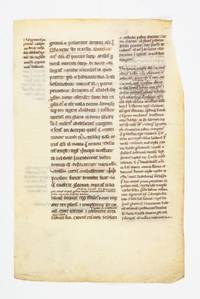
réf. ST17586Abbey of St. Oyan at St.-Claude du Jura France ca. 1175. 245 x 158 mm. 9 3/4 x 6 1/4". Single column of text with two columns of gloss text column with 26 lines in a fine proto-gothic book hand. Verso with scant remnants of mounting tape in a couple of places along one edge. See Gwara Handlist no. 77. ◆Upper margin of fore edge unevenly trimmed away but no text lost a dozen-and-a-half small round wormholes touching just a couple letters light soiling to edges and other minor imperfections but still IN FINE CONDITION the vellum very clean and the ink dark and legible. The most important innovation in biblical scholarship during the 12th century was the development of the "Glossa Ordinaria" to the Bible. Drawing on the whole earlier tradition of biblical exegesis but especially that of Latin patristic writers like Augustine and Jerome scholars working in the French cathedral schools of Laon and Paris systematized this material in an apparatus of marginal and interlinear glosses arranged around the relevant biblical passages. The present leaf showing a particularly beautiful and regular script is a lovely example of one such work. The biblical text appearing in the center column is differentiated by larger lettering and gloss appears interlineally and in a column on either side of the main text all in smaller lettering by the same hand. Scott Gwara notes that the parent manuscript was formerly in the Medieval library of St. Oyan at St.-Claude du Jura a Benedictine monastery founded as the Abbey of Condat around 425 and later known as St. Oyen after an obscure saint who served as Condat's fourth abbot. In the 13th century it was renamed St.-Claude. By the 20th century the manuscript was in the collection of William L. Clements d. 1934 the bulk of which was sold by his estate between 1934-37. The manuscript was then acquired and dismembered by biblioclast Otto Ege around 1939. Gwara notes that the manuscript was incomplete by the time it reached Ege containing only 80 leaves but was "otherwise in excellent condition." The present leaf certainly attests to this assertion being extremely clean bright and with comfortable margins. unknown
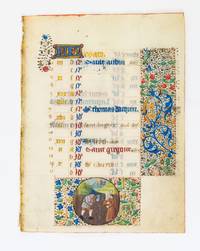
réf. ST17245-04France possibly Rouen mid-15th century. 173 x 130 mm. 6 3/4 x 5 1/8". Single column 16 ruled lines text in a gothic book hand. Text in gold blue and dark pink "KL" in blue with white tracery on a gold ground decorated with dark pink baubles and leaves and with a floral spray extension both sides with panel border composed of densely packed acanthus flowers and hairline vines with gold bezants WITH A SMALL ROUNDEL MINIATURE at the bottom depicting the labor of the month Pruning set on a panel of flowers hairline vines and gold bezants. With numbering to the left of the golden numbers and a few calendar entries in a later hand. ◆Light soiling to vellum a few small smudges in the borders a little paint transfer affecting a couple lines of text and margins of the verso but these issues all very minor and on the whole in fine condition with a particularly well-preserved miniature with rich uneroded paint. With lovely panel borders and a particularly charming roundel miniature showing the labor of the month this leaf likely comes from a high-quality manuscript made for a person of means. Though miniatures depicting the labors of the month are often illustrated with just a single person performing the task here we are treated to two laypeople--a man and a woman--working together to prune and break ground in their field. The man appears to be carrying an axe for trimming branches while the woman carries a long stick to loosen dirt for spring plantings. The names of several saints have been added to the calendar by a later hand though it would appear that they were erroneously placed in March: St. Hugh belongs on 9 April Pope Leo on 11 April and St. Tiburtius on 14 April. While almost all of these feast days are commonly found in Books of Hours of this period Hugh Bishop of Rouen is slightly unusual suggesting that the manuscript may have been made in or at least ended up in Rouen. unknown
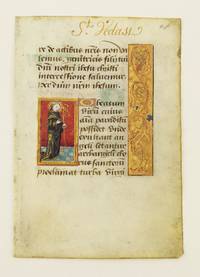
réf. ST12668bKNortheastern France probably Arras late 15th century. 146 x 95 mm. 5 3/4 x 3 3/4". Single column 15 lines in a pleasing bâtarde hand. Rubrics in red one- and two-line initials in brushed gold on a red or blue ground EACH SIDE OF EACH LEAF WITH A BRUSHED GOLD PANEL BORDER WITH VERY PRETTY ILLUSIONISTIC FLOWERS and one panel with acanthus apparently unfinished; EACH LEAF WITH ONE SMALL MINIATURE measuring approximately 40 x 25 mm. DEPICTING SAINTS. Headlines written in French in a later 18th century calligraphic hand. ◆Light soiling otherwise excellent specimens generally clean and smooth with ample margins and attractive decoration. From a charmingly decorated 15th century prayer book these lovely leaves offer the opportunity to acquire a miniature andconsiderable gold ornamentation at an attainable price. One leaf depicts Sts. Peter and Paul in a single frame and the other shows St. Vedast or Waast--a saint that was particularly venerated in France especially in the Arras region whence we be believe these leaves originated. For other leaves from this same manuscript please check our website. unknown
réf. 1464London: Macmillan and Co. 1895. Octavo. A sensuously romantic but chaste gift binding in full vellum with the initials " J. J. de W." in gilt on the front cover and " 25. June 1895 d. d. G. B. R." on the back cover. 184 pages. The gilt titled spine has an ornament of a single gilt inverted lily blossom on a sinuous stem with the date 1895 in gilt at the foot of the spine. Small gilt lily blossoms also adorn the corners of both covers. Vellum turn-ins with double gilt rules. Top edge gilt. Although this binding is unsigned it was obviously the work of a skilled binder producing a gift volume to represent the affection of the presenter and hopefully the cherished regard of the receiver. hardcover
réf. ST18310cGermany ca. 1100. 130 x 204 mm. 5 1/8 x 8". Single column 13 extant lines in a late Caroline hand. Rubrics in red. ◆Recovered from a binding and thus noticeably browned stained and vaguely wavy one side somewhat faded several small holes just two touching any letters other imperfections but still a very presentable specimen the ink especially dark on one side and legible on both. This is an early fragment in a distinctive hand lacking the heaviness of other scripts of the period and with a feeling of the elongated grace of the humanistic. Despite having previously been used as a binding scrap the fragment remains definitely readable partly because of the clarity of the scribal hand. Elected pope in 590 Gregory I ca. 540-604 also known as Gregory the Great was one of the most influential pontiffs in the history of the Church. In addition to revising liturgical worship he wrote extensively on theology offering homespun wisdom rather than esoteric debates. His "Homilies on the Gospels" were intended to be preached to common people rather than a monastic audience and as a consequence were greatly admired for their straightforward language and pastoral relevance. unknown
réf. ST18310bGermany ca. 1100. 120 x 200 mm. 4 3/4 x 8". Single column 21 extant lines in a late Caroline hand. ◆Recovered from a binding and thus noticeably browned and stained several small holes costing perhaps 30 letters other imperfections but still a very presentable specimen the ink dark and with loss of legibility in only one small place. This is an early fragment in a distinctive hand lacking the heaviness of other scripts of the period and with a feeling of the elongated grace of the humanistic. Despite having previously been used as a binding scrap the fragment remains extremely legible partly because of the clarity of the scribal hand. Elected pope in 590 Gregory I ca. 540-604 also known as Gregory the Great was one of the most influential pontiffs in the history of the Church. In addition to revising liturgical worship he wrote extensively on theology offering homespun wisdom rather than esoteric debates. His "Homilies on the Gospels" were intended to be preached to common people rather than a monastic audience and as a consequence were greatly admired for their straightforward language and pastoral relevance. unknown
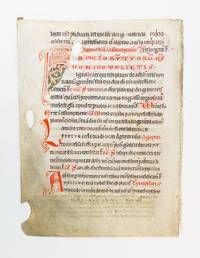
réf. ST17236Germany mid- to late 12th century. 290 x 217 mm. 11 3/8 x 8 1/2". Single column 21 lines in an attractive proto-gothic book hand. Rubrics in red several one-line initials in red five red initials measuring two to four lines long and with penwork embellishment A LOVELY SEVEN-LINE WHITE-VINE INITIAL outlined in red and with a pale yellow wash along the edge the lower half of the ground filled with green wash. Lower margins with notations in later Medieval hands. ◆A handful of original holes in the vellum no doubt from stretching the skin during processing with the scribe writing around the flaws where necessary a little soiling to lower outside corner one or two negligible spots otherwise IN FINE CONDITION the ink unusually rich and the paint very bright. From a Sacramentary a service book that contained the prayers said during Mass subsumed by the Missal in the 13th century this early leaf was once part of an attractive manuscript of very high quality. The very large and superb "F" opens the Mass for the Feast of the Assumption and the other readings here include Masses for Sts. Hippolytus and Cassian celebrated on 13 August; St. Eusabius 14 August; Vigil of the Assumption of the Virgin 14 August; Assumption of the Virgin 15 August; St. Agapitus 18 August; and the beginning of the Mass for Sts. Timothy Hippolytus and Symphorian 22 August. Sister leaves from this same manuscript have previously appeared in Sam Fogg Cat. 16 "Text Manuscripts and Documents 2200BC to 1600AD" 1995 nos. 30 and 31; Maggs Bros. European Bulletin 20 1995 no. 37; Quaritch Cat. 1270 "Bookhands of the Middle Ages VI" 2000 nos. 69 and 70; Sotheby's 6 December 2001 lot 8; and Bloomsbury 6 December 2017 lot 16. The Fogg description notes that similar initials can be seen in French German and Flemish manuscripts of the period "but very few manuscripts have the special characteristics of this one." For example the initials on the sister leaves described by Fogg contain atypically mauve and green as well as an "unusual . . . exterior contoured ground which is not confined by any geometric form." This means there is no line or shape to box in or define the capital's form; rather it appears as if surrounded by an aura or gentle shadow. Our initial contains a green ground only no mauve but the same unusual and attractive yellow aura. It is rare to find Romanesque leaves of this size and caliber in such fine condition and the present leaf with its beautiful regular proto-gothic hand exceptional white-vine initial and several large decorative initials in red is especially desirable. unknown
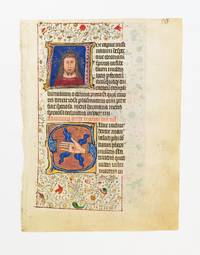
1465réf. ST17243aBruges ca. 1465. 193 x 145 mm. 7 5/8 x 5 3/4". Single column 21 lines in a gothic book hand. Rubrics in red WITH THREE LARGE HISTORIATED INITIALS: ONE WITH A PORTRAIT OF CHRIST WEARING THE CROWN OF THORNS AND TWO WITH DISEMBODIED HANDS SHOWING THE STIGMATA each initial in pink or blue with white tracery filled with dark pink or blue with thin gilt lines and dots hands with wavy blue rays radiating from behind the appendage all within a thin gilt frame both sides with a three-quarter border consisting of hairline vines gold bezants and a few colorful flowers. ◆Margins with a little light soiling BUT IN FINE CONDITION THE PAINT OF THE INITIALS ESPECIALLY RICH AND WELL PRESERVED. From a manuscript probably produced in Bruges for the English market this leaf contains arresting initials that direct the viewer's attention to the wounds endured by Christ during the Passion. According to Roger Wieck Passion Cycle images enjoyed a particular vogue in 15th century Dutch Flemish and English Books of Hours including those that were exported to England. In the present example the strikingly unusual imagery includes a portrait of Christ wearing the Crown of Thorns his gaze fixed directly at the viewer and in separate initials his left and right hands appear disembodied and displaying the stigmata. A sister leaf to the present item features three additional initials showing the wounds of the left and right foot as well as the spear injury to Christ's side depicted as an oval piece of flesh with a laceration across the center. The parent manuscript containing the present leaf sold at Christie's on 15 November 2006 lot 16 the description for which gives us additional information about the book's contents and provenance: it was made for the Use of Sarum included a calendar with the English saint Thomas Becket and Popes Gregory and Silvester with their names crossed out indicating that it was in England through at least the time of the Reformation and contained an early ownership inscription of a woman named Bridget Lowe with a Middle English inscription on the pastedown. Christie's also attributed the parent manuscript to the workshop of William Vrelant with miniatures possibly by his chief assistant the Master of the "Vraie Cronique Descoce." They note that this work is "of higher quality than many of the works that satisfied the English demand for Netherlandish illumination" and that it "demonstrates why Vrelant appealed to the great bibliophiles of the Burgundian Netherlands." Vrelant was the leading purveyor of books of private devotion in Bruges during the third quarter of the 15th century and his prominent position among Flemish illuminators of the time is indicated by the considerable number of manuscripts illustrated in his manner by other miniaturists both in Bruges and in nearby cities in Flanders. Similar examples to the present leaf can be found in intact Books of Hours at the Philadelphia Free Library MS Widener 3 and the Huntington HM 1086--both of which were produced in Flanders or the Netherlands around the same time as the present work--but the present leaf surpasses both of these examples in terms of excellence of the artistic hand and level of detail depicted. unknown
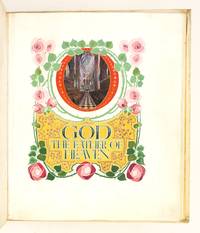
1907réf. ST16456Birmingham 1907. 312 x 275 mm. 12 3/8 x 10 3/4". 16 leaves illuminated on rectos only. Pleasing original full vellum over bevelled boards covers ruled in gilt and with gilt crosses in each corner gilt lettering on upper cover smooth spine gilt rules dividing compartments with central gilt cross thick vellum turn-ins ruled in gilt bright purple silk endpapers front joint very expertly repaired. Calligraphic lettering mostly in black green and red a few one-line initials and many three-line initials in blue or purple with red penwork several slightly larger purple or blue initials infilled with ivy of various colors and dotted with gold EACH PAGE WITH A DIFFERENT ARTS & CRAFTS-INSPIRED FLORAL BORDER consisting of multi-colored blossoms and acanthus as well as meandering vine-stems and highlighted with gold bezants or stippled gold ONE LEAF WITH A 90 MM. INITIAL INHABITED BY A REALISTIC CATHEDRAL INTERIOR the large lettering below it on a gold ground with etched patterns and painted purple ivy leaves the text and the initial surrounded by pink roses green leaves and thorny vines. ◆Corners a bit bumped vellum with a few shallow scratches slightly soiled in a few places other minor signs of use but the binding still quite clean and attractive; perhaps a hint of thumb-soiling to margins of a couple leaves but the contents in nearly perfect condition. This is a beautiful and engaging manuscript with imaginative illuminations by the little-known but extremely talented illuminator calligrapher and cartographer Ernest Costain Clegg 1876-1954. The text here reproduces the Great Litany of the Church of England derived from the Book of Common Prayer and composed of short divine petitions. Each leaf contains a different and unique border featuring stylized floral motifs often with curving vines encircling the text and a cheerful color palette consisting of clear pastels that beautifully offset the darker inks used in the text. The generous use of gold on the first leaf of text and gilt details throughout the borders provide a dimension of luxury without overshadowing the prayers themselves. Clegg draws on the Medieval tradition of manuscript illumination but this work also shows the influence of the Arts & Crafts movement of the 19th century especially in the beautiful initial inhabited by a realistic Cathedral interior pierced with light--a feature that invites comparison with the superlative work of Alberto Sangorski. But Clegg's reliance on a variety of floral decoration in his borders makes this manuscript more feminine than the typical work of Sangorski. Ernest Clegg entered the military in his early twenties serving in the Boer War 1899-1902 then returned to England to train at the Birmingham School of Art. In 1909 he went to work for Tiffany's of New York as a jewelry designer. Clegg also served in the English forces during the First World War; afterwards in America his popularity in the veteran community led to more commissions and a thriving artistic career. Clegg is perhaps best known for illustrating the poem "In Flanders Fields" written by John McCrae but he also found success as a cartographer producing among other works a well-known map of Charles Lindbergh's flight across the Atlantic in 1927. unknown
réf. ST16379-008France late 13th century. 125 x 88 mm. 4 7/8 x 3 1/2". Single column 15 lines in a gothic book hand. Attractively matted. Folio number in red several line enders in gold with blue penwork 10 one-line initials in gold on blue and pink ground one two-line initial painted pink and filled with blue and orange acanthus on gilt ground verso with a three-quarter border branching from the larger initial composed of pink and blue curling lines accentuated with gold spikes bezants and painted ivy leaves UPPER BRANCH TERMINATING IN A WONDERFUL HYBRID CREATURE WITH THE FACE OF A MAN AND THE BODY OF AN ORANGE BEAST AND THE LOWER BRANCH INCORPORATING ANOTHER FACE WITH A LONG BEARD. From the collection of Joseph Pope his MS Bergendal 116 about whom see below. ◆A little soiling and staining along edges of vellum and a couple of small marks in lower margin verso but in excellent condition overall the paint especially bright and fresh. From the distinguished collection of Canadian financier Joseph Pope 1921-2010 this charming leaf comes from a small-format Psalter intended for private use and features two amusing drolleries incorporated into the marginal design. Pope's collection was sold by Sotheby's on 5 July 2011 where this leaf appeared as part of lot 115; it was later listed in Quaritch Catalogue 1422 no. 88 which states that "according to Pope's note this leaf was found tipped in to a much later Book of Hours his MS Bergendal 64--produced in the southern Netherlands for a southern French patron during the first half of the 15th century--at f. 94 the middle of the Penitential Psalms; the manuscript was acquired by Pope at Sotheby's sale of 6 December 1983 lot 79.". unknown
réf. ST12668bLNortheastern France probably Arras late 15th century. 146 x 95 mm. 5 3/4 x 3 3/4". Single column 15 lines in a pleasing bâtarde hand. Attractively framed leaves with full borders showing one side only and the leaf with images of saints in double-sided glass frame showing both recto and verso. All leaves with rubrics in red and one- and two-line initials in brushed gold on a red or blue ground some leaves with three-line initials on orange or green ground. Each leaf WITH EITHER A FULL BORDER OR PANEL BORDER WITH BRUSHED GOLD GROUND AND VERY PRETTY ILLUSIONISTIC FLOWERS AND FRUITS the leaf with the panel border also FEATURING TWO SMALL MINIATURES OF SAINTS. Headlines written in French in a later 18th century calligraphic hand. ◆Brushed gold a little faded in places otherwise excellent specimens generally clean and smooth. From a charmingly decorated 15th century prayer book these beautifully framed leaves are ready to hang on the wall or give as a gift to a lucky recipient. Two types of leaves are offered here: the first consists of a full border with illusionistic flowers fruit and at least one insect or creature; the second contains a panel border and two small miniatures depicting St. Anthony often called the Father of all Monks and the lesser known St. Eligius patron saint of metalworkers. For unframed leaves from this same manuscript please check our website. unknown
réf. ST12668bJNortheastern France probably Arras late 15th century. 146 x 95 mm. 5 3/4 x 3 3/4". Single column 15 lines in a pleasing bâtarde hand. Rubrics in red one- and two-line initials in brushed gold on a red or blue ground EACH SIDE OF EACH LEAF WITH A BRUSHED GOLD PANEL BORDER WITH VERY PRETTY ILLUSIONISTIC FLOWERS; EACH LEAF WITH TWO SMALL MINIATURES measuring approximately 40 x 25 mm. depicting saints shown with their attributes. Headlines written in French in a later 18th century calligraphic hand. ◆Light soiling rubrics faded otherwise excellent specimens generally clean and smooth with ample margins attractive decoration and shining gold. From a charmingly decorated 15th century prayer book these lovely leaves offer the opportunity to acquire a miniature and considerable gold ornamentation at an attainable price. One leaf depicts St. Andrew holding an "X" shaped cross and St. Etienne i.e. St. Stephen here shown with three stones on his body and the other shows St. Remigius the so-called "Apostle of the Franks" and St. Quentin--a saint that was particularly venerated in France especially in the north whence we be believe these leaves originated. For other leaves from this same manuscript please check our website. unknown
réf. ST12778-0082South Germany or more probably Austria second half of the 12th century. 429 x 304 mm. 16 7/8 x 12". Double column 36 lines of text in a fine proto-gothic hand. ◆Text a bit faded on one side an upper corner slightly defective minor soiling and with the grain of the vellum apparent on verso but with the beautiful text entirely legible and the leaf as a whole quite pleasing. The hand here is memorable featuring wide upright letters that could not be more regular. Elected pope in 590 Gregory ca. 540-604 was one of the most influential pontiffs in the history of the Church. In addition to revising liturgical worship he wrote extensively on theology offering homespun wisdom rather than esoteric debates. He was declared a saint immediately upon his death. unknown
réf. ST12083eItaly ca. 1150. 406 x 273 mm. 16 x 10 3/4". Double column 42 lines in a fine rounded early proto-gothic hand. Recto with a pleasing three-line red initial. ◆Formerly used in a binding and consequently a bit soiled and trimmed at the head with loss of the first line perhaps 100 or so small wormholes in the margin only a few causing trivial harm to the text a faint grayish stain affecting a couple of words in the top 20 lines of one column on each side but the entirety of the text completely clear and the stately leaf quite fresh and unusually well-preserved in general for a recovered specimen. This leaf comes from a very large copy of one of the major texts by one of the great popes of the early Middle Ages. Dealing in part with the central occurrence in the salvation of humanity the text here treats of John 20:19-31 which tells of the risen Christ's appearance to the Apostles. Doubting Thomas insists on touching the Lord's wounds before he will be convinced of the Resurrection. Gregory tells his audience that Thomas was healed of unbelief and so must they be although they cannot see Jesus in the flesh as did Thomas. Written ca. 593 Pope Gregory's 40 homilies on the Gospels enjoyed enduring popularity throughout Medieval times as they offered ordinary Christians practical guidance on applying the lessons of the Gospels to their own lives. Elected pope in 590 Gregory ca. 540-604 was one of the most influential pontiffs in the history of the Church. In addition to revising liturgical worship he wrote extensively on theology offering homespun wisdom rather than esoteric debates. He was declared a saint immediately upon his death. The script here is regular rounded and very pleasing--almost soothing--to the eye. Moreover the letters are so large and there is so little significant damage to the leaf that the text can be easily read from a considerable distance. unknown
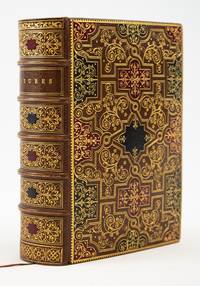
réf. ST20295Northern France probably Paris third quarter of 15th century. 130 x 100 mm. 5 1/8 x 3 7/8". Single column 15 lines in an elegant gothic book hand. 280 leaves. First four leaves misbound lacking at least seven leaves five of which probably contained miniatures. Contents: Devotion to the Passion f. 1r; blank f. 4; Calendar f. 5r; Gospel Lessons f. 17r; "Obsecro te" and "O intemerata" f. 23r; blank f. 23; Hours of the Virgin lacking opening leaves for Terce Nones and Vespers f. 33r; Penitential Psalms and Litany f. 100r; Hours of the Cross lacking preliminary leaf f. 120r; Hours of the Holy Spirit p. 123r; Office of the Dead lacking preliminary leaf f. 127r; "Sept Vers de Saint Bernard" and Suffrages f. 176v; series of devotional prayers in Latin and French including the Hours of the Conception an indulgence devotional poems in French prayers for specific occasions such as when facing tribulations going to confession protection against storms and for friends abroad the Stabat Mater the Seven Joys of the Virgin Gospel sequences "Le chemin de paradis" and many others f. 199r; blank f. 280. ESPECIALLY BEAUTIFUL MID-19TH CENTURY LIGHT BROWN MOROCCO LAVISHLY GILT IN THE "FANFARE" STYLE BY CAPÉ stamp-signed in gilt on front turn-in covers with large green and red morocco inlaid panels gilt strapwork scrolling and small star tools raised bands spine compartments with red or green morocco inlay surrounded by gilt scrolling embellishments gilt lettering RED MOROCCO DOUBLURES gilt in the style of Duodo with repeating pattern of flowers encircled by vines marbled endleaves modern paper and vellum flyleaves all edges gilt. Housed in a fine suede-lined pebble-grained leather pull-off case with gilt lettering on spine. Light red ruling and rubrics numerous line-fillers in blue and pink with gilt embellishments many one- and two-line initials in burnished gold on pink and blue ground three four-line initials in pink or blue filled with ivy leaves on a burnished gold ground two of these with a gilt and painted baguette along the outer edge of text and all with a three-quarter border of hairline vines flowers acanthus and gold leaves the majority of the leaves with a panel border of hairline vines and flowers on one side one historiated initial painted blue on a burnished gold ground depicting the Virgin accompanied by a gilt and painted baguette and three-quarter border FOUR SMALL MINIATURES DEPICTING THE APOSTLES each with a gilt and painted baguette and surrounded by a three-quarter border and EIGHT LARGE ARCH-TOPPED MINIATURES above a three-line initial painted blue or pink on gold ground a gilt "L" shaped bar border incorporating colorful flowers and a full border of border of hairline vines flowers acanthus and gold leaves and A HALF-PAGE RECTANGULAR MINIATURE with a border along the lower half. The subjects of the large miniatures include: the Mass of St. Gregory f. 1r; Annunciation f. 33r; Visitation f. 57r; Nativity f. 70r; Adoration of the Magi f. 80v; Crowning of the Virgin f. 94v; David in Prayer f. 100r; Pentecost f. 123r; and a rectangular miniature of the Holy Wound or perhaps the Bleeding Host of Dijon f. 241v. Isolated light rubbing and negligible chips to miniatures the dark blue paint appearing slightly worn in places as is often the case occasional faint smudges to borders and other imperfections but all of these trivial. IN THOROUGHLY FINE CONDITION INTERNALLY--the paint fresh the vellum clean and the margins quite comfortable--AND THE EXTRAORDINARILY FINE BINDING FLAWLESS. In a spectacular 19th century binding this lovely thick little Book of Hours was executed by a talented follower of Maître François and the Master of Jean Rolin and contains a large number of prayers and devotional texts many of them in French. The manuscript includes a fine array of large and small miniatures executed with a colorful palette and careful attention to detail. Particularly noteworthy is the excellent molding of faces. Each figure--no matter their station or importance to the scene--displays unique characteristics that give us a sense of their age sentiments and demeanor. This is an impressive feat given the small scale of the compositions and this individualization adds a great deal of value to the miniatures as well as the viewer's emotional experience connecting to the images. Our artist owes much to the work of the so-called Maître François and slightly before him the Master of Jean Rolin the latter an eponym attached to the illuminator of missals done for Rolin cardinal-bishop of Autun d. 1483. Perhaps of Burgundian origin the Master of Jean Rolin completed his artistic education in Paris probably in the workshop of the Bedford Master and afterward established his own atelier in Burgundy. There he played a key role in the transition from the Bedford Master's slightly more gothic style to the more thoroughly Renaissance style of Maître François who ran the most successful Parisian workshop during the years between 1460 and 1480 producing illuminated manuscripts small and large sacred and secular. Characteristic of Maître François's style are richly colored scenes interiors depicted with considerable detail women and children with pale porcelain complexions and male figures with darker weathered flesh tones--all of which can be seen in the present work. The final miniature present in this work however seems to have been executed by a different artist altogether being rather more flat in appearance and without the detailed facial molding noted earlier. About two-thirds of the manuscript follows fairly regular arrangement of texts with the exception of the Mass of St. Gregory which is misbound at the beginning of the volume. Then following the Suffrages are approximately 80 leaves of devotional texts in Latin and French including popular verses such as the "Seven Joys of the Virgin" and the "Stabat Mater" as well as more unusual texts such as the Hours of the Conception prayers for specific occasions or protections--for example against storms "Contre tempeste" and when one passes over water "Quant on passe par eaue"--indulgences and other related texts. Two of the more interesting passages are "Le chemin de paradis" a French prayer beginning "Qui en paradis veult aller" and a series of Latin poems that claim to be copied from originals found at the church of St. Paul in Rome. These copious additional prayers suggest a high degree of customization for a client who may have been particularly religious or at least very concerned with self-preservation! and they present intriguing possibilities for further study. The manuscript was rebound sometime in the middle years of the 19th century by Capé d. 1867 one of the most distinguished binders in France in his day. He was especially well known for the delicacy of his work which can be observed to great effect in the present example. He was the binder to the Empress Eugenie and Béraldi calls him "the Bozérian of the second Empire." His work has always been highly sought after and it resides in all of the great collections where bindings are considered important. This volume seems to have been sold to bookseller Francis Edwards as lot no. 95 at Sotheby's sale on 3 April 1957 and has been in private hands ever since. The manuscript is a little jewel inside and out and has obviously been a treasured vessel of prayer and art for generations of owners. unknown books
réf. 87191250. Central Italy c.1250. Matted in fine condition. § A well-painted initial of a man in flowing blue and pink robes holding a book to which he gestures probably Saint Paul. Italian miniature paintings of this period are known to be difficult to localize with any accuracy but as the face is strongly drawn with well-proportioned features it might well hail from central Italy. unknown books
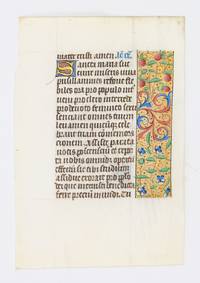
1480réf. ST18547Northern France ca. 1480. 164 x 111 mm. 6 1/2 x 4 3/8". Single column 17 lines in a gothic book hand. Rubrics in blue many leaves with line fillers in pink and/or blue with gilt bezants and white tracery each leaf with at least one and often many one- or two-line initials in burnished gold on blue and pink ground with white tracery every side with a panel border consisting of colorful acanthus and different types of flowers on a ground that is either entirely painted gold or with a pattern of painted gold and bare vellum. A few leaves with light wrinkling or a hit of soiling or foxing a couple of leaves with inoffensive marginal repairs but IN VERY FINE CONDITION EXTREMELY CLEAN AND BRIGHT. Featuring both burnished and painted gold in their decoration and offering a multitude of border patterns to choose from these are extremely attractive leaves that are all the more appealing for their fine condition. unknown books