1 531 résultats
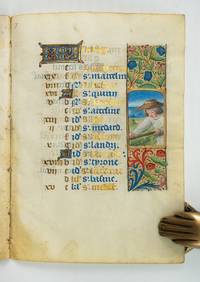
1500réf. ST20810SParis ca. 1500. 163 x 115 mm. 6 1/2 x 4 1/2". 12 leaves. Single column 18 lines in a gothic book hand. Feast days in alternating blue and burnished gold script two-line "KL" initials painted blue with white tracery and embellished with orange and blue ivy on a burnished gold ground each with a spray of gilt leaves and painted flowers one-line "A" initials in burnished gold over a pink and blue ground each page with a panel border of colorful flowers berries and acanthus over a painted gold ground with 24 SMALL MINIATURES depicting the labor of the month on rectos and zodiacal signs on versos. Some moderate smudging and soiling in bottom and fore margins January and February with tiny wormhole in head margin the miniature for January conceivably improved by a later hand but all in all a very lovely Calendar the high-quality paintings very well preserved and the whole with vibrant colors and brightly gleaming gold. Vibrantly illustrated and shimmering with gold this is an excellent example of a complete Calendar that would have appeared at the beginning of a luxuriously appointed Book of Hours. Each month is illustrated with the labor or occupation appropriate for the moment. These are in turn: warming by the fire feasting pruning picking flowers courting threshing hay harvesting wheat baking bread treading grapes sowing feeding hogs and slaughtering a hog. Our artist chose to compose these scenes more as portraits than depictions of actual tasks framing the image around each figure's face and sometimes only including small details that might indicate their occupation. In the month of June for example which depicts threshing hay we see only a sliver of the farmer's sickle and nothing at all of the hay. Instead the farmer himself is the primary focus here: and he is particularly well-executed with gentle shading on his downcast features careful brushstrokes highlighting the gleam of his hair and brushed gold suggesting the sun beating down on a bright June day. In addition to the labor or occupation of the month on the recto the 12 signs of the zodiac are depicted on the verso of each leaf these executed with equal charm and care. In cheerful bright colors our artist has depicted Leo's preening pose and glimmering mane the drama of Sagittarius' drawn bow and the cherubic plumpness of Aquarius molded in bluish shadows. In addition to the aesthetic achievements of its various parts the whole is desirable as a so-called composite Calendar with the name of a saint or special celebration occupying every day of the year. The origin of the composite Calendar is uncertain but the general opinion is that it was formalized in the early 14th century. The Parisian Hours of Jeanne d'Evreaux copied in ca. 1330 has been put forth as an early example. In any case the Calendar was subject to numerous changes in the course of time as various saints were canonized and supplanted those who while still recognized as saintly were deemed to be less favored residents for a particular calendar date. The saints' days on this Calendar are fairly typical for the Use of Paris and given the high-quality illumination liberal use of gold and robust borders it is likely that the parent manuscript was produced by an accomplished atelier in that city. Although single Calendar leaves regularly come on the market complete Calendars--particularly ones with extensive visual programs as here--are much more difficult to acquire. unknown books
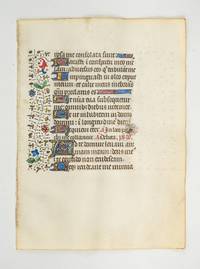
1475réf. ST19653GNorthern France ca. 1475. 155 x 110 mm. 6 x 4 1/4". Single column 16 lines in a gothic book hand. Rubrics in dark pink some leaves with line fillers in pink and blue with white embellishment and gilt bezants each leaf with at least one and some with many one- to three-line initial either in gilt on a pink and blue ground with white embellishment or painted blue with white embellishment filled with flowers or ivy on a gilt ground most leaves with one panel border of hairline vines gilt ivy and bezants and painted flowers. Occasional light soiling wrinkling and other very minor imperfections but in fine fresh condition overall very clean and with wide margins. Undoubtedly the work of a top atelier these lovely manuscript leaves have been written and decorated with a high degree of skill. Many of the leaves feature numerous glittering initials and the delicate panel borders add a bit of extra sparkle to the page. unknown books
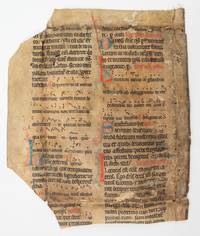
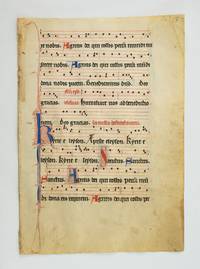
réf. ST21124c-01France or Low Countries 14th century. 270 x 230 mm. 10 3/4 x 9". Double columns 32 lines in a gothic book hand. Rubrics and staves in red several initials measuring two or more lines in red or blue with contrasting penwork. Unevenly trimmed missing at most a line of text at the bottom of each column and several words or part-words at corners of outer columns vellum with soiling browning small holes and paper residue consistent with having been used in a binding one side quite darkened but the text there legible with effort nevertheless and entirely legible on the other side. From a noted Missal with numerous large penwork initials this leaf was once used as the cover for a binding yet remains substantially complete. The text here comes from the Temporale containing the cycle of moveable feasts in the Christian year and includes text for Tuesday and Wednesday Feria III and IV of Passion Week. The musical notation on this leaf is highly developed consisting of a four-line staff clef marker and square neumes. unknown books
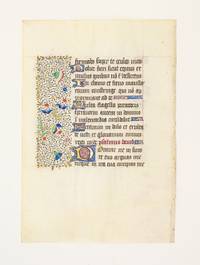
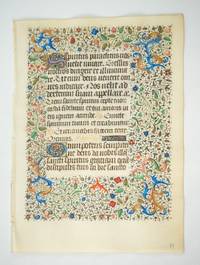
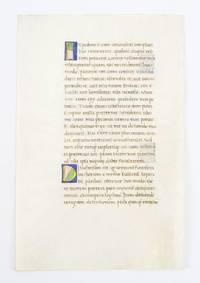
réf. ST17060HFrance probably Besançon 3rd quarter of 15th century. 239 x 165 mm. 9 3/8 x 6 1/2". Single column 15 lines in an elegant gothic book hand. Rubrics in dark pink line enders in pink and blue with white tracery and gold bezant each with multiple one- and/or two-line initials in burnished gold on dark pink and blue ground with white tracery each side of each leaf with a lovely panel border composed of hairline vines with gold ivy and bezants and colorful flowers and acanthus some with floral arrangements in vases and/or especially leafy vegetation. A couple leaves with a little yellowing or light soiling to vellum occasional small stains or smudges other negligible imperfections but on the whole VERY CLEAN BRIGHT AND WELL PRESERVED. From a large Book of Hours probably produced in Besançon these leaves feature very pretty panel borders on every page each with unique flourishes that include colorful acanthus flowers and/or fruits as well as a couple special examples with particularly large fleshy vegetation and vases of floral arrangements. Luxurious touches such as the numerous gilt initials several dozen gilt bezants and ivy leaves in each panel border and the unusually wide margins point to this manuscript having been a costly production. For additional leaves from this same manuscript at different price points please check our website. unknown books
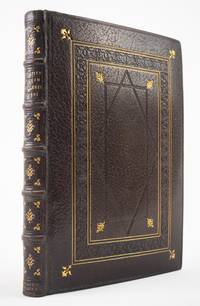
1626réf. ST21074Antwerp: Balthasar Moretus 1626. ONE OF 50 COPIES ON VELLUM PRINTED FOR THE KING OF SPAIN and 25 copies on paper. 257 x 185 mm. 10 1/4 x 7 1/4". 8 p.l. 91 pp.Translated by Nicolas Grudius. Handsome dark brown crushed morocco tooled in gilt and blind by the Club Bindery for Robert Hoe stamp-signed and dated 1903 on front turn-in and with Hoe's monogram on front pastedown covers with frame of double gilt rules enclosing repeated blind-stamped medallions central panel with blind-ruled lozenge and rectangle the latter with oblique gilt fleurons at corners raised bands spine compartments ruled in blind with gilt fleuron centerpiece and gilt floral buds at corners gilt lettering vellum endleaves all edges gilt tiny invisible repairs at top of spine and front joint. With two full-page armorial engravings by Cornelius Galle one the arms of the Spanish monarch the other the insignia of the Order engraved head- and tailpieces. Front pastedown with morocco bookplate of Robert Hoe as well as engraved bookplates of Arthur & Charlotte Vershbow and David Godine. Bibl. Belg. I 692; Voet II 1017; Van Praet V:161-2; Brunet Supp. I:291; USTC 1007848. Boards slightly bowed as almost inevitable with vellum books text a bit wavy also as expected occasional faint smudges or dustsoiling at edges but AN EXTREMELY PLEASING COPY the vellum creamy and bright the binding very lustrous. This is the luxurious vellum printing of the rules of the Order of the Golden Fleece bound in 16th century style for the renowned bibliophile Robert Hoe by the workshop he co-founded and supervised for much of its existence. Founded in 1429 by Philip Duke of Burgundy the exclusive Order of the Golden Fleece was the most distinguished knighthood in the Holy Roman Empire being limited to just 24 members. Its primary purpose was to preserve and protect the Catholic faith as well as to uphold the 12 knightly virtues outlined by Philip: Faith Charity Justice Sagacity Prudence Temperance Resolution Truth Liberality Diligence Hope and Valor. Those deserving to be collared with the order's golden necklace featuring an appended ram that gave the group its name swore to support their monarch militarily and in return they were exempt from taxes as well as being entitled to be tried for any crimes by a jury restricted to their fellow knights. The "Rules" or "Statutes" that make up the text here dictate the very strict obligations and behavioral guidelines for its members including proscriptions against such things as fleeing a battle out of cowardice or embracing beliefs antithetical to the Church along with a number of procedural decrees governing for example how exactly to participate in ceremonial occasions. The earliest Latin edition of the "Constitutiones" translated from the French by the secretary of the Order Flemish poet Nicolaus Grudius 1504-70 was printed by Guillaume Silvius at the Plantin Press in 1566. In total four vellum editions were issued over the next 200 years all now rare. The present copy collates as the 1626 edition issued by Balthasar Moretus which the Belgian national bibliography tells us was printed for the king of Spain with 50 copies on vellum and 25 on paper. Our copy was bound in 1903 for Robert Hoe 1839-1909 a founder of the Grolier Club and one of the world's great book collectors. After Grolier was established in 1884 it soon became apparent that the country's few established hand binders were overtaxed in providing repairs and rebinding for the club members' rapidly accumulating acquisitions. As a consequence in 1895 Grolier members along with Edwin Holden and other wealthy collectors established the Club Bindery in order to attract European craftsmen to provide close to home fine quality binding work rivalling what was available abroad. The Club Bindery was in operation until 1909 with Hoe being its most influential manager and client. It provided bindings that tended to be traditional in style--though frequently with elaborate decoration--and that lived up to its patrons' expectations in terms of excellence. Our volume later passed into the hands of another Grolier Club member Arthur Vershbow 1922-2012 and his wife Charlotte 1924-2000. All early editions of this work are scarce; we were able to trace just one other copy of our vellum-printed edition at auction sold for 11700 at van de Wiele in 2024. Balthasar Moretus unknown books
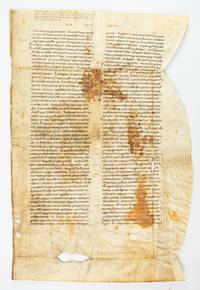
réf. ST20968-02Italy second half of 11th or opening of 12th century. 497 x 294 mm. 19 5/8 x 11 5/8". Double column 58 lines in a late Caroline hand. Running titles in red two two-line initials in red. Portfolio's pastedown with book label of the Schøyen Collection their MS 588. Recovered from a binding and thus with some general soiling and staining to vellum a couple of small holes verso unreadable modern reinforcement and repairs to the gutter and margins affecting a couple of letters at the beginning of a number of lines but the recto quite legible in most places and easily recoverable in the few places where it's not. This impressive leaf was once part of an immense lectern Bible that would have been prominently displayed at a church or monastery ca. 1075-1100. Measuring just under 500 mm. tall its dimensions are almost big enough to be considered an "Atlantic Bible" a distinctive modern designation reserved for massive Bibles produced in the 11th and 12th centuries. Despite the loss of legibility on one side due to the leaf's reuse as binding material the other side displays a lovely rounded Caroline hand with few abbreviations. The text comes from Exodus 8:17-9:21 describing several of the Plagues of Egypt. Our leaf was most recently part of the renowned Schøyen Collection one of the largest and most distinguished private manuscript collections in the world. Started in the 1920s by Norwegian engineer M. O. Schøyen and expanded by his son Martin the collection is particularly strong in paleography and biblical texts. Among its many unique and important manuscript pieces are treasures such as the St. Cecilia Bible the only Carolingian Bible in private hands and fragments of the Dead Sea Scrolls. unknown books
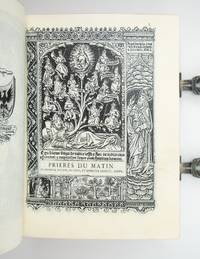
1858réf. ST21120Paris: Printed by J. Claye for Gruel & Engelman 1858. 155 x 117 mm. 6 1/8 x 4 5/8". 703 1 pp. VERY FINE GOTHIC-STYLE BLIND-STAMPED BROWN MOROCCO BY LÉON GRUEL stamp-signed at foot of spine covers with central panel showing the Tree of Jesse surrounded by the words "Egredietur virga de radice Iesse et flos deradice eius ascendet et requiescat super eum" A rod shall come forth from the root of Jesse and a flower shall grow out of his root and rest upon him" this framed by a roll of grapevines and floral vines oblique fleur-de-lys at each corner two silver square knot fore-edge clasps one catchplate replaced raised bands densely gilt turn-ins marbled endpapers and flyleaves all edges stained red. In a very fine brown morocco-backed buckram drop-back box with padded plush interior gilt lettering on spine. Title page and colophon with large device of Gruel & Engleman featuring two angels verso of title with printer's device of J. Claye each page with elaborate woodcut border featuring biblical scenes modelled on those in printed 15th century French Prayer books and seven miniatures Tree of Jesse Crucifixion Deposition Pentecost Trinity Conception of the Virgin Annunciation to the Virgin. Front flyleaf with a lengthy ink inscription to Mademoiselle Jeanne Ansart from printer Jules Claye in elegant calligraphic hand dated 1 December 1876. With three contemporary prayer cards and two commemorative cards--one for the ordination of a priest one for a nun professing her initial vows--laid in. See Judge "Léon Gruel: Master of Medieval Revival in Bookbinding" Encyclopedia of Design 2021 online: https://encyclopedia.design/2024/03/21/leon-gruel-master-of-medieval-revival-in-bookbinding/; Jeremy Norman "Master Printer Jules Claye Inscribes a Copy of a Book of Hours that He Printed on Vellum" History of Information online: https://www.historyofinformation.com/detail.phpid=5590. Faint rubbing to joints and extremities isolated trivial thumbing one small red smudge but A VERY FINE COPY--clean fresh and bright internally in a very lustrous binding with sharp impressions of the stamps. A luxurious volume in every way this is the only known copy printed on vellum of a 15th century-style prayer book created by distinguished Parisian publishers Gruel et Engelmann; it was bound by a celebrated craftsman who was an expert on the history of his craft and presented by the printer to a young woman perhaps to commemorate her taking religious vows. The firm that became Gruel et Engelmann had a complex evolution. It was founded as a bindery by Isidore Desforges in 1811 and after Desforges' daughter Catherine married Paul Gruel 1800-46 the latter took over the business in 1825. Following his death Catherine kept the bindery going for five years before marrying Parisian publisher Jean Engelmann d. 1875. The spouses merged their firms and combined their specialties to produce beautiful devotional books inspired by Medieval manuscript Books of Hours and early printed prayer books bound in appropriately historic styles. Catherine's son Léon Gruel 1840-1923 joined the firm as a binder and after his stepfather's death Gruel et Engelmann was run by Léon who headed the binding division and his stepbrother Edmond Engelmann who was in charge of the design and printing of books. In her "Bookbinders and their Craft" Prideaux says that the Gruel firm "always had the highest reputation . . . for initiative in artistic matters as well as for irreproachable execution in the detail of its many-sided achievements." The productions of Gruel et Englemann were informed by the collecting enthusiasms of the brothers--Léon's for historical bindings and Edmond's for illuminated manuscripts. Under their direction Gruel et Engelmann published and bound numerous works of devotion like the present "Paroissien" a service book that includes the texts and prayers in Latin and French used to celebrate Mass throughout the year. The author of "Manuel Historique et Bibliographique de l'Amateur de Relieure" and an expert on historical bindings Léon Gruel was adept at replicating any number of antiquarian bindings styles. As he noted in an interview with "The Bookman" in 1900 "Modern book binding has discovered nothing to equal the old designs and at best we can only copy." For this volume he chose the very appropriate Gothic style a particular favorite of his. According to the "Encyclopedia of Design" Gruel's "blend of reverence for the past with innovative application in the present allowed him to recreate historical styles with unparalleled accuracy and creativity." According to the former owner of this book distinguished bibliophile and rare book dealer Jeremy Norman Gruel et Engelmann never advertised a vellum printing of this title leading him to believe that their printer Jules Claye 1806-86--whom he considers "one of the great French trade printers of the mid-19th century"--printed this copy on vellum for himself. The sturdy vellum leaves make the text block here 63 mm. thick--a considerable bulk for a volume of this size. Claye recognized this and even concluded his lengthy and elegantly calligraphed inscription to Mlle. Jeanne Ansart with a graceful apology for the weight of the book: "As you approach the hour when God shall bless you / I offer prayers for you though we have never met / And I come to consecrate with a devout remembrance / The day you shall behold this new dawn. / This work of my handsI must admit / Is heavy for yours to bear yet it shall endure. / Forgive me remembering that our Divine Master / Climbed Golgotha beneath the burden of His cross." While it is possible that "the hour when God shall bless you" and "this new dawn" might indicate a marriage it seems more likely that this refers to Mlle. Ansart's taking the veil. The presence here of a Mass card that depicts a young woman professing her initial vows as a nun would seem to support this theory. Whatever path she chose Jeanne Ansart and successive owners cherished and carefully protected this luxurious volume over the years leaving it for us to savor visually and tactilely. [Printed by J. Claye for] Gruel & Engelman unknown books
1430réf. ST20979bParis ca. 1430. 191 x 140 mm. 7 1/2 x 5 1/2". Single column 16 lines in an elegant gothic book hand. Rubrics in gold line-fillers with color foliate and geometric designs on burnished gold ground three two-line initials in blue or pink enclosing colored vines with foliage on gold ground BOTH SIDES WITH A DENSE RINCEAUX BORDER consisting of colorful acanthus flowers and many hairline vines terminating in gold leaves ivy and seed pods and with numerous gilt bezants. IN BRILLIANT CONDITION. This is an extraordinarily fine and opulently decorated leaf from a Book of Hours with glittering rinceaux borders delicate initials and luxurious gold rubrics. These sumptuous details and the high quality of the work indicate that this leaf was part of a costly manuscript commissioned by a wealthy patron. Other leaves from the same parent manuscript were sold at Bloomsbury on 6 December 2017 lots 63 and 64. One of those leaves showed St. Genèvieve leading the female saints in the Litany pointing to Paris as the place of origin. unknown books
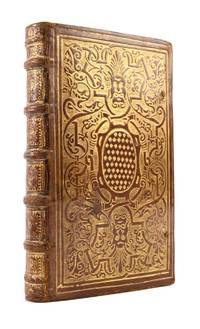
1505réf. ST21080Northern France probably Paris ca. 1505-10. 213 x 137 mm. 8 3/8 x 5 3/8". Single column 25 lines in a gothic hand. i 123 leaves. COMPLETE. Contents: blank f. i; Calendar f. 1r; Gospel Lessons f. 13r; Passion according to John f. 17r; "Obsecro te" and "O Intemerata" f. 23v; Hours of the Virgin f. 28r; Hours of the Cross f. 69r; Hours of the Holy Spirit 71v; Seven Penitential Psalms f. 75r; Litanies f. 82r; Office of the Dead f. 88r; Suffrages 114r; ruled blank f. 123. SPECTACULAR NEAR-CONTEMPORARY LYONNAISE BINDING OF POLISHED CALF VERY DENSELY GILT covers with a central oval filled with diamond-shaped tools surrounded by an intricate strapwork pattern incorporating acanthus and three heads at the top and bottom two with helmets looking sideways one more prominent staring ferociously straight on the negative space densely azured appearing from a distance as if entirely filled with gold raised bands spine compartments gilt with door-handle tools floral motifs and sawtooth borders edges gauffered and gilt later 17th century endpapers lacking ties. Rubrics in deep pink line fillers in red and blue with gilt embellishments numerous one-line initials in gold on red or blue ground many two-line initials in mauve or blue with white embellishment most enclosing a flower or two on painted gold ground EACH PAGE WITH A FULL BORDER consisting of a plain gold bar on three sides and a painted gold panel containing colorful flowers acanthus and the occasional banner WITH 21 SMALL MINIATURES each measuring between 30-50 mm. tall and 18 FULL-PAGE MINIATURES framed by a gilt and painted architectural border and accompanied by a three- or four-line initial with opening text on a banner the initial painted mauve or blue with white embellishment enclosing colorful flowers on painted gold ground the subjects of the large miniatures being: St. John on Patmos f. 13r; Agony in the Garden f. 17r; The Temptation of Adam and Eve f. 27v; Annunciation f. 28r; Visitation f. 34v; Nativity 41v; Annunciation to the Shepherds f. 44v; Adoration of the Magi f. 47v; Presentation in the Temple f. 50r; Flight into Egypt f. 52v; Coronation of the Virgin f. 57r; Christ Carrying the Cross f. 68v; Crucifixion f. 69r; Pentecost f. 71v; Bathsheba Bathing f. 74v; David and Uriah f. 75r; Job on the Dung Heap f. 88r; Trinity f. 114r. Front pastedown with book label of W. H. Corfield armorial label of "H C M" or perhaps "F C M" and a pasted-in piece of paper with early 19th century notes about the manuscript written in French. Joints with a little wear and flaking minor rubbing to edges and corners but the binding entirely sound and in a remarkable state of preservation glistening with gilt. A few small marginal holes where the vellum has thinned a couple miniatures with light flaking or rubbing to the architectural border a handful of trivial smudges to borders but the contents in fine condition being extraordinarily clean and fresh and the miniatures extremely well preserved. IN EXCEPTIONALLY FINE AND PLEASING CONDITION INSIDE AND OUT. Complete in a memorable 16th century binding and boasting a large and particularly appealing program of miniatures this splendid Parisian Book of Hours was produced by a highly skilled workshop for a patron of means and comes down to us in extraordinarily fine condition. The style of the miniatures closely resembles that of Jean Coene IV active ca. 1490-1520 an artist who hailed from a long line of manuscript illuminators originally from Bruges but active in Paris from the early 15th century. Identified by Isabelle Delaunay and Eberhard König and dubbed the "Master of the Paris Entries" Coene was a prolific artist who according to Peter Kidd "was perhaps particularly known to contemporary patrons for his ability to create new compositions." His versatility as an artist is demonstrated by the variety of volumes to which he contributed including histories voyages and Royal Entry books the latter earning him his sobriquet in addition to devotional works such as the Book of Hours seen here. Although the artist is known to have collaborated with famed Parisian illuminator Jean Pichore on several occasions see for example British Library MS Sloane 2418 Coene had his own style readily identifiable through his unique use of rich colors; sharp black outlines; modeled faces with half-closed eyes; thin eyebrows; pert mouths that turn slightly downward; and the generous application of liquid gold highlights particularly on garments and hair. Like most professional workshops of the period the Coene atelier was capable of producing work of varying quality which often depended on the wealth and needs of the patron; this work clearly a premium production shows none of the shortcuts one might expect in a more hurried execution. The consistently accomplished level of painterly skill as well as the harmony of the compositions here indicate a highly practiced hand. We can see the painter's proficiency for example in considerable delicacy and detail showing up in various places: the lace-like angel's wings in the Annunciation the carefully delineated sheep in the Annunciation to the Shepherds the various headdresses of earthly and heavenly rulers and particularly in the meticulously defined and intricately realized architectural frames. Additional pleasing features include the liquid gold application highlighting tresses and garments throughout the manuscript as well as the frequent and immensely agreeable appearance of an intensely rich red-orange. Of special note are the three openings in which miniatures face each other in logical pairs: Adam and Eve about to fall from grace facing the Annunciation where birth of mankind's savior is announced Carrying the Cross facing the Crucifixion and the bathing Bathsheba facing the lustful David who is apparently plotting the death of Bathsheba's luckless husband Uriah in battle. Pairings such as these are rarely encountered they make quite a grand statement they provide a reinforcing element to the biblical narrative and they highlight both the artist's talents and the patron's deep pockets. While many of the miniatures contain traditional subject matter we are also treated to some less frequently encountered scenes including the Garden of Gethsemane and the aforementioned Temptation of Adam and Eve. In addition the miniatures feature some noteworthy visual moments that demonstrate the artist's willingness to push beyond traditional iconography. In John on Patmos for example the Virgin and child unexpectedly appear in the sky bathed in brilliance; in the Nativity the ox and ass are front and center their heads bent nearly to the ground their mouths half open and within inches of the Christ Child a combination of curiosity and menace; and in the Flight into Egypt the Virgin whose central emotion is surely fear for her child has a sunhat almost rakishly tied around her neck. This last detail seems surely to derive from the Dürer engraving of the same subject done in 1503/04--a connection that is useful in more precisely dating the manuscript. What sets this manuscript apart even more than the nature and accomplishment of its decoration is its exceptionally fine condition with next to no signs of use internally and with an entirely unrestored period binding with its antique appeal undimmed by time. Probably dating to around 1550 the Lyonnaise binding is of very special interest brimming with gold and featuring an elaborate design incorporating unusual glowering faces. The earliest indication of ownership of this manuscript is seen in its 19th century armorial bookplate with the motto "Audentes Fortuna Juvat" "Fortune Favors the Brave" and the monogram "H C M" or "F C M". A Breviary at the Huntington mssHM 1077 with the same bookplate they say "H C M" is attributed to the Mackinnon family. A more certain provenance comes from the bookplate of W. H. Corfield 1843-1903 the first professor of hygiene and public health at University College London. Given his ownership of the present manuscript it is unsurprising that as a bibliophile he was recognized especially as a connoisseur of early bindings. Quaritch purchased our manuscript for the handsome sum of £126 at the auction of Corfield's library on 21 November 1904 lot 257 and we have been able to trace subsequent ownership to Thomas Fechnay Harvey 1879-1970 of Pennsylvania who gave the manuscript to his daughter Margaret J. Harvey 1910-84 of Philadelphia who in turn gave it as a wedding gift in 1972 to the person who sold it to us. We have found no record after 1904 or in fact before that date of the manuscript's being offered for public sale suggesting that it has been in private hands for well over a century. unknown books
réf. ST19578Northern Italy last quarter of 15th century. Each leaf measuring 250 x 164 mm. 9 7/8 x 6 3/8". Single column 24 lines in a handsome humanist hand. Each leaf with three to four large initials one measuring two lines all others three lines in burnished gold in-filled with pink and green paint with white embellishment on blue ground with white embellishments. Insignificant wrinkling and a couple faint creases to vellum tiny snag along top edge of each leaf but IN VERY FINE CONDITION the vellum especially clean and bright the paint and ink fresh and the margins generous. Written in a beautiful humanistic script enclosed by wide margins and adorned with tasteful gilt initials these leaves come from what must have been a particularly fine manuscript made for a person of means. The text comes from the "Rhetorica ad Herennium" which was long attributed to Cicero but is now believed to have been written ca. 80 B.C. by an unknown scholar. This guide to rhetoric remained influential through the Renaissance in large part because of its thorough treatment of rhetorical devices. The style of the initials--elegant burnished gold on a ground of pale pink green and sapphire blue with whisps of white embellishments--suggest that the manuscript was executed in Northern Italy perhaps Milan Bologna or Florence by a craftsman of great technical skill. Fine examples of humanistic script are becoming increasingly difficult to find on the market and the present examples are among the loveliest we have ever acquired. unknown books
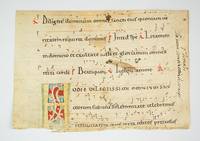
réf. ST20978Italy probably Tuscany first half of 12th century. Each half approximately 134 x 198 mm. 5 1/4 x 8 3/4". Single column 13 lines of text with neumes in a rounded proto-gothic hand. Rubrics and clef line in red two one-line initials in red A THREE-LINE ROMANESQUE WHITE-VINE INITIAL measuring 50 mm. tall in a pale yellow wash enclosing scrolling white-vines on a ground of green blue and red. Each half with a long closed tear one marginal the other touching text the part with the initial trimmed at top apparently cutting off all or part of a line lower end of initial a little faded and slightly trimmed the recto of the lower half rather faded but text discernible with close observation several small stains a small hole and other minor problems associated with being used as binding material; nevertheless in presentable condition with a once lovely and still pleasing initial. The refined Romanesque white-vine initial here opens the responsory "Hodie dilectissimi omnium" "Today the most beloved of all" for the feast of All Saints. Composed of light color washes paired with a vibrant red and featuring vines with acanthus-like curls the initial is simple but very elegant. The leaf probably comes from an antiphonary or similar manuscript containing the music to be sung for Mass with neumes organized around a single stave above each line of text. Unlike earlier notation which functioned as more of an aide-mémoire for singers who had already memorized the melody the notation here actually allows the singer to "read" the music: diastematic neumes show changes in melodic direction and the stave here labeled either "A" "C" or "F" clef for further clarity indicates the relative pitch of each note. The upper half of a leaf from the same parent manuscript was sold at Van de Wiele Auctions on 9 March 2024 lot 867 and was attributed to Tuscany based on the style its decoration which like our initial included distinctive acanthus sprays as well as muted washes of yellow green and blue. unknown books
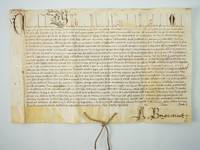
1597réf. ST12778-0365Rome 1597. 220 x 350 8 5/8 x 13 3/4". Single column 25 lines in a papal chancery hand. Elaborate lettering all across top line of text especially the first initial and at lower right corner. Lower margin with several signatures in ink; verso with brief notes in ink; remains of hemp tie for appended seal which has been cut away. Soft creases from folding four vertical one horizontal a handful of letters obscured apparently intentionally in the first and second lines very minor soiling to recto the verso being the hair side with overall darkening as usual but generally in excellent condition the script being done in a strong hand with intriguing scribal flourishes. This Papal Bull grants a marriage dispensation between Centio Balzani and Margarite Brancazze setting aside the impediment of consanguinity. Like others of its kind the document takes its name from the lead seals called "bullae" that were issued with official documents of the papacy lacking in the present example as a way of ensuring their authenticity. Apart from the very rare Solemn Privilege like Innocent III's famous granting of England in 1214 to his involuntary vassal King John there are three categories of Papal Bulls: Simple Privileges also called Solemn Letters Letters of Grace which confirm privileges and rights but are somewhat smaller and Mandates which are differentiated by their use of hemp ties as opposed to silk as is the case here. An online search finds nothing about the couple named in the bull but the document reveals that they were petitioning for a dispensation because they fell into the third and fourth degrees of consanguinity meaning that they shared at least one common ancestor. Although marrying within four degrees of consanguinity was prohibited by the church it was not uncommon for the Holy See to issue dispensations allowing such marriages to take place--particularly for the privileged classes. Two place names have been erased on this document obscuring both the name of the archbishop to whom the bull is addressed and the residence of Margarite. However we acquired this document along with two similar bulls relating to Naples and it would seem likely that the present item relates to the same city we can see that both obscured names begin with an "N". Pope Clement VIII born Ippolito Aldobrandini 1536-1605 led the Catholic Church from 1592 until his death. He is known for presiding over the final phase of the Counter-Reformation approving the revised Vulgate Bible and mediating peace between France and Spain including the reconciliation of King Henry IV of France with the Catholic Church. unknown books
réf. ST21065ANortheastern France or Rhineland early 14th century. 345 x 239 mm. 13 1/2 x 9 3/8". Single column nine lines of music and text in a gothic hand. Rubrics and staves in red calligraphic initials in black some leaves with one-line initials in red or blue some with contrasting penwork each leaf with two or more large initials measuring a line of text plus a full stave in blue or red with blue and red penwork often extending several lines above or below. Later ink foliation in upper right corners; one leaf with marginal notations in later hands. See: de Hamel Christopher. "Medieval and Renaissance Manuscripts from the Library of Sir Sydney Cockerell" British Library Journal 13 1987. Trimmed a little close at the top occasionally cutting into penwork decoration light to moderate soiling to vellum some leaves with light creasing small stains and/or wormholes but still in very good presentable condition. From a manuscript fragment that once passed through the hands of Sir Sydney Cockerell the leaves in this group appear to come from a rarely seen liturgical text called a Sequentiary. Consisting of sung hymns called "sequences" performed between the Alleluia and Gospel readings during Mass a Sequentiary could be either a standalone volume or part of a longer work such as a Gradual or Missal. The script here is a neat and legible gothic book hand with simple but attractive lettering in blue and red with contrasting penwork; there are also some interesting calligraphic initials in black--some with little spikes or other flourishes--that might warrant further study. These leaves were previously bound into a later perhaps 18th century limp vellum binding the pastedown of which contained a tipped-on handwritten note from Cockerell 1867-1962 who was William Morris' private secretary and the director of the Fitzwilliam Museum for nearly 30 years. Cockerell attributed this manuscript to Northern France and suggested a date of ca. 1280 we believe it dates a little later noting that it was probably made for Dominican use based on the presence of the sequences for St. Peter Martyr and St. Dominic. It is unclear whether Cockerell actually owned this manuscript at one point or served as a consultant for a dealer or a private collector as he was known to do: in the words of de Hamel Cockerell became "the arbiter of quality before whom generations of collectors and scholars brought their acquisitions and attributions for judgement. . . . Dyson Perrins Yates Thompson Chester Beatty Pierpont Morgan St John Hornby Lord Kennet Francis Wormald Eric Millar J. R. Abbey and many others never felt that a manuscript acquisition was truly made until Sydney Cockerell had seen and approved it." De Hamel also notes that Cockerell "gave away sold or exchanged manuscripts on many occasions during his life of collecting" making it difficult to know exactly how this manuscript may have crossed his path or for how long it was in his possession. His appraisal does however suggest that this manuscript was in a defective state from at least the 1920s and probably a good deal earlier than that. Most of the choir book leaves that we've offered for sale over the years have come from 15th and early 16th century manuscripts typically Italian or Spanish in origin; the present leaves offer an uncommon opportunity to purchase earlier specimens of musical notation--and they are leaves from an unusual liturgical text with distinguished if uncertain ownership history and at an attainable price. The price given here is for a single leaf; for additional leaves from this same manuscript at various prices please see our website. unknown books
réf. ST20972dParis: Nicolas Vivien early 16th century. 197 x 130 mm. 7 3/4 x 5 1/8". Single column 28 lines gothic typeface. Ruled in red each leaf with several one- to three-line initials painted gold on red or blue ground and A LOVELY ANIMATED FULL BORDER DONE IN MANUSCRIPT with trompe-l'oeil flowers a moth a fly and a bird on painted gold ground. Light soiling and a couple small stains to vellum one initial a bit smudged but in excellent condition overall. This beautifully embellished leaf from a printed Book of Hours demonstrates the enduring demand for manuscript illumination in the incunabular period and beyond. While the text here was completed on a printing press the initials and border were done entirely by hand adding luxury and luster to an otherwise unadorned page. Although this leaf likely belonged to a Book of Hours printed in Paris possibly an edition printed for Nicolas Vivien in or around 1503 the trompe-l'oeil style seen in the border was particularly popular among Flemish and Netherlandish illuminators of the period. The large blossoms and acanthus here seem to pop off the page because of the artist's use of subtle shading to indicate shadows and there is additional pleasure to be found in the small creatures--a bird carrying a small flower a moth and a housefly--that share the space. Nicolas Vivien(?) unknown books
1430réf. ST20979aParis ca. 1430. 191 x 140 mm. 7 1/2 x 5 1/2". Single column 16 lines in an elegant gothic book hand. Rubrics in gold line-fillers with color foliate and geometric designs on burnished gold ground two one-line initials and three two-line initials in blue or pink enclosing colored vines with foliage on gold ground one four-line initial in blue with white decoration enclosing a lattice pattern each compartment with an orange or blue leaf on gold ground BOTH SIDES WITH A DENSE RINCEAUX BORDER consisting of colorful acanthus flowers and many hairline vines terminating in gold leaves ivy and seed pods and with numerous gilt bezants. With just a couple tiny scuffs to paint and with slight rubbing to some of the small gold details but in lovely condition. This is an opulently decorated leaf from a Book of Hours offered in fine condition with glittering rinceaux borders delicate initials and luxurious gold rubrics. These sumptuous details and the high quality of the work indicate that this leaf was part of a costly manuscript commissioned by a wealthy patron. Other leaves from the same parent manuscript were sold at Bloomsbury on 6 December 2017 lots 63 and 64. One of these leaves showed St. Genèvieve leading the female saints in the Litany pointing to Paris as the place of origin. unknown books
réf. ST21065CNortheastern France or Rhineland early 14th century. 345 x 239 mm. 13 1/2 x 9 3/8". Single column nine lines of music and text in a gothic hand. Rubrics and staves in red calligraphic initials in black. Later ink foliation in upper right corners. See: de Hamel Christopher. "Medieval and Renaissance Manuscripts from the Library of Sir Sydney Cockerell" British Library Journal 13 1987. Vellum with light soiling and a little light creasing mostly marginal a few negligible marks but very clean and in excellent condition. From a manuscript fragment that once passed through the hands of Sir Sydney Cockerell the leaves in this group appear to come from a rarely seen liturgical text called a Sequentiary. Consisting of sung hymns called "sequences" performed between the Alleluia and Gospel readings during Mass a Sequentiary could be either a standalone volume or part of a longer work such as a Gradual or Missal. The script here is a neat and legible gothic book hand with some interesting calligraphic initials in black--some with little spikes or other flourishes--that might warrant further study. These leaves were previously bound into a later perhaps 18th century limp vellum binding the pastedown of which contained a tipped-on handwritten note from Cockerell 1867-1962 who was William Morris' private secretary and the director of the Fitzwilliam Museum for nearly 30 years. Cockerell attributed this manuscript to Northern France and suggested a date of ca. 1280 we believe it dates a little later noting that it was probably made for Dominican use based on the presence of the sequences for St. Peter Martyr and St. Dominic. It is unclear whether Cockerell actually owned this manuscript at one point or served as a consultant for a dealer or a private collector as he was known to do: in the words of de Hamel Cockerell became "the arbiter of quality before whom generations of collectors and scholars brought their acquisitions and attributions for judgement. . . . Dyson Perrins Yates Thompson Chester Beatty Pierpont Morgan St John Hornby Lord Kennet Francis Wormald Eric Millar J. R. Abbey and many others never felt that a manuscript acquisition was truly made until Sydney Cockerell had seen and approved it." De Hamel also notes that Cockerell "gave away sold or exchanged manuscripts on many occasions during his life of collecting" making it difficult to know exactly how this manuscript may have crossed his path or for how long it was in his possession. His appraisal does however suggest that this manuscript was in a defective state from at least the 1920s and probably a good deal earlier than that. Most of the choir book leaves that we offer for sale come from 15th and early 16th century manuscripts typically Italian or Spanish in origin; the present leaves offer an uncommon opportunity to purchase earlier specimens of musical notation from an unusual liturgical text with distinguished if uncertain ownership history and at an attainable price. The price given here is for a single leaf; for additional leaves from this same manuscript please see our website. unknown books
réf. ST21065BNortheastern France or Rhineland early 14th century. 345 x 239 mm. 13 1/2 x 9 3/8". Single column nine lines of music and text in a gothic hand. Rubrics and staves in red calligraphic initials in black one-line initials in red or blue some with contrasting penwork each leaf with at least one large initial measuring a line of text plus a full stave in blue or red with blue and red penwork often extending several lines above or below. Later ink foliation in upper right corners; a couple leaves with remnants of older manuscript leaves enforcing the gutter. See: de Hamel Christopher. "Medieval and Renaissance Manuscripts from the Library of Sir Sydney Cockerell" British Library Journal 13 1987. Trimmed a little close at the top occasionally cutting into penwork decoration light to moderate soiling to vellum some leaves with light creasing small stains and/or wormholes a few leaves with more noticeable flaws but still in very good presentable condition. From a manuscript fragment that once passed through the hands of Sir Sydney Cockerell the leaves in this group appear to come from a rarely seen liturgical text called a Sequentiary. Consisting of sung hymns called "sequences" performed between the Alleluia and Gospel readings during Mass a Sequentiary could be either a standalone volume or part of a longer work such as a Gradual or Missal. The script here is a neat and legible gothic book hand with simple but attractive lettering in blue and red with contrasting penwork; there are also some interesting calligraphic initials in black--some with little spikes or other flourishes--that might warrant further study. These leaves were previously bound into a later perhaps 18th century limp vellum binding the pastedown of which contained a tipped-on handwritten note from Cockerell 1867-1962 who was William Morris' private secretary and the director of the Fitzwilliam Museum for nearly 30 years. Cockerell attributed this manuscript to Northern France and suggested a date of ca. 1280 we believe it dates a little later noting that it was probably made for Dominican use based on the presence of the sequences for St. Peter Martyr and St. Dominic. It is unclear whether Cockerell actually owned this manuscript at one point or served as a consultant for a dealer or a private collector as he was known to do: in the words of de Hamel Cockerell became "the arbiter of quality before whom generations of collectors and scholars brought their acquisitions and attributions for judgement. . . . Dyson Perrins Yates Thompson Chester Beatty Pierpont Morgan St John Hornby Lord Kennet Francis Wormald Eric Millar J. R. Abbey and many others never felt that a manuscript acquisition was truly made until Sydney Cockerell had seen and approved it." De Hamel also notes that Cockerell "gave away sold or exchanged manuscripts on many occasions during his life of collecting" making it difficult to know exactly how this manuscript may have crossed his path or for how long it was in his possession. His appraisal does however suggest that this manuscript was in a defective state from at least the 1920s and probably a good deal earlier than that. Most of the choir book leaves that we offer for sale come from 15th and early 16th century manuscripts typically Italian or Spanish in origin; the present leaves offer an uncommon opportunity to purchase earlier specimens of musical notation from an unusual liturgical text with distinguished if uncertain ownership history and at an attainable price. The price given here is for a single leaf; for additional leaves from this same manuscript please see our website. unknown books
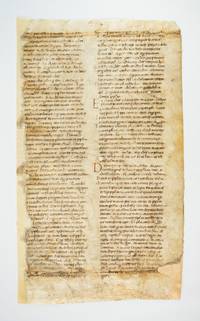
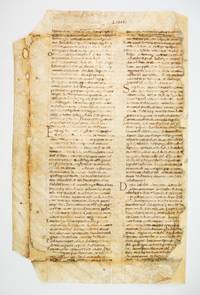
réf. ST20967aItaly late 11th or early 12th century. 485 x 124 mm. 19 1/8 x 12 3/4". Measured at widest part. Double column 53 lines in a rounded proto-gothic hand. Running titles in red. With contemporary or slightly later marginal notations; later inscriptions from its reuse as binding scrap dated 1557 and 1560 noting the volume "no. 181." Recovered from a binding and thus the vellum somewhat wrinkled soiled and with multiple folds some dark staining affecting legibility of several lines--though sense easily recoverable on one side and with effort on the other--a few tiny holes and two larger ones slightly affecting the text. Showing the usual problems associated with re-use but a grand and greatly appealing leaf nevertheless with its handsome script and imposing presence readily apparent. Partly because of its re-use in what obviously would have been a very large binding and more especially because of its age and early script this vast Romanesque Bible leaf is of there is no other way to say it but immense interest. Measuring nearly 20 inches tall it is almost large enough to be considered a so-called "Atlantic Bible" leaf a distinctive modern designation reserved for massive Bibles produced in the 11th and 12th centuries. The script here consists of a highly legible proto-gothic book hand with elegant rounded letter forms. Its overall appearance has much in common with Caroline miniscule including clubbed ascenders a strong "st" ligature and an "f" that extends below the baseline. In addition there are very few abbreviations and the ampersand symbol is used exclusively rather than the Tironian "et" favored in later scripts. The text here is from Deuteronomy 20:5-23:24 containing the final laws that Moses gives to the Israelites before entering the Promised Land. These "second laws" as they are often called include an array of statutes pertaining to sexual relations marriage divorce slavery warfare and inheritance as well as rules for agriculture clothing and diet. Our leaf previously belonged to the renowned Schøyen Collection one of the largest and most distinguished private manuscript collections in the world. Started in the 1920s by Norwegian engineer M. O. Schøyen and expanded by his son Martin the collection is particularly strong in paleography and biblical texts. Among its many unique and important manuscript pieces are treasures such as the St. Cecilia Bible the only Carolingian Bible in private hands and fragments of the Dead Sea Scrolls. unknown books
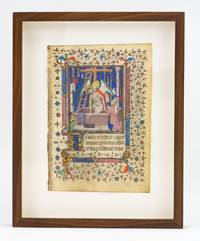
1415réf. ST17763Paris ca. 1415-20. Leaf: 160 x 110 mm. 6 1/4 x 3/8"; Frame: 232 x 185 mm. 9 1/8 x 7 1/4". Recto with three lines single column in a gothic book hand verso not inspected due to frame. Mounted in a wooden frame. Recto with a three-line initial in blue on gold ground embellished with ivy leaves A HALF-PAGE MINIATURE DEPICTING THE MASS OF ST. GREGORY the recently crucified Christ depicted emerging from a tomb supported by an angel and surrounded by the Arma Christi St. Gregory kneeling at the corner of the image the text and miniature framed by thick bar borders of pink blue and gold on three sides all SURROUNDED BY A FULL BORDER of hairline vines gilt ivy leaves and bezants and a few colorful flowers and acanthus. A little faint smudging in top and bottom borders very small scarcely noticeable area of blue background retouched not affecting the figures but A BEAUTIFUL LEAF the colors bright and the detail in the miniature very well preserved. Featuring carefully realized detail intriguing iconography and artistry that shows a very high degree of skill this is an important and early example of the work of the Master of the Harvard Hannibal. The subject of the present work is a well-known story about the sixth century Pope Gregory ca. 540-604 commonly known as St. Gregory the Great. According to legend Gregory was saying Mass when one of his deacons expressed a doubt in the doctrine of Transubstantiation whereby the communion bread actually becomes the body of Christ. Gregory prayed to God for a verifying sign whereupon Christ appeared in the guise of the Man of Sorrows clad in a loincloth and displaying the bloody wounds he incurred during the Crucifixion. Most Medieval miniatures depict Gregory kneeling before an altar as he says Mass accompanied by one or more deacons or assistants who bear witness to the miraculous event. In a notable departure from this norm the present miniature depicts the saint alone at the edge of the picture plane; in place of the chalice host and altar that would normally occupy the center of the scene is a considerable open tomb from which a larger-than-life-size Christ emerges. With blood still rushing from his wounds he places one hand on the edge of the tomb to steady himself while an angel supports him from behind. Christ's expression conveys both physical and mental pain as he struggles to support his own bodyweight; the angel who assists him spreads his wings protectively around the body of Christ while looking down at Gregory with a sorrowful expression knitted into his brow. The fine detail work seen in the figures' faces the angel's wings and the careful delineation of each slender finger is also carried over into more than a dozen objects crammed into the spaces in and around the tomb the rope is especially remarkable in the representation of its detail. Known as the "Arma Christi" or "Instruments of the Passion" these objects are meant to symbolize Christ's suffering. Seen here are: the cross nails and hammer that were used to crucify Christ the ladder used in the Deposition the disembodied hand symbolizing the one which slapped Christ's face the dice used by soldiers to see who would claim his seamless robe a lantern used by the soldiers who arrested Christ the 30 pieces of silver from Judas' betrayal a purple robe used in the mockery of Christ and other items that appear as part of the Passion narrative. It is also interesting to note that although a St. Gregory miniature usually appears at the beginning of the Hours of the Cross the Penitential Psalms or before the Seven Prayers of St. Gregory here rather unusually it opens a reading from John chapter 19 beginning "In illo tempore adprehendit Pilatus Iesum et flagellavit" describing the events of the Passion. This miniature can be attributed to an artist known as the Master of the Harvard Hannibal so-named for a splendid miniature painting of the "Coronation of Hannibal" prefacing a Livy in the Harvard College Library. Active from about 1415-30 in Paris and later possibly Rouen it is believed that our illuminator was a pupil of the Boucicaut Master with whom he is thought to have collaborated on several manuscripts both secular and religious. The present miniature would probably have been executed early in his career and while it certainly shows the influence of his teacher it also reveals certain stylistic tendencies that would become staples of the Master of the Harvard Hannibal's more mature work such as his preference for rich colors heavy molding of the faces and interest in decorative details. With its clever composition meticulous detail work and emotive figures that engage the viewer the present miniature is not only a beautiful work of art it also documents the precocious talent of an emerging master early in his professional career. unknown books
1915réf. ST17129-042Chicago: Written and Illuminated for The Renaissance Society ca. 1915. 216 x 153 mm. 8 1/2 x 6". ii 28 pp. 1 leaf colophon. Single column 18 lines in an attractive calligraphic hand. VERY PRETTY VIOLET CRUSHED MOROCCO GILT AND INLAID for The Renaissance Society stamp-signed in gilt on front doublure smooth spine with gilt titling FULL MOROCCO DOUBLURES consisting of a green morocco panel framed by purple morocco with gilt dots and scrolling floral motifs at each corner each with an inlaid white morocco flower cream-colored watered silk endleaves. In a lavender buckram chemise and matching purple morocco-backed slipcase with raised bands and gilt lettering. With many one-line initials in pink each leaf with a different two- to four-line initial in a different style with both painted and gilt elements and exuberantly decorated most leaves with a panel or "L"-shaped border ranging from simple lines to elaborate decorative bars a few borders with small landscapes and a total of FOUR FIGURAL SCENES decorative title page with colorful initials lettering and decorative flourishes text beginning with A HALF-PAGE MINIATURE OF ST. JEROME AT HIS DESK surrounded by A FULL BORDER of flowers gilt detailing and stylized heads of putti all by Louis Bauhan. Front free endpaper with bookplate of Phoebe Boyle. Leather with a slight chalky appearance silk endleaves starting to fray at fore edge a few leaves with a hint of waviness but THE MANUSCRIPT IN BEAUTIFUL CONDITION the vellum entirely clean and the paint especially bright and fresh. Exuberantly decorated by a major illustrator of the period this manuscript was commissioned and bound for The Renaissance Society of Chicago before making its way into the superb collection of American bibliophile Phoebe Boyle. The text here comes from a poem by "Atlantic Monthly" writer and editor Thomas Bailey Aldrich 1836-1907 imagining the agony and the ecstasy of St. Jerome as he sat down to write his translation of the Bible. The illumination though certainly inspired by the decorative programs of Medieval manuscripts is decidedly modern in appearance drawing on the Art Nouveau movement and utilizing bold color combinations and whimsical design motifs. It is not clear why the illustrator here Louis Bauhan 1855-1941 has used the ananym "Siuol Na-Huab" because there is no reason to hide responsibility for producing the clean elegant script the imaginative marginal decoration and the finished human and animal images that enliven the manuscript. Bauhan was a very successful painter and illustrator perhaps best known to the public as art editor of "Cosmopolitan Magazine" under John Brisben Walker who edited and published the magazine from 1889 to 1905. In 1881 Bauhan helped to found the Kit-Kat Club of New York a bohemian artists' and cultural association; he was persistently in demand as a book illustrator; and among other things he painted landscapes and portraits in oil. The colophon here states that the manuscript was written and illuminated for The Renaissance Society--an artistic group associated with the University of Chicago whose mission was to cultivate and promote modern art--and it was given an appropriately luxurious binding by the same organization. The manuscript was obviously valued highly enough to join the collection of Phoebe A. D. Boyle a client George Sutcliffe described as "rivalling the Medici in her patronage of the production of beautiful books." Shepherd "The Cinderella of the Arts" p. 63 Stephen Ratcliffe describes the Boyle collection as "unrivalled" for its jewelled bindings and modern illuminated manuscripts and any book from the Boyle collection which was put together with the greatest taste and discrimination is recognized as desirable beyond its intrinsic literary merit. Written and Illuminated for The Renaissance Society unknown books
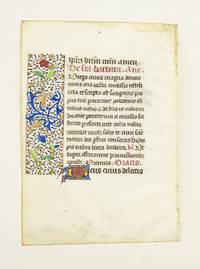
1450réf. ST11774DParis ca. 1450. 159 x 108 mm. 6 1/4 x 4 1/4". Single column 15 lines per page in an excellent gothic book hand. Rubrics in red each leaf with two or more two-line initials in burnished gold on red and blue ground with white tracery some also with one-line initials and line fillers similarly decorated one or both sides with a swirling panel border featuring flowers leaves strawberries and many burnished gold ivy leaves on hairline stems. Isolated trivial stains or imperfections but VERY BRIGHT CLEAN AND FRESH. In fine condition beautifully decorated and sparkling with gold these leaves are marvelous examples of a high-quality Parisian Book of Hours made for a person of means. The borders here are especially pleasing with skeins of hairline vines accented by burnished bezants and ivy bright blue and gold acanthus pale green leaves and cheerful red blossoms. For leaves at other price points please check our website. unknown books
réf. ST20968-01Italy second half of 11th or opening of 12th century. 497 x 294 mm. 19 5/8 x 11 5/8". Double column 58 lines in a late Caroline hand. Running titles in red three two-line initials in red. Recovered from a binding and thus with some general soiling and staining to vellum recto illegible except for part of the headline modern reinforcement to the gutter and margins affecting a couple of letters at the end of a number of lines but the verso quite legible in most places and easily recoverable in the few places where it's not. This impressive leaf was once part of an immense lectern Bible that would have been prominently displayed at a church or monastery ca. 1075-1100. Measuring just under 500 mm. tall its dimensions are almost big enough to be considered an "Atlantic Bible" a distinctive modern designation reserved for massive Bibles produced in the 11th and 12th centuries. Despite the loss of legibility on one side due to the leaf's reuse as binding material the other side displays a lovely rounded Caroline hand with few abbreviations. The text comes from Exodus 23:11-24:18 expounding parts of civil law and Moses' journey to Mount Sinai. Our leaf was most recently part of the renowned Schøyen Collection one of the largest and most distinguished private manuscript collections in the world. Started in the 1920s by Norwegian engineer M. O. Schøyen and expanded by his son Martin the collection is particularly strong in paleography and biblical texts. Among its many unique and important manuscript pieces are treasures such as the St. Cecilia Bible the only Carolingian Bible in private hands and fragments of the Dead Sea Scrolls. unknown books
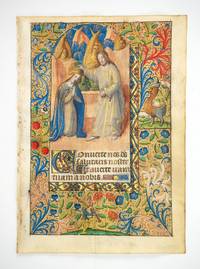
1500réf. ST20810RParis ca. 1500. 163 x 115 mm. 6 1/2 x 4 1/2". Single column 18 lines in a gothic book hand. Rubrics in red line fillers in blue and pink with gold bezant six one-line initials in burnished gold on pink and blue ground two two-line initials in blue on gold ground with a flower in the center one three-line initial in blue filled with ivy on gold ground verso with panel border of colorful flowers and acanthus recto with A LARGE ARCH-TOPPED MINIATURE OF THE CORONATION OF THE VIRGIN with an "L" shaped frame of burnished gold and painted flowers and A FULL BORDER of acanthus flowers a man playing a bagpipe and a hybrid creature wearing a hat all on a painted gold ground. Very minor wrinkling to vellum but the leaf IN LOVELY CONDITION with the gold everywhere gleaming brightly. From a luxuriously appointed Book of Hours this leaf features a handsome miniature of the Coronation of the Virgin attributed to the workshop of Jean Pichore fl. ca. 1502-20 a major figure among illuminators of the period and one of the most sought-after artists in France at the turn of the 16th century. Executed with imagination and delicacy the miniature features the traditional subject associated with the hour of Compline showing the Virgin being crowned Queen of Heaven following her Death and Assumption. The composition here is quite intimate with the Virgin kneeling before her son as she accepts with humility the crown he lays upon her head. Christ is depicted barefoot and slightly bowed toward his mother in a gentle display of respect. The artist creates a wonderful backdrop for this scene composed entirely of seraphim painted gold blue light pink and green closely packed together. Two of the seraphim hold up light pink draperies behind the central figures as if to shield this tender moment from prying eyes. The borders here are a source of delight featuring a figure wearing a jester-like cap and playing the bagpipe as well as a creature with the body of a bird and the face of a human donning a rather fashionable bycocket cap. The illumination here is of high quality features a liberal use of gold and contains unique marginal details suggesting that the original manuscript must have been a costly commission for a wealthy patron. unknown books
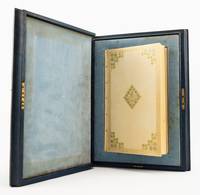
1937réf. ST21066London: William Heinemann Limited 1937. FIRST EDITION. Book: 245 x 152 mm. 9 3/4 x 6"; Case: 330 x 235 mm. 13 x 9 1/4". 3 p.l. 34 pp. LOVELY CONTEMPORARY STIFF VELLUM GILT AND PAINTED covers with delicate gilt frame sprays of flower and leaves at each corner outlined in gilt and painted blue and green central lozenge outlined in gilt dots and framed by painted flowers and leaves a large initial "A" in gilt at center smooth spine divided into compartments with gilt and painted floral ornament turn-ins with gilt floral roll sky blue silk endleaves all edges gilt. Housed in a fine oversized blue morocco case designed to look like a book with gilt lettering on the upper cover raised bands gilt ruled compartments and lettering to spine the interior constructed and padded to hold the smaller book and lined with blue velvet spine of case a bit sunned corners a little rubbed clasp no longer functional. A FINE COPY clean and fresh internally in a pristine binding. With very considerable visual and tactile appeal this is a gracefully bound copy of the the final book of verse issued by Richard Aldington published before he turned exclusively to writing prose. A leading poet of the early 20th-century Imagist school Aldington né Edward Godfree Aldington 1892-1962 was a prolific writer whose 50-year career produced novels biographies translations and literary criticism as well as sharp minimalist free verse. He was part of the contemporary London avant-garde crowd being close friends with Ezra Pound T. S. Eliot Amy Lowell and D. H. Lawrence; and he was especially close to the poet H. D. Hilda Doolittle his first wife from 1913-38. As literary editor of the leading Modernist periodical "The Egoist" he was an integral part of the pre-World War I literary scene and his first largely autobiographical work "Death of a Hero" 1929 was considered by George Orwell and Lawrence Durrell to be the best of the English Great War novels. The poems here were written in the mid-1930s when Aldington had decamped to the United States after the woman he loved Netta Patmore rejected his proposal of marriage. While tracing his grief and longing the verses also build the image of a "crystal world" created by the love of an ardent couple concluding that "Only from the purity of extreme passion / And alas the purity of extreme pain / Can you build the crystal world." Happily Aldington's beloved Netta to whom the work is dedicated reversed her decision and agreed in 1938 to help him build their crystal world together. The present lovely binding is unsigned but the delicate precise tooling and elegant design indicate the work of very talented hands. The romantic contents and the rather feminine aspect of the binding suggest that this was a gift from one lover to another perhaps a recipient sharing the initial "A" with our author. And the oversized and extravagant custom case indicates how much this object was treasured. William Heinemann Limited unknown books
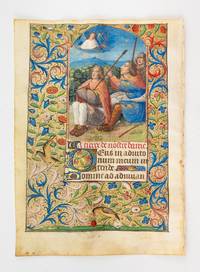
1500réf. ST20810PParis ca. 1500. 165 x 117 mm. 6 1/2 x 4 5/8". Single column 18 lines in a gothic book hand. Rubrics in red line fillers in blue and pink with gold bezant five one-line initials in burnished gold on pink and blue ground one two-line initial in blue on gold ground with a flower in the center one three-line initial in blue filled with ivy on gold ground recto with panel border of colorful flowers vase and acanthus verso with A LARGE ARCH-TOPPED MINIATURE OF THE ANNUNCIATION TO THE SHEPHERDS surrounded by A FULL BORDER of acanthus flowers and two birds all on a painted gold ground. Slight soiling to vellum but a very well-preserved leaf in fine condition. From what was surely a costly Book of Hours this leaf features a charming and skillfully painted miniature of the Annunciation to the Shepherds attributable to the workshop of Jean Pichore fl. ca. 1502-20 a major figure among illuminators of the period and one of the most sought-after artists in France at the turn of the 16th century. Depicting the traditional subject associated with the hour of Terce our miniature portrays as usual an angel appearing to shepherds tending their flock bringing news of the birth of Christ. Although the biblical narrative suggests that the shepherds were startled by the angel's appearance the three figures in this miniature appear remarkably unmoved--in fact only one of them seems to take any notice at all. The first shepherd sits on the ground looking straight ahead; the second holds his hands in prayer but looks little more than well prayerful at the angel in the sky; and a third figure maintains a slightly aloof expression taking no particular interest in the unfolding miraculous event. What may seem to be indifference can be explained easily enough by the artist's successful portrayal of nighttime cold! All three shepherds are thickly dressed one with his arms pressed tightly against his chest another with a hood partly covering his face and the sheep are tightly huddled together into one woolly white cluster. Another manifestation of the artist's success here is seen in the particularly well done molding of the faces with subtle shading attractively rendered features and clear individuation. Moreover although the shepherds seem essentially unmoved their garments are dusted with a glistening gold radiance from above a further subtle touch revealing a high level of achievement on the part of the painter. Finally the borders are one last source of delight with a small bird shown in mid-flight and a second one investigating a single strawberry that seems to have been placed there just for him. All of these indications of sophistication suggest that the original manuscript must have been commissioned by a patron able to pay a premium for the work of a highly skilled atelier. unknown books