1 535 résultats
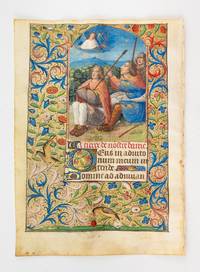
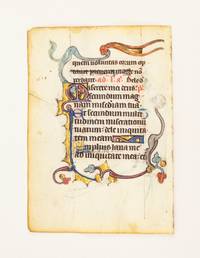
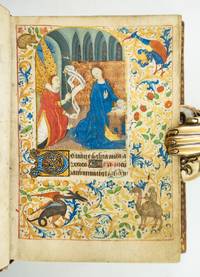
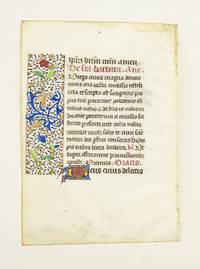
1450réf. ST11774DParis ca. 1450. 159 x 108 mm. 6 1/4 x 4 1/4". Single column 15 lines per page in an excellent gothic book hand. Rubrics in red each leaf with two or more two-line initials in burnished gold on red and blue ground with white tracery some also with one-line initials and line fillers similarly decorated one or both sides with a swirling panel border featuring flowers leaves strawberries and many burnished gold ivy leaves on hairline stems. Isolated trivial stains or imperfections but VERY BRIGHT CLEAN AND FRESH. In fine condition beautifully decorated and sparkling with gold these leaves are marvelous examples of a high-quality Parisian Book of Hours made for a person of means. The borders here are especially pleasing with skeins of hairline vines accented by burnished bezants and ivy bright blue and gold acanthus pale green leaves and cheerful red blossoms. For leaves at other price points please check our website. unknown books
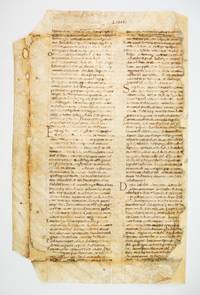
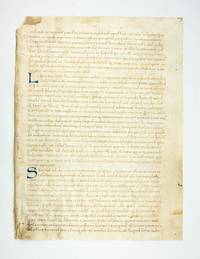
réf. ST20968-01Italy second half of 11th or opening of 12th century. 497 x 294 mm. 19 5/8 x 11 5/8". Double column 58 lines in a late Caroline hand. Running titles in red three two-line initials in red. Recovered from a binding and thus with some general soiling and staining to vellum recto illegible except for part of the headline modern reinforcement to the gutter and margins affecting a couple of letters at the end of a number of lines but the verso quite legible in most places and easily recoverable in the few places where it's not. This impressive leaf was once part of an immense lectern Bible that would have been prominently displayed at a church or monastery ca. 1075-1100. Measuring just under 500 mm. tall its dimensions are almost big enough to be considered an "Atlantic Bible" a distinctive modern designation reserved for massive Bibles produced in the 11th and 12th centuries. Despite the loss of legibility on one side due to the leaf's reuse as binding material the other side displays a lovely rounded Caroline hand with few abbreviations. The text comes from Exodus 23:11-24:18 expounding parts of civil law and Moses' journey to Mount Sinai. Our leaf was most recently part of the renowned Schøyen Collection one of the largest and most distinguished private manuscript collections in the world. Started in the 1920s by Norwegian engineer M. O. Schøyen and expanded by his son Martin the collection is particularly strong in paleography and biblical texts. Among its many unique and important manuscript pieces are treasures such as the St. Cecilia Bible the only Carolingian Bible in private hands and fragments of the Dead Sea Scrolls. unknown books
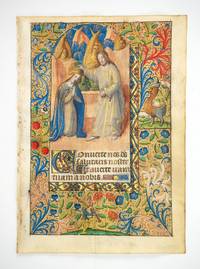
1500réf. ST20810RParis ca. 1500. 163 x 115 mm. 6 1/2 x 4 1/2". Single column 18 lines in a gothic book hand. Rubrics in red line fillers in blue and pink with gold bezant six one-line initials in burnished gold on pink and blue ground two two-line initials in blue on gold ground with a flower in the center one three-line initial in blue filled with ivy on gold ground verso with panel border of colorful flowers and acanthus recto with A LARGE ARCH-TOPPED MINIATURE OF THE CORONATION OF THE VIRGIN with an "L" shaped frame of burnished gold and painted flowers and A FULL BORDER of acanthus flowers a man playing a bagpipe and a hybrid creature wearing a hat all on a painted gold ground. Very minor wrinkling to vellum but the leaf IN LOVELY CONDITION with the gold everywhere gleaming brightly. From a luxuriously appointed Book of Hours this leaf features a handsome miniature of the Coronation of the Virgin attributed to the workshop of Jean Pichore fl. ca. 1502-20 a major figure among illuminators of the period and one of the most sought-after artists in France at the turn of the 16th century. Executed with imagination and delicacy the miniature features the traditional subject associated with the hour of Compline showing the Virgin being crowned Queen of Heaven following her Death and Assumption. The composition here is quite intimate with the Virgin kneeling before her son as she accepts with humility the crown he lays upon her head. Christ is depicted barefoot and slightly bowed toward his mother in a gentle display of respect. The artist creates a wonderful backdrop for this scene composed entirely of seraphim painted gold blue light pink and green closely packed together. Two of the seraphim hold up light pink draperies behind the central figures as if to shield this tender moment from prying eyes. The borders here are a source of delight featuring a figure wearing a jester-like cap and playing the bagpipe as well as a creature with the body of a bird and the face of a human donning a rather fashionable bycocket cap. The illumination here is of high quality features a liberal use of gold and contains unique marginal details suggesting that the original manuscript must have been a costly commission for a wealthy patron. unknown books
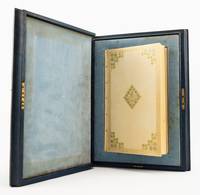
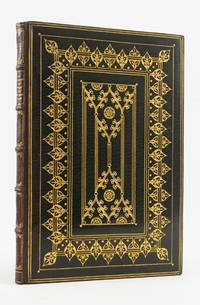
1937réf. ST21066London: William Heinemann Limited 1937. FIRST EDITION. Book: 245 x 152 mm. 9 3/4 x 6"; Case: 330 x 235 mm. 13 x 9 1/4". 3 p.l. 34 pp. LOVELY CONTEMPORARY STIFF VELLUM GILT AND PAINTED covers with delicate gilt frame sprays of flower and leaves at each corner outlined in gilt and painted blue and green central lozenge outlined in gilt dots and framed by painted flowers and leaves a large initial "A" in gilt at center smooth spine divided into compartments with gilt and painted floral ornament turn-ins with gilt floral roll sky blue silk endleaves all edges gilt. Housed in a fine oversized blue morocco case designed to look like a book with gilt lettering on the upper cover raised bands gilt ruled compartments and lettering to spine the interior constructed and padded to hold the smaller book and lined with blue velvet spine of case a bit sunned corners a little rubbed clasp no longer functional. A FINE COPY clean and fresh internally in a pristine binding. With very considerable visual and tactile appeal this is a gracefully bound copy of the the final book of verse issued by Richard Aldington published before he turned exclusively to writing prose. A leading poet of the early 20th-century Imagist school Aldington né Edward Godfree Aldington 1892-1962 was a prolific writer whose 50-year career produced novels biographies translations and literary criticism as well as sharp minimalist free verse. He was part of the contemporary London avant-garde crowd being close friends with Ezra Pound T. S. Eliot Amy Lowell and D. H. Lawrence; and he was especially close to the poet H. D. Hilda Doolittle his first wife from 1913-38. As literary editor of the leading Modernist periodical "The Egoist" he was an integral part of the pre-World War I literary scene and his first largely autobiographical work "Death of a Hero" 1929 was considered by George Orwell and Lawrence Durrell to be the best of the English Great War novels. The poems here were written in the mid-1930s when Aldington had decamped to the United States after the woman he loved Netta Patmore rejected his proposal of marriage. While tracing his grief and longing the verses also build the image of a "crystal world" created by the love of an ardent couple concluding that "Only from the purity of extreme passion / And alas the purity of extreme pain / Can you build the crystal world." Happily Aldington's beloved Netta to whom the work is dedicated reversed her decision and agreed in 1938 to help him build their crystal world together. The present lovely binding is unsigned but the delicate precise tooling and elegant design indicate the work of very talented hands. The romantic contents and the rather feminine aspect of the binding suggest that this was a gift from one lover to another perhaps a recipient sharing the initial "A" with our author. And the oversized and extravagant custom case indicates how much this object was treasured. William Heinemann Limited unknown books
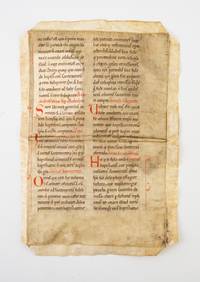
réf. ST20837bGermany late 12th or early 13th century. 335 x 224 mm. 13 1/4 x 8 7/8". Double column 29 lines in an elegant proto-gothic book hand. Rubrics in red several two-line initials in red. Recovered from a binding and so the vellum a bit soiled creased and wavy recto with a lighter patch where a title label was once situated light stains and glue and paper residue on the verso but overall the leaf remarkably clean entirely legible and surprisingly well preserved. Once serving as a cover for a later book this leaf comes from a nearly contemporaneous copy of Peter Lombard's "Sentences" considered the most important theological book of the 12th century. Written between 1155 and 1158 and arranged topically Lombard's "Sententiae" summarize past learning about Christian doctrine by quoting authorities in an attempt to resolve textual disagreement by dialectical analysis. As a source collection that continued to spark discussion Lombard's great work enjoyed sustained success as a theological textbook until the 17th century and inspired numerous commentaries including those of Aquinas and Luther. This leaf comes from Book IV "On the Doctrine of Signs" which is primarily concerned with the seven sacraments: Baptism Confirmation the Eucharist Penance Extreme Unction Sacred Orders and Matrimony. The script is an upright and very legible proto-gothic book hand with a few distinctive letter forms and abbreviations that may help determine a more definitive point of origin these include a "g" with a downward cross on its tail and a conjoined "qe" for "que". It is unusual and very lucky that this leaf survives completely intact as Medieval manuscripts used in later bindings were often cut down in size to make smaller covers or used as waste paper for pastedowns or other binding elements. unknown books
1500réf. ST20810PParis ca. 1500. 165 x 117 mm. 6 1/2 x 4 5/8". Single column 18 lines in a gothic book hand. Rubrics in red line fillers in blue and pink with gold bezant five one-line initials in burnished gold on pink and blue ground one two-line initial in blue on gold ground with a flower in the center one three-line initial in blue filled with ivy on gold ground recto with panel border of colorful flowers vase and acanthus verso with A LARGE ARCH-TOPPED MINIATURE OF THE ANNUNCIATION TO THE SHEPHERDS surrounded by A FULL BORDER of acanthus flowers and two birds all on a painted gold ground. Slight soiling to vellum but a very well-preserved leaf in fine condition. From what was surely a costly Book of Hours this leaf features a charming and skillfully painted miniature of the Annunciation to the Shepherds attributable to the workshop of Jean Pichore fl. ca. 1502-20 a major figure among illuminators of the period and one of the most sought-after artists in France at the turn of the 16th century. Depicting the traditional subject associated with the hour of Terce our miniature portrays as usual an angel appearing to shepherds tending their flock bringing news of the birth of Christ. Although the biblical narrative suggests that the shepherds were startled by the angel's appearance the three figures in this miniature appear remarkably unmoved--in fact only one of them seems to take any notice at all. The first shepherd sits on the ground looking straight ahead; the second holds his hands in prayer but looks little more than well prayerful at the angel in the sky; and a third figure maintains a slightly aloof expression taking no particular interest in the unfolding miraculous event. What may seem to be indifference can be explained easily enough by the artist's successful portrayal of nighttime cold! All three shepherds are thickly dressed one with his arms pressed tightly against his chest another with a hood partly covering his face and the sheep are tightly huddled together into one woolly white cluster. Another manifestation of the artist's success here is seen in the particularly well done molding of the faces with subtle shading attractively rendered features and clear individuation. Moreover although the shepherds seem essentially unmoved their garments are dusted with a glistening gold radiance from above a further subtle touch revealing a high level of achievement on the part of the painter. Finally the borders are one last source of delight with a small bird shown in mid-flight and a second one investigating a single strawberry that seems to have been placed there just for him. All of these indications of sophistication suggest that the original manuscript must have been commissioned by a patron able to pay a premium for the work of a highly skilled atelier. unknown books
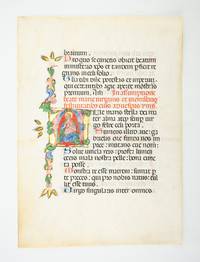
réf. ST20973Italy 15th century. 364 x 260 mm. 14 3/8 x 10 1/4". Single column 22 lines in a rounded gothic book hand. Rubrics in red versal initials alternating red and blue with purple penwork one three-line initial in blue with purple penwork A SIX-LINE "A" DEPICTING THE ASSUMPTION OF THE VIRGIN the initial painted pink with red green and blue nodes and acanthus on a burnished gold ground with extensions running the length of the text column incorporating more acanthus and small gold embellishments with sprays of the gold leaves at the top bottom and center. A little rubbing to the paint negligible soiling and small spots to margins but in excellent condition overall. This very large handsomely preserved leaf features a strikingly attractive initial of the Virgin opening the beloved hymn "Ave Maris Stella" "Hail Star of the Sea". Dating back to at least the ninth century and traditionally associated with the hour of Vespers on Marian feast days as here the hymn praises the Virgin's purity meekness and mercy calling upon her as the "Nurturing Mother of God" to dispel evil and free us from our sins. Inside the gilt and painted initial is a lovely portrait of the Virgin who is depicted seated against a red mandorla dressed in pink and wrapped in a green and blue mantle--perhaps a reference to the colors of the ocean. Her hands are raised in prayer fingers lightly touching above her heart and her well-defined features appear both strong and serene. Judging from the size of the initial liberal use of gold and the wide margins of this leaf the original manuscript must have been a costly item produced for a wealthy church or monastery. unknown books
réf. 1059101350. Tuscany: c. 1350. Folio 430 x 308 mm. Single leaf. With four-line staves of music on both sides with five recto and six verso lines of text beneath. With a very fine initial 'A' in Tuscan colors. The top edge has been repaired perhaps at the time with a strip of vellum for unknown reasons perhaps a mark of ownership removed. Otherwise in very good condition generally clean and fresh and with ample margins. § A fine early Tuscan leaf being the responses and versicles for the first reading at Matins. The leaf opens: "Absterget Deus omnem lacrimam ab oculis." Provenance: Bernard M. Rosenthal 1995 with his notes; private collection San Francisco. unknown books
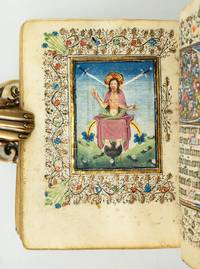
1450réf. 1058951450. Dutch school: c. 1450 or later. Single leaf 138 x 98 mm. Miniature without text image of Christ before Caiaphas being held by a soldier with a jester dancing behind him disciples and a cockerel seen through a doorway in the courtyard beyond within a three-sided border of simple flowers. In good condition. § Origin and provenance unknown; from a private California collection. unknown books
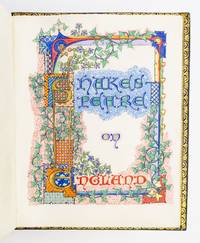
1944réf. ST19310Sheffield England December 1944. 265 x 215 mm. 10 1/2 x 8 1/2". 6 leaves illuminated on rectos final leaf also illuminated on verso with colophon. VERY ATTRACTIVE DARK BLUE MOROCCO GILT stamped-signed "Bound by Slinn" on front pastedown upper cover with monogram of Edwin Goddard Stokes framed by gilt-ruled compartments containing gilt lettering elaborate gilt foliage and a gilt crown tool at top the panel surrounded by a double gilt rule frame and dogtooth roll border with additional foliate tools rear cover with quatrefoil design in floral tools and pointillé dogtooth roll border smooth spine with gilt-ruled compartments. In a rather worn felt-lined brown paper wallet case with handwritten titling on spine. Each recto with one or two large two- to three-line initials either painted or gilt TITLE PAGE WITH A FULL BORDER and others with a large complex border all of them elaborately painted with a variety of patterns styles motifs and with gilt embellishments one border incorporating three coats of arms AND ANOTHER PAGE WITH A QUARTER-PAGE MINIATURE OF A KNIGHT ON HORSEBACK. Trivial wear at top of front joint otherwise in pristine condition. This is a charming modern illuminated manuscript penned during WWII that contains two excerpts from Shakespeare in praise of "this other Eden demi-paradise" called England--specifically passages from John of Gaunt's dying speech in "King Richard II" and lines from "King John." As stated in the colophon the manuscript "was Designed Written out and Illuminated by John Wilfred Clarke of Ecclesall Sheffield for his great friend Edwin Goddard Stokes of Ringinglow Sheffield." Clarke d. 1954 was a municipal engineer and town planner by trade professions for which skill in the visual arts particularly draftsmanship is not only preferred but required. He was clearly a talented amateur with a flair for pattern and design. Though he incorporates elements found in Medieval manuscripts--trailing ivy leaves penwork decoration tessellation and line enders--the style is at the same time modern utilizing bold color combinations and layered shapes and patterns. Given the artist's location it is quite possible that he was involved with the Sheffield School of Art which was founded in 1843 and offered classes in fine arts and crafts. We know that the binder Walter Slinn d. 1964 was a staff member at the school as well as a prominent local bookbinder. Nationalistic sentiments are made clear in the choice of material celebrating England in Shakespeare's voice and this manuscript is all the more poignant when seen in the context of its time and place. Sheffield an industrial city was a major producer of steel and armaments during WWII --and thus a high-value target for German air raids. The so-called "Sheffield Blitz" of 1940 resulted in hundreds of deaths and nearly 80000 damaged homes. In December of 1944 when this manuscript was completed the end of the war was not yet in sight. Despite the bleak circumstances the manuscript radiates color light and hope. The recipient of Clarke's attractive manuscript was Edwin Goddard Stokes 1902 - ca. 1957 one of the sons of the prominent Sheffield businessman Robert James Stokes founder of R. J. Stokes & Co. a tile company that still flourishes in the city now. It is clear that this item was carefully looked after by this "great friend" of the artist. So far as we have been able to determine Clarke is an unrecorded artist except for the present Shakespeare work and one other similar manuscript featuring excerpts from Chaucer now in Stanford University Library. unknown books
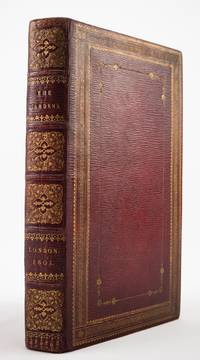
1805réf. ST21016London: Printed by T. Bensley 1805. APPARENTLY THE ONLY COPY PRINTED ON VELLUM. 260 x 152 mm. 10 x 1/4 x 6". 2 p.l. 146 pp. 1 leaf notes. Translated by Maria Henrietta Montolieu. Very pleasing contemporary straight-grain scarlet morocco gilt by Charles Hering binder's ticket on verso of front flyleaf covers bordered with a wide frame of multiple patterned rolls with rosette cornerpieces enclosing a delicate frame of a dotted roll cornered small floral tools raised bands spine gilt in compartments wide turn-ins sumptuously gilt cream silk endleaves with gilt borders and fleuron cornerpieces all edges gilt. WITH EIGHT ENGRAVINGS BY FRANCESCO BARTOLOZZI IN TWO STATES one on gold silk and the second on paper. EXTRA-ILLUSTRATED with two engravings depicting Princess Izabela Czartoryska and her daughter Zofia. A Large Paper Copy. Henrey 624. See also Clemens Alexander Wimmer "The Princess and the Poles" Historic Gardens Review no. 10 2002: 14-17. Spine slightly darkened joints and edges with minor barely noticeable wear vellum a bit and naturally rumpled and consequently the book yawning a bit a handful of light spots but still an extremely appealing copy with fine impressions of the plates vast margins and a special story to tell. Printed on vellum richly bound and illustrated with attractive plates on silk this is an extraordinarily luxurious copy of Delille's famous poem on gardens that almost certainly belonged to a noblewoman whose gardens are mentioned in the text. First published in 1780 our poem condemns formal gardens and broad promenades in favor of a gardening art which hides its artistry by reproducing the asymmetrical groupings of nature and careless bounty of the countryside. This view accords with the translation of Virgil's "Georgics" done by Delille 1738-1813 in 1769 a version that brought him great acclaim for its supple and sonorous versification. In fact it so pleased the Count of Artois the future Charles X that he named Delille abbot of Saint-Séverin; however revolution disrupted things and the poet for a time led a wandering life in Switzerland Germany and England where this updated and expanded version of "Gardens" was published in 1801. The present special edition includes the plates which had appeared as head- and tailpieces in the first edition but now used as stand-alone plates in two states. These were executed by Bartolozzi after originals by Portuguese neoclassical painter Francisco Vieira. In addition to the called-for suite of illustrations our copy includes two inserted plates portraits of Princess Izabela Czartoryska 1745-1835 and her daughter Zofia. Czartoryska was a major figure in the Polish Enlightenment as a writer and patron of the arts as well as an advocate for improving the lives of the poor. She is best remembered for the sprawling gardens at her palace in Pu awy which included a formal garden a "wild promenade" or landscape park and multiple structures including the neoclassical Temple of the Sibyl which became one of Poland's first museums. She made the acquaintance of the author while travelling through Paris in 1791 and the two struck up a friendship. She financially backed the second edition of the work in exchange for a mention of her gardens which duly appears in heightened verse on pp. 11-13: "Favoured Pulhavi! You from Heaven obtain / Each separate charm Earth's choicest scenes contain; / Bright glow thy features fresh from Nature's hand / Excite our wonder and our praise command." The presence of this poetic tribute--and especially the inserted plates showing the princess and her daughter-- clearly suggest that the our apparently unique luxury edition must have been a presentation copy to Czartoryska herself. The present copy is as striking outside as it is inside. Charles Hering was the most distinguished and influential English binder of the first decade of the 19th century and although his career was brief from about 1795-1812 Ramsden focuses on his work as representing the transition in binding styles from those of the German émigrés of the late 18th century to the new generation of binders headed by Charles Lewis. Dibdin states that until "the star of Charles Lewis rose above the bibliopegistic horizon no one could presume to 'measure business' with Hering. There was a strength squareness and a good style of work about his volumes which rendered him deservedly a great favourite." We have been unable to trace any other copies of the present edition on vellum. Printed by T. Bensley unknown books
réf. ST20981Italy 15th century. 264 x 200 mm. 10 3/8 x 7 7/8". Single column 41 lines in a neat humanist hand. With two two-line initials in blue. One corner torn away not affecting text a few marginal wormholes vellum a bit soiled and with a few small stains but a very good example the text entirely legible and overall clean and presentable. Containing text by an author who was much admired during the Renaissance this leaf is a lovely example of the humanistic script that emerged in Italy during the 15th century. The elegance and legibility of humanistic script derives from Caroline miniscule the predominant style of writing in Western manuscripts from the ninth through 12th centuries. Both scripts favor clear rounded letter forms wider spacing between letters and few abbreviations resulting in manuscripts that are extremely attractive and easy to read. The text here comes from a work titled "De Opificio Dei" exploring the handiwork of God with a concentration on the marvels of the human body and soul. The present leaf includes chapters 8-10 which discuss the human head including especially the seats of the senses: eyes ears nose and tongue. Our author Lactantius ca. 260-340 was a late-in-life Christian who became one of the ablest defenders of the faith in its early centuries. He was held in high esteem by Renaissance intellectuals and was one of the earliest authors to be printed first appearing in 1465. unknown books
1440réf. ST12158bAParis ca. 1440. 222 x 162 mm. 8 3/4 x 6 3/8". Single column 16 lines of text in a beautiful gothic book hand. Rubrics in red leaves with varying numbers of line fillers and one- and two-line initials in burnished gold blue and magenta highlighted with white tracery and WITH LOVELY RINCEAU BORDERS on one or both sides these composed of delicately twining hairline stems bearing red and blue blossoms and FEATURING A PROFUSION OF BURNISHED GOLD IVY LEAVES. IN OUTSTANDING CONDITION the vellum extraordinarily bright fresh and clean and WITH MARGINS AS VAST AS ONE COULD EVER HOPE FOR. Commissioned for use by a woman as indicated by the feminine form in the "Obsecro te" the Book of Hours from which these leaves come could only have been a manuscript of great beauty prepared for a household of very substantial wealth and importance. The level of achievement manifested here in both the scribal hand and the execution of the illuminated decoration clearly indicates that some of the best artisans money could buy were at work on this book and only a powerful family could afford to pay their price. Further corroboration of this fact is seen in the leaves' noticeable size and immense margins which are at least as wide as on any Book of Hours leaves we have ever owned. Such a conspicuous display of purchasing power those extra millimeters meant the slaughtering of extra animals and that meant greater cost announces an owner's self-congratulatory consequence that is uncommon except in the grandest of prayer books of the period. Happily the condition here matches the importance of the manuscript which was obviously considered from the beginning--and ever after--an object to be carefully preserved. For additional leaves from this Book of Hours at different price points please check our website. unknown books
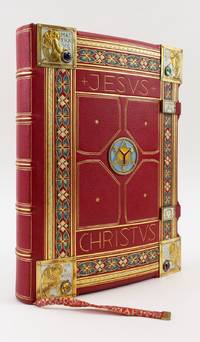
1925réf. ST16974Flensburg ca. 1925. 325 x 240 mm. 12 7/8 x 9 1/2". 4 p.l. first two blank 4 leaves 144 pp. 4 leaves last blank. Single column 31 lines in a fine calligraphic hand. FLAMBOYANT DEEP RED MOROCCO ELABORATELY INLAID AND GILT BY W. A. PETERSEN stamp-signed on rear turn-in covers framed by inlaid white morocco strip tooled with gilt triangles enclosing sides in a bead-and-lozenge pattern of gilt-outlined mandorlas containing a red cross on a blue background alternating with an inlaid white lozenge upper cover with brass and enamel cornerpieces featuring the symbols of the four Evangelists each of these set with a colored glass gem central panel divided into four compartments each containing a small star tool central brass and enamel medallion with a six-pointed star emblazoned with a sun and a red enamel "Y" two straps with brass and enamel clasps marked with Alpha and Omega lower cover with brass cornerpieces raised bands spine with gilt-ruled compartments turn-ins tooled with plain and dotted gilt rules and gilt stars deep pink moiré silk doublures shot with gold thread all edges gilt. In a box with a velvet-lined maroon buckram base and green marbled paper lid. With many initials of various sizes painted blue red green purple maroon or gilt three three-line initials in gold on a colored ground with the shape of a cross one two-line initial and 13 four- to six-line initials in gold on a multi-colored ground in a geometric design SEVEN HISTORIATED INITIALS each measuring seven to 11 lines in length FIVE MINIATURES MEASURING A THIRD TO THREE-QUARTERS OF THE PAGE each featuring a scene from the life of the Virgin or the life of Christ SIX FULL-PAGE ILLUMINATIONS incorporating text of different sizes and fonts many colors and patterns five of which contain a large central gilt circle the first of these completely filled with gold the others with a religious symbol in pen on bare vellum every page with a unique border composed of a thin frame with different geometric designs in gold and color some pages with an additional column of floral and foliate designs running down the left side of the text within the border plus additional flourishes elsewhere. Text in multiple sizes and fonts occasional words or phrases penned in color or gold. Boards somewhat bowed as often with bindings on vellum works occasional naturally occurring variations in the grain of the vellum a few instances of faint thumb smudging in corners but A BEAUTIFUL MANUSCRIPT IN ESPECIALLY FINE CONDITION the vellum smooth and fresh the illuminations shimmering and the binding unworn. Replete with gold illumination and bright colors evoking the appearance of Medieval manuscripts and stained glass this is an exquisitely produced work relating the life and words of Christ divided into five thematic parts: Light Word Spirit Death and Resurrection. Each part opens with a sumptuous full-page illumination reminiscent of the "carpet page" painting found in early Insular manuscripts; in the present work our artist fills the frame with a dazzling mixture of text and decorative patterns around a lustrous gilt medallion calling to mind the sun a resplendent halo or the Host. Although much of the decoration both on these full-page illuminations and elsewhere in this work remind one of Medieval manuscripts and are often composed of geometric designs and colors suggestive of stained glass the overall style here is decidedly modern. The palette is fresh and bold while the emphasis on strong lines and patterns shows the influence of the reigning Art Deco movement with echoes of the Art Nouveau movement that preceded it. Traditional biblical narratives in the form of historiated initials and miniatures are also presented here in refreshing ways: the image of the Sermon on the Mount for example places the viewer directly among the masses; we experience the event as a member of the audience would looking over the shoulders of the people in front of us to see Christ orating from a small hill silhouetted against a bright pink sky. Another memorable image--and the largest figural composition in this manuscript--is the Crucifixion. Though he has used a fairly standard composition the artist plays with our perception of space by setting the scene on a dark blue ground that envelopes the figures in a shadowy void; the only light source seems to come from the gold lettering immediately above the cross radiating off the face of Christ and to a lesser degree off the grief-stricken faces of John the Evangelist and the Virgin. All are pictured without haloes thus emphasizing the humanity of Christ over his divinity. As a whole this manuscript is extremely impressive in terms of artistry and technical execution and the prolific decoration and calligraphic variety hold the viewer's interest page after page. The equally impressive binding--modelled after the look of a Medieval Gospel book complete with enamel-like bosses and jewels--is fitting for a work that pays homage to the past while celebrating contemporary art and style. The life and work of calligrapher and illuminator Johann Holtz 1875-1944 is poorly documented but he seems to have been active in Flensberg Germany; he also worked as a graphic artist. Binder W. A. Petersen has proven equally illusive but we know that his workshop was also located in Flensburg. Given the town's close proximity to Denmark we might speculate whether Petersen was somehow related to the Copenhagen-based binder Immanuel Petersen who took over from master binder D. L. Clément in 1877. Despite the lack of biographical information on our artist and binder the work here needs no provenance information to be pleasing in every way from the gleaming binding to the beautifully preserved and magnificently illuminated contents. unknown books
réf. ST16985MFrance First half of 14th century. 110 x 82 mm. 4 3/8 x 3 1/4". Single column 12 lines in a gothic book hand. Line enders in pink and blue with gold accents each leaf with one or more one-line initials in blue with red penwork or gold with blue penwork each leaf with one two line initial painted pink or blue filled with painted floral motifs and on a gold ground one side of each leaf with A NEAR-FULL BORDER composed of pink and blue tendrils accompanied by spikey gold decoration and gold accents often terminating in ivy leaves and incorporating EXTRAORDINARILY CHARMING EXAMPLES OF MARGINALIA INCLUDING HUMAN-BEAST HYBRIDS. ◆Vellum a little soiled and with a few small stains one leaf with more noticeable smudging affecting some of the text and decoration another leaf with one of the heads a little rubbed but all other examples of marginalia very well preserved. Though diminutive in size these leaves contain enormously appealing marginal decoration in the form of humans animals and hybrid creatures inventively incorporated into the lively borders in manners that range from adorable to bizarre. Especially popular in Flanders Northern France and England during the 13th and 14th centuries marginalia such as these comprise some of the most memorable and entertaining images to be found in any Medieval manuscripts. Despite being found largely in religious books such as Psalters and Books of Hours the images are often strange humorous or even outrageous and they provide us with consistent delight. Being by definition outside of the central text or miniature the margins seem to have been a place where illuminators felt more at ease to experiment resulting in highly imaginative and unique artistic expressions. The present specimens come from a fragmentary manuscript with many leaves either missing or rendered defective where portions of the vellum were cut away. Fortunately this group of leaves is intact and retains much marvelous imagery including a beast with an exaggeratedly long body and horns and long-necked beasts with human heads--one who appears to be blowing smoke into the air one with a bearded face as its bottom and another with the body of a stork sporting a hat with a long pointy tendril. For additional leaves from this same manuscript at different price points please check our website. unknown books
1915réf. ST20770London: Especially written out and illuminated by Alberto Sangorski ca. 1915. 249 x 165 mm. 9 3/4 x 6 1/2". 18 2 pp. 2 leaves blank colophon. Attractive dark green crushed morocco gilt by Riviere & Son stamp-signed on front turn-in covers with wide frame and central panel tooled in gothic architectural motifs raised bands spine compartments with double gilt rules gilt lettering turn-ins framed by gilt fillets and dots scarlet watered silk pastedowns and endleaves all edges gilt old repair to head of spine. With one burnished gold initial "A" with intricate penwork embellishment in red and blue THE WORD "FOR" WRITTEN IN LARGE BURNISHED GOLD LETTERS SIX TIMES all with delicate penwork embellishment in blue or green TWO WITH A FAIRY-WINGED PUTTO perched on the crossbar of the "F" another "FOR" written in blue THE "F" IN BURNISHED GOLD ON A BACKGROUND OF BRUSHED GOLD WITH A PINK ROSE SPRIG a tailpiece of white jasmine blossoms entwined with a spray of lilac blooms FOUR ESPECIALLY FINE BRIGHT OVAL VIGNETTES approximately 90 mm. across SHOWING LOVELY GARDENS one of these accompanied by A HALF BORDER OF HUCKLEBERRY VINE another at the front as part of A SUPERB DOUBLE-PAGE OPENING FEATURING A PROFUSION OF PINK ROSES forming a frame around a gilt-edged cartouche bearing the title in blue surrounded by delicately blue and brown tendrils on the left AND A FRAME OF GRAPEVINES BEARING SUCCULENT PURPLE FRUIT ON A BRUSHED GOLD BACKGROUND on the right an oval view of a lake and mountains at its foot this frame enclosing text beginning with the words "GOD ALMIGHTY" in thickly burnished gold accented with curling blue and brown acanthus leaves and blue penwork. One page with trivial thumb smudge faint variations in shade of the vellum but A SUPERB SPECIMEN the vellum smooth and creamy the paint and gold bright and the virtually unworn binding with shining gilt. Featuring several gorgeous moments this is a luxurious and appropriately luxuriant illuminated manuscript of Bacon's prescription for the ideal princely garden. The most prominent modern creator of illuminated manuscripts our artist Alberto Sangorski 1862-1932 started his professional life as secretary to a goldsmith's firm before being attracted to the book arts at the age of 43. He began doing illuminated manuscripts that were then bound by his brother Francis' firm Sangorski & Sutcliffe with the colophon crediting the manuscript to the firm rather than acknowledging Alberto's contribution. Partly because of this failure to recognize his work Alberto had a falling out with Francis sometime around 1910 at which time he took his talents to Riviere the chief competitor to his brother's bindery. Robert Riviere began as a bookseller and binder in Bath in 1829 then set up shop as a binder in London in 1840; in 1881 he took his grandson Percival Calkin into partnership at which time the firm became known as Riviere & Son and the bindery continued to do business until 1939. Riviere was happy to allow Albert to add a colophon proclaiming as here that "This manuscript . . . was designed written out and illuminated by Alberto Sangorski." The decoration in the present work has an airy light-hearted aura with the bright gold lettering the delicate intricate penwork and the whimsical fairies conveying considerable joy and playfulness. And the beauty of the manuscript is heightened by the extremely fine condition here. Especially written out and illuminated by Alberto Sangorski unknown books
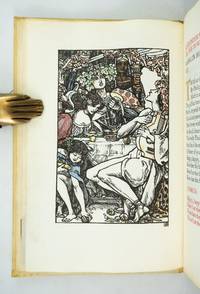
1904réf. ST20796London: Essex House Press 1904. No. 1 OF 140 COPIES all on vellum. 195 x 131 mm. 7 3/4 x 5 1/8". 1 p.l. frontispiece 3-11 2 pp. Original stiff vellum over thin boards front cover with embossed rose design. In custom-made linen clamshell box with red morocco label on spine. Hand-colored woodcut frontispiece and final tailpiece both by Reginald Savage hand-painted initials in burnished gold red blue or green. Printed in black and red. Front pastedown with red morocco bookplate of William Andrews Clark Jr.; front endleaves with evidence of bookplate and inscription removal. Tomkinson p. 76; Ransom p. 268; Franklin p. 200. A VERY FINE COPY clean bright and free of the splaying that very frequently afflicts the boards of this work. This is a most appealing example of the luxurious hand-crafted volumes produced under the auspices of the Essex House Press with our copy coming from the library of a noted Dryden collector. The book is the 11th from the Essex House series of 14 "Great Poems in the English Language" a group of lovely little works all printed on vellum and with delightful colored illustrations and historiated initials. Generally considered to be the best example in English of the choric hymn the present work is set at a feast given by Alexander the Great who finds himself entranced by the poet and lyrist Timotheus. The great leader is lost in reveries of exploits and victory he sighs and cries over battles lost and warriors slain and he finds inspiration for new conquests. Our printer C. R. Ashbee founded the Essex House Press in 1898 by purchasing the presses and other production equipment though not the type formerly owned by the Kelmscott Press which had shut down at the death of William Morris. Ashbee printed books for 12 years with vellum ink and paper identical to that used by Kelmscott in an effort to carry on the tradition Morris had established. But the Essex House Press because it was conceived of and continued as part of a larger enterprise involving various artisans at work in a group of workshops at Ashbee's Guild of Handicrafts located at Essex House in London's Mile End Road always had its own special identity a fact which Cave reflects when he calls it the "Arts and Crafts press 'par excellence.'" The illustrator here Reginald Savage fl. 1886-1904 is deemed by Houfe "a talented and imaginative designer and woodcut artist" and Houfe notes that he was also commended by his fellow illustrator Walter Crane 1845-1915 for his "weird designs." Former owner William Andrews Clark Jr. 1877-1934 put together one of the most distinguished collections of English and French literature of his day. He had strong holdings in many areas but especially in Shakespeare and the other Elizabethans in Dryden in Oscar Wilde and in the French drama. After a fire in his home in 1923 Clark constructed a separate fireproof building to house his collection; in 1926 this library building with its distinguished collection was deeded to the University of California and now serves as a prominent center for literary research. Essex House Press unknown books
1470réf. ST20836Western France Angers ca. 1470. 122 x 88 mm. 4 3/4 x 3 1/2". Single column 15 lines in a neat bâtarde hand. 152 leaves first and last three are ruled blank leaves; leaf count does not include the first blank endleaf erroneously included in the modern pencil foliation. COMPLETE. Contents: early ownership inscriptions f. 2v Calendar f. 5r Hours of the Virgin f. 17r Extract from the Gospel of John f. 55v Obsecro Te f. 57r Penitential Psalms and Litany f. 61r Office of the Dead f. 78r series of devotional prayers in Latin to the Virgin Mary Christ and the Archangel Michael f. 115r O Intemerata f. 134v series of devotional prayers in Latin f. 138r ruled blank leaves with family records of Jacques Bille f. 150v. Pleasing early 19th century caramel colored straight-grain morocco covers bordered with a double gilt rule smooth spine gilt in compartments divided with a double gilt rule and dotted roll and cross centerpieces neat early repair to head of spine turn-ins gilt marbled endpapers all edges gilt. Housed in a 20th century felt-lined slipcase with a gilt monogram on front. Ruled in red rubricated in red and blue two one-line burnished gold initials on a blue or pink ground one three-line blue and red penwork initial eight three- to four-line initials in pink and blue filled with ivy leaves on a burnished gold ground these pages with three-quarter borders of acanthus leaves dense rinceaux colorful fruit and flowers gold ivy leaves and bezants and WITH FOUR ARCH-TOPPED MINIATURES above a three- or four-line initial painted blue or pink on gold ground each surrounded by a full border of painted gold and brightly colored acanthus leaves vines and flowers studded with burnished gold bezants three borders inhabited with fantastical creatures the subjects of the miniatures including the Annunciation f. 17r; King David in Prayer f. 61r; a funeral procession f. 78r; and the Pietà f. 115r. Verso of first leaf with signature of Jacques Bille or Billes and the following page with a note in a different contemporary hand with the day and year erased and written over: "Ces presentes heures sont a iaques bille qui les trouvera si les luy Rende et il paiera voluntriers le VIII le jour de la sainct martin. Tesmoion son seign manuel cy mis le huytiesme jour de Avril L'an mil cinqcens et seze" "These present hours belong to Jaques Bille; whoever finds them should return them to him and he will gladly pay on the eighth the day of Saint Martin. Witness his manual signature placed here on the eighth day of April in the year one thousand five hundred and sixteen" followed by Bille's signature; third blank leaf with the ownership inscription "Tussanus Philippus Adeline Presbyter anno 1763"; verso of final text leaf and next three blanks with family records see below. Superficial crease to spine other insignificant signs of use to the leather but the binding sound and attractive. A hint of thumbing at lower corners of first half of the manuscript miniatures with a few isolated minor spots of rubbing not affecting faces otherwise in very fine condition internally the paint bright and fresh and the vellum clean. Almost certainly made in western France and with early ownership inscriptions tying it to that area this Book of Hours contains four extraordinarily high-quality miniatures by an accomplished artist very likely related to one of the greatest French manuscript illuminators of the period. Stylistic markers here include drapery with crisp folds figures with pale skin and high foreheads simple but perfectly executed scenery and a flair for detail. The latter talent is particularly evident on the various textiles and garments which include almost impossibly fine gold trimmings and sophisticated draping. It was in fact on the basis of the extraordinary drapery that the manuscript had previously been associated with the circle of Jean Fouquet called by Avril and Reynaud "the greatest French painter and illuminator of the 15th century." In a case of twin summits recent scholarship suggests an alternative attribution to the similarly illustrious circle of Maître de Jouvenel des Ursins a contemporary of Fouquet who according to Avril and Reynaud was "the most important illuminator of the mid 15th century in western France." Around him sprung up a group of artists collectively referred to as the "Jouvenel group" who were based primarily in the area between Tours Nantes and Angers. The illuminations in the present work are so skillful that with additional research it may be possible to pin down an attribution with more certainty; whatever the identity of the artists the level of finishing in these illuminations--from the careful molding of the faces and bodies to the expertly balanced compositions and elegant brushwork--are the hallmarks of a superior hand. When this item was sold at Sotheby's on 13 July 1977 the auction catalogue said that the miniatures "are painted with fine clear colours with great delicacy in the modelling of faces and costumes. The finest miniature is that of the Pietà set against a deep green hill with a fiery sun setting behind dark mountains and buildings and lighting up the evening sky." Indeed this image is a quiet masterpiece of illumination and an excellent example of this artist's work. The naked figure of Christ exhibits a real command of anatomy and proportion while subtle details such as the foreshortening to Christ's face and the whisper-thin cloth clinging to the lower body are done with an exquisite touch. The miniature of the funeral procession also stands out for its superior quality. The composition is quite different from the Pietà being a large group of people rather than an intimate portrait of two figures but it is approached with equal rigor and devotion to detail. The faces turning toward the viewer all show impressive individualization with the figure dressed in blue being particularly well formed and highly differentiated from the crowd--so much so that this could possibly be considered a patron portrait. Three of the miniatures in this work contain borders with delightful examples of marginalia including a court jester a hedgehog a male and female centaur wielding weapons a monkey riding a camel another monkey rubbing his posterior and other whimsical hybrid creatures. These stand out because they are rendered with the characteristic skill and attention to detail found in the larger miniatures so it is possible that they could also be the work of the miniature artist. Although the Calendar in this manuscript is fairly sparse at least two unusual entries in red point toward western France: St. Julian Bishop of Le Mans 27 January; and St. Maurilius patron saint of Angers 13 September. Significantly the Translation of St. Maurilius also appears on both 16 August and 19 of October in black. Strengthening this association with the west are the early ownership inscriptions tying to the Bille family from at least the early 16th century and possibly before. The final three leaves contain family records that include the date of Jacques Bille's wedding 8 April 1516 and the births of 15 children written in two or three hands between approximately 1520 and 1549. The name of our former owner was difficult to trace with certainty but we find mention of a Jacques Bille in the French National Archives where he is listed as a notary in Bourg in southwestern France. This would make sense given Bille's complex signatures found on the first two leaves--the extra flourishes may well reflect notarial signatures that he used in his work. In modern times our manuscript was sold at Sotheby's on 25 February 1946 lot 57 to Maggs who may well have sold it to Sven Ericcson who is listed as the owner of this and four other 15th century illuminated Books of Hours when it was sold at Sotheby's in 1977 for £3200. According to RBH it was purchased at that auction by "Malle" almost certainly Bernard Malle 1929-2008 brother of filmmaker Louis Malle and an eminent collector and bibliographer. In an elegant tribute to his late friend and mentor Bernard Clavreuil calls Malle "one of the most discerning . . . collectors of the postwar era" someone who "never ceased to refine and improve in order to achieve an impossible perfection." Malle also acted as a private advisor to more than one major collection and it is possible that he purchased the present manuscript on behalf of an unknown collector rather than his own library. These former owners clearly looked after this Book of Hours carefully over the years and for good reason: it is a work of considerable craftsmanship and beauty with illuminations distinguished by very substantial artistic skill. unknown books
1450réf. ST20835Flanders ca. 1450. 109 x 81 mm. 4 1/4 x 3 1/8". Single column 14 lines in a gothic book hand. 161 leaves. COMPLETE. Contents: Calendar f. 1r; Mass of the Holy Spirit f. 14r; Mass of the Holy Cross f. 23r; Requiem Mass f. 30r; Prayer on the Seven Last Words of Christ by the Venerable Bede f. 36v; Passion according to John f. 40v; blank f. 53; Hours of the Holy Cross f. 55r; Mass of the Virgin Mary f. 60r; Gospel Lessons f. 66v; Hours of the Virgin f. 73r; Penitential Psalms f. 126r; Litany f. 138r; Office of the Dead f. 144r. PLEASING NEAR-CONTEMPORARY BLIND-ROLLED CALF apparently with some old skilled restoration to joints spine and corners covers with rolled vine border surrounding a panel of three columns bearing a roll with parts of the inscription "AVE MARIA GRACIA PLENA" each word separated by one of four small motifs a flower a human profile the lamb of god and a sitting animal--perhaps a lion raised bands compartments with part of the same inscription roll. Lacking the original ties. Housed in a very attractive custom-made brown calf folding case with blind-stamped lettering on the spine interior lined in suede the whole within a calf-lipped suede-lined matching slipcase. Rubrics in red numerous one-line initials in blue with red penwork or gold with dark blue penwork many two-line initials in burnished gold on pink and blue ground with white embellishments several larger "I" initials between four and 11 lines in burnished gold on pink and blue ground with white embellishments 12 six- to seven-line initials some painted pink or blue with white embellishments and filled with flowers and tendrils on a gold ground or the initial in burnished gold on pink and blue ground with white embellishments EIGHT LARGE MINIATURES each inside a thin gold frame and with a three-quarter border of gilt leaves hairline vines and floral spays each facing page with a similar three-quarter border the subjects of the miniatures being: the Holy Spirit in the form of a dove f. 13v; St. Helena and the True Cross f. 22v; Raising of Lazarus f. 29v; Crucifixion f. 54v; Virgin and Child Enthroned f. 59v; Annunciation f. 72v; Last Judgment f. 125v; Funeral Mass f. 143v. Prickings visible in fore margins. See: Defoer et. al "The Golden Age of Dutch Manuscript Illumination" pp. 75-86. Just minor wear to the solid very pleasing early binding. A little chipping almost always mild to four of the miniatures with square frames the fifth the Annunciation somewhat rubbed and faded the three domed miniatures perfectly intact vellum with minor soiling and thumbing in places especially in lower corners of leaves in second half other trivial imperfections but overall a very well-preserved manuscript with no major issues. This enchanting little prayer book features eight attractive miniatures large gleaming burnished gold initials and a pleasing period binding--all in an excellent state of preservation. The miniature program here can be attributed to the so-called Masters of Otto van Moerdrecht the name given to a variety of Dutch artists active in the 1430s and '40s all working in a similar mode rather than to a specific master or workshop. According to Defoer et al. the work of these miniaturists "exhibit varied compositional formulas and bright highly contrasting colors . . . . The small somewhat doll-like figures appear rather wooden but their expressive gestures give the scenes a varied and vivid character." Two artistic hands are responsible for the present miniatures. The artist behind the first three miniatures all set within domed gilt frames the Holy Spirit St. Helena and Raising of Lazarus shows particular skill with a very smooth application of color figures with long eloquent hands and faces with subtle white highlighting. A second artist was responsible for the remaining five miniatures set within square golden frames Crucifixion Virgin and Child Enthroned Annunciation Last Judgment and Funeral Mass. Though this hand is less polished and the miniatures slightly smaller in size the scenes are all quite charming and attractively colored with vivid splashes of bright orange bubblegum pink sky blue and pale green. It is worth noting that the miniatures differ not only because of the artists' degree of success but also because of their condition: whereas the five are generally well preserved the other three are in a virtually perfect state. In addition to the central text of the Hours of the Virgin this manuscript contains several Masses each of which is preceded by a miniature. Perhaps the most interesting of these is the Mass of the Holy Cross which is paired with a miniature of St. Helena mother of Constantine the Great. According to Christian tradition Helena found the wooden cross used in the Crucifixion while she was travelling in Jerusalem in the fourth century. Constantine built the Basilica of the Holy Sepulchre in its honor and installed the relic there to be venerated. Britannica says that the adoration of the True Cross led to wide-spread sale of its fragments sought after as objects of devotion. It is unusual to find St. Helena depicted in a Book of Hours and this image is especially appealing with Helena in a beautiful red robe crown and halo embracing a large wooden cross in the center of the composition. The background is reminiscent of the work of the Gold Scrolls group with small swirls of liquid gold swimming in a scarlet sky the same scrolling motif graces the Holy Dove miniature. There is no indication of former ownership in this manuscript although the Calendar presents a few unusual saints that confirm a Flanders connection. These include St. Amandus in red known as the "Apostle of Flanders" on 2 February; St. Guido known as the "Poor Man of Anderlecht" on 9 September; St. Bavo in red patron saint of Ghent where a Cathedral is named in his honor on 10 October; and St. Eligius patron saint of goldsmiths and metalworkers on 1 December. The binding here is very close to contemporary and probably dates to the late 15th century. Neither the floral roll nor the "Ave Maria" roll seems to appear in EBDB. Similar rolls include r001954 r000623 and r000670 but ours is the only one with four different and charming tools one of each used between every "Ave" and "Maria." For a manuscript only slightly bigger than the palm of one’s hand this Book of Hours has a great deal to offer. In addition to its early binding and lovely illumination by an influential group of artists great care has been put into its preservation so that it resolutely endures for our pleasure and for owners in the centuries to come. unknown books
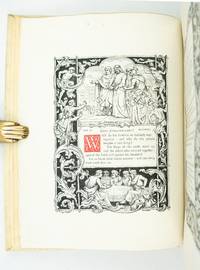
1862réf. ST20857London: Edmund Evans for Sampson Low Son and Co 1862. ONE OF PERHAPS 10 COPIES PRINTED ON VELLUM. 260 x 195 mm. 10 1/4 x 7 3/4". vii 1 235 1 pp. Publisher's stiff vellum smooth spine with gilt lettering edges untrimmed. In a modern felt-lined blue buckram drop-back box. Decorative initials in red or blue title page and text leaves with full criblé border of vined foliation occasionally inhabited eight or 10 leaves with more extensive illustrations at head or foot all engraved by W. J. Linton after illustrations by John Franklin. Front pastedown with ex-libris of Marion Hope Rattey. A Large Paper Copy. McLean "Victorian Book Design" p. 184. Short thin cracks to head and tail of front joint spine vaguely soiled upper cover with two very small brown spots and one trivial red mark occasional mild rumpling or naturally occurring variations in the grain or thickness of the vellum as usual a couple of minor smudges but still a very agreeable copy the binding solid and without the splaying common in vellum books the interior clean fresh and bright and the margins extraordinarily wide. This is an infrequently encountered copy of a beautiful Victorian book on vellum issued by one of the era's top printers. The volume was printed by Edmund Evans 1826-1905 who is now best remembered for his illustrations and advances in color wood engravings. Relatively little is known about this book's production: Ruari McLean tells us that it was "entirely printed" by Evans but it is unknown whether he was responsible for the design as well McLean remarks that "if Evans was responsible for its design it shows his superiority in book-making". We also are unsure how many copies were printed on vellum although the general consensus is 10. Regardless as McLean tells us "it is one of the prettiest books of the 'sixties" with sharp deep impressions of the type on the rich creamy vellum jewel-like colored initials and elegant wood-engraved illustrations. These illustrations are the work of John Franklin ca.1800-68 a painter and draftsman who was highly respected in his own time. The precisely realized borders feature idealized human forms posed within a robust botanical largely acanthus context the figures posing with balletic grace their expressive faces often turned gently away from the reader. The size of the leaf here is significant: the untrimmed edges retain their tiny printing pinholes which would normally have been trimmed away with regrettable loss. And not surprisingly our vellum printing is almost never seen: we could trace just two copies at auction since 1924. Former owner Marion Hope Rattey 1922-97 was likely the daughter of bibliographer Clifford C. Rattey 1886-1970 whose impressive library featured incunabula and block prints. [Edmund Evans for] Sampson Low, Son, and Co unknown books
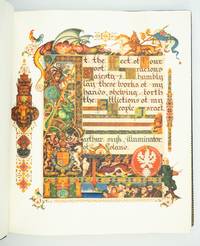
1939réf. ST20331London: Beaconsfield Press 1939. No. 72 OF 125 COPIES SIGNED BY THE ARTIST AND THE EDITOR for sale in the British Empire. 292 x 248 mm. 11 1/2 x 9 3/4". xxvi pp. 46 leaves all leaves French fold. Edited by Cecil Roth. Elegant original blue crushed morocco by Sangorski & Sutcliffe signed on front turn-in covers with gilt French fillet border and large intricate central figure designed by Szyk of a patriarch holding a goblet and book raised bands spine gilt in double ruled compartments with ornate crown centerpiece gilt titling turn-ins with double gilt-ruled and scalloped border surrounding an illustrated silk doublure featuring a Szyk portrait of Moses with the Ten Commandments done in shades of gray within a frame of elaborate design. In an excellent velvet-lined box of blue half morocco over lighter blue cloth upper cover with central lion's head in gilt on blue morocco spine like that of the book. WITH 14 FULL-PAGE AND 32 SMALLER COLOR REPRODUCTIONS OF DESIGNS BY SZYK. English translation printed in black commentary printed in red. Front flyleaf inscribed in ink: "To Mr. and Mrs. Solomon Brachman / very cordially / Arthur Szyk / New York. April 1945." Very faint naturally occurring variations in the grain of the vellum otherwise a pristine copy. With an important Holocaust-related authorial inscription this is a very fine copy of what the London Times described as "a book worthy to be placed among the most beautiful of books that the hand of man has produced." Arthur Szyk 1894-1951 a Polish Jew is considered by scholars to be the greatest 20th century illuminator. Using the style of the Medieval illuminated manuscript artists he has here created a Haggadah for Passover that is at once a beautiful book of devotion a political protest against the rise of Nazism and a plea for England's help for the Jews of Europe. By 1939 Szyk's anti-Nazi cartoons had caused Hitler to put a price on his head forcing him to flee to England. His original illustrations for his "Haggadah" featuring the villains of the Exodus with the heads of Hitler Goebbels and other leading Nazis had to be toned down before publication. All 46 pages of the Hebrew text are illustrated with scenes from the Passover story as well as vignettes of Jewish life in modern Europe—sometimes Szyk mixes the two to great effect. Perhaps the most moving illustration in the book is the elaborately illustrated dedication to King George VI of England appealing for his mercy to European Jews. The great symbols of the British Empire—the lion and unicorn St. George defeating the dragon—surround Szyk's plea to the king: "At the feet of your most gracious majesty I humbly lay these works of my hands shewing forth the affliction of my people Israel." In the lower right corner of the painting we see Jewish refugees beside one of the ships which were usually turned away from British shores while Szyk depicts himself leaning against the painting his brush and easel in hand. The text here is enriched by the historical introduction and the commentary contributed by Cecil Roth 1899-1970 the preeminent British expert on Jewish history. This crowning achievement of Szyk's life was four years in the making and has proved to be an enduring treasure. Szyk presented this copy to Texas oilfield supply magnate Solomon "Sol" Brachman 1896-1974 and his wife Etta. The son of a Latvian Jew Brachman was the founding president of the Jewish Federation of Fort Worth in 1936 and helped arrange an emergency $100000 bank loan for Israel on the eve of statehood in 1948. His wife who served as president of the National Council of Jewish Women was known as "the mother of Hadassah." Szyk's 1945 inscription was no doubt especially meaningful to this devout family whose Latvian relatives were among the 90 percent of that country's Jews who perished in the Holocaust. Beaconsfield Press unknown books
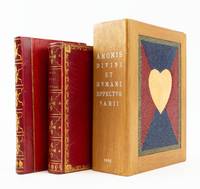
1626réf. ST19298Antwerp: M. Snyders 1626. FIRST EDITION. 135 x 82 mm. 5 1/4 x 3 1/4". 39 of 40 leaves lacking C4. Two volumes one as issued the other a companion volume containing related plates without any title page. Very pretty late 18th or early 19th century red morocco covers bordered by delicate cresting roll with leaf cornerpieces smooth spine gilt in compartments with leafy centerpieces gilt lettering turn-in with gilt floral roll pale blue watered silk endleaves all edges gilt. Supplemental volume in late 19th century red half morocco over red paper boards similarly tooled spine. Housed together in a custom-made modern wooden box with sliding panel closure a heart mosaic in multi-colored hard-grain leather on its sides. Amoris Divini WITH engraved title page and 38 of 39; lacking plate XXXIV ENGRAVED PLATES 35 OF THEM ON VELLUM ALL DELICATELY COLORED AND HEIGHTENED IN GOLD plates 19 29 30 31 and 36 bound after text pages for plates 31 36 29 30 and 34 respectively; second volume with 45 plates on paper though without any text including many of these same emblems apparently from a later edition of this work ALL DAINTILY HIGHLIGHTED WITH GILT. Front pastedown of first volume with monogram book label in colors and gilt verso of front free endpaper with oval armorial bookplate "Ex Museo Van Der Helle" see below. De Vries "De Nederlandsche Emblemata" 121; Landwehr "Low Countries" 33; Praz p. 254; Brunet I 240 this copy; Delbergue-Cormont "Bibliothèque de M. Van der Helle" Paris 10 Février 1868 lot 69 this copy. Amoris spine very slightly dulled occasional hints of marginal thumbing but A LOVELY COPY clean and fresh internally with rich colors and glistening gold in a well-preserved binding; supplemental plates with faint marginal browning but excellent internally the engravings gently shimmering with gold and the binding with few signs of wear. The main volume here comprises a collection of emblems illustrating concepts of human and divine love; it is made all the more special by being printed on vellum beautifully hand colored and then delicately highlighted with gold. The emblems depict Divine Love as a beardless young man with nimbus who always represents love in its purest form. Human love or worldly love is variously embodied in a winged Cupid sometimes blindfolded who represents erotic love and who is accompanied by symbols of treasure or power that represent worldly desires. Landwehr Praz and De Vries make no mention of a vellum edition but Brunet describes one copy on vellum painted in colors and gold which he says sold at the Duriez auction. That book appeared as lot 3216 in "Catalogue des livres imprimés et manuscrits composant la bibliothèque de feu M. L.-M.-J. Duriez de Lille membre de la Société des Bibliophiles français" Paris J.-S. Merlin 1827 where its binding description matches our copy. Having uncovered no other hand-colored copies on vellum in auction records or in OCLC we think it quite likely that the present volume is in fact the Duriez copy. Louis Duriez 1753-1825 was a Lille lawyer of sufficient skill and cleverness to move without incident from serving as lieutenant provost for his district under King Louis XVI to becoming receiver of the district of Lille after the revolution 1791 and purchasing the estate of an aristocrat which had been seized by the state. He rose to successively more important and remunerative governmental positions and was named Knight of the Royal Order of the Legion of Honor in 1814. In 1820 he was one of the founding members of the Société des Bibliophiles français an elite group limited to 24 scholarly collectors. After his death his collection of more than 5000 carefully chosen works was dispersed at 59 auctions held between 22 January and 1 April 1828 at Maison Silvestre in Paris. A perusal of the lots on offer finds a strong emphasis on fine bindings works on vellum and illustrated books many noting hand coloring. The emblems in the second thinner book here on paper without coloring--but with gold highlighting allow the reader to experience the pleasure to be found in comparing the degrees of decoration and opulence of the two volumes. These illustrations likely come from one of the later printings of this title each of which added new emblems to the original 39 called for in Landwehr and Praz. It is not clear when or by whom this second volume was wedded to the first. After its presumed residence in the Duriez collection our copy of the 1626 edition and perhaps its sidecar volume moved to another distinguished library--that formed by the scholarly and erudite French collector M. Van Der Helle of Lille who amassed a collection particularly rich in illustrated books and works on vellum. In the catalogue for the sale of his library in 1868 Paris auction house Delbergue-Cormont described him as a bibliophile "of the school of Renouard . . . who only liked irreproachable copies." We bought this item without being warned that it is slightly defective but given its distinguished provenance and the many other features it has going for it we did not ask the seller to take it back. M. Snyders unknown books
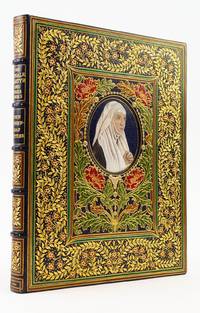
1914réf. ST18714London 1914. 265 x 207 mm. 10 1/2 x 8 1/4". 41 3 blank pp. 1 leaf colophon. RESPLENDENT IN DARK BLUE MOROCCO RICHLY GILT AND ONLAID BY RIVIERE & SON stamp-signed on front doublure covers with wide frame of swirling gilt vines bearing red morocco blossoms and blue and green berries bordered by strips of green and tan morocco central panel of upper cover with recessed oval containing a portrait of a young nun sculpted in leather with painted details this encircled by an onlaid ivory morocco rosary and surrounded by an exuberant spray of red morocco poppies with green and tan leaves central panel of lower cover with an arch-backed black morocco cat beneath the arch of a gray morocco horseshoe at center a black and red witch's hat above the horseshoe and the whole on a very densely stippled gilt ground incised with calligraphic curls and set with nine silver stars around the cat this centerpiece surrounded by curling gilt vines bearing red morocco and gilt posies raised bands spine compartments framed with tan morocco and containing a gilt and onlaid floral sprig TAN MOROCCO DOUBLURES bordered by a strip of purple morocco this with onlaid green morocco frame adorned with gilt latticework densely stippled gilt cornerpieces set with purple morocco passionflowers all accented with inlaid circles of purple navy and green in varying sizes leather hinges apricot watered silk endleaves all edges gilt. In the original silk- and velvet-lined green morocco box. Numerous two- to three-line initials in red blue or burnished gold three three-line illuminated initials 11 five- to six-line initials in shades of purple blue and green with highlights of pink and burnished gold two of these with extensions running the length of the text and two incorporated into full borders four very large initials 12 lines or more in colors and gold five full borders that on title page incorporating a small oval miniature of Whittier and TWO FULL-PAGE MINIATURES one of a young nun at prayer the other of two lovers walking in a forest. Calligraphed colophon SIGNED by Sangorski stating: "This manuscript . . . was designed written out and illuminated by Alberto Sangorski for Messrs. R. Rivière & Son Bookbinders & Booksellers to his Majesty King George V. London. This manuscript will not be duplicated. This manuscript was executed by me." From the collection of Phoebe A. D. Boyle her sale at Anderson Galleries 19-20 November 1923 lot 368. Front flyleaf with engraved bookplate of comic book pioneer M. C. Gaines 1894-1947; typed description from "Kolb Collection" Louis Kolb laid in. Ratcliffe "Albert Sangorski Bibliography" SJR 245. Vellum a bit wavy as is typical but A BEAUTIFUL COPY the leaves creamy and bright being painted with rich colors and glittering gold and IN A FLAWLESS BINDING. This is an outstanding example of the artistry of Alberto Sangorski and that of the binders gilders and finishers of Riviere & Son the volume being executed at the zenith of their creative powers and formerly owned by the most important collector of Sangorski's manuscripts. Sangorski has written out and illuminated three poems by American author John Greenleaf Whittier: "The Female Martyr" inspired by an 18-year-old nun from the Sisters of Charity who died nursing cholera victims; "The Witch's Daughter" set in Puritan New England; and "Memories" a lover's touching reminiscences of youthful romance. In addition to elaborate initials and borders in his preferred palette of blues purples and greens brightened with burnished gold Sangorski has created two full-page paintings one of the beautiful young nun at prayer the other of youthful sweethearts strolling arm-in-arm through a wood. Alberto Sangorski 1862-1932 started his professional life as secretary to a goldsmith's firm became attracted to the book arts at the age of 43 and began doing illuminated manuscripts that were then bound by his brother Francis' firm Sangorski & Sutcliffe. Sometime around 1910 Alberto and Francis had a falling out and the artist went to work for Riviere the chief competitor to his brother's firm. Like the manuscript here our binding by Riviere is the work of many months with hundreds of individual inlays onlays and applications of gilt. Robert Riviere began as a bookseller and binder in Bath in 1829 then set up shop as a binder in London in 1840; in 1881 he took his grandson Percival Calkin into partnership at which time the firm became known as Riviere & Son and the bindery continued to do business until 1939. New York collector Phoebe A. D. Boyle was the widow of a canvas manufacturer who had made a fortune providing tents to the U.S. Army in the Civil War. George Sutcliffe described this important client as "rivalling the Medici in her patronage of the production of beautiful books." Stephen Ratcliffe deems the Boyle collection as "unrivalled" for its jewelled bindings and modern illuminated manuscripts; 33 of Alberto Sangorski's creations appeared in her sale at Anderson Galleries in 1923 and during World War I she was one of the only customers for extravagant productions like the present item. Any book from the Boyle collection which was put together with the greatest taste and discrimination is recognized as desirable beyond its intrinsic literary merit. unknown books
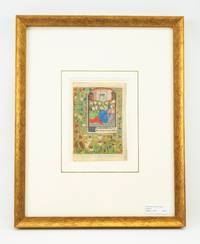
1490réf. ST20853France ca. 1490. 144 x 99 mm. 5 5/8 x 3 3/4". Single column recto with 14 lines in a gothic book hand. Attractively matted and framed. Rubrics in red two two-line initials one painted pink on blue ground with flowers the other painted blue and inhabited by a rampant lion on pink and gold ground recto with a panel border featuring long-stemmed flowers and owls on a pink ground verso WITH A HALF-PAGE ARCH-TOPPED MINIATURE DEPICTING PENTECOST WITH A FULL BORDER featuring a plethora of different flowers berries greenery songbirds an owl and a butterfly all ON A RICHLY PAINTED GOLD GROUND. Trimmed close on one side and just grazing a border on the opposite side very minor chipping to faces trivial signs of rubbing or wear otherwise a fine leaf--colorful bright and very pleasing to the eye. This leaf contains the customary Pentecost miniature associated with the Hours of the Holy Spirit but with several attributes that set it apart from other examples we have encountered. The miniature here depicts a densely crowded scene with the Virgin at the center surrounded by the apostles each of whom wears a burnished gold halo. Packed tightly together they gaze up at a white dove who emanates small red tongues of fire above their heads. According to biblical tradition this visitation by the Holy Ghost in the form of a dove enabled Christ's disciples to start preaching marking the beginning of the Christian Church. The artist favors an unusual pastel palette choosing pale pink for the walls and eggshell blue for some of the floor tiles as well as bright yellow muted lilac rose and lime green for the robes of the apostles. Looking more closely at the figures we see that each face is carefully individualized each with its own features and expressions. Although most crane their necks to get a view of the miracle unfolding one of the apostles looks directly out at the viewer as if surprised by our presence. Moving outside the miniature we note that the leaf features a particularly exuberant border with tangles of flowers fruit acanthus leaves and several birds including an owl in one corner. There is additional interest on the verso with another bright border painted an intense pink and filled with more flowers and owls. unknown books
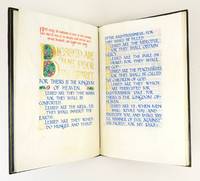
1939réf. ST17129-020Wimbledon Surrey September 1939. 373 x 255 mm. 14 3/4 x 10". 12 vellum leaves seven with text and illuminations. Single column approximately 30 lines in a fine calligraphic hand. Attractive contemporary dark blue crushed morocco covers with gilt and blind rules raised bands with gilt rules gilt-ruled turn-ins vellum pastedowns. Text in blue black green and red a few lines with larger lettering in gilt several two-line initials in colored ink five two-line initials in red or blue with floral decorations opening pages with eight two-line initials in gold the lines here of a larger size than rest of text six three-line initials in gold filled and surrounded by floral decoration three four- to six-line gilt initials with more intricate floral decorations one of these with gilt stippling and two surrounded by a gilt frame and ONE VERY LARGE 80 x 45 mm GILT "B" decorated with stippling filled with two-tone green leaves pink flowers and large gold bezants. First leaf with ink inscription "Presented by Dr. W J Pearson / in appreciation of the work of / Ashridge Hospital 1939-1946"; two silk guards. Boards with a hint of soiling but A BEAUTIFUL MANUSCRIPT IN OUTSTANDING CONDITION the paint lovely and bright and the gold sparkling. This beautifully executed manuscript by a notable female calligrapher and illuminator features the oft-quoted and much-loved biblical text known as the "Sermon on the Mount" in which Matthew relates various moral teachings attributed to Christ. The text is written in an extremely pleasing and regular upright script throughout but the first opening listing the nine Beatitudes in capital letters is especially striking. Opening with the largest and most attractive initial in the manuscript it begins with "Blessed are the poor in spirit" in prominent gilt lettering; this is followed by the other blessings each beginning with a smaller gilt "B" initial written entirely in blue capital letters. The rest of the text penned primarily in black ink but accented with cheerful gilt initials and occasional colored lettering exudes a sense of order and simple elegance befitting the contents. Illuminator and calligrapher Violet Wilson was born in Wimbledon in 1902. She studied calligraphy under Claire G. M. Evans who had been a pupil of Graily Hewitt known for his work with the Ashendene Press and one of the principal British calligraphers and teachers of lettering in the first half of the 20th century. Wilson became a member of the Society of Scribes and Illuminators in the U.K. in the 1930s. The San Francisco Public Library has examples of her work in its Harrison Collection of Calligraphy and another illuminated copy of the "Sermon on the Mount" made in 1957 was included in the Baltimore Art Museum's 1965 exhibition and catalogue titled "Two Thousand Years of Calligraphy." The catalogue entry no. 213 notes that Wilson preferred to work on books and decorative maps and exhibited her work in many countries. According to the presentation inscription in the present work this manuscript was given to Ashridge Hospital--formerly a monastery and royal residence--by the distinguished physician Dr. Wilfred John Pearson 1884-1957 who had headed one of the London sectors of the Emergency Medical Service during World War II. His obituary in the "British Medical Journal" declared him "one of the striking figures of his time.". unknown books