1 531 résultats
1967réf. 010322paris Editions Surréalistes 1967 In-8 oblong Broché, couv. rempliée Ed. originale Signé par l'auteur et l'illustrateur
1967réf. 013469paris Editions Surréalistes 1967 In-8 oblong Broché, couv. rempliée Ed. originale Signé par l'auteur et l'illustrateur
1967réf. 014157paris Editions Surréalistes 1967 In-8 oblong Broché, couv. rempliée Ed. originale Signé par l'auteur et l'illustrateur
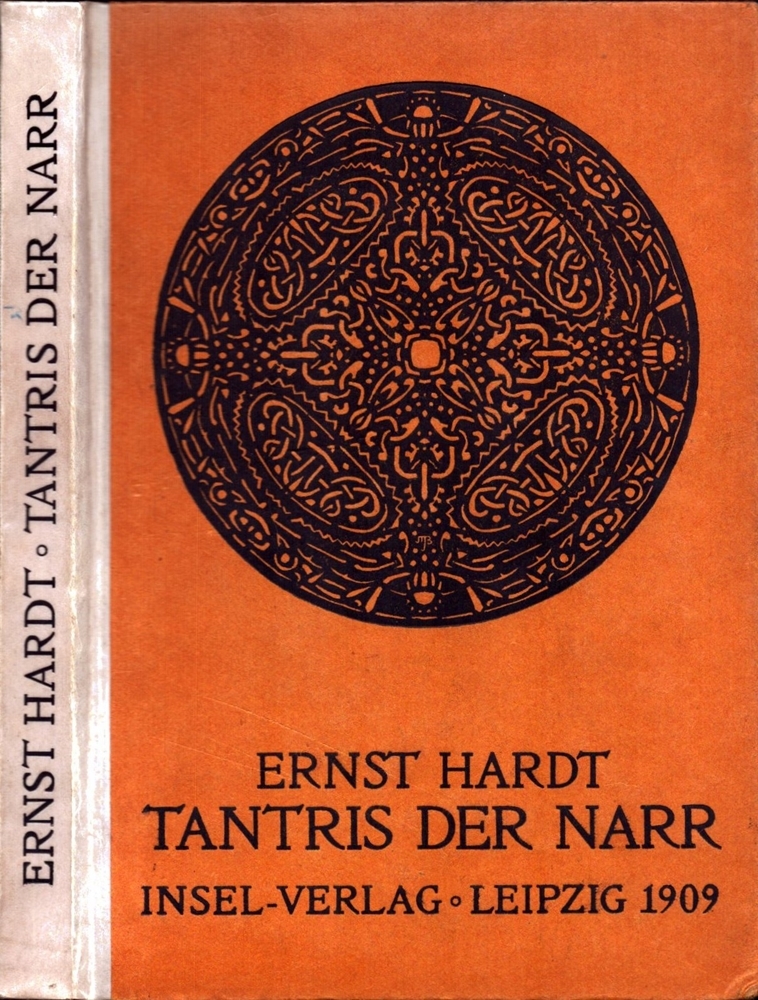
1909réf. 97708Leipzig, Insel-Verlag, 1909. 134 S. 20,5 cm. OHPgt. mit ornamentalem Deckelschmuck.
1971réf. 011201Paris Edition J. Goutal-Darly 1971 In-2 En feuilles, couverture à rabats, emboitage toilé éditeur
1964réf. 013728Paris Rare 1964 In-2 En feuilles, couverture Ed. originale
réf. 1187Paris, Fernand Sorlot, 1937 14 x 19, 217 pp., broché, bon état
réf. 665- broché - Editions Comp'Act - Collection Morari, dirigée par Henri Poncet - Edition originale - Septembre 1993 - In-8 (21,5 x 10,5 cm) brochage par agrafes, sous jaquette, dans le cartonnage de l'éditeur - 25 pages - ISBN : 2-87661-077-9 - L'autrice est nommée Malika B. Durif dans cet ouvrage - Exemplaire tiré sur chiffon Yearling
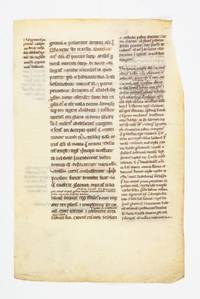
réf. ST17586Abbey of St. Oyan at St.-Claude du Jura France ca. 1175. 245 x 158 mm. 9 3/4 x 6 1/4". Single column of text with two columns of gloss text column with 26 lines in a fine proto-gothic book hand. Verso with scant remnants of mounting tape in a couple of places along one edge. See Gwara Handlist no. 77. ◆Upper margin of fore edge unevenly trimmed away but no text lost a dozen-and-a-half small round wormholes touching just a couple letters light soiling to edges and other minor imperfections but still IN FINE CONDITION the vellum very clean and the ink dark and legible. The most important innovation in biblical scholarship during the 12th century was the development of the "Glossa Ordinaria" to the Bible. Drawing on the whole earlier tradition of biblical exegesis but especially that of Latin patristic writers like Augustine and Jerome scholars working in the French cathedral schools of Laon and Paris systematized this material in an apparatus of marginal and interlinear glosses arranged around the relevant biblical passages. The present leaf showing a particularly beautiful and regular script is a lovely example of one such work. The biblical text appearing in the center column is differentiated by larger lettering and gloss appears interlineally and in a column on either side of the main text all in smaller lettering by the same hand. Scott Gwara notes that the parent manuscript was formerly in the Medieval library of St. Oyan at St.-Claude du Jura a Benedictine monastery founded as the Abbey of Condat around 425 and later known as St. Oyen after an obscure saint who served as Condat's fourth abbot. In the 13th century it was renamed St.-Claude. By the 20th century the manuscript was in the collection of William L. Clements d. 1934 the bulk of which was sold by his estate between 1934-37. The manuscript was then acquired and dismembered by biblioclast Otto Ege around 1939. Gwara notes that the manuscript was incomplete by the time it reached Ege containing only 80 leaves but was "otherwise in excellent condition." The present leaf certainly attests to this assertion being extremely clean bright and with comfortable margins. unknown
réf. ST17586Abbey of St. Oyan at St.-Claude du Jura France ca. 1175. 245 x 158 mm. 9 3/4 x 6 1/4". Single column of text with two columns of gloss text column with 26 lines in a fine proto-gothic book hand. Verso with scant remnants of mounting tape in a couple of places along one edge. See Gwara Handlist no. 77. ◆Upper margin of fore edge unevenly trimmed away but no text lost a dozen-and-a-half small round wormholes touching just a couple letters light soiling to edges and other minor imperfections but still IN FINE CONDITION the vellum very clean and the ink dark and legible. The most important innovation in biblical scholarship during the 12th century was the development of the "Glossa Ordinaria" to the Bible. Drawing on the whole earlier tradition of biblical exegesis but especially that of Latin patristic writers like Augustine and Jerome scholars working in the French cathedral schools of Laon and Paris systematized this material in an apparatus of marginal and interlinear glosses arranged around the relevant biblical passages. The present leaf showing a particularly beautiful and regular script is a lovely example of one such work. The biblical text appearing in the center column is differentiated by larger lettering and gloss appears interlineally and in a column on either side of the main text all in smaller lettering by the same hand. Scott Gwara notes that the parent manuscript was formerly in the Medieval library of St. Oyan at St.-Claude du Jura a Benedictine monastery founded as the Abbey of Condat around 425 and later known as St. Oyen after an obscure saint who served as Condat's fourth abbot. In the 13th century it was renamed St.-Claude. By the 20th century the manuscript was in the collection of William L. Clements d. 1934 the bulk of which was sold by his estate between 1934-37. The manuscript was then acquired and dismembered by biblioclast Otto Ege around 1939. Gwara notes that the manuscript was incomplete by the time it reached Ege containing only 80 leaves but was "otherwise in excellent condition." The present leaf certainly attests to this assertion being extremely clean bright and with comfortable margins. unknown books
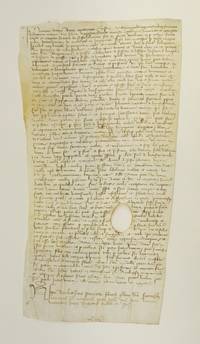
1429réf. ST12778-0360Italy 1429. 323 x 173 mm. 12 3/4 x 6 3/4". Single column 60 lines in a neat cursive script. Notarial signature at lower left; verso with a date and notations in contemporary hands. ◆Vellum trimmed a little close four horizontal and three vertical fold creases slight darkening to verso five very small holes no text obscured and one larger naturally-occurring hole in the text otherwise in excellent condition with a very clear hand. This is a notarized document recording an agreement made between the chapel and convent i.e. the whole community of the house of St. John a group of female religious located in the parish of St. Peter and the brothers of Bonsignioribus another religious house in the parish of St. Laurence Major. The women of St. John agree to pay to the brothers of Bonsignioribus a sum of 11 libras 8 soldas and 9 denarios. The reason for this payment is unclear pending further investigation into some of the more abbreviated portions of the text. The document is of additional interest for the fact that several female members of the house of St. John are mentioned by name. Based on these names and that of the notary Ambrosius Spanzota . . . Parmensis it would appear that the document was written in Italy possibly in Parma and that the two houses were also located there. unknown
1429réf. ST12778-0360Italy 1429. 323 x 173 mm. 12 3/4 x 6 3/4". Single column 60 lines in a neat cursive script. Notarial signature at lower left; verso with a date and notations in contemporary hands. ◆Vellum trimmed a little close four horizontal and three vertical fold creases slight darkening to verso five very small holes no text obscured and one larger naturally-occurring hole in the text otherwise in excellent condition with a very clear hand. This is a notarized document recording an agreement made between the chapel and convent i.e. the whole community of the house of St. John a group of female religious located in the parish of St. Peter and the brothers of Bonsignioribus another religious house in the parish of St. Laurence Major. The women of St. John agree to pay to the brothers of Bonsignioribus a sum of 11 libras 8 soldas and 9 denarios. The reason for this payment is unclear pending further investigation into some of the more abbreviated portions of the text. The document is of additional interest for the fact that several female members of the house of St. John are mentioned by name. Based on these names and that of the notary Ambrosius Spanzota . . . Parmensis it would appear that the document was written in Italy possibly in Parma and that the two houses were also located there. unknown books
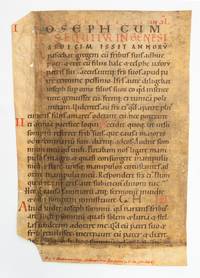
réf. ST20617dAustria Salzburg second half of 12th century. 321 x 218 mm. 12 5/8 x 8 5/8". Single column 27 lines in a lovely proto-gothic hand top two lines in red or black uncials. Rubrics and numbers in red two one-line initials in red with A LARGE 115 mm. IMAGE OF JOSEPH WEARING HIS COAT OF MANY COLORS the body outlined in brown ink and the coat outlined in red. Lower margin of recto with a 20th century note in red ink see below. Recovered from a binding and thus with overall darkening on the recto and with nothing readable on the verso bottom line of text a bit damaged because of crease through it a few small holes two corners trimmed one or two letters of final line of text lost but more than half of the Joseph figure including the face still visible and the text on the recto entirely legible. Containing a beautiful proto-gothic script and a rare figurative Romanesque initial this leaf is a particularly desirable example of early Austrian manuscript production. The text here is as neatly noted in German at the tail edge of the recto Genesis 37:2-10 the beginning of the story of Joseph the 17-year-old son of Jacob here called Israel and his second wife Rachel. In the well-known biblical account Joseph is his father's favorite of 12 sons and the patriarch gives him a beautiful coat of many colors making his brothers jealous. Joseph here intensifies their dislike of him by recounting to his brothers two of his dreams in which sheaves of grain and then various celestial bodies bowed down to him. Dream or reality the images did not sit well with the brothers who sold Joseph into slavery. Although once the leaf was reused as binding material we can nevertheless make out an historiated "I" in the form of Joseph as a young man including an outline of his multi-colored coat. It is difficult to say with certainty whether the initial would originally have been washed with color or composed solely as a line drawing but whatever the case we are lucky to have so much of it intact. With his long flowing hair semi-nude body and hand placed delicately on his hip Joseph is depicted in quite a seductive manner and the simple line-drawing further emphasizes the body's curves and lithe appearance. Romanesque initials with historiation are not nearly as common as decorative ones and the present depiction is especially unusual. While illustrations of Joseph do appear in other manuscripts of this period they tend to focus on specific events from the biblical narrative--particularly those that lend themselves to the tradition of Joseph as a prefiguration of Christ such as Joseph being thrown into the pit or revealing his identity to his brothers. The present example by contrast is all about the presentation of the figure. This leaf almost certainly belonged to a Lectionary owned by a Romanesque church in Salzburg a manuscript that was later dismembered for use in bookbinding. According to the source from which we purchased this leaf it was shown in 1893 to the Medieval historian and later the Abbot of St. Peter's Salzburg Willibald Hauthaler 1843-1922 who wrote the identification in red ink along the lower edge. It was later owned by the Salzburg-based merchant artist and collector Carl von Frey 1826-96. It appeared at Christie's in 2010 where along with five sister leaves it sold for £13970. unknown
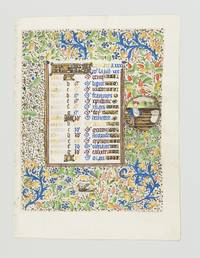
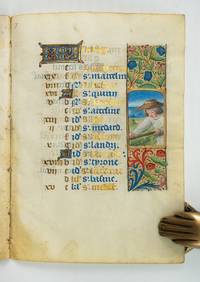
1460réf. ST12835Paris ca. 1460. 195 x 143 mm. 7 3/4 x 5 1/2". Single column 16 lines in a gothic book hand. Minor feast days in red and blue major feasts in gold numerous gold and painted line fillers the five "A" initials and the "KL" highly decorative and painted pink and blue against a gold background gold and pink bar surrounding the text on three sides BOTH SIDES OF THE LEAF WITH EXTRAVAGANTLY DECORATIVE BOTANICAL FULL BORDERS with two small birds hidden within and INCORPORATING TWO MEDALLION MINIATURES DEPICTING THE LABOR OF THE MONTH SOWING AND THE SIGN OF THE ZODIAC SCORPIO FOR OCTOBER. ◆IN VERY FINE FRESH CONDITION with gold and paint extraordinarily bright. The extraordinarily lavish and animated full borders coupled here with extensive use of brushed and burnished gold--for major feast days for decorative border elements and even for the hundreds of seeds being sown!--suggests that this calendar folio comes from a Book of Hours that was commissioned for a person or persons of high rank since it would have been very costly. The leaf comes from a manuscript that included numerous roundels depicting the lives of St. Catherine and the more obscure St. Alexius and it is possible that the Book of Hours belonged to a husband and wife for whom these saints served as patrons. The style of the delicately painted figures especially in the roundels indicates an artist who was familiar with the early output of the Coëtivy Master who according to Avril and Renaud can be identified with Colin d'Amiens who made a great name for himself in Paris not as was previously thought with Henri de Vulcop who made a great name for himself in the Loire region. The master takes his name from the Book of Hours now in the Austrian national library that he painted for Olivier de Coëtivy and his wife Marie de Valois one of some 30 works that have been identified as his. Although there is considerable Flemish influence that can be seen in his work he has links for example with Simon Marmion Colin d'Amiens was active in Paris during the third quarter of the 15th century and with Barthélmy van Eyck and Jean Fouquet was among the three great artists of this period patronized by the French court--Avril and Renaud says flatly that our master was "the most important artist practising in Paris in the third quarter of the century from about 1450 to 1485." For more on the Coëtivy Master see Avril and Reynaud pp. 58-69. unknown
1460réf. ST12835Paris ca. 1460. 195 x 143 mm. 7 3/4 x 5 1/2". Single column 16 lines in a gothic book hand. Minor feast days in red and blue major feasts in gold numerous gold and painted line fillers the five "A" initials and the "KL" highly decorative and painted pink and blue against a gold background gold and pink bar surrounding the text on three sides BOTH SIDES OF THE LEAF WITH EXTRAVAGANTLY DECORATIVE BOTANICAL FULL BORDERS with two small birds hidden within and INCORPORATING TWO MEDALLION MINIATURES DEPICTING THE LABOR OF THE MONTH SOWING AND THE SIGN OF THE ZODIAC SCORPIO FOR OCTOBER. ◆IN VERY FINE FRESH CONDITION with gold and paint extraordinarily bright. The extraordinarily lavish and animated full borders coupled here with extensive use of brushed and burnished gold--for major feast days for decorative border elements and even for the hundreds of seeds being sown!--suggests that this calendar folio comes from a Book of Hours that was commissioned for a person or persons of high rank since it would have been very costly. The leaf comes from a manuscript that included numerous roundels depicting the lives of St. Catherine and the more obscure St. Alexius and it is possible that the Book of Hours belonged to a husband and wife for whom these saints served as patrons. The style of the delicately painted figures especially in the roundels indicates an artist who was familiar with the early output of the Coëtivy Master who according to Avril and Renaud can be identified with Colin d'Amiens who made a great name for himself in Paris not as was previously thought with Henri de Vulcop who made a great name for himself in the Loire region. The master takes his name from the Book of Hours now in the Austrian national library that he painted for Olivier de Coëtivy and his wife Marie de Valois one of some 30 works that have been identified as his. Although there is considerable Flemish influence that can be seen in his work he has links for example with Simon Marmion Colin d'Amiens was active in Paris during the third quarter of the 15th century and with Barthélmy van Eyck and Jean Fouquet was among the three great artists of this period patronized by the French court--Avril and Renaud says flatly that our master was "the most important artist practising in Paris in the third quarter of the century from about 1450 to 1485." For more on the Coëtivy Master see Avril and Reynaud pp. 58-69. unknown books
réf. ST20617dAustria Salzburg second half of 12th century. 321 x 218 mm. 12 5/8 x 8 5/8". Single column 27 lines in a lovely proto-gothic hand top two lines in red or black uncials. Rubrics and numbers in red two one-line initials in red with A LARGE 115 mm. IMAGE OF JOSEPH WEARING HIS COAT OF MANY COLORS the body outlined in brown ink and the coat outlined in red. Lower margin of recto with a 20th century note in red ink see below. Recovered from a binding and thus with overall darkening on the recto and with nothing readable on the verso bottom line of text a bit damaged because of crease through it a few small holes two corners trimmed one or two letters of final line of text lost but more than half of the Joseph figure including the face still visible and the text on the recto entirely legible. Containing a beautiful proto-gothic script and a rare figurative Romanesque initial this leaf is a particularly desirable example of early Austrian manuscript production. The text here is as neatly noted in German at the tail edge of the recto Genesis 37:2-10 the beginning of the story of Joseph the 17-year-old son of Jacob here called Israel and his second wife Rachel. In the well-known biblical account Joseph is his father's favorite of 12 sons and the patriarch gives him a beautiful coat of many colors making his brothers jealous. Joseph here intensifies their dislike of him by recounting to his brothers two of his dreams in which sheaves of grain and then various celestial bodies bowed down to him. Dream or reality the images did not sit well with the brothers who sold Joseph into slavery. Although once the leaf was reused as binding material we can nevertheless make out an historiated "I" in the form of Joseph as a young man including an outline of his multi-colored coat. It is difficult to say with certainty whether the initial would originally have been washed with color or composed solely as a line drawing but whatever the case we are lucky to have so much of it intact. With his long flowing hair semi-nude body and hand placed delicately on his hip Joseph is depicted in quite a seductive manner and the simple line-drawing further emphasizes the body's curves and lithe appearance. Romanesque initials with historiation are not nearly as common as decorative ones and the present depiction is especially unusual. While illustrations of Joseph do appear in other manuscripts of this period they tend to focus on specific events from the biblical narrative--particularly those that lend themselves to the tradition of Joseph as a prefiguration of Christ such as Joseph being thrown into the pit or revealing his identity to his brothers. The present example by contrast is all about the presentation of the figure. This leaf almost certainly belonged to a Lectionary owned by a Romanesque church in Salzburg a manuscript that was later dismembered for use in bookbinding. According to the source from which we purchased this leaf it was shown in 1893 to the Medieval historian and later the Abbot of St. Peter's Salzburg Willibald Hauthaler 1843-1922 who wrote the identification in red ink along the lower edge. It was later owned by the Salzburg-based merchant artist and collector Carl von Frey 1826-96. It appeared at Christie's in 2010 where along with five sister leaves it sold for £13970. unknown books
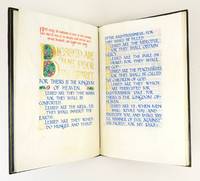
1939réf. ST17129-020Wimbledon Surrey September 1939. 373 x 255 mm. 14 3/4 x 10". 12 vellum leaves seven with text and illuminations. Single column approximately 30 lines in a fine calligraphic hand. Attractive contemporary dark blue crushed morocco covers with gilt and blind rules raised bands with gilt rules gilt-ruled turn-ins vellum pastedowns. Text in blue black green and red a few lines with larger lettering in gilt several two-line initials in colored ink five two-line initials in red or blue with floral decorations opening pages with eight two-line initials in gold the lines here of a larger size than rest of text six three-line initials in gold filled and surrounded by floral decoration three four- to six-line gilt initials with more intricate floral decorations one of these with gilt stippling and two surrounded by a gilt frame and ONE VERY LARGE 80 x 45 mm GILT "B" decorated with stippling filled with two-tone green leaves pink flowers and large gold bezants. First leaf with ink inscription "Presented by Dr. W J Pearson / in appreciation of the work of / Ashridge Hospital 1939-1946"; two silk guards. Boards with a hint of soiling but A BEAUTIFUL MANUSCRIPT IN OUTSTANDING CONDITION the paint lovely and bright and the gold sparkling. This beautifully executed manuscript by a notable female calligrapher and illuminator features the oft-quoted and much-loved biblical text known as the "Sermon on the Mount" in which Matthew relates various moral teachings attributed to Christ. The text is written in an extremely pleasing and regular upright script throughout but the first opening listing the nine Beatitudes in capital letters is especially striking. Opening with the largest and most attractive initial in the manuscript it begins with "Blessed are the poor in spirit" in prominent gilt lettering; this is followed by the other blessings each beginning with a smaller gilt "B" initial written entirely in blue capital letters. The rest of the text penned primarily in black ink but accented with cheerful gilt initials and occasional colored lettering exudes a sense of order and simple elegance befitting the contents. Illuminator and calligrapher Violet Wilson was born in Wimbledon in 1902. She studied calligraphy under Claire G. M. Evans who had been a pupil of Graily Hewitt known for his work with the Ashendene Press and one of the principal British calligraphers and teachers of lettering in the first half of the 20th century. Wilson became a member of the Society of Scribes and Illuminators in the U.K. in the 1930s. The San Francisco Public Library has examples of her work in its Harrison Collection of Calligraphy and another illuminated copy of the "Sermon on the Mount" made in 1957 was included in the Baltimore Art Museum's 1965 exhibition and catalogue titled "Two Thousand Years of Calligraphy." The catalogue entry no. 213 notes that Wilson preferred to work on books and decorative maps and exhibited her work in many countries. According to the presentation inscription in the present work this manuscript was given to Ashridge Hospital--formerly a monastery and royal residence--by the distinguished physician Dr. Wilfred John Pearson 1884-1957 who had headed one of the London sectors of the Emergency Medical Service during World War II. His obituary in the "British Medical Journal" declared him "one of the striking figures of his time.". unknown
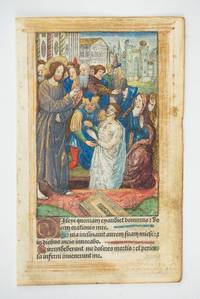
1520réf. ST12778-0887cParis: Gilles Hardouyn ca. 1520. 177 x 110 mm. 7 x 4 1/4". Single column 33 lines in an attractive gothic type. With hand-illuminated initials and a FULL-PAGE MINIATURE DEPICTING THE RAISING OF LAZARUS ILLUMINATED IN COLORS AND GOLD BY A CONTEMPORARY HAND. See Hilary Maddocks "A Book of Hours by Anthoine Vérard" University of Melbourne Collections issue 16 2015 pp. 19-20. One quarter-inch repair to the center of the leaf which on the recto slightly affects Lazarus' neck and on the verso affects three letters which have been neatly touched up a handful of small chips to the paint the architectural border somewhat rubbed in the lower right corner mild soiling to the margins; not without flaws but a richly and carefully colored leaf that is still pleasing. Richly painted and amply highlighted with brushed gold this leaf from a printed Book of Hours includes a large miniature depicting the raising of Lazarus. Christ stands arm extended in benediction over the newly reawakened Lazarus who gazes up at him standing upright in his grave. A crowd looks on with a well-dressed man crouched in front of the grave apparently having helped Lazarus to stand. Our illuminator has enhanced the drama of the moment with the rosy cheeks of the bystanders emphasizing Lazarus' deathly pallor and with Jesus' shimmering robe distinguishing him from the crowd. The faces and folds of cloth are delicately shaded and the minutely detailed lines of gold carefully applied stylistically tying this printed leaf to the fully hand-painted Books of Hours that printed versions were slowly replacing during the early years of the 16th century. The composition seems to come from a suite of illustrations designed by illuminator Jean Pichore fl. 1490-1521 done for the printer Gilles also Gillet Hardouyn. Gilles Hardouyn (?) unknown
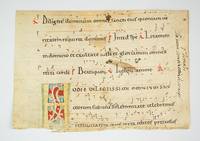
réf. ST20978Italy probably Tuscany first half of 12th century. Each half approximately 134 x 198 mm. 5 1/4 x 8 3/4". Single column 13 lines of text with neumes in a rounded proto-gothic hand. Rubrics and clef line in red two one-line initials in red A THREE-LINE ROMANESQUE WHITE-VINE INITIAL measuring 50 mm. tall in a pale yellow wash enclosing scrolling white-vines on a ground of green blue and red. Each half with a long closed tear one marginal the other touching text the part with the initial trimmed at top apparently cutting off all or part of a line lower end of initial a little faded and slightly trimmed the recto of the lower half rather faded but text discernible with close observation several small stains a small hole and other minor problems associated with being used as binding material; nevertheless in presentable condition with a once lovely and still pleasing initial. The refined Romanesque white-vine initial here opens the responsory "Hodie dilectissimi omnium" "Today the most beloved of all" for the feast of All Saints. Composed of light color washes paired with a vibrant red and featuring vines with acanthus-like curls the initial is simple but very elegant. The leaf probably comes from an antiphonary or similar manuscript containing the music to be sung for Mass with neumes organized around a single stave above each line of text. Unlike earlier notation which functioned as more of an aide-mémoire for singers who had already memorized the melody the notation here actually allows the singer to "read" the music: diastematic neumes show changes in melodic direction and the stave here labeled either "A" "C" or "F" clef for further clarity indicates the relative pitch of each note. The upper half of a leaf from the same parent manuscript was sold at Van de Wiele Auctions on 9 March 2024 lot 867 and was attributed to Tuscany based on the style its decoration which like our initial included distinctive acanthus sprays as well as muted washes of yellow green and blue. unknown
1500réf. ST20810SParis ca. 1500. 163 x 115 mm. 6 1/2 x 4 1/2". 12 leaves. Single column 18 lines in a gothic book hand. Feast days in alternating blue and burnished gold script two-line "KL" initials painted blue with white tracery and embellished with orange and blue ivy on a burnished gold ground each with a spray of gilt leaves and painted flowers one-line "A" initials in burnished gold over a pink and blue ground each page with a panel border of colorful flowers berries and acanthus over a painted gold ground with 24 SMALL MINIATURES depicting the labor of the month on rectos and zodiacal signs on versos. Some moderate smudging and soiling in bottom and fore margins January and February with tiny wormhole in head margin the miniature for January conceivably improved by a later hand but all in all a very lovely Calendar the high-quality paintings very well preserved and the whole with vibrant colors and brightly gleaming gold. Vibrantly illustrated and shimmering with gold this is an excellent example of a complete Calendar that would have appeared at the beginning of a luxuriously appointed Book of Hours. Each month is illustrated with the labor or occupation appropriate for the moment. These are in turn: warming by the fire feasting pruning picking flowers courting threshing hay harvesting wheat baking bread treading grapes sowing feeding hogs and slaughtering a hog. Our artist chose to compose these scenes more as portraits than depictions of actual tasks framing the image around each figure's face and sometimes only including small details that might indicate their occupation. In the month of June for example which depicts threshing hay we see only a sliver of the farmer's sickle and nothing at all of the hay. Instead the farmer himself is the primary focus here: and he is particularly well-executed with gentle shading on his downcast features careful brushstrokes highlighting the gleam of his hair and brushed gold suggesting the sun beating down on a bright June day. In addition to the labor or occupation of the month on the recto the 12 signs of the zodiac are depicted on the verso of each leaf these executed with equal charm and care. In cheerful bright colors our artist has depicted Leo's preening pose and glimmering mane the drama of Sagittarius' drawn bow and the cherubic plumpness of Aquarius molded in bluish shadows. In addition to the aesthetic achievements of its various parts the whole is desirable as a so-called composite Calendar with the name of a saint or special celebration occupying every day of the year. The origin of the composite Calendar is uncertain but the general opinion is that it was formalized in the early 14th century. The Parisian Hours of Jeanne d'Evreaux copied in ca. 1330 has been put forth as an early example. In any case the Calendar was subject to numerous changes in the course of time as various saints were canonized and supplanted those who while still recognized as saintly were deemed to be less favored residents for a particular calendar date. The saints' days on this Calendar are fairly typical for the Use of Paris and given the high-quality illumination liberal use of gold and robust borders it is likely that the parent manuscript was produced by an accomplished atelier in that city. Although single Calendar leaves regularly come on the market complete Calendars--particularly ones with extensive visual programs as here--are much more difficult to acquire. unknown
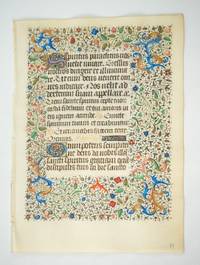
1430réf. ST20979bParis ca. 1430. 191 x 140 mm. 7 1/2 x 5 1/2". Single column 16 lines in an elegant gothic book hand. Rubrics in gold line-fillers with color foliate and geometric designs on burnished gold ground three two-line initials in blue or pink enclosing colored vines with foliage on gold ground BOTH SIDES WITH A DENSE RINCEAUX BORDER consisting of colorful acanthus flowers and many hairline vines terminating in gold leaves ivy and seed pods and with numerous gilt bezants. IN BRILLIANT CONDITION. This is an extraordinarily fine and opulently decorated leaf from a Book of Hours with glittering rinceaux borders delicate initials and luxurious gold rubrics. These sumptuous details and the high quality of the work indicate that this leaf was part of a costly manuscript commissioned by a wealthy patron. Other leaves from the same parent manuscript were sold at Bloomsbury on 6 December 2017 lots 63 and 64. One of those leaves showed St. Genèvieve leading the female saints in the Litany pointing to Paris as the place of origin. unknown
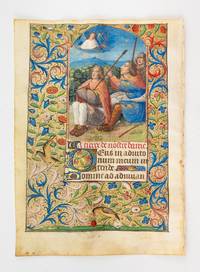
1500réf. ST20810PParis ca. 1500. 165 x 117 mm. 6 1/2 x 4 5/8". Single column 18 lines in a gothic book hand. Rubrics in red line fillers in blue and pink with gold bezant five one-line initials in burnished gold on pink and blue ground one two-line initial in blue on gold ground with a flower in the center one three-line initial in blue filled with ivy on gold ground recto with panel border of colorful flowers vase and acanthus verso with A LARGE ARCH-TOPPED MINIATURE OF THE ANNUNCIATION TO THE SHEPHERDS surrounded by A FULL BORDER of acanthus flowers and two birds all on a painted gold ground. Slight soiling to vellum but a very well-preserved leaf in fine condition. From what was surely a costly Book of Hours this leaf features a charming and skillfully painted miniature of the Annunciation to the Shepherds attributable to the workshop of Jean Pichore fl. ca. 1502-20 a major figure among illuminators of the period and one of the most sought-after artists in France at the turn of the 16th century. Depicting the traditional subject associated with the hour of Terce our miniature portrays as usual an angel appearing to shepherds tending their flock bringing news of the birth of Christ. Although the biblical narrative suggests that the shepherds were startled by the angel's appearance the three figures in this miniature appear remarkably unmoved--in fact only one of them seems to take any notice at all. The first shepherd sits on the ground looking straight ahead; the second holds his hands in prayer but looks little more than well prayerful at the angel in the sky; and a third figure maintains a slightly aloof expression taking no particular interest in the unfolding miraculous event. What may seem to be indifference can be explained easily enough by the artist's successful portrayal of nighttime cold! All three shepherds are thickly dressed one with his arms pressed tightly against his chest another with a hood partly covering his face and the sheep are tightly huddled together into one woolly white cluster. Another manifestation of the artist's success here is seen in the particularly well done molding of the faces with subtle shading attractively rendered features and clear individuation. Moreover although the shepherds seem essentially unmoved their garments are dusted with a glistening gold radiance from above a further subtle touch revealing a high level of achievement on the part of the painter. Finally the borders are one last source of delight with a small bird shown in mid-flight and a second one investigating a single strawberry that seems to have been placed there just for him. All of these indications of sophistication suggest that the original manuscript must have been commissioned by a patron able to pay a premium for the work of a highly skilled atelier. unknown
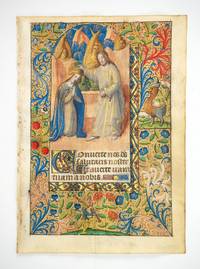
1500réf. ST20810RParis ca. 1500. 163 x 115 mm. 6 1/2 x 4 1/2". Single column 18 lines in a gothic book hand. Rubrics in red line fillers in blue and pink with gold bezant six one-line initials in burnished gold on pink and blue ground two two-line initials in blue on gold ground with a flower in the center one three-line initial in blue filled with ivy on gold ground verso with panel border of colorful flowers and acanthus recto with A LARGE ARCH-TOPPED MINIATURE OF THE CORONATION OF THE VIRGIN with an "L" shaped frame of burnished gold and painted flowers and A FULL BORDER of acanthus flowers a man playing a bagpipe and a hybrid creature wearing a hat all on a painted gold ground. Very minor wrinkling to vellum but the leaf IN LOVELY CONDITION with the gold everywhere gleaming brightly. From a luxuriously appointed Book of Hours this leaf features a handsome miniature of the Coronation of the Virgin attributed to the workshop of Jean Pichore fl. ca. 1502-20 a major figure among illuminators of the period and one of the most sought-after artists in France at the turn of the 16th century. Executed with imagination and delicacy the miniature features the traditional subject associated with the hour of Compline showing the Virgin being crowned Queen of Heaven following her Death and Assumption. The composition here is quite intimate with the Virgin kneeling before her son as she accepts with humility the crown he lays upon her head. Christ is depicted barefoot and slightly bowed toward his mother in a gentle display of respect. The artist creates a wonderful backdrop for this scene composed entirely of seraphim painted gold blue light pink and green closely packed together. Two of the seraphim hold up light pink draperies behind the central figures as if to shield this tender moment from prying eyes. The borders here are a source of delight featuring a figure wearing a jester-like cap and playing the bagpipe as well as a creature with the body of a bird and the face of a human donning a rather fashionable bycocket cap. The illumination here is of high quality features a liberal use of gold and contains unique marginal details suggesting that the original manuscript must have been a costly commission for a wealthy patron. unknown
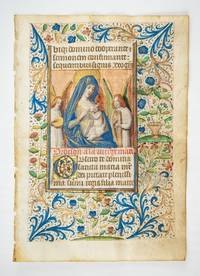
1500réf. ST20810MParis ca. 1500. 165 x 115 mm. 6 1/2 x 4 1/2". Single column verso with 18 lines in a gothic book hand. Rubrics in red one three-line initial in blue filled with foliage on burnished gold ground verso with panel border of colorful flowers a vase and acanthus recto with A MINIATURE OF THE VIRGIN AND CHILD flanked by two angels framed by gold and painted bars on three sides and A FULL BORDER of acanthus flowers a vase and gold bezants. Minor soiling to vellum but in excellent condition the miniature especially well preserved. This especially intimate and tender scene shows the so-called Virgo Lactans or Nursing Madonna the Virgin suckling the infant Christ; it accompanies the text for "Obsecro te" a popular Marian prayer appealing to the Virgin for protection and intercession. The prayer is not always accompanied by a miniature and the present illustration being rather large and skillfully done is a particularly appealing example. The Virgin's facial features are especially excellent with beautiful molding and shading that give her visage deep complexity and emotional resonance. The use of gold in this miniature adds to its richness; delicately highlighted garments tresses and angel wings catch the light and seem to shimmer as one moves the page. The high-quality illumination liberal use of gold and robust borders all suggest that the original manuscript must have been the product of an accomplished workshop. unknown
1430réf. ST20979aParis ca. 1430. 191 x 140 mm. 7 1/2 x 5 1/2". Single column 16 lines in an elegant gothic book hand. Rubrics in gold line-fillers with color foliate and geometric designs on burnished gold ground two one-line initials and three two-line initials in blue or pink enclosing colored vines with foliage on gold ground one four-line initial in blue with white decoration enclosing a lattice pattern each compartment with an orange or blue leaf on gold ground BOTH SIDES WITH A DENSE RINCEAUX BORDER consisting of colorful acanthus flowers and many hairline vines terminating in gold leaves ivy and seed pods and with numerous gilt bezants. With just a couple tiny scuffs to paint and with slight rubbing to some of the small gold details but in lovely condition. This is an opulently decorated leaf from a Book of Hours offered in fine condition with glittering rinceaux borders delicate initials and luxurious gold rubrics. These sumptuous details and the high quality of the work indicate that this leaf was part of a costly manuscript commissioned by a wealthy patron. Other leaves from the same parent manuscript were sold at Bloomsbury on 6 December 2017 lots 63 and 64. One of these leaves showed St. Genèvieve leading the female saints in the Litany pointing to Paris as the place of origin. unknown