AN ILLUMINATED VELLUM MANUSCRIPT LEAF WITH SMALL MINIATURES OF SAINTS FROM A BOOK OF HOURS IN LATINBiblio.com

1 531 résultats
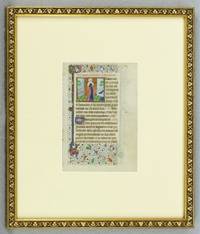
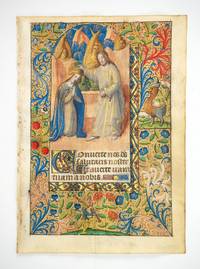
réf. ST12668bHNortheastern France probably Arras late 15th century. 146 x 95 mm. 5 3/4 x 3 3/4". Single column 15 lines in a pleasing bâtarde hand. Rubrics in red one- and two-line initials in brushed gold on a red or blue ground EACH SIDE OF LEAF WITH A BRUSHED GOLD PANEL BORDER WITH VERY PRETTY ILLUSIONISTIC FLOWERS AND FRUITS and intricate strapwork design in colors; WITH TWO SMALL MINIATURES measuring approximately 40 x 25 mm. depicting John the Baptist and John the Evangelist shown with their attributes. Headlines written in French in a later 18th century calligraphic hand. ◆Light soiling a touch of paint loss to frames and background not very noticeable and not affecting the figures otherwise an excellent specimen generally clean and smooth with ample margins winning decoration and shining gold. From a charmingly decorated 15th century prayer book this leaf offers the opportunity to acquire two particularly nice miniatures each depicting an important saint. The recto shows St. John the Baptist with a lamb at his side and a book balanced on his knee; and the verso depicts St. John the Evangelist as a young man holding a chalice with what ought to be snakes emerging from it in reference to the poisoned cup he was invited to drink as a test of faith but which instead look more like tendrils of smoke. For other leaves from this same manuscript please check our website. unknown
1460réf. ST12839Paris ca. 1460. 153 x 110 mm. 6 x 4 3/8". Single column 14 lines of text in a fine gothic book hand. One-line initial in burnished gold on a pink and blue ground with white tracery a two-line initial and a three-line initial in pink with white tracery on a ground of burnished gold the center filled with twining blue vines bearing pink and scarlet flowers verso with a rinceau panel border featuring twining hairline stems bearing burnished gold ivy leaves and fruit blue and gold acanthus leaves and flowers recto WITH AN ARCH-TOPPED MINIATURE OF THE HOLY TRINITY SURROUNDED BY THE HEAVENLY HOST this and the accompanying text enclosed by a pink blue and burnished gold bar border on one side and a brushed gold bar border with pink lotus flowers on two sides the whole surrounded by A FULL RINCEAU BORDER DENSE WITH ACANTHUS LEAVES FOLIAGE FRUIT FLOWERS AND TINY GOLD BERRIES on hairline stems. ◆A little paint flaked from the book held by the Trinity a couple of small spots in the margin otherwise in fine condition--clean and smooth with comfortable margins and bright gold. The Trinity is shown here seated on a canopied throne with God the Son his hand raised in blessing to the left of the Father. The latter in a towering crown holds a gold orb and the Father and Son together support a large book opened between them. The dove of the Holy Spirit hovers above the book radiating golden beams. The Trinity is flanked on both sides by cherubim and seraphim in rich red and soft yellow. It is the rendering of this angelic ambiance that elevates the level of aesthetic achievement here: both red and yellow celestial beings are given a ghostly appearance as if appearing out of a filmy yellow or a densely red fog. The artistic qualities as a whole suggest that this leaf comes from a manuscript commissioned by a person of significant means. unknown
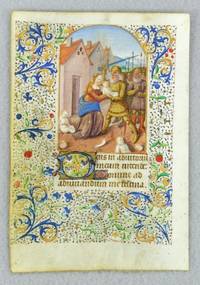
1450réf. ST11774-85Paris ca. 1450. 159 x 108 mm. 6 1/4 x 4 1/4". Single column four lines of text on the verso 15 on the recto in a very pleasing gothic book hand. Attractively matted. Recto with a line filler in colors and gold verso with a one-line initial in burnished gold on a maroon and blue background with white tracery and a three-line "D" in blue and white enclosing a spray of violets in the same colors the capital on a burnished gold ground the same side WITH A FULL SWIRLING BORDER of acanthus leaves flowers and berries and many burnished gold ivy leaves ENCLOSING A BLOODY ILLUMINATED MINIATURE OF THE MASSACRE OF THE INNOCENTS measuring approximately 78 x 54 mm. Fore and lower margins on the side with the miniature a bit rubbed and with a faint patina reflecting frequent use also minor fading and loss of paint and gold in the same place otherwise in fine condition THE MINIATURE itself REMARKABLY WELL PRESERVED WITHOUT ANY EROSION OF PIGMENT. This leaf comes from a Book of Hours decorated by extremely skilled members of what must have been a first-class workshop. The Massacre of the Innocents cannot help but be a moving subject and the composition here as well as the painter's considerable ability add to the emotional impact in the present miniature. The center of the scene is dominated by the gold-armored gray-bearded soldier whose sword is raised over the head of a woman clinging to her son. The blood-spattered foreground is littered with the dismembered bodies of infants looking like so many broken dolls. On the left we see a row of modest cottages providing considerable depth as they recede toward distant hills. On the right stands a crowd of grim-faced soldiers all as elderly as their commander and seemingly following orders that are unwelcomed; it is perhaps the acute sadness in their faces that makes this scene especially memorable. The clear sky green fields and serene blue mountains in the distance contrast markedly with the horrific events unfolding. unknown
1465réf. ST11151bBruges ca. 1465. 181 x 127 mm. 7 1/8 x 5". Single column 19 lines in a careful pleasing gothic book hand. In a very attractive new gilt wooden frame. Rubrics in pink or faded red one two-line initial in blue magenta and burnished gold two lines with undulating line fillers in blue and gold both sides of the leaf with a three-quarter panel border incorporating foliage blossoms and ivy leaves on hairline stems the vertical part of this frame with a bar border composed of colors and burnished gold terminating at top and bottom in colorful acanthus leaves and WITH TWO SMALL BUT VERY PLEASING MINIATURE PAINTINGS SAINT ELIZABETH ON THE RECTO AND SAINT GERTRUDE ON THE VERSO. ◆Tiny wormhole in fore edge where it has done negligible damage small portions of the blue paint in the Elizabeth miniature eroded gray paint slightly smeared as well but apparently at the time of painting otherwise in fine clean fresh condition. This leaf is characteristic work from the circle of Willem Vrelant the leading purveyor of books of private devotion in Bruges during the third quarter of the 15th century. His leading position among Flemish illuminators of the time is indicated by the considerable number of manuscripts illustrated in his manner by other miniaturists both in Bruges and in nearby cities in Flanders. The illuminator of our Book of Hours shows a number of distinctive stylistic traits. Among these are a preference for boldly patterned cloth backdrops tessellated flooring landscapes filled with stylized bushes and trees and persisting prominent architectural constructions that frame the subject frequently in a corner in these leaves it is a waist-high outdoor wall or an indoor feature resembling wainscoting. The inclination for strong geometrical patterning is manifested in the artist's angular treatment of human figures and their garments. Dressed in pink and blue Elizabeth is depicted with a sweet round face. She is saluted here as the woman worthy to be the mother of John the Baptist the forerunner of the Redeemer. Gertrude is dressed in monastic black although a pink undergarment is visible and her inky habit is trimmed in gold. This shimmering feature is a reminder that Gertrude 626-59 was the daughter of Pepin I of Landen Mayor of the Palace for the Frankish realm of Austrasia and the forebear of Charlemagne. Gertrude is a natural choice for illustration by an artist of Bruges since she was the patron of nearby Nivelles. The saint was routinely invoked for aid in coping with mice and is here shown surrounded by four animated rodents as black as her habit. No legend survives to explain why she had such power over the creatures who seem here to be more her pets one climbs her staff of office than her victims. unknown
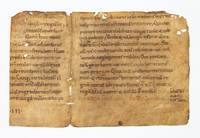
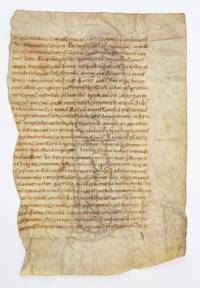
réf. ST18310cGermany ca. 1100. 130 x 204 mm. 5 1/8 x 8". Single column 13 extant lines in a late Caroline hand. Rubrics in red. ◆Recovered from a binding and thus noticeably browned stained and vaguely wavy one side somewhat faded several small holes just two touching any letters other imperfections but still a very presentable specimen the ink especially dark on one side and legible on both. This is an early fragment in a distinctive hand lacking the heaviness of other scripts of the period and with a feeling of the elongated grace of the humanistic. Despite having previously been used as a binding scrap the fragment remains definitely readable partly because of the clarity of the scribal hand. Elected pope in 590 Gregory I ca. 540-604 also known as Gregory the Great was one of the most influential pontiffs in the history of the Church. In addition to revising liturgical worship he wrote extensively on theology offering homespun wisdom rather than esoteric debates. His "Homilies on the Gospels" were intended to be preached to common people rather than a monastic audience and as a consequence were greatly admired for their straightforward language and pastoral relevance. unknown
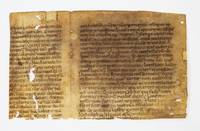
réf. ST18310bGermany ca. 1100. 120 x 200 mm. 4 3/4 x 8". Single column 21 extant lines in a late Caroline hand. ◆Recovered from a binding and thus noticeably browned and stained several small holes costing perhaps 30 letters other imperfections but still a very presentable specimen the ink dark and with loss of legibility in only one small place. This is an early fragment in a distinctive hand lacking the heaviness of other scripts of the period and with a feeling of the elongated grace of the humanistic. Despite having previously been used as a binding scrap the fragment remains extremely legible partly because of the clarity of the scribal hand. Elected pope in 590 Gregory I ca. 540-604 also known as Gregory the Great was one of the most influential pontiffs in the history of the Church. In addition to revising liturgical worship he wrote extensively on theology offering homespun wisdom rather than esoteric debates. His "Homilies on the Gospels" were intended to be preached to common people rather than a monastic audience and as a consequence were greatly admired for their straightforward language and pastoral relevance. unknown
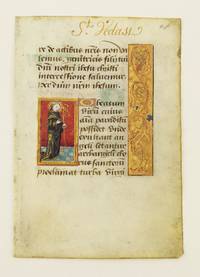
réf. ST12668bKNortheastern France probably Arras late 15th century. 146 x 95 mm. 5 3/4 x 3 3/4". Single column 15 lines in a pleasing bâtarde hand. Rubrics in red one- and two-line initials in brushed gold on a red or blue ground EACH SIDE OF EACH LEAF WITH A BRUSHED GOLD PANEL BORDER WITH VERY PRETTY ILLUSIONISTIC FLOWERS and one panel with acanthus apparently unfinished; EACH LEAF WITH ONE SMALL MINIATURE measuring approximately 40 x 25 mm. DEPICTING SAINTS. Headlines written in French in a later 18th century calligraphic hand. ◆Light soiling otherwise excellent specimens generally clean and smooth with ample margins and attractive decoration. From a charmingly decorated 15th century prayer book these lovely leaves offer the opportunity to acquire a miniature andconsiderable gold ornamentation at an attainable price. One leaf depicts Sts. Peter and Paul in a single frame and the other shows St. Vedast or Waast--a saint that was particularly venerated in France especially in the Arras region whence we be believe these leaves originated. For other leaves from this same manuscript please check our website. unknown
réf. ST12668bJNortheastern France probably Arras late 15th century. 146 x 95 mm. 5 3/4 x 3 3/4". Single column 15 lines in a pleasing bâtarde hand. Rubrics in red one- and two-line initials in brushed gold on a red or blue ground EACH SIDE OF EACH LEAF WITH A BRUSHED GOLD PANEL BORDER WITH VERY PRETTY ILLUSIONISTIC FLOWERS; EACH LEAF WITH TWO SMALL MINIATURES measuring approximately 40 x 25 mm. depicting saints shown with their attributes. Headlines written in French in a later 18th century calligraphic hand. ◆Light soiling rubrics faded otherwise excellent specimens generally clean and smooth with ample margins attractive decoration and shining gold. From a charmingly decorated 15th century prayer book these lovely leaves offer the opportunity to acquire a miniature and considerable gold ornamentation at an attainable price. One leaf depicts St. Andrew holding an "X" shaped cross and St. Etienne i.e. St. Stephen here shown with three stones on his body and the other shows St. Remigius the so-called "Apostle of the Franks" and St. Quentin--a saint that was particularly venerated in France especially in the north whence we be believe these leaves originated. For other leaves from this same manuscript please check our website. unknown
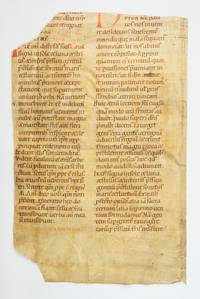
réf. ST19350-006Germany 12th century. 272 x 185 mm. 10 3/4 x 7 1/4". Single column 28 lines in a late Caroline hand. ◆Leaf trimmed irregularly along one side about 18 lines lacking a letter or two vellum a bit wrinkled and worn text a little faded in places but still very presentable and the text almost entirely legible. Penned in a pleasing and very legible late Caroline hand this leaf has sustained very little loss and is remarkably well preserved for having been previously reused as binding scrap. Although the text includes several abbreviations that are commonly found in proto-gothic scripts the hand also shares a number of similarities with the Caroline minuscule that dominated Western Europe scribal hands in earlier periods including a long "s" with the shaft on the line and the use of the ampersand as a general abbreviation for the letters "et" occurring anywhere in a word. The text here comes from Pope Gregory the Great's "Moralia" conceived as a commentary on the book of Job and begun when Gregory was just a young papal envoy to Constantinople. It is a guide to the Christian life written in simple direct language which transforms the thought of Augustine into a practical manual of behavior. unknown
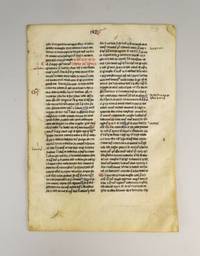
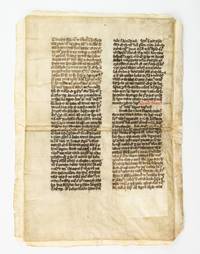
réf. ST13657aFrance second half of the 13th century. Each leaf measures 330 x 240 mm. 13 x 9 3/8". Double column 38 lines of text in a proto-gothic hand. Rubrics in red running title and numerous paragraph marks in red and blue one leaf with one two-line initial in blue with red pen flourishes. Margins with several text corrections one leaf with a catch-word. Faint soiling and a few negligible stains touching text not affecting legibility but overall FINE SPECIMENS with very few flaws. Containing part of a popular treatise on the Vices these well-preserved and attractive large format leaves come from a manuscript that may have been contemporary to the life of the author William Perault ca. 1190-1270. Although the so-called "Seven Deadly Sins" that we still recognize today remained a popular moral paradigm throughout the Middle Ages it was by no means canonical. Authors were free to borrow manipulate and elaborate on the topic at will resulting in a profusion of treatises and competing systems of morality. This work by Perault Latin: Peraldus was a particularly prominent treatise that not only survived the Middle Ages but later went into print in several editions. The "Summa of Vice" expounds upon the Seven with which most of us are familiar--Pride Envy Anger Sloth Greed Gluttony and Lust--but it also includes an eighth sin which Perault called "peccatum linguae" or "the sin of the tongue." The present leaves consider the sin of Pride Superbia the most severe and dangerous of all the vices in Medieval imagery it is often depicted as the root of all other sins with some interesting discussion of garish dress make-up hair coloring and wigs. unknown
réf. ST13657aFrance second half of the 13th century. Each leaf measures 330 x 240 mm. 13 x 9 3/8". Double column 38 lines of text in a proto-gothic hand. Rubrics in red running title and numerous paragraph marks in red and blue one leaf with one two-line initial in blue with red pen flourishes. Margins with several text corrections one leaf with a catch-word. Faint soiling and a few negligible stains touching text not affecting legibility but overall FINE SPECIMENS with very few flaws. Containing part of a popular treatise on the Vices these well-preserved and attractive large format leaves come from a manuscript that may have been contemporary to the life of the author William Perault ca. 1190-1270. Although the so-called "Seven Deadly Sins" that we still recognize today remained a popular moral paradigm throughout the Middle Ages it was by no means canonical. Authors were free to borrow manipulate and elaborate on the topic at will resulting in a profusion of treatises and competing systems of morality. This work by Perault Latin: Peraldus was a particularly prominent treatise that not only survived the Middle Ages but later went into print in several editions. The "Summa of Vice" expounds upon the Seven with which most of us are familiar--Pride Envy Anger Sloth Greed Gluttony and Lust--but it also includes an eighth sin which Perault called "peccatum linguae" or "the sin of the tongue." The present leaves consider the sin of Pride Superbia the most severe and dangerous of all the vices in Medieval imagery it is often depicted as the root of all other sins with some interesting discussion of garish dress make-up hair coloring and wigs. unknown books
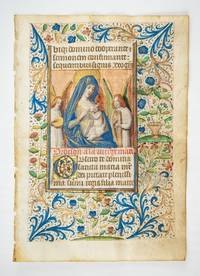
1500réf. ST20810MParis ca. 1500. 165 x 115 mm. 6 1/2 x 4 1/2". Single column verso with 18 lines in a gothic book hand. Rubrics in red one three-line initial in blue filled with foliage on burnished gold ground verso with panel border of colorful flowers a vase and acanthus recto with A MINIATURE OF THE VIRGIN AND CHILD flanked by two angels framed by gold and painted bars on three sides and A FULL BORDER of acanthus flowers a vase and gold bezants. Minor soiling to vellum but in excellent condition the miniature especially well preserved. This especially intimate and tender scene shows the so-called Virgo Lactans or Nursing Madonna the Virgin suckling the infant Christ; it accompanies the text for "Obsecro te" a popular Marian prayer appealing to the Virgin for protection and intercession. The prayer is not always accompanied by a miniature and the present illustration being rather large and skillfully done is a particularly appealing example. The Virgin's facial features are especially excellent with beautiful molding and shading that give her visage deep complexity and emotional resonance. The use of gold in this miniature adds to its richness; delicately highlighted garments tresses and angel wings catch the light and seem to shimmer as one moves the page. The high-quality illumination liberal use of gold and robust borders all suggest that the original manuscript must have been the product of an accomplished workshop. unknown books
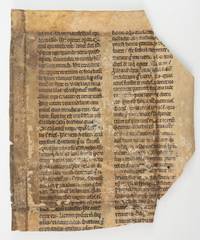
réf. ST20837eFrance mid-13th century. 321 x 230 mm. 12 5/8 x 9". Double column 39 lines in a dense gothic hand. Rubric in red. Recovered from a binding and so the vellum a bit creased and soiled though less soiled than is often seen some tiny remnants of later printed text from reuse but the text almost entirely legible and the leaf surprisingly well preserved overall with its very substantial margins fully intact. Once serving as a cover for a later book this leaf seems to come from an unpublished collection of sermons incorporating biblical excerpts such as Revelation 12:1 "A great sign appeared in heaven: A woman clothed with the sun and the moon under her feet and on her head a crown of twelve stars". The lack of decoration and simple rubrication suggest that the parent manuscript was made for utilitarian purposes at a time when a need for such books increased due in part to the rise of mendicant orders like the Franciscans and Dominicans. Members of these orders rejected traditional monastic isolation and instead settled in urban centers to preach and minister to the people. It is unusual and very lucky that this leaf survives completely intact as Medieval manuscripts used in later bindings were often cut down in size to make smaller covers or used as waste paper for pastedowns or other binding elements. Considerable rewarding research remains to be done to identify the content here along with its various religious and social contexts. unknown books
1460réf. ST12839Paris ca. 1460. 153 x 110 mm. 6 x 4 3/8". Single column 14 lines of text in a fine gothic book hand. One-line initial in burnished gold on a pink and blue ground with white tracery a two-line initial and a three-line initial in pink with white tracery on a ground of burnished gold the center filled with twining blue vines bearing pink and scarlet flowers verso with a rinceau panel border featuring twining hairline stems bearing burnished gold ivy leaves and fruit blue and gold acanthus leaves and flowers recto WITH AN ARCH-TOPPED MINIATURE OF THE HOLY TRINITY SURROUNDED BY THE HEAVENLY HOST this and the accompanying text enclosed by a pink blue and burnished gold bar border on one side and a brushed gold bar border with pink lotus flowers on two sides the whole surrounded by A FULL RINCEAU BORDER DENSE WITH ACANTHUS LEAVES FOLIAGE FRUIT FLOWERS AND TINY GOLD BERRIES on hairline stems. ◆A little paint flaked from the book held by the Trinity a couple of small spots in the margin otherwise in fine condition--clean and smooth with comfortable margins and bright gold. The Trinity is shown here seated on a canopied throne with God the Son his hand raised in blessing to the left of the Father. The latter in a towering crown holds a gold orb and the Father and Son together support a large book opened between them. The dove of the Holy Spirit hovers above the book radiating golden beams. The Trinity is flanked on both sides by cherubim and seraphim in rich red and soft yellow. It is the rendering of this angelic ambiance that elevates the level of aesthetic achievement here: both red and yellow celestial beings are given a ghostly appearance as if appearing out of a filmy yellow or a densely red fog. The artistic qualities as a whole suggest that this leaf comes from a manuscript commissioned by a person of significant means. unknown books
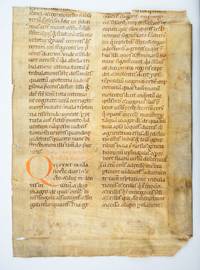
réf. ST20617eAustria Salzburg second half of 12th century. Unevenly trimmed but approximately 362 x 234 mm. 14 1/4 x 9 1/8". Double column 31 extant lines in a lovely proto-gothic hand. Rubrics in red remains of two large multi-line initials in red. Lower margin of recto with modern note in red ink in very small letters identifying the text. Recovered from a binding and thus unevenly trimmed top margin and a small part of text trimmed away at the top a handful of tiny cuts and holes of no significance vellum a little brownish but the leaf rather smooth and the majestic text entirely legible. This lectionary fragment which contains two important patristic sermons for the season of Advent demonstrates a highly regular graceful and majestic proto-gothic book hand. The oval-shaped elongation of Caroline letter forms characteristic of 12th century book hands and the mixture of rustic and uncial capitals our scribe has used for section titles appear particularly pleasing in the lovely uncramped hand at work here. The text on the recto is from St. Augustine's second Advent sermon one of a series of homilies written for the liturgical seasons. The verso contains St. Gregory's homily for the first Sunday of Advent preceded by Luke 21:25-33 a rehearsal of the signs of the end of days. The homily draws on this gospel passage to exhort the faithful to prepare themselves for the second coming. The present leaf almost certainly belonged to a Lectionary owned by a Romanesque church in Salzburg a manuscript that was later dismembered for use in bookbinding. According to the source from which we purchased this leaf it was shown in 1893 to Willibald Hauthaler 1843-1922 the Medieval historian and later the Abbot of St. Peter's Salzburg who wrote the identification along the lower edge. It was later owned by the Salzburg-based merchant artist and collector Carl von Frey 1826-96. It appeared at Christie's in 2010 where along with five sister leaves it sold for £13970. unknown books
réf. ST20617fAustria Salzburg second half of 12th century. Unfolded: 350 x 296 mm. 13 3/4 x 11 3/4 mm. Double column 30 extant lines in a lovely proto-gothic hand. Rubrics in red two four-line initials in red. Recovered from a binding and thus with top margin and a small part of text trimmed away verso rather darkened with soil and glue part of the text readily legible the rest recoverable with effort negligible wormholes and small cuts but still a pleasing leaf with the recto rather clean and quite easy to read. This lectionary fragment which contains extracts from patristic writings for the season of Advent demonstrates a majestic highly regular and graceful proto-gothic book hand. The oval-shaped elongation of Caroline letter forms that are characteristic of 12th century book hands along with the mixture of rustic and uncial capitals our scribe has used for section titles appear particularly pleasing in the lovely uncramped hand at work here. The majority of the text is from St. Augustine of Hippo's "Quaestiones Evangeliorum" which provides a series of questions and answers regarding the Gospels of Luke and Matthew. The section of the work here XLIV discusses Luke 17:34-35 in which Jesus tells of the coming Kingdom of God. This text is preceded by Pope Gregory the Great's homily for the second Sunday of Advent. The final column of text on the verso is unfortunately rather rubbed and therefore difficult to identify but the headline indicates that it originates from a sermon of Pope Leo the Great. The present leaf almost certainly belonged to a Lectionary owned by a Romanesque church in Salzburg a manuscript that was later dismembered for use in bookbinding. According to the source from which we purchased this leaf it was shown in 1893 to Willibald Hauthaler 1843-1922 the Medieval historian and later the Abbot of St. Peter's Salzburg who wrote the identification along the lower edge. It was later owned by the Salzburg-based merchant artist and collector Carl von Frey 1826-96. It appeared at Christie's in 2010 where along with five sister leaves it sold for £13970. unknown books
réf. ST19350-006Germany 12th century. 272 x 185 mm. 10 3/4 x 7 1/4". Single column 28 lines in a late Caroline hand. ◆Leaf trimmed irregularly along one side about 18 lines lacking a letter or two vellum a bit wrinkled and worn text a little faded in places but still very presentable and the text almost entirely legible. Penned in a pleasing and very legible late Caroline hand this leaf has sustained very little loss and is remarkably well preserved for having been previously reused as binding scrap. Although the text includes several abbreviations that are commonly found in proto-gothic scripts the hand also shares a number of similarities with the Caroline minuscule that dominated Western Europe scribal hands in earlier periods including a long "s" with the shaft on the line and the use of the ampersand as a general abbreviation for the letters "et" occurring anywhere in a word. The text here comes from Pope Gregory the Great's "Moralia" conceived as a commentary on the book of Job and begun when Gregory was just a young papal envoy to Constantinople. It is a guide to the Christian life written in simple direct language which transforms the thought of Augustine into a practical manual of behavior. unknown books
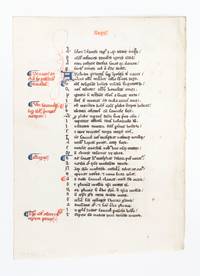
réf. ST18542England ca. 1375. 287 x 198 mm. 11 1/4 x 7 3/4. Single column 32 lines in a small rounded English gothic hand with rubrics in the margins. Rubrics in red running title in red paragraph marks in red or blue two initials measuring two lines in height and colored blue with red penwork. See: P. E. Beichner "Aurora Petri Rigae Biblia Versificata A Verse Commentary on the Bible." ◆Remnants of mounting tape in top margin of recto but a really excellent specimen the hand very clear the ink especially rich and the vellum extremely clean and quite bright. Written in a gothic hand heavily influenced by the English secretarial style this leaf comes from a copy of the "Aurora" a commentary on the Bible in verse form written in the late 12th century by French poet Petrus Riga 1140-1209 a canon of Rheims cathedral. Although little is known about the author's life Riga's text became immensely popular throughout Europe and was routinely studied in Medieval universities. According to Beichner "for those who could read Latin it supplied Scriptural lore in a popular form and it also served as a book of popular theology devotional reading moral instruction and entertainment. Its influence was propagated by teachers preachers and lexicographers by poets and other writers. It was studied imitated translated and quoted. Not only was it widely read in monasteries and convents but it was also recommended reading for the sons of nobles." It is interesting to note that although Riga's work was copied numerous times in the 13th century copies from the later Medieval period such as the present work are uncommonly rare. The parent manuscript containing our leaf was previously in the possession of the Dukes of Westminster and was sold at Sotheby's on 11 July 1966 lot 229 when it was advertised as having 267 leaves missing the first gathering plus 13 other leaves. Bookseller Francis Edwards acquired the manuscript at that sale removed three damaged leaves and sold the remainder. It was thereafter broken up and dispersed. Several sister leaves are now in the collections of Marquette University Lawrence University and the University of South Carolina. unknown books
1500réf. ST20810RParis ca. 1500. 163 x 115 mm. 6 1/2 x 4 1/2". Single column 18 lines in a gothic book hand. Rubrics in red line fillers in blue and pink with gold bezant six one-line initials in burnished gold on pink and blue ground two two-line initials in blue on gold ground with a flower in the center one three-line initial in blue filled with ivy on gold ground verso with panel border of colorful flowers and acanthus recto with A LARGE ARCH-TOPPED MINIATURE OF THE CORONATION OF THE VIRGIN with an "L" shaped frame of burnished gold and painted flowers and A FULL BORDER of acanthus flowers a man playing a bagpipe and a hybrid creature wearing a hat all on a painted gold ground. Very minor wrinkling to vellum but the leaf IN LOVELY CONDITION with the gold everywhere gleaming brightly. From a luxuriously appointed Book of Hours this leaf features a handsome miniature of the Coronation of the Virgin attributed to the workshop of Jean Pichore fl. ca. 1502-20 a major figure among illuminators of the period and one of the most sought-after artists in France at the turn of the 16th century. Executed with imagination and delicacy the miniature features the traditional subject associated with the hour of Compline showing the Virgin being crowned Queen of Heaven following her Death and Assumption. The composition here is quite intimate with the Virgin kneeling before her son as she accepts with humility the crown he lays upon her head. Christ is depicted barefoot and slightly bowed toward his mother in a gentle display of respect. The artist creates a wonderful backdrop for this scene composed entirely of seraphim painted gold blue light pink and green closely packed together. Two of the seraphim hold up light pink draperies behind the central figures as if to shield this tender moment from prying eyes. The borders here are a source of delight featuring a figure wearing a jester-like cap and playing the bagpipe as well as a creature with the body of a bird and the face of a human donning a rather fashionable bycocket cap. The illumination here is of high quality features a liberal use of gold and contains unique marginal details suggesting that the original manuscript must have been a costly commission for a wealthy patron. unknown books
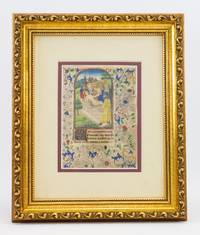
réf. ST19540bSouthern Netherlands Bruges third quarter of 15th century. Matted leaf: 150 x 150 mm. 5 7/8 x 4 3/8". Frame: 307 x 258 mm. 12 x 10 1/4". Single column with four lines below the miniature and the obverse with 17 lines in a batarde hand. Attractively matted and framed the leaf slightly shifted in the mat revealing top and side edges but in no danger of damage. Rubrics in red four one-line initials and three three-line initials all but one in burnished gold on blue and red ground with white tracery the initial beneath the miniature painted pink on a burnished gold ground and filled with painted ivy vines AN ARCH-TOPPED LARGE MINIATURE DEPICTING THE ENTOMBMENT the body of Christ surrounded by seven other people depicted in an outdoor setting with the turrets of a walled city in the background the miniature in a double frame of gold and pink surrounded by A FULL BORDER composed of hairline vines acanthus colorful flowers and gilt bezants and inhabited by a small bird. Minor soiling and a faint thumb print to borders but IN VERY FINE CONDITION THE MINIATURE BEAUTIFULLY PRESERVED. This is a beautifully rendered and deeply touching scene depicting the entombment of the crucified Christ and the pathos experienced by those at his side. Holding the sheet on which the body is lowered into the sarcophagus are on the far left the richly clothed Joseph of Arimathea and on the far right Nicodemus who dons an especially lovely yellow garment with delicate embroidery. Between the two men in the foreground but behind the body are the Virgin Mary who presses the hand of her deceased son to her lips; John the Evangelist whose body is turned toward the Virgin in a gesture of support but whose gaze is focused on the Savior; and Mary Magdalene who holds a small ointment jar. Two other women with halos stand closely behind them consoling one another. The artist has done a masterful job at creating a composition that captures the emotional gravity of the scene: Christ's body gently cradled in a white sheet is on full display with blood still trickling from the wounds on his head and side. Despite there being seven people crowded around him our attention is drawn to the action between Christ and the Virgin who gently grasps his hand with motherly affection and bids him a final farewell. Flickers of different emotions appear on the faces of his followers including pity sorrow stoicism and disbelief--echoing perhaps the viewer's own range of feelings upon viewing this image. The level of detail excellence of composition care seen in the molded bodies and faces and the convincing setting suggest that the artist was quite practiced and that the original manuscript from which the leaf comes was of very high quality. unknown books
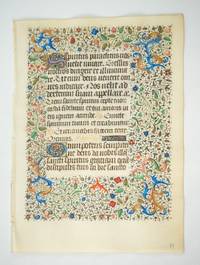
1430réf. ST20979bParis ca. 1430. 191 x 140 mm. 7 1/2 x 5 1/2". Single column 16 lines in an elegant gothic book hand. Rubrics in gold line-fillers with color foliate and geometric designs on burnished gold ground three two-line initials in blue or pink enclosing colored vines with foliage on gold ground BOTH SIDES WITH A DENSE RINCEAUX BORDER consisting of colorful acanthus flowers and many hairline vines terminating in gold leaves ivy and seed pods and with numerous gilt bezants. IN BRILLIANT CONDITION. This is an extraordinarily fine and opulently decorated leaf from a Book of Hours with glittering rinceaux borders delicate initials and luxurious gold rubrics. These sumptuous details and the high quality of the work indicate that this leaf was part of a costly manuscript commissioned by a wealthy patron. Other leaves from the same parent manuscript were sold at Bloomsbury on 6 December 2017 lots 63 and 64. One of those leaves showed St. Genèvieve leading the female saints in the Litany pointing to Paris as the place of origin. unknown books
réf. ST21124c-02France or Low Countries 14th century. 270 x 461 mm. 10 5/8 x 18 1/8". Double columns 32 lines in a gothic book hand. Rubrics and staves in red three two-line initials in red or blue with contrasting penwork now quite faded. Unevenly trimmed missing at most a line of text at the bottom of each column and several words or part-words at corners of outer columns vellum with soiling browning small holes and paper residue consistent with having been used in a binding but the text entirely legible on one side and legible with effort on the other rather darkened side. From a noted Missal with large penwork initials this leaf was once used as the cover for a binding yet remains substantially complete. The text here comes from the Temporale containing the cycle of moveable feasts in the Christian year and includes Wednesday Feria IV after the fourth Sunday of Lent with a long passage from John 9. The musical notation on this leaf is highly developed consisting of a four-line staff clef marker and square neumes. unknown books
réf. ST12083fItaly ca. 1150. 406 x 273 mm. 16 x 10 3/4". Double column 42 lines in a fine rounded early proto-gothic hand. With rubrics in red one three-line initial "I" and A PANELLED 13-LINE INITIAL "F" all of these on the very faded recto and consequently indistinct. Formerly used in a binding with text on the recto unreadable the verso with a narrow band of darkening along one edge not obscuring text edges very wormed but 90 percent of the worming in the margin with very little damage to the text; some obvious condition problems but the large and beautiful script on one of the sides entirely legible and certainly very pleasing. This leaf comes from a very large copy of one of the major texts by one of the great popes of the early Middle Ages and it is notable for the spaciousness and elegance of its script. The sermon here is based on the Gospel reading for Easter Sunday John 20:1-9 which reports Mary Magdalene's discovery of the empty tomb and her running to tell the apostles what she had--and hadn't--found. Given the fact that the passage under discussion celebrates the most critical event in Christianity the opening phrase "Fractus longa molestia stomachus" is unexpected who would have thought it appropriate to mention protracted gastrointestinal problems and probably more effective as a result. Gregory says he is so weakened that he had given up explaining the Gospel to his flock but now he must resume. He recounts how Mary Magdalene told John and Peter about the empty tomb how John arrived first but did not enter the sepulcher and how Peter the tardier one did. Gregory then gives an allegorical interpretation of this episode: John he says represents the Synagogue Peter the Church; the Jews were prior to the Christians but they hesitated on the brink of belief in the Son of God while the Christians entered into full belief. unknown books
réf. ST12083eItaly ca. 1150. 406 x 273 mm. 16 x 10 3/4". Double column 42 lines in a fine rounded early proto-gothic hand. Recto with a pleasing three-line red initial. ◆Formerly used in a binding and consequently a bit soiled and trimmed at the head with loss of the first line perhaps 100 or so small wormholes in the margin only a few causing trivial harm to the text a faint grayish stain affecting a couple of words in the top 20 lines of one column on each side but the entirety of the text completely clear and the stately leaf quite fresh and unusually well-preserved in general for a recovered specimen. This leaf comes from a very large copy of one of the major texts by one of the great popes of the early Middle Ages. Dealing in part with the central occurrence in the salvation of humanity the text here treats of John 20:19-31 which tells of the risen Christ's appearance to the Apostles. Doubting Thomas insists on touching the Lord's wounds before he will be convinced of the Resurrection. Gregory tells his audience that Thomas was healed of unbelief and so must they be although they cannot see Jesus in the flesh as did Thomas. Written ca. 593 Pope Gregory's 40 homilies on the Gospels enjoyed enduring popularity throughout Medieval times as they offered ordinary Christians practical guidance on applying the lessons of the Gospels to their own lives. Elected pope in 590 Gregory ca. 540-604 was one of the most influential pontiffs in the history of the Church. In addition to revising liturgical worship he wrote extensively on theology offering homespun wisdom rather than esoteric debates. He was declared a saint immediately upon his death. The script here is regular rounded and very pleasing--almost soothing--to the eye. Moreover the letters are so large and there is so little significant damage to the leaf that the text can be easily read from a considerable distance. unknown books
réf. ST18310bGermany ca. 1100. 120 x 200 mm. 4 3/4 x 8". Single column 21 extant lines in a late Caroline hand. ◆Recovered from a binding and thus noticeably browned and stained several small holes costing perhaps 30 letters other imperfections but still a very presentable specimen the ink dark and with loss of legibility in only one small place. This is an early fragment in a distinctive hand lacking the heaviness of other scripts of the period and with a feeling of the elongated grace of the humanistic. Despite having previously been used as a binding scrap the fragment remains extremely legible partly because of the clarity of the scribal hand. Elected pope in 590 Gregory I ca. 540-604 also known as Gregory the Great was one of the most influential pontiffs in the history of the Church. In addition to revising liturgical worship he wrote extensively on theology offering homespun wisdom rather than esoteric debates. His "Homilies on the Gospels" were intended to be preached to common people rather than a monastic audience and as a consequence were greatly admired for their straightforward language and pastoral relevance. unknown books