1 531 résultats
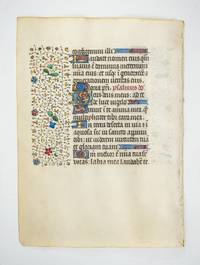
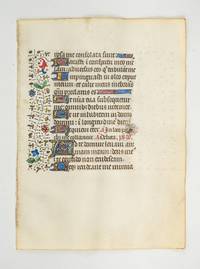
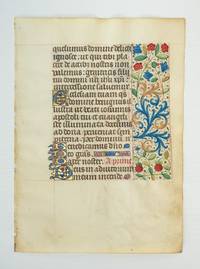
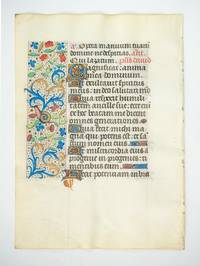
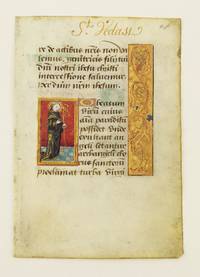
réf. ST12668bKNortheastern France probably Arras late 15th century. 146 x 95 mm. 5 3/4 x 3 3/4". Single column 15 lines in a pleasing bâtarde hand. Rubrics in red one- and two-line initials in brushed gold on a red or blue ground EACH SIDE OF EACH LEAF WITH A BRUSHED GOLD PANEL BORDER WITH VERY PRETTY ILLUSIONISTIC FLOWERS and one panel with acanthus apparently unfinished; EACH LEAF WITH ONE SMALL MINIATURE measuring approximately 40 x 25 mm. DEPICTING SAINTS. Headlines written in French in a later 18th century calligraphic hand. ◆Light soiling otherwise excellent specimens generally clean and smooth with ample margins and attractive decoration. From a charmingly decorated 15th century prayer book these lovely leaves offer the opportunity to acquire a miniature andconsiderable gold ornamentation at an attainable price. One leaf depicts Sts. Peter and Paul in a single frame and the other shows St. Vedast or Waast--a saint that was particularly venerated in France especially in the Arras region whence we be believe these leaves originated. For other leaves from this same manuscript please check our website. unknown books
réf. ST12668bJNortheastern France probably Arras late 15th century. 146 x 95 mm. 5 3/4 x 3 3/4". Single column 15 lines in a pleasing bâtarde hand. Rubrics in red one- and two-line initials in brushed gold on a red or blue ground EACH SIDE OF EACH LEAF WITH A BRUSHED GOLD PANEL BORDER WITH VERY PRETTY ILLUSIONISTIC FLOWERS; EACH LEAF WITH TWO SMALL MINIATURES measuring approximately 40 x 25 mm. depicting saints shown with their attributes. Headlines written in French in a later 18th century calligraphic hand. ◆Light soiling rubrics faded otherwise excellent specimens generally clean and smooth with ample margins attractive decoration and shining gold. From a charmingly decorated 15th century prayer book these lovely leaves offer the opportunity to acquire a miniature and considerable gold ornamentation at an attainable price. One leaf depicts St. Andrew holding an "X" shaped cross and St. Etienne i.e. St. Stephen here shown with three stones on his body and the other shows St. Remigius the so-called "Apostle of the Franks" and St. Quentin--a saint that was particularly venerated in France especially in the north whence we be believe these leaves originated. For other leaves from this same manuscript please check our website. unknown books
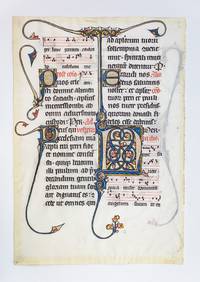
réf. ST20214Northern France perhaps Beauvais or Amiens late 13th or early 14th century. 286 x 199 mm. 11 1/4 x 7 3/4". Double column containing a mixture of staves and text approximately 21 lines in an excellent formal gothic book hand. Attractively matted. Rubrics in red chant text containing black penwork initials with red and yellow geometric elaboration BEAUTIFULLY ILLUMINATED with five two-line initials painted blue or pink with white tracery on a ground in the contrasting color two of the initials filled with grotesques and swirling vines and two with the filler design traced out but never completed each initial with blue and pink extensions terminating in orange leaves or spiky shapes; the verso featuring AN IMPRESSIVE SIX-LINE "N" 58 x 50 mm. in the same style filled with an intricate knotwork design and orange leaves with long extensions including a horizontal extension across the upper margin. Margins with light offsetting of the designs from the facing leaf; remnants of mounting tape on recto corners and bottom edge; verso apparently with a barely visible Medieval "14" in lower margin. An area measuring 5 mm. at edges just faintly yellowed from mat burn but IN FINE CONDITION the vellum otherwise quite bright the paint rich and the gold brightly glittering. This sumptuously decorated leaf--which is beautifully preserved and contains a particularly large and handsome initial--comes from the last volume of a three-volume Missal presented to Beauvais Cathedral by Canon Robert de Hangest d. 1356. The Missal remained at the cathedral at least through the 17th century when it is noted in an inventory but was removed from the church at some point likely in the aftermath of the French Revolution. The parent volume eventually entered the collection of Henri-Auguste Brölemann 1775-1854 of Lyon who passed it to his grand-daughter Etienne Mallet who then sold it at Sotheby's in 1926. It was then acquired for the collection of William Hearst where it remained for the next 25 years. In 1941 it was again sold at auction and subsequently dismembered. Though long thought to have been the work of famed biblioclast Otto Ege recent scholarship suggests that it was actually Phillip Duschnes who was responsible for breaking up the book keeping some leaves for himself and selling others on to his colleague Ege for inclusion in his portfolios of "Fifty Original Leaves from Medieval Manuscripts." The Beauvais Missal has been a subject of interest for many notable scholars chief among them being Christopher de Hamel--see: "Otto Ege and the Beauvais Missal" in "Gilding the Lilly: A Hundred Medieval and Illuminated Manuscripts in the Lilly Library" and it is currently the focus of a major effort to "reconstruct" the manuscript digitally--a project spearheaded by Lisa Fagin Davis. Other leaves from the parent volume are in the collections of the Morgan Library the Metropolitan Museum of Art the Cleveland Museum of Art and the Houghton Library at Harvard among many others. Although there is some dispute among art historians the illumination has been tentatively attributed to the artist of the Hours of Yolande of Soissons produced in Amiens ca. 1280 and now held by the Morgan Library MS M.729. It is worth noting that the town of Hangest home to the original owner is only 10 miles from Amiens and is a likely place of origin for the Missal. The present leaf contains a text for a major feast day and thus contains a large and extravagantly decorated initial for its opening "'Nunc scio vere." It is not too much to say that the decoration here is masterful but curiously--and of special interest to us from a modern perspective--the illuminators seem to have forgotten to put the finishing touches on the two smaller initials above which still contain sketches of the preliminary design. unknown books
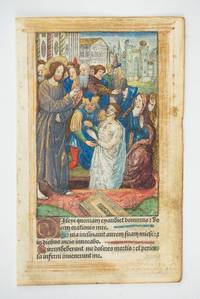
1520réf. ST12778-0887cParis: Gilles Hardouyn ca. 1520. 177 x 110 mm. 7 x 4 1/4". Single column 33 lines in an attractive gothic type. With hand-illuminated initials and a FULL-PAGE MINIATURE DEPICTING THE RAISING OF LAZARUS ILLUMINATED IN COLORS AND GOLD BY A CONTEMPORARY HAND. See Hilary Maddocks "A Book of Hours by Anthoine Vérard" University of Melbourne Collections issue 16 2015 pp. 19-20. One quarter-inch repair to the center of the leaf which on the recto slightly affects Lazarus' neck and on the verso affects three letters which have been neatly touched up a handful of small chips to the paint the architectural border somewhat rubbed in the lower right corner mild soiling to the margins; not without flaws but a richly and carefully colored leaf that is still pleasing. Richly painted and amply highlighted with brushed gold this leaf from a printed Book of Hours includes a large miniature depicting the raising of Lazarus. Christ stands arm extended in benediction over the newly reawakened Lazarus who gazes up at him standing upright in his grave. A crowd looks on with a well-dressed man crouched in front of the grave apparently having helped Lazarus to stand. Our illuminator has enhanced the drama of the moment with the rosy cheeks of the bystanders emphasizing Lazarus' deathly pallor and with Jesus' shimmering robe distinguishing him from the crowd. The faces and folds of cloth are delicately shaded and the minutely detailed lines of gold carefully applied stylistically tying this printed leaf to the fully hand-painted Books of Hours that printed versions were slowly replacing during the early years of the 16th century. The composition seems to come from a suite of illustrations designed by illuminator Jean Pichore fl. 1490-1521 done for the printer Gilles also Gillet Hardouyn. Gilles Hardouyn (?) unknown books
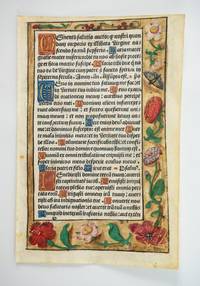
réf. ST20972dParis: Nicolas Vivien early 16th century. 197 x 130 mm. 7 3/4 x 5 1/8". Single column 28 lines gothic typeface. Ruled in red each leaf with several one- to three-line initials painted gold on red or blue ground and A LOVELY ANIMATED FULL BORDER DONE IN MANUSCRIPT with trompe-l'oeil flowers a moth a fly and a bird on painted gold ground. Light soiling and a couple small stains to vellum one initial a bit smudged but in excellent condition overall. This beautifully embellished leaf from a printed Book of Hours demonstrates the enduring demand for manuscript illumination in the incunabular period and beyond. While the text here was completed on a printing press the initials and border were done entirely by hand adding luxury and luster to an otherwise unadorned page. Although this leaf likely belonged to a Book of Hours printed in Paris possibly an edition printed for Nicolas Vivien in or around 1503 the trompe-l'oeil style seen in the border was particularly popular among Flemish and Netherlandish illuminators of the period. The large blossoms and acanthus here seem to pop off the page because of the artist's use of subtle shading to indicate shadows and there is additional pleasure to be found in the small creatures--a bird carrying a small flower a moth and a housefly--that share the space. Nicolas Vivien(?) unknown
réf. ST20972b-cParis: Nicolas Vivien early 16th century. 197 x 130 mm. 7 3/4 x 5 1/8". Single column 28 lines gothic typeface. Ruled in red two one-line initials and two three-line initials painted in gold on red or blue ground and A LOVELY ANIMATED FULL PAINTED BORDER done by hand with trompe-l'oeil flowers one leaf also with a moth on painted gold ground. Top margin a little small light soiling to vellum borders with a couple superficial scratches and tiny smudges but in excellent condition overall. These beautifully embellished leaves from a printed Book of Hours demonstrate the enduring demand for manuscript illumination in the incunabular period and beyond. While the text here was completed on a printing press the initials and borders were done entirely by hand adding luxury and luster to otherwise unadorned pages. Although these leaves likely belonged to a Book of Hours printed in Paris possibly an edition printed for Nicolas Viven in or around 1503 the trompe-l'oeil style seen in the borders was particularly popular among Flemish and Netherlandish illuminators of the period. Because of the artist's use of subtle shading to indicate shadows the large blossoms here seem to pop off the page and one of the leaves contains a delicate little moth--attracted perhaps by the gleaming painted gold ground. Nicolas Vivien(?) unknown
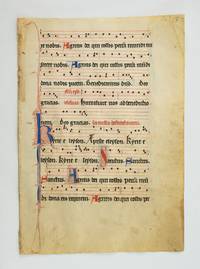
réf. ST21065ANortheastern France or Rhineland early 14th century. 345 x 239 mm. 13 1/2 x 9 3/8". Single column nine lines of music and text in a gothic hand. Rubrics and staves in red calligraphic initials in black some leaves with one-line initials in red or blue some with contrasting penwork each leaf with two or more large initials measuring a line of text plus a full stave in blue or red with blue and red penwork often extending several lines above or below. Later ink foliation in upper right corners; one leaf with marginal notations in later hands. See: de Hamel Christopher. "Medieval and Renaissance Manuscripts from the Library of Sir Sydney Cockerell" British Library Journal 13 1987. Trimmed a little close at the top occasionally cutting into penwork decoration light to moderate soiling to vellum some leaves with light creasing small stains and/or wormholes but still in very good presentable condition. From a manuscript fragment that once passed through the hands of Sir Sydney Cockerell the leaves in this group appear to come from a rarely seen liturgical text called a Sequentiary. Consisting of sung hymns called "sequences" performed between the Alleluia and Gospel readings during Mass a Sequentiary could be either a standalone volume or part of a longer work such as a Gradual or Missal. The script here is a neat and legible gothic book hand with simple but attractive lettering in blue and red with contrasting penwork; there are also some interesting calligraphic initials in black--some with little spikes or other flourishes--that might warrant further study. These leaves were previously bound into a later perhaps 18th century limp vellum binding the pastedown of which contained a tipped-on handwritten note from Cockerell 1867-1962 who was William Morris' private secretary and the director of the Fitzwilliam Museum for nearly 30 years. Cockerell attributed this manuscript to Northern France and suggested a date of ca. 1280 we believe it dates a little later noting that it was probably made for Dominican use based on the presence of the sequences for St. Peter Martyr and St. Dominic. It is unclear whether Cockerell actually owned this manuscript at one point or served as a consultant for a dealer or a private collector as he was known to do: in the words of de Hamel Cockerell became "the arbiter of quality before whom generations of collectors and scholars brought their acquisitions and attributions for judgement. . . . Dyson Perrins Yates Thompson Chester Beatty Pierpont Morgan St John Hornby Lord Kennet Francis Wormald Eric Millar J. R. Abbey and many others never felt that a manuscript acquisition was truly made until Sydney Cockerell had seen and approved it." De Hamel also notes that Cockerell "gave away sold or exchanged manuscripts on many occasions during his life of collecting" making it difficult to know exactly how this manuscript may have crossed his path or for how long it was in his possession. His appraisal does however suggest that this manuscript was in a defective state from at least the 1920s and probably a good deal earlier than that. Most of the choir book leaves that we've offered for sale over the years have come from 15th and early 16th century manuscripts typically Italian or Spanish in origin; the present leaves offer an uncommon opportunity to purchase earlier specimens of musical notation--and they are leaves from an unusual liturgical text with distinguished if uncertain ownership history and at an attainable price. The price given here is for a single leaf; for additional leaves from this same manuscript at various prices please see our website. unknown
réf. ST21065CNortheastern France or Rhineland early 14th century. 345 x 239 mm. 13 1/2 x 9 3/8". Single column nine lines of music and text in a gothic hand. Rubrics and staves in red calligraphic initials in black. Later ink foliation in upper right corners. See: de Hamel Christopher. "Medieval and Renaissance Manuscripts from the Library of Sir Sydney Cockerell" British Library Journal 13 1987. Vellum with light soiling and a little light creasing mostly marginal a few negligible marks but very clean and in excellent condition. From a manuscript fragment that once passed through the hands of Sir Sydney Cockerell the leaves in this group appear to come from a rarely seen liturgical text called a Sequentiary. Consisting of sung hymns called "sequences" performed between the Alleluia and Gospel readings during Mass a Sequentiary could be either a standalone volume or part of a longer work such as a Gradual or Missal. The script here is a neat and legible gothic book hand with some interesting calligraphic initials in black--some with little spikes or other flourishes--that might warrant further study. These leaves were previously bound into a later perhaps 18th century limp vellum binding the pastedown of which contained a tipped-on handwritten note from Cockerell 1867-1962 who was William Morris' private secretary and the director of the Fitzwilliam Museum for nearly 30 years. Cockerell attributed this manuscript to Northern France and suggested a date of ca. 1280 we believe it dates a little later noting that it was probably made for Dominican use based on the presence of the sequences for St. Peter Martyr and St. Dominic. It is unclear whether Cockerell actually owned this manuscript at one point or served as a consultant for a dealer or a private collector as he was known to do: in the words of de Hamel Cockerell became "the arbiter of quality before whom generations of collectors and scholars brought their acquisitions and attributions for judgement. . . . Dyson Perrins Yates Thompson Chester Beatty Pierpont Morgan St John Hornby Lord Kennet Francis Wormald Eric Millar J. R. Abbey and many others never felt that a manuscript acquisition was truly made until Sydney Cockerell had seen and approved it." De Hamel also notes that Cockerell "gave away sold or exchanged manuscripts on many occasions during his life of collecting" making it difficult to know exactly how this manuscript may have crossed his path or for how long it was in his possession. His appraisal does however suggest that this manuscript was in a defective state from at least the 1920s and probably a good deal earlier than that. Most of the choir book leaves that we offer for sale come from 15th and early 16th century manuscripts typically Italian or Spanish in origin; the present leaves offer an uncommon opportunity to purchase earlier specimens of musical notation from an unusual liturgical text with distinguished if uncertain ownership history and at an attainable price. The price given here is for a single leaf; for additional leaves from this same manuscript please see our website. unknown
réf. ST21065DNortheastern France or Rhineland early 14th century. 345 x 239 mm. 13 1/2 x 9 3/8". Single column nine lines of music and text in a gothic hand. Rubrics and staves in red calligraphic initials in black one-line initials in red or blue some with contrasting penwork each leaf with one or more large initials measuring a line of text plus a full stave in blue or red with blue and red penwork often extending several lines above or below. Later ink foliation in upper right corners; some leaves with marginal notations in later hand; one specimen with older manuscript fragment enforcing the gutter. See: de Hamel Christopher. "Medieval and Renaissance Manuscripts from the Library of Sir Sydney Cockerell" British Library Journal 13 1987. Trimmed a little close at the top occasionally cutting into penwork decoration moderate soiling to vellum with noticeable mostly marginal condition issues including wormholes large repairs to margins and stains. From a manuscript fragment that once passed through the hands of Sir Sydney Cockerell the leaves in this group appear to come from a rarely seen liturgical text called a Sequentiary. Consisting of sung hymns called "sequences" performed between the Alleluia and Gospel readings during Mass a Sequentiary could be either a standalone volume or part of a longer work such as a Gradual or Missal. The script here is a neat and legible gothic book hand with simple but attractive lettering in blue and red with contrasting penwork; there are also some interesting calligraphic initials in black--some with little spikes or other flourishes--that might warrant further study. These leaves were previously bound into a later perhaps 18th century limp vellum binding the pastedown of which contained a tipped-on handwritten note from Cockerell 1867-1962 who was William Morris' private secretary and the director of the Fitzwilliam Museum for nearly 30 years. Cockerell attributed this manuscript to Northern France and suggested a date of ca. 1280 we believe it dates a little later noting that it was probably made for Dominican use based on the presence of the sequences for St. Peter Martyr and St. Dominic. It is unclear whether Cockerell actually owned this manuscript at one point or served as a consultant for a dealer or a private collector as he was known to do: in the words of de Hamel Cockerell became "the arbiter of quality before whom generations of collectors and scholars brought their acquisitions and attributions for judgement. . . . Dyson Perrins Yates Thompson Chester Beatty Pierpont Morgan St John Hornby Lord Kennet Francis Wormald Eric Millar J. R. Abbey and many others never felt that a manuscript acquisition was truly made until Sydney Cockerell had seen and approved it." De Hamel also notes that Cockerell "gave away sold or exchanged manuscripts on many occasions during his life of collecting" making it difficult to know exactly how this manuscript may have crossed his path or for how long it was in his possession. His appraisal does however suggest that this manuscript was in a defective state from at least the 1920s and probably a good deal earlier than that. Most of the choir book leaves that we offer for sale come from 15th and early 16th century manuscripts typically Italian or Spanish in origin; the present leaves offer an uncommon opportunity to purchase earlier specimens of musical notation from an unusual liturgical text with distinguished if uncertain ownership history and at an attainable price. The price given here is for a single leaf; for additional leaves from this same manuscript please see our website. unknown
réf. ST21065BNortheastern France or Rhineland early 14th century. 345 x 239 mm. 13 1/2 x 9 3/8". Single column nine lines of music and text in a gothic hand. Rubrics and staves in red calligraphic initials in black one-line initials in red or blue some with contrasting penwork each leaf with at least one large initial measuring a line of text plus a full stave in blue or red with blue and red penwork often extending several lines above or below. Later ink foliation in upper right corners; a couple leaves with remnants of older manuscript leaves enforcing the gutter. See: de Hamel Christopher. "Medieval and Renaissance Manuscripts from the Library of Sir Sydney Cockerell" British Library Journal 13 1987. Trimmed a little close at the top occasionally cutting into penwork decoration light to moderate soiling to vellum some leaves with light creasing small stains and/or wormholes a few leaves with more noticeable flaws but still in very good presentable condition. From a manuscript fragment that once passed through the hands of Sir Sydney Cockerell the leaves in this group appear to come from a rarely seen liturgical text called a Sequentiary. Consisting of sung hymns called "sequences" performed between the Alleluia and Gospel readings during Mass a Sequentiary could be either a standalone volume or part of a longer work such as a Gradual or Missal. The script here is a neat and legible gothic book hand with simple but attractive lettering in blue and red with contrasting penwork; there are also some interesting calligraphic initials in black--some with little spikes or other flourishes--that might warrant further study. These leaves were previously bound into a later perhaps 18th century limp vellum binding the pastedown of which contained a tipped-on handwritten note from Cockerell 1867-1962 who was William Morris' private secretary and the director of the Fitzwilliam Museum for nearly 30 years. Cockerell attributed this manuscript to Northern France and suggested a date of ca. 1280 we believe it dates a little later noting that it was probably made for Dominican use based on the presence of the sequences for St. Peter Martyr and St. Dominic. It is unclear whether Cockerell actually owned this manuscript at one point or served as a consultant for a dealer or a private collector as he was known to do: in the words of de Hamel Cockerell became "the arbiter of quality before whom generations of collectors and scholars brought their acquisitions and attributions for judgement. . . . Dyson Perrins Yates Thompson Chester Beatty Pierpont Morgan St John Hornby Lord Kennet Francis Wormald Eric Millar J. R. Abbey and many others never felt that a manuscript acquisition was truly made until Sydney Cockerell had seen and approved it." De Hamel also notes that Cockerell "gave away sold or exchanged manuscripts on many occasions during his life of collecting" making it difficult to know exactly how this manuscript may have crossed his path or for how long it was in his possession. His appraisal does however suggest that this manuscript was in a defective state from at least the 1920s and probably a good deal earlier than that. Most of the choir book leaves that we offer for sale come from 15th and early 16th century manuscripts typically Italian or Spanish in origin; the present leaves offer an uncommon opportunity to purchase earlier specimens of musical notation from an unusual liturgical text with distinguished if uncertain ownership history and at an attainable price. The price given here is for a single leaf; for additional leaves from this same manuscript please see our website. unknown
1475réf. ST19653LNorthern France ca. 1475. 155 x 110 mm. 6 x 4 1/4". Single column 16 lines in a gothic book hand. Rubrics in red line fillers in pink and blue with gilt bezants and white embellishment most leaves with one or more one-line initials in burnished gold on pink and blue ground with white embellishments and some with one or more two-line initials in blue or pink with white embellishments enclosing leaves or flowers on burnished gold ground each side with panel border of acanthus sprays of flowers and/or fruit and gilt bezants five with a well-realized bird or insect in the borders two with small mounds of fruit or flowers emerging from a golden vase. In fine fresh condition very clean and with wide margins. Undoubtedly the work of a top atelier these lovely manuscript leaves have been written and decorated with a high degree of skill. Each leaf features multiple glittering initials and the delicate panel borders add a bit of extra sparkle to the page. The price is meant to be as attractive as the decoration. unknown
1475réf. ST19653GNorthern France ca. 1475. 155 x 110 mm. 6 x 4 1/4". Single column 16 lines in a gothic book hand. Rubrics in dark pink some leaves with line fillers in pink and blue with white embellishment and gilt bezants each leaf with at least one and some with many one- to three-line initial either in gilt on a pink and blue ground with white embellishment or painted blue with white embellishment filled with flowers or ivy on a gilt ground most leaves with one panel border of hairline vines gilt ivy and bezants and painted flowers. Occasional light soiling wrinkling and other very minor imperfections but in fine fresh condition overall very clean and with wide margins. Undoubtedly the work of a top atelier these lovely manuscript leaves have been written and decorated with a high degree of skill. Many of the leaves feature numerous glittering initials and the delicate panel borders add a bit of extra sparkle to the page. unknown
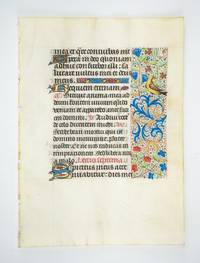
1500réf. ST20810BParis ca. 1500. 165 x 115 mm. 6 1/2 x 4 1/2". Single column 18 lines in a gothic book hand. Rubrics in red line fillers in pink and blue with gilt bezants and white embellishment most leaves with one or more one-line initials in burnished gold on pink and blue ground with white embellishments many leaves with one or more two-line initials in blue or pink with white embellishments enclosing leaves or flowers on burnished gold ground each side with panel border of acanthus flowers and/or fruit and gilt bezants one leaf with a small bird perched in the border sold at this price level due to an ink smear. The odd smudge of small stain but generally quite clean fresh and well preserved. Featuring high-quality illuminated initials a fine border on every page and the liberal use of painted and burnished gold these leaves clearly come from a luxurious Book of Hours produced by an accomplished workshop. Although a common element is the appearance of prominent blue acanthus every panel border shows a slightly different design with varying flower combinations a fact that may make selecting a single favorite quite difficult!. unknown
1500réf. ST20810GParis ca. 1500. 165 x 115 mm. 6 1/2 x 4 1/2". Single column 18 lines in a gothic book hand. Rubrics in red line fillers in pink and blue with gilt bezants and white embellishment each leaf with one or more one-line initials in burnished gold on pink and blue ground with white embellishments and one two-line initial in blue or pink with white embellishments enclosing leaves or flowers on burnished gold ground EACH SIDE WITH A PANEL BORDER INCORPORATING AN ANIMAL OR HYBRID CREATURE and filled with acanthus flowers and/or fruit and gilt bezants. Light soiling or thumbing to some leaves but in uniformly excellent condition almost entirely clean fresh and bright. Whether you prefer your marginalia in the form of beautiful peacocks murderous-looking bunnies or fantastic hybrids these leaves feature pleasing creatures fanciful and charming. Featuring high-quality illuminated initials a fine border on every page and the liberal use of painted and burnished gold the leaves clearly come from a luxurious Book of Hours produced by an accomplished workshop. The marginal creatures are prominent executed with considerable skill and exhibit a great deal of personality. unknown
1500réf. ST20810FParis ca. 1500. 165 x 115 mm. 6 1/2 x 4 1/2". Single column 18 lines in a gothic book hand. Rubrics in red line fillers in pink and blue with gilt bezants and white embellishment most leaves with one or more one-line initials in burnished gold on pink and blue ground with white embellishments and some with one or more two-line initials in blue or pink with white embellishments enclosing leaves or flowers on burnished gold ground each side with panel border of acanthus sprays of flowers and/or fruit and gilt bezants five with a well-realized bird or insect in the borders two with with small mounds of fruit or flowers emerging from a golden vase. Some leaves with small marks smudges or other minor imperfections but generally in excellent condition being quite clean fresh and altogether attractive. Featuring high-quality illuminated initials a fine border on every page and the liberal use of painted and burnished gold these leaves clearly come from a luxurious Book of Hours produced by an accomplished workshop. Although a common element is the appearance of prominent blue acanthus every panel border shows a slightly different design including those with flowers emanating from golden chalices mounds of grape vines or charming well-realized birds or bees. These leaves are especially delightful carefully painted and very well preserved. unknown
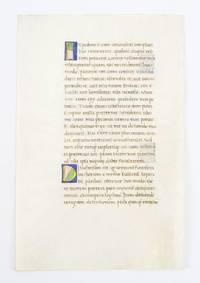
réf. ST19578Northern Italy last quarter of 15th century. Each leaf measuring 250 x 164 mm. 9 7/8 x 6 3/8". Single column 24 lines in a handsome humanist hand. Each leaf with three to four large initials one measuring two lines all others three lines in burnished gold in-filled with pink and green paint with white embellishment on blue ground with white embellishments. Insignificant wrinkling and a couple faint creases to vellum tiny snag along top edge of each leaf but IN VERY FINE CONDITION the vellum especially clean and bright the paint and ink fresh and the margins generous. Written in a beautiful humanistic script enclosed by wide margins and adorned with tasteful gilt initials these leaves come from what must have been a particularly fine manuscript made for a person of means. The text comes from the "Rhetorica ad Herennium" which was long attributed to Cicero but is now believed to have been written ca. 80 B.C. by an unknown scholar. This guide to rhetoric remained influential through the Renaissance in large part because of its thorough treatment of rhetorical devices. The style of the initials--elegant burnished gold on a ground of pale pink green and sapphire blue with whisps of white embellishments--suggest that the manuscript was executed in Northern Italy perhaps Milan Bologna or Florence by a craftsman of great technical skill. Fine examples of humanistic script are becoming increasingly difficult to find on the market and the present examples are among the loveliest we have ever acquired. unknown
réf. ST20972dParis: Nicolas Vivien early 16th century. 197 x 130 mm. 7 3/4 x 5 1/8". Single column 28 lines gothic typeface. Ruled in red each leaf with several one- to three-line initials painted gold on red or blue ground and A LOVELY ANIMATED FULL BORDER DONE IN MANUSCRIPT with trompe-l'oeil flowers a moth a fly and a bird on painted gold ground. Light soiling and a couple small stains to vellum one initial a bit smudged but in excellent condition overall. This beautifully embellished leaf from a printed Book of Hours demonstrates the enduring demand for manuscript illumination in the incunabular period and beyond. While the text here was completed on a printing press the initials and border were done entirely by hand adding luxury and luster to an otherwise unadorned page. Although this leaf likely belonged to a Book of Hours printed in Paris possibly an edition printed for Nicolas Vivien in or around 1503 the trompe-l'oeil style seen in the border was particularly popular among Flemish and Netherlandish illuminators of the period. The large blossoms and acanthus here seem to pop off the page because of the artist's use of subtle shading to indicate shadows and there is additional pleasure to be found in the small creatures--a bird carrying a small flower a moth and a housefly--that share the space. Nicolas Vivien(?) unknown books
réf. ST20972b-cParis: Nicolas Vivien early 16th century. 197 x 130 mm. 7 3/4 x 5 1/8". Single column 28 lines gothic typeface. Ruled in red two one-line initials and two three-line initials painted in gold on red or blue ground and A LOVELY ANIMATED FULL PAINTED BORDER done by hand with trompe-l'oeil flowers one leaf also with a moth on painted gold ground. Top margin a little small light soiling to vellum borders with a couple superficial scratches and tiny smudges but in excellent condition overall. These beautifully embellished leaves from a printed Book of Hours demonstrate the enduring demand for manuscript illumination in the incunabular period and beyond. While the text here was completed on a printing press the initials and borders were done entirely by hand adding luxury and luster to otherwise unadorned pages. Although these leaves likely belonged to a Book of Hours printed in Paris possibly an edition printed for Nicolas Viven in or around 1503 the trompe-l'oeil style seen in the borders was particularly popular among Flemish and Netherlandish illuminators of the period. Because of the artist's use of subtle shading to indicate shadows the large blossoms here seem to pop off the page and one of the leaves contains a delicate little moth--attracted perhaps by the gleaming painted gold ground. Nicolas Vivien(?) unknown books
1475réf. ST19653LNorthern France ca. 1475. 155 x 110 mm. 6 x 4 1/4". Single column 16 lines in a gothic book hand. Rubrics in red line fillers in pink and blue with gilt bezants and white embellishment most leaves with one or more one-line initials in burnished gold on pink and blue ground with white embellishments and some with one or more two-line initials in blue or pink with white embellishments enclosing leaves or flowers on burnished gold ground each side with panel border of acanthus sprays of flowers and/or fruit and gilt bezants five with a well-realized bird or insect in the borders two with small mounds of fruit or flowers emerging from a golden vase. In fine fresh condition very clean and with wide margins. Undoubtedly the work of a top atelier these lovely manuscript leaves have been written and decorated with a high degree of skill. Each leaf features multiple glittering initials and the delicate panel borders add a bit of extra sparkle to the page. The price is meant to be as attractive as the decoration. unknown books
1475réf. ST19653GNorthern France ca. 1475. 155 x 110 mm. 6 x 4 1/4". Single column 16 lines in a gothic book hand. Rubrics in dark pink some leaves with line fillers in pink and blue with white embellishment and gilt bezants each leaf with at least one and some with many one- to three-line initial either in gilt on a pink and blue ground with white embellishment or painted blue with white embellishment filled with flowers or ivy on a gilt ground most leaves with one panel border of hairline vines gilt ivy and bezants and painted flowers. Occasional light soiling wrinkling and other very minor imperfections but in fine fresh condition overall very clean and with wide margins. Undoubtedly the work of a top atelier these lovely manuscript leaves have been written and decorated with a high degree of skill. Many of the leaves feature numerous glittering initials and the delicate panel borders add a bit of extra sparkle to the page. unknown books
réf. ST21065CNortheastern France or Rhineland early 14th century. 345 x 239 mm. 13 1/2 x 9 3/8". Single column nine lines of music and text in a gothic hand. Rubrics and staves in red calligraphic initials in black. Later ink foliation in upper right corners. See: de Hamel Christopher. "Medieval and Renaissance Manuscripts from the Library of Sir Sydney Cockerell" British Library Journal 13 1987. Vellum with light soiling and a little light creasing mostly marginal a few negligible marks but very clean and in excellent condition. From a manuscript fragment that once passed through the hands of Sir Sydney Cockerell the leaves in this group appear to come from a rarely seen liturgical text called a Sequentiary. Consisting of sung hymns called "sequences" performed between the Alleluia and Gospel readings during Mass a Sequentiary could be either a standalone volume or part of a longer work such as a Gradual or Missal. The script here is a neat and legible gothic book hand with some interesting calligraphic initials in black--some with little spikes or other flourishes--that might warrant further study. These leaves were previously bound into a later perhaps 18th century limp vellum binding the pastedown of which contained a tipped-on handwritten note from Cockerell 1867-1962 who was William Morris' private secretary and the director of the Fitzwilliam Museum for nearly 30 years. Cockerell attributed this manuscript to Northern France and suggested a date of ca. 1280 we believe it dates a little later noting that it was probably made for Dominican use based on the presence of the sequences for St. Peter Martyr and St. Dominic. It is unclear whether Cockerell actually owned this manuscript at one point or served as a consultant for a dealer or a private collector as he was known to do: in the words of de Hamel Cockerell became "the arbiter of quality before whom generations of collectors and scholars brought their acquisitions and attributions for judgement. . . . Dyson Perrins Yates Thompson Chester Beatty Pierpont Morgan St John Hornby Lord Kennet Francis Wormald Eric Millar J. R. Abbey and many others never felt that a manuscript acquisition was truly made until Sydney Cockerell had seen and approved it." De Hamel also notes that Cockerell "gave away sold or exchanged manuscripts on many occasions during his life of collecting" making it difficult to know exactly how this manuscript may have crossed his path or for how long it was in his possession. His appraisal does however suggest that this manuscript was in a defective state from at least the 1920s and probably a good deal earlier than that. Most of the choir book leaves that we offer for sale come from 15th and early 16th century manuscripts typically Italian or Spanish in origin; the present leaves offer an uncommon opportunity to purchase earlier specimens of musical notation from an unusual liturgical text with distinguished if uncertain ownership history and at an attainable price. The price given here is for a single leaf; for additional leaves from this same manuscript please see our website. unknown books
réf. ST21065DNortheastern France or Rhineland early 14th century. 345 x 239 mm. 13 1/2 x 9 3/8". Single column nine lines of music and text in a gothic hand. Rubrics and staves in red calligraphic initials in black one-line initials in red or blue some with contrasting penwork each leaf with one or more large initials measuring a line of text plus a full stave in blue or red with blue and red penwork often extending several lines above or below. Later ink foliation in upper right corners; some leaves with marginal notations in later hand; one specimen with older manuscript fragment enforcing the gutter. See: de Hamel Christopher. "Medieval and Renaissance Manuscripts from the Library of Sir Sydney Cockerell" British Library Journal 13 1987. Trimmed a little close at the top occasionally cutting into penwork decoration moderate soiling to vellum with noticeable mostly marginal condition issues including wormholes large repairs to margins and stains. From a manuscript fragment that once passed through the hands of Sir Sydney Cockerell the leaves in this group appear to come from a rarely seen liturgical text called a Sequentiary. Consisting of sung hymns called "sequences" performed between the Alleluia and Gospel readings during Mass a Sequentiary could be either a standalone volume or part of a longer work such as a Gradual or Missal. The script here is a neat and legible gothic book hand with simple but attractive lettering in blue and red with contrasting penwork; there are also some interesting calligraphic initials in black--some with little spikes or other flourishes--that might warrant further study. These leaves were previously bound into a later perhaps 18th century limp vellum binding the pastedown of which contained a tipped-on handwritten note from Cockerell 1867-1962 who was William Morris' private secretary and the director of the Fitzwilliam Museum for nearly 30 years. Cockerell attributed this manuscript to Northern France and suggested a date of ca. 1280 we believe it dates a little later noting that it was probably made for Dominican use based on the presence of the sequences for St. Peter Martyr and St. Dominic. It is unclear whether Cockerell actually owned this manuscript at one point or served as a consultant for a dealer or a private collector as he was known to do: in the words of de Hamel Cockerell became "the arbiter of quality before whom generations of collectors and scholars brought their acquisitions and attributions for judgement. . . . Dyson Perrins Yates Thompson Chester Beatty Pierpont Morgan St John Hornby Lord Kennet Francis Wormald Eric Millar J. R. Abbey and many others never felt that a manuscript acquisition was truly made until Sydney Cockerell had seen and approved it." De Hamel also notes that Cockerell "gave away sold or exchanged manuscripts on many occasions during his life of collecting" making it difficult to know exactly how this manuscript may have crossed his path or for how long it was in his possession. His appraisal does however suggest that this manuscript was in a defective state from at least the 1920s and probably a good deal earlier than that. Most of the choir book leaves that we offer for sale come from 15th and early 16th century manuscripts typically Italian or Spanish in origin; the present leaves offer an uncommon opportunity to purchase earlier specimens of musical notation from an unusual liturgical text with distinguished if uncertain ownership history and at an attainable price. The price given here is for a single leaf; for additional leaves from this same manuscript please see our website. unknown books
réf. ST21065BNortheastern France or Rhineland early 14th century. 345 x 239 mm. 13 1/2 x 9 3/8". Single column nine lines of music and text in a gothic hand. Rubrics and staves in red calligraphic initials in black one-line initials in red or blue some with contrasting penwork each leaf with at least one large initial measuring a line of text plus a full stave in blue or red with blue and red penwork often extending several lines above or below. Later ink foliation in upper right corners; a couple leaves with remnants of older manuscript leaves enforcing the gutter. See: de Hamel Christopher. "Medieval and Renaissance Manuscripts from the Library of Sir Sydney Cockerell" British Library Journal 13 1987. Trimmed a little close at the top occasionally cutting into penwork decoration light to moderate soiling to vellum some leaves with light creasing small stains and/or wormholes a few leaves with more noticeable flaws but still in very good presentable condition. From a manuscript fragment that once passed through the hands of Sir Sydney Cockerell the leaves in this group appear to come from a rarely seen liturgical text called a Sequentiary. Consisting of sung hymns called "sequences" performed between the Alleluia and Gospel readings during Mass a Sequentiary could be either a standalone volume or part of a longer work such as a Gradual or Missal. The script here is a neat and legible gothic book hand with simple but attractive lettering in blue and red with contrasting penwork; there are also some interesting calligraphic initials in black--some with little spikes or other flourishes--that might warrant further study. These leaves were previously bound into a later perhaps 18th century limp vellum binding the pastedown of which contained a tipped-on handwritten note from Cockerell 1867-1962 who was William Morris' private secretary and the director of the Fitzwilliam Museum for nearly 30 years. Cockerell attributed this manuscript to Northern France and suggested a date of ca. 1280 we believe it dates a little later noting that it was probably made for Dominican use based on the presence of the sequences for St. Peter Martyr and St. Dominic. It is unclear whether Cockerell actually owned this manuscript at one point or served as a consultant for a dealer or a private collector as he was known to do: in the words of de Hamel Cockerell became "the arbiter of quality before whom generations of collectors and scholars brought their acquisitions and attributions for judgement. . . . Dyson Perrins Yates Thompson Chester Beatty Pierpont Morgan St John Hornby Lord Kennet Francis Wormald Eric Millar J. R. Abbey and many others never felt that a manuscript acquisition was truly made until Sydney Cockerell had seen and approved it." De Hamel also notes that Cockerell "gave away sold or exchanged manuscripts on many occasions during his life of collecting" making it difficult to know exactly how this manuscript may have crossed his path or for how long it was in his possession. His appraisal does however suggest that this manuscript was in a defective state from at least the 1920s and probably a good deal earlier than that. Most of the choir book leaves that we offer for sale come from 15th and early 16th century manuscripts typically Italian or Spanish in origin; the present leaves offer an uncommon opportunity to purchase earlier specimens of musical notation from an unusual liturgical text with distinguished if uncertain ownership history and at an attainable price. The price given here is for a single leaf; for additional leaves from this same manuscript please see our website. unknown books
réf. ST21065ANortheastern France or Rhineland early 14th century. 345 x 239 mm. 13 1/2 x 9 3/8". Single column nine lines of music and text in a gothic hand. Rubrics and staves in red calligraphic initials in black some leaves with one-line initials in red or blue some with contrasting penwork each leaf with two or more large initials measuring a line of text plus a full stave in blue or red with blue and red penwork often extending several lines above or below. Later ink foliation in upper right corners; one leaf with marginal notations in later hands. See: de Hamel Christopher. "Medieval and Renaissance Manuscripts from the Library of Sir Sydney Cockerell" British Library Journal 13 1987. Trimmed a little close at the top occasionally cutting into penwork decoration light to moderate soiling to vellum some leaves with light creasing small stains and/or wormholes but still in very good presentable condition. From a manuscript fragment that once passed through the hands of Sir Sydney Cockerell the leaves in this group appear to come from a rarely seen liturgical text called a Sequentiary. Consisting of sung hymns called "sequences" performed between the Alleluia and Gospel readings during Mass a Sequentiary could be either a standalone volume or part of a longer work such as a Gradual or Missal. The script here is a neat and legible gothic book hand with simple but attractive lettering in blue and red with contrasting penwork; there are also some interesting calligraphic initials in black--some with little spikes or other flourishes--that might warrant further study. These leaves were previously bound into a later perhaps 18th century limp vellum binding the pastedown of which contained a tipped-on handwritten note from Cockerell 1867-1962 who was William Morris' private secretary and the director of the Fitzwilliam Museum for nearly 30 years. Cockerell attributed this manuscript to Northern France and suggested a date of ca. 1280 we believe it dates a little later noting that it was probably made for Dominican use based on the presence of the sequences for St. Peter Martyr and St. Dominic. It is unclear whether Cockerell actually owned this manuscript at one point or served as a consultant for a dealer or a private collector as he was known to do: in the words of de Hamel Cockerell became "the arbiter of quality before whom generations of collectors and scholars brought their acquisitions and attributions for judgement. . . . Dyson Perrins Yates Thompson Chester Beatty Pierpont Morgan St John Hornby Lord Kennet Francis Wormald Eric Millar J. R. Abbey and many others never felt that a manuscript acquisition was truly made until Sydney Cockerell had seen and approved it." De Hamel also notes that Cockerell "gave away sold or exchanged manuscripts on many occasions during his life of collecting" making it difficult to know exactly how this manuscript may have crossed his path or for how long it was in his possession. His appraisal does however suggest that this manuscript was in a defective state from at least the 1920s and probably a good deal earlier than that. Most of the choir book leaves that we've offered for sale over the years have come from 15th and early 16th century manuscripts typically Italian or Spanish in origin; the present leaves offer an uncommon opportunity to purchase earlier specimens of musical notation--and they are leaves from an unusual liturgical text with distinguished if uncertain ownership history and at an attainable price. The price given here is for a single leaf; for additional leaves from this same manuscript at various prices please see our website. unknown books
1500réf. ST20810FParis ca. 1500. 165 x 115 mm. 6 1/2 x 4 1/2". Single column 18 lines in a gothic book hand. Rubrics in red line fillers in pink and blue with gilt bezants and white embellishment most leaves with one or more one-line initials in burnished gold on pink and blue ground with white embellishments and some with one or more two-line initials in blue or pink with white embellishments enclosing leaves or flowers on burnished gold ground each side with panel border of acanthus sprays of flowers and/or fruit and gilt bezants five with a well-realized bird or insect in the borders two with with small mounds of fruit or flowers emerging from a golden vase. Some leaves with small marks smudges or other minor imperfections but generally in excellent condition being quite clean fresh and altogether attractive. Featuring high-quality illuminated initials a fine border on every page and the liberal use of painted and burnished gold these leaves clearly come from a luxurious Book of Hours produced by an accomplished workshop. Although a common element is the appearance of prominent blue acanthus every panel border shows a slightly different design including those with flowers emanating from golden chalices mounds of grape vines or charming well-realized birds or bees. These leaves are especially delightful carefully painted and very well preserved. unknown books