DELACROIX HenryABAA

1 787 résultats
réf. 230475Paris: Art et Architecture. First. hardcover. very good. Edited by S. de Bondona. 2 pages of text title introduction and list of plates. 48 exquisite pochoir plates showing interior designs in art deco style executed by the ateliers Renson & Fils. The plates all fine and clean are loose as issued in the original oblong green board portfolio faded to tan with black cloth spine rubbed and ties. Paris: Editions Art et Architecture n.d. ca 1925. First Edition. Scarce. Very good . Art et Architecture unknown books
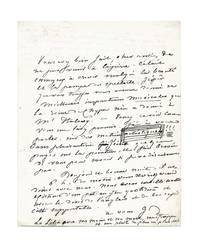
1856réf. 92346n. l. 1856. Fine. Delacroix Asks the Great Architect Hittorff to Support His Candidacy for the Académie n. l. 29 décembre 1856 13.2 x 20.6 cm Un bifeuillet Autograph letter signed by Eugène Delacroix with autograh date ""29 December 1856"" one and a half pages on a bifolium with usual folds. A precious letter by Delacroix to his celebrated colleague who laid out the squares avenues and gardens of the capital while the painter adorned its ceilings. Delacroix here addresses the architect responsible for the embellishment of the Champs-Élysées the Place de la Concorde and the Avenue de l'Étoile. As architect to the City of Paris and to the Government he who drew up the plans for the vast renovations in the Bois de Boulogne and its two lakes. He moved within the painter's circle his name appears in Delacroix's Journal and had been since 1853 a member of the Académie des Beaux-Arts: the very institution to which Delacroix had sought election seven times opposed each time by Ingres. Success came only days after this letter: Delacroix was elected to the most-coveted Institut on 10 January 1857 to the seat left vacant by painter Paul Delaroche. ""It is a month now since I have been suffering from a cold that has degenerated into an inflammation of the throat and for about twelve days I have been strictly confined indoors for fear of the outside cold. I deeply regret not having been able before this moment to come and speak with you regarding my candidacy. I hope however to be able to go out by the end of this week or the beginning of next: but in the meantime I take the liberty of commending myself to the kindness and obligingness you have so kindly shown me . E. Delacroix unknown
1850réf. 86760Champrosay s. d. [1840-1860] | 13.50 x 20.10 cm | une page sur un feuillet remplié
1842réf. Sand29DELACROIX SAND George 1804-1876 Two autograph letters signed " GS " to Eugène Delacroix Nohant 6 & 7 July 1842 3 p. in-8° in total in black ink Autograph addresses on verso Stamp marks previous trace of mounting Saddened by the departure of her "good little" Delacroix after the latter's stay in Nohant in the company of Chopin and the rest of the Sand family the writer found herself immersed in her reading of Les Mystères de Paris From the Marc Loliée library " Cher bon petit J'espère que vous êtes arrivé à bon port sans trop souffrir de la chaleur qui a été modérée le jour de votre départ. Vous avez oublié ici quelques effets dont Maurice a fait une caisse laquelle part aujourd'hui. Comme le port en est payé accusez-en réception afin qu'elle ne s'égare pas sans que nous la fassions réclamer. J'ai encore retrouvé dans mes mouchoirs un mouchoir à vous. Je vous le mets à part ainsi que ceux qui pourraient se retrouver au prochain blanchissage. Que Jenny la gouvernante de Delacroix ne nous accuse donc pas de vous avoir grinché vos zardes¹. – Je lis le Chourineur et je vous assure que malgré l'horreur du sujet et des détails² c'est jusqu'à présent fort intéressant et fabriqué avec beaucoup de talent. – Nous sommes restés tout tristes et tout déconfits de votre départ. Nous tâchons de jouer au billard mais je crois que vous avez emporté le carambouillage³ dans votre poche et que vous ne nous avez laissé que le manque de touche. J'attends avec impatience un petit mot de vous. Nous sommes encore trop chagrins pour vous en dire long aujourd'hui. Et puis l'heure me presse. À présent cher soyez bien portant. Si vous nous regrettez autant que nous vous regrettons faites un effort pour nous oublier jusqu'à notre retour Sand et Chopin rentreront à Paris le 31 juillet alors vous nous raimerez de nouveau. Adieu moi et tous vous embrassons et vous aimons. GS. " " Cher ami mon dadet sic de Thomas peut-être Thomas Aucante autrefois vacher a commencé le cours de bêtises auxquelles je dois m'attendre en ne payant pas le port de la caisse que je vous ai envoyée hier. Si bien qu'il faut que vous le sachiez afin de n'avoir pas de contestation avec l'administration. Accusez-moi réception car tout ceci a été fort mal fait malgré mes précautions. Nous nous portons bien. Nous vous aimons. J'ai rêvé de vous toute la nuit ; j'espère que c'est bon signe et que vous êtes bien portant. À vous GS. " In response to his friend's repeated invitations Delacroix spent nearly two weeks in Nohant in June 1842. He wanted above all to rest "vegetate" as he put it and enjoy the pleasures of the countryside. Back in Paris he replied on the 8th stating that he had received the crate and calling the person who had brought it to him a cheat and an imposter demanding postage. He asked his friend for a small purse left in Nohant a purse that Solange had given him and a small cord from Algiers. He concluded: "The weather is awful for the nerves. When you dreamed that you saw me did you dream that you were the Duchess of Berry I send you all my sincere embraces but I am very sad" Corr. gén. de Delacroix t. II p. 116. Using the slang present in Eugène Sue's work we understand that Sand is here in the middle of reading The Mysteries of Paris. The serial novel published in the Journal des débats from June 19 1842 to October 15 1843 inaugurated mass literature in the 19th century and earned its author immense fame in all social classes. Provenance: Bibliothèque Marc Loliée Bibliography: Correspondance t. V éd. G. Lubin Garnier n°2477 & 2478
1841réf. Sand14DELACROIX SAND George 1804-1876 Autograph letter signed " G.S. " to Eugène Delacroix Paris Postal mark 23rd December 1841 1 p. 1/2 in-8° Autograph address on fourth folio wax seal : " Monsieur Delacroix rue des Marais Saint Germain 17 " Superb letter to her friend Delacroix about her desire to write "a few pages on painting" the Femmes d'Alger her contempt for the Ingresque school and other artistic news " Vous avez bien fait cher ami de ne pas venir à l'Opéra. C'était ennuyeux à crever malgré la beauté et la pompe du spectacle. J'espère que vos truffes vous auront donné de meilleures inspirations musicales que la reine de Chypre n'en a donné à Mr Halevy.1 Venez ce soir comme vous me l'avez promis. J'ai à vous parler sur des matières artistiques !!! le mot est entouré par Sand d'un triple trait de plume. Sans plaisanterie j'écris quelques pages sur la peinture et j'ai besoin de vous pour savoir si je ne déraisonne pas. 2 Bonjour et bonne nuit. Il est 6h du matin. Vous devriez venir dîner avec nous. Nous avons embelli notre existence d'un pot-au-feu quotidien et avec le dîner de l'anglais3 et du bon café c'est supportable. G.S. La Lélia4avec son moine et son mort me frappe et me plaît de plus en plus c'est ce qui m'a mise en veine d'écrire sur la couleur et ce qu'il faut entendre par la forme. Avec ça j'ai vu vos femmes d'Alger5 ce matin. Si vous m'encouragez je suis capable de faire le prochain salon dans notre revue La Revue indépendante et vous savez que je ne caponnerai pas ne se montrera pas lâche avec tout cette école silhouettiste6 qui se dit en possession du dessin ". 1 La Reine de Chypre an opera in five acts by Halévy to a libretto by St. George took place the day before December 22 1841. Unlike George Sand Richard Wagner who was also present at the premiere considered the music "noble moved and even new and exhilarating" although he criticized Halévy's failings in simple orchestration. 2 In Horace which George Sand was then writing she staged a rapin a pupil of Delacroix but there were no "few pages on painting". Is this an article intended for the Independent Review – which it has just created – but which it has renounced The word written in postscript confirms that it is an aesthetic reflection that focuses on "color" and "form". 3 Possible reference to an English restaurateur or caterer frequented by George Sand. 4 Lélia avec son moine et son mort is the third work offered by Delacroix to George Sand for the gifts of 1842. It is a pastel depicting Lélia kneeling near Stenio's corpse while the monk Magnus "in the shadows leaning stiffly against the wall of the cave darted on her his sparkling eyes". The subject was treated several times by Delacroix. 5 This is the Femmes d'Alger dans leur appartement a painting presented at the Salon of 1834 where it caused a sensation. A synthesis of orientalism and romanticism this painting expresses a deep "melancholy" for the poet and art critic Baudelaire. 6 George Sand refers to the school of Ingres as a "Silhouettist school". We know the adversity between the two painters that animated the artistic scene of the nineteenth century. The writer had resolutely taken Delacroix's side that of "form" and "color". Bibliography: George Sand – Correspondance t. V Lubin Garnier p. 529-531 lettre n°2369 Correspondance éd. Françoise Alexandre Les éditions de l'Amateur p. 117-118 n°50 Provenance: Achille Piron Delacroix's universal legatee Bibliothèque Marc Loliée
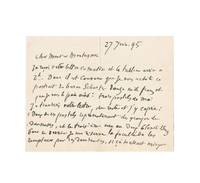
1895réf. Degas4DELACROIX DEGAS Edgar 1834-1917 Autograph letter signed "Degas" to collector Montagnac Np 27 June 1895 2 pages in-8 oblong on laid paper in bespoke leather sleeve. Fold marks previous and discreet tape repair on verso Degas collector acquires a painting by Delacroix in exchange for three of his pastels of dancers as currency " Cher Monsieur Montagnac Je reçois votre lettre ce matin et le tableau de Delacroix arrive à 2h. Donc il est convenu que je vous achète ce portrait du baron Schwiter douze mille francs et que je vous paie ainsi : trois pastels de moi. Je transcris votre lettre du reste j'y copie : Deux de ces pastels représenteront des groupes de danseuses et le troisième une ou deux blanchisseuses. Pour ce dernier je me réserve la faculté de les remplacer par des danseuses si ça m'allait mieux. Si vous pouvez me dites-vous me livrer un de ces pastels d'ici un ou deux mois vous me feriez le plus grand plaisir. Vous ajoutez : Il est entendu que les 3 pastels seront terminés pour l'hiver prochain. Tout cela est bien et j'y souscris. Au revoir cher Monsieur et recevez mes remercîments. Degas " A shrewd collector Degas had assembled a remarkable collection of paintings from the Renaissance to Romanticism including Greco Ingres Courbet Delacroix etc. Of the latter of which he owned thirteen paintings it is the portrait of Baron Schwiter that is here the object of his lusts. This full-length portrait of Baron Louis de Schwiter 1805-1889 an important collector and familiar of Delacroix was painted in 1827. Refused by the jury of the Salon the same year it is now kept at the National Gallery in London which had acquired it during the dispersal of Degas' property after his passing in 1917. Provenance: Bibliothèque Bernard Loliée
1840réf. 77055Léon Curmer | Paris 1840-1842 | 18 x 26.50 cm | 11 volumes reliés
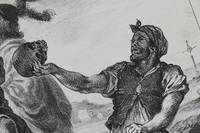
1843réf. 48704Paris.: Chez Gihaut Frères. 1843. Loose as issued with the original front and rear wrappers housed in modern box; wrappers torn with tape repair; occasional foxing to some plates mainly in the margins damp-staining affecting the upper margin only of one plate a small stain on the far right margin of another plate. Folio. 13 original lithographs by Eugène Delacroix. The complete suite of the first published edition on large paper.From the first published edition with 13 original lithographs limited to 80 copies with this one of 60 on French paper; 20 copies were also issued on Chine.Delacroix originally composed 16 lithographs in order to illustrate Hamlet the work gradually being completed between 1834 and 1843 but only 13 were issued with the first published edition. All of the prints presented here are with letters and the majority are with the printer’s imprint of Villain. The prints in the set are as follows: - 'La reine s'efforce de consoler Hamlet' Robaut 577; Delteil 103; - 'Hamlet veut suivre l'ombre de son père' Robaut 578; Delteil 104; - 'La fantôme sur une autre partie de la terrasse' Robaut 579; Delteil 105; - 'Polonius and Hamlet' Robaut 580; Delteil 106; - 'Hamlet fait jouer aux comediens la scène de l'empoisonnement de son père' Robaut 583; Delteil; Delteil 109; - 'Hamlet et Guildenstern' Robaut 584; Delteil 108; - 'Hamlet tente de tuer le roi' Robaut 585; Delteil 110; - 'Le meurtre de Polonius' Robaut 586 - 587; Delteil 111; - 'Hamlet et la reine' Robaut 588; Delteil 112; - 'Hamlet et le cadavre de Polonius' Robaut 589; Delteil 113; - 'Mort d'Ophélie' Robaut 591 - 592; Delteil 115; - 'Hamlet et Horatio devant les fossoyeurs' Robaut 593 - 594; Delteil 116; - 'Mort d'Hamlet' Robaut 597; Delteil 118. Chez Gihaut Frères. unknown
1823réf. 759401823. Fine. s. d. ca 1823 12 x 18.20 cm Six pages sur deux feuillets rempliés Almost entirely unpublished handwritten letter from the painter Eugène Delacroix to the love of his youth the mysterious Julie now identified as being Madame de Pron by her maiden name Louise du Bois des Cours de La Maisonfort wife of Louis-Jules Baron Rossignol de Pron and daughter of the Marquis de La Maisonfort Minister of France in Tuscany patron of Lamartine and friend of Chateaubriand. 90 lines 6 pages on two folded leaves. A few deletions and two bibliographical annotations in pencil on the upper part of the first page no114. This letter is one of the last to his lover in private ownership all of Delacroix's correspondence to Madame de Pron being kept at the Getty Research Institute Los Angeles. Only nine of the ninety lines of this unpublished letter were transcribed in the Burlington Magazine in September 2009 alongside the long article by Michèle Hanoosh Bertrand and Lorraine Servois whose research finally revealed the identity of the famous recipient. Sublime love letter from twenty-four-year-old Eugène Delacroix addressed to his lover Madame de Pron twelve years his senior who unleashed the liveliest passion in him. This episode of the painter's youth then considered the rising star of Romanticism for a long time remained a mystery in the biography of Delacroix who was careful to preserve the anonymity of his lover thanks to various pseudonyms: Cara the Lady of the Italians and even Julie as in this letter in reference to the famous epistolary novel Julie ou la Nouvelle Héloïse by Rousseau. For obvious reasons Delacroix did not sign his name on any of the letters in correspondence with the lady. A great figure of the legitimate aristocracy the recipient of this feverish letter is Madame de Pron daughter of the Marquis de La Maisonfort Minister of France in Tuscany patron of Lamartine friend of Chateaubriand. Her beauty was immortalized in 1818 by Élisabeth Vigée-Lebrun who painted her portrait in pastel with an oriental hairstyle. Delacroix and Madame de Pron met in April 1822 when the portrait of the latter's son Adrien was commissioned a pupil at the Lycée Impérial now Lycée Louis-le-Grand. Delacroix had been commissioned for the portrait by his close friend Charles Soulier Madame de Pron's lover who despite himself served as an intermediary for Delacroix. In the absence of Soulier who had gone to Italy the painter and the young women established an intense romantic relationship. The portrait commission became a pretext for their tender meetings in his studio on rue de Grès while no trace of the child's painting has been found to this day. Their adventure lasted a little over a year but it was one of the most intense passions of the artist's life. Our letter undoubtedly corresponds to the last throes of their relationship in the month of November 1823. After one of their visits at the end of a hiatus of several months Delacroix writes to her again under the influence of emotion: I come home with a shaken heart what a wonderful evening! . Sometimes I say to myself: why did I see her again In the calm sanctuary where I lived even in the middle of the invisible places that I had formed . I managed to silence my heart. Madame de Pron had indeed decided to bring an end to their intimate relationship see her letter from 10 November 1823: I want sweet friendship . I do not want to torment you Getty Research Institute. Losing all discernment and with blind devotion Delacroix attempts to revive their affair: Make me lie prove to me that your soul is indeed that of the Julie that I once knew since mine has regained its charming emotions and its worries. But the painter runs into Soulier and General de Coëtlosquet also lovers of Madame de Pron. Delacroix had narrowly avoided a final disagreement with Soulier who had almost seen a letter from Madame de Pron in h unknown
1828réf. 48710Paris.: Ch. Motte & Sautelet. 1828. Black morocco-backed marbled boards and endpapers gilt spine original printed wrappers by Devéria bound in. Folio. Frontispiece portrait of Goethe half-title additional lithograph wrapper by Devéria title and 17 lithographs by Delacroix. A large paper copy of the first edition of Delacroix’s masterful interpretation of ‘Faust’ a pioneering meeting of word and image and a monument of nineteenth-century illustration.All of the plates printed on chine and mounted to larger sheets conform to first or first published state with the address of ‘Ch. Motte’. The wrapper is present in two states one of the front cover on white paper and the other including both the front and rear covers and the backstrip on blue paper.One of the monuments of nineteenth-century illustration.'Ouvrage remarquable et typique de l'époque romantique illustration magistrale du grand Delacroix qui est heureusement de plus en plus estimé des bibliophiles de gout.' Carteret. Ch. Motte & Sautelet. hardcover
1843réf. 87676Chez Gihaut frères, Edit. Boulevard des Italiens, 5 | Paris s.d. (1843) | 36.40 x 49.80 cm | relié
1843réf. 87676Paris: Chez Gihaut frères Edit. Boulevard des Italiens 5 1843. Fine. Chez Gihaut frères Edit. Boulevard des Italiens 5 Paris s.d. 1843 36.40 x 49.80 cm relié Complete set of 13 original lithographs by Eugène Delacroix in first edition first issue with the letter one of 20 copies on Chine paper pasted on laid paper: ""It was originally printed in a few proofs on Chine the format of which exceeds the square line by one or two centimeters. They are highly sought-after even though they bear the letter"" Robaut. Bound in the original publisher's brown half-shagreen binding title gilt stamped on first board original first cover wrapper preserved. Small restored tear to the margin of the wrapper over 5 cm sunned spine joints and corners rubbed scattered foxing and a dampstain to the lower part of the laid paper on which the lithographs are pasted on without affecting the lithographs themselves. Exceptional and rare set of original lithographs by Eugène Delacroix on Chine paper illustrating Shakespeare's masterpiece. A cornerstone of Romantic art this series was ""made at M. Delacroix's personal expense. Only 80 copies were printed 60 on blanc and 20 on chine and these were sold out at the time of the author's death"" Henri Béraldi. It is now esteemed as Delacroix's most accomplished graphic undertaking which took him more than ten years to achieve and generally considered to be one of the first modern livres de peintre. This is Delacroix's second lithographic portfolio based on a literary work after Goethe's 'Faust' in 1828. Strongly influenced by Goya's Caprices the plates feature deep black tones and striking contrasts magnified by the Chine paper: ""No one is unaware of the important role played by Delacroix in lithography . in the Hamlet in the Horse struck down by a tiger or better still in the Lion of the Atlas and the Royal Tiger these marvels he shows what vigor and color the lithographic pencil can acquire in the hand of a master""Henri Béraldi. Despite good reviews from Théophile Gautier and Jules Janin the Hamlet suite remained little-known from the moment of its publication by the Gihaut brothers upon Delacroix's request: ""I had them printed in small numbers and I was well advised for they were not successful and were far from having met printing costs"" wrote Delacroix in a letter to Champfleury May 1 1852. Even in the 19th-century copies on Chine paper were almost impossible to find: only twenty years after publication Philippe Burty considered the set ""so rare now"" regardless of its different issues Colonel De La Combe sale 1863. His contribution to Hamlet's visual imagination and iconography is immense. Delacroix first created the pose of Ophelia's lifeless body lying horizontally on the water - foreshadowing John Everett Millais' famous painting. It was from these lithographs that a number of his paintings were created: ""Between the 1830s and his death Delacroix also painted oil versions of a number of lithographs including Hamlet and His Mother now in the Metropolitan Museum."" Alan R. Young Hamlet and the Visual Arts 1709-1900. Delacroix showed interest in Shakespeare's theater - and Hamlet in particular - early on. As a youth he signed some of his letters ""Yorick"" when recounting his first passions for the young Englishwoman Elizabeth Salter. According to his diary studied by Luciana Lourenço Paes he probably read the play in the original English and identified with the main protagonist who inspired his ""Self-portrait as Hamlet"" now in the Musée Delacroix. In 1825 the painter traveled to London where he attended several of the Bard's plays and apparently regretted missing the Hamlet performed by the legendary Henry Keane at the Drury Lane Theater. Two years later Delacroix was among the Romantics who fell under the spell of a special performance of Hamlet at the Théâtre de l'Odéon by the English company of Covent Garden director Charles Kemble. It was the first time Shakespeare had been played in his origin Chez Gihaut frères, Edit. Boulevard des Italiens, 5 unknown