1.807 resultados
1842ref. Sand29DELACROIX SAND George 1804-1876 Two autograph letters signed " GS " to Eugène Delacroix Nohant 6 & 7 July 1842 3 p. in-8° in total in black ink Autograph addresses on verso Stamp marks previous trace of mounting Saddened by the departure of her "good little" Delacroix after the latter's stay in Nohant in the company of Chopin and the rest of the Sand family the writer found herself immersed in her reading of Les Mystères de Paris From the Marc Loliée library " Cher bon petit J'espère que vous êtes arrivé à bon port sans trop souffrir de la chaleur qui a été modérée le jour de votre départ. Vous avez oublié ici quelques effets dont Maurice a fait une caisse laquelle part aujourd'hui. Comme le port en est payé accusez-en réception afin qu'elle ne s'égare pas sans que nous la fassions réclamer. J'ai encore retrouvé dans mes mouchoirs un mouchoir à vous. Je vous le mets à part ainsi que ceux qui pourraient se retrouver au prochain blanchissage. Que Jenny la gouvernante de Delacroix ne nous accuse donc pas de vous avoir grinché vos zardes¹. – Je lis le Chourineur et je vous assure que malgré l'horreur du sujet et des détails² c'est jusqu'à présent fort intéressant et fabriqué avec beaucoup de talent. – Nous sommes restés tout tristes et tout déconfits de votre départ. Nous tâchons de jouer au billard mais je crois que vous avez emporté le carambouillage³ dans votre poche et que vous ne nous avez laissé que le manque de touche. J'attends avec impatience un petit mot de vous. Nous sommes encore trop chagrins pour vous en dire long aujourd'hui. Et puis l'heure me presse. À présent cher soyez bien portant. Si vous nous regrettez autant que nous vous regrettons faites un effort pour nous oublier jusqu'à notre retour Sand et Chopin rentreront à Paris le 31 juillet alors vous nous raimerez de nouveau. Adieu moi et tous vous embrassons et vous aimons. GS. " " Cher ami mon dadet sic de Thomas peut-être Thomas Aucante autrefois vacher a commencé le cours de bêtises auxquelles je dois m'attendre en ne payant pas le port de la caisse que je vous ai envoyée hier. Si bien qu'il faut que vous le sachiez afin de n'avoir pas de contestation avec l'administration. Accusez-moi réception car tout ceci a été fort mal fait malgré mes précautions. Nous nous portons bien. Nous vous aimons. J'ai rêvé de vous toute la nuit ; j'espère que c'est bon signe et que vous êtes bien portant. À vous GS. " In response to his friend's repeated invitations Delacroix spent nearly two weeks in Nohant in June 1842. He wanted above all to rest "vegetate" as he put it and enjoy the pleasures of the countryside. Back in Paris he replied on the 8th stating that he had received the crate and calling the person who had brought it to him a cheat and an imposter demanding postage. He asked his friend for a small purse left in Nohant a purse that Solange had given him and a small cord from Algiers. He concluded: "The weather is awful for the nerves. When you dreamed that you saw me did you dream that you were the Duchess of Berry I send you all my sincere embraces but I am very sad" Corr. gén. de Delacroix t. II p. 116. Using the slang present in Eugène Sue's work we understand that Sand is here in the middle of reading The Mysteries of Paris. The serial novel published in the Journal des débats from June 19 1842 to October 15 1843 inaugurated mass literature in the 19th century and earned its author immense fame in all social classes. Provenance: Bibliothèque Marc Loliée Bibliography: Correspondance t. V éd. G. Lubin Garnier n°2477 & 2478
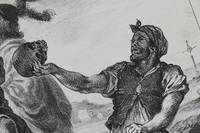
1843ref. 49023Paris.: Chez Gihaut Frères. 1843. Loose as issued with the original front wrapper with printed titles in black. Folio. 494 x 328 mm. Leaf with title front wrapper and 13 original lithographs by Eugène Delacroix each with quotation from Shakespeare in French beneath. The complete suite of the first published edition on large paper.From the first published edition with 13 original lithographs limited to 80 copies with this one of 60 on French paper; 20 copies were also issued on Chine.Delacroix originally composed 16 lithographs in order to illustrate Hamlet the work gradually being completed between 1834 and 1843 but only 13 were issued with the first published edition. All of the prints presented here are with letters and the majority are with the printer’s imprint of Villain. The prints in the set are as follows: - 'La reine s'efforce de consoler Hamlet' Robaut 577; Delteil 103; - 'Hamlet veut suivre l'ombre de son père' Robaut 578; Delteil 104; - 'La fantôme sur une autre partie de la terrasse' Robaut 579; Delteil 105; - 'Polonius and Hamlet' Robaut 580; Delteil 106; - 'Hamlet fait jouer aux comediens la scène de l'empoisonnement de son père' Robaut 583; Delteil; Delteil 109; - 'Hamlet et Guildenstern' Robaut 584; Delteil 108; - 'Hamlet tente de tuer le roi' Robaut 585; Delteil 110; - 'Le meurtre de Polonius' Robaut 586 - 587; Delteil 111; - 'Hamlet et la reine' Robaut 588; Delteil 112; - 'Hamlet et le cadavre de Polonius' Robaut 589; Delteil 113; - 'Mort d'Ophélie' Robaut 591 - 592; Delteil 115; - 'Hamlet et Horatio devant les fossoyeurs' Robaut 593 - 594; Delteil 116 - with a large tear through the upper blank margin of the sheet not affecting the image; - 'Mort d'Hamlet' Robaut 597; Delteil 118. Chez Gihaut Frères. unknown
1840ref. 77055Léon Curmer | Paris 1840-1842 | 18 x 26.50 cm | 11 volumes reliés
1840ref. 77055Paris: Léon Curmer 1840. Fine. Léon Curmer Paris 1840-1842 18 x 26.50 cm 11 volumes reliés Les Français peints par eux-mêmes. Encyclopédie morale du dix-neuvième siècle Le Prisme with Les Anglais peints par eux-mêmes The French painted by themselves The English painted by themselves Léon Curmer Paris 1840-1842 18 x 265 cm 11 volumes in half morocco First edition one of the grand papier deluxe copies with two states of the illustrations for the 8 volumes of Les Français peints par eux-mêmes: one in black on tinted paper and one enhanced by hand using the so-called coloris gommé technique with watercolour and varnish on white paper. Les Anglais peints par eux-mêmes includes the engravings in black. No deluxe copies in colour have been made for this rare set of Les Français. Bound in half brown morocco spine in five compartments enhanced with stipple engraving and double gilt panels richly decorated with gilt floral motifs framing a mosaic medallion of green morocco with a gilt rose stamped in the center cartouches at the top decorated with a gilt garland framing the place and publication date some light minor rubbing on some compartments gilt fillets on the marbled paper boards comb-patterned endpapers top edges gilt. Elegant late nineteenth century bindings signed Durvand-Thiret. Complete with all engravings along with added engravings i.e. 930 engravings including 415 in colour. Title pages dated 1841 for all volumes of Les Français except for volume 5 of Les Parisiens and volume 3 of La Province dated 1842. Les Français peints par eux-mêmes has 415 engravings in black including that of Napoleon on horseback instead of the 405 announced and 415 in colour including a double page map of France in volume III of the Province. The English volume illustrated by Kenny Meadous is complete with 100 plates in black. This unique set contains in total almost a thousand black and coloured engravings and more than 1500 in-text illustrations. Famous gallery of woodcut portraits depicting the social classes of the 19th century by the greatest artists of the time: Gavarni Daumier Delacroix Grandville Johannot Bellangé Charlet Daubigny etc. The portraits are all accompanied by original texts from the most famous Romantic authors including: Balzac Nodier Gautier Nerval Gozlan Janin Karr etc. Scarce foxing affecting mainly the Prism and the Anglais. The texts and illustrations of the book paint a lively picture of inhabitants and their trade in metropolitan France and its colonies. It sets the tone for panoramic literature a new genre coined by Walter Benjamin in Charles Baudelaire. A lyric poet at the height of capitalism. In addition to these portraits of the Français the contribution of a whole areopagus of great and small authors and illustrators S. Le Men La 'littérature panoramique' dans la genèse de la Comédie Humaine: Balzac et Les Français peints par eux-mêmes L'Année balzacienne 2002/1 No. 3 CAIRN includes some of the most renowned authors and cartoonists of the time each of whom made an original creation for the project. This protean fresco was directed by editor Léon Curmer already known for the publishing success of Paul et Virginie between 1836 and 1838. Curmer is represented here by an article L'éditeur in volume IV written by Elias Regnault. The latter takes example in Louis-Sebastien Mercier's Tableau de Paris published in 1781 whose vision is even further extended by the representation of French provinces in Les Français. Thanks to Curmer the work finds an even deeper meaning: the editor has widened his frame and instead of letting a few fleeting portraits get lost in the immense daily whirlwind that engulfs all things he has sought to bring together the most salient physiognomies of that time. S. Le Men Ibid. Curmer selected the authors and illustrators closest to the ones they depict: It is therefore a question of calling upon authors and illustrators who are wel Léon Curmer hardcover

1828ref. 48710Paris.: Ch. Motte & Sautelet. 1828. Black morocco-backed marbled boards and endpapers gilt spine original printed wrappers by Devéria bound in. Folio. Frontispiece portrait of Goethe half-title additional lithograph wrapper by Devéria title and 17 lithographs by Delacroix. A large paper copy of the first edition of Delacroix’s masterful interpretation of ‘Faust’ a pioneering meeting of word and image and a monument of nineteenth-century illustration.All of the plates printed on chine and mounted to larger sheets conform to first or first published state with the address of ‘Ch. Motte’. The wrapper is present in two states one of the front cover on white paper and the other including both the front and rear covers and the backstrip on blue paper.One of the monuments of nineteenth-century illustration.'Ouvrage remarquable et typique de l'époque romantique illustration magistrale du grand Delacroix qui est heureusement de plus en plus estimé des bibliophiles de gout.' Carteret. Ch. Motte & Sautelet. hardcover
1843ref. 87676Chez Gihaut frères, Edit. Boulevard des Italiens, 5 | Paris s.d. (1843) | 36.40 x 49.80 cm | relié
1843ref. 87676Paris: Chez Gihaut frères Edit. Boulevard des Italiens 5 1843. Fine. Chez Gihaut frères Edit. Boulevard des Italiens 5 Paris s.d. 1843 36.40 x 49.80 cm relié Complete set of 13 original lithographs by Eugène Delacroix in first edition first issue with the letter one of 20 copies on Chine paper pasted on laid paper: ""It was originally printed in a few proofs on Chine the format of which exceeds the square line by one or two centimeters. They are highly sought-after even though they bear the letter"" Robaut. Bound in the original publisher's brown half-shagreen binding title gilt stamped on first board original first cover wrapper preserved. Small restored tear to the margin of the wrapper over 5 cm sunned spine joints and corners rubbed scattered foxing and a dampstain to the lower part of the laid paper on which the lithographs are pasted on without affecting the lithographs themselves. Exceptional and rare set of original lithographs by Eugène Delacroix on Chine paper illustrating Shakespeare's masterpiece. A cornerstone of Romantic art this series was ""made at M. Delacroix's personal expense. Only 80 copies were printed 60 on blanc and 20 on chine and these were sold out at the time of the author's death"" Henri Béraldi. It is now esteemed as Delacroix's most accomplished graphic undertaking which took him more than ten years to achieve and generally considered to be one of the first modern livres de peintre. This is Delacroix's second lithographic portfolio based on a literary work after Goethe's 'Faust' in 1828. Strongly influenced by Goya's Caprices the plates feature deep black tones and striking contrasts magnified by the Chine paper: ""No one is unaware of the important role played by Delacroix in lithography . in the Hamlet in the Horse struck down by a tiger or better still in the Lion of the Atlas and the Royal Tiger these marvels he shows what vigor and color the lithographic pencil can acquire in the hand of a master""Henri Béraldi. Despite good reviews from Théophile Gautier and Jules Janin the Hamlet suite remained little-known from the moment of its publication by the Gihaut brothers upon Delacroix's request: ""I had them printed in small numbers and I was well advised for they were not successful and were far from having met printing costs"" wrote Delacroix in a letter to Champfleury May 1 1852. Even in the 19th-century copies on Chine paper were almost impossible to find: only twenty years after publication Philippe Burty considered the set ""so rare now"" regardless of its different issues Colonel De La Combe sale 1863. His contribution to Hamlet's visual imagination and iconography is immense. Delacroix first created the pose of Ophelia's lifeless body lying horizontally on the water - foreshadowing John Everett Millais' famous painting. It was from these lithographs that a number of his paintings were created: ""Between the 1830s and his death Delacroix also painted oil versions of a number of lithographs including Hamlet and His Mother now in the Metropolitan Museum."" Alan R. Young Hamlet and the Visual Arts 1709-1900. Delacroix showed interest in Shakespeare's theater - and Hamlet in particular - early on. As a youth he signed some of his letters ""Yorick"" when recounting his first passions for the young Englishwoman Elizabeth Salter. According to his diary studied by Luciana Lourenço Paes he probably read the play in the original English and identified with the main protagonist who inspired his ""Self-portrait as Hamlet"" now in the Musée Delacroix. In 1825 the painter traveled to London where he attended several of the Bard's plays and apparently regretted missing the Hamlet performed by the legendary Henry Keane at the Drury Lane Theater. Two years later Delacroix was among the Romantics who fell under the spell of a special performance of Hamlet at the Théâtre de l'Odéon by the English company of Covent Garden director Charles Kemble. It was the first time Shakespeare had been played in his origin Chez Gihaut frères, Edit. Boulevard des Italiens, 5 unknown