319 resultados
1858ref. 37453Auxerre Typographie Ch. Gallot s.d. [1858] prospectus in-8 en feuille
ref. 13899Le bazar des récréations prime offerte aux abonnés du conseiller des enfants. Première série. In 12 broché à l’italienne, plats illustrés (lithographie) en noir. Titre illustré, 46 pages, 1 page de table des matières, texte sur 2 colonnes, 10 lithographies, hors-texte, plus la couverture, d’Henry EMY Paris- Bureaux Rue Montmartre 163 sans date. Quelques traces de manipulations, cependant bon état d’ensemble. La corde -le saute mouton-le colin Maillard- la marelle- les quatre coins- la paume, le volant, le bilboquet etc.
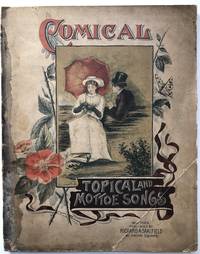
1887ref. H7060New York: Richard A. Saalfield 1887. Good. Quarto 11.5 inches tall pictorial color wraps 171 pp of music plus a few ads. Good with some staining and loss to spine crease on cover mended on the verso with old tape; it has not stained the page light wear and soil some wear to title page and to table of contents page soil but generally very good and clean inside. RARE with only one copy cited by OCLC at Brown University. Unusually the cover artist misspelled 'motto' as 'mottoe' -- see one of the pics for a shot of the table of contents. Richard A. Saalfield unknown
1910ref. List3655New York / Chicago / London: M. Witmark & Sons 1910. Folio sheet music 13 ½ x 10 ½ inches. Color pictorial cover. Light wear and minor creasing to edges; very good overall. A lively Irish-themed novelty song promoted as "Emma Carus' Great Irish Song Hit" issued by the major popular music publisher M. Witmark & Sons. The cover illustration shows Carus dancing before a marching crowd carrying a banner reading "Home Rule" evoking the Irish nationalist movement then a prominent political issue both in Ireland and among Irish-American communities. Emma Carus 1879-1927 was a well-known American vaudeville performer and comic singer who appeared widely in theaters and variety shows during the early twentieth century. Born in New York she became a popular stage personality through novelty songs and character performances often introducing new numbers that were quickly issued in sheet music by publishers such as Witmark. The present piece with lyrics by Bob Harty and music by Ernest Breuer reflects the continuing popularity of Irish-themed songs in American vaudeville and popular music during the period when political themes such as Irish Home Rule frequently appeared in theatrical songs and stage sketches aimed at Irish-American audiences. We find a copy with a variant cover in commerce but not this design. M. Witmark & Sons unknown
1910ref. List3655New York / Chicago / London: M. Witmark & Sons 1910. Folio sheet music 13 ½ x 10 ½ inches. Color pictorial cover. Light wear and minor creasing to edges; very good overall. A lively Irish-themed novelty song promoted as "Emma Carus' Great Irish Song Hit" issued by the major popular music publisher M. Witmark & Sons. The cover illustration shows Carus dancing before a marching crowd carrying a banner reading "Home Rule" evoking the Irish nationalist movement then a prominent political issue both in Ireland and among Irish-American communities. Emma Carus 1879-1927 was a well-known American vaudeville performer and comic singer who appeared widely in theaters and variety shows during the early twentieth century. Born in New York she became a popular stage personality through novelty songs and character performances often introducing new numbers that were quickly issued in sheet music by publishers such as Witmark. The present piece with lyrics by Bob Harty and music by Ernest Breuer reflects the continuing popularity of Irish-themed songs in American vaudeville and popular music during the period when political themes such as Irish Home Rule frequently appeared in theatrical songs and stage sketches aimed at Irish-American audiences. We find a copy with a variant cover in commerce but not this design. M. Witmark & Sons unknown books
1923ref. 63201New York: George H. Doran 1923. 8vo. xiv 337 1 pp. Frontisp. numerous illustrations plates photos. Gray publisher’s cloth red lettering minor dustsoiling & slight foxing to fore-edges of textblock w/ d.j. cover art by James Montgomery Flagg minor dustsoiling rubbing faint stain soiling to spine still VG-/G- copy. First edition of this thrilling and inspirational story of the famed pioneering journalist publicist for P.T. Barnum Circus the Olympic Music Hall agent for the Orpheum vaudeville circuit and more. She represented Al Jolson Will Rogers Lillian Russell and many others. In 1919 she lost her life savings to a bad investment and was confined to a hospital for 5 years in cast and braces because of a paralyzing back injury. This inspirational story was written with one hand holding a pencil and moving over a pad of paper while flat on her back. Illustrations were contributed to this memoir by Rube Goldberg James Montgomery Flagg Tony Sarg Thornton Fisher Ed Hughes and others. Scarce in dustjacket. George H. Doran, hardcover
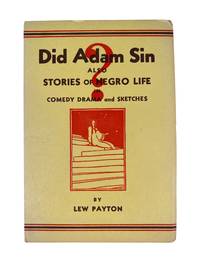
1937ref. 221321937. African AmericanTheaterLiterature Payton Lew. Did Adam Sin Also Stories of Negro Life in Comedy Drama and Sketches. Los Angeles: Lew Payton 1937. First edition. 132 pages. Original yellow wrappers printed in red and brown featuring an abstract graphic of a seated classical figure and a prominent red question mark in the background. A scarce self-published collection of dramatic sketches. Did Adam Sin represents a significant contribution to African American theatrical literature during the Harlem Renaissance's waning years. Written by actor playwright and vaudeville veteran Lew Payton the book offers seven stage-ready works that explore the lives struggles and humor of Black Americans in the early 20th century. Titles include A Bitter Pill Two Sons of Ham and Who Is De Boss blending satire pathos and social commentary with vernacular expression and period-specific concerns. Lew Payton began performing as a child in West Virginia and came of age as an entertainer during the height of Black vaudeville. Here Payton archives both the legacy of African American popular performance and his personal experience in street parades cakewalk acts and Hollywood film roles. The introduction recounts Payton's early experiences with minstrel circuits and his Los Angeles school for Black stage actors. This context situates the collection not only as literature but as pedagogical tool and cultural preservation. The plays foreground the racial dynamics resilience and humor of Black life offering roles that resist the demeaning stereotypes endemic to Hollywood and white theater. Contemporary scholarship increasingly cites Did Adam Sin for its historical value and its intervention into the politics of representation in American drama. Minor edge wear and light toning to wrappers; interior clean and bright; spine uncreased. Overall very good condition. A scarce and important work in the canon of African American theater notable for its authorship self-publication and its insight into Black performance culture during the interwar period. unknown
1937ref. 221321937. African AmericanTheaterLiterature Payton Lew. Did Adam Sin Also Stories of Negro Life in Comedy Drama and Sketches. Los Angeles: Lew Payton 1937. First edition. 132 pages. Original yellow wrappers printed in red and brown featuring an abstract graphic of a seated classical figure and a prominent red question mark in the background. A scarce self-published collection of dramatic sketches. Did Adam Sin represents a significant contribution to African American theatrical literature during the Harlem Renaissance's waning years. Written by actor playwright and vaudeville veteran Lew Payton the book offers seven stage-ready works that explore the lives struggles and humor of Black Americans in the early 20th century. Titles include A Bitter Pill Two Sons of Ham and Who Is De Boss blending satire pathos and social commentary with vernacular expression and period-specific concerns. Lew Payton began performing as a child in West Virginia and came of age as an entertainer during the height of Black vaudeville. Here Payton archives both the legacy of African American popular performance and his personal experience in street parades cakewalk acts and Hollywood film roles. The introduction recounts Payton's early experiences with minstrel circuits and his Los Angeles school for Black stage actors. This context situates the collection not only as literature but as pedagogical tool and cultural preservation. The plays foreground the racial dynamics resilience and humor of Black life offering roles that resist the demeaning stereotypes endemic to Hollywood and white theater. Contemporary scholarship increasingly cites Did Adam Sin for its historical value and its intervention into the politics of representation in American drama. Minor edge wear and light toning to wrappers; interior clean and bright; spine uncreased. Overall very good condition. A scarce and important work in the canon of African American theater notable for its authorship self-publication and its insight into Black performance culture during the interwar period. unknown books
1762ref. 4516Chez Duchesne 14,5 x 22 Paris Edition Originale 1762 Plaquette in-8, reliure demi-vélin de l'époque, plats cartonnés papier caillouté, dos lisse, titre noir, gravure de Soliman II en frontispice signée Gravelot - Lemire, [4]-102 pp., suivies de deux pages de privilège et de deux pages de "Catalogues des pièces des comédies française et italienne, parodies et opéra comiques qui se vendent détachées". Bandeau gravé en tête de l'épitre dédicatoire au Maréchal de Richelieu. Edition originale de cette célèbre pièce de Favart (Paris 1710 - Belleville 1792) "représentée pour la première fois par les comédiens italiens ordinaires du roi le 9 avril 1761 et remise au théatre le 19 décembre de la même année" où Mme Favart sa femme joue le rôle de Roxelane, et et qui fut représentée sous le titre des "Trois sultanes". Petite salissure à l'angle extérieur du frontispice, bon intérieur. (EvC143) PHOTOS NUMERIQUES DISPONIBLES PAR EMAIL SUR SIMPLE DEMANDE-DIGITAL PHOTOGRAPS MAY BE AVAILABLE ON REQUEST. Livre
ref. 17424Lauder undated; Logan Stonehaven 1987. Page detached from an autograph album 17.5 x 11cm good condition. On the recto the autograph signature of Harry Lauder with the trademark sketch of himself with bonnet and pipe. On the verso the following by Logan "To Archie Many Happy memories of Lauder and Jimmy Logan his signature Stonehaven 1987." Note: Logan "His one-man musical based on the life of Scottish entertainer Sir Harry Lauder was called Lauder 1976.5 Logan collected Lauder memorabilia which is now housed in the Scottish Theatre Archive at the University of Glasgow.". Lauder undated; Logan, Stonehaven 1987. unknown
ref. BIBRR111230005Paperback. USED. THIS RARE/ANTIQUE BOOK PUBLISHED IN THE YEAR 1965 BY Institut francais d'indologie HAVING 100 PGS AND SIZE 6.509.50 WRITTEN IN English. THE BOOK IS IN READABLE CONDITION Originally in Unbound with some issues like PB damage and some Pin Holes. THE IMAGE OF THIS BOOK IS GIVEN FOR YOUR REFERENCE. WE CAN REBIND THE SAME IN LEATHER BINDING FOR EXTRA $ 25. paperback
190910 pages plus 2 pages of advertisements. Heavily worn. Few markings. Sheet music
ref. 6073Ne semble pas avoir été édité.Très bel état. Plein papier, pièce de titre sur le plat supérieur. Reliure moderne dans le style de l'époque. Très bon XIXè siècle 1 volume in-4°
ref. 18981comédie-vaudeville improvisée en un acte, composée en cinq heures, dans la grande salle de l'hôtel de ville de Toulon, sur un sujet fourni par le public. Toulon. Aurel. 1829. In-8 (22x13). 24 pages. Demi-basane modeste de l'époque.
1845ref. 37390[Paris] Typographie Vinchon s.d. [1845] prospectus in-8 en feuille
1846ref. 37394S.l. [Paris] s.d. [1846] prospectus in-8 en feuille
1857ref. 37444Auxerre Imprimerie, librairie et lithographie Ch. Gallot s.d. [1857] prospectus in-8 en feuille
ref. AMA-654Belle affiche imprimée Belle affiche imprimée en noir sur papier saumon dans un encadrement de feuilles d’acanthe. Orléans, Imprimerie Ve Huet-Perdoux. 600 x 435 mm.
ref. AMA-655Affiche imprimée en noir sur papier blanc, [Orléans],Imprimerie de Danicourt-Huet rue Royale n° 94, 1825. Petite mouillure avec menu manque au coin supérieur gauche.
ref. 654In 8 broché,190 pages,24 illustrations hors-texte en couleurs et 19 dans le texte de DUBOUT.Edition du livre Monte-Carlo.1944.édition numérotée sur grand velin Crèvecoeur. emboîtage avec titre doré pour le premier et bordure toilée bleu pour le second.très bon état.
1924ref. 39161Vaudeville Managers Protective Association 1924. vg-. Vaudeville Managers Protective Association unknown
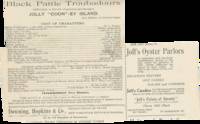
1899ref. List2923Portland Oregon 1899. Two double-sided clippings measuring approximately 7 ½ x 4 ¾ inches both put together with tape. Slightly wrinkled and toned; excellent. Matilda Sissieretta Jones 1869–1933 was an African-American opera singer from Portsmouth Virginia. She studied at the Providence Academy of Music and the New England Conservatory in Boston. At the start of her career Jones sang solo or in small groups touring North and South America the Caribbean and Europe. Jones’ talent was renowned; she was the first Black artist to sing at Carnegie Hall and she performed for multiple US presidents and the English royal family among many other accomplishments.1 In 1896 she formed Black Patti’s Troubadours—Jones was given the nickname “Black Patti” by a critic after famed Spanish opera singer Adelina Patti. The Troubadours would perform comical vaudeville and minstrel skits without Jones followed by Jones performing her “operatic kaleidoscope” of musical excerpts. Offered here are two magazine clippings—based on the advertisements these were printed in Portland Oregon—promoting two Black Patti’s shows: “A Rag Time Frolic at Ras-Bury Park” and “Jolly ‘Coon’-ey Island”. The latter was written by Ernest Hogan a musician widely credited with creating the ragtime genre; he would become the first African-American performer to produce and star in a Broadway show 1907’s The Oyster Man. Jones’ kaleidoscope pieces include excerpts from Faust Pirates of Penzance and others; both shows also feature an audience-judged cakewalk. Of interest to scholars of M. Sissieretta Jones and African-American entertainers at the turn of the century. 1 “Jones M. Sissieretta ‘Black Patti’” in Africana: The Encyclopedia of the African and African American Experience ed. Anthony Appiah and Henry Louis Gates Basic Civitas Books 1999 1064. unknown
1899ref. List2923Portland Oregon 1899. Two double-sided clippings measuring approximately 7 ½ x 4 ¾ inches both put together with tape. Slightly wrinkled and toned; excellent. Matilda Sissieretta Jones 1869–1933 was an African-American opera singer from Portsmouth Virginia. She studied at the Providence Academy of Music and the New England Conservatory in Boston. At the start of her career Jones sang solo or in small groups touring North and South America the Caribbean and Europe. Jones’ talent was renowned; she was the first Black artist to sing at Carnegie Hall and she performed for multiple US presidents and the English royal family among many other accomplishments.1 In 1896 she formed Black Patti’s Troubadours—Jones was given the nickname “Black Patti” by a critic after famed Spanish opera singer Adelina Patti. The Troubadours would perform comical vaudeville and minstrel skits without Jones followed by Jones performing her “operatic kaleidoscope” of musical excerpts. Offered here are two magazine clippings—based on the advertisements these were printed in Portland Oregon—promoting two Black Patti’s shows: “A Rag Time Frolic at Ras-Bury Park” and “Jolly ‘Coon’-ey Island”. The latter was written by Ernest Hogan a musician widely credited with creating the ragtime genre; he would become the first African-American performer to produce and star in a Broadway show 1907’s The Oyster Man. Jones’ kaleidoscope pieces include excerpts from Faust Pirates of Penzance and others; both shows also feature an audience-judged cakewalk. Of interest to scholars of M. Sissieretta Jones and African-American entertainers at the turn of the century. 1 “Jones M. Sissieretta ‘Black Patti’” in Africana: The Encyclopedia of the African and African American Experience ed. Anthony Appiah and Henry Louis Gates Basic Civitas Books 1999 1064. unknown books