336 resultados
1857ref. 37444Auxerre Imprimerie, librairie et lithographie Ch. Gallot s.d. [1857] prospectus in-8 en feuille
ref. 3025La Haye, chez P.F. Gueffier, 1768 - in-8, 487 pp., Vol 2. - rel. bas. brune, airs notés pour les opéras comiques (qqs trous de vers sans atteinte au texte, dos cassé)
1904ref. 98971904 Paris, Librairie Théatrale, 1904; in-8°, demi-chagrin rouge de l'époque, dos à nerfs, titre doré; 160pp.
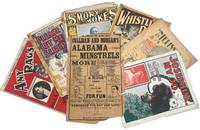
1902ref. 220121902. Minstrelsy Archive of minstrel sheet music and ephemera documenting the role of blackface performance and racial caricature in American popular music during the late 19th and early 20th centuries. Josephine My Jo. Words by R.C. McPherson; music by Jas. T. Brymn 1902 appears alongside a group of minstrel and ragtime-era compositions and a touring advertisement for Culligan and Morgan's Alabama Minstrels establishing a concentrated record of how African American identity was constructed marketed and circulated as commercial entertainment. These materials are tied to vaudeville circuits Tin Pan Alley publishing and traveling minstrel troupes including works associated with Lew Dockstader's Minstrels. Brymn an African American composer who later led the 350th Field Artillery Regiment Band during World War I represents the constrained presence of Black musicians working within a white-dominated industry reliant on the mass acceptance of racist tropes and widely disseminated caricatured imagery and dialect performance. Archive consists of 9 items: 8 pieces of large-format sheet music and 1 minstrel tour poster dating from 1897 to approximately 1900-1915. Sheet music titles include Josephine My Jo 1902; Melissy: A Melody of Dark Town Admiration by Joseph B. Carey 1897 issued as a supplement to the San Francisco Examiner; and additional titles including Any Rags by Thos. S. Allen Smoky Mokes Bunch O' Blackberries By the Watermelon Vine Lindy Lou Whistling Rufus by Kerry Mills and Your Dad Gave His Life for His Country as performed by Lew Dockstader's Minstrels. Sheet music measures approximately 11" x 14" and retains staple-bound or disbound formats with illustrated covers. The poster for Culligan and Morgan's Alabama Minstrels printed in Ohio with illustrations by the National Press and Engraving Company of Chicago measures approximately 10.5" x 27" and survives in multiple separated sections. Across the archive cover imagery employs exaggerated racial caricatures "Darktown" themes and blackface performance conventions reflecting the visual and commercial strategies through which minstrel entertainment was promoted to national audiences. General toning edge wear and chipping present across the sheet music with occasional fragility to bindings; poster is brittle with losses and separation along folds and margins. The advert poster is separated into three pieces with text largely preserved but overall in poor form. Archive in overall good condition. The grouping provides direct primary source evidence of how blackface and minstrelsy operated as a popular form of entertainment and music production while also documenting the limited participation of African American composers within that structure and the broader transition from minstrel traditions into ragtime-era popular music. unknown
1902ref. 220121902. Minstrelsy Archive of minstrel sheet music and ephemera documenting the role of blackface performance and racial caricature in American popular music during the late 19th and early 20th centuries. Josephine My Jo. Words by R.C. McPherson; music by Jas. T. Brymn 1902 appears alongside a group of minstrel and ragtime-era compositions and a touring advertisement for Culligan and Morgan's Alabama Minstrels establishing a concentrated record of how African American identity was constructed marketed and circulated as commercial entertainment. These materials are tied to vaudeville circuits Tin Pan Alley publishing and traveling minstrel troupes including works associated with Lew Dockstader's Minstrels. Brymn an African American composer who later led the 350th Field Artillery Regiment Band during World War I represents the constrained presence of Black musicians working within a white-dominated industry reliant on the mass acceptance of racist tropes and widely disseminated caricatured imagery and dialect performance. Archive consists of 9 items: 8 pieces of large-format sheet music and 1 minstrel tour poster dating from 1897 to approximately 1900-1915. Sheet music titles include Josephine My Jo 1902; Melissy: A Melody of Dark Town Admiration by Joseph B. Carey 1897 issued as a supplement to the San Francisco Examiner; and additional titles including Any Rags by Thos. S. Allen Smoky Mokes Bunch O' Blackberries By the Watermelon Vine Lindy Lou Whistling Rufus by Kerry Mills and Your Dad Gave His Life for His Country as performed by Lew Dockstader's Minstrels. Sheet music measures approximately 11" x 14" and retains staple-bound or disbound formats with illustrated covers. The poster for Culligan and Morgan's Alabama Minstrels printed in Ohio with illustrations by the National Press and Engraving Company of Chicago measures approximately 10.5" x 27" and survives in multiple separated sections. Across the archive cover imagery employs exaggerated racial caricatures "Darktown" themes and blackface performance conventions reflecting the visual and commercial strategies through which minstrel entertainment was promoted to national audiences. General toning edge wear and chipping present across the sheet music with occasional fragility to bindings; poster is brittle with losses and separation along folds and margins. The advert poster is separated into three pieces with text largely preserved but overall in poor form. Archive in overall good condition. The grouping provides direct primary source evidence of how blackface and minstrelsy operated as a popular form of entertainment and music production while also documenting the limited participation of African American composers within that structure and the broader transition from minstrel traditions into ragtime-era popular music. unknown books
ref. 0259789143.Gpaperback. Good. Access codes and supplements are not guaranteed with used items. May be an ex-library book. paperback
ref. 0282206299.Gpaperback. Good. Access codes and supplements are not guaranteed with used items. May be an ex-library book. paperback
ref. 0260670804.Ghardcover. Good. Access codes and supplements are not guaranteed with used items. May be an ex-library book. hardcover
ref. 0266005853.Gpaperback. Good. Access codes and supplements are not guaranteed with used items. May be an ex-library book. paperback
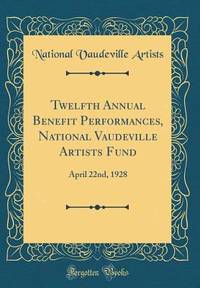
1928ref. 244319New York: National Vaudeville Artists Fund. Poor with no dust jacket. 1928. Hardcover. Spine is mostly detached along the edges some chipping to the upper end. Book is now in a clear plastic cover which protects and holds the spine. Covers have heavy edge and corner wear and moderate rubbing. The binding is cracked and basically the book is in 2 halves. . National Vaudeville Artists Fund hardcover
1925ref. 64700New York NY: Harper & Brothers 1925. 8vo. 8 264 pp. Frontisp. numerous photo plates. Red publisher’s cloth gilt lettering front cover & spine minor shelfwear slight dustsoiling w/ d.j. cover art of Cohan w/ initials RJ front cover minor chipping head & foot of spine couple minor closed tears edgewear old paper repair to spine on verso still a VG/VG- copy w/ former ownership marking on front pastedown. First edition stated of this anecdotal memoir by the famed actor playwright singer dancer and producer offering a vivid picture of the Vaudeville and Broadway Theatre circuit in the closing years of the Gilded Age into the Progressive Era through World War I when he became known as “the man who owned Broadway” and his adaptation of the Earl Derr Biggers “Seven Keys to Baldpate” mystery was a long-running hit and later silent film. Very scarce in original dustjacket. Harper & Brothers, hardcover
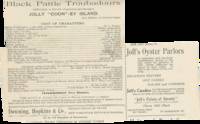
1899ref. List2923Portland Oregon 1899. Two double-sided clippings measuring approximately 7 ½ x 4 ¾ inches both put together with tape. Slightly wrinkled and toned; excellent. Matilda Sissieretta Jones 1869–1933 was an African-American opera singer from Portsmouth Virginia. She studied at the Providence Academy of Music and the New England Conservatory in Boston. At the start of her career Jones sang solo or in small groups touring North and South America the Caribbean and Europe. Jones’ talent was renowned; she was the first Black artist to sing at Carnegie Hall and she performed for multiple US presidents and the English royal family among many other accomplishments.1 In 1896 she formed Black Patti’s Troubadours—Jones was given the nickname “Black Patti” by a critic after famed Spanish opera singer Adelina Patti. The Troubadours would perform comical vaudeville and minstrel skits without Jones followed by Jones performing her “operatic kaleidoscope” of musical excerpts. Offered here are two magazine clippings—based on the advertisements these were printed in Portland Oregon—promoting two Black Patti’s shows: “A Rag Time Frolic at Ras-Bury Park” and “Jolly ‘Coon’-ey Island”. The latter was written by Ernest Hogan a musician widely credited with creating the ragtime genre; he would become the first African-American performer to produce and star in a Broadway show 1907’s The Oyster Man. Jones’ kaleidoscope pieces include excerpts from Faust Pirates of Penzance and others; both shows also feature an audience-judged cakewalk. Of interest to scholars of M. Sissieretta Jones and African-American entertainers at the turn of the century. 1 “Jones M. Sissieretta ‘Black Patti’” in Africana: The Encyclopedia of the African and African American Experience ed. Anthony Appiah and Henry Louis Gates Basic Civitas Books 1999 1064. unknown
1899ref. List2923Portland Oregon 1899. Two double-sided clippings measuring approximately 7 ½ x 4 ¾ inches both put together with tape. Slightly wrinkled and toned; excellent. Matilda Sissieretta Jones 1869–1933 was an African-American opera singer from Portsmouth Virginia. She studied at the Providence Academy of Music and the New England Conservatory in Boston. At the start of her career Jones sang solo or in small groups touring North and South America the Caribbean and Europe. Jones’ talent was renowned; she was the first Black artist to sing at Carnegie Hall and she performed for multiple US presidents and the English royal family among many other accomplishments.1 In 1896 she formed Black Patti’s Troubadours—Jones was given the nickname “Black Patti” by a critic after famed Spanish opera singer Adelina Patti. The Troubadours would perform comical vaudeville and minstrel skits without Jones followed by Jones performing her “operatic kaleidoscope” of musical excerpts. Offered here are two magazine clippings—based on the advertisements these were printed in Portland Oregon—promoting two Black Patti’s shows: “A Rag Time Frolic at Ras-Bury Park” and “Jolly ‘Coon’-ey Island”. The latter was written by Ernest Hogan a musician widely credited with creating the ragtime genre; he would become the first African-American performer to produce and star in a Broadway show 1907’s The Oyster Man. Jones’ kaleidoscope pieces include excerpts from Faust Pirates of Penzance and others; both shows also feature an audience-judged cakewalk. Of interest to scholars of M. Sissieretta Jones and African-American entertainers at the turn of the century. 1 “Jones M. Sissieretta ‘Black Patti’” in Africana: The Encyclopedia of the African and African American Experience ed. Anthony Appiah and Henry Louis Gates Basic Civitas Books 1999 1064. unknown books
ref. 1334863334.Gpaperback. Good. Access codes and supplements are not guaranteed with used items. May be an ex-library book. paperback
1922Roma, Libreria Salesiana, 1922, 16mo (cm. 18 x 12) brossura originale, pp. 91.
Paris, Calmann-Lévy, 1878, in-16, br. edit., pp. 24.
ref. c5169Editions du Bélier, 1943 ; grand in-8°, broché, couverture rempliée blanche illustrée en couleurs; 145pp.,1f.nch. Illustré en couleurs de dessins dans le texte ou à pleine page par R. Peynet.
1955ref. 120663Paris, Librairie d'Amérique et d'Orient 1955 In-4 27 x 18 cm. Broché, couverture grise, auteur & titre en noir sur le dos et le premier plat de couverture, XXVIII-157 pp., notes bibliographiques en pied de page, table des matières.Exemplaire en bon état.
Paris, Michel Lévy frères, 1860, in-16, br. edit. rosa, pp. 36. Elencati gli interpreti.
ref. 19506Les Productions de Paris, 1964. 18 x 21, 416 pp., nombreuses illustrations en N/B et dessins en rose, cartonnage d'édition illustré, très bon état.
ref. 0267050593.Ghardcover. Good. Access codes and supplements are not guaranteed with used items. May be an ex-library book. hardcover
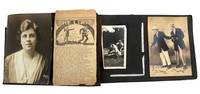
1911ref. 239881911. Midwestern theatrical photograph album circa 1912 to 1918 centered on a striking group of large photographs documenting professional popular entertainment during the height of American vaudeville and variety theater. The theatrical images encompass blackface minstrelsy musical and comic performance costumed spectacle and patriotic staging while the remainder of the album records the dances music Great Lakes excursions and social life of the young Midwestern circle that assembled it. Additional material includes the Demon Dozen's 1912 Leap Year Dance a portrait identified as Metropolitan Opera soprano Mabel Garrison and contemporary theatrical ephemera. Photo album containing 101 photographs silver gelatin prints including large full-page photographs and smaller photographs ranging from approximately 4 by 2.5 to 7.5 by 5 inches Midwestern United States and Great Lakes locations circa 1912 to 1918. The large photographs form the album's most substantial theatrical component and appear to depict professional or organized stage performers. A particularly striking photograph shows a large blackface minstrel company with rows of male performers in stage makeup white shirts and bow ties posed before a painted architectural backdrop accompanied by musicians and a pianist. Other photographs show costumed performers in white sailor outfits carrying tambourines and parasols; a company posed with rifles around an American flag; musicians with mandolins; and performers arranged in exaggerated comic tableaux. Collectively the photographs document several forms central to early twentieth-century American popular entertainment: minstrelsy musical performance patriotic spectacle costume acts and broad stage comedy. The smaller photographs place this theatrical material within a broader world of Midwestern leisure. Young men and women appear aboard Great Lakes vessels on beaches and rural outings making music posing for informal portraits and gathering socially. Inscriptions identify individuals and groups including "Doc Merz" "Merz & Curtiss" "Tubby" "Judge" and successive "G.H.C." groups. One photograph is captioned "U.S.S. Essex" while another shows a company posed aboard a vessel. Also retained is substantial material from the Demon Dozen's 1912 Leap Year Dance at Odd Fellows Hall including a printed dance program with partners handwritten beside waltzes two-steps schottisches a rye waltz and a Cubanola. Newspaper accounts describe the grand march German favors decorations and supper providing unusually specific evidence of organized social dancing during the period. The album's connection to contemporary professional entertainment is reinforced by an advertisement for Harry Lauder's farewell American tour and Irving Berlin's Stop! Look! Listen! Berton Braley's anti-Kaiser poem "The Limit" and a portrait identified in manuscript as "Mabel Garrison opera singer." Also a Great Lakes vessel photograph is identified as the Eastland the Chicago excursion steamer whose 1915 capsizing killed more than 800 people. The album provides a visually rich record of popular entertainment and leisure in the prewar and wartime Midwest with its large theatrical photographs providing its strongest documentary content and the surrounding images of dancing music excursions and social life showing the cultural world in which such entertainment circulated. Album leaves and mounts show moderate handling and edge wear; some photographs cut and unbound. Clippings show chipping and photographs show scattered fading surface wear and occasional creasing. Overall in good to near fine condition. unknown
1911ref. 239881911. Midwestern theatrical photograph album circa 1912 to 1918 centered on a striking group of large photographs documenting professional popular entertainment during the height of American vaudeville and variety theater. The theatrical images encompass blackface minstrelsy musical and comic performance costumed spectacle and patriotic staging while the remainder of the album records the dances music Great Lakes excursions and social life of the young Midwestern circle that assembled it. Additional material includes the Demon Dozen's 1912 Leap Year Dance a portrait identified as Metropolitan Opera soprano Mabel Garrison and contemporary theatrical ephemera. Photo album containing 101 photographs silver gelatin prints including large full-page photographs and smaller photographs ranging from approximately 4 by 2.5 to 7.5 by 5 inches Midwestern United States and Great Lakes locations circa 1912 to 1918. The large photographs form the album's most substantial theatrical component and appear to depict professional or organized stage performers. A particularly striking photograph shows a large blackface minstrel company with rows of male performers in stage makeup white shirts and bow ties posed before a painted architectural backdrop accompanied by musicians and a pianist. Other photographs show costumed performers in white sailor outfits carrying tambourines and parasols; a company posed with rifles around an American flag; musicians with mandolins; and performers arranged in exaggerated comic tableaux. Collectively the photographs document several forms central to early twentieth-century American popular entertainment: minstrelsy musical performance patriotic spectacle costume acts and broad stage comedy. The smaller photographs place this theatrical material within a broader world of Midwestern leisure. Young men and women appear aboard Great Lakes vessels on beaches and rural outings making music posing for informal portraits and gathering socially. Inscriptions identify individuals and groups including "Doc Merz" "Merz & Curtiss" "Tubby" "Judge" and successive "G.H.C." groups. One photograph is captioned "U.S.S. Essex" while another shows a company posed aboard a vessel. Also retained is substantial material from the Demon Dozen's 1912 Leap Year Dance at Odd Fellows Hall including a printed dance program with partners handwritten beside waltzes two-steps schottisches a rye waltz and a Cubanola. Newspaper accounts describe the grand march German favors decorations and supper providing unusually specific evidence of organized social dancing during the period. The album's connection to contemporary professional entertainment is reinforced by an advertisement for Harry Lauder's farewell American tour and Irving Berlin's Stop! Look! Listen! Berton Braley's anti-Kaiser poem "The Limit" and a portrait identified in manuscript as "Mabel Garrison opera singer." Also a Great Lakes vessel photograph is identified as the Eastland the Chicago excursion steamer whose 1915 capsizing killed more than 800 people. The album provides a visually rich record of popular entertainment and leisure in the prewar and wartime Midwest with its large theatrical photographs providing its strongest documentary content and the surrounding images of dancing music excursions and social life showing the cultural world in which such entertainment circulated. Album leaves and mounts show moderate handling and edge wear; some photographs cut and unbound. Clippings show chipping and photographs show scattered fading surface wear and occasional creasing. Overall in good to near fine condition. unknown books
[Paris, 1906], in-8 piccolo, br. edit., pp. [4]. Con ill. n.t. e una raffigurazione del Theatre de Vaudeville con i nomi delle logge e dei palchi.
1983ref. 6045822Heidelberg, Winter 1983. 8°. 244 pp. Broschur. Kleines Signaturschild. Stempel verso Titel. Sonst ordentlich.