FLEURY A.Livre Rare Book

3.176 Ergebnisse
1847Best.-Nr. RO30059706ADOLPHE DELAHAYS. 1847. In-12. Broché. Bon état, Couv. convenable, Coiffe en tête abîmée, Non coupé. 512 + 439 pages. Tampons de bibliothèque en page de titre.. . . . Classification Dewey : 848-Ecrits divers, citations, journaux intimes, souvenirs, mémoires
1901Best.-Nr. R160220745Edouard Rouveyre. 1901. In-8. Broché. Etat d'usage, Couv. légèrement passée, Dos satisfaisant, Intérieur acceptable. LI + 330 pages + 334 pages - rousseurs sur les plats.. . . . Classification Dewey : 848-Ecrits divers, citations, journaux intimes, souvenirs, mémoires
Best.-Nr. 18192Bruxelles - Liège Jean-François Broncart 1753 in 12 (16,5x10) 1 volume reliure plein veau fauve de l'époque, dos à nerfs orné de caissons dorés avec fleuron centraux, pièce de titre de cuir rouge, 193 pages. Relié à la suite: MOEURS DES CHRÉTIENS, (Bruxelles - Liège, Jean-François Broncart, 1753), 280 pages [1]. Dernière édition, corrigée & augmentée. M. Fleury, Prêtre, Précepteur de Monseigneur de Vermondois. Bon exemplaire
Best.-Nr. R300261422Plon. Non daté. in-8. Broché. Bon état, Couv. convenable, Dos satisfaisant, Intérieur frais. Paris, Plon, 1897-1898, 2 volumes in 8, broché, illustrations, 433 et 389 pp.. . . . Classification Dewey : 355.021-Militaria
Best.-Nr. R200051941ALBIN MICHEL. NON DATE. In-8. Broché. A relier, Coins frottés, Dos abîmé, Intérieur frais. 366+ 410+ 464 pages- nombreuses illustrations en noir et blanc dans et hors texte- dos partiellement manquant- pages désolidarisées- 3 photos disponibles. . . . Classification Dewey : 944.07-IIe République et Second Empire, 1848-1870
1834Best.-Nr. R320129634Chez Périsse Frères. 1834. In-12. Relié plein cuir. Etat d'usage, Coins frottés, Coiffe en tête abîmée, Mouillures. 377 pages - contre plats jaspés - titre, filets et ornements dorés sur le dos - tampons sur la page de titre - étiquette collée sur la coiffe en pied - mouillures à l'intérieur de l'ouvrage sans réelle conséquence sur la lecture.. . . . Classification Dewey : 230-Christianisme. Théologie chrétienne
Best.-Nr. 59227Paris: Hetzel s.a. seconda metà '800. Cm. 185 pp. 141 3 102 2 36 di catalogo Hetzel. Brossura originale decorata. Ben conservato a fogli chiusi. Hetzel unknown
1740Best.-Nr. R320176869Chez Pierre Jean Mariette. 1740. In-12. Relié plein cuir. Etat d'usage, Coins frottés, Dos à nerfs, Intérieur frais. 615 pages + 600 pages - tranches rosées - dos à 5 nerfs - caissons dorés sur le dos - pièce de titre absente - coiffes légèrement abîmées - coins émoussés.. . . . Classification Dewey : 94.3-Livres anciens XVIII ème
1961Best.-Nr. R200018381EYROLLES. 1961. In-8. Cartonnage d'éditeurs. Bon état, Couv. convenable, Dos satisfaisant, Intérieur frais. 523 pages illustrées de nombreuses representations en noir et blanc, rodhoide.. . . . Classification Dewey : 600-TECHNIQUE (SCIENCES APPLIQUEES)
1912Best.-Nr. R160222564Honoré Champion. 1910-1912. In-8. Broché. Bon état, Couv. convenable, Dos satisfaisant, Intérieur acceptable. 284 + XXXV pages au total pour les 2 tomes - quelques annotations et mots soulignés au stylo à l'intérieur du livre ne gênant pas la lecture.. . . . Classification Dewey : 908.447-Régionalisme : Aquitaine
Best.-Nr. DADAX3030320006Springer 2019-11-26. 1st ed. 2019. paperback. New. 6.10x0.31x9.25. Buy with confidence. Excellent Customer Service & Return policy. Springer paperback
Best.-Nr. 6208993636.Gpaperback. Good. Access codes and supplements are not guaranteed with used items. May be an ex-library book. paperback
2011Best.-Nr. BN41508Flammarion Verlag 2011. 2011. Hardcover. 240 x 284 mm. Ce n'est pas un hasard si aujourd'hui le repas français est inscrit par l'UNESCO au patrimoine immatériel mondial car l'art de recevoir à la française ne se résume pas à ces trois verbes : préparer cuisiner servir. Porté haut par des générations de cuisiniers pâtissiers sauciers maîtres d'hôtels chefs de rang. l'art de recevoir est enseigné par l'Institut Paul Bocuse à des étudiants venus du monde entier. Ils sont formés aux métiers de la restauration et de l'hôtellerie avec un seul mot d'ordre la perfection. Étiquette et protocole choix d'un repas et recettes adaptées aux circonstances table dressée dans les règles de l'art service efficace et impeccable rien n'est laissé au hasard pour le plus grand plaisir des convives. Cet ouvrage permettra à chacun d'appliquer chez soi ce qui fait l'excellence d'un tel établissement sans oublier que convivialité et plaisir donnent tout leur sens à un bon repas. Sprache französisch Maße 240 x 284 mm Kunst Musik Theater ISBN-10 2-08-125609-6 2081256096 ISBN-13 978-2-08-125609-5 9782081256095 L'Art de recevoir à la française Institut Paul Bocuse L'art de recevoir a la francaise Pitte Jean-Robert; Dumas Catherine; Zizza-Lalu Eve-Marie Fleury François Kunst Musik Theater ISBN-10 2-08-125609-6 2081256096 ISBN-13 978-2-08-125609-5 9782081256095 L'Art de recevoir à la française Institut Paul Bocuse L'art de recevoir a la francaise Pitte Jean-Robert; Dumas Catherine; Zizza-Lalu Eve-Marie Fleury François Ce n'est pas un hasard si aujourd'hui le repas français est inscrit par l'UNESCO au patrimoine immatériel mondial car l'art de recevoir à la française ne se résume pas à ces trois verbes : préparer cuisiner servir. Porté haut par des générations de cuisiniers pâtissiers sauciers maîtres d'hôtels chefs de rang. l'art de recevoir est enseigné par l'Institut Paul Bocuse à des étudiants venus du monde entier. Ils sont formés aux métiers de la restauration et de l'hôtellerie avec un seul mot d'ordre la perfection. Étiquette et protocole choix d'un repas et recettes adaptées aux circonstances table dressée dans les règles de l'art service efficace et impeccable rien n'est laissé au hasard pour le plus grand plaisir des convives. Cet ouvrage permettra à chacun d'appliquer chez soi ce qui fait l'excellence d'un tel établissement sans oublier que convivialité et plaisir donnent tout leur sens à un bon repas. Sprache französisch Maße 240 x 284 mm Flammarion Verlag hardcover
1997326 pages including index and black and white photos. The personal story of Theoren Fleury. Follows him through an entire hockey season while he was with the Calgary Flames. More than a sports biography, this is an engaging and insightful look at hockey as a child's game, an adult's profession, big business, mass entertainment, family pastime, and the greatest spectator sport yet invented. "...a fascinating glimpse of human nature on the rampage." - Peter C. Newman. Published before Fleury's problems in New York and Chicago. Includes 16 pages of black and white photos. Clean, bright and unmarked. Faint signs of handling. Excellent copy. Book
Best.-Nr. 201706510Paris, Chez pierre-jean mariette , 1765 ; in-12, 391 pp., cartonnage de l'éditeur.
Best.-Nr. 217919/06/1866 ...Voudriez-vous avoir l'obligeance de demander Mr Jacquemart dans lequel de ses ouvrages de cramique et quel endroit il a donn une demande potiers anglais tendant obtenir un brevet ou un monopole en France de fabrication par impression... demande Champfleury qui dsire ...citer le passage dans un livre...Auteur de romans tels Les souffrances du professeur Delteil (1853) et Les bourgeois de Molinchart (1855), Champfleury ddia sa nouvelle Chien-Caillou, fantaisie d'hiver (1847) Victor Hugo qui le flicita chaleureusement. Il fut galement critique d'art pour L'vnement et Le messager de l'Assemble et ses comptes rendus des Salons contriburent lancer la carrirre de Gustave Courbet.
Best.-Nr. 21444Paris, Dentu, [ sd] In-12, reliure postérieure demi cuir grenat sur cuve jaspé, dos lisse titrés sobrement, [3] XX-522pp., [9] nf, nombreuses fig. dans le texte, complet de l'extrait du catalogue. Bel exemplaire.
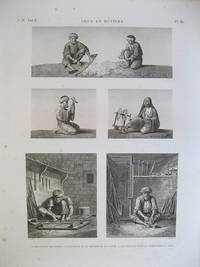
Best.-Nr. 1997Trades Professions & the Arts: Paris Impremerie de C.L.F.Pancoucke 1820-1829. Copper engravings 5 on 1 plate showing a variety of trades from the second volume of "Etat Moderne" of the "Description de l'Egypte" 2nd Edition; black & white; verso blank. Blind stamp of the publisher Panckoucke to margin. The images show cotton being sorted and spun; the spinning of woolen thread; A wood turner using his foot to shape the wood on the lathe and the "serrurier" planing a block of wood. Good dark impression; some light spotting to margins; remains of glue and tissue guard to right margin. "Description de l'Egypte ou Recueil des observations et des recherches qui ont été faites en Egypte pendant l'expédition de l'armée française." When Napoleon Bonaparte invaded Egypt in 1798 he brought with him an entourage of more than 160 scholars and scientists. Known as the French Commission on the Sciences and Arts of Egypt these experts undertook an extensive survey of the country's archeology topography and natural history. . For four years more than 150 artists engineers linguists and scientists traveled throughout the country examining almost every aspect of ancient and contemporary Egypt. They recorded and measured in meticulous detail Egypt's topography flora and fauna and its ancient and contemporary architecture. A soldier who was part of the expedition found the famous Rosetta Stone which the French linguist and scholar Jean-François Champollion 1790-1832 later used to unlock many of the mysteries that long had surrounded the language of ancient Egypt. The Egyptian expedition ended with a total military failure. The French left Egypt in 1801 with the honors of war but defeated; yet military failure remains a significant event in the history of knowledge because it is the first time a military expedition was accompanied by a scientific expedition. In 1802 Napoleon authorized the publication of the commission's findings in a monumental multi-volume work that included plates maps scholarly essays and a detailed index. Publication of the original Imperial edition began in 1809 and continued to 1822 sold by subscription. It proved so popular that a second edition was published under the post-Napoleonic Bourbon Restoration. The "Royal edition" published in Paris by C.L.F. Panckoucke from 1820-1830. The Second edition consists of 11 or 12 volumes of plates in folio and 24 of text bound as 26 8vo. Brunet:II 617; Blackmer/Navari: 476 1st edition Trades Professions & the Arts Egypt Spinning Wood workers Paris Impremerie de C.L.F.Pancoucke 1820-1829 unknown
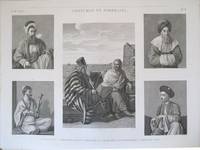
Best.-Nr. 1998Middle East: Paris Impremerie de C.L.F.Pancoucke 1820-1829. Copper engravings 5 on 1 plate showing portraits and costumes from the second volume of "Etat Moderne" of the "Description de l'Egypte" 2nd Edition; black & white; verso blank. Blind stamp of the publisher Panckoucke to margin. The central image of two men by the seashore is surrounded by 4 smaller portaits Good dark impression; some light spotting to margins; remains of glue and tissue guard to right margin. The print is black and white. "Description de l'Egypte ou Recueil des observations et des recherches qui ont été faites en Egypte pendant l'expédition de l'armée française." When Napoleon Bonaparte invaded Egypt in 1798 he brought with him an entourage of more than 160 scholars and scientists. Known as the French Commission on the Sciences and Arts of Egypt these experts undertook an extensive survey of the country's archeology topography and natural history. . For four years more than 150 artists engineers linguists and scientists traveled throughout the country examining almost every aspect of ancient and contemporary Egypt. They recorded and measured in meticulous detail Egypt's topography flora and fauna and its ancient and contemporary architecture. A soldier who was part of the expedition found the famous Rosetta Stone which the French linguist and scholar Jean-François Champollion 1790-1832 later used to unlock many of the mysteries that long had surrounded the language of ancient Egypt. The Egyptian expedition ended with a total military failure. The French left Egypt in 1801 with the honors of war but defeated; yet military failure remains a significant event in the history of knowledge because it is the first time a military expedition was accompanied by a scientific expedition. In 1802 Napoleon authorized the publication of the commission's findings in a monumental multi-volume work that included plates maps scholarly essays and a detailed index. Publication of the original Imperial edition began in 1809 and continued to 1822 sold by subscription. It proved so popular that a second edition was published under the post-Napoleonic Bourbon Restoration. The "Royal edition" published in Paris by C.L.F. Panckoucke from 1820-1830. The Second edition consists of 11 or 12 volumes of plates in folio and 24 of text bound as 26 8vo. Brunet:II 617; Blackmer/Navari: 476 1st edition Middle East Egypt Costumes Paris Impremerie de C.L.F.Pancoucke 1820-1829 unknown
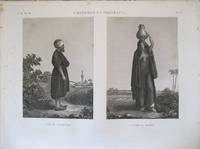
Best.-Nr. 1999Middle East: Paris Impremerie de C.L.F.Pancoucke 1820-1829. Copper engravings 2 on 1 plate showing costumes from the second volume of "Etat Moderne" of the "Description de l'Egypte" 2nd Edition; black & white; verso blank. Blind stamp of the publisher Panckoucke to margin. The images show the grooms tanding in the countryside; the woman with a water jar on her head stands on the edge of the desert with the Pyramids in the background. Good dark impression; some light spotting to margins; remains of glue and tissue guard to right margin. "Description de l'Egypte ou Recueil des observations et des recherches qui ont été faites en Egypte pendant l'expédition de l'armée française." When Napoleon Bonaparte invaded Egypt in 1798 he brought with him an entourage of more than 160 scholars and scientists. Known as the French Commission on the Sciences and Arts of Egypt these experts undertook an extensive survey of the country's archeology topography and natural history. . For four years more than 150 artists engineers linguists and scientists traveled throughout the country examining almost every aspect of ancient and contemporary Egypt. They recorded and measured in meticulous detail Egypt's topography flora and fauna and its ancient and contemporary architecture. A soldier who was part of the expedition found the famous Rosetta Stone which the French linguist and scholar Jean-François Champollion 1790-1832 later used to unlock many of the mysteries that long had surrounded the language of ancient Egypt. The Egyptian expedition ended with a total military failure. The French left Egypt in 1801 with the honors of war but defeated; yet military failure remains a significant event in the history of knowledge because it is the first time a military expedition was accompanied by a scientific expedition. In 1802 Napoleon authorized the publication of the commission's findings in a monumental multi-volume work that included plates maps scholarly essays and a detailed index. Publication of the original Imperial edition began in 1809 and continued to 1822 sold by subscription. It proved so popular that a second edition was published under the post-Napoleonic Bourbon Restoration. The "Royal edition" published in Paris by C.L.F. Panckoucke from 1820-1830. The Second edition consists of 11 or 12 volumes of plates in folio and 24 of text bound as 26 8vo. Brunet:II 617; Blackmer/Navari: 476 1st edition Middle East Egypt Costumes Paris Impremerie de C.L.F.Pancoucke 1820-1829 unknown
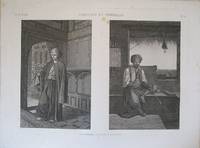
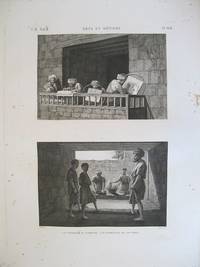
Best.-Nr. 2000Middle East: Paris Impremerie de C.L.F.Pancoucke 1820-1829. Copper engravings 2 on 1 plate showing costumes from the second volume of "Etat Moderne" of the "Description de l'Egypte" 2nd Edition; black & white; verso blank. Blind stamp of the publisher Panckoucke to margin. The images show the marmeluke standing inside a richly decorated house; the Sailor sits in a simple seaside house; they are both smoking chibouques Good dark impression; some light spotting to margins; remains of glue and tissue guard to right margin. "Description de l'Egypte ou Recueil des observations et des recherches qui ont été faites en Egypte pendant l'expédition de l'armée française." When Napoleon Bonaparte invaded Egypt in 1798 he brought with him an entourage of more than 160 scholars and scientists. Known as the French Commission on the Sciences and Arts of Egypt these experts undertook an extensive survey of the country's archeology topography and natural history. . For four years more than 150 artists engineers linguists and scientists traveled throughout the country examining almost every aspect of ancient and contemporary Egypt. They recorded and measured in meticulous detail Egypt's topography flora and fauna and its ancient and contemporary architecture. A soldier who was part of the expedition found the famous Rosetta Stone which the French linguist and scholar Jean-François Champollion 1790-1832 later used to unlock many of the mysteries that long had surrounded the language of ancient Egypt. The Egyptian expedition ended with a total military failure. The French left Egypt in 1801 with the honors of war but defeated; yet military failure remains a significant event in the history of knowledge because it is the first time a military expedition was accompanied by a scientific expedition. In 1802 Napoleon authorized the publication of the commission's findings in a monumental multi-volume work that included plates maps scholarly essays and a detailed index. Publication of the original Imperial edition began in 1809 and continued to 1822 sold by subscription. It proved so popular that a second edition was published under the post-Napoleonic Bourbon Restoration. The "Royal edition" published in Paris by C.L.F. Panckoucke from 1820-1830. The Second edition consists of 11 or 12 volumes of plates in folio and 24 of text bound as 26 8vo. Brunet:II 617; Blackmer/Navari: 476 1st edition Middle East Egypt Costumes Paris Impremerie de C.L.F.Pancoucke 1820-1829 unknown
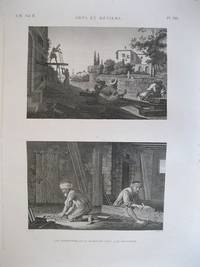
Best.-Nr. 1992Trades Professions & the Arts: Paris Impremerie de C.L.F.Pancoucke 1820-1829. Copper engravings 2 on 1 plate showing the trades of carpenter with a sawyer and joiner from the second volume of "Etat Moderne" of the "Description de l'Egypte" 2nd Edition; black & white; verso blank. Blind stamp of the publisher Panckoucke to margin. Good dark impression; some light spotting to extreme left margin; remains of glue and tissue guard to right margin. "Description de l'Egypte ou Recueil des observations et des recherches qui ont été faites en Egypte pendant l'expédition de l'armée française." When Napoleon Bonaparte invaded Egypt in 1798 he brought with him an entourage of more than 160 scholars and scientists. Known as the French Commission on the Sciences and Arts of Egypt these experts undertook an extensive survey of the country's archeology topography and natural history. . For four years more than 150 artists engineers linguists and scientists traveled throughout the country examining almost every aspect of ancient and contemporary Egypt. They recorded and measured in meticulous detail Egypt's topography flora and fauna and its ancient and contemporary architecture. A soldier who was part of the expedition found the famous Rosetta Stone which the French linguist and scholar Jean-François Champollion 1790-1832 later used to unlock many of the mysteries that long had surrounded the language of ancient Egypt. The Egyptian expedition ended with a total military failure. The French left Egypt in 1801 with the honors of war but defeated; yet military failure remains a significant event in the history of knowledge because it is the first time a military expedition was accompanied by a scientific expedition. In 1802 Napoleon authorized the publication of the commission's findings in a monumental multi-volume work that included plates maps scholarly essays and a detailed index. Publication of the original Imperial edition began in 1809 and continued to 1822 sold by subscription. It proved so popular that a second edition was published under the post-Napoleonic Bourbon Restoration. The "Royal edition" published in Paris by C.L.F. Panckoucke from 1820-1830. The Second edition consists of 11 or 12 volumes of plates in folio and 24 of text bound as 26 8vo. Brunet:II 617; Blackmer/Navari: 476 1st edition Trades Professions & the Arts Egypt Carpenter Sawyer Joiner Paris Impremerie de C.L.F.Pancoucke 1820-1829 unknown
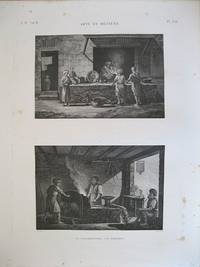
Best.-Nr. 1995Trades Professions & the Arts: Paris Impremerie de C.L.F.Pancoucke 1820-1829. Copper engravings 2 on 1 plate showing the trades of coppersmith and blacksmith from the second volume of "Etat Moderne" of the "Description de l'Egypte" 2nd Edition; black & white; verso blank. Blind stamp of the publisher Panckoucke to margin. The images show the coppersmith's workshop as he makes a bowl and the interior of the blacksmith's forge. Good dark impression; some spotting to margins; remains of glue and tissue guard to right margin. "Description de l'Egypte ou Recueil des observations et des recherches qui ont été faites en Egypte pendant l'expédition de l'armée française." When Napoleon Bonaparte invaded Egypt in 1798 he brought with him an entourage of more than 160 scholars and scientists. Known as the French Commission on the Sciences and Arts of Egypt these experts undertook an extensive survey of the country's archeology topography and natural history. . For four years more than 150 artists engineers linguists and scientists traveled throughout the country examining almost every aspect of ancient and contemporary Egypt. They recorded and measured in meticulous detail Egypt's topography flora and fauna and its ancient and contemporary architecture. A soldier who was part of the expedition found the famous Rosetta Stone which the French linguist and scholar Jean-François Champollion 1790-1832 later used to unlock many of the mysteries that long had surrounded the language of ancient Egypt. The Egyptian expedition ended with a total military failure. The French left Egypt in 1801 with the honors of war but defeated; yet military failure remains a significant event in the history of knowledge because it is the first time a military expedition was accompanied by a scientific expedition. In 1802 Napoleon authorized the publication of the commission's findings in a monumental multi-volume work that included plates maps scholarly essays and a detailed index. Publication of the original Imperial edition began in 1809 and continued to 1822 sold by subscription. It proved so popular that a second edition was published under the post-Napoleonic Bourbon Restoration. The "Royal edition" published in Paris by C.L.F. Panckoucke from 1820-1830. The Second edition consists of 11 or 12 volumes of plates in folio and 24 of text bound as 26 8vo. Brunet:II 617; Blackmer/Navari: 476 1st edition Trades Professions & the Arts Egypt Coppersmith Blacksmith Paris Impremerie de C.L.F.Pancoucke 1820-1829 unknown
Best.-Nr. 1993Trades Professions & the Arts: Paris Impremerie de C.L.F.Pancoucke 1820-1829. Copper engravings 2 on 1 plate showing the trades of dyer & rope maker from the second volume of "Etat Moderne" of the "Description de l'Egypte" 2nd Edition; black & white; verso blank. Blind stamp of the publisher Panckoucke to margin. Good dark impression; a few spots to extreme margins; remains of glue and tissue guard to right margin. "Description de l'Egypte ou Recueil des observations et des recherches qui ont été faites en Egypte pendant l'expédition de l'armée française." When Napoleon Bonaparte invaded Egypt in 1798 he brought with him an entourage of more than 160 scholars and scientists. Known as the French Commission on the Sciences and Arts of Egypt these experts undertook an extensive survey of the country's archeology topography and natural history. . For four years more than 150 artists engineers linguists and scientists traveled throughout the country examining almost every aspect of ancient and contemporary Egypt. They recorded and measured in meticulous detail Egypt's topography flora and fauna and its ancient and contemporary architecture. A soldier who was part of the expedition found the famous Rosetta Stone which the French linguist and scholar Jean-François Champollion 1790-1832 later used to unlock many of the mysteries that long had surrounded the language of ancient Egypt. The Egyptian expedition ended with a total military failure. The French left Egypt in 1801 with the honors of war but defeated; yet military failure remains a significant event in the history of knowledge because it is the first time a military expedition was accompanied by a scientific expedition. In 1802 Napoleon authorized the publication of the commission's findings in a monumental multi-volume work that included plates maps scholarly essays and a detailed index. Publication of the original Imperial edition began in 1809 and continued to 1822 sold by subscription. It proved so popular that a second edition was published under the post-Napoleonic Bourbon Restoration. The "Royal edition" published in Paris by C.L.F. Panckoucke from 1820-1830. The Second edition consists of 11 or 12 volumes of plates in folio and 24 of text bound as 26 8vo. Brunet:II 617; Blackmer/Navari: 476 1st edition Trades Professions & the Arts Egypt Dyer Rope Maker Paris Impremerie de C.L.F.Pancoucke 1820-1829 unknown
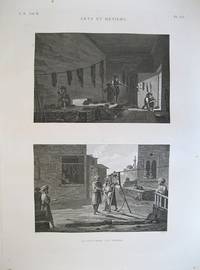
Best.-Nr. 1994Trades Professions & the Arts: Paris Impremerie de C.L.F.Pancoucke 1820-1829. Copper engravings 2 on 1 plate showing the trades of embroiderer & the felt maker from the second volume of "Etat Moderne" of the "Description de l'Egypte" 2nd Edition; black & white; verso blank. Blind stamp of the publisher Panckoucke to margin. Good dark impression; spotting to margins; remains of glue and tissue guard to right margin. "Description de l'Egypte ou Recueil des observations et des recherches qui ont été faites en Egypte pendant l'expédition de l'armée française." When Napoleon Bonaparte invaded Egypt in 1798 he brought with him an entourage of more than 160 scholars and scientists. Known as the French Commission on the Sciences and Arts of Egypt these experts undertook an extensive survey of the country's archeology topography and natural history. . For four years more than 150 artists engineers linguists and scientists traveled throughout the country examining almost every aspect of ancient and contemporary Egypt. They recorded and measured in meticulous detail Egypt's topography flora and fauna and its ancient and contemporary architecture. A soldier who was part of the expedition found the famous Rosetta Stone which the French linguist and scholar Jean-François Champollion 1790-1832 later used to unlock many of the mysteries that long had surrounded the language of ancient Egypt. The Egyptian expedition ended with a total military failure. The French left Egypt in 1801 with the honors of war but defeated; yet military failure remains a significant event in the history of knowledge because it is the first time a military expedition was accompanied by a scientific expedition. In 1802 Napoleon authorized the publication of the commission's findings in a monumental multi-volume work that included plates maps scholarly essays and a detailed index. Publication of the original Imperial edition began in 1809 and continued to 1822 sold by subscription. It proved so popular that a second edition was published under the post-Napoleonic Bourbon Restoration. The "Royal edition" published in Paris by C.L.F. Panckoucke from 1820-1830. The Second edition consists of 11 or 12 volumes of plates in folio and 24 of text bound as 26 8vo. Brunet:II 617; Blackmer/Navari: 476 1st edition Trades Professions & the Arts Egypt Embroiderer Felt Maker Paris Impremerie de C.L.F.Pancoucke 1820-1829 unknown