Charles Louis Fleury Panckoucke,Biblio.com
3.176 Ergebnisse
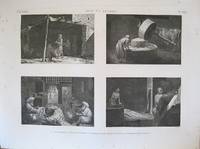
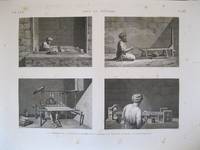
Best.-Nr. 1987Trades Professions & the Arts: Paris Impremerie de C.L.F.Pancoucke 1820-1829. Copper engravings 4 on 1 plate showing the trades of lacemaker cord maker wool weaver and belt maker from the second volume of "Etat Moderne" of the "Description de l'Egypte" 2nd Edition; black & white; verso blank. Blind stamp of the publisher Panckoucke to margin. The images show the workshops of the various trades: all the trades use a kind of loom. Good dark impression; generally clean; some spotting to margins; remains of glue and tissue guard to upper margin. "Description de l'Egypte ou Recueil des observations et des recherches qui ont été faites en Egypte pendant l'expédition de l'armée française." When Napoleon Bonaparte invaded Egypt in 1798 he brought with him an entourage of more than 160 scholars and scientists. Known as the French Commission on the Sciences and Arts of Egypt these experts undertook an extensive survey of the country's archeology topography and natural history. . For four years more than 150 artists engineers linguists and scientists traveled throughout the country examining almost every aspect of ancient and contemporary Egypt. They recorded and measured in meticulous detail Egypt's topography flora and fauna and its ancient and contemporary architecture. A soldier who was part of the expedition found the famous Rosetta Stone which the French linguist and scholar Jean-François Champollion 1790-1832 later used to unlock many of the mysteries that long had surrounded the language of ancient Egypt. The Egyptian expedition ended with a total military failure. The French left Egypt in 1801 with the honors of war but defeated; yet military failure remains a significant event in the history of knowledge because it is the first time a military expedition was accompanied by a scientific expedition. In 1802 Napoleon authorized the publication of the commission's findings in a monumental multi-volume work that included plates maps scholarly essays and a detailed index. Publication of the original Imperial edition began in 1809 and continued to 1822 sold by subscription. It proved so popular that a second edition was published under the post-Napoleonic Bourbon Restoration. The "Royal edition" published in Paris by C.L.F. Panckoucke from 1820-1830. The Second edition consists of 11 or 12 volumes of plates in folio and 24 of text bound as 26 8vo. Brunet:II 617; Blackmer/Navari: 476 1st edition Trades Professions & the Arts Egypt Lacemaker Weaver of wool Cordmaker beltmaker Paris Impremerie de C.L.F.Pancoucke 1820-1829 unknown
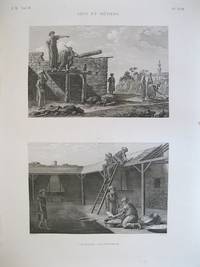
Best.-Nr. 1991Trades Professions & the Arts: Paris Impremerie de C.L.F.Pancoucke 1820-1829. Copper engravings 2 on 1 plate showing the trades of builder and roofer from the second volume of "Etat Moderne" of the "Description de l'Egypte" 2nd Edition; black & white; verso blank. Blind stamp of the publisher Panckoucke to margin. Good dark impression; some light spotting to extreme left margin; remains of glue and tissue guard to right margin. "Description de l'Egypte ou Recueil des observations et des recherches qui ont été faites en Egypte pendant l'expédition de l'armée française." When Napoleon Bonaparte invaded Egypt in 1798 he brought with him an entourage of more than 160 scholars and scientists. Known as the French Commission on the Sciences and Arts of Egypt these experts undertook an extensive survey of the country's archeology topography and natural history. . For four years more than 150 artists engineers linguists and scientists traveled throughout the country examining almost every aspect of ancient and contemporary Egypt. They recorded and measured in meticulous detail Egypt's topography flora and fauna and its ancient and contemporary architecture. A soldier who was part of the expedition found the famous Rosetta Stone which the French linguist and scholar Jean-François Champollion 1790-1832 later used to unlock many of the mysteries that long had surrounded the language of ancient Egypt. The Egyptian expedition ended with a total military failure. The French left Egypt in 1801 with the honors of war but defeated; yet military failure remains a significant event in the history of knowledge because it is the first time a military expedition was accompanied by a scientific expedition. In 1802 Napoleon authorized the publication of the commission's findings in a monumental multi-volume work that included plates maps scholarly essays and a detailed index. Publication of the original Imperial edition began in 1809 and continued to 1822 sold by subscription. It proved so popular that a second edition was published under the post-Napoleonic Bourbon Restoration. The "Royal edition" published in Paris by C.L.F. Panckoucke from 1820-1830. The Second edition consists of 11 or 12 volumes of plates in folio and 24 of text bound as 26 8vo. Brunet:II 617; Blackmer/Navari: 476 1st edition Trades Professions & the Arts Egypt Builder Mason Roofer Paris Impremerie de C.L.F.Pancoucke 1820-1829 unknown
Best.-Nr. 1985Trades Professions & the Arts: Paris Impremerie de C.L.F.Pancoucke 1820-1829. Copper engravings 4 on 1 plate showing the trades of miller baker pastry chef & confectioner from the second volume of "Etat Moderne" of the "Description de l'Egypte" 2nd Edition; black & white; verso blank. Blind stamp of the publisher Panckoucke to margin. The images show the workshops of the various trades: the miller grinding flour; the Baker placing loaves in the oven; the confectioner cutting and pulling sugar; the pastry chef baking above a fire. Good dark impression; generally clean; some spotting to margins; remains of glue and tissue guard to upper margin. "Description de l'Egypte ou Recueil des observations et des recherches qui ont été faites en Egypte pendant l'expédition de l'armée française." When Napoleon Bonaparte invaded Egypt in 1798 he brought with him an entourage of more than 160 scholars and scientists. Known as the French Commission on the Sciences and Arts of Egypt these experts undertook an extensive survey of the country's archeology topography and natural history. . For four years more than 150 artists engineers linguists and scientists traveled throughout the country examining almost every aspect of ancient and contemporary Egypt. They recorded and measured in meticulous detail Egypt's topography flora and fauna and its ancient and contemporary architecture. A soldier who was part of the expedition found the famous Rosetta Stone which the French linguist and scholar Jean-François Champollion 1790-1832 later used to unlock many of the mysteries that long had surrounded the language of ancient Egypt. The Egyptian expedition ended with a total military failure. The French left Egypt in 1801 with the honors of war but defeated; yet military failure remains a significant event in the history of knowledge because it is the first time a military expedition was accompanied by a scientific expedition. In 1802 Napoleon authorized the publication of the commission's findings in a monumental multi-volume work that included plates maps scholarly essays and a detailed index. Publication of the original Imperial edition began in 1809 and continued to 1822 sold by subscription. It proved so popular that a second edition was published under the post-Napoleonic Bourbon Restoration. The "Royal edition" published in Paris by C.L.F. Panckoucke from 1820-1830. The Second edition consists of 11 or 12 volumes of plates in folio and 24 of text bound as 26 8vo. Brunet:II 617; Blackmer/Navari: 476 1st edition Trades Professions & the Arts Egypt Baker Miller Confectioner Pastry Chef Paris Impremerie de C.L.F.Pancoucke 1820-1829 unknown
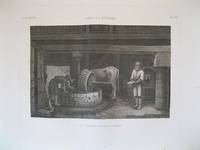
Best.-Nr. 1990Trades Professions & the Arts: Paris Impremerie de C.L.F.Pancoucke 1820-1829. Copper engraving showing the interior of an Olive press or mill from the second volume of "Etat Moderne" of the "Description de l'Egypte" 2nd Edition; black & white; verso blank. Blind stamp of the publisher Panckoucke to margin. Good dark impression; some light spotting to margins; remains of glue and tissue guard to upper margin. "Description de l'Egypte ou Recueil des observations et des recherches qui ont été faites en Egypte pendant l'expédition de l'armée française." When Napoleon Bonaparte invaded Egypt in 1798 he brought with him an entourage of more than 160 scholars and scientists. Known as the French Commission on the Sciences and Arts of Egypt these experts undertook an extensive survey of the country's archeology topography and natural history. . For four years more than 150 artists engineers linguists and scientists traveled throughout the country examining almost every aspect of ancient and contemporary Egypt. They recorded and measured in meticulous detail Egypt's topography flora and fauna and its ancient and contemporary architecture. A soldier who was part of the expedition found the famous Rosetta Stone which the French linguist and scholar Jean-François Champollion 1790-1832 later used to unlock many of the mysteries that long had surrounded the language of ancient Egypt. The Egyptian expedition ended with a total military failure. The French left Egypt in 1801 with the honors of war but defeated; yet military failure remains a significant event in the history of knowledge because it is the first time a military expedition was accompanied by a scientific expedition. In 1802 Napoleon authorized the publication of the commission's findings in a monumental multi-volume work that included plates maps scholarly essays and a detailed index. Publication of the original Imperial edition began in 1809 and continued to 1822 sold by subscription. It proved so popular that a second edition was published under the post-Napoleonic Bourbon Restoration. The "Royal edition" published in Paris by C.L.F. Panckoucke from 1820-1830. The Second edition consists of 11 or 12 volumes of plates in folio and 24 of text bound as 26 8vo. Brunet:II 617; Blackmer/Navari: 476 1st edition Trades Professions & the Arts Egypt Olive press Paris Impremerie de C.L.F.Pancoucke 1820-1829 unknown
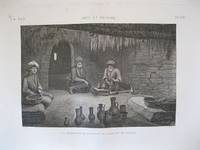
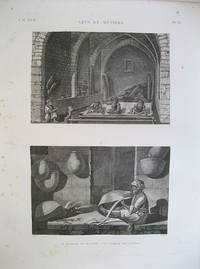
Best.-Nr. 1989Trades Professions & the Arts: Paris Impremerie de C.L.F.Pancoucke 1820-1829. Copper engraving showing the interior of a potter's workshop from the second volume of "Etat Moderne" of the "Description de l'Egypte" 2nd Edition; black & white; verso blank. Blind stamp of the publisher Panckoucke to margin. The image shows the workshop with the potter at his wheel. Good dark impression; some light spotting to margins; remains of glue and tissue guard to upper margin. "Description de l'Egypte ou Recueil des observations et des recherches qui ont été faites en Egypte pendant l'expédition de l'armée française." When Napoleon Bonaparte invaded Egypt in 1798 he brought with him an entourage of more than 160 scholars and scientists. Known as the French Commission on the Sciences and Arts of Egypt these experts undertook an extensive survey of the country's archeology topography and natural history. . For four years more than 150 artists engineers linguists and scientists traveled throughout the country examining almost every aspect of ancient and contemporary Egypt. They recorded and measured in meticulous detail Egypt's topography flora and fauna and its ancient and contemporary architecture. A soldier who was part of the expedition found the famous Rosetta Stone which the French linguist and scholar Jean-François Champollion 1790-1832 later used to unlock many of the mysteries that long had surrounded the language of ancient Egypt. The Egyptian expedition ended with a total military failure. The French left Egypt in 1801 with the honors of war but defeated; yet military failure remains a significant event in the history of knowledge because it is the first time a military expedition was accompanied by a scientific expedition. In 1802 Napoleon authorized the publication of the commission's findings in a monumental multi-volume work that included plates maps scholarly essays and a detailed index. Publication of the original Imperial edition began in 1809 and continued to 1822 sold by subscription. It proved so popular that a second edition was published under the post-Napoleonic Bourbon Restoration. The "Royal edition" published in Paris by C.L.F. Panckoucke from 1820-1830. The Second edition consists of 11 or 12 volumes of plates in folio and 24 of text bound as 26 8vo. Brunet:II 617; Blackmer/Navari: 476 1st edition Trades Professions & the Arts Egypt Pottery Paris Impremerie de C.L.F.Pancoucke 1820-1829 unknown
Best.-Nr. 1996Trades Professions & the Arts: Paris Impremerie de C.L.F.Pancoucke 1820-1829. Copper engravings 2 on 1 plate showing the trades of reed mat and basket weaving from the second volume of "Etat Moderne" of the "Description de l'Egypte" 2nd Edition; black & white; verso blank. Blind stamp of the publisher Panckoucke to margin. The images show the mat maker weaving the reed and the basket weaver stitching the basket . Good dark impression; some spotting to margins; remains of glue and tissue guard to right margin. "Description de l'Egypte ou Recueil des observations et des recherches qui ont été faites en Egypte pendant l'expédition de l'armée française." When Napoleon Bonaparte invaded Egypt in 1798 he brought with him an entourage of more than 160 scholars and scientists. Known as the French Commission on the Sciences and Arts of Egypt these experts undertook an extensive survey of the country's archeology topography and natural history. . For four years more than 150 artists engineers linguists and scientists traveled throughout the country examining almost every aspect of ancient and contemporary Egypt. They recorded and measured in meticulous detail Egypt's topography flora and fauna and its ancient and contemporary architecture. A soldier who was part of the expedition found the famous Rosetta Stone which the French linguist and scholar Jean-François Champollion 1790-1832 later used to unlock many of the mysteries that long had surrounded the language of ancient Egypt. The Egyptian expedition ended with a total military failure. The French left Egypt in 1801 with the honors of war but defeated; yet military failure remains a significant event in the history of knowledge because it is the first time a military expedition was accompanied by a scientific expedition. In 1802 Napoleon authorized the publication of the commission's findings in a monumental multi-volume work that included plates maps scholarly essays and a detailed index. Publication of the original Imperial edition began in 1809 and continued to 1822 sold by subscription. It proved so popular that a second edition was published under the post-Napoleonic Bourbon Restoration. The "Royal edition" published in Paris by C.L.F. Panckoucke from 1820-1830. The Second edition consists of 11 or 12 volumes of plates in folio and 24 of text bound as 26 8vo. Brunet:II 617; Blackmer/Navari: 476 1st edition Trades Professions & the Arts Egypt Reed mat maker Basket weaver Paris Impremerie de C.L.F.Pancoucke 1820-1829 unknown
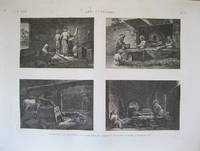
Best.-Nr. 1986Trades Professions & the Arts: Paris Impremerie de C.L.F.Pancoucke 1820-1829. Copper engravings 4 on 1 plate showing the trades of toolmaker plaster grinder tanner or currier and coffee roaster from the second volume of "Etat Moderne" of the "Description de l'Egypte" 2nd Edition; black & white; verso blank. Blind stamp of the publisher Panckoucke to margin. The images show the workshops of the various trades: the toolmaker forging a pickhead; the miller of plaster with his mill powered by an ox; the coffee roaster stirring the beans over a fire and the naked curriers/tanners stretching the skins to make Marocco leather. Good dark impression; generally clean; some spotting to margins; remains of glue and tissue guard to upper margin. "Description de l'Egypte ou Recueil des observations et des recherches qui ont été faites en Egypte pendant l'expédition de l'armée française." When Napoleon Bonaparte invaded Egypt in 1798 he brought with him an entourage of more than 160 scholars and scientists. Known as the French Commission on the Sciences and Arts of Egypt these experts undertook an extensive survey of the country's archeology topography and natural history. . For four years more than 150 artists engineers linguists and scientists traveled throughout the country examining almost every aspect of ancient and contemporary Egypt. They recorded and measured in meticulous detail Egypt's topography flora and fauna and its ancient and contemporary architecture. A soldier who was part of the expedition found the famous Rosetta Stone which the French linguist and scholar Jean-François Champollion 1790-1832 later used to unlock many of the mysteries that long had surrounded the language of ancient Egypt. The Egyptian expedition ended with a total military failure. The French left Egypt in 1801 with the honors of war but defeated; yet military failure remains a significant event in the history of knowledge because it is the first time a military expedition was accompanied by a scientific expedition. In 1802 Napoleon authorized the publication of the commission's findings in a monumental multi-volume work that included plates maps scholarly essays and a detailed index. Publication of the original Imperial edition began in 1809 and continued to 1822 sold by subscription. It proved so popular that a second edition was published under the post-Napoleonic Bourbon Restoration. The "Royal edition" published in Paris by C.L.F. Panckoucke from 1820-1830. The Second edition consists of 11 or 12 volumes of plates in folio and 24 of text bound as 26 8vo. Brunet:II 617; Blackmer/Navari: 476 1st edition Trades Professions & the Arts Egypt Toolmaker Plaster Miller Coffee Roaster Tanner/ Currier Paris Impremerie de C.L.F.Pancoucke 1820-1829 hardcover
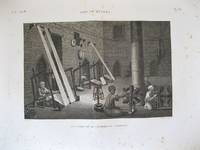
Best.-Nr. 1988Trades Professions & the Arts: Paris Impremerie de C.L.F.Pancoucke 1820-1829. Copper engraving showing the interior of a weaver's workshop from the second volume of "Etat Moderne" of the "Description de l'Egypte" 2nd Edition; black & white; verso blank. Blind stamp of the publisher Panckoucke to margin. The image shows the workshop with two weavers at their looms whilst apprentices spin threads. Good dark impression; foxing & spotting to margins; remains of glue and tissue guard to upper margin. "Description de l'Egypte ou Recueil des observations et des recherches qui ont été faites en Egypte pendant l'expédition de l'armée française." When Napoleon Bonaparte invaded Egypt in 1798 he brought with him an entourage of more than 160 scholars and scientists. Known as the French Commission on the Sciences and Arts of Egypt these experts undertook an extensive survey of the country's archeology topography and natural history. . For four years more than 150 artists engineers linguists and scientists traveled throughout the country examining almost every aspect of ancient and contemporary Egypt. They recorded and measured in meticulous detail Egypt's topography flora and fauna and its ancient and contemporary architecture. A soldier who was part of the expedition found the famous Rosetta Stone which the French linguist and scholar Jean-François Champollion 1790-1832 later used to unlock many of the mysteries that long had surrounded the language of ancient Egypt. The Egyptian expedition ended with a total military failure. The French left Egypt in 1801 with the honors of war but defeated; yet military failure remains a significant event in the history of knowledge because it is the first time a military expedition was accompanied by a scientific expedition. In 1802 Napoleon authorized the publication of the commission's findings in a monumental multi-volume work that included plates maps scholarly essays and a detailed index. Publication of the original Imperial edition began in 1809 and continued to 1822 sold by subscription. It proved so popular that a second edition was published under the post-Napoleonic Bourbon Restoration. The "Royal edition" published in Paris by C.L.F. Panckoucke from 1820-1830. The Second edition consists of 11 or 12 volumes of plates in folio and 24 of text bound as 26 8vo. Brunet:II 617; Blackmer/Navari: 476 1st edition Trades Professions & the Arts Egypt Weaving Paris Impremerie de C.L.F.Pancoucke 1820-1829 unknown
1755Best.-Nr. 24021755. : 75 . 1 Blank pages / 1 Blank pages / 1 Blank pages / 403 Pages / 5 NNP / 3 Blank pages Binding: Contemporary Full Leather Sextodecimo 16mo Height cm: 17 CM Width cm: 10 CM Thickness cm: 27 CM hardcover
1849Best.-Nr. 46405754Lyon, chez tous les libraires, 1849 ; in-8, demi-chagrin brun, dos orné à froid. 2 ff., 235 pp.ÉDITION ORIGINALE.Héraclite dans ma jeunesseJe voulais flageller les humains de mes vers ;Démocrite dans ma vieillesseJ’ai compris qu’il vaut mieux rire de leurs travers.Cet aimable fabuliste, né à Rive-de-Gier en 1778, mort en 1852, fut propriétaire-négociant à Lyons en 1807, maître verrier à Rive-de-Gier et maire de sa ville en 1830.ENVOI AUTOGRAPHE “à mon ami Durry”. Ce Durry est aussi le dédicataire de la fable Oculi, Jeanneton et le roi d’Yvetot (p. 181).
Best.-Nr. 211799Paris, Plon, 1906 2 vol. petit in-8, V-536 pp. et 497 pp., 6 planches, index, demi-basane fauve, dos à nerfs, couvertures (abîmées) conservées (reliure moderne). Il manque le portrait de Clarke.
1712Best.-Nr. 161981712 veau brun, dos à n. in-12, (5ff.), 416pp., (2ff.), P. Pierre Emery 1712
1712Best.-Nr. 253861712 P. Pierre Emery 1712 veau brun, dos à n. in-12, (5ff.), 416pp., (2ff.),bon état.
Best.-Nr. 4280Paris,1746. In-12, reliure d'époque en veau moucheté. Dos à nerfs orné. Bon état.
1763Best.-Nr. 114741763 basane mouchetée, dos à n. in-12, XX-529pp., (1f.), P. Hérissant , 1763,
Best.-Nr. 20758Macon, Protat frères, 1917. In-4, 217 pp. 4 pl., demi-chagrin rouge, dos à nefs (dos éclairci, quelques taches, rousseurs).
Best.-Nr. 158259Paris, 20 janvier, 1862 in-4, 1 pp. sur papier en-tête de la Maison de l'Empereur, service du premier écuyer, aide de camp.
Best.-Nr. 46400126, Angoulême, Impr. Chasseignac, 1901; in-8, broché, couv. impr. 61 pp., 1 f.- EDITION ORIGINALE. Tiré à part du Bullet. de la Société arch. et hist. de la Charente. Premières imprimeries Cauvin, De Minières, Le Paige, Mauclair, Pélard, Puinesge, Robin, Vinsac, Rezé. La première impression d'Angoulême est de 1491. UN DES TRES RARES EXEMPLAIRES SUR HOLLANDE.
1741Best.-Nr. 1A BRUXELLES, ET SE VEND A LIEGE. CHEZ JEAN-F. BRONCART. 1741. IN-12 (10 X 17 X 4 CENTIMETRES ENVIRON) DE (4) + 236 + (3) PAGES, RELIURE D'EPOQUE PLEIN VEAU MARBRE, DOS A CINQ NERFS ORNE DE CAISSONS A FLEURONS DORES, TITRE DORE SUR ETIQUETTE MAROQUIN HAVANE, TRANCHES ROUGES. RELIE AVEC, DU MEME AUTEUR: - LES MOEURS DES CHRETIENS. PAR M. FLEURY, PRETRE, PRECEPTEUR DE MONSEIGNEUR DE VERMANDOIS. DERNIERE EDITION CORRIGEE & AUGMENTEE. A BRUXELLES, ET SE VEND A LIEGE. CHEZ JEAN-F. BRONCART. 1741. IN-12 DE (8) + 348 PAGES.2 OUVRAGES RELIES EN UN VOLUME. PETITES TRACES D'USURE EXTERIEURE, SINON BON EXEMPLAIRE.
1700Best.-Nr. 2003PARIS. PIERRE AUBOUYN ET CHARLES CLOUZIER. 1700. IN-12 (10 X 16,5 CENTIMETRES ENVIRON) DE (4) + 427 PAGES, RELIURE D'EPOQUE PLEIN VEAU, DOS A CINQ NERFS ORNE DE CAISSONS A FLEURONS DORES, TITRE DORE SUR ETIQUETTE MAROQUIN ROUGE, TRANCHES ROUGES. PETITES TRACES D'USURE DONT COINS, SINON BON EXEMPLAIRE.
1996Best.-Nr. ws1078Dos carré collé 1996 RARE. In-4 (21,2 x 29,7 cm), dos carré collé, 183 pages, sans mention d'éditeur, envoi avec dessin original de Hanin ; petits chocs et quelques frottements aux plats, par ailleurs assez bon état. Livraison a domicile (La Poste) ou en Mondial Relay sur simple demande.
1950Best.-Nr. 26002CHEMILLE 1950 une photographie originale en noir, avec dessous étiquette imprimée en noir : "LAVOIR DE LA RUE DU PETIT BOURG" [superbe photographie animée] (cliché : Guy FLEURY (hors concours), format de la photo : 24 x 18 cm, snas date (années 50)
Best.-Nr. 63078Eds Masson Paris 1920 In-8 22 cm 40pp. hommage autographe de l'auteur: Au grand peintre des Crepuscules d'Islam Nb-0386 unknown
Best.-Nr. 43329Eyrolles - premiere edition In-8 523pp. illustr. figures et tableaux reliure pleine toile de l'editeur unknown
1901Best.-Nr. 97371901 Bergerac, 1901, grand in 4, dem chagrin bordeaux, dos à nerfs, titre doré couverture conservée, 269 pp., avecun envoi de l'auteur (signé par l'auteur