2 091 résultats
1946réf. 709New York: Ars Sacra-Herbert Dubler Inc 1946. Boards. Near fine. Ida BOHATTA-MORPURGO. 16mo; 20pp; color pictorial grey boards with anthropomorphic bee on the front; 6 full-page color illustrations; light shelf wear; near fine. This little book of noted Austrian illustrator and author Ida Bohatta-Morpurgo 1900-1992 translated into English by June Head. Unusually fine condition. Ars Sacra-Herbert Dubler, Inc unknown
1832réf. 44145Paris Crochard 1832. Contemp. hcalf. gilt spine light wear along edges. In: "Annales de Chimie et de Physique Par MM. Gay-Lussac et Arago." tome 50 Series 2. Entire volume offered. 448 pp. 2 folded engraved plates. Faraday's papers: pp. 5-67 a. pp. 113-162. First French editions of the 2 first memoirs of Faradays groundbreaking researches on electricity constituting the first 2 papers of his "Experimental Researches in Electricity" and containing his fundamental discovery of electromagnetic induction THE FOUNDATION OF NEARLY ALL THE ELECTRICITY IN USE TODAY. In 1820 Oersted had generated magnetism from electricity Faraday here finds the opposite effect generating electricity by magnetism. He also described the first electrical generator second paper. THESE PAPERS ARE SOME OF THE GREAT CLASSICS OF CHEMISTRY AND PHYSICS."Faraday demonstrated this theory involving the lines of force.by inserting a magnet into a coil of wire attached to a galvanometer. While the magnet was being inserted or removd current flowed through the wire. If the magnet was held stationary and the coil moved over it one way or the other there was current in the wire. In either case the magnetic lines of force about the magnet were cut by the wire.If the magnet and coil were both held motionless whether the magnet was within the coil or not there was no current.Faraday hd thus discovered electricalinduction.It was to lead to great things but this was not apparent."Asimov."Although his discovery of the electric motor and the dynamo was almost entirely identical to his theoretical discoveries it laid the foundation of the modern electrical industry - electric light and power teælephony wireless telegraphy televison etc. - by providing for the production of continous mechanical motion from an electrical source and vice versa." PMM 308.Horblit 29 - Milestones 62. - Dibner 64. - PMM 308. unknown
1811réf. 43628Halle Rengerschen Buchhandlung 1811 1811 1812. Without wrappers as published in "Annalen der Physik. Herausgegeben von Ludwig Wilhelm Gilbert" Bd. 37 Drittes u. Viertes Stück Bd. 38 Sechtes Stück Bd. 40 Zweites u. Drittes Stück. The entire issues offered 5 issues. With titlepage to vol. 37 38 a. 40. Pp. 233-480 a. 3 engraved plates. pp. 121-236 a. 2 engraved plates. pp. 117-348 a. 1 engraved plate. Berzelius's papers: pp. 249-337 a. 415-472.- Pp. 161-226. - Pp. 162-208 a. 235-330. The papers represents one of the first announcements of Berzelius' discovery of the fixed chemical proportions determining the weights and valencies of the various constituent elements in inorganic compounds. The papers were published at the same time in German both here in Annalen and in Schweiger's Journal and in French. By running many hundreds of analysis of chemical compounds he gave so many examples of the law of definite proportions that the world of chemistry could no longer doubt its validity and in so doing he gave experimental evidence to the atomic theory. He hereby laid a solid fundation for the further development of chemistry.According to Söderbaum Jac. Berzelius 2 p.12 "It was a giant work one of the most importent in the history of chemistry which was here presented. One is even more impressed when one remembers that it was a pioneer undertaking in every sense of the term. Analytic and synthetic methods existed before Berzelius' time to be sure but there were no precise methods of the sort which he required. They all had to be elaborated at the cost of time and labour."J. Erik Jorpes "Jac. Berzelius" p.45."In general Berzelius's efforts were directed toward the consolidation and extension of the atomic theory. He improved chemical analysis and determined the composition of a large number of compounds thus verifying the laws of constant and multiple proportions and furnishing the most accurate equivalent weights then available. By ingenious methods he arrived at the correct atomic composition of most common substances and thus was enabled to draw up in 1826 a table of atomic weights very nearly identical with the modern one."Leicester & Klicktein "A Source Book in Chemistry" p. 258.Parkinson "Breakthroughs" 1810-20 C. unknown
1834réf. 49065Leipzig Barth 1834. Contemp. hcalf. raised bands spine gilt. Spine with light wear. in. "Annalen der Physik und Chemie. J.C. Poggendorff" Zweite reine 3. bd.VIII5584 pp. and 5 plates. Entire volume offerd. Faradays papers: pp. 149-189 Sixth series pp. 301-331 a. 481-520 Seventh series. Internally clean and fine printed on good paper. First appearance in German - prepared by Faraday himself for publication in Annalen - of 2 historical papers in chemistry and physiscs in which Faraday in the first detects a new recombination-effect in electrolysis and in the second we have the MILESTONE PAPER in which Faraday announces the discoveries of further laws of electrochemistry stating the general relations of electricity to chemistry and introducing new terms with precise meanings. The first part of the paper introduces his new terminology giving the words a limited and precise meaning. These words devised with the assistance of William Whewell are now familiar to all chemists electrode anode cathode ion anion and cation. He also introduces the "Volta-electrometer" and arrives at the "Law of electro-chemical equivalents". The paper offered is one of Farday's most famous papers."Another section of the paper is devoted to a closer examination of the law of constant electrochemical action with respect to water and to the development of a gas electrometer to measure quantities of electricity. Faraday's "Volta-electrometer" provided the first practical means for the quantitative measurement of electricity." Source Book in Chemistry p. 280-81.The Sixth series: "In the course of his experimental investigations of a general and importent law of electro-chemical action which required the accurate measurement of thegases evolved during the decomposition of water and other substances the author was lead to the detection of a curious effect which had never been previously noticed and of which the knowledge had he before possessed it would have prevented many of the errors and inconsistencies occurring in the conclusions he at first deduced from his earlier experiments. The phenomena observed was the gradual recombination of elements which had been previously separated from each other by voltaic action. This happened when after water had been decomposed by voltaic electricity the mixed gases resulting from such decomposition were left in contact with the platina wires or plates which had acted as poles; for under these circumstances they gradually diminished in vo.umes water was reprioduced and at lust the whole of the gases disappeared."Abstract - Faraday explains the causes of this recombination. hardcover
1832réf. 44146Leipzig Johann Ambrosius Barth 1832. Contemp. hcalf. raised bands gilt spine. Light wear along edges. In "Annalen der Physik und Chemie. Hrsg. von J.C. Poggendorff" Band 25. Entire volume offered. VIII648 pp. and 6 folded engraved plates. Small stamps on verso of titlepage and plates. Faraday's papers: pp. 91-142 a. pp. 142-186. with 3 folded engraved plates. Clean and fine. First German editions of the 2 first memoirs of Faradays groundbreaking researches on electricity constituting the first 2 papers of his "Experimental Researches in Electricity" and containing his fundamental discovery of electromagnetic induction THE FOUNDATION OF NEARLY ALL THE ELECTRICITY IN USE TODAY. In 1820 Oersted had generated magnetism from electricity Faraday here finds the opposite effect generating electricity by magnetism. He also described the first electrical generator second paper. THESE PAPERS ARE SOME OF THE GREAT CLASSICS OF CHEMISTRY AND PHYSICS."Faraday demonstrated this theory involving the lines of force.by inserting a magnet into a coil of wire attached to a galvanometer. While the magnet was being inserted or removd current flowed through the wire. If the magnet was held stationary and the coil moved over it one way or the other there was current in the wire. In either case the magnetic lines of force about the magnet were cut by the wire.If the magnet and coil were both held motionless whether the magnet was within the coil or not there was no current.Faraday hd thus discovered electricalinduction.It was to lead to great things but this was not apparent."Asimov."Although his discovery of the electric motor and the dynamo was almost entirely identical to his theoretical discoveries it laid the foundation of the modern electrical industry - electric light and power teælephony wireless telegraphy televison etc. - by providing for the production of continous mechanical motion from an electrical source and vice versa." PMM 308.Horblit 29 - Milestones 62. - Dibner 64. - PMM 308.The volume contains further notable papers. Elie de Beaumont "Zweiter geologischer Brief.an A.v. Humboldt über die relative Alter der Gebirgszüge" pp. 1-58 a. 2 plates one handcoloured papers by Döbereiner E. Lenz Moser Mitscherlich de Saussure J. Dumas F.E. Neumann Gay-Lussac Johannes Müller "Beobachtungen zur Analyse der Lymphe des Bluts und des Chylus" pp. 513-590. hardcover
1803réf. 45109Paris Chez Fuchs An Xe 1803. In: "Annales de Chimie ou Recueil de Mémoires concernant la Chemie" Tome 45 Cahier 2 a. Tome 46 Cahier 3. Pp. 113-212 entire issue offered and pp. 225-336 entire issue offered. Dalton's papers: pp. 177-181 a. pp. 250-272. First appearance in French of these importent papers. publication of which at once gave him European reputation. The first paper combated Rumford's view that the circulation of heat in fluids is by convection only. Second paper is the French translation of the first of the 5 seminal papers which appeared under the general title "Experimental Essays on the constitution of mixed Gases; on the Force of steam or vapor etc."published 1801-3. The paper expresses the generalisation that the maximum density of a vapour in contact with its liquid remains the same whether other gases be present or not and the view that the particles of every kind of elastic fluid are elastic only with regard to those of their own kind the LAW OF PARTIAL PRESSURES. Smyth No 27 and No 29:1. - Parkinson "Breakthroughs" 1801 M/C. unknown
1842réf. 44147Leipzig Johann Ambrosius Barth 1842. Without wrappers. In "Annalen der Physik und Chemie. Hrsg. von J.C. Poggendorff" Ergänzungsband 1 Stück 2. Pp. 193-384 a. 1 folded engraved plate. The entire issue offered. Henry's paper: pp. 282-312. First German version of Henry's description of his discovery of self-induction. He missed the credit for the discovery of induction to Faraday but he had done the key experiment ahead of Faraday but Faraday was the first to publish. But he is credited for the discovery of self-induction 1832 and Faraday discovered it independently two years later 1834."In Henry's paper however he explained thet the electric current in a coil can induce another current not only in another coil but in itself. The actual current observed in the coil is then the combination of the original current and the induced current. This is called self induction."Isac Asimov.The issue contains further notable papers Michael Faraday's "Vierzehnte Reihe von Experimental-Untersuchungen über Elektricität" § 2o-22. Nos 1667-1748. Pp. 249-281. First German version. In this paper FARADAYamplifies his theory of electrostatic induction by making further use of the analogy with the induction of magnetism. Whittaker describes the paper as having "THE FUNDAMENTAL EQUATION OF ELECTROSTATICS" as modified in order to take into account the effect of the specific inductive capacity."Whittaker I pp.187-89. unknown
1911réf. 46922London Harrison and Sons 1911. Small 4to. Contemp. full cloth. Spine gilt and with gilt lettering. A stamp to verso of titlepage and a few other leaves. In: "Proceedings of the Royal Society of London. Series A." Vol. LXXXV. XXIII605XXIV pp. and 11 plates. Entire volume offered. Wilson's paper: pp. 285-288 a. 1 plate. Clean and fine. First appearance of the paper which describes the final version of his invention the famous Cloud-Chamber - the first Cloud Chamber was invented by him in 1896 - for making visible and photographing the paths of charged particles an invention for which Wilson received a share of the Nobel Prize in 1827. By using the Cloud Chamber he was here 1911 able to observe the track of an alpha ray by condensing water drops onto the ions produced by its passage.The Cloud Chamber which Rutherford called "the most original apparatus in the whole history of physics" became standard equipment in physics laboratories and made possible numerous important discoveries in the fields of particle and nuclear physicsAfter 1896 "Wilson continued to experiment with ultraviolet radiation and other techniques for producing condensation effects but soon concentrated on atmospheric electricity not returning to the cloud chamber until December 1910. He designed an improved chamber with new methods of illumination and the possibility of photographing the results. At this time Wilson realized that it might be possible to reveal the track of an a ray by condensing water drops onto the ions produced by its passage. During March 1911 he saw this effect produced in his apparatus. Thus the elucidation of phenomena seen in the Scottish hills led to the possibility of studying the processes of radioactivity and the Wilson cloud chamber became an important piece of laboratory equipment. But it was in the study of cosmic rays that it achieved its full power particularly in the refined form developed by Patrick Blackett in which it was possible to study particles of very high energy and the production of electron-positron pairs with the chamber situated in a strong magnetic field." DSB. hardcover
1832réf. 48987Paris Crochard 1832. Contemp. hcloth gilt lettering to spine. In: "Annales de Chimie et de Physique Par MM. Gay-Lussac et Arago." tome 50 Series 2. Entire volume offered. 448 pp. 2 folded engraved plates. Faraday's papers: pp. 5-67 a. pp. 113-162. Some scattered brownspots. First French editions of the 2 first memoirs of Faradays groundbreaking researches on electricity constituting the first 2 papers of his "Experimental Researches in Electricity" and containing his fundamental discovery of electromagnetic induction THE FOUNDATION OF NEARLY ALL THE ELECTRICITY IN USE TODAY. In 1820 Oersted had generated magnetism from electricity Faraday here finds the opposite effect generating electricity by magnetism. He also described the first electrical generator second paper. THESE PAPERS ARE SOME OF THE GREAT CLASSICS OF CHEMISTRY AND PHYSICS."Faraday demonstrated this theory involving the lines of force.by inserting a magnet into a coil of wire attached to a galvanometer. While the magnet was being inserted or removd current flowed through the wire. If the magnet was held stationary and the coil moved over it one way or the other there was current in the wire. In either case the magnetic lines of force about the magnet were cut by the wire.If the magnet and coil were both held motionless whether the magnet was within the coil or not there was no current.Faraday hd thus discovered electricalinduction.It was to lead to great things but this was not apparent."Asimov."Although his discovery of the electric motor and the dynamo was almost entirely identical to his theoretical discoveries it laid the foundation of the modern electrical industry - electric light and power teælephony wireless telegraphy televison etc. - by providing for the production of continous mechanical motion from an electrical source and vice versa." PMM 308.Horblit 29 - Milestones 62. - Dibner 64. - PMM 308.The volume contains further notable papers. Elie de Beaumont "Zweiter geologischer Brief.an A.v. Humboldt über die relative Alter der Gebirgszüge" pp. 1-58 a. 2 plates one handcoloured papers by Döbereiner E. Lenz Moser Mitscherlich de Saussure J. Dumas F.E. Neumann Gay-Lussac Johannes Müller "Beobachtungen zur Analyse der Lymphe des Bluts und des Chylus" pp. 513-590. hardcover
1803réf. 44130Halle Rengerschen Buchhandlung 1803. Without wrappers as extracted from "Annalen der Physik. Herausgegeben von Ludwig Wilhelm Gilbert" Bd. 12. Pp. 257-291 a. 1 folded engraved plate showing the experimental apparatus used. First appearance in German of this extremely important paper in which Gay-Lussac first formulated the law the Gay-Lussac's Law stating that if the mass and pressure of a gas are held constant then gas volume increases linearly as the temperature rises. This is sometimes written as V = k T where k is a constant dependent on the type mass and pressure of the gas and T is temperature on an absolute scale. In terms of the ideal gas law k = n R / P."In 1802 he Gay-Lussac showed that different gases all expanded by equal amounts with rise in temperature. Charles had made the same discovery some years earlier but had not published it; the credit therefore belongs to Gay-Lussac at least as much and probably more. This was an extremely importent discovery which Avogadro was to use within the decade to formulate hid long-neglected hypothesis that equal volumes of different gases at equal temperatures contained equal numbers of particles."Asimov.Magie "A Source Book in Physics" p.165-172 - Leicester & Klickstein "A Source Book of Chemistry" p. 374-379. - Parkinson "Breakthroughs" 1802 C. unknown
1863réf. 44144Paris Victor Masson et Fils 1863 a. 1864. Boundin 2 contemp. hcalf. Gilt spines raised bands light wear along edges. In: "Annales de Chimie et de Physique" 3e Series - Tome 68 a. 4e Series tome 1. 512 pp. a. 5 large folded engraved plates. 512 pp. a. 3 large folded engraved plates. Kirchhoff's papers: pp. 5-45 a. pp. 396-411. 5 plates belongs to K's papers 4 showing spectra and 1 plate double page depicts the famous spectroscope invented by K. and used by K. and Bunsen in their importent analysis of the spectra of the elements. First edition in French of Kirchhoff's milestone papers on the interpretation of the dark D lines - noticed by Fraunhofer in 1814 - in the spectrum of the sun the papers that inspired Max Planck to his theory of quanta 1900. The papers are the French translations of his papers published in Abhandl. d. königl. Akad. d. Wissenscchaften in Berlin in 1861 and 1862.In the course of his preparatory work in the autumn of 1859 Kirchhoff made an unexpected observation. It had long been known that the dark D lines noticed in the solar spectrum by Fraunhofer 1814 coincided with the yellow lines emitted by flames containing sodium.Kirchhoff's unexpected discovery was that if the intensity of the solar spectrum increased above a certain limit the dark D lines were made much darker by the interrposition of the sodium flame. He instantly felt that he had got hold of "something fundamental" even though he was at a loss to suggest an explanation. On the day following the surprising observation Kirchhoff found the the correct interpretation which wass soon confirmed by new experiments: a substance capable of emittiing a certain spectral line has a strong absorptive power for the same line.The dark D lines in the solar spectrum could accordingly be ascribed to absorption by a solar atmosphere containing sodium. Immense prospects thus opened up of ascertaining the chemical composition of the sun and other stars from the study of their optical spectra. A few more weeks sufficed for Kirchhoff to elaborate a quantitative theory of the relationship between emissive and absorptive poweer."DSB VII pp. 381-82.PMM 278 b. - Barchas 1169-70 - Sparrow 117 - Horbli 59 - Dibner 153 the note. hardcover
1811réf. 46030Paris Chez J. Klostermann fils 1811-12. Bound in 6 contemp. hcalf. Gilt spines slightly rubbed. Wear to top of spines. In: "Annales de Chimie ou Recueil de Mémoires concernant la Chemie" Tome 78 79 80 81 82 and 83. Entire volumes offered. The 14 parts: Tome 78: pp. 5-37 105-132 217-242. - Tome 79: pp. 113-142 233-264. - Tome 80: pp. 5-37 225-258. - Tome 81: pp. 5-36 278-303. - Tome 82: pp. 5-33 113-125 225-72. Tome 83: pp. 5-35 a. pp. 117-127. With in all 3 engraved plates. Some scattered brownspots. The papers represents one of the first announcements of Berzelius' discovery of the fixed chemical proportions determining the weights and valencies of the various constituent elements in inorganic compounds. The papers were published at the same time in Swedish German both here in Annalen and in Schweiger's Journal and in French. By running many hundreds of analysis of chemical compounds he gave so many examples of the law of definite proportions that the world of chemistry could no longer doubt its validity and in so doing he gave experimental evidence to the atomic theory. He hereby laid a solid fundation for the further development of chemistry. A reprint is found in Ostwald's Klassiker der exakten Wissenschaften No. 35.According to Söderbaum Jac. Berzelius 2 p.12 "It was a giant work one of the most importent in the history of chemistry which was here presented. One is even more impressed when one remembers that it was a pioneer undertaking in every sense of the term. Analytic and synthetic methods existed before Berzelius' time to be sure but there were no precise methods of the sort which he required. They all had to be elaborated at the cost of time and labour."J. Erik Jorpes "Jac. Berzelius" p.45."In general Berzelius's efforts were directed toward the consolidation and extension of the atomic theory. He improved chemical analysis and determined the composition of a large number of compounds thus verifying the laws of constant and multiple proportions and furnishing the most accurate equivalent weights then available. By ingenious methods he arrived at the correct atomic composition of most common substances and thus was enabled to draw up in 1826 a table of atomic weights very nearly identical with the modern one."Leicester & Klicktein "A Source Book in Chemistry" p. 258.Parkinson "Breakthroughs" 1810-20 C. unknown
1809réf. 50198Paris Mad. Ve Barnard 1809. Contemp. hcalf. Spine gilt. Wear to top of spine. A few scratches to binding. Small stamps on verso of titlepage.In: "Annales de Chimie ou Recueil de Mémoires concernant la Chemie" Tome 70. 336 pp. Entire volume offered. Davy's paper: pp. 189-254. First edition in French the first English 1808 of this importent historical paper in chemistry in which Davy shows that electricity is capable of decomposing some alkalies isolating two new substances and discovering potassium and sodium. Neville in his Historical Chemical Library vol. I p.340 writes about this paper "ONE OF THE GREAT CLASSIC RESEARCHES IN CHEMISTRY in which Davy announced in this his second Bakterian lecture the isloation of metallic potassium and sodium by the electrolytic decomposition of their fused oxides.""He Davy began his own electrical experiments.The results were spectacular. On October 6 1807 the current passing through molten potash liberated a metal which Davy called potassium. The little globules of shining metal tore the water molecule apart as it eagerly recombined with oxygen and the liberated hydrogen burst into lavender flame. Davy danced about in a delirium of joy. A week later he isolated sodium from soda."Asimow. The paper offered here describes these discoveries."Humphry Davy was one of the most brilliant chemists of the early nineteenth century. His early study of nitrous oxide brought him his first reputation but his later and most importent investigations were devoted to electrochemistry. Following Galvani's experiments and the discovery of the voltaic pile interest in galvanic electricity had become widespread. The first electrolysis by means of the pile was carried out in 1800 by Nicholson and Carisle who obtained oxygen and hydrogen from water. Davy began to examine the chemical effects of electricity in 1800 and his numerous discoveries were presented in his Bakerian lecture to the Royal Society on November 20 1806. A Source Book in Chemistry p. 243. unknown
2018réf. G082976853XI3N01Vida Publishers 2018. Unknown. Good. Missing dust jacket; Pages can have notes/highlighting. Spine may show signs of wear. ~ ThriftBooks: Read More Spend Less.Dust jacket quality is not guaranteed. Vida Publishers unknown
réf. DADAX1444786067Hodder & Stoughton 0000-00-00. hardcover. New. 4.96x0.87x7.64. Buy with confidence. Excellent Customer Service & Return policy. Hodder & Stoughton hardcover
1982réf. 580969Boston: Little Brown and Company 1982. Hardcover. Near Fine. First edition. Tall octavo. 203pp. Illustrated with plates. Blue cloth gilt in clothcovered slipcase as issued. Spine a bit sunned else fine in just about fine slipcase with a thin strip of light tanning on one panel. One of 1000 numbered and signed copies apparently different copies were signed by different members of the opera company. This copy Signed by General Manager of the Metropolitan Opera Company Anthony Bliss and one other person "Kim". Little, Brown and Company hardcover
1982réf. 580970Boston: Little Brown and Company 1982. Hardcover. Near Fine. First edition. Tall octavo. 203pp. Illustrated with plates. Blue cloth gilt in clothcovered slipcase as issued. Spine modestly sunned and a bit of light spotting on the rear board near fine in just about fine slipcase with a bit of light tanning. One of 1000 numbered and signed copies apparently different copies were signed by different members of the opera company. This copy Signed by Rise Stevens and another person. Little, Brown and Company hardcover
2020réf. __1529391334Hodder & Stoughton 2020. Flexiback. New. 1280 pages. 9.84x6.89x1.18 inches. Hodder & Stoughton unknown
1930réf. b30267Alamore Press 1930. First Edition . Hardcover. Near Fine. Rebound in cloth-covered boards with paper labels. The text is near fine with some minor creasing. A very uncommon item in any condition. Alamore Press hardcover
1950réf. b22548New York: ABC Television 1950. First Edition . Unbound. Near Fine. Complete original script for the Pulitzer Prize Playhouse production of the televised adaptation of Booth Tarkington's The Magnificent Ambersons broadcast on ABC Television on November 3 1950. The script is noted as "FINAL" and dated October 20 1950. This is director Alex Segal's copy and contains his numerous pencil both black and red notations and deletions throughout. IMDB states that the four primary actors in this production were Melvyn Douglas Ruth Hussey Florence Eldridge and Richard Hylton although it incorrectly lists the director. The script has 101 mimeographed pages. Most are in near fine condition. The title-page has a rust mark from a clip and brief wear page 61 is ruffled along the bottom edge and the final page also has a rust mark. Segal's extensive pencil notations appear on almost every page usually in multiples. ABC Television unknown
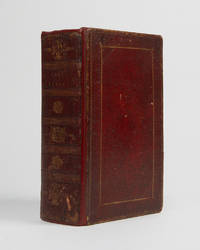
réf. 123536London Printed by George E. Eyre and William Spottiswoode 1854. . 4to 29 x 22.5 cm; excised bookplate from front pastedown; contemporary pebble-grain black morocco covers panelled in gilt gilt spine in 6 compartments all edges gilt a little rubbed very good. A well-preserved mid-Victorian King James Bible in the original black pebble-grain gilt-panelled morocco binding. London, Printed by George E. Eyre and William Spottiswoode, 1854. unknown
réf. 123842Cambridge Printed by J. Smith Printer to the University 1815. . Stereotype edition; large 8vo 23 x 15 cm; foxing to title moderate spotting throughout ownership inscription in pen to title MS notes in pen to free endpapers related family history notes loose to rear later endappers gutter-margins reinforced; contemporary straight-grained end morocco covers ruled in gilt and blind rebacked original gilt spine in 6-compartments laid down gauffered edges slightly rubbed with loss to corners and edges. A stereotype edition of the King James Bible bound in contemporary red morocco gilt. 'William Ged 1690-1749 the inventor of stereotyping obtained in 1731 a contract for printing Prayer Books and Bibles for Cambridge University. But he completed only two Prayer Books and surrendered his lease in 1738. Thwarted at every turn by trade jealousy he failed in all his attempts to establish a business. "Subsequently Andrew Wilson the Earl of Stanhope's practical man starting where Ged left off worked out the plaster-of-Paris plan that preceded the papier-mâché system which has established stereotyping in its present position"' Herbert. Cambridge, Printed by J. Smith, Printer to the University, 1815. unknown
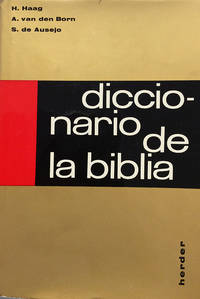
réf. 73789España: Herder 1963. 1ª Edición. Tapa Dura. Bien/Aceptable. 25x16. Basada en el Bibel-Lexikon de Herbert Haag y en Bijbels Woordenboek de A. van den Born y otros especialistas. Edición castellana preparada por Serafín de Ausejo. Tapa dura con sobrecubierta. Láminas fuera de texto. Sobrecubiertas algo rozadas en bordes. Texto a dos columnas. Dedicatoria No Autores en hoja de cortesía. Buen estado. Herder hardcover
réf. 123616London Imprinted at London by Robert Barker Printer to the Kings most Excellent Maiestie 1614-1613. . Four works in 1 vol.; 4to 23.5 x 18 cm; woodcut title-pages NT title dated 1613 with apocrypha Common Prayer with woodcut title and calendar printed in red and black early MS annotations in pen to margin of Bible 2H3 extensive MS family register to front endpapers the odd spot and area of toning final f. with closed tear to margin internally generally clean and crisp; contemporary blind-panelled calf later endpapers spine expertly restored edges sprinkled red a little rubbed very good or better. A superb example of the Geneva Bible well-preserved in contemporary blind-panelled calf and complete with the Book of Common Prayer Concordances and Psalms. The Geneva Bible was first published in 1560. The translation was primarily the work of English 'Marian exiles' on the continent who having fled England following the accession of Mary I in 1553 sought to create a version of the scriptures that emphasised clarity and promoted accessibility for the learned lay. It was the primary Bible of the evangelical movement and continued to be used by dissenting Protestants from Shakespeare to Oliver Cromwell well into the seventeenth century; it was one of the Bibles taken to America by the first pilgrims on the Mayflower. Notable innovations include the use of verse divisions which made it easier to locate specific passages and extensive study notes commentary and annotations that reflected the Reformed Calvinist theology of the time. As a result the translation proved unpopular with the Elizabethan regime which sought a more moderate religious settlement. The Archbishop of Canterbury Matthew Parker was duly authorised in 1568 to produce a more orthodox translation the Bishops' Bible which promoted the Anglican church and would go on to form the basis of the King James Version in 1611. Nevertheless the Geneva Bible remained popular until at least 1644 when the last known seventeenth-century edition was printed. ESTC S1399 S93850 & S121126 our copy a variant with 'Company' not 'Companie' in imprint; Herbert 330 our copy without Speed's Genealogies and map; DM 256; Griffith 16141. London, Imprinted at London by Robert Barker, Printer to the Kings most Excellent Maiestie, 1614-[1613]. unknown
réf. 123826Edinburgh Printed by James Watson one of Her Majesty's Printers. Sold at his shop next door to the Red-Lyon opposition to the Lucken-Booths 1714. . 12mo 15 x 9 cm; engraved title-page woodcut headpiece and ornaments; nineteenth-century purple calf covers with blind-tooled barbed-rectangle centrepiece within gilt roll border gilt spine contrasting black morocco lettering-piece all edges gilt slightly rubbed spine a little faded very good. A handsome pocket-edition of the King James Bible from the last year of the reign of Queen Anne 1665-1714 bound with a metrical psalms in a blind-tooled purple calf binding of the nineteenth-century. Edinburgh, Printed by James Watson, one of Her Majesty's Printers. Sold at his shop next door to the Red-Lyon, opposition to the unknown