1.180 Ergebnisse
1668Best.-Nr. 1393London: Thomas Roycroft 1668. First Edition. 2 vols. in 1. First editions of both volumes. Eighteenth-century calf rebacked to style flat spine divided into seven compartments morocco lettering-piece in the second the others with a repeated gilt ornament covers with a Greek key border marbled endpapers. Fables: Title in red and black. Engraved headpiece and initial on B1 engraved frontispiece and 81 engraved plates by Hollar Stoop and Barlow; without the portrait of Ogilby found in some copies. Aesopics: Title in red and black. Engraved headpiece and initial on B1 woodcut headpieces and initials on T4 and Ee1 68 engraved plates by Hollar English Gaywood and others 39 of them illustrating the fables in the earliest issue before the plates were numbered. A near fine copy. Folio 382 x 264mm pp. vi 211 1; iv 231 1. Provenance: Henry Huth 1815-1878 with his morocco book-label; sold at the Huth sale of his celebrated library Sotheby Wilkinson & Hodge 15 November 1911 lot 63 £4 10s to James Tregaskis. References: Schuchard 13 and 16b; Wing A693 and A698; Parthey 334-390; Pennington 333-408g; Eames "John Ogilby and His Aesop" Bulletin of the New York Public Library 65/2 1961 pp. 71-88. John Ogilby 1600-1676 led one of the most varied careers of his century: dancing master theatre impresario translator publisher and late in life royal cosmographer. His folio Aesop ranks among the finest English illustrated books of the seventeenth century and among Wenceslaus Hollar's best work as an illustrator. Ogilby had first published a verse Aesop in 1651 a quarto with roughly engraved plates after Francis Cleyn. After the success of his illustrated Virgil of 1654 and 1658 he returned to the fables on a grander scale commissioning Cleyn to redraw his designs at a larger size most of them then etched by Hollar. Ogilby's methods of publication were as ambitious as the book itself. To finance it he turned to a lottery the earliest instance we've found of an author using one for a private commercial venture rather than a public work. In 1665 he offered 1821 chances at forty shillings each with prizes drawn from his own publications among them the Fables valued at £3 a copy and worth £7620 in total. Events overtook him. The Great Plague of 1665 drove many would-be subscribers out of London and in September 1666 the Great Fire destroyed much of the city including Ogilby's house and a large though now unknown part of the Fables' 1665 stock which accounts for its rarity today. A second lottery in May 1668 funded both a reprint of the first volume from the same plates and a new companion volume Aesopics. Copies are consequently most often found with the second edition of the first volume bound alongside the first edition of the second; a copy with both volumes in first edition as here is decidedly scarce. The fifty new fables of Aesopics owe more to Ogilby than to Aesop. He called himself "a Designer of my own Fables" and Samuel Pepys recorded in his diary on 27 June 1666 that "Ogilby is putting out some new Fables of his own which will be very fine and very satyricall." Whatever their merits as fables they carry the fullest measure of Ogilby's own voice: learned playful and fond of topical satire. As Eames writes "Ogilby's Aesop was a labor of love. Unlike some of his later works undertaken with a calculating eye on their chances of commercial success these paraphrases obviously afforded him pure joy in the making. Like a proud schoolboy he parades his knowledge of history and mythology in an abundance of classical references." What distinguished the volume in Eames's account was above all "the size of the volume the paper and the printing and above all the illustrations that gave it its distinction. Seldom has Aesop been more grandly treated." Few bodies of literature have traveled as far as the fables attributed to Aesop said by Herodotus to have been a slave on Samos in the sixth century BC. Collected in antiquity and recast in verse by Phaedrus in Latin and Babrius in Greek they became a staple of the medieval schoolroom and Caxton's English Aesop of 1484 was among the earliest books printed in England. Their brevity and animal disguises made them a natural vehicle for moral instruction and in times of censorship for political comment exactly the use Restoration writers like Ogilby made of them. In the same year Aesopics appeared 1668 La Fontaine published the first books of his own Fables and the tradition went on to shape children's literature and everyday speech alike from "sour grapes" to "the boy who cried wolf. Thomas Roycroft unknown
1744Best.-Nr. 1163571744. FOSSATI Giorgio. Raccolta di Varie Favole delineate ed incise in Rame. Six volumes in two. 16 44; 16 48; 8 76; 8 59; 8 59; 8 36 pp. Title-pages in vol. I with engraved ornamental borders printed in red. Illustrated with 3 engraved headpieces and 216 engraved plates printed in red green blue brown and black. 4to. 295 x 205 mm bound in full Venetian contemporary vellum boards. Venice: Carlo Pecora 1744. First Edition of one of the most sought-after Venetian eighteenth-century colour-printed works. The two hundred plus engravings are printed in the following colour inks: blue olive green sepia madder rose chocolate brown yellow brown Payne's grey reddish brown cadmium orange black and blue-grey. This scarce Venetian edition of classical fables with coloured engravings was designed and executed by the architect Giorgio Fossati. Birds beasts plants and humans are placed in Venetian pastoral or architectural settings. The latter are especially noteworthy and reveal the practiced hand and eye of their author; in plate XXXIII "The Gentleman and the Ape" the grand illusionistic stage setting recalls the work of the Bibiena. The Swiss-born Giorgio Fossati 1705-1785 designer of the facade of the Scuola and church of San Rocco in Venice was an important promulgator of architectural history theory and practice through his many sumptuous publications including new editions of Vignola Palladio and Félibien. Fossati specialized in books with illustrations printed in colour. The colour-technique he employed involved no overprinting or mixing just pure colour printed on heavy white Italian paper giving his books an extravagant Venetian character. Copies of the Favole that were bound in six volumes sometimes manifest additional engraved title-pages preceding each volume of text; the present copy like that of the Spencer Collection NYPL has the two engraved title-pages preceding vol. I. In our copy the allegorical explications of the fables in the first two volumes 8 8 pp. are bound before their respective texts. Fine copies in contemporary Venetian bindings are very rare on the market. This is a fresh fine and attractive copy in its contemporary Venetian binding. PROVENANCE: With later bookplate bearing a crossed monogram "L.L." surrounded in each corner by the emblem of medicine a serpent entwining the staff of Asclepius. Cohen-Ricci 410. Lewine 192. Sander 727. Morazzoni 232. Lanckoronska 108. Rosenwald 1570. Pedrocco The Glory of Venice Art in the Eighteenth Century 1994 ch. VIII p. 290 & fig. 190. hardcover books
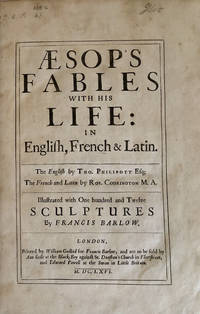
1666Best.-Nr. 48718London.: Printed by William Godbid for Francis Barlow and are to be sold by Ann Seile at the Black-Boy against St. Dunstan's Church in Fleetstreet and Edward Powell at the Swan in Little Britain. 1666. Full contemporary calf boards ruled in blind later spine with red morocco label with gilt title and blind rules in seven compartments marbled edges. Folio. 356 x 242 mm. Printed title within double rules engraved title by Barlow with central title within elaborate cartouche and surrounded by an eagle leopard boar fox wolf and lion leaf with large decorative woodcut inhabited ten-line initial and Barlow's dedication to Sir Francis Pruijan or Prujean leaf with Barlow's 'To the Reader' leaf with engraved frontispiece of Aesop with animals and additional engraving with text beneath 20 leaves with 'A Brief Prospect of the Life of Aesop' 16 leaves with 'La Vie d'Esope' 9 leaves with 'Aesopi Philosophice Fabulantis Vita' and Aesop's 110 fables illustrated with 110 engravings final leaves with 'La Table' and 'The Table' decorative woodcut initials and tail-pieces throughout; sheet size: 350 x 228 mm. A very rare large paper copy of the scarce first edition of Francis Barlow's undoubted masterpiece of English book illustration.By the time of the Restoration Francis Barlow had achieved a measure of success with his suites of prints of animals - engraved by the best such as Hollar Griffier and Place - and his decoration of houses and by the mid-1660s had contributed to the Aesop of Ogilby and Hollar. It is not entirely clear why he would wish to issue another edition of the Fables Hofer suggests a competitive nature and a different projected audience but by 1665 he had engraved a superb title it bears that date and by the time of publication in 1666 the date to the letterpress title had engraved a frontispiece of Aesop surrounded by animals and 110 half-page vignettes after his own drawings to illustrate the Fables. Each of the Fable engravings is accompanied by lines of verse by Thomas Philipott; the translations of Aesop's life into French and Latin was by Robert Codrington. Whatever Barlow's motivation the result is one of the most extensive and beautiful English illustrated books of the seventeenth century and one of the scarcest the scarcity often attributed to the loss of the sheets in the Great Fire of London. Large paper copies of this first edition are identifiable see ESTC through various issue points all present here but also as per Philip Hofer the transposition of some of Barlow's engravings. In the present copy the engraving for 'Fab. XLVIII' 'The Ant and Fly' is in fact that for 'Fab. XLXIX' 'The Ant and Grasshopper'. Hofer indicates too that the engravings for 'Fab. LXX' 'The Tortoise and Hare' and 'Fab. LXXI' The Young Man and His Cat' are also transposed however in the present copy they are not the margins headlines etc. conform to the remaining large paper leaves although 'The Young Man and His Cat' features the erroneous title 'The Nurse and Her Child' 'Fab. LXIX' albeit with the correct page number. Large paper copies also feature 'FINIS' beneath the signature Ppp at the foot of the leaf with the final engraving for 'FAB. CX' 'The Tortoise & Eagle'; in addition the spacing of the text in the large paper copy also suggests that the text on this leaf was reset.A second edition was published in 1687 with additional plates to illustrate the life of Aesop and with Philipott's verse replaced with new verse by Aphra Behn. A third edition was issued in 1703 and a posthumous French edition appeared in 1714 published in Amsterdam; Philip Hofer suggests that the third edition was really made up of unused sheets from the two earlier editions but with a new title and that the edition in French - it makes use of some of Barlow's plates - is not a Barlow edition.'This seventeenth-century polyglot English-French-Latin Aesop is handsomely illustrated with engravings after designs by Francis Barlow 1626 - 1702 an English painter renowned for his pictures of country life and field sports. He was perhaps the finest English draughtsman of animal scenes in the seventeenth century. Barlow who published the book at his own expense explains in his preface that he intends the work to contribute to the education of young people. This is the first edition; the relatively few copies known are all survivors of the Great Fire of London which swept over the printer's premises in 1666.' Early Children's Books and Their Illustration.'No artist has responded with more sensitivity and less sentimentality to the gentle grace of deer . The least of creatures the frog the hare the snake and the swallow and the least favoured of them the ass the boar and the wolf -- he draws them all with an intimacy charm and inviolable integrity never surpassed in an English book . '. Edward Hodnett.'Francis Barlow was the first native English book illustrator - indeed the leading interpretative illustrator in England before 1800 . Otto Benesch of the Albertina Museum Vienna has called him 'one of the greatest illustrators of all time'.' Edward Hodnett.This large paper issue of the 1666 Aesop is very scarce: while ESTC lists 17 copies for the small paper issue see ESTC R21542 it notes only two of the large: the copy at the Huntington and that at the Morgan Library and Museum New York; Harvard also holds a copy.ESTC R477463; see 'Francis Barlow' by Edward Hodnett 1978; see #9 in the Morgan Library and Museum's 'Early Children's Books and Their Illustration' 1975; see Philip Hofer's 'Francis Barlow's Aesop' printetd in the Harvard Library Bulletin Autumn 1948. Printed by William Godbid for Francis Barlow, and are to be sold by Ann Seile at the Black-Boy against St. Dunstan's Church in F hardcover
1665Best.-Nr. H-236AESOP c.620-564 BCE and Francis BARLOW c.1626-1702 artist. Aesop's Fables with his Life: in English French and Latin. Translated by Thomas Philipott and Robert Codrington. London: Printed by William Godbid for Francis Barlow 1665. Folio 370 x 240mm. Pre-fire First edition and large paper issue of Barlow's masterpiece on Aesop's Fables. The first edition of 1665-1666 is a rare survivor as nearly all copies were destroyed in the 1666 London fire. According to the Yale Center for British Art who has a similar copy the first edition was largely destroyed in the London fire this copy has the Rob. Codrington trans. entry on the title page consistent with the pre-fire first edition. A second edition was published in 1687 with additional plates to illustrate the life of Aesop and with Philipott's verse replaced with new verse by Aphra Behn. A third edition was issued in 1703 and a posthumous French edition appeared in 1714 published in Amsterdam. The Fables themselves are in English verse by Mrs Behn and French and Latin prose each followed by a moral. Illustrated throughout with detailed images of animals and scenes this edition stands as a landmark book in the history of printing definitely a rare feat of the 17th century. Hodnett describes Barlow's anatomically-skilled drawings as 'the special glory of the Aesop illustrations' and affirms 'No artist has responded with more sensitivity and less sentimentality to the gentle grace of deer … The least of creatures the frog the hare the snake and the swallow and the least favored of them the ass the boar and the wolf — he draws them all with an intimacy charm and inviolable integrity never surpassed in an English book' Edward Hodnett Francis Barlow: First Master of English Book Illustration London 1978 pp.182 185. The fables we now associate with the legendary ancient author Aesop have a complicated textual transmission history but they have been an important part of the educational tradition of the Greco-Roman world and its successors for thousands of years—not only teaching moral lessons but playing a role in language instruction through their many translations. Printed by William Godbid for Francis Barlow hardcover
1501Best.-Nr. 1859Basel: Jacob Wolff of Pforzheim 1501. First edition thus. An early illustrated edition of Aesop's Fables augmented and edited by Sebastian Brant and the first edition to include his additional 140 sections. Two parts in one volume folio leaves measuring 297 x 208 mm. Collates complete retaining one of the two blank leaves M6 lacking. Collation identical to the Fairfax-Murray copy: a-b8 c6-o8 alternately p-s6 s6 blank and original; A-B8 C-D6 E8-K6 alternately L4 M5 M6 final blank lacking. With the famous woodcut portrait of Aesop on the verso of a1 and a smaller woodcut portrait of Brant on the verso of A1 in part two. A total of 335 woodcuts divided into 194 in part one and 141 in part two inclusive of the portraits. Text in Latin. Full black straight-grain morocco. Boards ruled in gilt with gilt dentelles. Spine stamped and lettered in gilt. All edges gilt. Marbled endpapers. Generous margins. Previous owner's small bookplate on front pastedown. This copy has been very carefully restored and generally presents quite well. Certain passages were deemed obscene shortly after publication and as a consequence most known copies have a few sections defaced. This copy is no different with a number of passages and illustrations crossed out and/or marked "no legas" "do not read". A number of leaves have had small marginal tears or wormholes repaired occasionally affecting a letter or a word. One leaf C4 with a small hole affecting the woodcut on the recto and two or three words on the verso. A few leaves have been remargined including the title page to part 2 leaf A1. In two places leaves are bound out of order. The flaws notwithstanding a lovely book. The plan of this edition was conceived by Sebastian Brant. The first part of the book is based on Johann Zainer's first illustrated edition of 1476-77 translated into Latin by Heinrich Steinhöwel. Brant expands the work polishes the language and includes his commentaries to these fables. The second part is an entirely new work by Brant of 140 fables riddles accounts of miracles and other wonders of nature. These 140 new chapters follow the same structure as the first section with a woodcut followed by verse and then prose "some of a very remarkable character" according to Hugh W. Davies Fairfax Murray. These compositions are taken from the works of Stace Juvenal Virgil Ovid Lucien. The first story taken from Hesiod is said to be the oldest known fable. "The numerous woodcuts in this volume fall into two distinct categories. The woodcuts in the first part with a few exceptions are rather simplistic and naive in execution and are based in reverse on the woodcuts from Zainer's successful Ulm edition of c.1476 incidentally the first illustrated edition of Aesop; the actual blocks were first used in Wolff's edition of not after 1489 Goff A115. The woodcuts of the second part are more sophisticated with the use of hatching and perspective to enliven the images and they were cut specifically for this edition; is it thought they were produced by the workshop of Johann Grüninger in Strassburg" Sotheby's. According to Hugh W. Davies "The remainder of the cuts are by a new artist the style entirely differing from the older blocks. These are heavily shaded by thin close parallel lines amalgamating into a solid mass in the deepest shadows. The perspective as a rule is fair: the faces are well rounded the noses being broad at the bridge but well-shaped. The cuts have the appearance of metal but they nevertheless are probably on wood." In the past 30 years there have been five other auction results for this book one copy selling twice. The average price achieved in those five sales including the buyer's premium is just under $119000. If we average just the two copies sold in the last ten years that average jumps to over $167000. Of those five results the lowest sale price from 2002 made over $81000. And finally to complete the analysis a particularly fine copy was offered by the trade in 2014 for 200000 pounds roughly $329000. So while our copy has its defects and imperfections as do almost all other copies it is priced competitively for such a lovely and important work. Fairfax Murray 20. Goed. I 390 24. Adams A291. Jacob Wolff of Pforzheim unknown books