1281 risultati
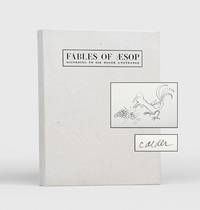
1931rif. 82103New York:: Harrison of Paris; Minton Balch and Company 1931. First edition; one of twenty copies marked "not for Sale" and including an original signed Calder ink drawing which was not used in the publication hinged in after the front free endpaper as issued. . publisher's boards in lettered dust jacket and glassine wrapper; in the publisher's maroon chemise and slipcase with printed paper labels on front panel and the spine of the chemise. . A very fine copy in a slightly sunned slipcase with a little rubbing / use at extremities and tanning to the paper label on the spine of the chemise. 4to. With Fifth Drawings by Alexander Calder. The unused drawing appears to illustrate the story of "A Dog and a Thief" at p. 116. This copy is printed on Guarros' Spanish pure rag paper with coloured silk threads. Harrison of Paris; Minton, Balch and Company, hardcover
1931rif. 183084Paris & New York: Harrison Minton Balch and Company 1931. With an original signed drawing First edition limited issue number XXVII of 50 copies with a tipped-in original published drawing signed by the artist. The drawing in this copy is from the Cock and Diamond fable. The text of the present edition is based on Roger L'Estrange's translation of Aesop's Fables 1692. Harrison of Paris was founded by publisher and heiress Barbara Harrison Wescott 1904-1977 and art patron and curator Monroe Wheeler 1899-1988 in 1930. The illustrator Alexander Calder came from a long line of sculptors and first took up printmaking after moving to Paris in 1926 where he befriended Marcel Duchamp Fernand Leger Joan Miró and Piet Mondrian. Quarto. Illustrated throughout with line drawings by Alexander Calder on Guarro's Spanish pure rag paper with coloured silk threads. Original paper-covered boards front cover lettered in black edges untrimmed endleaves uncut. With the original glassine dust jacket and the original paper knife loosely inserted. Housed in the original red card chemise and slipcase with printed label to front cover. A few small marks to boards; glassine jacket a little chipped tape repair to rear jacket; slipcase a little toned: a near-fine copy. hardcover
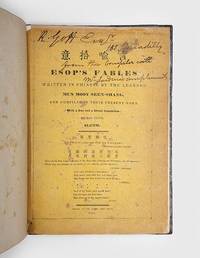
1840rif. 173764Canton: Canton Press Office 1840. The first full Chinese translation of Aesop's Fables First edition association copy inscribed by William Jardine one of the three "generous patrons" named in the dedication on the front wrapper "R. Goff Esqr. 105 Piccadilly from the compiler with Mr. Jardine's compliments". Jardine 1784-1843 co-founded the successful trading firm Jardine Matheson & Co. and held significant sway over the course of Anglo-Chinese relations either side of the First Opium War. This Chinese translation was intended as a primer to help the growing number of British students of Chinese working for Jardine Matheson the East India Company and other concerns in Canton. Robert Thom 1807-46 who adopted the pen-name "Sloth" honed his language skills while working for Jardine's and acted as a translator for British forces during the First Opium War 1839-42 and at the 1843 Supplementary Treaty negotiations. He was later British consul at Ningbo. Each page offers three columns of English Chinese characters and romanized Chinese. For each fable Thom dictated the Chinese to his teacher who brushed them in a legible hand. According to the introduction the volume was the first time Chinese wooden blocks and European metal type were used side-by-side during printing. Thom's translation was later reprinted in various modified editions by the Anglo-Chinese College the Shanghai Free Hospital and the Wenyutang Chinese Printing and Publishing Company. This edition is well represented institutionally but is uncommon in commerce - we have traced only five appearances at auction in the past six decades. Of these only one retained both of the original wrappers as here. Provenance: Robert Goff 1801-1866 was an antiquarian who travelled widely in the Middle East and Asia presenting a collection of Egyptian antiquities to the British Museum in 1847. This copy was later in the Bibliotheca Lindesiana one of the most impressive private collections of the 19th century its bookplate is on the front pastedown. Alexander Lindsay 1812-80 later 25th Earl of Crawford and 8th Earl of Balcarres met Goff while the latter was travelling and at the sale of Goff's art collection in 1866 Quaritch acquired a collection of Chinese drawings and sold these to Lindsay. This copy entered the Lindsay library either via Quaritch or via the dispersal of the Goff library in the 1890s. It is recorded in the 1910 Bibliotheca Lindesiana catalogue. Quarto 295 x 202 mm. With engraving of Chinese character styles furnished by Elijah Coleman Bridgman the compiler of the Canton Chrestomathy. Late 19th-century brown hard-grain half morocco by Henry Wood raised bands ruled in gilt spine lettered in gilt Papier Tourniquet-pattern sides marbled endpapers with design of Spanish moiré on Turkish with overprinted gold vein pattern top edge gilt original yellow printed wrappers bound in. Binding a little worn corners and extremities recoloured light foxing neat tissue repairs at foot of wrappers and title page loss at lower corner of p. 103 a few tide marks to fore edges: a very good copy. Bibliotheca Lindesiana 1910 80 this copy; Cordier 1683; Lust 1065. hardcover
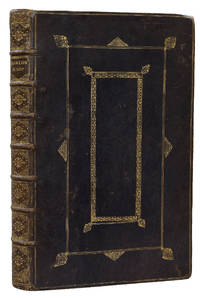
1687rif. 47459London.: H. Hills jun. for Francis Barlow. 1687. Full contemporary midnight blue morocco by the 'Barlow's Aesop Binder' boards ruled in gilt to surround gilt tooled decorative panels with foliate decorative corner pieces banded spine with elaborate decorative tooling and title 'BARLOWs AESOP' gilt turn ins and board edges with gilt roll tool decoration marbled endpapers a.e.g. black morocco-backed velvet-lined buckram box. Folio. 372 x 242 mm. Engraved title printed title engraving with the Devonshire arms dedication leaf 'to the Right Honourable William of Devonshire' leaf 'to the Reader' engraved frontispiece and 31 engraved plates illustrating the 'Life of Aesop' and 110 half-page vignette engravings to the 'Fables'. A superlative large paper copy in a contemporary English binding by the Barlow's Aesop Binder of Barlow's undoubted masterpiece of English book illustration.This copy - printed on excellent paper - is in a beautiful contemporary binding the binding in a beautiful state of preservation by the ‘Barlow’s Aesop Binder’. Few bindings by the 'Barlow’s Aesop Binder' are known and the present copy identifiable by the lettering to the spine and the comparable decorative tooling is one of only a handful. Active in the 1680s and 1690s the bindery worked certainly for William and Mary although the identified copies of Barlow’s masterpiece from the bindery include too the Devonshire dedication copy from Chatsworth the Cracherode copy both these now at the British Library Pepys’ copy at Magdalene Cambridge the present copy and one other in a private collection in the US.This second edition of Francis Barlow's masterpiece adds 31 plates 32 including the frontispiece to illustrate the life of Aesop including the often mutilated 'obscene' plate here untouched and includes verse by Aphra Behn 1640 - 1689 commissioned especially for each of the 'Fables'. The unsigned plates are engraved by Barlow and the remainder by Thomas Dudley a student of Wenceslaus Hollar. Barlow himself drew and engraved all of the illustrations for the 'Fables' themselves.'The Ingenious Mrs. A. Behn has been so obliging as to perform the English Poetry which in short comprehends the Sense of the Fable and Moral: Whereof to say much were needless since it may sufficiently recommend it self to all Persons of Understanding.' Francis Barlow.'Francis Barlow was the first native English book illustrator - indeed the leading interpretative illustrator in England before 1800 . Otto Benesch of the Albertina Museum Vienna has called him 'one of the greatest illustrators of all time'.' Edward Hodnett.Complete copies of Barlow's work in good condition are scarce the present copy however a large paper example in its original binding by theh Barlow’s Aesop Binder printed on a different thick paper stock and entirely unsophisticated is of the utmost rarity. This is borne out if it is necessary to provide evidence by the fact that this copy featured in two sophisticated collections of illustrated books of the last 50 years: firstly that of Arthur and Charlotte Vershbow secondly that of Robert S. Pirie; the latter collector rarely if ever settled for second best and would certainly have bought another copy if he had found one. That he had to wait for the present copy is telling.Wing 703; see ‘English Restoration Bindings’ by Howard Nixon pg. 40 nos. 98 / 99; see 'Francis Barlow' by Edward Hodnett 1978. H. Hills jun. for Francis Barlow. hardcover
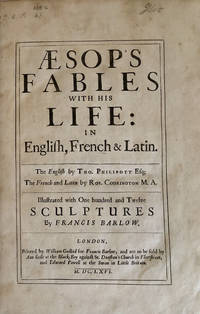
1666rif. 48718London.: Printed by William Godbid for Francis Barlow and are to be sold by Ann Seile at the Black-Boy against St. Dunstan's Church in Fleetstreet and Edward Powell at the Swan in Little Britain. 1666. Full contemporary calf boards ruled in blind later spine with red morocco label with gilt title and blind rules in seven compartments marbled edges. Folio. 356 x 242 mm. Printed title within double rules engraved title by Barlow with central title within elaborate cartouche and surrounded by an eagle leopard boar fox wolf and lion leaf with large decorative woodcut inhabited ten-line initial and Barlow's dedication to Sir Francis Pruijan or Prujean leaf with Barlow's 'To the Reader' leaf with engraved frontispiece of Aesop with animals and additional engraving with text beneath 20 leaves with 'A Brief Prospect of the Life of Aesop' 16 leaves with 'La Vie d'Esope' 9 leaves with 'Aesopi Philosophice Fabulantis Vita' and Aesop's 110 fables illustrated with 110 engravings final leaves with 'La Table' and 'The Table' decorative woodcut initials and tail-pieces throughout; sheet size: 350 x 228 mm. A very rare large paper copy of the scarce first edition of Francis Barlow's undoubted masterpiece of English book illustration.By the time of the Restoration Francis Barlow had achieved a measure of success with his suites of prints of animals - engraved by the best such as Hollar Griffier and Place - and his decoration of houses and by the mid-1660s had contributed to the Aesop of Ogilby and Hollar. It is not entirely clear why he would wish to issue another edition of the Fables Hofer suggests a competitive nature and a different projected audience but by 1665 he had engraved a superb title it bears that date and by the time of publication in 1666 the date to the letterpress title had engraved a frontispiece of Aesop surrounded by animals and 110 half-page vignettes after his own drawings to illustrate the Fables. Each of the Fable engravings is accompanied by lines of verse by Thomas Philipott; the translations of Aesop's life into French and Latin was by Robert Codrington. Whatever Barlow's motivation the result is one of the most extensive and beautiful English illustrated books of the seventeenth century and one of the scarcest the scarcity often attributed to the loss of the sheets in the Great Fire of London. Large paper copies of this first edition are identifiable see ESTC through various issue points all present here but also as per Philip Hofer the transposition of some of Barlow's engravings. In the present copy the engraving for 'Fab. XLVIII' 'The Ant and Fly' is in fact that for 'Fab. XLXIX' 'The Ant and Grasshopper'. Hofer indicates too that the engravings for 'Fab. LXX' 'The Tortoise and Hare' and 'Fab. LXXI' The Young Man and His Cat' are also transposed however in the present copy they are not the margins headlines etc. conform to the remaining large paper leaves although 'The Young Man and His Cat' features the erroneous title 'The Nurse and Her Child' 'Fab. LXIX' albeit with the correct page number. Large paper copies also feature 'FINIS' beneath the signature Ppp at the foot of the leaf with the final engraving for 'FAB. CX' 'The Tortoise & Eagle'; in addition the spacing of the text in the large paper copy also suggests that the text on this leaf was reset.A second edition was published in 1687 with additional plates to illustrate the life of Aesop and with Philipott's verse replaced with new verse by Aphra Behn. A third edition was issued in 1703 and a posthumous French edition appeared in 1714 published in Amsterdam; Philip Hofer suggests that the third edition was really made up of unused sheets from the two earlier editions but with a new title and that the edition in French - it makes use of some of Barlow's plates - is not a Barlow edition.'This seventeenth-century polyglot English-French-Latin Aesop is handsomely illustrated with engravings after designs by Francis Barlow 1626 - 1702 an English painter renowned for his pictures of country life and field sports. He was perhaps the finest English draughtsman of animal scenes in the seventeenth century. Barlow who published the book at his own expense explains in his preface that he intends the work to contribute to the education of young people. This is the first edition; the relatively few copies known are all survivors of the Great Fire of London which swept over the printer's premises in 1666.' Early Children's Books and Their Illustration.'No artist has responded with more sensitivity and less sentimentality to the gentle grace of deer . The least of creatures the frog the hare the snake and the swallow and the least favoured of them the ass the boar and the wolf -- he draws them all with an intimacy charm and inviolable integrity never surpassed in an English book . '. Edward Hodnett.'Francis Barlow was the first native English book illustrator - indeed the leading interpretative illustrator in England before 1800 . Otto Benesch of the Albertina Museum Vienna has called him 'one of the greatest illustrators of all time'.' Edward Hodnett.This large paper issue of the 1666 Aesop is very scarce: while ESTC lists 17 copies for the small paper issue see ESTC R21542 it notes only two of the large: the copy at the Huntington and that at the Morgan Library and Museum New York; Harvard also holds a copy.ESTC R477463; see 'Francis Barlow' by Edward Hodnett 1978; see #9 in the Morgan Library and Museum's 'Early Children's Books and Their Illustration' 1975; see Philip Hofer's 'Francis Barlow's Aesop' printetd in the Harvard Library Bulletin Autumn 1948. Printed by William Godbid for Francis Barlow, and are to be sold by Ann Seile at the Black-Boy against St. Dunstan's Church in F hardcover
1665rif. H-236AESOP c.620-564 BCE and Francis BARLOW c.1626-1702 artist. Aesop's Fables with his Life: in English French and Latin. Translated by Thomas Philipott and Robert Codrington. London: Printed by William Godbid for Francis Barlow 1665. Folio 370 x 240mm. Pre-fire First edition and large paper issue of Barlow's masterpiece on Aesop's Fables. The first edition of 1665-1666 is a rare survivor as nearly all copies were destroyed in the 1666 London fire. According to the Yale Center for British Art who has a similar copy the first edition was largely destroyed in the London fire this copy has the Rob. Codrington trans. entry on the title page consistent with the pre-fire first edition. A second edition was published in 1687 with additional plates to illustrate the life of Aesop and with Philipott's verse replaced with new verse by Aphra Behn. A third edition was issued in 1703 and a posthumous French edition appeared in 1714 published in Amsterdam. The Fables themselves are in English verse by Mrs Behn and French and Latin prose each followed by a moral. Illustrated throughout with detailed images of animals and scenes this edition stands as a landmark book in the history of printing definitely a rare feat of the 17th century. Hodnett describes Barlow's anatomically-skilled drawings as 'the special glory of the Aesop illustrations' and affirms 'No artist has responded with more sensitivity and less sentimentality to the gentle grace of deer … The least of creatures the frog the hare the snake and the swallow and the least favored of them the ass the boar and the wolf — he draws them all with an intimacy charm and inviolable integrity never surpassed in an English book' Edward Hodnett Francis Barlow: First Master of English Book Illustration London 1978 pp.182 185. The fables we now associate with the legendary ancient author Aesop have a complicated textual transmission history but they have been an important part of the educational tradition of the Greco-Roman world and its successors for thousands of years—not only teaching moral lessons but playing a role in language instruction through their many translations. Printed by William Godbid for Francis Barlow hardcover