Aesop / Arthur Rackham illustratorBiblio.com
1 693 résultats
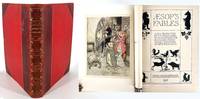
1912réf. 1744London / New York: William Heinemann / Doubleday 1912. First Edition. Very Good. Arthur Rackham. 8vo 8 1/8 x 6 1/4 inches 250 x 155 mm; xxix 224 pp; Thirteen color plates including frontispiece with descriptive tissue guards and fifty-three drawings in black & white nineteen full-page. Handsomely bound in half red calf over red cloth boards by Oxford Binding stamped in gilt inside lower edge; spine with gilt compartments and lettering marbled endpapers top edge gilt. Corners and joints rubbed but the binding remains firm square and attractive. Interior generally clean with light toning and occasional foxing most noticeable where tissue guards have rested against the text. Plates bright and well-preserved. A classic early 20th-century illustrated edition of Aesop's Fables featuring some of Rackham's most charming and expressive work combining his distinctive line drawings with richly colored plates. A desirable example in a pleasing period-style binding. William Heinemann / Doubleday unknown
réf. 67774483-75Scholastic Incorporated. Used - Like New. Used book that is in almost brand-new condition. May contain a remainder mark. Better World Books: Buy Books. Do Good. Scholastic, Incorporated unknown
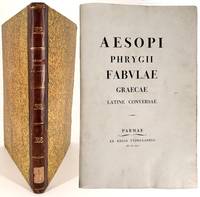
1800réf. 2962Parma: Giambattista Bodoni 1800. Very good . Folio 17 1/4 x 19 1/2 inches 440 x 293 mm; 8 176 4 pp. 19th Century quarter-binding in tan calf boards covered in marbled paper gilt title and decorations on spine; edges rubbed and corners bumped; front hinge partially split but binding is square and solid; generous margins with some marginal restoration from leaf 19/4 to end else internally clean and bright. Provenance: dedication inked by Ludovico Florio March 1862 on verso of second leaf; Barone Zappalà Asmundo paper label on spine; Carlo Antinori bookplate pasted inside front board. Brooks 796. A superb Bodoni classical imprint this handsome folio edition of Aesop's Fabulae is among the finest productions of the Parma Royal Press. The Greek text is printed with a parallel Latin translation in Bodoni's magnificent type demonstrating the harmony precision and elegance for which his editions are celebrated. Produced at the height of Bodoni's career it is an enduring masterpiece of neoclassical printing and an essential work for collectors of fine typography and Bodoni imprints. H. C. BROOKS in his Compendiosa bibliografia di edizioni bodoniane Florence 1927 says it is "of a simple yet incomparable beauty. Giambattista Bodoni unknown
1666réf. 48718London.: Printed by William Godbid for Francis Barlow and are to be sold by Ann Seile at the Black-Boy against St. Dunstan's Church in Fleetstreet and Edward Powell at the Swan in Little Britain. 1666. Full contemporary calf boards ruled in blind later spine with red morocco label with gilt title and blind rules in seven compartments marbled edges. Folio. 356 x 242 mm. Printed title within double rules engraved title by Barlow with central title within elaborate cartouche and surrounded by an eagle leopard boar fox wolf and lion leaf with large decorative woodcut inhabited ten-line initial and Barlow's dedication to Sir Francis Pruijan or Prujean leaf with Barlow's 'To the Reader' leaf with engraved frontispiece of Aesop with animals and additional engraving with text beneath 20 leaves with 'A Brief Prospect of the Life of Aesop' 16 leaves with 'La Vie d'Esope' 9 leaves with 'Aesopi Philosophice Fabulantis Vita' and Aesop's 110 fables illustrated with 110 engravings final leaves with 'La Table' and 'The Table' decorative woodcut initials and tail-pieces throughout; sheet size: 350 x 228 mm. A very rare large paper copy of the scarce first edition of Francis Barlow's undoubted masterpiece of English book illustration.By the time of the Restoration Francis Barlow had achieved a measure of success with his suites of prints of animals - engraved by the best such as Hollar Griffier and Place - and his decoration of houses and by the mid-1660s had contributed to the Aesop of Ogilby and Hollar. It is not entirely clear why he would wish to issue another edition of the Fables Hofer suggests a competitive nature and a different projected audience but by 1665 he had engraved a superb title it bears that date and by the time of publication in 1666 the date to the letterpress title had engraved a frontispiece of Aesop surrounded by animals and 110 half-page vignettes after his own drawings to illustrate the Fables. Each of the Fable engravings is accompanied by lines of verse by Thomas Philipott; the translations of Aesop's life into French and Latin was by Robert Codrington. Whatever Barlow's motivation the result is one of the most extensive and beautiful English illustrated books of the seventeenth century and one of the scarcest the scarcity often attributed to the loss of the sheets in the Great Fire of London. Large paper copies of this first edition are identifiable see ESTC through various issue points all present here but also as per Philip Hofer the transposition of some of Barlow's engravings. In the present copy the engraving for 'Fab. XLVIII' 'The Ant and Fly' is in fact that for 'Fab. XLXIX' 'The Ant and Grasshopper'. Hofer indicates too that the engravings for 'Fab. LXX' 'The Tortoise and Hare' and 'Fab. LXXI' The Young Man and His Cat' are also transposed however in the present copy they are not the margins headlines etc. conform to the remaining large paper leaves although 'The Young Man and His Cat' features the erroneous title 'The Nurse and Her Child' 'Fab. LXIX' albeit with the correct page number. Large paper copies also feature 'FINIS' beneath the signature Ppp at the foot of the leaf with the final engraving for 'FAB. CX' 'The Tortoise & Eagle'; in addition the spacing of the text in the large paper copy also suggests that the text on this leaf was reset.A second edition was published in 1687 with additional plates to illustrate the life of Aesop and with Philipott's verse replaced with new verse by Aphra Behn. A third edition was issued in 1703 and a posthumous French edition appeared in 1714 published in Amsterdam; Philip Hofer suggests that the third edition was really made up of unused sheets from the two earlier editions but with a new title and that the edition in French - it makes use of some of Barlow's plates - is not a Barlow edition.'This seventeenth-century polyglot English-French-Latin Aesop is handsomely illustrated with engravings after designs by Francis Barlow 1626 - 1702 an English painter renowned for his pictures of country life and field sports. He was perhaps the finest English draughtsman of animal scenes in the seventeenth century. Barlow who published the book at his own expense explains in his preface that he intends the work to contribute to the education of young people. This is the first edition; the relatively few copies known are all survivors of the Great Fire of London which swept over the printer's premises in 1666.' Early Children's Books and Their Illustration.'No artist has responded with more sensitivity and less sentimentality to the gentle grace of deer . The least of creatures the frog the hare the snake and the swallow and the least favoured of them the ass the boar and the wolf -- he draws them all with an intimacy charm and inviolable integrity never surpassed in an English book . '. Edward Hodnett.'Francis Barlow was the first native English book illustrator - indeed the leading interpretative illustrator in England before 1800 . Otto Benesch of the Albertina Museum Vienna has called him 'one of the greatest illustrators of all time'.' Edward Hodnett.This large paper issue of the 1666 Aesop is very scarce: while ESTC lists 17 copies for the small paper issue see ESTC R21542 it notes only two of the large: the copy at the Huntington and that at the Morgan Library and Museum New York; Harvard also holds a copy.ESTC R477463; see 'Francis Barlow' by Edward Hodnett 1978; see #9 in the Morgan Library and Museum's 'Early Children's Books and Their Illustration' 1975; see Philip Hofer's 'Francis Barlow's Aesop' printetd in the Harvard Library Bulletin Autumn 1948. Printed by William Godbid for Francis Barlow, and are to be sold by Ann Seile at the Black-Boy against St. Dunstan's Church in F hardcover
1968réf. 962P30New York: Doubleday & Company Inc 1968. Leather. Fine/Very Good Indeed. 8.5" by 5.5"; 9.5" by 6.5". Murray Tinkelman. Two copies of Murray Tinkelman's charmingly illustrated Aesop one copy being beautifully rebound and vividly hand coloured by Eric Sweet. Two copies of this Tinkelman edition of Aesop presented together in a custom cloth clamshell. One copy is in the original publisher's cloth with two unclipped book club edition dust wrappers the other is strikingly bound in a quarter morocco binding with patterned paper to the board. Bound by Eric Sweet in January 2006. Clamshell is in a near fine condition.Both volumes are illustrated with line drawings throughout however the rebound copy has been vibrantly hand-coloured.Aesop's Fables is a selection of fables generally attributed to the Ancient Greek storyteller Aesop who lived around 620 BCE-564 BCE. The fables are moral tales that guide in religious and secular aspects of life following adventures of many different creatures.Illustrated by the award-winning Murray Tinkelman primarily known for his illustrations for sci-fi and fantasy.Based on the translation of George Fyler Townsend.With an introduction by Isaac Bashevis Singer.Book club editions.Bound by Eric Sweet a keen collector of private press and fables. He studied at the Brighton College of Art before moving to London to work as a lettering artist and typographer for advertising agencies later becoming the head of Birmingham School of Printing. Sweet's bindings are unique and striking reflecting the topics of the volumes in distinctive style. One copy is in the original publisher's cloth with two unclipped dust wrappers the other is rebound in a quarter morocco binding with decorative paper to the boards presented together in a custom cloth clamshell bound by Eric Sweet. Externally the rebound copy is fine. The original cloth copy is a little rubbed to the spine with a publisher's label to the rear paste down and ink to the verso of the front endpaper. Dust wrappers are a little edge worn with small tears and chips mostly to the spine. One of the dust wrappers has been reinforced to the reverse. Spines are a little sunned and a few light handling marks to the wraps. Internally firmly bound. Pages are bright and clean. A few light marks to the clamshell in a near fine condition. Fine Doubleday & Company Inc hardcover
1800réf. 961P60London: C. Whittingham; J. Johnson; W. Ginger and Son; et al c1800. Leather. Very Good. 6.5" by 4". Not Stated. A scarce edition of the enduring fables of Aesop an illustrated edition with an engraved to each fable. A scarce edition of Aesop's 'Fables'.Illustrated with an engraved title and an engraving for each fable. Collated complete.Aesop's Fables is a selection of fables generally attributed to the Ancient Greek storyteller Aesop who lived around 620 BCE-564 BCE. The fables are moral tales that guide in religious and secular aspects of life following adventure of many different creatures.Undated dated from Jisc from a copy held at the British Library. In a contemporary calf binding. Externally generally smart a little rubbed. Neat repair to the front joint. Small tear to the head of the front joint. Minor bumping to the extremities. Front hinge is starting but firm. Internally firmly bound. Pages are bright and generally clean with scattered spots mostly to the first and last few pages. Very Good C. Whittingham; J. Johnson; W. Ginger and Son; et al hardcover
1899réf. 962F25London: John Lane The Bodley Head; Angus & Robertson 1899-1977. First edition. Cloth. Near Fine. 10.5" by 8". Percy J. Billinghurst. Two scarce editions of Aesop's fables including the very scarce first edition of the Percy J. Billinghurst illustrated edition and a late twentieth century edition also featuring his illustrations. Two volumes of the fables of Aesop both featuring the illustrations of Percy J. Billinghurst.The first of these two volumes is the very scarce first edition of this charming late nineteenth century edition of Aesop's fables with this edition from the English version of English pamphleteer Sir Roger L'Estrange featuring an introduction from Kenneth Grahame - author of 'The Wind of the Willows' - and illustrated by Percy J. Billinghurst.Illustrated with a frontispiece and with full page illustrations throughout - included in the pagination - from illustrator and bookplate designer Percy J. Billinghurst. The second volume is the scarce 1977 first edition of George Beal's retelling of the fables which also features Billinghurst's illustrations throughout.Aesop's Fables are a collection of brief moral tales attributed to a storyteller believed to have lived in ancient Greece around the 6th century BCE. These tales typically feature animals as characters who embody human traits and behaviours teaching practical life lessons through their interactions. Classic fables like "The Tortoise and the Hare" "The Boy Who Cried Wolf" and "The Ant and the Grasshopper" use simple narratives to convey enduring wisdom about virtues such as perseverance honesty and hard work.Housed in a cloth slip case In the publisher's original pictorial cloth bindings housed in cloth slip case. Externally excellent with bump to head of 1899 volume. Internally firmly bound. Pages of 1977 volume exceptionally clean and bright with the odd spot to the 1899 volume. Slip case in excellent condition. Near Fine John Lane The Bodley Head; Angus & Robertson hardcover
1804réf. 962F36London: J. Brambles A. Meggitt and J. Walters et al 1804 . Vellum. Fine. 8" by 5.5". Not Stated. A beautifully bound quarter vellum example of Croxall's translation of Aesop's fables charmingly illustrated with vignette illustrations. A beautifully bound early nineteenth century edition of the fables of Aesop.Illustrated with a frontispiece and with vignette woodcuts throughout.Samuel Croxall was an Anglican churchman writer and translator particularly noted for his translation of Aesop's Fables first published in 1722.Aesop's Fables are a collection of brief moral tales attributed to a storyteller believed to have lived in ancient Greece around the 6th century BCE. These tales typically feature animals as characters who embody human traits and behaviours teaching practical life lessons through their interactions. Classic fables like "The Tortoise and the Hare" "The Boy Who Cried Wolf" and "The Ant and the Grasshopper" use simple narratives to convey enduring wisdom about virtues such as perseverance honesty and hard work. Endpapers renewed. Former owner's inscription to title page head.The leaves of this volume have been washed. Bound by Eric Sweet in quarter vellum with marbled paper covered boards and with ink title to back strip. With a corresponding felt lined chemise and cloth covered slip case. Eric Sweet was a keen collector of private press and fables. He studied at the Brighton College of Art before moving to London to work as a lettering artist and typographer for advertising agencies later becoming the head of Birmingham School of Printing. Sweet's bindings are unique and striking reflecting the topics of the volumes in distinctive style. In a quarter vellum binding with marbled paper covered boards. Housed in a felt lined chemise and cloth covered slip case. Externally fine. Endpapers renewed. Slip case and chemise in fine condition. Internally firmly bound. The leaves of this volume have been washed. Pages exceptionally bright with only the odd light handling mark. Fine J. Brambles, A. Meggitt, and J. Walters et al hardcover
1820réf. 963Z8Derby: Henry Mozley and Sons 1820. Leather. Near Fine. 6.5" by 4". None stated. An excellent copy Samuel Croxall's noted edition of Aesop's fables illustrated with wood engravings and bound by Eric Sweet in crushed quarter morocco with a clamshell casing. A nineteenth century edition of Samuel Croxall's edition. Bound by Eric Sweet a keen collector of private press and fables. He studied at the Brighton College of Art before moving to London to work as a lettering artist and typographer for advertising agencies later becoming the head of Birmingham School of Printing. Sweet's bindings are unique and striking reflecting the topics of the volumes in distinctive style.Illustrated with a monochrome wood engraved frontispiece and monochrome wood engraved vignettes. A charming collection of fables credited to Aesop a Greek storyteller and fabulist whose tales were characterised by the anthropomorphic animal characters. This edition was translated and written by Samuel Croxall and is notable for its addition of his 'instructions' to the end of each fable which taught the reader how to apply the lessons of the fables to every day life.Bound in modern crushed quarter morocco with marbled paper to the boards housed in a cloth clamshell box.Undated dated by the binder's date. Bound in modern crushed quarter morocco with marbled paper to the boards housed in a cloth clamshell box. Endpapers renewed. Externally lovely. Internally firmly bound with lightly age toned pages and the odd minor spot. The clamshell is lovely. Near Fine Henry Mozley and Sons hardcover
1924réf. 962Y34London: John Lane The Bodley Head Ltd 1924. Leather. Fine. 9" by 6.5". Percy J. Billinghurst . A beautifully bound volume of Aesop's Fables decorated throughout with illustrations by Percy J. Billinghurst. A handsome later impression of this illustrated edition of Aesop's Fables including 'The Lion and the Mouse' 'The Stag and the Horse' and 'The Boasting Mule'. In a handsome modern rebind of quarter morocco decorative paper covered boards and marbled endpapers. Held in the binder's uniform clamshell with a spine title label. From the translation of English pamphleteer Sir Roger L'Estrange and with an introduction by British author of 'The Wind of the Willows' Kenneth Grahame. Strikingly illustrated throughout with full-page drawings by Percy J. Billinghurst. Bound by Eric Sweet a keen collector of private press and fables. He studied at the Brighton College of Art before moving to London to work as a lettering artist and typographer for advertising agencies later becoming the head of Birmingham School of Printing. Sweet's bindings are unique and striking reflecting the topics of the volumes in distinctive style. Rebound in quarter morocco with decorative paper covered boards and marbled endpapers. In the binder's uniform clamshell with spine title label. Externally lovely. Clamshell has a hint of shelf wear otherwise excellent. Internally firmly bound with bright and clean pages. Fine John Lane The Bodley Head Ltd hardcover
1828réf. 963Z11London: Joseph Booker; et al. 1828. Cloth. Very Good Indeed. 5.5" by 3.5". None stated. A pocket sized edition of Samuel Croxall's noted edition of Aesop's fables adorned with over one hundred wood engravings. An early nineteenth century copy of Samuel Croxall's edition.Illustrated with upwards of one hundred and fifty vignette engravings on wood.A charming collection of fables credited to Aesop a Greek storyteller and fabulist whose tales were characterised by the anthropomorphic animal characters. This edition was translated and written by Samuel Croxall and is notable for its addition of his 'instructions' to the end of each fable which taught the reader how to apply the lessons of the fables to every day life.In the original cloth housed in a modern cardboard clamshell casing. In the original cloth housed in a modern cardboard clamshell casing. Externally very smart with fading to the spine the odd minor mark to the boards and minimal bumping to the extremities. Internally firmly bound with bright and generally clean pages. The clamshell is lovely. Very Good Indeed Joseph Booker; et al. hardcover
1912réf. 963Y2London: Adam and Charles Black 1912. First edition. Cloth. Very Good. 8" by 6". Charles Folkard . The first of this illustrated edition of Aesop's fables adorned with colour plates by Charles Folkard. The first edition with Charles Folkard's illustrations. In the publisher's charming pictorial cloth binding. Collated complete with a colour frontispiece eleven further colour plates and numerous illustrations in the text throughout by Charles Folkard 1878-1963. Folkard studied at various art schools including the St John"s Wood School of Art and Goldsmith"s College School of Art before establishing himself through illustrating children"s classics and nursery literature.This anthology offers many classic fables originating from Aesop including 'The Fox and the Stork' 'The Old Hound' 'The Wolf and the Lamb' and 'The Wind and the Sun'.With two pages of publisher's advertisements to the rear. In the original pictorial cloth binding. Externally very smart with slight rubbing and bumping to the extremities most notably to the head of the spine. Internally firmly bound. Pages are generally bright with scattered spotting of varying degrees throughout. Contemporary ink inscription to the front free endpaper. Very Good Adam and Charles Black hardcover
réf. 145496197X.Ghardcover. Good. Access codes and supplements are not guaranteed with used items. May be an ex-library book. hardcover
1708réf. 1514Amsterdam: Pierre Mortier 1708. First Illustrated Edition. Near Fine. 2 vols. bound into one. Small 8vo 5 7/8 x 3.34 inches 150 x 95 mm 12 297 7; 2 287 4 pp. Frontispiece engraving printer devices on title pages and 117 in-text half-page engravings one for each fable engraved by Georg Paul Busch. Cancel on p. 276 fable LXX where wrong image had been printed. Contemporary vellum binding with later ms. title on spine edges speckled in red. Pages bright and clean with some bookseller pencil and ink markings on front and back flyleaves. Vellum a little thumbed but in excellent condition for a book of its age. STCN 334560683. A VERY RARE and EARLY EDITION of Aesop translated into French by Jean-Baptiste Morvan de Bellegarde 1649 -1734 a Jesuit priest author of works on ethics religion and education and accompanied by his discussion of the moral of each fable and four lines of verse. The fables are accompanied by a lively depiction of the story by the Berlin copper-plate engraver Georg Paul Busch 1682 - 1759. In Vol. 1 the 78 fables are preceded by "La Vie d'Esope" pp. 1-93 written by the Byzantine Greek monk and scholar Maximus Planudes c. 1260 - c. 1305. Vol. 2 contains fables 79-117 as well as French prose translations of further fables without illustrations: 18 numbered fables by the Renaissance Italian humanist poet and scholar Francesco Filelfo or Philelphus 139-1481 translated from the Latin verse; 37 fables based on Aesop by Gabrias and Avienus translated from the Latin verse; two longer fables: the "Battle of the cats and the rats" and the "Battle of the rats and the frogs"; five Aesop "tales" taken from Plato's dialogue Protagoras including one titled "De l'Origine de l'Amour"; six numbered "poetical fables" with Olympian Gods as protagonists; and finally three more tales the first from Herodotus and the last from Gerbellius. Each volumes includes an index. Later editions of the book 1736 for example pair two illustrations on one page. Busch's engravings show a certain hand with strong contrasts and dynamic movements. Pierre Mortier unknown
2017réf. G1499483678I3N00Windmill Books 2017. Library Binding. Good. Pages can have notes/highlighting. Spine may show signs of wear. ~ ThriftBooks: Read More Spend Less.Dust jacket quality is not guaranteed. Windmill Books unknown
réf. 0870-23Ulm Johann Cornad Wohler Druck: Johannes Gassenmeyer 1714. Zum andern mal vermehrter in Druck verfetiget" 2. Auflage. 1. Teil von 3 apart. 12°. Gefalt. Kupfertitel gefalt. Titelbl. in Schwarz u. Rot 2 Bll. 400 S. 2 Bll. mit 50 gefalt. Kupfertaf. Ldr.-Bd. d. Zeit über Holzdeckeln mit 2 intakten Schließen. Rücken mit verblasstem handschriftl. Titel Deckel mit reicher Rollstempel- und Streicheisenverzierung. Blauschnitt. Einband etwas berieben. Innen leicht gebräunt und stockfleckig 5 Tafeln mit Einrissen oder kl. Ausrissen im w. Rand. Titel mit zeigen. Nummer in Tinte. vgl. Wegehaupt I 18; vgl. VD17 12:646391S - Erster von 3 Teilen der 2. Auflage der in Ulm gedruckten überarbeitenen Fabeln des Aesop 6. Jhd. v. Chr. Die Überarbeitung und die zumeist an die Fabeln anschließenden Kommentare "Nutzen dieser Fabel" stammen laut Vorwort von Matthäus Schultheiß gest. vor 1714 der möglicherweise mit dem Drucker früherer Ulmer Ausgaben und Auflagen Matthäus Schultes aktiv 1652-1692 ident ist. Die Kupferstiche stammen vermutlich von dem Augsburger Kupferstecher Christoph Schmidt der nach Aegidius Sadelers 1570-1629 Fabel-Illustrationen gearbeitet hat. Für die vorliegende Ausgabe wurden wohl teils die Kupferstich-Platten der Ausgabe Ulm 1679 verwendet bzw. überarbeitet jedoch wurde die Signatur "Aegid. Sadeler inventor; Christ. Schmidt sculp. Augsp." aus den Platten gelöscht. Die ersten 127 S. enthalten eine Lebensbeschreibung Aesops. Ulm, Johann Cornad Wohler (Druck: Johannes Gassenmeyer) 1714. unknown
1975réf. 006539London: Paddington Press. A reprint of the 1818 edition with a new intro by Michael Marqusee. Attractive half-leather binding with marbled boards and matching endpapers. Without dustwrapper as issued . Fine. Hardcover. 1st thus. 1975. Paddington Press hardcover
2017réf. G1499483678I4N10Windmill Books 2017. Library Binding. Very Good. Former library book; May have limited writing in cover pages. Pages are unmarked. ~ ThriftBooks: Read More Spend Less.Dust jacket quality is not guaranteed. Windmill Books unknown
1699réf. 1345219London: printed for R. Sare B. Took M. Gillyflower A. & J. Churchil G. Sawbridge and H. Hindmarsh 1699. Third Edition. Hardcover. Folio 12 28 8 476 pages; VG-. Bound by Jon Robbins in modern period style calf. Spine lightly sun-faded. With frontis. portrait pi1v; Includes indices. Minor physical damage to middle of fore edge of text block going in approximately 1/8 inch at most does not impact text. Archival repair to portrait and frontispiece minimal loss to edges. Marginalia to c5. small piece missing from upper fore corner of X1 closed tear to middle of Tt1 small tidemark to upper fore corner of Zz4 small open tear to upper edge of Aaa3. JR Consignment. Shelved Room A Oversize. Oversized items. Will require additional postage for expedited/international orders. Economy international shipping unavailable due to size/weight restrictions. Contact seller for additional information. Lacking part 2. Wing A709.; Includes fables by Barlandus Avianus Abstemius Poggius and others;. 1345219. Special Collections - Upstairs. printed for R. Sare, B. Took, M. Gillyflower, A. & J. Churchil, G. Sawbridge, and H. Hindmarsh hardcover
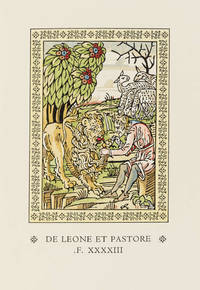
réf. 299Verona: Officina Bodoni 1972. Limited Edition. Fine. Octavo 9 7/8 x 6 1/2 in 250 x 165 mm; 2 volume set in slipcase. Vol. 1 pp. 280 with 68 hand-colored woodcuts; Vol. 2 pp. 120. Set in Centaur type and printed on hand-made Magnani paper with goose watermark. Original morocco-backed vellum with strapwork border and title in gilt t.e.g. remaining uncut; number 146 of 160 sets; text in Latin Italian and English. Woodcut illustrations by Anna Bramanti after Liberale da Verona ALL HAND-COLOURED AFTER A COPY OF THE 1479 EDITION IN THE BRITISH MUSEUM BY THE ATELIER DANIEL JACOMET OF PARIS list of woodcuts loosely inserted. Mardersteig 182. An exquisite and beautifully-executed edition of Aesop's FABLES richly illustrated with newly-cut wood engravings after a copy of the 1479 edition in the collection of the British Museum whose woodcuts are attributed to Liberale da Verona 1441-1526. The illustrations are beautifully carved and hand-colored with a rich scale of colors and shadings that remind us of illuminated miniatures. The Latin text comes from the Giovanni Alvise 1479 edition and was translated from the Greek by the Veronese poet Accio Zucco who possibly also used some earlier medieval translations. Each fable is followed by two sonnets by Zucco: the first tells the story Sonetto materiale and the second point the moral of the fable Sonetto morale. For this edition the Latin and Italian texts were revised by the philiologist Giovanni Battista Pighi. The second volume contains the William Caxton translation 1484 into English of the first 60 fables. The remaining 6 fables are here translated from Latin by Betty Radice. Prefatory note by Tanya and Hans Schmoller who carried out the revision of the text. Vol. 1 frontispiece: "THE FABLES OF AESOP. Printed from the Veronese edition of MCCCCLXXIX in Latin verses and the Italian version by Accio Zucco with the woodcuts newly engraved and coloured after a copy in the British Museum." Vol. 2 frontispiece: "The first three books of CAXTON'S AESOP containing the fables illustrated in the Verona Aesopus of MCCCLXXIX" Commenting on the making of this edition Giovanni Madersteig wrote: "At the end of the epilogue I examine the different illustrated editions of the fables printed in Italy during the fifteenth century. This comparison proves that the Verona Aesop was the model for all of them. Even the better-known Aesop from Naples printed by Tuppo contains quite a number of scenes with the same composition but in mirror image. The watermark of the goose which identifies the paper used in the first edition of the Aesop and in other Veronese books as having come from Toscolano was revived for this and other books printed at the Officina Bodoni." Barr John. The Officina Bodoni Montagnola Verona: Books Printed By Giovanni Mardersteig on the Hand Press 1923-1977. London: The British Library 1978. pp. 170-174 Giovanni Mardersteig Weimar 1892 - Verona 1977 was a printer and typographer who as head of Officina Bodoni created books exemplifying the highest standards in the art of printing. The press began in 1922 in Montagnola Switzerland and moved to Verona in 1927. It printed and published some 200 books and pamphlets including Politian's Favola d'Orfeo; Shelley's Epipsychidion Shakespeare's Tempest and Dante's Vita nuova. There are good collections in many major European and American libraries. The Bodleian Library at Oxford holds a particularly rich collection. Following Mardersteig's death in 1977 his son Martino Mardersteig took over and still occasionally used the Officina Bodoni imprint for works he printed on his father's hand-presses. Officina Bodoni unknown
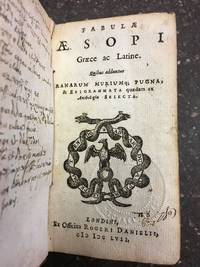
1657réf. 1334141Londini London: ex officina Rogeri Danielis 1657. Hardcover. 12mo. 8 246 VG-; bound in early full cloth plain spine; moderate wear and rubbing to boards some worming to both boards bumping to corners; ; greek handwriting to front pastedown front and rear endpapers; ex-library with markings to recto of title page; embossed stamp to title page page 99; small ink stains to pages 88/89; lacking last black leaf; Latin and Greek on facing pages; scarce; AG consignment; shelved case 3. ESTC: R20664 Per ESTC "The battle of the frogs and mice" is erroneously attributed to Homer.;. 1334141. Shelved Dupont Bookstore. ex officina Rogeri Danielis hardcover
réf. 8966397-6Aulton Press. Used - Good. Former library copy. Pages intact with minimal writing/highlighting. The binding may be loose and creased. Dust jackets/supplements are not included. Includes library markings. Stock photo provided. Product includes identifying sticker. Better World Books: Buy Books. Do Good. Aulton Press unknown
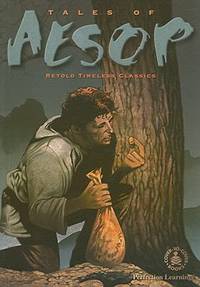
2000réf. G0789128454I3N10Perfection Learning Corporation 2000. Paperback. Good. Disclaimer:A copy that has been read but remains in clean condition. All pages are intact and the cover is intact. The spine may show signs of wear. Pages can include limited notes and highlighting and the copy can include previous owner inscriptions. An ex-library book and may have standard library stamps and/or stickers. At ThriftBooks our motto is: Read More Spend Less.Dust jacket quality is not guaranteed. Perfection Learning Corporation paperback
2000réf. G0789128454I5N00Perfection Learning Corporation 2000. Paperback. Acceptable. Disclaimer:A readable copy. All pages are intact and the cover is intact. Pages can include considerable notes-in pen or highlighter-but the notes cannot obscure the text. At ThriftBooks our motto is: Read More Spend Less.Dust jacket quality is not guaranteed. Perfection Learning Corporation paperback
réf. SKU1096032White Gallaher & White. leather_bound. Acceptable. 0x0x0. 1825; Poor Condition; brown leather covers with title label on spine; wear to covers heaviest to edges; no jacket; Ex library with minimal stamps and markings; rear hinge is broken and rear board is loosely attached; top half of front fly is clipped off; internal spotting/discoloration; 228 pages; some illustrations are colored in; 24mo 4 3/4" to 5 3/4" tall; White, Gallaher & White hardcover