Aesop; Phaedri; Flavvi AvianiBiblio.com

1 689 résultats
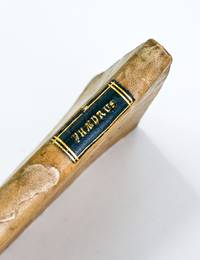
1742réf. 963Q18Parisiis : Coustelier 1742 . Leather. Very Good Indeed. 6" by 3.5". Antoine Coypel . A beautifully bound eighteenth-century Latin edition of this collection of fables inspired by Aesop taken from the writings of early fabulists Phaedrus and Avianus. Beautifully bound in full calf housed in a custom cloth clamshell by Eric Sweet. Pages have been washed during the restoration process.Comprised of 'Phaedri Augusti Liberti Fabularum Aesopiarum' and 'Flavvi Aviani Fabularum Aesopiarum'.Two works bound together although running with a continuous pagination as is expected with this work. A collection of fables inspired by Aesop the first part originating from Roman fabulist Gaius Julius Phaedrus and the second part being compiled from the writings of pagan writer Avianus. Born in the 1st century AD not much was known about Phaedrus until the discovery of a few of his manuscripts during the Renaissance when his popularity soared. He is recognised as being the first versifier of Aesop's fables into Latin. Born around AD 400 Avianus was a pagan writer of fables in Latin inspired by Babrius the author of a collection of Greek fables known today as Aesop's fables. Written in Latin. Illustrated with a frontispiece of Antoine Coypel after Fessard and five vignettes. Collated complete. Pagination error p107-p111 skipped in pagination as is expected of this edition. Restoration carried out and clamshell created by Eric Sweet a keen collector of private press and fables. He studied at the Brighton College of Art before moving to London to work as a lettering artist and typographer for advertising agencies later becoming the head of Birmingham School of Printing.Label of 'Bibliothèque du Boisgeloup'. Bound in full calf housed in a custom cloth clamshell. Externally very smart with light rubbing to joints and extremities and the odd mark. Bookplate to front paste down. Internally firmly bound. Pages have been washed and are bright and clean. Pagination error p107-p111 skipped in pagination as is expected of this edition. Very Good Indeed Coustelier hardcover
1784réf. ABC_45444Zweibrücken 1784. 8vo. Sprinkled paper over boards red sprinkled edges. With a strange engraving showing a fantastic creature with a roosters head a man in his belly a rams head for an ass stepping on a fish with a rabbit in the background in an oval with the inscription Agostini on the title-page. 2 LII 232 pp. The well printed celebrated "Biponti society" edition of Phaedrus part of a renowned series of Greek and Latin texts published in the German city of Zweibrücken Biponti a town near Sarbrücken starting in 1779. The edition is partly based on the edition of Johann Albert Fabricius 1621-1736 as edited by Johann August Ernesti 1707-1781. Ultimately however the starting point of the edition was the Petrus Burman recension with notes by Gudius and with fables added from the Romulus the Niccolò Perotti 1430-1480 appendix and others as well as the Avianus and Anonymous i.e. "Anonymous Neveleti" fables mentioned. The book also contains the Vita Phaedri by Johannes Scheffer 1621-1679 and the "Notitia literaria de Phaedro ex Jo. Alb. Fabricii Bibliotheca Latina" by the editor Ernesti pp. xiii-lii and "De Anonymus vetere fabularum auctore. latin. ed Ernesti" also by the editor.Top and bottom of spine bumped.l Schwabe/Barbier 111-112. hardcover
1797réf. H5474Paris: Didot; Excudebam Petrus Didot Natu Major Anno Reip. VI In Aedibus Palatinus. 1797. Hardcover. Very Good. Published in An VI 1797-1798 8vo pink boards remains of spine label very good light rubbing along joints minor occasional foxing; handsome mid-19th century bookplate by Dupont for A. Kuhnholtz-Lordat a collector from Montpellier. 3 99 pp. Didot; Excudebam Petrus Didot, Natu Major, Anno Reip. VI, In Aedibus Palatinus.. hardcover
1784réf. 963Q22Biponti : Biponti 1784 . Vellum. Very Good. 8" by 5". None. A vellum-bound copy of the celebrated "Biponti" edition of Phaedrus's fables of Aesop along with contributions from other noted fabulists. The Biponti edition part of a celebrated series of Greek and Latin texts published in Biponti Germany.Bound in a contemporary full vellum with a custom cloth clamshell. A Latin collection of Phaedrus's fables of Aesop originating from 1st Century Roman fabulist Gaius Julius Phaedrus known for being the first versifier of Aesop's fables into Latin. Also included in this collection are fables by another well-known writer in the field pagan fabulist Aviani as well as a number of anonymous contributors. Based on the 1727 edition of Pierre Burman or Petrus Burman with contributions from other authors. With an unusual illustration to the title page depicting a mixture of animals in one. Bookplate of Bibliotheque de J. Thompson Bruxelles 1870 and another of Ch. de Toughe. Clamshell by Eric Sweet a keen collector of private press and fables. He studied at the Brighton College of Art before moving to London to work as a lettering artist and typographer for advertising agencies later becoming the head of Birmingham School of Printing. Bound in a contemporary full vellum with a custom cloth clamshell. Externally very good with rubbing to the extremities and marking to the vellum as is common with this binding. Bookplate and inscriptions to front paste down. Internally firmly bound. Pages are bright and clean. Clamshell is also in excellent condition with just a little fading. Very Good Biponti hardcover
1718réf. FF2503Utrecht:: Apud Guilielmum vande Water 1718. 1718. Two parts in one volume. Octavo. 62 398; 258 70 pp. Elaborate engraved frontispiece woodcut title vignette head & tail pieces index. Title printed in red & black. Internally generally clean and tight with offsetting to title. Later full red straight grain morocco single-ruled in gilt with gilt-stamped and lettered spine with solid single gilt roll to edges foot of spine gilt-stamped: TRAJ: AD RHEN publisher: 1718 all edges gilt marbled endsheets; somewhat rubbed. Bookplates of Thomas M. Lowndes and Henry Drury. Very good. With a fore-edge painting depicting a scene of HAWICK ROXBURGHSHIRE SCOTLAND after an engraving by John Greig fl. 1800-1843 from an original study by Luke Clennell 1781-1840. The fore-edge painting is based on an engraving found in Sir Walter Scott's Border Antiquities of England and Scotland Longman & Co. 1814-1817. This well-painted scene is likely of 20th century vintage. / The Dutch scholar Peter Burman was professor of the art of rhetoric and the history of Utrecht and also of Greek philology. In 1715 he succeeded Perizonius receiving the chair of history and the Greek language and the art of rhetoric at the Lyon-Batava Academy. Later he was librarian and director of the Lyon-Batava Academy. This is his commentary on Phaedrus which was originally issued in 1698. PROVENANCE: Thomas M. Lowndes – Henry Drury both pre-fore-edge – Jack Bartfield Fine Books New York – Randall J. Moskovitz MD Memphis Tennessee. Apud Guilielmum vande Water, 1718. unknown books
1753réf. 15331Berlin, (Wagner in Ulm für) A. Haude u. J. C. Spener, 1753. Kl.-8°. Mit gest. Titelvignette. 14 Bll., 192 S., Ppbd. d. Zt.
1754pp. xlviij, 305 + Engraved Frontis. Fine headpieces and tail pieces engraved by Fessard, Sornique, and others. Foxed. 12mo. Disbound. All edges gold gilt. Brunet V/1788; Cohen 798. Gaius Julius Phadrus (1st century), was a Thracian slave who translated Aesop's fables into Latin verse. He was certainly more than a reproducer of Aesop, and can be credited with adding many fables of his own. A brief history of the Barbou Classics is given by Schweiger (II 1269). In 1742 Lenglet de Fresnoy persuaded Coustelier to start a series which was meant to be a French rival to the Elzeviers - even surpassing them in terms of scholarship and typography. Though this effort soon exhausted itself, it was revived by Jean Joseph Barbou in 1753. Seven of these attractive little books appeared in 1753-1755, and though there were more issued in the next decade, there was not enough market interest to support a sustained publishing program. They still stand as a monument to French scholarship and typography. This copy is priced low enough to allow for a nice new binding. **PRICE JUST REDUCED! SMALL BOX 5
1816réf. 62391103 pages 1 advert at the rear text in Latin Published by Law & Whittaker hardcover
réf. 26132o.O. o.J. 1920. 6 Orig.-Holzschnitte auf Japan Blattgrösse: 20 x 117 cm Büttenpapierin Passpartout: 24 x 32 cm. 1 orig.-graphisches Titelbl. Lose Blatt Tadellos Auflage 50 Ex. Die Schnitte stellen folgende Fabeln dar: Vom quacksalbernden Schuster; Die beiden Last tragenden Maultiere; Der zerplatzte Frosch und der Ochse; Der Leopard.; Die Schlange und der Amboss. Hübsche detailgetreue naturalistische Holzschnitte. Das kleinere ebenfalls orig.-graphische Titelblatt und alle Schnitte signiert. Titelbl. auch dat. 1920. Phaedrus röm Fabeldichter übersetzte zuerst Fabeln des Aesop und schuf später eigenständige Geschichtchen die seine Zeitgenossen belehrten und karikierten. 010 o.O., o.J., 1920 unknown
1697réf. 55531Paris: Widow of Claude Thiboust Madeleine Thévenon / Augustin Leguerrier 1697. Very good. First edition published in France of this influential Latin collection of Aesopian-fables - almost certainly the edition used by fairy tale-popularizer Charles Perrault for his French translation of 1699. Faerno's Neo-Latin fables were first published in 1563 as FABULAE CENTUM and soon became the most successful original work in the Aesopian tradition until La Fontaine; like La Fontaine Faerno adapted classical sources like Aesop as well as writing his own fables. In fact this edition's name refers to another important fabulist and celebrated Latin translator of Aesop Phaedrus whose work was rediscovered in the Renaissance; Faerno's fables were considered so good that many thought he cribbed them from Phaedrus - a charge against which Perrault defended him in his French translation of 1699. This edition was published the same year as Perrault's book of fairy tales HISTOIRES OU CONTES DU TEMPS PASSÉ 1697. Perrault appears to have begun his translation of Faerno around the same time suggesting that Perrault saw his fairy-tale work as linked to the fabulist tradition going back to Aesop. This edition the first printed in France according to the anonymous preface was meant especially for the education of children rearranging some of the entries to start with those easier to comprehend. Ashby notes that "Aesop's fables were not originally created for children" 6 but rather were intended as lessons for adults. Yet Faerno's own Aesopian fables were seen as a pedagogical tool from the beginning especially for teaching students Latin; it was works like this one that helped transform the wisdom tradition of the Aesopian fable into what we now see as a children's genre side by side with the fairy tale tradition. 12mo 5.5'' x 3.25''. Contemporary vellum green goatskin spine label. 22 156 12 pages. Boards bowed with notable soil. Faint dampstaining to text a couple small losses to rear endpaper. Tight. Widow of Claude Thiboust [Madeleine Thévenon] / Augustin Leguerrier unknown
1920réf. 104556Berlin: Amsler & Ruthart. Fine. 1920. First Edition. Hardcover. Nine laid and matted wood engravings in black ink on japan paper by artist Erich Glas 1897-1973 depicting eight fables from Aesop/Phaedrus. Each engraving is signed at lower margin by the artist. Prints and tilte page / colophon page also signed by the artist are laid in publisher's portfolio bound in 1/2 linen over hand made paper cover boards. An edition of 50 copies this being #34. In fine condition. ; 4to 11" - 13" tall . Amsler & Ruthart hardcover
1697réf. 55531Paris: Widow of Claude Thiboust Madeleine Thévenon / Augustin Leguerrier 1697. Very good. First edition published in France of this influential Latin collection of Aesopian-fables - almost certainly the edition used by fairy tale-popularizer Charles Perrault for his French translation of 1699. Faerno's Neo-Latin fables were first published in 1563 as FABULAE CENTUM and soon became the most successful original work in the Aesopian tradition until La Fontaine; like La Fontaine Faerno adapted classical sources like Aesop as well as writing his own fables. In fact this edition's name refers to another important fabulist and celebrated Latin translator of Aesop Phaedrus whose work was rediscovered in the Renaissance; Faerno's fables were considered so good that many thought he cribbed them from Phaedrus - a charge against which Perrault defended him in his French translation of 1699. This edition was published the same year as Perrault's book of fairy tales HISTOIRES OU CONTES DU TEMPS PASSÉ 1697. Perrault appears to have begun his translation of Faerno around the same time suggesting that Perrault saw his fairy-tale work as linked to the fabulist tradition going back to Aesop. This edition the first printed in France according to the anonymous preface was meant especially for the education of children rearranging some of the entries to start with those easier to comprehend. Ashby notes that "Aesop's fables were not originally created for children" 6 but rather were intended as lessons for adults. Yet Faerno's own Aesopian fables were seen as a pedagogical tool from the beginning especially for teaching students Latin; it was works like this one that helped transform the wisdom tradition of the Aesopian fable into what we now see as a children's genre side by side with the fairy tale tradition. 12mo 5.5'' x 3.25''. Contemporary vellum green goatskin spine label. 22 156 12 pages. Boards bowed with notable soil. Faint dampstaining to text a couple small losses to rear endpaper. Tight. Widow of Claude Thiboust [Madeleine Thévenon] / Augustin Leguerrier unknown books
réf. 3732641Dublin: M.H. Gill & Son 1881. 103pp. Sm. 8vo. Cloth. Two illustrations. Faint soil and trifle fading to binding; a near fine copy with bright gilt Translated into English from Latin tales from Aesop and others as told by Phaedrus the 1st-century Roman fabulist and the first to versify Aesop’s fables into Latin. With notes and an introduction by the translator. Rare. OCLC returns one copy in America one in Australia. unknown
1923réf. 6794Paris, Berger-Levrault, 1923. Deux parties en un volume grand in-4 broché de [18- titre, faux-titre, justification, introduction, table]-286-[2] pages, premier plat orné de décors et titres dorés, dos orné de filets, fleurons, dates et titres dorés, second plat orné d'un motif floral doré. Bords de la fragile couverture un peu usé avec de mimimes déchirures, dos plissé, intérieur sans défaut.
1726réf. JP0028Cambridge: Cornelius Crownfield 1726. 1st Edition. . Book Book Hardcover. Very Good. Cambridge: Cornelius Crownfield 1726. 1st Edition . Very Good. Recently rebound quarter calf using the original or 19th. century marbled boards and dark polished leather spine with black leather label for gilt title "BENTLEY'S COMMENTARIES 1726". Full-page frontispiece of Prince Frederick facing the dedicatory text. Title pages for the whole volume the first Terence part and the second Phaerdus' Aesop. Pagination: frontispiece leaf5 xxv 444 2Phaedrus title leaf frontispiece leaf Aesop and beastsvi871 finishing with the original rear free endpaper. Sporadic foxing of about three interior leaves and last few leaves lightly browned otherwise a very good copy excellently bound for safe and repeated use. This first edition lacks the indices illustrated title leaf and extra plate of the 1728 Amsterdam edition which despite the very similar pagination is independently typeset with the engraved plates very similar but freely copied from this Cambridge edition. see our JP0019 if unsold. Why not buy both to compare the printing and perhaps the text Cambridge: Cornelius Crownfield hardcover
1953formato 25X20,5. Legatura editoriale pagine 68. Serie Prima N.1. Quinta ristampa dalla Prima Edizione. Piccole mancanze ai piatti di copertina. Dorso mancante. Interno in buono stato
réf. 1880771144.Gpaperback. Good. Access codes and supplements are not guaranteed with used items. May be an ex-library book. paperback
réf. B9781165160082Paperback / softback. New. paperback
2008réf. DADAX1437338763Kessinger Publishing 2008-12-10. paperback. New. 6.00x0.76x9.00. Buy with confidence. Excellent Customer Service & Return policy. Kessinger Publishing paperback
réf. 1165160080.Gpaperback. Good. Access codes and supplements are not guaranteed with used items. May be an ex-library book. paperback
réf. 1437338763.Gpaperback. Good. Access codes and supplements are not guaranteed with used items. May be an ex-library book. paperback
réf. 109491Milano Rovello date. In 8° grande brossure editoriali con trasparente. Della raffinata rivista disponiamo di una importante e perfetta collezione così composta: dal n° 1 al n° 102 consecutivi ad eccezione dei numeri 85/86 e 93/94. La rivista ha continuato ad uscire seppur con numeri doppi o anche tripli fino al numero 120 quando cessò definitivamente. E ritorna la frase che Mario Scognamiglio ripetè il giorno che chiuse anche la sua magica libreria: «Tutti mi capiscono nessuno mi ha aiutato». Il blocco unknown
réf. 1017970831.Ghardcover. Good. Access codes and supplements are not guaranteed with used items. May be an ex-library book. hardcover
1882réf. 962H2London; New York: George Routledge and Sons 1882. Paperback. Very Good. 11" by 8.5". None Stated. A scarce copy of this volume from Routledge's Sixpenny Series published with the effort to democratize access to literature in the 19th century pairing these classic fables with charming illustrations. In the publisher's original paper wraps.The Routledge Sixpenny Series edition of Aesop's Fables is a 19th-century publication that aimed to make these fables more accessible to a wider audience. They are what the publisher calls "a series of the Cheapest Standard Books for Youth ever published in this or in any country" of that time typically priced at sixpence hence the name.This edition is particularly notable its 114 engraved illustrations by Harrison Weir. With publisher's advertisements to endpapers and rear paper wrap. In the publisher's original paper wraps. Externally generally smart. The odd handling mark to wraps. Spine rubbed occasionally resulting in the odd closed tear and slight loss to the pink paper particularly where the spine has been sewn. One or two closed tears and chipping to the extremities of the wrap. Internally generally firmly bound. Pages bright and clean if a little age toned. One or two handling marks with the odd spot heavier to fore edge. Very Good George Routledge and Sons paperback
1989DISPONIBILITÀ GARANTITA AL 99%; SPEDIZIONE ENTRO 12 ORE DALL'ORDINE. FONDO DI MAGAZZINO PARI AL NUOVO. PERFETTO, LIEVISSIMI SEGNI DEL TEMPO E SCOLORITURA DELLA SOVRACCOPERTA. RARO. Descrizione bibliografica Titolo: Sapere e paradosso nell'Antichità: Esopo e la favola Autore: Stefano Jedrkiewicz Editore: Roma: Edizioni dell'Ateneo, 1989 Lunghezza: 516 pagine; 23 cm Collana: Volume 60 di Filologia e Critica: GEI Gruppo Editoriale Internazionale Soggetti: Esopo, Favole esopiche, Scritti in prosa, Scritti Miscellanei In Greco Classico, Grecia, Critica letteraria, Studi culturali, Letteratura greca, Favola, Fiabe, Opere generali, Mitologia classica, Morale, Etica, Filosofia, Animali personificati, Uomini, Conoscenza, Paradosso, Immaginario, Mentalità, Lingua, Schiavitù, Romanzi greci, Racconti, Filologia, Scrittori greci, Simbolismo, Dèi, Divinità, Collera, Aesop, Criticism and interpretation, Knowledge, Theory of Paradox, Fables, Classical, History, Philologie, Histoire, Aesopus, Fabulae, Esope, Fabulas griegas, Saggi, Libri Vintage, Fuori catalogo, Bibliografia, Ésope et de la fable ésopique, Le théâtre athénien et son public, L'image du sage en Grèce, Le Socrate de Platon, Erodoto, Animales y sophía, Culture hellénistique, Heuretés, Aesopica, Aneddoti, Biografia, Morte, Pius, Delfi, Ostilità, Società, Pharmakos, Potere, Socrate, Ahiqar, Saggezza, Bivalenza, Eroi, Muse, Anti-Apollo, Zalmoxis, Vita Aesopi, Ironia esopica, Sette Savi, Tragedia, Pubblico, Lettori, Identità, Stile, Struttura, Non-umano, Umanizzazione, Antropomorfismo, Peripeteia, Comunicazione poetica, Poesia, Favolistica, Messaggio, Simposio, Metafora, Commedia, Politica, Erudizione, Polis, Anonimato, Citazioni, Fabeln, Bambini, Ragazzi, Folk-tale, Folklore, Corpus, Attribuzione, Rhodopis, Sarcasmo, Condanna, Orazioni pubbliche, Archetipi, Exempla, Inganno, Verità, Apparenza, Stoltezza, Astuzia, La volpe e l'uva, Al lupo! Al lupo!, La cicala e la formica, La lepre e la tartaruga, L'uomo e il satiro, L'allodola e il contadino, Il topo di città e il topo di campagna, Il cane e le conchiglie, Il cervo alla fonte e il leone, Il corvo e la volpe, Il leone e l'asino che andavano a caccia insieme, Zeus, Prometeo, Atena e Momo, Eracle e Atena, L'eunuco e il sacerdote, Opere letterarie in greco antico, Aesop, Exopic Fables, Prose Writings, Miscellaneous, Greece, Literary Criticism, Cultural Studies, Greek Literature, Fable, Fairy Tales, General Works, Classical Mythology, Ethics, Philosophy, Personified Animals, Men, Knowledge, Paradox, Imaginary, Mentality, Language, Rhetoric, Slavery, Greek Novels, Philology, Greek Writers, Symbolism, Gods, Anger, Essays, Books Out of print, Bibliography, Herodotus, Anecdotes, Biography, Death, Delphi, Hostility, Society, Power, Socrates, Wisdom, Heroes, Irony, Seven Savi, Tragedy, Audience, Readers, Identity, Style, Structure, Non-Human, Humanization, Anthropomorphism, Poetic Communication, Poetry, Message, Symposium, Metaphor, Comedy, Politics, Erudition, Anonymity, Citations, Children, Condemnation, Public Orations, Archetypes, Deception, Truth, Appearance, Foolishness, Cunning, The fox and the grapes, To the wolf! To the wolf!, The cicada and the ant, The hare and the turtle, The man and the satyr, The lark and the peasant, The city mouse and the country mouse, The dog and the shells, The deer at the source and the lion, The crow and the fox, The lion and the donkey who went hunting together, Prometheus, Athena, Heracles, The eunuch and the priest, Literary works in ancient Greek Parole e frasi comuni Adrados Aesopi Ahiqar analogia aneddoti animali Apollo Archiloco Aristofane Aristophanes Aristotele attico attribuite attuanti Babrio battuta finale biografia bivalenza capacità caso Chambry cinica collezioni complesso comune connotazioni contesto Creso cultura culturale Delfi Delfici Demetrio Demetrio Falereo dimensione Diogene divinità elementi epoca Erodoto Esiodo favola esopica favolistica Fedro figura filosofo forma formula funzione greco Hausrath Iside IV secolo a.C Jagoda Luzzatto aquila Lasserre letteraria lògos messaggio Muse narrativa narratore narrazione Nectanebo Nojgaard nozione orale paradigma Penna Perry personaggi pharmakós Platone Plutarco poleis Progymn protagonista pubblico racconto esopico reale realtà retorica Rhetorica riferimento Romanzo romanzo greco rovesciamento saggezza saggio schiavitù schiavo senso Sette Savi situazione Socrate Solone storia struttura tematica Thiele umano valore versione Vesp volpe Xanto Zalmoxis Zeus