PERRAULT, Charles, and othersBiblio.com

1801réf. 174725Paris: chez Poncelin An IX. = 1801. A choice selection of the best-known French fairy tales A charming illustrated selection from the most important corpus of fairy tales published in the 18th century Le Cabinet des fées published in 41 volumes in 1785-9. The first volume prints the eight famous tales by Charles Perrault originally published as Histoires ou Contes du temps passé 1697: "Le Petit Chaperon rouge" "Les Fées" "La Barbe-bleue" "La Belle au bois dormant" "Le Chat botté" "Cendrillon" "Riquet à la houppe" and "Le Petit Poucet". The concluding tale is "L'Adroite princesse" by Perrault's niece Marie-Jeanne L'Héritier. The second volume has three more Perrault tales "Griselidis" "Peau d'Âne" and "Les Souhaits ridicules" together with "Persinette" by Mademoiselle de La Force "Incarnat Blanc et Noir" attributed to Chevalier de Mailly "Kadour" a tale set in Kashmir and "Les Deux Pantoufles". Each volume has a frontispiece of a full-page woodcut on the half-title verso; 15 of the tales have woodcut vignettes at their head. 2 vols bound in one duodecimo 130 x 82 mm pp. 4 iv 173 1; iv 169 3. Half-titles with full-page woodcuts on verso to face titles woodcut vignettes at head of most tales. Contemporary sprinkled quarter calf red morocco label gilt ornaments in compartments marbled sides red edges. Joints rubbed very occasional minor spots a very good copy. Opie collection of children's literature 049:074. unknown
réf. albc1df2fad025d3478Perro S. Magical Tales. In Russian (ask us if in doubt)/Perro Sh. Volshebnye skazki. Short description: In Russian (ask us if in doubt).Illustration by Gustava Dore. Translated from the French by I. S. Turgenev. Moscow Publishing House. Leather mosaic. 2010. 176 p. We have thousands of titles and often several copies of each title may be available. Please feel free to contact us for a detailed description of the copies available. SKUalbc1df2fad025d3478
1820réf. 86499Chez Saintin, 6 rue de l'Eperon | Paris s. d. [circa 1810] | 8.90 x 13.80 cm | relié
1683réf. 41683À Paris, chez Jean-Baptiste Coignard, 1683. In-folio de (8)-xxvii-(1)-124 pp., veau brun granité, dos à nerfs orné (reliure de l'époque).
1700réf. 13713A Paris, chez Jean-Baptiste Coignard, 1700. In-4 de (12)-44 pp., 11 planches, veau brun, dos orné à nerfs (reliure de l'époque).
1690réf. 008815 42 1 p. 13 plates 1 folding 246 x 324 mm ---- First and only edition of this fully engraved cornerstone of the Quarrel of the Ancients and Moderns all the more important as a record of lost paintings by some of France's most esteemed artists. The etchings enhanced with the burin reproduce eleven paintings that once adorned the ceiling of the library in the private home of Charles Perrault that titan of French letters commonly considered the father of the modern fairy tale. Today the work is typically credited with inaugurating the use of the term beaux arts and even in its own day the book "attracted attention for its ambition" and "the publication of the collection is among the most outstanding initiatives in the art of decoration in 17th-century France" Martin. Most of the paintings the volume reproduces have been lost. For many years only one had been firmly identified though Marie-Pauline Martin appears to have traced three more. ¶ The Querelle des anciens et des modernes was more or less as it sounds a debate between two sparring factions on the best of literary and artistic achievement. The Ancients advocated for the elevation of classical work which had clearly stood the test of time essentially to continue the work of the Renaissance. The Moderns argued that since the kingdom of Louis XIV was the greatest to yet grace the earth its achievements must surely surpass that of the ancient world. Perrault was in the crown's employ—he served as secretary to the official who supervised the French Academy which set the Sun King's artistic standards—so he argued from an inherently stronger position backed by the full support of the state. Perrault was the de facto leader of the Moderns and his Parallèle des anciens et des modernes a multi-volume work that began publication in 1688was a critical contribution to the discourse and source of the punning Querelle. If his Parallèle was something of a textual manifesto then this Cabinet is a kind of visual counterpart a visual manifestation of faith in contemporary art. "During the years of the Quarrel he recruited the best painters in Paris to turn his library into a visual statement of his support for the Moderns. Those who did not visit his library could still get at least an impression of it by looking at the engraved plates of the Cabinet des beaux arts" Bertucci. ¶ One plank of Perrault's platform which he lays out in the accompanying text was the equal regard for liberal and mechanical arts. This represents a culmination of centuries of artistic thought. Throughout the Middle Ages and with few exceptions artists were invariably viewed as mere craftspeople—laborers who worked with their hands. This began to change with the Renaissance. "Encouraged by Humanism in literature religion and education art gradually came to be seen as an intellectual occupation. The artisanal aspect remained important but successful artists increasingly presented themselves as learned figures" Jonckheere. Artists had finally earned the privilege to place their work among the liberal arts as participants in intellectual labor. Perrault here comes full circle and claims the two—the liberal arts and the mechanical arts—to be equals. There was a progressive aspect from the audience's perspective too. Not so weighed down by two millennia of cultural patrimony "modernity ostensibly demanded much less of its spectators in the way of connoisseurship and erudition" though we'd hardly say these scenes abandon traditional iconography altogether. "In short Perrault's Cabinet des Beaux-Arts seemed to create a cultural space for newcomers both collectively and individually" Scott. ¶ The book is exceptional not simply for its significance to the querelle but no less as an anthology of the best French artists of the age. The allegorical paintings include a depiction of Apollo by Charles de La Fosse this a foldout plate; Mercury both designed and engraved by Jean-Baptiste Corneille; Minerva by Louis de Boullogne II; Eloquence by René-Antoine Houasse; Poetry by Alexandre Ubeleski; Music by Noël Nicolas Coypel; Architecture here attributed to Boulogne l'aisné though Louis Boullogne the Elder died in 1674 perhaps his son copied his design; Painting by Claude Audran III; Sculpture by Jacques Antoine Friquet de Vauroze; Optics by Nicolas Corneille; and Mechanics by Jean Jouvenet. The engravers who reproduced these paintings are Louis de Chastillon Étienne Baudet Jean-Baptiste Bonnart Pierre Lepautre Gérard Edelinck Benoît Audran Louis Cossin Charles Louis Simonneau and Louis Simonneau II. Preceding these full-page reproductions are a view of the library's entrance engraved by a member of the Le Pautre family and a view of the entire ceiling—identifiably rendering each of the eleven paintings—engraved by Jean Dolivar. The head- and tail-piece were designed by Charles Le Brun II and engraved by François Chauveau. ¶ An extraordinary compendium of the very best in French painting and engraving. ---- PROVENANCE: Old shelf-mark on title 1.N.59. ---- CONDITION: Eighteenth-century brown leather with a cat's paw pattern the spine tooled in gold; marbled endpapers. ¶ Scattered mild to moderate foxing and soiling the title bearing the worst; last few leaves mildly dampstained in the lower margin; a half dozen leaves at front with negligible worming in the lower margin nowhere near any content; a few 1 cm closed tears in the foldout Apollo plate one of them crossing the plate mark but stopping just shy of the image itself. Professionally and sympathetically rebacked preserving most of the original spine; corners the boards likewise repaired and the upper corner of the front fly-leaf restored; leather a bit scuffed and worn at the extremities; upper corner neatly ripped from the second front fly-leaf presumably an old inscription. ---- REFERENCES: Cicognara #3433; Brunet Manuel du libraire v. 4 col. 509 ¶ Marie-Pauline Martin "Le Cabinet des Beaux-arts de Charles Perrault: le monument d'un moderne" Revue de l'art 190 2015 p. 9 cited above; an altogether excellent assessment of the work; Maxime Préaud Inventaire du fonds français: Graveurs du XVIIe siècle: Pierre Lepature tome 13 2008 p. 294 describing the title and Poésie plate; Katie Scott The Rococo Interior 1995 p. 218 cited above 219 "If Perrault had allowed personal whim to play some part in devising his ceiling ultimately the cabinet served to proclaim not his taste but the triumphant patronage of Louis XIV"; Paola Bertucci Artisanal Enlightenment: Science and the Mechanical Arts in Old Regime France 2017 p. 18 cited above 19 "Perrault explained here that the notion of beaux arts replaced ancient classifications of human learning which defined the liberal and the mechanical arts as respectively the work of the mind and the work of the hand. He rejected the ancient hierarchy that placed the liberal above the mechanical arts because only the former were noble and dignified. The beaux arts Perrault explained were those arts that inspired and educated one's taste and genius."; Koenraad Jonckheere A New History of Western Art 2022 p. 376 cited above; Stephen Parcell Four Historical Definitions of Architecture 2012 p. 180 "the first book to refer explicitly to the beaux-arts"; Nicholas Cronk The Classical Sublime: French Neoclassicism and the Language of Literature 2002 p. 159 "In the early 1680s Charles Perrault commissioned a series of eleven paintings from the most prominent painters then working in the capital to create a Cabinet des Muses for his Paris home.the iconographical importance of the project was evidently at least as important to Perrault as its actual realisation. The one painting of the eleven to have survived is L'Eloquence by René-Antoine Houasse."; Natalie Heinich "De l'apparition de l''artiste' a l'invention des 'beaux-arts'" Revue d'histoire moderne et contemporaine 37 Jan-Mar 1990 p. 14 on the book's role in formalizing the beaux arts: "Thus we witness the birth of a generic category which.will impose its own form on the whole of European culture from the 18th century onwards"; Pierre Rosenberg "Un émule polonais de Le Brun: Alexandre Ubelesqui" Artibus et Historiae 11.22 1990 p. 166 "The interest in this work is the personality of the patron and the list of artists" Gérard Edelinck and André-Charles Boulle hardcover
1679réf. 045233Paris: De L'Imprimerie Royale 1679. Second Edition. Hardcover Vellum. Good Condition. Willem Swidde. Contemporary full mottled calf gilt with arms of Louis XIV to both boards and royal cipher to spine; a slightly bungled stamp to the boards but a nice job on the spine but still very clearly the arms of Louis XIV 1638-1715 and a nice association of binding and book. Dry and cracked hinges weak but holding. Tide mark to bottom corner of the volume heavy at the beginning largely effecting the text but lightly to the plates as well. On Perrault's advise Louis XIV included 39 fountains in the gardens of Versailles each illustrating one of the fables of Aesop. The 41 plates here are of the 39 fountains plus a map of the garden and a view of the entrance. The first edition was published in 1677 later editions followed in Dutch English etc. Tchemerzine - Volume 9/10 167 Brunet III p.723 the 1st edition. Provenance: Louis XIV Armorial binding with royal cipher in spine compartments and crown and fleur de lis on the front cover. Later PAW bookplate inside front cover. Size: Quarto 4to. Illustrator: Willem Swidde. Quantity Available: 1. Shipped Weight: 1-2 kilos. Category: Myths Legends & Folklore; Antiquarian & Rare. Inventory No: 045233. De L'Imprimerie Royale hardcover
1837réf. 133272Paris: Pintard et Letaille c. 1837. Interactive fairy tales An attractive moveable book for children comprising the tales of Little Red Riding Hood Riquet on the Hoop and Tom Thumb with two colour backdrops into which the young reader could insert a sequence of cut-out figures to illustrate the story as it progressed. The book was first published in 1820 by Lambert Nepveu et Lefuel. This is the subsequent printing by Pintard and Letaille in circa 1837. Oblong duodecimo. Rear of book with folding flaps enclosing 2 hand-coloured and varnished plates with slits to insert hand-coloured cut-out subjects of which there are here 25 26 were issued; folding plate illustrating how to place the figurines. Original pink boards engraved pictorial title card to front cover. Very light soiling rear inner hinge split light foxing to contents. A very good copy. Not in Gumuchian. hardcover
1989réf. 1058401989 2 Montage photographique. Tirage C-Print. Feuille : 505x610mm Image 403x596mmSigné sur le montage, sous encadrement original.
1957réf. 3549BBLausanne, André et Pierre Gonin, (1957). 4°. 23 Bl. Mit 1 Farbstiftzeichnung u. zahlr. farb., z.T. ganzs. Textillust. von Hans Fischer. Lose in Orig.-Pergament und Schuber.
1820réf. 86499Paris: Chez Saintin 6 rue de l'Eperon 1820. Fine. Chez Saintin 6 rue de l'Eperon Paris s. d. circa 1810 8.90 x 13.80 cm relié Very elegant edition of Perrault's fairy tales printed with the stereotype process invented by Louis-Etienne Herhan. Illustrated with 5 full-text engravings 2 vignettes each and a vignette on the engraved title after the frontispiece by Antoine Clouzier for the first edition of Perrault's tales Paris Barbin 1697. Full roan binding smooth spine framed in gilt and gilt motifs black title label stamped in gilt boards framed in gilt inner dentelle endpapers and pastedowns in caillouté paper all edges gilt. Joints slightly split at head of spine a small brown stain to title page and frontispiece some spotting. Very rare edition including Bluebeard Little Red Riding Hood The Fairy Sleeping Beauty Puss in Boots Cinderella Riquet with the Tuft Little Thumb The Clever Princess Donkey-skin The Ridiculous Wishes. A very scarce item OCLC does not locate any copy printed by Saintin at this address. Chez Saintin, 6 rue de l'Eperon hardcover
1957réf. 3549BB1957. Lausanne André et Pierre Gonin 1957. 4°. 23 Bl. Mit 1 Farbstiftzeichnung u. zahlr. farb. z.T. ganzs. Textillust. von Hans Fischer. Lose in Orig.-Pergament und Schuber. Vgl. Schug 1662. - "Die von dem Schweizer Hans Fischer 1909-1958 ersonnene Paraphrase ist eine der geglücktesten überhaupt. Er motiviert sie mit den Worten: 'Was nicht in der Geschichte steht: nämlich dass es für einen Kater gar nicht einfach ist in Stiefeln zu stehen und auf zwei Beinen zu gehen. Das musste er zuerst lernen" Schug. Mit Farbstiftzeichnung von Hans Fischer. Der Kater empfängt die Kutsche. unknown
1902réf. 761A59London: The Eragny Press 1902. Hardback. Very Good. 8.5" by 5.5". T. Sturge Moore. A very scarce edition of this popular tale limited to two hundred and thirty copies and illustrated by T. Sturge Moore. A limited edition copy of two hundred and thirty printings of this work. A very scarce volume. Comprising a popular tale the most famous version by Charles Perrault Histoire de Peau d'Ane Donkey Skin originally published in 1694. According to Ruth B. Bottigheimer this would be the first written French fairy tale classing among folktales of Aarne-Thompson.An Eragny press edition. This publisher active between 1896 and 1914 specialised in small handmade books in limited prints with stunning wood engravings. It produced a total of thirty two titles. Founded by Lucien Pissarro the publications were inspired by the works of the Kelmscott Press. Pissarro was a great printmaker and wood engraver himself he worked in France for about thirty years before he moved to Britain.With three engravings by T. Surge Moore and frontispiece by L. Pissarro. in the original publisher's paper covered boards with title stamped in gilt to front board and spine. Externally sound with slight shelfwear and rubbing to head and tail of spine. Slight handling marks to boards. William S. Argent's bookplate to front pastedown. Internally firmly bound. Pages are bright and clean. Small bookworm mark affecting pastedown to sixteen not affecting contents or text. Illustrated with frontispiece three engravings by T. Sturge Moore. Very Good The Eragny Press hardcover
1759réf. Perrault1759PERRAULT Charles: Mémoires de Charles Perrault de l'Académie Françoise et Premier Commis des batimens du Roi. Contenant beaucoup de particularités & d'Anecdotes intéressantes du ministère de M. Colbert. Avignon: Pierre Patte 1759. First edition of the Memoirs by the author of Mother Goose's Tales very rare when preserved in an elegant ancient binding as our copy. Tchemerzine V 188 The Memoirs stop after the break with Colbert and were published by the architect Pierre Patte. Originally coming from the region of Tours but established in Paris the Perrault family belongs to a haute bourgeoisie of Robe with a modern and Jansenist sensibility whose sons are lawyer Jean receiver general of finances Pierre architect and doctor Claude or doctor in theology Nicolas. As for Charles if he seems to follow a banal course of a future robin brilliant literary studies at the college of Beauvais in Paris law degrees and registration at the bar in 1651 he actually breaks with the school institution. Then we see him trying to celebrate the great events of the kingdom: odes on peace on the occasion of the Treaty of the Pyrenees 1659 on the wedding of Louis XIV and Marie-Therese 1660 on the birth of the Dauphin 1661 with a controversial literary talent by Racine but with a growing political success to the point of appearing soon to the young King and his administrators as a great choice to carry out the cultural project of the reordering of France; while he is committed to the superintendence of the royal buildings Perrault who has proved again his encomiastic science Discours sur lacquisition de Dunkerque par le roi 1663 is appointed on the recommendation of Chapelain secretary of the Petite Academy future Académie des inscriptions et des belles-lettres. He is elected to the French Academy 1671 of which he became Chancellor at the death of Seguier 1672 and redefines its rules of operation. Its effectiveness is once again such that in the same year Colbert creates for him a tailor-made position the general control of the buildings. After the death of Colbert 1683 he is dismissed from his position of Controller General and excluded from the Petite Académie by Louvois; only remained Director of the Academy he is de facto placed in an almost total retreat at the age of fifty-five. Charles Perrault then devotes himself to the education of his children he was a widower since 1678 but more importantly resumes and deepens a religious reflection Épître chrétienne sur la pénitence praise of Louis XIV protector of the Catholic religion 1683 ode Aux nouveaux convertis 1685 etc. which will prove to be the ethical base of the upcoming Quarrel of the Ancients and the Moderns. As evidenced by his consultation with two religious former moderates Bossuet and Huet about his Saint Paulin évêque de Nole 1686 epic in six songs that appears to be followed by an epistle to Fontenelle Le Génie. On January 27 1687 the public reading of the Siècle de Louis XIV by Charles Perrault to the glory of the Moderns caused a quarrel between the Ancients and the Moderns to burst whose stakes exceed the controversies of their respective leaders Boileau and himself. In fact it will result in the reconciliation 1694 of those who probably were differently of the same opinion Boileau. [Pierre Patte] hardcover
1688réf. Perrault1688PERRAULT Charles: Paralelle des Anciens et des Modernes en ce qui regarde les Arts et les Sciences. Dialogues. Paris: Jean Baptiste Coignard 1688. The first volume only of four but complete in itself as issued devoted to the Sciences and the Arts; subsequent volumes were published from 1692 to 1697 covering Eloquence Poetry and lastly Astronomy Geography Navigation War Philosophy Music and Medicine. 12mo xxxix 252 34pp errata leaf often lacking; vintage full leather extra gilt spine with title label. First edition of this celebrated Ancients versus Moderns conflict. The author believes that the Moderns are superior to the Ancients and concludes on the positive principle that beauty is not immutable and that French genius can assert itself from within freed from the constraints of comparison with Antiquity and the Italian renaissance. Tchemerzine IX 170; Brunet VI 18296 Graesse V p. 206. Jean Baptiste Coignard, hardcover
1688réf. Perrault1688PERRAULT Charles: Paralelle des Anciens et des Modernes en ce qui regarde les Arts et les Sciences. Dialogues. Paris: Jean Baptiste Coignard 1688. The first volume only of four but complete in itself as issued devoted to the Sciences and the Arts; subsequent volumes were published from 1692 to 1697 covering Eloquence Poetry and lastly Astronomy Geography Navigation War Philosophy Music and Medicine. 12mo xxxix 252 34pp errata leaf often lacking; vintage full leather extra gilt spine with title label. First edition of this celebrated Ancients versus Moderns conflict. The author believes that the Moderns are superior to the Ancients and concludes on the positive principle that beauty is not immutable and that French genius can assert itself from within freed from the constraints of comparison with Antiquity and the Italian renaissance. Tchemerzine IX 170; Brunet VI 18296 Graesse V p. 206. Jean Baptiste Coignard, hardcover books
1759réf. Perrault1759PERRAULT Charles: Mémoires de Charles Perrault de l'Académie Françoise et Premier Commis des batimens du Roi. Contenant beaucoup de particularités & d'Anecdotes intéressantes du ministère de M. Colbert. Avignon: Pierre Patte 1759. First edition of the Memoirs by the author of Mother Goose's Tales very rare when preserved in an elegant ancient binding as our copy. Tchemerzine V 188 The Memoirs stop after the break with Colbert and were published by the architect Pierre Patte. Originally coming from the region of Tours but established in Paris the Perrault family belongs to a haute bourgeoisie of Robe with a modern and Jansenist sensibility whose sons are lawyer Jean receiver general of finances Pierre architect and doctor Claude or doctor in theology Nicolas. As for Charles if he seems to follow a banal course of a future robin brilliant literary studies at the college of Beauvais in Paris law degrees and registration at the bar in 1651 he actually breaks with the school institution. Then we see him trying to celebrate the great events of the kingdom: odes on peace on the occasion of the Treaty of the Pyrenees 1659 on the wedding of Louis XIV and Marie-Therese 1660 on the birth of the Dauphin 1661 with a controversial literary talent by Racine but with a growing political success to the point of appearing soon to the young King and his administrators as a great choice to carry out the cultural project of the reordering of France; while he is committed to the superintendence of the royal buildings Perrault who has proved again his encomiastic science Discours sur lacquisition de Dunkerque par le roi 1663 is appointed on the recommendation of Chapelain secretary of the Petite Academy future Académie des inscriptions et des belles-lettres. He is elected to the French Academy 1671 of which he became Chancellor at the death of Seguier 1672 and redefines its rules of operation. Its effectiveness is once again such that in the same year Colbert creates for him a tailor-made position the general control of the buildings. After the death of Colbert 1683 he is dismissed from his position of Controller General and excluded from the Petite Académie by Louvois; only remained Director of the Academy he is de facto placed in an almost total retreat at the age of fifty-five. Charles Perrault then devotes himself to the education of his children he was a widower since 1678 but more importantly resumes and deepens a religious reflection Épître chrétienne sur la pénitence praise of Louis XIV protector of the Catholic religion 1683 ode Aux nouveaux convertis 1685 etc. which will prove to be the ethical base of the upcoming Quarrel of the Ancients and the Moderns. As evidenced by his consultation with two religious former moderates Bossuet and Huet about his Saint Paulin évêque de Nole 1686 epic in six songs that appears to be followed by an epistle to Fontenelle Le Génie. On January 27 1687 the public reading of the Siècle de Louis XIV by Charles Perrault to the glory of the Moderns caused a quarrel between the Ancients and the Moderns to burst whose stakes exceed the controversies of their respective leaders Boileau and himself. In fact it will result in the reconciliation 1694 of those who probably were differently of the same opinion Boileau. [Pierre Patte] hardcover books
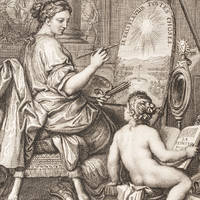
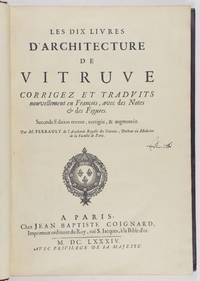
1684réf. 55420Paris: Jean Baptiste Coignard 1684. Second revised edition. Contemporary Calf. Nearly fine. Folio 40.6 by 27.9 cm. Collation: pi1 a2 e2 i2 o2 A-4Y2 4Z4 -4Z4; = 194 leaves . 18 354 16 pp; engraved hors texte half-title; 68 numbered engraved plates some double-suite in text; woodcut diagrams throughout. Contemporary marbled calf lightly worn at extremities spine with raised bands lettered and tooled in gilt dentelles; marbled endleaves. Occasional light dampstain at top gutter sometimes just encroaching beyond margin else a fine amply-margined copy. Second revised edition. "This edition contained few emendations but many important additions which based on various opinions prompted the author to reprint his version. He also changed three figures and added three plates one in Book VI and two in Book X. Although this work could have been further refined it nevertheless rightfully holds a prominent place among the Vitruvian versions and commentaries" Cicognara. Claude Perrault 1613-1688 was a member of the Royal Academy of Sciences and a doctor of medicine and anatomist in the faculty at Paris; he designed the Paris Observatory and participated in the design of the east façade of the Louvre. His published works are evidence of a polymathic mind encompassing architecture physics and natural history. Fowler ranks the present work among "the scholarly editions of Vitruvius Fowler. With engravings signed by: Sébastien Leclerc Jacques Grignon Georges Tournier Nicolas Pitau Gérard Edelinck Pieter Van Der Banck Gérard Scotin Jean Patigny Pierre Lepautre Etienne Gantrel. The military and civil engineer Marcus Vitruvius Pollio ca. 70-80 BCE - ca. 15 CE is the author of the only surviving ancient treatise on architecture arranged in ten books. By his own account Vitruvius served in the Roman army under the command of Julius Caesar. Rediscovered by the Florentine humanist Poggio Bracciolini 1380-1459 in the library of Saint Gall Abbey and publicized by Leon Battista Alberti 1404-1472 Vitruvius' De Architectura would later define the canon of classical architecture. His assertion that structures should exhibit the three qualities of stability firmitatis utility utilitiatis and beauty venustatis became a commonplace in architectural theory. The wide-ranging program of De Architectura deals with "principles of buildings in general building materials designs of theatres temples and other public buildings town and country houses baths interior decoration and wall paintings clocks and dials astronomy mechanical and military engineering." PMM. Throughout the Renaissance Vitruvius' work provided inspiration for Michelangelo Leon Battista Alberti Donato Bramante Lorenzo Ghiberti Giacomo Vignola Andrea Palladio and many others. The first printed edition of De Architectura appeared at Rome ca. 1483-90; the first illustrated edition at Venice 1511. Provenance: Bookplate of Harold Douthit. Cf. Digital Cicognara Library 730; Cf. Fowler 418 first ed. 1673. Full title and imprint: Le Dix Livres d'Architecture de Vitruve Corrigez et Traduits nouvellement en François avec des notes & figures. Seconde edition reveue corrigée & augmentée par M. Perrault de l'Academie Royalle des Sciences Docteur en Medecine de la Faculté de Paris. A Paris chez Jean Baptiste Coignard imprimeur ordinaire du roy ruë S. Jacques à la Bible d'or M.DC.LXXXIV. 1684. Jean Baptiste Coignard unknown
1684réf. 55420Paris: Jean Baptiste Coignard 1684. Second revised edition. Contemporary Calf. Nearly fine. Folio 40.6 by 27.9 cm. Collation: pi1 a2 e2 i2 o2 A-4Y2 4Z4 -4Z4; = 194 leaves . 18 354 16 pp; engraved hors texte half-title; 68 numbered engraved plates some double-suite in text; woodcut diagrams throughout. Contemporary marbled calf lightly worn at extremities spine with raised bands lettered and tooled in gilt dentelles; marbled endleaves. Occasional light dampstain at top gutter sometimes just encroaching beyond margin else a fine amply-margined copy. Second revised edition. "This edition contained few emendations but many important additions which based on various opinions prompted the author to reprint his version. He also changed three figures and added three plates one in Book VI and two in Book X. Although this work could have been further refined it nevertheless rightfully holds a prominent place among the Vitruvian versions and commentaries" Cicognara. Claude Perrault 1613-1688 was a member of the Royal Academy of Sciences and a doctor of medicine and anatomist in the faculty at Paris; he designed the Paris Observatory and participated in the design of the east façade of the Louvre. His published works are evidence of a polymathic mind encompassing architecture physics and natural history. Fowler ranks the present work among "the scholarly editions of Vitruvius Fowler. With engravings signed by: Sébastien Leclerc Jacques Grignon Georges Tournier Nicolas Pitau Gérard Edelinck Pieter Van Der Banck Gérard Scotin Jean Patigny Pierre Lepautre Etienne Gantrel. The military and civil engineer Marcus Vitruvius Pollio ca. 70-80 BCE - ca. 15 CE is the author of the only surviving ancient treatise on architecture arranged in ten books. By his own account Vitruvius served in the Roman army under the command of Julius Caesar. Rediscovered by the Florentine humanist Poggio Bracciolini 1380-1459 in the library of Saint Gall Abbey and publicized by Leon Battista Alberti 1404-1472 Vitruvius' De Architectura would later define the canon of classical architecture. His assertion that structures should exhibit the three qualities of stability firmitatis utility utilitiatis and beauty venustatis became a commonplace in architectural theory. The wide-ranging program of De Architectura deals with "principles of buildings in general building materials designs of theatres temples and other public buildings town and country houses baths interior decoration and wall paintings clocks and dials astronomy mechanical and military engineering." PMM. Throughout the Renaissance Vitruvius' work provided inspiration for Michelangelo Leon Battista Alberti Donato Bramante Lorenzo Ghiberti Giacomo Vignola Andrea Palladio and many others. The first printed edition of De Architectura appeared at Rome ca. 1483-90; the first illustrated edition at Venice 1511. Provenance: Bookplate of Harold Douthit. Cf. Digital Cicognara Library 730; Cf. Fowler 418 first ed. 1673. Full title and imprint: Le Dix Livres d'Architecture de Vitruve Corrigez et Traduits nouvellement en François avec des notes & figures. Seconde edition reveue corrigée & augmentée par M. Perrault de l'Academie Royalle des Sciences Docteur en Medecine de la Faculté de Paris. A Paris chez Jean Baptiste Coignard imprimeur ordinaire du roy ruë S. Jacques à la Bible d'or M.DC.LXXXIV. 1684. Jean Baptiste Coignard unknown books
1801réf. 015916Paris: Chez Henry Tardieu An IX 1800 1801. Book measures 17x10.5.cm. 4 258 2 p. 12 leaves of plates with half title. Bound in modern full panelled leather leather title label. Binding in fine condition. Internally previous owners name on title dated 1823 a few pages creased 1 plate repaired without loss spotting to plates. Generally pages and plates in good condition. A very nice copy. F. Full Calf. Very Good Plus. Illus. by Camu. 12mo - over 6¾" - 7¾" tall. Chez Henry Tardieu An IX [1800] Hardcover
réf. 108160Paris La Sirène 1920. . First edition first printing one of one of 50 deluxe copies on Whatman; square 4to 25.5 x 25.5 cm; 8 circular pochoir plates 'colorié au patron' and 60 black and white illustrations in the text after Laforge; modern black morocco flat spine title in silver to spine original pink wrappers bound in a fine copy. Charles Perrault's classic fairy tales are here illustrated with striking art deco pochoir plates by Lucien Laforge. This copy is from the first printing of 50 examples on thick paper and is not only much rarer than the general trade edition but is far superior in terms of quality. Lucien Laforge was born in Paris in 1889 and was a staunch pacifist feigning lunacy twice to be discharged during WWI. He published a work in 1922 titled 'le film 1914' which satirised the conflict with grotesque cartoons blaming the horrors on the greed and stupidity of the wealthy elite. His simple and sometimes haunting style is also evident in his illustrations for fairy tales and was not considered fashionable at the time but displays the chilling legacy of the war. The bold black lines of his characters were incredibly progressive and appear almost cartoon-like. Paris, La Sirène, 1920. unknown
réf. LCS-18556Dans ces deux œuvres, Perrault propose une double parabole de sa réflexion sur l’ordre du monde: d’une part sous forme spirituelle avec «Adam» et de l’autre, sous la forme apparemment naïve d’«Histoire ou Contes du Temps passé». Paris, Jean Baptiste Coignard, 1697. In-12 de (5) ff., 93 pp. et (1) p. de privilège, vignette de Coypel gravée par Simonneau en tête de chaque chant, notes manuscrites dans la marge inf. des pp. 2, 4, 5, 8. Plein veau brun granité, dos à nerfs richement orné, pièces de titre de maroquin rouge, coupes décorées, tranches mouchetées. Reliure de l’époque. 162 x 97 mm.
réf. LCS-17686Fort intéressant mémoires, rares en élégante reliure ancienne. Avignon, 1759. 1 volume in-12 de (2) ff. et 204 pages. Plein veau marbré glacé, dos lisse orné, tranches jaunes. Reliure de la fin du XVIIIe siècle. 162 x 85 mm.
réf. 003416A Paris: Par la Compagnie des Libraires 1733. Hardcover. Very Good. Quarto. Volume III of Mémoires de l'Académie royale des sciences in three parts. Part I: xxi i iv 231 ipp.; Part II: ii iv 294 iipp.; Part III: iv 215 iiipp. Contemporary calf very worn with the arms of Adam Gottlob Moltke 1710-1792 statesman diplomat and the closest advisor to the Danish king Frederik V 1723-1766 on the covers. With 97 engraved folding plates depicting animals and skeletal diagrams. From the libraries of George Schuckburgh sixth Baron Shuckburgh with his bookplate and Adam Gottlob Moltke 1710-1792 statesman diplomat and the closest advisor to the Danish king Frederik V 1723-1766 with his supralibros on the covers. Though the binding is quite worn it is in very good condition internally. 0 A Paris: Par la Compagnie des Libraires, 1733. hardcover
1679réf. 032848A Paris: De L'Imprimerie Royale 1679 A fair copy of the 1st edition of the Description de la Grotte de Versailles bound with a very good copy of the 2nd edition of Labyrinte de Versailles in contemporary elephant folio full leather binding. La Grotte has had 5 of the 20 plates cut out but Labyrinte is complete. The binding is sound with raised bands and title label to spine. It is very worn with a lot of wear to corners with leather loss and to spine joints spine ends and edges. The surface of the boards is a little rough. All page edges red. There is an old bookplate to the front pastedown endpaper - Earl Vane from the Library of the Rev. John Vane. Contents: 3 blanks; title 1679; blank verso; Description pp 1-11; Imprimerie to verso p 11; plates 13 single and 2 double; title to Labyrinte 1697; blank verso; Description pp 3-34; blank recto with Explication du Plan du Labyrinte to verso; plate 1; fables quatrains by Isaac Benserade and plates Sebastien Leclerc on opposing pages - 78 pp 39 plates; table 3 pp with L'Imprimerie to verso final leaf; 4 x final blanks. The binding is 50 cm x 35 cms; the page size in Labyrinte matches that of the Grotte but the actual text and plate size is 15.8 x 10.2 cm. Contents are in very good clean condition. Please enquire if you would like to see further images. De L'Imprimerie Royale hardcover