5.448 resultados
1801ref. RO80180007FR.LEMARIE. 1801. In-12. Relié. Etat passable, Couv. défraîchie, Dos satisfaisant, Rousseurs. 466 Pages. Nombreuses rousseurs sans conséquence pour la lecture. Pages désolidarisés. Plats légerement abimés.. . . . Classification Dewey : 435-Grammaire allemande
1745ref. RO80039391LOTTIN Ph. N. 5ème édition. 1745. In-12. Relié plein cuir. Etat d'usage, Coins frottés, Mors fendus, Intérieur frais. 616 pages. Bandeaux, lettrines et culs-de-lampe. Relié plein cuir marron. Pièce de titre cuir bordeaux. Titre et caissons dorés sur le dos, à 5 nerfs. Tranches rouges.. . . . Classification Dewey : 445-Grammaire française
ref. DADAX0198299540New unknown
ref. DADAX0199226334New unknown
ref. DADAX0199267308New unknown
1931Very Good Arabic In modern full leather bdg. Roy. 8vo. (24 x 17 cm). In Arabic and Modern Turkish. [xv], [1], 186, [2], 158 p. Abû ?ayyân Athîr ad-Dîn al-Gharnâtî, whose full name is Mu?ammad ibn Yûsuf bin 'Alî ibn Yûsuf ibn Hayyân, sometimes called Ibn Hayyan, was a celebrated commentator on the Quran and foremost Arabic grammarian of his era. His magnum opus Tafsir al-Bahr al-Muhit (Explanation of the Ocean) is the most important reference on Qur'anic expressions and the issues of grammar, vocabulary, etymology and the transcriber-copyists of the Holy Qur'an. Quite exceptionally for a linguist of Arabic of his day was his strong interest in non-Arabic languages. He wrote several works of comparative linguistics for Arabic speakers, and gives extensive comparative grammatical analysis and explanation. He was born in Spain in November of 1256 to a family of Berber origins, from the Berber tribe of Nifza. Historians variously cite Gharnati's place of birth as both Jaén and Granada; his appellation "Gharnati" derives from this latter. At the time Jaén was a dependency of Granada, and the appellation conflict may only be apparent. Abu Hayyan adhered to the Zahiri madhhab of Sunni Islam. When asked toward the end of his life about a claim he had switched to the Shafi'i madhhab, or some other school, he responded that, anyone who had known the ?ahiri school could never leave it. He regarded Sufism as heresy, and the metaphysicsts ibn Arabi, Mansur Al-Hallaj, Ibn al-Farid, Ibn Sab'in and Abu al-Hasan al-Shushtari, as especially impious heretics.[5] Abu Hayyan, along with most Muslim scholars of Andalus of the time, saw the appeal of Sufism as a particular threat to secular Muslims. On the Arabic language, Abu Hayyan shared the views of his fellow ?âhirî Andalusian, Ibn Ma?â'. Absolute belief in the divine mover led them to reject the concept of linguistic causality. For them the 'cause' of all things, including language, is attributable solely to God. Thus on theological grounds, he was suspicious of the so-called "eastern grammarian" supporters of 'linguistic causality'. When Abu Hayyan arrived in Egypt the Mamluk Sultan was ruler. Although Abu Hayyan held the Turkic languages of Mamluk Egypt superior to the Kipchak and Turkmen languages with which he was familiar, he also wrote grammars of Amharic, Middle Mongol, the Berber languages and the Turkic. Other Arabic-language linguists of his day had little regard for foreign languages. Abu Hayyan often illuminated Arabic grammatical concepts with quotes from various language. (Wikipedia). Ahmet Caferoglu was a Turkish filologist. He has worked on basic works of Turkish, etymology, Turkish dialects and Anatolian dialects. He was the first language dialect researcher and historian of science with sturdy title in Turkey. OCLC: 150018789 / 977434024 / 906866886 / 917024141 / 576836072 / 924028884.
1975Good Arabic Paperback. 4to. (29 x 21 cm). In Arabic. 200 p. Ex-library stamps. Splits on the spine. Otherwise a good copy. Shantarînî was an Arab poet and historian from al-Andalus. He was born in Santarém (sometimes spelled Shantarin or Xantarin) and hailed from the Banu Taghlib tribe. Ibn Bassam describes how the incessant invasions of the Castilians forced him to run away from Santarém in Portugal, "the last of the cities of the west," after seeing his lands ravaged and his wealth destroyed, a ruined man with no possessions save his battered sword. Especially well known is his anthology Dhakhira fi mahasin Ahl al-Jazira. one of the most important sources of information in the field of history, literature, and culture of the Almoravid dynasty. It was edited in eight volumes by Ihsan Abbas, written in rhymed prose, many of its biographies are contemporary and filled out with details taken from the Kitab al-Matin of Ibn Hayyan. The parts taken from that book are easily distinguishable because Ibn Bassam prefixes the words qala Ibn Hayyan ("Ibn Hayyan says") and concludes the extract with intaha kalam Ibn Hayyan ("here ends ibn Hayyan's words"). The set is 8 volumes, this is only one volume (2.1).
2014RARE collection of 27 updated articles (some were partly rewritten especially for this volume) on various aspects of the Dead Sea Scrolls by Devorah Dimant (b.1939) - Professor emerita for Biblical Studies at the University of Haifa. An introductory essay written especially for this volume surveys the present state of research on the Scrolls. 235x165mm. XV+610 pages. Dark-blue Hardcover with dust-jacket. Git front cover and spine. Jacket slightly dirty. Several scratch-and bump-marks on jacket. [SUMMARY]: This extremely rare book on the Dead Sea Scrolls by one of the leading modern biblical scholars, reflecting the rapid expansion and change of perspective that has taken place in research on the collection in recent years following its full publication, is in very good condition.
1891Very Good Armenian In contemporary black cloth bdg. No gilt on cloth. [4], 275, [1] p. Ownership signature in Ottoman script as 'Doctor Cemil, Bayburd'. [A COMPARATIVE ARMENIAN DICTIONARY from ARMENIAN to OTTOMAN TURKISH] Yndarzak barraran Hayeree tatskeren. Abikean was an Armenian prolific lexicographer and linguist. Editions in OCLC has 160 p. This Edition not in OCLC.
1827Former owner's name to ffep. Former owner's bookplate to inner cover (William Gifford Cookesley) from his days in Eton (dated 1840). Full leather binding. Corners edgeworn. Some wear, flaking and scratches to leather binding. Foxing to pages passim. G+ to VG- condition. Internally VG. ; 455 pages
ref. DADAX0367438062New unknown
ref. DADAX002534904XNew unknown
ref. 64410, Brepols, 2023 Hardback, 433 pages, Size:156 x 234 mm, Illustrations:6 b/w, 8 tables b/w., Language: English. ISBN 9782503601816.
1978IN HEBREW WITH ENGLISH INTRODUCTION. THREE VOLUMES. [ALL VOLUMES]: 235x160 mm. Unpaginated. Hardcover. Gilt lettering on cover and spine. Pages slightly yellowing. [VOL.I]: Cover slightly rubbed. [VOL.III]: Cover slightly stained. Cover edges slightly rubbed. Else all volumes in good condition.
ref. DADAX0078298172New unknown
ref. DADAX0415732689New unknown
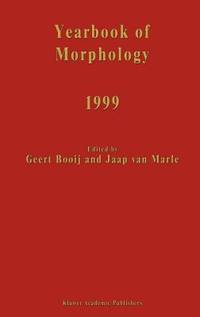
2001ref. 014646London: Kluwer Academic Publishers 2001. Cloth/Laminated Boards. Like New/No d/j as Published. 8vo - over 7¾" - 9¾" tall. Type: Book The Yearbook of Morphology series published since 1988 has proven to be an eminent support for an upswing of morphological research since it contains articles on topics which are central in the theoretical debates which are frequently referred to. "The Yearbook of Morphology 1999" focuses on diachronic morphology and shows in a number of articles by specialists how complicated morphological systems develop in the course of time. In addition this volume deals with a number of hotly debated issues in theoretical morphology: its interaction with phonology including Optimality Theory the relation between inflection and word formation and the formal modelling of inflectional systems. A feature of this volume is an article on morphology in sign language a new area of research in linguistics. The relevant evidence comes from a wide variety of languages amongst which Germanic Romance and Slavic languages are prominent. 319pp. Kluwer Academic Publishers hardcover
ref. DADAX0521108675New unknown
ref. DADAX0199207879New unknown
ref. 1801646252.Gpaperback. Good. Access codes and supplements are not guaranteed with used items. May be an ex-library book. paperback
1813ref. 95511Newburyport MA: E. Little & Co 1813. Hardcover. Fair. Full leather boards with wear along edges. 1813 publication but no statement of edition; based on statement in the beginning from the District of Massachusetts it appears to be the first. Tight spine. Spine retains gilt bands not raised but not the title. Pages are unmarked but quite age-darkened. Geared toward students studying Latin. 12mo. 255 pp. including a final page headed "Errors." Scarce. E. Little & Co hardcover
ref. DADAX0132353350New unknown
1897RARE critical edition of the original Arabic text of a treatise on Hebrew verbs by the eminent medieval Jewish linguist Judah ben David Hayyuj (Abu Zakariyya Yahya ibn Dawud, 945-1000). 225x155mm. LXXXV+271 pages. Patterned blue rebound Hardcover with green cloth spine. Original cover pasted on front. Spine stained. Spine bottom edge and rear hinge rubbed. Inner cover and whitepges somewhat age- and glue-stained. Several pages upper corner slightly creased. Small light bump-mark on several pages upper corner. Pages yellowing. [SUMMARY]: This extremely rare critical edition of an influential medieval Arabic work on Hebrew verbs, written by the father of scientific grammar of Hebrew language, is in good condition.
1924THREE VOLUMES IN ONE. [VOLUME I]: Le Systeme Verbal Semitique et L'expression du Temps. [VOLUME II]: Altarabische Pausalformen [VOLUME III]: Lexicon Syropalaestinum: Academia Litterarum Regia Borussica. [ALL VOLUMES]: 26x18 cm. xxvii+317+106+xvi+226 pages. Hardcover. Cover yellowing. Spine faded and slightly rubbed. Notes on few pages. Else in good condition.
197722x13.5 cm. 28+180 pages. Hardcover with dust jacket. Bottom of cover and spine are slightly rubbed. Edges of book are slightly dirty. Pages are slightly yellowing. Else in good condition.