730 résultats
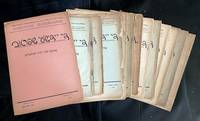
1930réf. 42139Kiev: Katedr far Yidisher Kultur ba der Ukr. Visnshaftl. Akademye Filologishe Sektsye 1930. Paper Wrappers. 1st edition. Original printed publisher’s color paper wrappers 4to large ca 72-116 columns ca 36-58 pages per issue. 28 cm. In Yiddish. Title translates roughly as “The Yiddish Language.” Succeeded in 1931 by “Afn shprakhfront.”Di Yidishe Shprakh was a “Yiddish linguistic journal published in Kiev from 1927 to 1930. A bimonthly journal Di yidishe shprakh The Yiddish Language was published by the cooperative publishing house Kultur-lige and was the main philological publication of the Kiev Yiddish academic center. Its editor was the veteran Yiddishist Nokhem Shtif a founder of YIVO who had returned to Kiev from Germany in 1926. The journal’s inaugural issue March–April 1927 was published under the auspices of the Central Yiddish Bureau of the Ukrainian Commissariat for Education. With the next issue Di yidishe shprakh was an organ of the Chair and from July to October 1929 it was an organ of the Institute for Jewish later Proletarian Jewish Culture at the Ukrainian Academy of Sciences. Initially defined as a 'journal for practical Yiddish linguistics' from May to June 1927 it appeared as simply a 'journal for Yiddish linguistics. 'Shtif distinguished three language registers: the vernacular of the old generation partly represented in the works of Sholem Aleichem and predecessors; the highbrow language of modern writers such as Dovid Bergelson; and the contemporary 'culture language' most notably of the press. Although Shtif sought to target speakers of the mass 'culture language' the journal’s circulation hovered around 500 copies read mainly by Yiddish teachers.Apart from Shtif who published articles on various language-planning problems the most active contributors to Di yidishe shprakh were Ber Slutski Ayzik Zaretski Elye Falkovitsh Lipe Reznik and Shimen Dobin. In early 1929 Moscow literary critic Aron Gurshteyn criticized the journal for its purist approach to language planning. In the July–October 1929 issue Shtif published his article 'Di sotsyale diferentsiatsye in yidish' The Social Differentiation in Yiddish heralding an intensification of Soviet linguists’ anti-Hebraist campaign. That issue of Di yidishe shprakh adopted completely reformed Soviet spelling omitting for example final consonant letters.Although the last—twenty-fifth—issue of the journal was dated November–December 1930 it included materials from the First All-Union Yiddish Language Conference convened in Kiev from 8 to 13 February 1931 that issue is present here. Published under the imprint of the Central Publishing House this issue also signaled the demise of the remaining vestiges of the Kiev Kultur-lige. Yoysef Liberberg’s article 'Far parteyishkayt in der yidisher visnshaft-arbet' For a Party Approach to Yiddish Linguistics marked a full break with YIVO scholars particularly with YIVO director Max Weinreich whom Liberberg ridiculed for presenting Yiddish as an emanation of the Ashkenazic Jews’ soul. The Yiddish Language Conference decided to change the name of the journal. Between 1931 and 1939 it appeared sporadically under the title Afn shprakhfront On the Language Front reflecting its new more aggressive and politically charged approach' Gennady Estraikh in YIVO Encyclopedia of Jews in Eastern Europe 2010. For more see David Shneer “Yiddish and the Creation of Soviet Jewish Culture 1918–1930” Cambridge and New York 2004. SUBJECTS: Yiddish language -- Periodicals. Title also listed on covers in Russian “Ievreis'ka Mova” and German “Jiddische Sprach”. OCLC: 22840298. Most holdings in OCLC appear to be fragmentary. Covers are browning and fragile as expected but are otherwise very well preserved with very little edgewear. Internal text pages are also toning but remain relatively strong as pulp paper. Very important journal scarce in this degree of completeness Note that Estraikh suggests a circulation of only 500!. B YID-43-5-E. Kiev: Katedr far Yidisher Kultur ba der Ukr. Visnshaftl. Akademye, Filologishe Sektsye unknown
19041st edition. Period boards. 8vo. 416 pages, 25 cm. In Yiddish. Issues 1-52. Title translates to Literary Suppliment to the Workers Friend. Arbeter Fraynd was a London-based weekly Yiddish radical paper founded in 1885 by socialist Morris Winchevsky. After the emigration of Saul Yanovsky to the United States in 1894, Woolf Wess became the editor in 1895. In 1898, Rudolf Rocker, a German non-Jewish anarchist who had immersed himself into the Yiddish radical culture of London's East End, became the editor of the paper. The paper was suppressed at numerous times by the British government (Wikipedia, 2018) . Prager p125. Also listed in John Pattens Yiddish Anarchist Bibliography Periodicals. SUBJECTS: Yiddish literature - England - Periodicals. OCLC lists 9 copies worldwide (OCLC: 174120785) . Binding repaired and spine rebacked. Paper brown but solid, occational margin wear, Overall good condition. Important. (YID-40-97)
19081st edition. Mixed period and later boards. 8vo. 745 pages; 550, 16, 24, 24, 24 pages; 690 pages. 23 cm. In Yiddish. Title translates to The New Life. The complete first three years of this important Yiddish monthly. Zhitlowsky, an immigrant socialist revolutionary, sought to synthesize socialism with nationalism as early as 1883. He demanded for Jews "national equal rights with all peoples" and asserted that only through the Yiddish language could the social and national revival of the Jewish people be effected. He maintained that one could remain identified with the Jewish nationality even if abandoning the Jewish religion. He urged the Jewish masses to participate in the class struggle as a national unit. Alone among the cosmopolitan Jewish socialists he favored national socialism. In 1897 he began publishing philosophical studies in Jewish history and a comprehensive program of action which later appeared in book form as Pisma o starom I novom yevreystvie ("Letters on Old and Modern Judaism, " 1907) . His main thesis was that national consciousness consists mainly of spiritual-cultural determinants and that these national characteristics can be maintained by the Jews in the future in the lands of their dispersion, just as they have survived the lack of territory or unity of language since the end of the second commonwealth. After emancipation of the individual the Jews as a group should be granted national self-government within the framework of the state along with other national minorities. His secularization of the national idea as opposed to those who saw the essence of Judaism in religion, and his optimistic view of the future of Judaism in the Diaspora, were the main underpinnings of his insistence on national cultural autonomy. Zhitlowsky was "in favor of the centrality of Yiddish in the national Jewish experience and labored toward the recognition of that language, and of those who lived out their lives in it, as one of the several cultural linguistic communities of Eastern Europe, and of the Western world as a whole" (Isaac Levitas, et al, in EJ) . Includes Zhitlowskys original, first volume, 16 page prologue entitled This program and the dissemination of the monograph The New Life. Some internal binding repair, but solid, paper toning as expected but nice and clean, a Good, solid complete set. (YID-30-8)
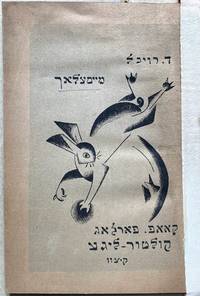
1922réf. 43563Kiev: Kultur lige 1922. 1st edition. Original modernist illustrated paper wrappers bound into pamphlet protector. 12mo 30 pages. With many illustrations. 22 cm. In Yiddish. Title translate as "Little Tales." A collection of five tales by Aleksander Afanasyev Vladimir Dal and Hans Christian Andersen adapted by David Roikhel and illustrated by the Yiddish Modernist artist Mark Epstein. A striking example of Mark Epstein's early Cubist-inspired graphic work produced for the now famous Jewish children's book Mayselakh. published in Kiev in 1922 and closely associated with the educational and cultural program of the Kultur Lige. Mark Epstein 1897-1949 was among the most important Jewish graphic artists associated with the Kultur Lige. Born in Babruysk he received a traditional Jewish education before studying at the Kiev School of Art. In 1918 he worked in the studio of Alexandra Exter whose influence can be seen in the dynamic Cubist-inflected vocabulary of his early work. That same year he participated in a Jewish artists' exhibition in Moscow and was one of the founders of the art section of the Kultur Lige in Kiev. Epstein was closely associated with the remarkable circle of Jewish modernist writers and poets active in Kiev including Der Nister Pinchas Kahanovich David Bergelson and Yechezkel Dobrushin. This milieu profoundly influenced his artistic development. Epstein worked across several media as a graphic artist painter sculptor and stage designer becoming one of the leading visual interpreters of the new Yiddish cultural movement. Children's illustration occupied an important place in his work. He designed covers and illustrations for Frayd Joy a Yiddish periodical for young people published in Kiev from 1922 to 1925. Mayselakh here is part of this same remarkable period of Yiddish publishing when artists associated with the Kultur Lige joined contemporary European artistic movements with with Yiddish literature and the educational needs of a new generation. Unlike many of his colleagues in the Kultur Lige's art section Epstein remained in Kiev after the establishment of Soviet rule and continued his artistic and educational activities under the transformed organization. From 1923 to 1931 he directed the Jewish Arts and Trades School in Kiev the institution that emerged from the Kultur Lige's former art section after its incorporation into the Soviet cultural system. He simultaneously worked as a stage and costume designer for theatres in Kiev and Kharkiv. In 1932 following the closure of the Jewish Arts and Trades School and the dissolution of the remaining Kultur Lige institutions Epstein was forced to leave Kiev for Moscow. Mayselakh is a stunning example of early Soviet Jewish children's publishing combining Yiddish literary culture with the bold modernist imagery of one of the most important artists of the Kiev Kultur Lige. For more see: Estraikh G. Hoge K. & Mikhail K. Children and Yiddish Literature from Early Modernity to Post-Modernity. Routledge 2016. Epstein's modernist masterpiece should not be confused with another Kultur Lige-issued-collection of childrens tales from 1922 the 58-page similarly titled work by Itsik Kipnis 1896-1974 Mayselekh far Klayne Kinder . Mayselakh has appeared at major auction only twice in its long history in 2019 when a copy sold for $2700 and in 2021 when a copy sold for $3000.00. OCLC: 122741292 1514928517. OCLC Locates only 4 copies worldwide Columbia Met-NYC YIVO & Bib. Nat. France Light dampstains & staple rust with light rippling from the epic 1966 JTSA fire which this book survived see photos. Otherwise Very Good. An attractive example of a famous example of Modernist Kultur Lige children's publishing. PBERL-1-14. Kiev: Kultur lige unknown
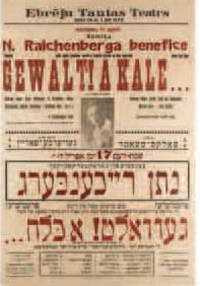
réf. 51-1032Latvia: 1920s-1930s. A Collection of 8 Yiddish Theater posters from the 1920s and 1930s. Yiddish Latvian poster of the Ebreju Tautas Teatrs Jewish people Theater. Letter press in red and black on fine paper mounted on canvas. 91 x 60.5 cm. Riga Spiestuve vards 1930 announcement of an event on Saturday April 17 d. j.: Bene_ z of the character comedian Natan Reichenberg. Premiere! For the first time in Riga the large entertaining equipment operetta with completely new vocal pieces help! A bride. The comic role of "Kivele Feldsher" Akiva the medics the Bene_ acquires ziant. -Printed in Latvian and Yiddish language with photographic print. -Paper browned minimal fold marks on the outer edge. -Rare poster.Yiddish Latvian poster of the Rigas teatris zidu minoritates Riga Jewish minorities Theater. Letterpress in red and black on fine paper. 71 x 53.5 cm. Riga SP. extra 1925. announcement of the _ eaterstücks the Jewish robber on November 26. -Printed in the Latvian and Yiddish languages. -Paper slightly tanned with vertical folding kl. Defects especially upper-right corner on the outer edge with small tears. -Very rare poster.Yiddish Latvian poster of the Rigas teatris zidu minoritates Riga Jewish minorities _ Theater. Letter press in red and black on fine paper. 71 x 50 cm. Riga SP. extra 1925. announcement of different theatrical works: A man an unlucky guy. -The curly haired blonde -In life tri_ all . -The Jewish Bandit November 17-22. -Printed in the Latvian and Yiddish languages. -Paper minimally tanned with vertical and horizontal folding Small Defects minimal _ square on the outer edge with small tears. -Very rare poster.Yiddish Latvian poster of the Rigas teatris zidu minoritates Riga Jewish minorities Theater. Letterpress in red and black on fine paper. 106 x 71 cm. Riga SP. extra 1933 announcement of solemn Erö_ regulation IX season on Saturday Sept. 30 Sunday 1 Oct 1933 8.30 evening. Performed by: Genia Schalit Nina Talini oSIP Runitsch in the well-known piece of David Golder. In four acts by A. Nemirowskaja. -With 2 dates. -Printed in the Latvian and Yiddish languages. -Paper minimally tanned partly with resounding mount tracks with vertical and horizontal folds & light Abklatsch small. Defects somewhat spotted and knicked. -Very rare poster. Latvian Yiddish poster. Woodcut on fine green paper. 66 x 51 cm. Daugavpils Latvia Pilsetas spiestuve litogra_ Yes 1920s. The translated content of the poster: Sunday August 15 7: 00 the Dünaburger Trade Association invites in the Riga road 42 in the Novonowitsch-Hall to a meeting on the election of the municipal administration. Speaker are: Al Kopelowski A. Bulavko Sch. Heller Salman Barak N. Magid and others. "Dealer! Come numerous. Dealers and sellers. Bear in mind that your list is the list of 5 the Listedes of trade association."- printed in the Latvian and Yiddish languages. -Paper with vertical & horizontal folds and knicks-Rare poster.Latvian Yiddish poster. Woodcut in blue on fine paper. 93 x 62.5 cm. Daugavpils Latvia Pilset. spiestuvelitogra _ Yes 1920s. Election poster: David challenge the dealer! 'Remember - no voice of the dealer for a different list than the list 5 vote for the list of dealers no. 5' - 3 languages printed in Yiddish Russian and Latvian. -Paper with vertical & horizontal folding some with red marks. Knicks and small tears -Rare poster.Latvian Yiddish poster. Woodcut on fine Orange paper. 49.5 x 31.5 cm. Daugavpils Latvia Pilsetas spiestuve litogra_ Yes 1920s. The translated content of the poster: Agudat Israel Daugavpils. Taking place on Monday August 17 8 o'clock in the evening. A folk Assembly in Klingmann Hall Riga Street 42. The elections. Asked to show! -Printed in the Latvian and Yiddish languages. -Paper with horizontal folds tears and stains-Rare poster.Images of all the posters are available Latvia: 1920s-1930s unknown