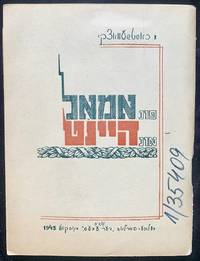
1943réf. 43487Moscow: Der Emes 1943. First edition. Original illustrated paper wrappers 16vo 62 pages. In Yiddish. Title translates as "From Then and Now: Songs and Ballads About War" War poems by Soviet-Yiddish poet Moyshe Khashtshevatski. "Khashtshevatski was a poet prose writer and playwright born in Buki near Uman Ukraine.In 1918 April 6 he debuted in print with a poem entitled 'Friling Kumt' Spring Comes in the Kiev newspaper Di Naye Tsayt The New Times-using the pen name M. Mishal. In 1921 he moved to Kiev where he forged a strong bond with the local Yiddish writers Yekhezkl Dobrushin Dovid Hofshteyn and Der Nister among others and from that point he enhanced ever more his reputation as a creator and builder of Soviet Yiddish literature.From 1923 over the course of three years he contributed intensively to Emes Truth in Moscow and he actively took part in the Soviet community and political life. Although his first works were in the symbolist vein he would later switch to a more realistic depiction of life and address the major issues and events of the time. He brought new motifs and artistic imagery into Soviet Yiddish poetry. The range of his interests was extremely broad. He also masterfully translated from the Russian and Ukrainian classics as well as from other languages. In 1943 the Moscow publisher Der Emes The Truth brought out two books by him: a poetry collection entitled Fun Amol un Haynt Of Then and Now this work and jottings about the hero of the Soviet Union Khayim Diskin Khayim Diskin. The majority of poems in the former were dedicated to war themes. Shortly after the outbreak of the Nazi-Soviet war in 1941 he was evacuated to Samarkand Uzbekistan and there he learned of the death of his only son at the front. He proceeded to volunteer for mobilization into the Red Army despite the fact that he was forty-six years of age. He contributed in the harshest of battles in that period of the fighting and died in battle." Leksikon Fun Der Nayer Yidisher Literatur SUBJECTS: Yiddish poetry. OCLC: 233117501 Number penned to front wrapper & title page; edgewear to one corner on many leaves no text affected and paper is browning and somewhat fragile but otherwise Good Condition. BK YID-48-111A-L-'mexcc. Moscow: Der Emes unknown
1930First edition. Original paper wrappers. 8vo, 172 pages. 23 cm. SUBJECTS: Yiddish language -- Congresses. Yidisher visnshaftlekher institut -- Congresses. Browning to cover and pages. Very good condition. (AC-1-16)
19071st edition. Original paper wrappers in protective cardboard binder. 8vo. 16 pages, 21 cm. In Yiddish with some Russian on title page. Title translates to A Little Chrestomathy. Chrestomathy refers to the selection of literary passages from a foreign language assembled for studying the language. Features passages by Y.L. Perets, Mendele Mokher Sefarim, and Avrom Reizen. SUBJECTS: Yiddish language study. OCLC: 233376695/58407193. OCLC lists three copies worldwide (NLI, YIVO, Harvard). Pages browning. Very good condition. Scarce. (YID-33-4-+)
19341st edition. Original boards. 8vo. 364 pages, 22 cm. Features illustrations and portrait of Shvartsbard. In Yiddish. Title translates to In the Course of Years. Shalom-Shmuel Schwarzbard (1886-1938) was a Russian-born French Yiddish poet of Jewish descent. He served in the French and Soviet military, was a bolshevik, and is known for his assassination of the Ukrainian national leader Symon Petliura while in Paris. His trial was highly publicized and he claimed to have killed Petliura in retribution for the pogroms in Ukraine. He was eventually acquitted (Wikipedia, 2018) . He was viewed as a hero by many; this work is published by the Shalom Shvartsbard Committee in Chicago. SUBJECTS: Jews -- Ukraine -- Biography. Ex-library with usual markings. Very good Condition. (YID-40-91-X-'fl)
1936Title translates as Mendele Anthology: Published for the 100th Birthday of MMS. A nazi-era Yiddish language study book on Mendele Mokher Sefarim, produced by the children's publishers Grinke Beymelekh ("Green Saplings"). Mendele Mokher Seforim (1835-1917) is revered as the grandfather of Yiddish literature for his innovations in laying a new literary framework for Yiddish. His work realistically portrayed Jewish life with honesty and without judgment and depicted the world of the shtetl [village] with all its poverty and decay; all its joy and poetry. Mendele was born in Belorussia (Belarus) and came from a comfortable family of Lithuanian rabbis. He initially wrote in Hebrew and was a proponent of the Haskalah, but started writing writing in Yiddish in the 1860s (Stevens, 2019). SUBJECTS: Yiddish-language study. OCLC Number:234575366. OCLC lists 5 copies worldwide (NLI, YIVO, Harvard, NYBC, HUC). Spine rebacked with tape, paper toning, a bit fragile at the edges with some light damp stains. Pages and wrappers are edge worn with no loss to contents. About Good- Condition. Scarce. (YID-33-63-'elx)
1857Period Wrappers. 8vo, 32 pages, 19 cm. In Hebrew with Judeo-German commentary underneath. Yaari, 779. OCLC lists one copy worldwide (Harvard) . Pages are foxing and occasionally edgeworn. Overall good condition. (Hag-18-17)
Nyu york [New York]: Idisher sotsyalistisher federatsye in Amerika, 1914. Paper Wrappers, 8vo, 110 pages. Annual. Includes illustrations. 23 cm. In Yiddish. Periodical lasted until 1918 issue; Vols II (1915) and later are titled "Idishe yohrbukh. " "In 1908 a Jewish Agitation Bureau was established [by the Socialist Party of America] in order to spread socialism among Yiddish-speaking Jews. Stimulated by immigrants with experience in the East European Bund, the Bureau developed into the Jewish Socialist Federation (J. S. F. ) from 1912, over strong opposition from Abe Cahan and other Yiddish-speaking stalwarts opposed to such "separatism. " Actually the J. S. F. Disavowed any distinct Jewish purpose and attempted only to spread socialism, while it vigorously combated Zionism. Its membership was drawn mainly from immigrants of Bundist background" (Schneier Levenberg in EJ) . SUBJECT(S) : Socialism -- Periodicals. Jews -- New York (State) -- New York -- Periodicals. OCLC lists 6 holdings. Edgewear, rear cover detached. Otherwise good condition with good paper. (AMR-56-14X)
Nyu york [New York]: Idisher sotsyalistisher federatsye in Amerika, 1914. CLoth, 8vo, 110 pages. Annual. Includes illustrations. 23 cm. In Yiddish. Periodical lasted until 1918 issue; Vols II (1915) and later are titled "Idishe yohrbukh. " "In 1908 a Jewish Agitation Bureau was established [by the Socialist Party of America] in order to spread socialism among Yiddish-speaking Jews. Stimulated by immigrants with experience in the East European Bund, the Bureau developed into the Jewish Socialist Federation (J. S. F. ) from 1912, over strong opposition from Abe Cahan and other Yiddish-speaking stalwarts opposed to such "separatism. " Actually the J. S. F. Disavowed any distinct Jewish purpose and attempted only to spread socialism, while it vigorously combated Zionism. Its membership was drawn mainly from immigrants of Bundist background" (Schneier Levenberg in EJ) . SUBJECT(S) : Socialism -- Periodicals. Jews -- New York (State) -- New York -- Periodicals. OCLC lists 6 holdings. Hinges starting, but still good and solid. Good Condition. (AMR-56-14X)
1946Small 8vo; First Edition. Paper Wrappers, 4to (Large), 36 pages. One of 8000 issued. In Yiddish with English Cover, table of contents, & photo captions. Important journal lasting 10 issues which written & published by Jewish DPs themselves to document crimes and survival in the Holocaust. The publisher's decision to include the English table of contents, probably in part to insure the journal's use in future war crimes trials, makes these first hand accounts especially user-friendly today, almost 60 years later. Robinson & Friedman #1247: "The Historical Commission [was] established in 1945 under the auspices of the Central Committee of Liberated Jews in the U. S. Zone. [It] Ceased operations early in 1949. Details of the activities of the Munich center can be found in No. 1247 [Fun Letsten Churbn]..." Hagit Lavsky notes in the Encyclopedia of the Holocaust (Gutman, ed., 1990, p. 383) that, "Commemoration and documentation projects [by Jewish DPs] included the work of the Tsentraler Historisher Komisiye (Central Historical Commission), established in December 1945 by the Central Committee in Munich, to assist in bringing Nazi criminals to trial. A network of regional committees was set up under the commission's auspices whose task it was to take evidence and collect documentary material, including material on DPs. In August 1946, the commission published the first issue of the monthly FUN LETZTEN HURBAN." Published under DP-Publications License US-E-3 OMGB, Information Control Division. This first issue is the only large magazine-size issue published, and remains the scarcest of the set. This copy fragile, with original blue detached edgeworn wrappers mounted on attached later paper for stabilization. Paper is somewhat fragile, but complete and usable. Fair condition, complete. (HOLO2-122-51G)
1925Original illustrated cover wrappers with distinctive modernist typeface and design. Chidlrens literature. Printed on quality glossy paper. Includes 6 illustrations by Gudelman and photo of author. Aron Gudelman (1890 - 1978) was a sculptor, illustrator, etcher, lecturer, and teacher. Born in Russia, he immigrated to New York in 1905 at the time of pogroms in Russia. After attending the Cooper Union and the National Academy of Design, in 1914 he studied with Jean-Antoine Injalbert at the Ecole des Beaux-Arts in Paris. Supporting himself as a machinist in the 1920s, Goodelman became a communist. His concerns about social and economic conditions were expressed in his art. He participated in exhibitions at the John Reed Club in the early 1930s. After World War II, Goodelman created artworks related to the Holocaust. He taught at City College of New York in the 1960s (National Museum of American Art, 1996) . Blue cover Variant. Shul Pinkas Chcago Nr. 203 . Light wear to cover, Very Good Condition, (Yid-24-7)
1936Original publishers cloth in dramatic modernist color illustrated dust jacket designed by Zuni Maud with illustrations on front and rear; 8vo, 243 pages. 23 cm. In Yiddish. SUBJECT (S) : Yiddish literature -- 20th century. Illustrator Zuni Maud (born 1905) was an Artist, cartoonist, puppeteer, playwright, writer and poet. [He] Studied at the Cooper Union Art School, Baron de Hirsch Art School and National Academy of Art, New York. [and] Did illustrations for *Der kibitser* and stage and costume design for productions by Maurice Schwartz in the Yiddish Art Theater. Contributed articles to Der kundes (N. Y. ) , Jewish Daily Forward (N. Y. ) , Di tsayt (N. Y. ) , Kinderland (N. Y. ) , Kinder zshurnal (N. Y. ) , Frayhayt (N. Y. ) . [He was the] Illustrator of a number of books. In 1925, together with Yosel Cutler, [he] founded the Modicot marionette theater. [He] Wrote plays, children's stories and poems (YIVO, 2018) . Author Yitzchak Rayz (1885-1943) , better known by his pen name Moyshe Nadir was an American Yiddish language writer and satirist . In 1898, at the age of 13, Rayz immigrated to New York and adopted the Americanized name Isaac Reiss. Within a few years his work was published widely in the New York Yiddish press, under a variety of pseudonyms, including Rinnalde Rinaldine, Dilensee Mirkarosh, Der Royzenkavalir, Doctor Hotzikl, and, finally, Moishe Nadir. The name Nadir is a Yiddish expression meaning here you are or that's for you, but can also mean take this and choke on it. As a teenager, he wrote for Der Groyser Kundes (The Big Prankster) and later co-edited Der Yiddisher Gazlon (The Yiddish Bandit) with Jacob Adler. He wrote for an assortment of Communist Yiddish publications including the Frayhayt (Freedom) newspaper and its successor Morgn Frayhayt (Morning Freedom) and the magazines Der Signal (The Signal) and Der Hammer (The Hammer) . When his sharp-tongued theater reviews caused him to be banned from theatrical productions, he resorted to attending plays in disguise. His own plays were performed by Maurice Schwartzs Yiddish Art Theater, Zuni Maude and Yosl Cutlers Modicut puppet theater, Artef (Arbeter Teater Faraband, Workers Theater Alliance) and the Federal Theater Project. Among his better known poems are the erotic Vilde Royzen (Wild Roses, 1915) and his 1932 Rivington Strit (Rivington Street) . After a long association with the Frayhayt and the Morgn Frayhayt, Rayz began to distance himself from the Communist cause with the onset of the show trials in the Soviet Union and publicly broke with the Morgn Frayhayt in the wake of the Molotiv-Ribbentrop Pact. He set out his reasons in Di, vos blayben mit der Morgn Frayhayt (Those who stay with the Morgn Frayhayt) in response to Morgn Frayhayt editor Moissaye Olgins Di vos gayen avek (Those who leave) . Rayz discusses his relationship to the Communist Party in his posthumous Moyde Ani (Wikipedia, 2019) . Very Good Condition in dust jacket which shows some edgewear affecting some letters on the spine. Very Good in Good Jacket. (yid-41-92)
19711st Yiddish Edition. Original illustrated photographic paper wrappers. 8vo. 46 pages, 22 cm. In Yiddish. Holocaust stageplay. Title translates to The Medem Sanitorium. Translated into Yiddish by Mosheh Lokiec. Zygmunt Turkow (18961970) was a Polish actor, director, playwright and director of Jewish origin from Warsaw, who became famous for roles in the pre-war Jewish films and stage plays in Yiddish. His brother, Jonas Turkow, was also a noted actor and stage manager. Shortly after German invasion of Poland in 1939 he left Poland together with his second wife. In 1940 he settled in Brazil. In 1952 he moved to Israel (Wikipedia, 2019). SUBJECTS: Holocaust, Jewish (1939-1945) -- Drama. OCLC 122833421, OCLC lists 6 copies worldwide (NYPL, YIVO, UIllinois, NYBC, Toronto, McGill). Crease through enter of pamphlet. Otherwise very good condition. Scarce. (YID-33-55-'elx)
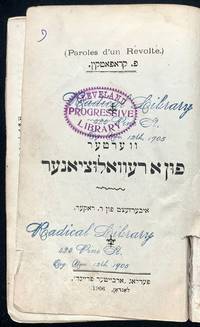
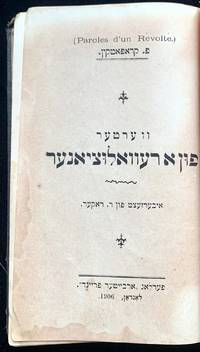
1906réf. 43217London: "Arbayter fraynd 1906. First Yiddish edition. Period boards 8vo xiii 426 pages 19 cm. In Yiddish. Title translates as “Words from a Revolutionary.” Translation of “Paroles d'un re´volte´.” Includes translation of the forewords by the author and Elise´e Reclus. Includes bibliographical references. “During his long exile Kropotkin wrote a series of influential works the most important being ‘Paroles d’un révolté’ 1885; “Words of a Rebel”.Kropotkin’s aim as he often remarked was to provide anarchism with a scientific basis. In Mutual Aid which is widely regarded as his masterpiece he argued that despite the Darwinian concept of the survival of the fittest cooperation rather than conflict is the chief factor in the evolution of species. Providing abundant examples he showed that sociability is a dominant feature at every level of the animal world. Among humans too he found that mutual aid has been the rule rather than the exception. He traced the evolution of voluntary cooperation from the primitive tribe peasant village and medieval commune to a variety of modern associations—trade unions learned societies the Red Cross—that have continued to practice mutual support despite the rise of the coercive bureaucratic state. The trend of modern history he believed was pointing back toward decentralized nonpolitical cooperative societies in which people could develop their creative faculties without interference from rulers clerics or soldiers.” SUBJECTS: Anarchism. OCLC: 19303211. Ex-library with early 19th Century left-wing library markings see photos. Good- Condition YID-48-41-LXCCGG-’e. London: "Arbayter fraynd unknown
1906réf. 43219London: "Arbayter fraynd 1906. First Yiddish edition. Period boards 8vo xiii 426 pages 19 cm. In Yiddish. Title translates as “Words from a Revolutionary.” Translation of “Paroles d'un re´volte´.” Includes translation of the forewords by the author and Elise´e Reclus. Includes bibliographical references. “During his long exile Kropotkin wrote a series of influential works the most important being ‘Paroles d’un révolté’ 1885; “Words of a Rebel”.Kropotkin’s aim as he often remarked was to provide anarchism with a scientific basis. In Mutual Aid which is widely regarded as his masterpiece he argued that despite the Darwinian concept of the survival of the fittest cooperation rather than conflict is the chief factor in the evolution of species. Providing abundant examples he showed that sociability is a dominant feature at every level of the animal world. Among humans too he found that mutual aid has been the rule rather than the exception. He traced the evolution of voluntary cooperation from the primitive tribe peasant village and medieval commune to a variety of modern associations—trade unions learned societies the Red Cross—that have continued to practice mutual support despite the rise of the coercive bureaucratic state. The trend of modern history he believed was pointing back toward decentralized nonpolitical cooperative societies in which people could develop their creative faculties without interference from rulers clerics or soldiers.” SUBJECTS: Anarchism. OCLC: 19303211. Spine is taped.Tight binding but text block is clean and intact. Good Condition YID-48-40-LXCCGG-’e. London: "Arbayter fraynd unknown
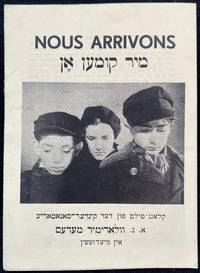
1938réf. 43520No Place Paris: No Publisher The Bund 1938. No Date 1938. 1st edition. Single fold pamphlet 12mo 3 pages. Includes photo on cover & inside. All text in Yiddish. Title translates as "We are Coming. A Sound-Film from the Children's Sanatorium Vladimir Medem in Miedzshin" a neighborhood in Warsaw. Promotional pamphlet for use in France and Belgium and possibly elsewhere for Aleksander Ford's 1936 film re-released in 1937-1938 for fundraising purposes on the children of the Medem Sanatorium entitled "Mir Kumen On" which translates literally as "We are Coming." For the English release of the film the title was instead translated as "Children Must Laugh;" it is viewable online at www.youtube.com/watchv=vozD_XbGHGA. The restored film was featured at the Museum of Modern Art's To Save and Project: The 14th MoMA International Festival of Film Preservation in 2016. "A rare record of Jewish life in Poland before World War II this 1936 film Mir Kumen Onwas produced in several language versions as an international fundraiser for the Medem Sanatorium near Warsaw a clinic sponsored by the General Union of Jewish Workers the Bund that provided care and an escape from urban poverty for some 10000 children between 1926 and 1939. Directed in a Soviet-influenced style by Alexander Ford a committed Communist who later became the head of Poland's National Film School the film follows three children as they gradually overcome their emotional withdrawal and distrust and enter the communal life of the institution" MoMA 2016. From the pamphlet text: "Narrow and dark streets of Greater Warsaw. Crowded and wet attics attics and cellars. 'Apartments' filled with people who lack mother's breasts for the always screaming child. An unemployed father. And - children everywhere many children. Children - withered rickety with crooked legs sunken chests and pale faces they - the children - know all the bitterness of life from a very early age. Often very often they are already 'earners' themselves - in a poor workshop in the street or until late at night they sell th apples and 'hot warm bagels'. And now from this environment the children arrive at the Medem sanatorium: Hanale from the Jewish secular school the pale Zalmanka from Cheder and Laser - the bagel seller. In the beginning everything is strange to them in the 'strange' Medem-Sanatorium: no one punishes no one shouts no one is angry. Everything is friendly to them everyone strives to understand them as their best friend. Joy and freedom mixed with free independent work rule over everything here. And our three heroes quickly got used to the new life-forms. They flourish. They become stronger physically and mentally they actively participate in the work of the 'self-management' of children they begin to understand that the world does not have to be like that as they realized in Warsaw that they can and must be someone else someone free someone equal someone beautiful. The children are taken in by the spirit of true friendship they begin to understand that person's suffering and get an aspiration to help that person. And when their daily newspaper brings news that the coal miners are on strike in Zaglembia that their children are starving they are deeply moved. Because - who can understand better than them what a strike means and feel more than them what is called hunger And at a general meeting the children according to their own proposal give each one a day of their time in the sanatorium so that the 180 children - create 180 days for their brothers in Zaglembia Times flies in the sanatorium. And now we see our 3 'heroes' as they drive off back home. The faces of all 3 are drawn. A deep sadness lies on the young childish faces." Both the pamphlet and the film end with the song "Mir Kumen On"--We Are Coming-the words by Nokhem Yud 1888-1966 and music by Yankl Troupianski 1909-1944. The film's theme song was also used by Camp Hemshekh in New York as its anthem in the 1960s & 1970s. "Everything in the film is factual and authentic. There is not a single artist in the film - everything is performed by the participating children of the Medem Sanatorium." We were unable to locate any copies using OCLC nor with a google search. An unrecorded promotional brochure for a very important film. Near Fine Condition. Very important. Exceedingly rare. PBERL-1-9-XX. No Place [Paris?]: No Publisher [The Bund?] unknown
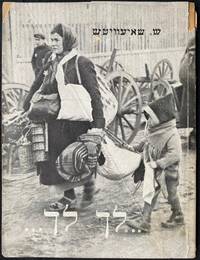
1946réf. 43433Lodzsh: Tsentraler Yidisher Historisher Komisye baym Tsentral-Komitet fun Poylishe Yidn 1946. 1st edition. Original dramatic photgraphic covers 8vo 70 1 page 1 leaf. Includes facsimiles. 21 cm. In Yiddish. Poems. "Oysgabes fun Der Tsentraler Yidisher Historisher Komisye baym Tsentral-Komitet fun Poylishe Yidn. Serye yidishe literatur 1." "Published by a commission The Central Jewish Historical Commission dedicated to recording the fate of Polish Jews published this book length poem by Simkhah Szajewics. Written in the Lodz Ghetto it appeared immediately after the war in 1946; Szajewicz perished in a concentration camp in 1944" from an exhibit at the National Yiddish Book Center which houses their copy in their Rare Book Collection. The book includes two long poems: "Lekh-lekha" and "Friling 702 " as well as letters and other related material. See David Roskies' interesting reflection on this work and it's stunning photographic cover at jtsa.edu/torah/go-forth-the-grammar-of-remembrance. For more about the author-poet see Chava rosenfarb's essay on Shayevitch in Tablet Magazine at tabletmag.com/sections/arts-letters/articles/the-last-poet-of-lodz. SUBJECTS: Jews -- Persecutions -- Poland -- Lódz. Holocaust Jewish 1939-1945 -- Poetry. Jews -- Correspondence. Crease and wear to wrapper and foot and crown of spine see photo better condition than usually found attractive. Good Condition. B HOLO2-110-36A-CCALX-'emm H-40-10. Lodzsh: Tsentraler Yidisher Historisher Komisye baym Tsentral-Komitet fun Poylishe Yidn unknown
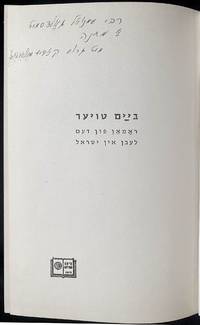
1967réf. 43562Nyu-York New York: Tsiko 1967. Hardcover. 1st edition. Original printed cloth 8vo 412 pages. 24 cm. In Yiddish. Title translates as "At the Gate: A Novel." Inscribed on title page by the author "Roman fun dem lebn in Yis´roel." Kadya Molodowsky was a major figure in the Yiddish literary scene in Warsaw from the 1920s through 1935 and in New York from 1935 until her death in 1975. A teacher in the Yiddish schools in Warsaw as a young woman she was best known for her children's poems. In the United States she wrote for the Yiddish press and founded and edited a journal Sviva Surroundings which she published for three decades. Living in Israel 1948-52 she founded and edited a journal Heym. She published six major books of poems 1927-1965 novels short stories plays and essays. Recurrent themes in her work include the lives of Jewish women and girls Jewish tradition in the face of modernity Israel and the Holocaust. OCLC: 11759957. Very Good Condition. An attractive inscribed work by a leading female Yiddish writer. BER-1-7. Nyu-York [New York]: Tsiko hardcover
1923TEXT IN YIDDISH, with table headings, captions and contents pages (Inhalts-Verzeichnis) IN GERMAN. RARE FOUR VOLUMES (No.1 through 4 BOUND TOGETHER) of a journal of Jewish demographics founded by the World Jewish Congress in order to better learn about, and thus better help the impoverished Jewish communities. Published from 1923 to 1924, and collected in one volume in 1924, the journal contains data on the Jews of the European countries, the USA, North and South Africa, Australia and New-Zealand, Palestine, Syria and India. Among other data, the journal contains statistical information on the geographical distribution of Jews, distribution of income, ages and family size, along with data such as the fate of Jewish assets that were seized during the pogroms of the late 1910s. 300x230mm. 292 pages. Maroon cloth Hardcover with gilt front cover and spine. Gilt lettering and decorations partly peeled. Cover curved. Cover and spine rubbed and stained. Cover corners and bottom edge bumped. Spine edges bumped and tattered/peeling. Front whitepages coming loose from binding. Binding visible on front inner cover and between front whitepage and title-page. Front whitepage fore edge slightly torn. Pages 289-292 and rear whitepage detached from binding. Library stamp on pre-title and title-pages, and page 292. Small ink inscriptions on title-page and page 292. Pages yellowing/browning. [SUMMARY]: This valuable collection of hard data on Jewish life prior to the Holocaust is otherwise in good condition.
réf. 65779, Brepols, 2020 Hardback, 924 pages, Size:156 x 234 mm, Illustrations:4 tables b/w., Language: French. ISBN 9782503569741.
1963IN HEBREW AND YIDDISH. Contains photos in b&w. 220x275 mm. Gilt hardcover. Cover stained and slightly bumped. Pages yellowing. Else in good condition.
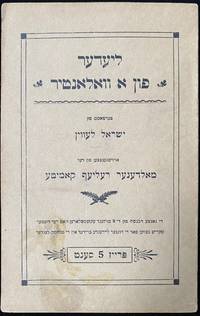
1919réf. 42896No Place Malden MA: Maldener Relief Komite 1919. No Date 1919. 1st Edition. Original printed paper wrappers 8vo 14 pages. 21 cm. In Yiddish. Title translates as "Verses of a Volunteer." No city or date listed but clearly published during or immediately after WW I with the Leksikon suggesting Malden MA 1919 OCLC suggests Boston the location of the printer and a clearly incorrect date of 1900 perhaps intending "1900s". Malden the poet's home town just outside of Boston and clearly the home of the "Maldener Relief Komite" makes much more sense making this is the first documented yiddish publication in Malden MA north of Boston. "The poet dedicated the entire income of 5 thousand copies to the brothers suffering from hunger in the countries at war" Translated from the front cover. Includes 4 poems: Der Volontir; Ikh Zukh a Vort; Nach der Milhome; Hazkharot Neshimot. The final poem is "in memory of the fallen Jewish heroes in all the war-torn lands." Israel Levine 1878-1970 "was born in a village in Minsk district Byelorussia. In 1895 he arrived in the United States lived in various cities worked as a teacher in Talmud Torahs and was secretary for Mizrachi in the town in which he lived Malden Massachusetts. He debuted in print in 1904 in Fraye arbeter-shtime Free voice of labor in New York with a poem entitled 'Funken shpritsn' Sparks fly and from that point he went on to contribute poetry and translations from Tanakh and from ethical books to: Yidishes tageblat Jewish daily newspaper Forverts Forward Dos yudishe folk The Jewish people Di varheyt The truth and Idisher kemfer Jewish fighter-in New York; Idishe shtime Jewish voice in Boston; and more. He published in book form: Lider fun a volontir Poems of a volunteer Malden 1919 16 pp.; Sefer naim zemirot tehilim Naim Zemirot on Psalms translated into a poetic form with short prefaces by Dr. Meir Vaksman and Aharon Kaminska Jerusalem 1934 19 pp" Khayim Leyb Fuks in Leksikon Fun Der Nayer Yidisher Literatur OCLC: 19307496. OCLC lists 4 copies worldwide YIVO Brandeis Harvard NYBC none outside the northeast. A few stains & discoloring Very Good Condition an excellent copy. Scarce. B YID-45-9XX-LE-'. No Place [Malden, MA]: Maldener Relief Komite unknown
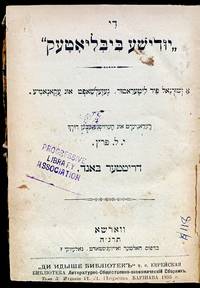
1895réf. 43079Warsaw: Izdanie I.L. Perets 1895. First edition period boards 8vo 179 pages. 23 cm. In Yiddish. Title translates as “The Jewish Library: A Journal for Literature Society and Economics.” Third volume of semiannual publication edited by I.L. Peretz. Di Yudishe Bibliotek was published periodically between 1891 and 1904. This issue includes belle-lettres poetry and scientific essays. “To encourage Jews toward a wider knowledge of secular subjects Peretz for several years wrote articles on physics chemistry economics and other subjects for Di yudishe bibliotek which he also edited.” Encyclopedia Britannica. Yitskhok Leybush Peretz 1852-1915 is one the best known Yiddish and Hebrew authors of the 19th century. Peretz was one of the three classic Yiddish writers with S. Y. Abramovitsh and Sholem Aleichem and the founder of Yiddish modernism. In the first decade of the 20th century he was at the center of an active literary circle in Warsaw. SUBJECTS: Yiddish literature -- Poland -- Periodicals. Jews -- Poland -- Periodicals. Jews. Yiddish literature. OCLC: 992802478. Ex-library with usual markings and normal wear and age to pages but otherwise in good condition. Good Condition. YID-46-19-GGLEX-’cc. Warsaw: [Izdanie I.L. Perets] unknown
1912réf. 224381912. Schwartz Isidor publisher. The Citizen: A Guide to Naturalization published after 1912 provided Yiddish-speaking Jewish immigrants with practical instruction for obtaining American citizenship during a period of substantial Jewish immigration to New York. Published in Brooklyn the manual translated the language and civic knowledge required for naturalization into forms accessible to applicants with limited English proficiency. Its questions and model answers address American government electoral procedures and New York State institutions while phonetic renderings of English enabled readers to rehearse responses for oral examination. The publication documents the role of Yiddish-language commercial publishers in helping Jewish immigrants navigate federal citizenship requirements and acquire the vocabulary of American civic life. Schwartz Isidor publisher. Vi Azoy Tsu Veren a Sitizen. / The Citizen: A Guide to Naturalization. All Important Questions and Answers Printed in Hebrew and Yiddish Also Translations in Plain English Which You are to Know When Applying for Your Final Citizen Papers. Brooklyn: Aroysgegeben fun Isidor Schwartz / Published by Isidor Schwartz n.d. after 1912. Only edition. 31 pages. Text in English and Yiddish including Hebrew script and phonetic transliterations. 6" x 4.5". Stapled pamphlet in printed wrappers. Organized around questions and prescribed answers the manual combines general civics instruction with information specific to New York naturalization applicants. Questions include "How does a bill become a law" "What is the capital of New York State" and "How many stars has the American flag" The supplied answer "Forty-eight stars" establishes a date after the admission of New Mexico and Arizona in 1912 and is consistent with the period before Alaska's statehood in 1959. The response to a question concerning electoral choice states "We vote for the candidate who is in our opinion best fitted to occupy the office he wishes to be elected to." Such prescribed formulations show how applicants were instructed to memorize both civic facts and the language of political participation. The pamphlet belongs to the Yiddish-language instructional literature produced for Jewish immigrants confronting English-language administrative and legal requirements in the United States. Its combination of Yiddish explanations phonetic English and standardized examination responses demonstrates how Brooklyn publishers adapted citizenship instruction to immigrants whose spoken and written English remained limited. The inclusion of New York State questions further identifies its intended regional readership. OCLC records eight institutional copies worldwide according to a published bibliographic census. Moderate chipping and edge wear to front and rear wrappers with several closed tears and losses at corners; interior pages clean and legible. Overall good condition. An uncommon example of Yiddish-language naturalization instruction documenting the practical preparation of Jewish immigrants for American citizenship. unknown
1912réf. 224381912. Schwartz Isidor publisher. The Citizen: A Guide to Naturalization published after 1912 provided Yiddish-speaking Jewish immigrants with practical instruction for obtaining American citizenship during a period of substantial Jewish immigration to New York. Published in Brooklyn the manual translated the language and civic knowledge required for naturalization into forms accessible to applicants with limited English proficiency. Its questions and model answers address American government electoral procedures and New York State institutions while phonetic renderings of English enabled readers to rehearse responses for oral examination. The publication documents the role of Yiddish-language commercial publishers in helping Jewish immigrants navigate federal citizenship requirements and acquire the vocabulary of American civic life. Schwartz Isidor publisher. Vi Azoy Tsu Veren a Sitizen. / The Citizen: A Guide to Naturalization. All Important Questions and Answers Printed in Hebrew and Yiddish Also Translations in Plain English Which You are to Know When Applying for Your Final Citizen Papers. Brooklyn: Aroysgegeben fun Isidor Schwartz / Published by Isidor Schwartz n.d. after 1912. Only edition. 31 pages. Text in English and Yiddish including Hebrew script and phonetic transliterations. 6" x 4.5". Stapled pamphlet in printed wrappers. Organized around questions and prescribed answers the manual combines general civics instruction with information specific to New York naturalization applicants. Questions include "How does a bill become a law" "What is the capital of New York State" and "How many stars has the American flag" The supplied answer "Forty-eight stars" establishes a date after the admission of New Mexico and Arizona in 1912 and is consistent with the period before Alaska's statehood in 1959. The response to a question concerning electoral choice states "We vote for the candidate who is in our opinion best fitted to occupy the office he wishes to be elected to." Such prescribed formulations show how applicants were instructed to memorize both civic facts and the language of political participation. The pamphlet belongs to the Yiddish-language instructional literature produced for Jewish immigrants confronting English-language administrative and legal requirements in the United States. Its combination of Yiddish explanations phonetic English and standardized examination responses demonstrates how Brooklyn publishers adapted citizenship instruction to immigrants whose spoken and written English remained limited. The inclusion of New York State questions further identifies its intended regional readership. OCLC records eight institutional copies worldwide according to a published bibliographic census. Moderate chipping and edge wear to front and rear wrappers with several closed tears and losses at corners; interior pages clean and legible. Overall good condition. An uncommon example of Yiddish-language naturalization instruction documenting the practical preparation of Jewish immigrants for American citizenship. unknown books
Leipzig: F. A. Brockhaus, 1882. Disbound; 8vo. Xii, 587 pages. Marbled endpapers. In German. Bibliographical citations. Max Grünbaum was a distinguished Munich Orientalist. A Chrestomathy is an aid, by means of prose passages, in learning a language. Contains Medieval Yiddish translations of the Bible. SUBJECT (S) : Yiddish language -- Translating into German. Ex-library with minimal markings. Some age staining. Corners of a few pages chipped. Although cover not present, binding is tight. Text in good condition. (GR-07-8)