729 Ergebnisse
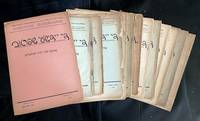
1930Best.-Nr. 42139Kiev: Katedr far Yidisher Kultur ba der Ukr. Visnshaftl. Akademye Filologishe Sektsye 1930. Paper Wrappers. 1st edition. Original printed publisher’s color paper wrappers 4to large ca 72-116 columns ca 36-58 pages per issue. 28 cm. In Yiddish. Title translates roughly as “The Yiddish Language.” Succeeded in 1931 by “Afn shprakhfront.”Di Yidishe Shprakh was a “Yiddish linguistic journal published in Kiev from 1927 to 1930. A bimonthly journal Di yidishe shprakh The Yiddish Language was published by the cooperative publishing house Kultur-lige and was the main philological publication of the Kiev Yiddish academic center. Its editor was the veteran Yiddishist Nokhem Shtif a founder of YIVO who had returned to Kiev from Germany in 1926. The journal’s inaugural issue March–April 1927 was published under the auspices of the Central Yiddish Bureau of the Ukrainian Commissariat for Education. With the next issue Di yidishe shprakh was an organ of the Chair and from July to October 1929 it was an organ of the Institute for Jewish later Proletarian Jewish Culture at the Ukrainian Academy of Sciences. Initially defined as a 'journal for practical Yiddish linguistics' from May to June 1927 it appeared as simply a 'journal for Yiddish linguistics. 'Shtif distinguished three language registers: the vernacular of the old generation partly represented in the works of Sholem Aleichem and predecessors; the highbrow language of modern writers such as Dovid Bergelson; and the contemporary 'culture language' most notably of the press. Although Shtif sought to target speakers of the mass 'culture language' the journal’s circulation hovered around 500 copies read mainly by Yiddish teachers.Apart from Shtif who published articles on various language-planning problems the most active contributors to Di yidishe shprakh were Ber Slutski Ayzik Zaretski Elye Falkovitsh Lipe Reznik and Shimen Dobin. In early 1929 Moscow literary critic Aron Gurshteyn criticized the journal for its purist approach to language planning. In the July–October 1929 issue Shtif published his article 'Di sotsyale diferentsiatsye in yidish' The Social Differentiation in Yiddish heralding an intensification of Soviet linguists’ anti-Hebraist campaign. That issue of Di yidishe shprakh adopted completely reformed Soviet spelling omitting for example final consonant letters.Although the last—twenty-fifth—issue of the journal was dated November–December 1930 it included materials from the First All-Union Yiddish Language Conference convened in Kiev from 8 to 13 February 1931 that issue is present here. Published under the imprint of the Central Publishing House this issue also signaled the demise of the remaining vestiges of the Kiev Kultur-lige. Yoysef Liberberg’s article 'Far parteyishkayt in der yidisher visnshaft-arbet' For a Party Approach to Yiddish Linguistics marked a full break with YIVO scholars particularly with YIVO director Max Weinreich whom Liberberg ridiculed for presenting Yiddish as an emanation of the Ashkenazic Jews’ soul. The Yiddish Language Conference decided to change the name of the journal. Between 1931 and 1939 it appeared sporadically under the title Afn shprakhfront On the Language Front reflecting its new more aggressive and politically charged approach' Gennady Estraikh in YIVO Encyclopedia of Jews in Eastern Europe 2010. For more see David Shneer “Yiddish and the Creation of Soviet Jewish Culture 1918–1930” Cambridge and New York 2004. SUBJECTS: Yiddish language -- Periodicals. Title also listed on covers in Russian “Ievreis'ka Mova” and German “Jiddische Sprach”. OCLC: 22840298. Most holdings in OCLC appear to be fragmentary. Covers are browning and fragile as expected but are otherwise very well preserved with very little edgewear. Internal text pages are also toning but remain relatively strong as pulp paper. Very important journal scarce in this degree of completeness Note that Estraikh suggests a circulation of only 500!. B YID-43-5-E. Kiev: Katedr far Yidisher Kultur ba der Ukr. Visnshaftl. Akademye, Filologishe Sektsye unknown
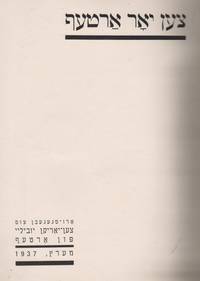
1937Best.-Nr. 35363New York; Posy-Shoulson Press 1937. 1st edition. Original Wraps. 4to. 4 171 2 23 pages. 28 cm. In Yiddish with English section and title page: Ten years Artef; published for the tenth anniversary of the Artef March 1937. Extensively illustrated publication for the tenth year anniversary of the radical Yiddish theatre company Artef: "the radical Yiddish dramatic troupe based in New York during the heyday of the Yiddish theater in America. Begun in the mid-1920s as a study group of amateur worker-actors at one time there were nine separate studios with over 120 students in the 1930s the troupe went professional putting on at least two and often three new plays per season. With such plays as Jacob Mostel 's Strike Shmuel Godiner 's Jim Kooperkop Avrum Vevioka 's Diamonds and Maxim Gorky 's Egor Bulychev and Dostigaev and Others Artef spread propaganda to the masses. Ideologically Artef was far left; its hope was a Communist society here in America. As a troupe its role was 'agit-prop' to agitate and propagandize to serve as the cultural representative of radical workers. In fact most of its tickets were pre-sold through worker unions and at least in its early years Artef gave presentations at political events. Its first large-scale production was Mass Play and Ballet of the Russian Revolution which appeared at the Lenin memorial celebration in Madison Square Garden on January 21 1928. Artef 's greatest artistic and commercial successes were connected with the talented productions of director Benno Schneider. Schneider who had been active in the Zionist Habima troupe in Moscow wed aesthetic excellence to revolutionary ideology with his interpretation of Aristocrats an adaptation of Sholem Aleichem 's Mentshn. Incidentally Schneider earned such a positive reputation with Artef that he received offers to direct on Broadway a promotion that cost the radical Yiddish theater dearly. The end of the Artef was gradual and its causes were closely associated with the reduced role of Yiddish in American life. But there were bright lights before the darkness. During the 'days of the Popular Front ' when the Communists formed associations with less radical leftist parties the Artef attracted a larger audience which led to an optimistic expansion that later was responsible for huge financial losses. The darkness occurred at the end of the thirties when the number of Yiddish speakers began to diminish. The last performance of the Artef was on July 7 1941." Review by Dr. Brian Horowitz of 'Yiddish Proletarian Theatre: The Art and Politics of the Artef 1925–1940 ' written by Edna Nahshon. Many of the actors and directors in Artef went on to establish solid careers on Broadway Hollywood and for those blacklisted overseas. Bound in brown velour wraps with gilt title. Heavily illustrated. Subjects: Arbeiter theatre verband New York. Jewish theater. Theater - New York State - New York. Artef - Anniversaries etc. OCLC: 19310798. Light wear to edges of wraps otherwise clean and fresh. Good condition. B YID-22-9-LEBWW. New York; Posy-Shoulson Press unknown
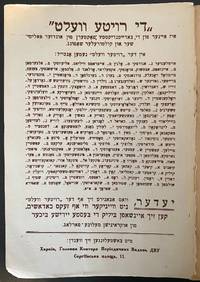
1930Best.-Nr. 17315Kharkov Ukraine: Ukrinishn Melukhe-Farlag 1930. 1st edition. Original Paper Wrappers lacks front wrapper 8vo 160 pages. 21 cm. In Yiddish. Di Royte Velt was a monthly Yiddish literary magazine which began publication in 1924. “The Yiddish literary journal Di royte velt The Red World published in 1924-33 in Kharkiv Kharkov in Russian then the Ukrainian capital was one of the strongholds of 'anti-Litvakovism'. In general terms the story of Di royte velt represents an insightful chapter in the history of Soviet Yiddish literary life of the 1920s and 1930s. In 1924 there arose the question of moving the Yiddish literary centre from Kiev to Kharkiv and of launching a Kiev-based Yiddish literary journal. This matter was discussed in a special memorandum of the Press Department of the Central Committee of the Ukrainian Communist Party. The head of the department M. Ravitsh-Cherkasky was Jewish. Motl Kiper the head of the Ukrainian Jewish Section backed this proposal arguing that Yiddish literature would benefit immensely from the capital's proletarian environment where it would liberate itself from the nationalist and Yiddishist hang-ups of Kiev. In reality the Kharkiv Jewish proletariat was more acculturated than elsewhere in Ukraine: only 36 per cent of Kharkiv Region's Jewish trade unionists were Yiddish-speakers compared with 89 per cent in the Berdichev Region 55 per cent in the Kiev Region and 42 per cent in the Odessa Region. It was no easy matter to create overnight a literary centre in a city which had a number of journalists but no literary lions. Moshe Taitsh for instance had been transferred to Moscow to reinforce the editorial staff of Der emes. For all that the apparatchiks' initiative resulted in creating in Kharkiv a new Yiddish literary journal Di royte velt. The first editors of Di royte velt were Henekh Kazakevich and M. Ravitsh-Cherkasky. While the latter was a king for a day in Yiddish literatureKazakevich was a remarkable figure in Soviet Yiddish journalism…. The first issue of the new journal appeared in September 1924 with a print-run of 2000. It was labelled a 'political-social literary-scientific bi-weekly journal'. Indeed the first issue contained only two literary works: a poem by Itsik Fefer and a story by Shmuel Persov. The other materials were devoted to theatre politics cosmology and literary criticism. Significantly the journal stressed its international character. Among its potential contributors we find the names of the editors and writers of the New York communist Yiddish daily Frayhayt Freedom Moshe Olgin Morris Vinchevsky Shakhne Epshtein Moshe Kats and Moshe Nadir. Also it was announced that the Vilna-based Boris Kletskin publishing house was preparing for publication books by four Soviet writers listed among the journals' contributors: Arn Kushnirov Moshe Khashtshevatsky Ezra Finninberg and Nokhum Oislender” Gennady Estraikh 2002: 'The Kharkiv Yiddish literary world 1920s-mid-1930s'East European Jewish Affairs 32: 2 70 — 88; for Estraikh’s extensive discussion of the importance of Di Royte Velt see the full article at https://www.yiddishweb.com/wp-content/uploads/2018/01/Kharkiv-Yiddish_Estra ikh.pdf. SUBJECTS : Yiddish literature -- Periodicals. OCLC: 10594044. Lacks Yiddish cover and 1st 2 leaves. Russian cover is present. YID-47-6. Kharkov [Ukraine]: Ukrinishn Melukhe-Farlag unknown
Best.-Nr. 67203E-363. Very Good. Hardcover. Hardcover. 8vo. Published by Harper & Row New York 1966. Xi 90 pgs. Illustrated. First Edition/First Printing. DJ has light shelf-wear present to the DJ extremities lower right corner of the DJ is clipped but price is still present to the top of the front flap. Bound in decorated cloth boards with titles present to the spine and front board. Boards have light shelf-wear present to the extremities. No ownership marks present. Text is clean and free of marks. Binding tight and solid. Nobel laureate Isaac Bashevis Singer introduces readers to the village of Chelm in this Newbery Honor Book. Chelm is a village of fools. The most famous foolsthe oldest and the greatestare the seven Elders. But there are lesser fools too: a silly irresponsible bridegroom; four sisters who mix up their feed in bed one night; a young man who imagines himself dead. Here are seven magical folktales spun by a master storyteller that speak of fools devils schlemiels and even heroeslike Zlateh the goat. ; 8vo 8" - 9" tall . hardcover
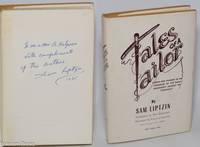
1965Best.-Nr. 62414New York: Sam Liptzin Book Committee 1965. 272p. first edition illus. dj slightly shelfworn hint of foxing on top-edge of text block board corners minorly bumped else in very good condition. Signed and inscribed by the author to a friend. Sam Liptzin Book Committee unknown
1938Best.-Nr. 4223-121720Cantor small name stamp FLEP Pocket intact BPD else content appears as unread and unblemished with dark blue colored cloth covered boards displaying no significant surface/edge wear as shown. Synopsis: In Polish Woods which was first published in its English translation from its original Yiddish in 1938 is a historical novel describing the devolution of the Kotzker dynasty between the age of Napoleon and the Polish Revolt of 1863. Author Joseph Opatoshu reflects on the conflicting and even opposite tendencies in development of the Jewish ideology during this era which would largely determine the future of the Jewish people: Hasidism enlightenment and assimilation. Insurance & handling is included free. Extra Charges/Fees apply on Shipments Outside The U.S. and Expedited Shipments. Oversize and/or heavy books may require additional fees. Will advise. Dated 12.08.20J #4223-121720 Updated 11.5.25 The Jewish Publication Society of America hardcover
1936Best.-Nr. 1iCg0016New York: Alfred A. Knopf Inc. 1936. Book. Good. Decorative Cloth. 3rd Printing Oct. 1936. 8vo or 8° Medium Octavo: 7¾" x 9¾" tall. 642 numbered pages. Solidly bound copy with moderate external wear. Clean text. Book could easily pass as 'very good' considering its age. Moderate foxing on endpapers and page edges. There is no dj. Third printing October 1936. Alfred A. Knopf, Inc. Hardcover
1964Best.-Nr. N5079Tel Aviv Israel: Di Goldene Keyt -Perets Publ House 1964. Original Cloth. Very Good. 8vo. 42812pp Yiddish text. Titleßpage also in English. Hinges at bottom of back covers 2 cm slightly open. Some foxing on covers. Otherwise a very good copy. Di Goldene Keyt -Perets Publ House hardcover
1959Best.-Nr. 32876New York: Celia Adler Foundation / Shulsinger Bros. Linotyping & Publishing Co 1959. Very Good/Very Good. New York: Celia Adler Foundation / Shulsinger Bros. Linotyping & Publishing Co. 1959. First Edition. Two octavo volumes 23.5cm; 688pp. Black and white photographs. Photo-illustrated dust jackets; blue cloth boards. Yiddish-language text throughout. Dust jackets show mild chipping with a few short tears along edges; general rubbing and sun-fading. Old damp-marks to board edges of both volumes causing discoloration to cloth but no structural damage. Bindings sound. Glue residue to endpapers of volume II else unmarked and still a Very Good set of this uncommon autobiography of "The First Lady of Yiddish Theater." Adler was known for creating leading roles in Yiddish versions of many classic plays and was the first actor to portray a Holocaust survivor in her brother Luther's 1946 Broadway production A Flag is Born. Scarce. Celia Adler Foundation / Shulsinger Bros. Linotyping & Publishing Co unknown
1929Best.-Nr. 36164Vilne: Vilner Farlag B. Kletskin 1929. Hardcover. g. Quarto. Vol. 2: 8 516 XXVII. Black buckram with gold lettering on front. Blind stamp borders on spine with red text boxes. Blind stamp symbol and lettering on back boards. Brown decorative endpapers b/w photographic facsimile plates and cuts throughout. Includes articles about the history of Yiddish theater Slavic influences on Yiddish burial customs early German thief jargon and Yiddish surnames in Ukraine. Additional title pages and summaries in English. Slight wearing on edges and ends. Top of spine torn. Slight age toning. Binding and interior in good condition. Text in Yiddish. Vilner Farlag B. Kletskin hardcover
1970Best.-Nr. AM005New York: Farrar Straus & Giroux 1970. First Edition Stated. Cloth. Very Good /very good. Shimin Symeon. Unpaginated approx. 36p. Signed by author on book plate on front pastedown. Jacket edges worn. Book plate states "Commemorating the dedication of the Isaac Bashevis Singer Library of Camp Hess Kramer May 6 1979." Author awarded Newbery Honors for Zlateh the Goat and Other Stories 1967 and When Shlemiel Went to Warsaw and Other Stories 1969. Black & brown illustrations. 12-1/4"x10-1/4" Farrar, Straus & Giroux hardcover
1922Best.-Nr. N442Berlin: Rimon Publ. House 1922. First Edition . Hardcover. Near Fine. Folio. 1922-1924. Issues 1 - 6 all published. Some 250pp. for the 6 parts bound together in the ORIGINAL PUBLISHER'S HALF CLOTH. Each issue HAS A FINE DECORATIVE COVER PRESERVED HERE. PROFUSELY ILLUSTRATED. MANY IN COLOR. Contributors included Bialik Lissitzky Chagall Tchernichovsky Nathan Altman and others many of the Jewish-Russian Avantgarde. This YIDDISH language journal published in BERLIN between 1922-1924 was dedicated to Jewish arts and literature and unique in its paper and printing quality. It served as a parallel publication to the Hebrew edition "Rimon" but varied in the literary content which was edited by the famous Yiddish writers Dovid Bergelson and Der Nister. The initiators of this exquisite production were Dr. Mark Wischnitzer and his wife famous art historian RACHEL BERNSTEIN-WISCHNITZER who had joined a group of Russian-Jewish intellectuals immigrants in Berlin with multi-lingual literary needs. Text in yiddish except for the additional content page in each issue which is in German for the first issue and in English for all the others issues. Condition of binding: Head and tail of spine with small expert repair hard to notice Cover with a few minimal markings. A VERY GOOD CLEAN AND FRESH COPY .RARE in this complete and fine state! ---ERSTE ORIGINAL -AUSGABE 1- 6 alles erschienen. Ca. 250 S. für die 6 Teile zusammengebunden in dem Original-Halbleinen des Herausgebers. Jede einzelne der 6 Ausgaben hat ein eindrucksvolles dekoratives Umschlagsblatt alle sind erhalten. Reich illustriert teils farbig. Mit Beiträgen von Ch.N. Bialik Marc Chagall Eli Lissitzky Nathan Altman u.a. viele Vertreter der JÜDISCH- RUSSISCHEN AVANTGARDE. Dieses jiddische Journal wurde in Berlin zwischen 1922 -und 1924 veröffentlicht und war der jüdischen Kunst und Literatur gewidmet. Es erschien parallel zu der hebräischen Edition genannt "Rimon" hatte aber einen anderen literarischen Inhalt. Text in jiddisch mit Ausnahme der zusätzlichen Inhaltsgabe der jeweiligen der 6 Ausgaben beim ersten Heft in deutsch bei Heft 2- 6 in englisch.Die Initiatoren dieser herausragenden Produktion in herausragender Druckqualität waren Dr. Mark Wischnitzer und seine Frau die berühmte Kunsthistorikerin Rachel Bernstein-Wischitzer.Beide hatten sich einer Gruppe von russisch-jüdischen Intellektuellen in Berlin angeschlossen.: Einband am Kopf des Rückens und unten mit einer kleinen kaum sichtbaren professionellen Restauration. Einband mit einigen wenigen minimalen Gebrauchsspuren. Ein sehr sauberes und frisches Exemplar. SELTEN! Rimon Publ. House hardcover
Best.-Nr. feb122284Used. For more details please contact me unknown
Best.-Nr. feb123153Used. For more details please contact me unknown
Best.-Nr. KSX-1YD-LOOFine. Visually Inspected by Owner: Paperback as pictured no marks in text and binding solid. 3rd edition 2003. Old and New Testament. Bible was not used a couple of very minor minor small crease on a couple of pages from storing. We ship M-F at 4pm and Sat. at 12 pm with tracking info. paperback
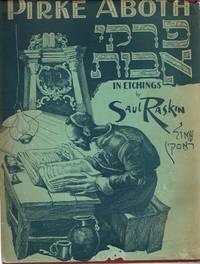
1938Best.-Nr. 7471NY: Academy Photo Offset Inc. Very Good in Good dust jacket. 1938. First Edition Thus. 1. Hard Cover. Publisher's full burgundy cloth Hebrew lettering gilt on cover. title page in color. Illustrated with fine etchings by Saul Raskin Text in English and Hebrew. Covers very lightly soiled Hebrew inscriptions on ffep very mildly shelf-worn else fine. The dust jacket now in Mylar is moderately chipped with some loss at the head of the spine. All of the etchings are in bright clean condition. VERY GOOD/VERY GOOD. . Etchings. 4to 11" - 13" tall. 124 2 pp . Academy Photo Offset, Inc. hardcover
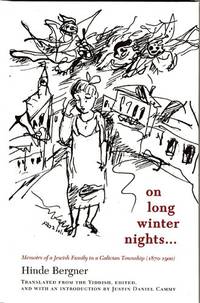
2005Best.-Nr. L3 box729 a5On Long Winter Nights…: Memoirs of a Jewish Family in a Galician Township 1870–190 Harvard Center for Jewish Studies. By Hinde Bergner; Translated from the Yiddish edited and with an introduction by Justin Daniel Cammy. 2005 by Harvard University Center for Jewish Studies Harvard University Press. Hardcover 122 pp. Harvard University Center for Jewish Studies, Harvard University Press. hardcover
1926Best.-Nr. biblio39295New York: Boni and Liveright; First Edition 1926. 145 pp 2 pp musical score. Good Hardcover no dj. DarkCyan cloth. Remnant of the Spine title label. No Wear to the cover. Soiled Endpapers. Clean Unmarked text. Strong Tight binding and hinges. 7.8"x5.25"x0.9". be27491. Boni and Liverigh hardcover
1927Best.-Nr. 228396Vilno: Yiddish Scientific Institute 1927. Stiff Wrapper. Good . VII 84 pp. in English and Yiddish Covers the years 1925-1927 "The spiritual uprising of the masses of the Jewish people.has called into being new cultural necessities." Yiddish Scientific Institute unknown
2017brossura Il Re Lear di William Shakespeare andato in scena al Teatro Ebraico di Stato di Mosca (Goset) nel 1935 è un episodio fondamentale quanto poco conosciuto della cultura del Novecento. Gli attoriautori del Goset, in particolare Solomon Michoels nella magistrale interpretazione del vecchio re e Veniamin Zuskin, un Fool straordinario, guidati dal regista Sergej Radlov, realizzarono uno spettacolo da porre al vertice dell'arte scenica e attorica yiddish nella sua versione sovietica. In queste pagine si propone ai lettori di oggi la ricostruzione e l'analisi di una messinscena che ci permette di riflettere su un atto creativo e poetico talmente potente, per quanto basato su un "classico" inoffensivo, da innescare la feroce reazione del regime stalinista. L'esito della vicenda qui raccontata fu tragico, ma "rivedere" e riflettere su questa peculiare messinscena del testo shakespeariano permette di cogliere a distanza di tanti anni la straordinaria vitalità e attualità del "mistero del teatro". In appendice è presentato in traduzione italiana il testo di Solomon Michoels Il mio lavoro sul "Re Lear" di Shakespeare, testimonianza di una cultura teatrale che a un secolo di distanza sembra prefigurare un teatro poetico ancora da venire.
2012br. La nuova edizione del dizionario ebraico si presenta riveduta, corretta e aggiornata in tutti i suoi lemmi. L'impaginazione è stata razionalizzata e la qualità grafica, per la resa dei caratteri ebraici, è stata riportata agli standard contemporanei. L'introduzione grammaticale, pur conservando l'impianto originale, è stata interamente rivista, nell'intento di facilitarne la comprensione, al di là della semplice memorizzazione, senza allontanarsi eccessivamente da un approccio scientifico. La terminologia tecnica è stata allineata alle tendenze della linguistica semitica contemporanea.
2003Mm 120x220 Collana "Piccola enciclopedia". Volume nella sua brossura originale con alette, 119 pagine con un ricco corredo di illustrazioni in nero e a colori nel testo e fuori testo. Opera in ottime condizioni. Spedizione in 24 ore dalla conferma dell'ordine.
1989Mm 140x215 Collana "La Gaja Scienza" - Traduzione di Mario Biondi. Volume nella sua brossura originale, 221 pagine. Copia in ottime condizioni, mai letta; spedizione in 24 ore dalla conferma dell'ordine.
2013Mm 140x210 Collana "Gli Adelphi" - Brossura originale, 498 pagine con un glossario in chiusura. Buona copia, spedizione in 24 ore dalla conferma dell'ordine.
1964Mm 140x215 Prima edizione italiana. Collana "La Gaja Scienza" - Traduzione di Bruno Oddera. Volume in copertina rigida con sovraccoperta, taglio superiore di color celeste, 323 pagine. Copia eccellente, mai letta. SPEDIZIONE IN 24 ORE DALLA CONFERMA DELL'ORDINE.