661 risultati
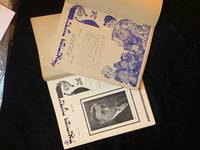
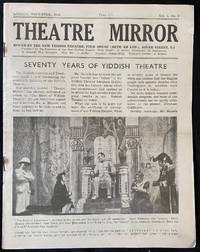
1946rif. 43547London: Nay-Idish teater 1946. Paperback. First edition. Original stapled paper wrappers 4to 16 4 pages including illustrations and photos. 29 cm. Text in Yiddish 16 pages and English 4 pages. Monthly periodical published by the New Yiddish Theater in London. Numbering was continuous despite the volume change with the start of the new calendar year. "In 1945 playwright producer and manager Abish Meisels staged an adaptation of Abraham Goldfaden's The Ten Commandments at the New Yiddish Theatre in the East End. An Austrian refugee Meisels immigrated to London in 1938. Five years later he walked down Adler Street and entered Adler Hall. He turned a key unlocking the doors to the New Yiddish Theatre. According to Meisels his mission was 'to present the best in Jewish drama; to keep alive the art of the Jewish theatre and to inculcate into the minds of the younger generation a love and appreciation of their lives customs and language.' .Meisels' production may have been salient for London's post-war Jewish community. Many of his 20-person company were refugees from Nazi-occupied Europe as were others of London's Jewish population. They found in Meisels' theatre as he put it a 'much needed cultural educational and social centre' and a sense of belonging. By the time Meisels opened his theatre in 1943 the Yiddish stage had been in existence for nearly 70 years. Its story began in 1876 when writer Abraham Goldfaden staged the first Yiddish theatrical productions in Romania and Russia. Yiddish plays were first performed in the UK in the 1880s concurrent with the mass migration of Yiddish-speaking Eastern European Jews to Britain. Between 1881 and 1914 nearly 120000 of these immigrants entered the country most settling in the East End. These Yiddish-speaking Jews brought with them the desire for entertainment in their native tongue. Meisels' company was the last theatre in Britain devoted to Yiddish productions. It followed the Hebrew Dramatic Club on Princes Street 1886-1887; the Pavilion Theatre onWhitechapel Road 1906-1934; the Temple of Art known as the Feinman Yiddish People's Theatre on Commercial Road; the Grand Palais on Commercial Road 1934-1970 and the Jewish National Theatre at Adler Hall 1936- 1939. The use of Yiddish declined asthe community became assimilated. In 1947 Meisels locked the doors to the NewYiddish Theatre for the last time." Stefanie Halpern Jewish Renaissance.For more on London's New Yiddish Theatre and Theater Mirror/Teater Shpigl see the London Jewish Museum's interview with Katie Power https://jewishmuseum.org.uk/whats-on/exhibitions-2/pitch-up-community-voices-katie-power. SUBJECTS: Jewish theater -- Periodicals. Jewish theater. OCLC: 35448905. OCLC locates 5 holdings in the US NYPL LOC Columbia HUC UWisc-Madison Archival corner repair rusting to staples. Good Condition. BER-1 YID-48-82A-GGX-'mccel. London: Nay-Idish teater paperback
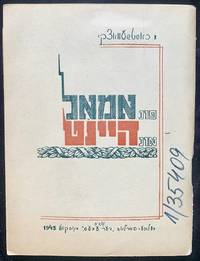
1943rif. 43487Moscow: Der Emes 1943. First edition. Original illustrated paper wrappers 16vo 62 pages. In Yiddish. Title translates as "From Then and Now: Songs and Ballads About War" War poems by Soviet-Yiddish poet Moyshe Khashtshevatski. "Khashtshevatski was a poet prose writer and playwright born in Buki near Uman Ukraine.In 1918 April 6 he debuted in print with a poem entitled 'Friling Kumt' Spring Comes in the Kiev newspaper Di Naye Tsayt The New Times-using the pen name M. Mishal. In 1921 he moved to Kiev where he forged a strong bond with the local Yiddish writers Yekhezkl Dobrushin Dovid Hofshteyn and Der Nister among others and from that point he enhanced ever more his reputation as a creator and builder of Soviet Yiddish literature.From 1923 over the course of three years he contributed intensively to Emes Truth in Moscow and he actively took part in the Soviet community and political life. Although his first works were in the symbolist vein he would later switch to a more realistic depiction of life and address the major issues and events of the time. He brought new motifs and artistic imagery into Soviet Yiddish poetry. The range of his interests was extremely broad. He also masterfully translated from the Russian and Ukrainian classics as well as from other languages. In 1943 the Moscow publisher Der Emes The Truth brought out two books by him: a poetry collection entitled Fun Amol un Haynt Of Then and Now this work and jottings about the hero of the Soviet Union Khayim Diskin Khayim Diskin. The majority of poems in the former were dedicated to war themes. Shortly after the outbreak of the Nazi-Soviet war in 1941 he was evacuated to Samarkand Uzbekistan and there he learned of the death of his only son at the front. He proceeded to volunteer for mobilization into the Red Army despite the fact that he was forty-six years of age. He contributed in the harshest of battles in that period of the fighting and died in battle." Leksikon Fun Der Nayer Yidisher Literatur SUBJECTS: Yiddish poetry. OCLC: 233117501 Number penned to front wrapper & title page; edgewear to one corner on many leaves no text affected and paper is browning and somewhat fragile but otherwise Good Condition. BK YID-48-111A-L-'mexcc. Moscow: Der Emes unknown
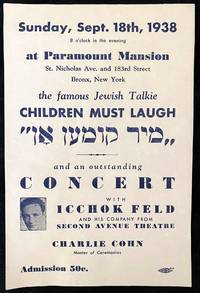
1938rif. 43522New York: No Publisher Paramount Mansion 1938. 1st edition. 5.5x8.5 inches blue on white photographic flyer in English with Yiddish film title. The film title "Mir Kumen On" can be translated directly as "We are Coming" though in the US the title was translated as "Children Must Laugh" and in France and Belgium as "Nous Arrivons." The restored film is viewable online at www.youtube.com/watchv=vozD_XbGHGA and was featured at the Museum of Modern Art's To Save and Project: The 14th MoMA International Festival of Film Preservation in 2016. "A rare record of Jewish life in Poland before World War II this 1936 film Children Must Laugh was produced in several language versions as an international fundraiser for the Medem Sanatorium near Warsaw a clinic sponsored by the General Union of Jewish Workers the Bund that provided care and an escape from urban poverty for some 10000 children between 1926 and 1939. Directed in a Soviet-influenced style by Alexander Ford a committed Communist who later became the head of Poland's National Film School the film follows three children as they gradually overcome their emotional withdrawal and distrust and enter the communal life of the institution" MoMA 2016. Full text: Sunday Sept. 18 1938 8 o'clock in the evening At Paramount Mansion St. Nicholas Ave and 183rd Street Bronx New York The famous Jewish Talkie CHILDREN MUST LAUGH "MIR KUMEN ON" And an outstanding CONCERT WITH ICCHOK FELD AND HIS COMPANY FROM SECOND AVENUE THEATRE CHARLIE COHN Master of Ceremonies Admission 50c. A massive fundraising campaign for the Medem Sanitorium was undertaken in 1937-38 and the film was shown internationally as a way to build support and solicit funds. We were able to locate no copies using OCLC nor with a google search. Apparently an unrecorded promotional flyer for a very important film. Near Fine Condition. Important displayable and exceedingly rare. PBERL-1-10-XX. New York: No Publisher [Paramount Mansion?] unknown
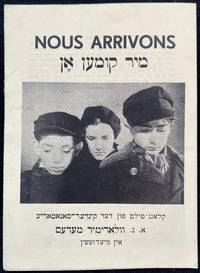
1938rif. 43520No Place Paris: No Publisher The Bund 1938. No Date 1938. 1st edition. Single fold pamphlet 12mo 3 pages. Includes photo on cover & inside. All text in Yiddish. Title translates as "We are Coming. A Sound-Film from the Children's Sanatorium Vladimir Medem in Miedzshin" a neighborhood in Warsaw. Promotional pamphlet for use in France and Belgium and possibly elsewhere for Aleksander Ford's 1936 film re-released in 1937-1938 for fundraising purposes on the children of the Medem Sanatorium entitled "Mir Kumen On" which translates literally as "We are Coming." For the English release of the film the title was instead translated as "Children Must Laugh;" it is viewable online at www.youtube.com/watchv=vozD_XbGHGA. The restored film was featured at the Museum of Modern Art's To Save and Project: The 14th MoMA International Festival of Film Preservation in 2016. "A rare record of Jewish life in Poland before World War II this 1936 film Mir Kumen Onwas produced in several language versions as an international fundraiser for the Medem Sanatorium near Warsaw a clinic sponsored by the General Union of Jewish Workers the Bund that provided care and an escape from urban poverty for some 10000 children between 1926 and 1939. Directed in a Soviet-influenced style by Alexander Ford a committed Communist who later became the head of Poland's National Film School the film follows three children as they gradually overcome their emotional withdrawal and distrust and enter the communal life of the institution" MoMA 2016. From the pamphlet text: "Narrow and dark streets of Greater Warsaw. Crowded and wet attics attics and cellars. 'Apartments' filled with people who lack mother's breasts for the always screaming child. An unemployed father. And - children everywhere many children. Children - withered rickety with crooked legs sunken chests and pale faces they - the children - know all the bitterness of life from a very early age. Often very often they are already 'earners' themselves - in a poor workshop in the street or until late at night they sell th apples and 'hot warm bagels'. And now from this environment the children arrive at the Medem sanatorium: Hanale from the Jewish secular school the pale Zalmanka from Cheder and Laser - the bagel seller. In the beginning everything is strange to them in the 'strange' Medem-Sanatorium: no one punishes no one shouts no one is angry. Everything is friendly to them everyone strives to understand them as their best friend. Joy and freedom mixed with free independent work rule over everything here. And our three heroes quickly got used to the new life-forms. They flourish. They become stronger physically and mentally they actively participate in the work of the 'self-management' of children they begin to understand that the world does not have to be like that as they realized in Warsaw that they can and must be someone else someone free someone equal someone beautiful. The children are taken in by the spirit of true friendship they begin to understand that person's suffering and get an aspiration to help that person. And when their daily newspaper brings news that the coal miners are on strike in Zaglembia that their children are starving they are deeply moved. Because - who can understand better than them what a strike means and feel more than them what is called hunger And at a general meeting the children according to their own proposal give each one a day of their time in the sanatorium so that the 180 children - create 180 days for their brothers in Zaglembia Times flies in the sanatorium. And now we see our 3 'heroes' as they drive off back home. The faces of all 3 are drawn. A deep sadness lies on the young childish faces." Both the pamphlet and the film end with the song "Mir Kumen On"--We Are Coming-the words by Nokhem Yud 1888-1966 and music by Yankl Troupianski 1909-1944. The film's theme song was also used by Camp Hemshekh in New York as its anthem in the 1960s & 1970s. "Everything in the film is factual and authentic. There is not a single artist in the film - everything is performed by the participating children of the Medem Sanatorium." We were unable to locate any copies using OCLC nor with a google search. An unrecorded promotional brochure for a very important film. Near Fine Condition. Very important. Exceedingly rare. PBERL-1-9-XX. No Place [Paris?]: No Publisher [The Bund?] unknown
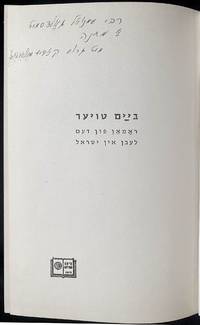
1967rif. 43562Nyu-York New York: Tsiko 1967. Hardcover. 1st edition. Original printed cloth 8vo 412 pages. 24 cm. In Yiddish. Title translates as "At the Gate: A Novel." Inscribed on title page by the author "Roman fun dem lebn in Yis´roel." Kadya Molodowsky was a major figure in the Yiddish literary scene in Warsaw from the 1920s through 1935 and in New York from 1935 until her death in 1975. A teacher in the Yiddish schools in Warsaw as a young woman she was best known for her children's poems. In the United States she wrote for the Yiddish press and founded and edited a journal Sviva Surroundings which she published for three decades. Living in Israel 1948-52 she founded and edited a journal Heym. She published six major books of poems 1927-1965 novels short stories plays and essays. Recurrent themes in her work include the lives of Jewish women and girls Jewish tradition in the face of modernity Israel and the Holocaust. OCLC: 11759957. Very Good Condition. An attractive inscribed work by a leading female Yiddish writer. BER-1-7. Nyu-York [New York]: Tsiko hardcover
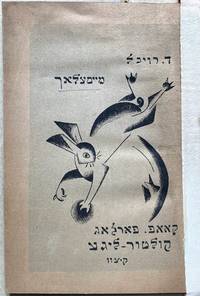
1922rif. 43563Kiev: Kultur lige 1922. 1st edition. Original modernist illustrated paper wrappers bound into pamphlet protector. 12mo 30 pages. With many illustrations. 22 cm. In Yiddish. Title translate as "Little Tales." A collection of five tales by Aleksander Afanasyev Vladimir Dal and Hans Christian Andersen adapted by David Roikhel and illustrated by the Yiddish Modernist artist Mark Epstein. A striking example of Mark Epstein's early Cubist-inspired graphic work produced for the now famous Jewish children's book Mayselakh. published in Kiev in 1922 and closely associated with the educational and cultural program of the Kultur Lige. Mark Epstein 1897-1949 was among the most important Jewish graphic artists associated with the Kultur Lige. Born in Babruysk he received a traditional Jewish education before studying at the Kiev School of Art. In 1918 he worked in the studio of Alexandra Exter whose influence can be seen in the dynamic Cubist-inflected vocabulary of his early work. That same year he participated in a Jewish artists' exhibition in Moscow and was one of the founders of the art section of the Kultur Lige in Kiev. Epstein was closely associated with the remarkable circle of Jewish modernist writers and poets active in Kiev including Der Nister Pinchas Kahanovich David Bergelson and Yechezkel Dobrushin. This milieu profoundly influenced his artistic development. Epstein worked across several media as a graphic artist painter sculptor and stage designer becoming one of the leading visual interpreters of the new Yiddish cultural movement. Children's illustration occupied an important place in his work. He designed covers and illustrations for Frayd Joy a Yiddish periodical for young people published in Kiev from 1922 to 1925. Mayselakh here is part of this same remarkable period of Yiddish publishing when artists associated with the Kultur Lige joined contemporary European artistic movements with with Yiddish literature and the educational needs of a new generation. Unlike many of his colleagues in the Kultur Lige's art section Epstein remained in Kiev after the establishment of Soviet rule and continued his artistic and educational activities under the transformed organization. From 1923 to 1931 he directed the Jewish Arts and Trades School in Kiev the institution that emerged from the Kultur Lige's former art section after its incorporation into the Soviet cultural system. He simultaneously worked as a stage and costume designer for theatres in Kiev and Kharkiv. In 1932 following the closure of the Jewish Arts and Trades School and the dissolution of the remaining Kultur Lige institutions Epstein was forced to leave Kiev for Moscow. Mayselakh is a stunning example of early Soviet Jewish children's publishing combining Yiddish literary culture with the bold modernist imagery of one of the most important artists of the Kiev Kultur Lige. For more see: Estraikh G. Hoge K. & Mikhail K. Children and Yiddish Literature from Early Modernity to Post-Modernity. Routledge 2016. Epstein's modernist masterpiece should not be confused with another Kultur Lige-issued-collection of childrens tales from 1922 the 58-page similarly titled work by Itsik Kipnis 1896-1974 Mayselekh far Klayne Kinder . Mayselakh has appeared at major auction only twice in its long history in 2019 when a copy sold for $2700 and in 2021 when a copy sold for $3000.00. OCLC: 122741292 1514928517. OCLC Locates only 4 copies worldwide Columbia Met-NYC YIVO & Bib. Nat. France Light dampstains & staple rust with light rippling from the epic 1966 JTSA fire which this book survived see photos. Otherwise Very Good. An attractive example of a famous example of Modernist Kultur Lige children's publishing. PBERL-1-14. Kiev: Kultur lige unknown
1938rif. 132057Philadelphia: Jewish Publication Society of America 1938. 1st edition. Nice copy. octavo. hardback in original cloth 392pp. Interesting Yiddish novel of Polish Jews against a background of Polish national liberation Jewish Publication Society of America hardcover
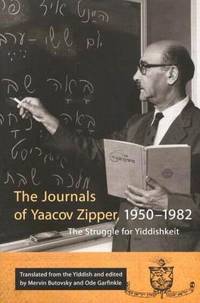
rif. 64208974McGill-Queen's University Press . Hardback. New. pp. xxv 362 McGill-Queen's University Press hardcover
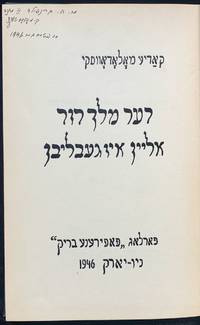
1946rif. 43238New York: Papirene Brik 1946. First edition. Original boards. 8vo 156 pages 24 cm. In Yiddish. Title appears in English as "Only King David Remained." Inscribed by Molodowsky on title page in year of publication Early post-war book of poems by Kadya Mololdowsky that is composed of poems about the Holocaust and that "draw upon traditional Jewish literary responses to catastrophe." Contains some of Molodowsky's most well regarded poems. Kadya Molodowsky was a major figure in the Yiddish literary scene in Warsaw from the 1920s through 1935 and in New York from 1935 until her death in 1975. A teacher in the Yiddish schools in Warsaw as a young woman she was best known for her children's poems. In the United States she wrote for the Yiddish press and founded and edited a journal Sviva Surroundings which she published for three decades. Living in Israel 1948-52 she founded and edited a journal Heym. She published six major books of poems 1927-1965 novels short stories plays and essays. Recurrent themes in her work include the lives of Jewish women and girls Jewish tradition in the face of modernity Israel and the Holocaust. SUBJECTS: Yiddish poetry. David King of Israel -- Poetry. David King of Israel. Poetry. OCLC: 19314664. Clean copy with book stamp from "Emil Gorovets's Library." Very Good Condition. An attractive inscribed work by a leading female Yiddish writer. YID-48-47-LEXCCM!-'gg. New York: Papirene Brik unknown
1939rif. 299009Prepared by the Yiddish Writers' Guild of the Federal Writers' Project 1939. Hardcover . Good . 206 pp.In Yiddish former owner name stamped on fep oclc 19314860 Prepared by the Yiddish Writers' Guild of the Federal Writers' Project, hardcover
1938rif. 218650New York : Yiddish Scientific Institute 1938. First Edition. Hardback. Very good copy in the original gilt-blocked cloth. Spine bands worn with some fraying. Panel edges somewhat dulled and rubbed as with age. Bumped corners. Rear hinge starting. Minor library marks. Remains quite well-preserved overall.; 8vo 8"" - 9"" tall; 348 pages; Description: 1v. 348p. 1 port; 23cm. Subjects: Jewish studies -- Science -- History -- Language -- Yiddish culture -- United States. Notes: Added title page and table of contents in English. Language: Hebrew. New York : Yiddish Scientific Institute hardcover
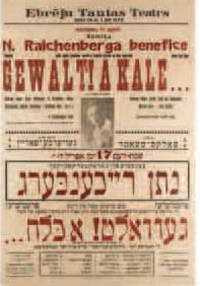
rif. 51-1032Latvia: 1920s-1930s. A Collection of 8 Yiddish Theater posters from the 1920s and 1930s. Yiddish Latvian poster of the Ebreju Tautas Teatrs Jewish people Theater. Letter press in red and black on fine paper mounted on canvas. 91 x 60.5 cm. Riga Spiestuve vards 1930 announcement of an event on Saturday April 17 d. j.: Bene_ z of the character comedian Natan Reichenberg. Premiere! For the first time in Riga the large entertaining equipment operetta with completely new vocal pieces help! A bride. The comic role of "Kivele Feldsher" Akiva the medics the Bene_ acquires ziant. -Printed in Latvian and Yiddish language with photographic print. -Paper browned minimal fold marks on the outer edge. -Rare poster.Yiddish Latvian poster of the Rigas teatris zidu minoritates Riga Jewish minorities Theater. Letterpress in red and black on fine paper. 71 x 53.5 cm. Riga SP. extra 1925. announcement of the _ eaterstücks the Jewish robber on November 26. -Printed in the Latvian and Yiddish languages. -Paper slightly tanned with vertical folding kl. Defects especially upper-right corner on the outer edge with small tears. -Very rare poster.Yiddish Latvian poster of the Rigas teatris zidu minoritates Riga Jewish minorities _ Theater. Letter press in red and black on fine paper. 71 x 50 cm. Riga SP. extra 1925. announcement of different theatrical works: A man an unlucky guy. -The curly haired blonde -In life tri_ all . -The Jewish Bandit November 17-22. -Printed in the Latvian and Yiddish languages. -Paper minimally tanned with vertical and horizontal folding Small Defects minimal _ square on the outer edge with small tears. -Very rare poster.Yiddish Latvian poster of the Rigas teatris zidu minoritates Riga Jewish minorities Theater. Letterpress in red and black on fine paper. 106 x 71 cm. Riga SP. extra 1933 announcement of solemn Erö_ regulation IX season on Saturday Sept. 30 Sunday 1 Oct 1933 8.30 evening. Performed by: Genia Schalit Nina Talini oSIP Runitsch in the well-known piece of David Golder. In four acts by A. Nemirowskaja. -With 2 dates. -Printed in the Latvian and Yiddish languages. -Paper minimally tanned partly with resounding mount tracks with vertical and horizontal folds & light Abklatsch small. Defects somewhat spotted and knicked. -Very rare poster. Latvian Yiddish poster. Woodcut on fine green paper. 66 x 51 cm. Daugavpils Latvia Pilsetas spiestuve litogra_ Yes 1920s. The translated content of the poster: Sunday August 15 7: 00 the Dünaburger Trade Association invites in the Riga road 42 in the Novonowitsch-Hall to a meeting on the election of the municipal administration. Speaker are: Al Kopelowski A. Bulavko Sch. Heller Salman Barak N. Magid and others. "Dealer! Come numerous. Dealers and sellers. Bear in mind that your list is the list of 5 the Listedes of trade association."- printed in the Latvian and Yiddish languages. -Paper with vertical & horizontal folds and knicks-Rare poster.Latvian Yiddish poster. Woodcut in blue on fine paper. 93 x 62.5 cm. Daugavpils Latvia Pilset. spiestuvelitogra _ Yes 1920s. Election poster: David challenge the dealer! 'Remember - no voice of the dealer for a different list than the list 5 vote for the list of dealers no. 5' - 3 languages printed in Yiddish Russian and Latvian. -Paper with vertical & horizontal folding some with red marks. Knicks and small tears -Rare poster.Latvian Yiddish poster. Woodcut on fine Orange paper. 49.5 x 31.5 cm. Daugavpils Latvia Pilsetas spiestuve litogra_ Yes 1920s. The translated content of the poster: Agudat Israel Daugavpils. Taking place on Monday August 17 8 o'clock in the evening. A folk Assembly in Klingmann Hall Riga Street 42. The elections. Asked to show! -Printed in the Latvian and Yiddish languages. -Paper with horizontal folds tears and stains-Rare poster.Images of all the posters are available Latvia: 1920s-1930s unknown
1926rif. 298804Vilna: Kletskin 1926. Hardcover . Very Good-. 439 half pages In Yiddish Kletskin hardcover
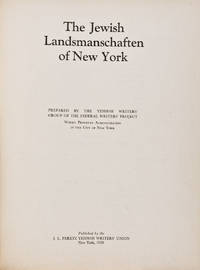
1938rif. 28020New York: I. L. Peretz Yiddish Writers' Union 1938. First edition. Hardcover. g. Quarto. 397 3pp. Rebacked with blue library tape over original cloth with Yiddish lettering on front cover. Title pages in Yiddish and English. Scarce work being a survey of immigrant societies in New York. Includes essays on landsmanshaft history and activities as well as survey results in Yiddish; also contains the Directory of Organizations in English. Age-wear on binding with original spine replaced by library blue tape and heavy rubbing along edges. Previous owner's stamps on both endpapers. Age-toning along paper margin. Text in Yiddish with some English. Binding in overall fair interior in good condition. I. L. Peretz Yiddish Writers' Union hardcover
1946rif. 1116373New York: Jewish Encyclopedic Handbooks Central Yiddish Culture Organization CYCO. Fine maroon leatherbound 2 volume set gilt all edges Volume 1 has 430 pp with B/W illustrations; Volume 2 has 430 pp with B/W illustrations. . Fine. Leather Bound. 1946. Jewish Encyclopedic Handbooks Central Yiddish Culture Organization (CYCO hardcover
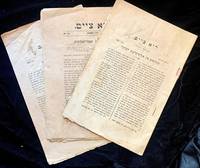
1898rif. 43426New York: N.M. Shaikewitz 1898. First edition staple binding 4to 29-31 pages each issue 30 cm. In Yiddish. Three issues of Di Tsayt a monthly Yiddish language publication published in New York. The journal ran from 1897-1898. Singerman S582; Freidus p. 282 Weissberger 56. "Menahem Mendel Dolitzky was a Hebrew and Yiddish poet and novelist. Born in Bialystok he received a traditional Orthodox education and as a teenager became interested in the ideas of the Haskalah.He served as a Hebrew teacher in various towns and in 1881 was an eyewitness to pogroms in southern Russia which had a profound effect on him. .In 1892 when the Jews were expelled from Moscow Dolitzki emigrated to New York and was warmly received by the small band of Hebrew maskilim in the U.S. He began publishing descriptions of the persecution of Jews in Russia in the journal Ha-Ivri mainly in poetic form.Despite the efforts of the Hebraists in the U.S. to assist him he found no way of making a living from Hebrew writing. After working at various jobs he finally took up writing for the daily Yiddish press turning out serialized novels which catered to the popular reader" EJ. SUBJECTS: Jews -- New York State -- New York -- Periodicals. Yiddish literature -- Periodicals. Jews. Yiddish literature. OCLC: 50546431. OCLC and Singerman together locate 4 complete holdings Harvard NYPL YIVO HUC and one of vol I only Yale. Lacks original outer paper wrappers some toning Good Condition Scarce YID-48-109-. [New York: N.M. Shaikewitz] unknown
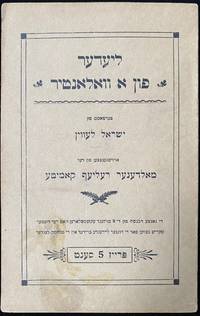
1919rif. 42896No Place Malden MA: Maldener Relief Komite 1919. No Date 1919. 1st Edition. Original printed paper wrappers 8vo 14 pages. 21 cm. In Yiddish. Title translates as "Verses of a Volunteer." No city or date listed but clearly published during or immediately after WW I with the Leksikon suggesting Malden MA 1919 OCLC suggests Boston the location of the printer and a clearly incorrect date of 1900 perhaps intending "1900s". Malden the poet's home town just outside of Boston and clearly the home of the "Maldener Relief Komite" makes much more sense making this is the first documented yiddish publication in Malden MA north of Boston. "The poet dedicated the entire income of 5 thousand copies to the brothers suffering from hunger in the countries at war" Translated from the front cover. Includes 4 poems: Der Volontir; Ikh Zukh a Vort; Nach der Milhome; Hazkharot Neshimot. The final poem is "in memory of the fallen Jewish heroes in all the war-torn lands." Israel Levine 1878-1970 "was born in a village in Minsk district Byelorussia. In 1895 he arrived in the United States lived in various cities worked as a teacher in Talmud Torahs and was secretary for Mizrachi in the town in which he lived Malden Massachusetts. He debuted in print in 1904 in Fraye arbeter-shtime Free voice of labor in New York with a poem entitled 'Funken shpritsn' Sparks fly and from that point he went on to contribute poetry and translations from Tanakh and from ethical books to: Yidishes tageblat Jewish daily newspaper Forverts Forward Dos yudishe folk The Jewish people Di varheyt The truth and Idisher kemfer Jewish fighter-in New York; Idishe shtime Jewish voice in Boston; and more. He published in book form: Lider fun a volontir Poems of a volunteer Malden 1919 16 pp.; Sefer naim zemirot tehilim Naim Zemirot on Psalms translated into a poetic form with short prefaces by Dr. Meir Vaksman and Aharon Kaminska Jerusalem 1934 19 pp" Khayim Leyb Fuks in Leksikon Fun Der Nayer Yidisher Literatur OCLC: 19307496. OCLC lists 4 copies worldwide YIVO Brandeis Harvard NYBC none outside the northeast. A few stains & discoloring Very Good Condition an excellent copy. Scarce. B YID-45-9XX-LE-'. No Place [Malden, MA]: Maldener Relief Komite unknown
1957rif. 43419New York: Shalom-Alekhem folks shuln 1957. First edition. Original illustrated paper wrappers bound by year into later paper outer wrappers for each yearly volume 4to each issue contains 18 pages includes illustrations. 26 cm. In Yiddish. Title translates as "Children's Journal." All published copies of the famous Yiddish children's magazine Kinder Zhurnal from 1956 and 1957 during the Cold War. Six issues per year. "Kinder zhurnal a children's magazine was in existence from 1920 to 1981. Its first editor Shmuel Niger served from 1922 to 1948. The magazine published works by writers such as Mani Leib Aleph Katz Jacob Glatstein Kadia Molodowsky. Farlag Matones was established in 1925 as a publisher of children's books but became a leading publisher of Yiddish literature and of well-known authors such as Menahem Boraisha Jacob Glatstein Chaim Grade Moses Moyshe Leib Halpern Leibush Lehrer Isaac Bashevis Singer Hillel Zeitlin Aaron Zeitlin. Lippa Lehrer was the manager and leading figure of both organizations and was editor of Kinder zhurnal for a number of years." YIVO SUBJECTS: Children's literature Yiddish -- Periodicals. Children's literature Yiddish. OCLC: 10158059 Outer blank paper wrappers faded with light rusting to staples but issues themselves remain in Very Good Condition. YID-48-104-GGLEX-'cc. New York: Shalom-Alekhem folks shuln unknown
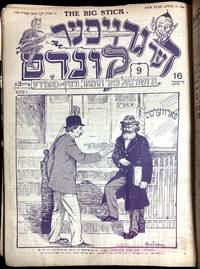
1909rif. 42930New York: Ferlag "Kibets 1909. 1st Edition. Original publisher's binding Folio newspaper. Complete first volume Starting with Vol I Nr 1 of "Der Kibitser" Dec. 15 1908 renamed and renumbered first as Vol I Nr 1 Jan 22 1909 of "Der Groyser Kibetser The big kibetzer" with the following issue of Feb 5 numbered as "3" to correctly follow from the first issue and then with Vol I Nr 6 March 19 1909 onward as "Der Groyser Kundes The Big Stick" or "The Big Prankster." Incidentally the other set of this volume we examined also did not have a Nr 2 so we are confident this is complete as issued. One centerfold cartoon by Zuni Maud see image features "Der Kaptialistisher Tayfel"--the Capitalist Devil-holding back a "mother" by the hair to stop her from interfering as "baby's milk-bottle" is drained off by the "milk-trust" cat. The caption reads "The Capitalist Devil: - to the mother: Never mind madam all in English in Hebrew letters you go to the factory the milk-trust will take good care of your baby." This cartoon-laden periodical was a New York City Yiddish language satirical bi- weekly which ran from 1908 until 1927. The humor paper was issued biweekly this volume for its first 20 months and then weekly after that. OCLC also references another Vol I Nr 1 from April 15 1908 a special S´imhes` Toyreh Simchas Torah issue but this may have been a one-off. Founded by the humorist Yosef Tunkel or Der Tunkeler his pen name meaning 'The Dark One' the paper was taken on by Jacob Marinoff when Tunkel left to work for an established paper in Warsaw. The paper consciously set itself up in opposition to the serious Yiddish-language press of the time such as the socialist Forverts.Naturally more traditional religious Judaism did not escape its satire: The later 1915 "Christmas" edition included a parodic conversation between Jesus and the prophet Elijah. Despite its irreverent attitude to everything it also published poetry by Di Yunge "The Young Ones" poets such as Moyshe-Leyb Halpern and Zuni Maud. At its height it had a circulation of 35000 but folded in 1927 due to flagging sales. Der Groyer Kunds is highlighted in this recent talk by Yiddish comics scholar Eddie Portnoy on the reactions in the Yiddish press to restrictions on Jewish immigration to the US: https://www.yiddishbookcenter.org/collections/archival-recordings/recorded-programs/ybcr-nybc-ybcr-1048/door-slams-shut-reactions-yiddish-press-immigration . SUBJECTS: Yiddish wit and humor -- Periodicals. OCLC: 28297536. Most holdings appear to be fragmentary and do not include these issues. Issue 18 with torn cover. In final issue the bottom margin suffers some loss to the final leaves none to the dramatic front cover though. Damaged boards are loose and most issues are coming loose though the quality paper used has remaind strong and bright much better than standard newsprint would have. Important graphic Yiddish humor from the great migration period. Dramatic and displayable! BK5 YID-43-9A-LEX. [New York]: Ferlag "Kibets unknown
rif. a61093London 1904-1905. 45 issues of this Yiddish anarchist weekly bound in one volume. 4to. about 370pp. hardcover with new paper spine. Good corners of the binding are worn. The leaves are browned and a bit fragile. Issues 46 47 and 48 are chipped at the top corner with some loss of text all other issues are intact. Very scarce. . hardcover
1942rif. 58463NY: Academy Photo Offset Inc. 1942. First Edition. Hardcover. Very Good in Very Good dust jacket. Oversized orange cloth titled in black. Points gently bumped textblock edge stained. Illustrated. The DJ is toned to spine chipped to spine ends somewhat stained. Text in Hebrew Yiddish and English.; Folio 13" - 23" tall; 160 pages . Academy Photo Offset Inc hardcover
1940rif. 58464NY: Academy Photo Offset. 1940. First Edition. Hardcover. Near Fine in Very Good dust jacket. Oversized cloth. Near fine with slight shelf bumping tiny stain to textblock edge. The DJ has slight edgewear mild toning and slight staining to flap fold.; Folio 13" - 23" tall; 136 pages . Academy Photo Offset hardcover
rif. 74096E-091. Hardcover. Very Good. Hardcover. 8vo. Published by Harper & Row New York 1966. Xi 90 pgs. Illustrated. First Edition/First Printing. DJ has light shelf-wear present to the DJ extremities lower right corner of the DJ is clipped but price is still present to the top of the front flap. Bound in decorated cloth boards with titles present to the spine and front board. Boards have light shelf-wear present to the extremities. No ownership marks present. Text is clean and free of marks. Binding tight and solid. Nobel laureate Isaac Bashevis Singer introduces readers to the village of Chelm in this Newbery Honor Book. Chelm is a village of fools. The most famous fools—the oldest and the greatest—are the seven Elders. But there are lesser fools too: a silly irresponsible bridegroom; four sisters who mix up their feed in bed one night; a young man who imagines himself dead. Here are seven magical folktales spun by a master storyteller that speak of fools devils schlemiels and even heroes—like Zlateh the goat.; 8vo 8" - 9" tall . hardcover
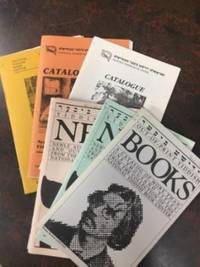
1988rif. bing65mm00009The National Yiddish Book Center 1988. Paperback. Very good. Prompt shipment with tracking. we ship in CLEAN SECURE NEW boxes Very good condition 7 staple-bound catalogues dating from the 1980s published by The National Yiddish Book Center Amherst MA. Mostly clean pages some dog-eared some dates and notes. The National Yiddish Book Center paperback
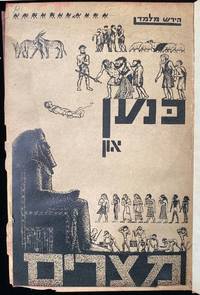
1930rif. 42782Rige Riga: Yungbukh 1930. 1st edition. Period boards with original covers bound in. 8vo. 157 pages 21 cm. In Yiddish with Latvian "front" cover and title page at rear. Title translates as "Canaan and Egypt: A Novel." Wonderfully illustrated cover bound in featuring cartoonish drawings of Canaanites and Egyptians. Two volumes in one: 1. Yoysef in Mitsroyim and 2. Yosef der reter fun Mitsroyim. SUBJECTS: Yiddish fiction. OCLC: 503648109. OCLC lists 8 copies worldwide including copies of an undated edition which we assume to be a later reprint. Ex-library with usual marks. Paper brown and somewhat fragile old dampstain to lower edge of boards extending into margins of first and last leaves. Original bound-in covers have come loose. Good condition thus. B YID-33-27-L-'ccex. Rige [Riga]: Yungbukh unknown