719 résultats
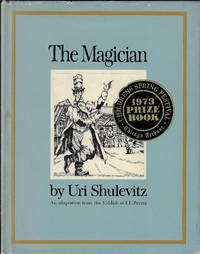
1973réf. 010596New York: Macmillan 1973 Blue cloth with a blindstamped design of the magician slight fading along bottom edge else fine; illustrated dust jacket slightly faded with a few edge tears "Chicago Tribune Children's Spring Festival Prize Book" sticker affixed to front panel original price intact $3.95. Shulevitz' adaptation of this well-known Yiddish tale by I L Peretz about how Elijah disguises himself as a traveling magician and conjures a feast for a needy couple. Detailed and wonderful b&w artwork by Shulevitz on every page. . First Printing. Cloth Hard Cover. Near Fine/Very Good. Illus. by Uri Shulevitz. 8vo. Macmillan hardcover books
1927IN YIDDISH. 23.5x16cm. 464 pages. Hardcover. Cover stained and rubbed. Cover edges and corners worn and bumped. Spine worn, rubbed and tattered. Spine cracked. Pen inscription on front inner cover and title page. Ex-library copy with usual marks. Several pages edges and corners slightly worn. Pages yellowing. Else in good condition.
1967IN YIDDISH AND HEBREW. RARE Yizkor book (memorial book) commemorating the Jewish community of Falenica annihilated in the Holocaust. Falenica is a part of Wawer, one of districts of Warsaw on the right bank of the Vistula, in the far southeastern corner of the city (until 1951 a separate village, afterwards became part of Warsaw). Falenica is located along the main rail line, which connects Warsaw with Lublin. During World War II the Germans opened a Jewish ghetto there, called Falenica-Miedzeszyn Ghetto. All of its inhabitants were transported to Treblinka in August 1942. Contains many b&w photographs. 280x220mm. 478 pages. Black cloth Hardcover with gilt front cover and spine. Cover dirty and slightly scratched. Front cover upper corner and spine edges bumped. Rear endpaper upper edge/corner slightly peeling. Rear whitepage bottom corner creased/wrinkled. Pages slightly yellowing. [SUMMARY]: This extremely rare Yizkor book commemorating the exterminated Jewish community of Falenica is in good condition. PLEASE NOTE: This item is overweight. We may ask for extra shipping costs.
1923Later cloth. 12mo. 111 pages. 19 cm. First edition. In Yiddish. Pogroms in Ukraine; The time of the Volunteer Army; a history of the Ukraine Pogroms carried out by the White Ukrainian forces (the Dobrovolcheskaya armiya) ; includes entries on Jewish Self-Defense Groups in the Ukraine. The author, Nokhem Shtif (18791933) , was a linguist, literary historian, and political activist. After the February 1917 Revolution, Shtif was among the founders of the revived Folkspartey (Folks Party) . Inspired by Simon Dubnow, the party had been first formed in 1907, but remained dormant throughout the following decade. He left Kiev in 1920, spending a short time in Minsk, where he and Zelig Kalmanovitch lectured for Yiddish teachers. Subsequently, Shtif moved to Kovno (Kaunas) , then a stronghold of the Folkspartey, but eventually settled in Berlin in March 1922. His book on pogroms in Ukraine was published in Berlin in Russian (Pogromy na Ukraine; 1922) and in Yiddish (Pogromen in Ukraine; 1923) . (Yivo Encyclopedia) . Bound in attractive later marbled boards and cloth, with gilt title on spine. Subjects: Jews - Persecutions - Ukraine. Pogroms - Ukraine. Ukraine - History - Revolution, 1917-1921. Ukraine - Ethnic relations. OCLC lists 7 copies. With institutional bookstamps on title page, otherwise clean and fresh. Good + condition. (EE-5-18)
1929Original Wraps for each issue, all bound into publisher's distinctive illustrated boards. 4to. [approx. 18 pages per issue]. 29 cm. Run of Kinder Zhurnal, Wrappers in various colors, almost always with beautiful period front cover illustrations and, internally, period modernist yiddish illustrations by artists including Aaron Goodelman. "Kinder zhurnal and Farlag Matones were both founded by the Sholem Aleichem Folk Institute, an organization established in New York in 1918 to coordinate a secular Yiddish school system. Kinder zhurnal, a children's magazine, was in existence from 1920 to 1981. Its first editor, Shmuel Niger, served from 1922 to 1948. The magazine published works by writers such as Mani Leib, Aleph Katz, Jacob Glatstein, Kadia Molodowsky. " - Guide to the Yivo Archives. For more, see Naomi Tozman's 1993 masters thesis, :Kinder zhurnal: a microcosm of the Yiddishist philosophy and secular education movement in America," which can be downloaded at https://escholarship.mcgill.ca/downloads/1c18dg573?locale=en. Subjects: Children's literature, Yiddish - Periodicals. Kinder Zhurnal Kinder Journal Kinder Zshurnal Sholem Aleichem Folks Shuln. Sholem Aleichem Folk Institute (New York, N. Y. ) . Yiddish periodicals - New York (State) - New York. Jews - Education - New York (State). OCLC: 179197128. Most libraries which have any issues at all appear to have limited runs, oftentimes only a year or two. Overall very clean and fresh, not aged, and well kept. Some wear to cloth on spine, internally very clean and nice, overall about Very good- condition. (YID-22-51-L-'e)
1929Original Wraps for each issue, all bound into publisher's distinctive illustrated boards. 4to. [approx. 18 pages per issue]. 29 cm. Run of Kinder Zhurnal, Wrappers in various colors, almost always with beautiful period front cover illustrations and, internally, period modernist yiddish illustrations by artists including Aaron Goodelman. "Kinder zhurnal and Farlag Matones were both founded by the Sholem Aleichem Folk Institute, an organization established in New York in 1918 to coordinate a secular Yiddish school system. Kinder zhurnal, a children's magazine, was in existence from 1920 to 1981. Its first editor, Shmuel Niger, served from 1922 to 1948. The magazine published works by writers such as Mani Leib, Aleph Katz, Jacob Glatstein, Kadia Molodowsky. " - Guide to the Yivo Archives. For more, see Naomi Tozman's 1993 masters thesis, :Kinder zhurnal: a microcosm of the Yiddishist philosophy and secular education movement in America," which can be downloaded at https://escholarship.mcgill.ca/downloads/1c18dg573?locale=en. Subjects: Children's literature, Yiddish - Periodicals. Kinder Zhurnal Kinder Journal Kinder Zshurnal Sholem Aleichem Folks Shuln. Sholem Aleichem Folk Institute (New York, N. Y. ) . Yiddish periodicals - New York (State) - New York. Jews - Education - New York (State). OCLC: 179197128. Most libraries which have any issues at all appear to have limited runs, oftentimes only a year or two. Gorgeous flawless copy, a stunning copy, Very good+ condition. (YID-22-51-L-'e)
1922Original Wraps for each issue, bound by publisher into illustrated boards. 4to. [approx. 18 pages per issue]. 29 cm. Begins with the special "Yubelai Numer," April/May 1922, and running a full calendar year, though Volume/Issue numbering follows a different system! Run of Kinder Zhurnal, Wrappers in various colors, almost always with beautiful period front cover illustrations and, internally, period modernist yiddish illustrations by artists including Aaron Goodelman. "Kinder zhurnal and Farlag Matones were both founded by the Sholem Aleichem Folk Institute, an organization established in New York in 1918 to coordinate a secular Yiddish school system. Kinder zhurnal, a children's magazine, was in existence from 1920 to 1981. Its first editor, Shmuel Niger, served from 1922 to 1948. The magazine published works by writers such as Mani Leib, Aleph Katz, Jacob Glatstein, Kadia Molodowsky. " - Guide to the Yivo Archives. For more, see Naomi Tozman's 1993 masters thesis, :Kinder zhurnal: a microcosm of the Yiddishist philosophy and secular education movement in America," which can be downloaded at https://escholarship.mcgill.ca/downloads/1c18dg573?locale=en. Subjects: Children's literature, Yiddish - Periodicals. Kinder Zhurnal Kinder Journal Kinder Zshurnal Sholem Aleichem Folks Shuln. Sholem Aleichem Folk Institute (New York, N. Y. ) . Yiddish periodicals - New York (State) - New York. Jews - Education - New York (State). OCLC: 179197128. Most libraries which have any issues at all appear to have limited runs, oftentimes only a year or two.Bit of discoloration to illustration boards, otherwise an excellent copy with no damage, Very good condition (YID-22-51D-L-'e)
1922Original Wraps for each issue, bound by publisher into illustrated boards. 4to. [approx. 18 pages per issue]. 29 cm. Begins with the special "Yubelai Numer," April/May 1922, and running a full calendar year, though Volume/Issue numbering follows a different system! Run of Kinder Zhurnal, Wrappers in various colors, almost always with beautiful period front cover illustrations and, internally, period modernist yiddish illustrations by artists including Aaron Goodelman. "Kinder zhurnal and Farlag Matones were both founded by the Sholem Aleichem Folk Institute, an organization established in New York in 1918 to coordinate a secular Yiddish school system. Kinder zhurnal, a children's magazine, was in existence from 1920 to 1981. Its first editor, Shmuel Niger, served from 1922 to 1948. The magazine published works by writers such as Mani Leib, Aleph Katz, Jacob Glatstein, Kadia Molodowsky. " - Guide to the Yivo Archives. For more, see Naomi Tozman's 1993 masters thesis, :Kinder zhurnal: a microcosm of the Yiddishist philosophy and secular education movement in America," which can be downloaded at https://escholarship.mcgill.ca/downloads/1c18dg573?locale=en. Subjects: Children's literature, Yiddish - Periodicals. Kinder Zhurnal Kinder Journal Kinder Zshurnal Sholem Aleichem Folks Shuln. Sholem Aleichem Folk Institute (New York, N. Y. ) . Yiddish periodicals - New York (State) - New York. Jews - Education - New York (State). OCLC: 179197128. Most libraries which have any issues at all appear to have limited runs, oftentimes only a year or two. Some paper covers, with browning paper, have come loose (all are present) with a tough of edgewear, some wear to cloth, Good condition overall (YID-22-51D-E-'e)
1921Original Wraps for each issue, all bound together at spine but lacking boards. 4to. [approx. 18 pages per issue]. 29 cm. The publisher generally bound Vol II, Nr. 11/12 (Jan/Feb 1923) with Vol III as a 1923 volume, so is not present here. Run of Kinder Zhurnal, Wrappers in various colors, almost always with beautiful period front cover illustrations and, internally, period modernist yiddish illustrations by artists including Aaron Goodelman. "Kinder zhurnal and Farlag Matones were both founded by the Sholem Aleichem Folk Institute, an organization established in New York in 1918 to coordinate a secular Yiddish school system. Kinder zhurnal, a children's magazine, was in existence from 1920 to 1981. Its first editor, Shmuel Niger, served from 1922 to 1948. The magazine published works by writers such as Mani Leib, Aleph Katz, Jacob Glatstein, Kadia Molodowsky. " - Guide to the Yivo Archives. For more, see Naomi Tozman's 1993 masters thesis, :Kinder zhurnal: a microcosm of the Yiddishist philosophy and secular education movement in America," which can be downloaded at https://escholarship.mcgill.ca/downloads/1c18dg573?locale=en. Subjects: Children's literature, Yiddish - Periodicals. Kinder Zhurnal Kinder Journal Kinder Zshurnal Sholem Aleichem Folks Shuln. Sholem Aleichem Folk Institute (New York, N. Y. ) . Yiddish periodicals - New York (State) - New York. Jews - Education - New York (State). OCLC: 179197128. Most libraries which have any issues at all appear to have limited runs, oftentimes only a year or two.Light wear to outer wrappers at first and final issue, touch of worming to two issues, Overall Good+ condition. (YID-22-51B-L-'e)
1932Original Wraps for each issue, all bound into publisher's distinctive illustrated boards. 4to. [approx. 18 pages per issue]. 29 cm. Run of Kinder Zhurnal, Wrappers in various colors, almost always with beautiful period front cover illustrations and, internally, period modernist yiddish illustrations by artists including Aaron Goodelman. "Kinder zhurnal and Farlag Matones were both founded by the Sholem Aleichem Folk Institute, an organization established in New York in 1918 to coordinate a secular Yiddish school system. Kinder zhurnal, a children's magazine, was in existence from 1920 to 1981. Its first editor, Shmuel Niger, served from 1922 to 1948. The magazine published works by writers such as Mani Leib, Aleph Katz, Jacob Glatstein, Kadia Molodowsky. " - Guide to the Yivo Archives. For more, see Naomi Tozman's 1993 masters thesis, :Kinder zhurnal: a microcosm of the Yiddishist philosophy and secular education movement in America," which can be downloaded at https://escholarship.mcgill.ca/downloads/1c18dg573?locale=en. Subjects: Children's literature, Yiddish - Periodicals. Kinder Zhurnal Kinder Journal Kinder Zshurnal Sholem Aleichem Folks Shuln. Sholem Aleichem Folk Institute (New York, N. Y. ) . Yiddish periodicals - New York (State) - New York. Jews - Education - New York (State). OCLC: 179197128. Most libraries which have any issues at all appear to have limited runs, oftentimes only a year or two. Two issues show some toning, three cover pages have come loose but are present. Some wear to spine. Overall Good condition. (YID-22-51A-L-'e)
1975Publishers cloth. 8vo. 200, XIII pages. 25 cm. First edition. In Hebrew with English summary. Added title page: The Crown Rabbinate in Russia; A Chapter in the Cultural Struggle Between Orthodox Jews and Maskilim. The Crown Rabbis of late imperial Russia held the government-mandated designation of rabbi, but their functions as record keepers, Russian administrative representatives, and sometimes Jewish communal (but secular) leaders belied the religious title. the opening of government-sponsored rabbinical training seminaries in Vilna and Zhitomir in 1847 these schools reflected the practical ideals of the maskilim, who emphasized the need for religious leaders to have a strong secular education. the crown rabbinate outlasted the crown rabbinical schools. On the one hand, the increasingly influential maskilim and other progressive Jews promoted the notion that a rabbi should embody worldly ideas and guide his community in the social, economic, and intellectual components of the Haskalah. Orthodox Jews, on the other hand, wanted only a traditional spiritual rabbinate. By the turn of the twentieth century, the question of who should be empowered with the religious representation of, and authority over, the Jewish communities in Russia had turned into a heated debate that played itself out in the Russian Jewish press and at various meetings of rabbis and the intelligentsia. The Russian Jewish journals Ha-Melits and Voskhod served as forums for this debate, which continued until World War I and aimed, ultimately, at solving the problem of the dual rabbinate. All the while, crown rabbis continued to function in their official capacities, even participating in various Russian rabbinic commissions as well as the Rabbinic Congress of 1910. (YIVO Encyclopedia) In the series: Mehkarim be-toldot `am-Yisrael ve-Erets-Yisrael : Sidrah monografit; kerekh 1 (Studies in the history of the Jewish people and the land of Israel; 1) Subjects: Crown Rabbinate. Haskalah - Russia. Jews - Europe, Eastern - Politics and government. Jews - Legal status, laws, etc. - Russia - History. Jews - Russia - Emancipation. Jews - Russia - Politics and government. Judaism - Russia. OCLC lists 15 copies. Light wear to cloth, otherwise fresh and clean. Very good + condition. (EE-5-39)
2004Publishers cloth. 8vo. Ix, 300 pages. 23 cm. Illustrated. First edition. Signed by author. "Yiddish and the Creation of Soviet Jewish Culture gives voice to the activists empowered by the state to create a Soviet Jewish national culture. These activists were striving for a national revolution to create a new culture for Jews to identify as Jews on new, secular, Soviet terms. This book explores the ways in which Jews were part of, not apart from, both the Soviet system and Jewish history. Soviet Jewish culture worked within contemporary Jewish national and cultural trends and simultaneously participated in the larger project of propagating the Soviet state and ideology. Soviet Jewish activists were not nationalists or Soviets, but both at once. David Shneer addresses some of the painful truths about the Jews' own implication and imbrication in the Soviet system and inserts their role in twentieth-century Jewish culture into the narrative of Jewish history. " (Dust jacket description) Subjects: Jews -- Soviet Union -- Intellectual life. Yiddish language -- Social aspects -- Soviet Union. Yiddish literature -- Soviet Union -- History and criticism. Jews -- Soviet Union -- Identity. Jews -- Cultural assimilation -- Soviet Union. Jewish socialists -- Soviet Union -- History. Light shelf wear. Sticker on dust jacket designating that this is an autographed copy. Very good + condition. (EE-6-9)
1979IN HEBREW AND YIDDISH WITH ENGLISH FOREWORD. 24.5x15.5 cm. VI+706 pages. Hardcover. Cover slightly stained and slightly rubbed. Spine slightly loose. Pages slightly yellowing. Else in good condition. PLEASE NOTE: This item is overweight. We may ask for extra shipping costs.
197924.5x15 cm. vi+706 cm. Hardcover. Cover slightly worn. Spine slightly bumped on edges. Pencil writing in book. Pages slightly yellowing. Else in good condition.
19341st edition. Original paper wrappers. 8vo. 20 pages, 24 cm. In Yiddish. Title translates to Montreal: Monthly Literature Journal. Montreal was Canada's Yiddish publishing capital in the interwar period. The journal forged a bond between the Yiddish culture of Europe and helped spread the work Canadian Yiddish writers. The Montreal journal was one of the more popular journals of the Depression era and focused on proletarian themes. (Margolis, 2009) SUBJECTS: Jews -- Canada -- Periodicals. OCLC lists 4 copies worldwide (YIVO, HUC, NLI, Brandeis) (OCLC: 959582783) . Very light soiling. Very Good Condition. Sarce. (YID-40-79)
2003210x140 mm. 68 pages. Softcover. In good condition.
1951IN YIDDISH. 23.5x16.5cm. 541 pages. Hardcover. Cover corners slightly bumped. Spine slightly bumped. Text block edges slightly stained. Pages slightly yellowing. Else in good condition. PLEASE NOTE: This item is overweight. We may ask for extra shipping costs.
1977IN YIDDISH. VOLUME I ONLY. 23.5x16.5cm. 415 pages. Gilt hardcover with dust-jacket. Cover and spine edges slightly bumped. Ex-Library copy with usual marks. Pages yellowing. Else in good condition.
1934IN YIDDISH. 235x155 mm. 63 pages. Soft cover. Cover slightly yellowing. Cover corners slightly wrinkled. Pen inscription on cover. Spine torn. Ex libris sticker on inner cover. Else in good condition.
1943IN YIDDISH. 240x160 mm. 272 pages. Hardcover. Ex library copy with usual marks. Cover yellowing and stained. Cover corners slightly worn. Inner cover and pages age-stained - no damage to text. Pages yellowing. Else in good condition.
19278vo; 1st edition. Cloth, Small octavo, 334 pages. In Yiddish. Section headings include "The Jews in Amsterdam", The Theological Storm", and "Leibnitz". Includes bibliographical references (pages 319-334).SUBJECT(S): Spinoza, Benedictus de, 1632-1677. "Jacob Shatzky (also: Yaakov, or Yankev Shatski; in Polish: Szacki) (18931956) was a distinguished Jewish historian.Shatzky was born in Warsaw. He received a traditional Jewish education and went on to study at universities in Lwów, Vienna, Berlin and Warsaw. He earned his Ph.D. from the University of Warsaw in 1922 with a thesis on 'The Jewish Question in the Kingdom of Poland During the Paskiewicz Era.' Historians who studied under Shatzky include Lucy Dawidowicz.Shatzky enlisted in Pilsudski's Legion and fought with distinction in the First World War; he was promoted to the rank of lieutenant. He was sent by the Polish Foreign Ministry in 1918 to report on a pogrom in Vilna. He resigned from his post when it became clear that the government would not act to punish the perpetrators of the pogroms.Shatzky emigrated to the United States in 1923. He served as Chief Librarian of the New York State Psychiatric Institute from 1930 to 1956. He acquired the personal library of Sigmund Freud for the collection" (Wikipedia). OCLC: 19308492. Some wear, Good Condition. (YID-42-43-EL-'x)
1940hard cover, worn edges, Signed by the author, yellowing pages, else in good condition.
1963Contains b&w plates. 23.5x15.5 cm. 225 pages. Gilt hardcover. Spine edges slightly worn. Else in good condition.
1947réf. AUB-3174Paris, éd. Nagel 1947. Bon exemplaire broché, couverture ornée d'éd., in-8, 747 pages avec table.
1996TWO VOLUME SET. IN HEBREW. [BOTH VOLUMES]: 24.5x17 cm. [167+V]+[309] pages. Hardcover. Spine edges slightly bumped. [VOLUME TWO]: Cover slightly bumped. [SUMMARY]: Else both volumes in good condition.


